The Locality Plan for Trafford to 2020 - Meetings, agendas ...
←
→
Page content transcription
If your browser does not render page correctly, please read the page content below
The Locality Plan for Trafford to 2020

                                         1
‘By health and social care working
together, we will improve the quality,
 range and access of services for the
         people of Trafford.’

                                         2
Contents

                                         Page

Foreword                                  4

Introduction                              5

Chapter 1 Trafford’s Locality Profile    14

            Trafford Care Coordination
Chapter 2                                20
            Centre
          Additional Transformational
Chapter 3                                28
          Developments

Chapter 4 Place Based Opportunities      37

Chapter 5 Enablers of Change             47

Appendices                               54

                                                3
Foreword
By Councillor Sean Anstee, Leader of Trafford           Trafford is a great place to live, work, learn and relax. We have out-
Council and Matt Colledge, Chair of Trafford Clinical   standing educational standards, nationally recognised service provi-
Commissioning Group’s Governing Body                    sion across health and social care and a vibrant business and local
                                                        community network. It is our intention to protect these things.
                                                        However, Trafford’s health and social care system faces some real
                                                        challenges to it’s future sustainability, caused by decreased funding
                                                        from central Government, increasing demands from an ageing popu-
                                                        lation and health inequalities across the borough.
                                                        Our Locality Plan describes how we intend to protect the great things
                                                        about Trafford so we can secure it’s future beyond 2020. It is of
                                                        course specific to health and social care, but that system is funda-
                                                        mentally reliant upon all of us taking responsibility to help; we must
                      Councillor Sean Anstee,
                                                        harness our assets to help us collectively achieve our ambitions and
                      Leader of Trafford Council
                                                        also accept that we need to personally change some of our behav-
                                                        iours to reduce the demands on the health and social care system.
                                                        This Locality Plan also presents some really exciting developments
                                                        and opportunities for Trafford—which will enable us to not only be
                                                        successful, but also pioneer new ways of working for others to benefit
                                                        from.
                                                        As a borough, we have often been at the forefront of
Matt Colledge, Chair of Trafford
                                                        transformational developments and it is heartening to see that in the
Clinical Commissioning Group’s                          context of such significant challenges, our aspirations remain so high.
               Governing Body
                                                                                                                                  4
Introduction: Why do we need a Locality Plan?
Health and Social Care Devolution in Greater Manchester provides a fantastic opportunity for both Trafford and the wider sub-region to take control of decision making and
influence the future shape of an integrated health and social care system, improving outcomes for our residents. The imperative to take this opportunity is driven by the
financial challenge that means the current system is not sustainable. Financial modelling indicates a gap in funding in Trafford by 2020-21 of approximately £111m and
across GM it will be in the region of £2bn if nothing changes from the current position. In Trafford the financial gap relates to Social Care £44.3m, Trafford Clinical Commis-
sioning Group (CCG) £26.6m and NHS Acute Providers £40m, so a range of interventions are required based on a strategic vision of the place to manage this gap.
Trafford’s Locality Plan presents the framework for an enhanced, integrated and co-commissioned health and social care offer for Trafford citizens. It headlines the complex,
bold and ambitious programme of change underway to address the multiple challenges of austerity, rising population demands and public expectation. It provides an
outline of both current and intended programmes which will support us to close the financial gap by 2020-21 and also the impact that our transformational programmes will
have.
The purpose of the plan is to outline how we intend to radically reform the health and social care system over the period up to 2021, in line with the devolution of health
and social care responsibilities across Greater Manchester. It is intended as public document and a substantial amount of detail will underpin the plan and be made availa-
ble for those who wish to have it. It is supported by information about our placed based opportunities (e.g. asset based community development, housing, economic well-
being) and those things which will ‘enable’ us to deliver our reforms (e.g. workforce, governance and finance). It sets out a new relationship between Trafford Council and
the CCG to collaborate on a scale not seen before to ensure a truly place based, partnership approach to health and social care in Trafford.
The changes will be driven through the revolutionary development which is the Trafford Care Coordination Centre; this will coordinate complex care pathways on behalf
of the patient and in doing so provide a rich source of real time intelligence, which can be used to redesign services, promote health improvements through targeted mar-
keting and support behaviour change through the provision of a comprehensive and interactive service directory.
This new system will be complemented by a range of other transformational developments which will contribute to the system wide change required across Trafford.
These programmes of work will provide:
Changes in the primary care system, including 7 day working and a shift in activity from hospitals to the community. through increasing the role and function of local
pharmacists to offer local services and advice to support individuals; dedicated health and social care support for residential and nursing homes; continued invest-
ment in and potential expansion of the community enhanced care service model;
An all age integrated health and social care service delivery model for community based services that will see teams working through integrated structures that are
multi-agency and geographically based in four localities;
Greater levels of independence for service users through a new model of social care, which will call upon the use of community assets and individual resources before
and in addition to the use of public service resources;
Improved quality, access and range of support services for people with learning disabilities, autism and mental health needs, to support personal resilience;
More effective use of resources available to support health and social care in Trafford by pooling budgets and equal commissioning of services that citizens require,
alongside a holistic approach to health and social care that considers an individual’s wider circumstances such as employment status and housing.
5
Trafford’s Vision for 2020
We do not believe the system is sustainable as it stands and a review of demographic pressures and the estimated financial gap in
the system by 2020 reinforces that.
Therefore, our approach for Trafford is to fundamentally transform the whole health and social system - within a place based
context and fully utilising our rich community assets.
Why do we need a Locality Plan?
The vision for Trafford as part of the devolution of Greater Manchester:
‘By health and social care working together we will improve the quality,
range and access of services for the people of Trafford.’
A sustainable health and social care system is everyone’s responsibility and requires shifts in behaviour, culture and lifestyle. So,
to achieve our vision for 2020, health (NHS Trafford Clinical Commissioning Group) and social care (Trafford Council) will work
together across the locality and with a multitude of stakeholders including:
GPs and local hospitals
Community health services e.g. Pennine Care Foundation NHS Trust
Pharmacists
Homecare services and residential home providers,
Trafford Strategic Partners
The voluntary and community sector
Active citizens
6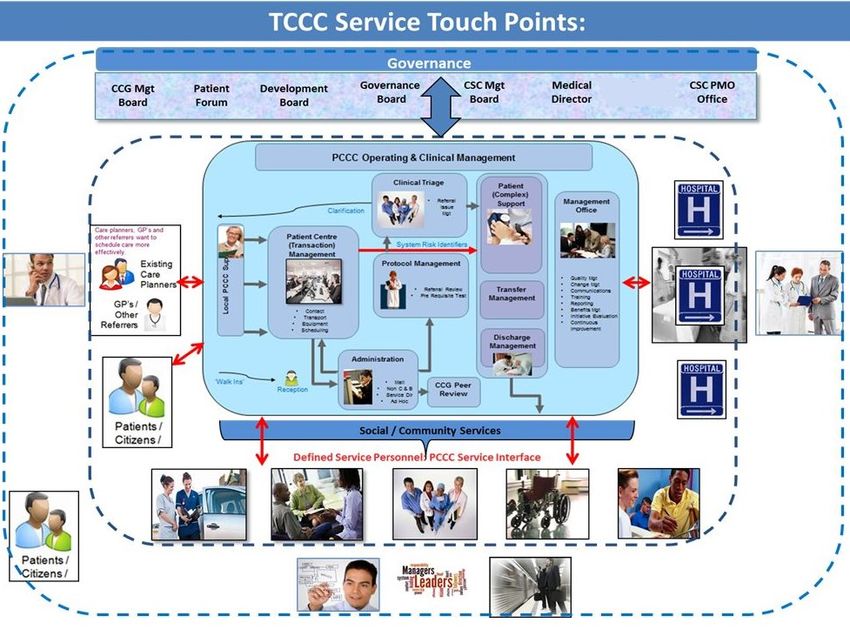
Our Principles for Change
In implementing the level of change required over the By 2020 this means you will:
course of the next 5 years, health and social care services
will be delivered according to a number of principles for Get to see a GP when clinically appropriate be able to get support from adults or
change: children’s social care outside of core working hours, have support services such as
homecare and parenting support provided to you at times that make a difference
and have your appointments at any clinic or community service booked in a sensi-
Why do we need a Locality Plan?
7 day access to treatment and care ble order;
Be able to find out what is going on in your community that you can join in with,
with people to help you find your way around if you need it and the opportunity to
buy services for yourself like equipment and support, through recommended sup-
Ability to access the right information pliers;
Be able to access to services that keep you well at home, making sure you can still
at the right time
do the things you enjoy doing, with same day access to equipment and adapta-
tions to help you at home and out and about, and the chance to access good edu-
cation, employment and training opportunities;
Enabling people to retain their Talk to experts once and through one contact point, with information provided
independence through one website and one phone number and from staff trained to talk to peo-
ple with a whole range of different issues. You will get information and advice on
managing any of your problems, whether that is something like asthma through to
debt, that is accurate, easy to follow and based on what works best;
Promotion & encouragement of self- See that community services will care for you at home as far as possible, whether
reliance that is very skilled mental health support or community diabetes clinics, to main-
tain your health and help you to stay out of hospital;
Be seen and treated in a modern purpose built premises which are welcoming and
Delivery of a financially sustainable inviting and provide the opportunity to have all you needs met in one building;
and clinically safe health and social Be able to see that the money available to Trafford is being used well to maintain
care economy public services that can last into the future.
.
Deflection of activity from In order to achieve this, health and
inappropriate sources to manage and
social care need to transform
reduce dependency
7
Our Big Idea: Trafford Care Coordination Centre (TCCC)
                                  The Trafford Care Coordination Centre (TCCC) is a whole system reconfiguration designed to enable a radical new model of delivering co-ordination of
                                  care. It will provide a host of benefits to patients and their carers and is the flagship development of the CCG , being the first of its kind in the country.
                                  It is due to go live in Trafford in January 2016 with the full range of its services developed and delivered in 2016. It will manage Trafford’s health and
                                  social care system and apply our 6 Principles of Change in delivering a range of services which will ‘enable’ the system work efficiently and effectively .
Why do we need a Locality Plan?

                                  Chapters 2-5 describe in
                                  more detail the TCCC, the
                                  other     transformational
                                  developments, the ena-
                                  blers of change and the
                                  placed based opportuni-
                                  ties which underpin our
                                  plan.

                                                                                                                  Enablers

                                                                                                                                                                                               8
What is the Trafford Care Coordination Centre?
                                              The health and social care system in Trafford has been undergoing a
                                              radical re-design process to ensure it is fit for the next twenty years.
                                              The current system has huge amounts of waste, replication and con-
                                              fusion within it for how people access and receive care. The Trafford
                                              Care Coordination Centre (TCCC) was designed to ensure the resi-
                                              dents of Trafford could easily access the right services for their needs
                                              in a timely and organised manner.

                                              The TCCC allows for health and social care needs to be managed by
                                              patients and families with support from administrative and clinical
                                              teams to ensure care is well managed for both patients and clinicians.
                                              The centre is designed to be focused around patient / public need
                                              and the team within it ensure that they understand the needs of the
                                              individuals and help plan care around them; it has been designed to
Chapter TWO: TCCC

                                              ensure that people have the optimal pathway of care. For our pa-
                                              tients with more complex needs, this will mean that patients have
                                              regular support and a named individual who can help with planning
                                              their care. The TCCC will liaise with any teams and organisations that
                                              it needs to on the patients behalf to ensure the best possible out-
                                              come for that individual; they will be in frequent communication with
                                              GPs to ensure that care is joined up across all organisations.

                                              The TCCC has access to an extensive directory of services which
                                              means they can offer a wide range of choice to patients seeking sup-
                                              port and signposting. It will also proactively act to reduce the silos of
                                              health & social care services.

                                                                                                                          9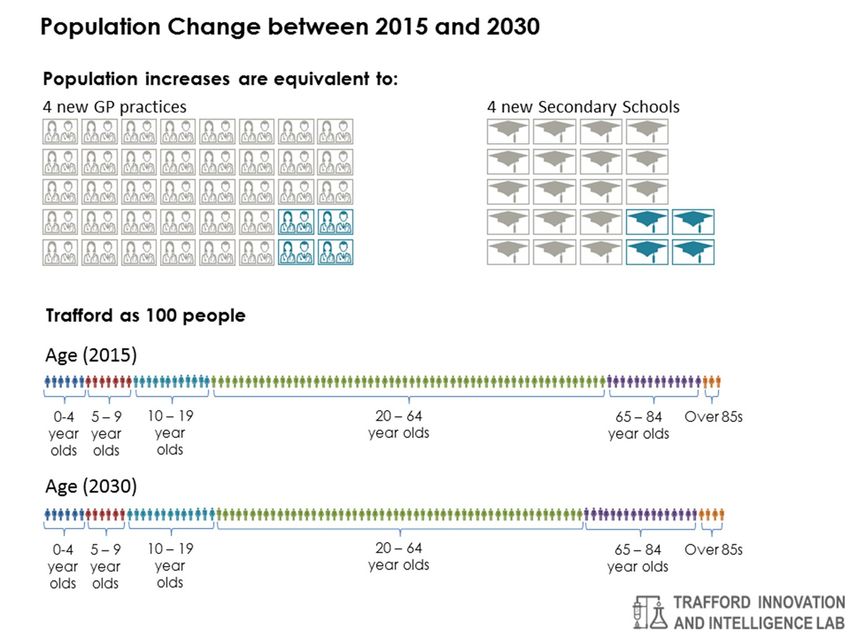
What else will be transformed by 2020?
Service Area Measure of Success What this means for res- What this means for
idents public services
Additional hospital
Why do we need a Locality Plan?
appointments You get access to care and treat- Reduction in the number of
Reduced acute attendances ment at the right time to prevent people attending A&E and being
Primary Care Reduced Did Not Attends you from going to hospital admitted to hospital by 15%
(DNAs)
Reduced referrals to A&E by
30,000 additional primary care
GPs
appointment slots as a result of 7
Development of 4 health and
wellbeing centres across
day working
Trafford which will increase
community service support and
access
The TCCC will organise diagnos-
tic tests prior to referrals to
speed up the care journey and
provide an improved patient
experience
All over 75 year olds to have a
personal care plan
Reduced hospital admissions
from nursing homes as a result
of increased level of primary
care provision
10What else will be transformed by 2020?
Service Area Measure of Success What this means for What this means for
Reduced inappropriate
admissions You receive treatment from high Reduced number of outpatient
New services to meet patients quality hospital services at the appointments and follow ups in
Why do we need a Locality Plan?
Planning Acute needs right time and in the right place hospital clinics by 10%
Provision Services across Trafford to
support access Fall prevention activity will reduce
hospital admissions by 10%
50% more intermediate care bed
nights available
An all age integration of health
and social care services You will have an increased level 10 % fewer frail elderly residents are
Locality Health & Greater levels of independence of support from your family in hospital or high cost care
Social Care Teams for our residents and service
users You will feel more independent
A workforce which is fit for the and confident
future
7 day access to services
Reduced demand on hospital You will have an increased 15% reduction in non-elective
Community services level of independence attendances and admissions
All over 75 year olds will have a
Enhanced Care
care plan in place You will help to direct A reduction in the number of admis-
Flexible access to a range of your treatment sions to residential and nursing care
appointments and diagnostic by 15%
tests
11What else will be transformed?
Service Area Measure of Success What this means for What this means for
residents public services
Admissions to residential You will have an increased level of
Reduction in number of
care remain low independence
looked after children by 20%
Why do we need a Locality Plan?
Reduced demand on services
Social Care
Improved access to urgent Care delivered to you in your
Reduction in the number of
services for those living in home
adults with high cost packages of
residential and nursing
care
homes
Reduced numbers of people You will receive more of your care
in contact with the Criminal from our family, volunteers and
A reduction in the number of
Learning Justice System/admitted to the community
young people and
Disability Services secure provision adults with high
Increased numbers of people You will feel more independent
cost packages of care
in education/ employment/ and confident
volunteering
You will have an increased
satisfaction with services
(measured through ASCOF/HOF)
An increased number of young
Reduced waiting times You will have an increased level of people and adults will have
Mental
Increased range of mental satisfaction with services intensive care at home with
Health Services
health support provision reductions in hospital
admissions of 15%
12What support do we need to deliver these changes?
To support achievement of this change programme an investment proposal has been put together for submission
to the Comprehensive Spending Review. A total investment of £16m revenue and £36m capital has been
identified to support delivery of the outcomes in Trafford covering;
Why do we need a Locality Plan?
Trafford Care Co-ordination Centre (TCCC): An investment of £5m is required to support phase 2 of the TCCC
model and ensure a system wide impact of the development.
Estates: A capital cost of £36m is needed to support the development of four integrated locality hubs as a
key point of access for our communities. There is also a request for a revenue allocation of £5m to enable
this development.
Primary Care: An investment of £3m is required to implement a new primary care model with improved
access and wrap around social care support to 7 day working.
Transformation and Commissioning changes: Additional investment of £3m over the five year period is
required to deliver the significant integrated transformation of health and social care.
The above forms our ‘asks’ from the Greater Manchester Devolution Agreement.
13Trafford’s Locality Profile
Although Trafford has slightly higher life expectancy than the England average, Although the local rate of liver disease is high across the borough, hospital admis-
we are doing less well in some areas. This will directly lead to poorer health sion rates demonstrate the impact of alcohol within our communities. Areas of
especially for our older people. These areas include: high deprivation experience high rates of hospital admissions due to alcohol relat-
ed harm, Bucklow-St Martins, Clifford and Longford wards experience the highest
Reducing death from preventable causes rates in Trafford. As well as having an obvious detriment to the patient, those hos-
Uptake of NHS health checks pital admissions incur a financial cost to Trafford that could be better prevented.
Liver disease There are measures required to change the environment in which people live, in
Cancer screening order to either reduce the risks they face or to make healthier choices easier. It is
Diabetic retinopathy screening a priority to address the high number of households affected by fuel poverty, es-
Injuries due to falls in people aged over 65 pecially in some of the more affluent wards, where residents may be asset rich but
Fuel poverty cash poor.
Improvement in these key areas to at least the England average would result in Long-term conditions are a major cause of preventable death in Trafford. Cardio-
significant improvements in health and reduce the need for services. Some vascular disease, cancer, chronic obstructive pulmonary disease and diabetes all
improvement can be achieved through reducing life style related ill health, contribute to poor health, disability and death. Some groups are disproportionate-
such as that caused by smoking, alcohol use, lack of physical activity and obesi- ly affected by long-term conditions. For example, more men die from cardiovascu-
ty. There are established programmes in all of those areas, but the reach and lar disease than women.
impact of these services is variable, meaning that not all of the population is as Evidence also shows that some black and minority ethnic (BME) communities are
well supported to make lifestyle change as is required. more likely to develop long-term conditions at an earlier age, for example South
For example, locally the mortality rates for liver disease under the age of 75 Asian populations are more likely to develop diabetes in mid-adulthood compared
years and liver disease considered preventable have tracked the national to other groups. One long-term condition can increase the likelihood of develop-
trend. ; however the gap between national and local rate is increasing and in ing other co-morbidities, such as CVD, thus exacerbating the impact of inequality.
2011-2013, the mortality rate from liver disease considered preventable was
Chapter ONE
significantly higher than the national rate at 20.3 per 100 000 in Trafford com-
pared to 15.7 per 100 000 nationally. Programmes and services have been commissioned to address the
needs of residents with long term conditions, but the pace and scale of
those needs to be accelerated to achieve the level of impact required to
The revised Health and Wellbeing Strategy sets reducing alcohol
reduce demand on specialist services. A new diabetes strategy will in-
related harm as a priority for 2015 onwards and a review of alcohol
troduce a multi-disciplinary community model of diabetic provision and
services will form part of a piece of work required to being to tackle
help bring primary care standards to a gold standard.
this issue.
14Increasing physical activity is a key enabler, which will improve the men-
tal and physical health of our population. We are working to implement
the strategic pledges within the Greater Manchester Moving Blueprint
for sport and physical activity, in order to minimise the risk of poor physi-
cal and emotional health outcomes in the region. Furthermore, through
the objectives set by the Strategic Sport and Physical Activity Partner-
ship, there is a clear commitment from Trafford partners to maximise the
use of both the built and natural environments to facilitate progress in
this area. Central to this is the work that is underway to map available
leisure resources, their uptake and quality in order to inform the re-
specification of leisure services in the Borough.
At a population level increased physical activity levels have positive im-
pacts on communities and the environment. However, the health costs
Chapter ONE: Locality Profile
of physical inactivity per 100,000 population is £2,231,409.
In Trafford 28.2% of residents are inactive, compared to 28.9%
nationally, with 55.9% taking the recommended 150 mins of physical ac-
tivity a week compared to 56% nationally. For both these indicators, In Trafford, as demonstrated by national evidence, the number of falls in-
Trafford is rated as amber. The challenge for Trafford partnerships is to creases with age. With an increasingly aging population the costs associat-
engage residents to become less inactive by increasing participation in 1 ed with falls are considerable. Between 2009/2010 and 2012/13, 931
x 30 minutes of sport and physical activity per week through a mix of evi- emergency admissions due to falls were for people aged 85 years and over
dence-based behaviour change interventions and behaviour shaping compared to 187 for people aged 65 to 69 years.
initiatives at the preventative end. More women than men aged 65 years and over experience an emergency
admission as a result of a fall. In 2012/2013, 414 women compared to 167
men were admitted to hospital following a fall. Between 2009/2010 and
2012/2013, females accounted for 70.5% of emergency admissions for
falls in the borough. The risk of an admission is most markedly seen in
older females, between 2009/2010 and 2012/2013, 32% of admissions for
people aged 65 years and over were attributed to women aged 85 years
and over.
The successful delivery of a comprehensive falls service which draws on
the expertise and support of a whole range of partners, like the Fire and
Rescue CRIT service, will be a major contributor to reducing hospital
attendances and admissions.
1516
17
18
OTHER

        19
More about the Trafford Care Coordination Centre
The ‘care co-ordination’ centre concept came about from the realisation that putting in place new and alternative ways of delivering treatment would
not necessarily result in patients being referred into them unless GP’s, patients and those providing treatment were supported and assisted in chang-
ing the way they work together.
Currently patients may not be referred to the most appropriate service, and services may not be correctly utilised. There is waste in the system with
for example, patients attending clinics when they have not had their diagnostic investigations completed prior to their hospital appointment. This
results in more appointments than should be necessary and frustration from patients and carers.
The TCCC will proactively act to reduce the fragmentation of health & social care services. It is innovative and will provide the evidence to enable the
planning and effective demand management which reflects the needs of individuals and Trafford as a whole. It will facilitate the opportunity for the
CCG and the council to redirect investment to those areas where there are gaps in services to deliver more patient focused systems and to support
greater health promotion. This will support a new way of commissioning, combining greater accuracy in predictive planning and more effective de-
mand management across both health and social care sectors. This should deliver improved outcomes and benefits for Trafford which can be repli-
cated across similar areas within the NHS.
The TCCC will work across and between organisations using common language and processes across health and social care services, to get the best
Chapter TWO: TCCC
possible experience for service users. It is not a call centre or a simple referral management system; it will manage:
Complex cases – providing support, care planning and clinical intervention
Referral management – providing a means to ensure that referrals are of good quality and get to the right place at the right time and there is
reduced variation in treatment
Discharge management – enabling timely and effective discharge from hospital and for to ensure follow up care in the community
Transport and equipment – arranging transport and equipment
Enquiry management – managing enquiries regarding services, for patients, carers and staff
Automated ‘pick-up’ – identifying individuals with increasing needs and directing support those that need it
The overarching principle of the TCCC is the catalyst for health and social care system reform, implementing the principles of change through the best
use of resources across Trafford, delivering the quality, range and access to services that the population of Trafford demands.
This is illustrated by the diagram on the next page.
20Mastercall
Governance
Chapter TWO: TCCC
21What will it deliver?
The TCCC offers multiple potential benefits, to patients, organisations and to the system. It will release capacity from profession-
als who will use their time more effectively on the delivery of direct patient care, as the co-ordination of care will be the respon-
sibility of the TCCC. This centre will provide a single view of an individual’s care record, which will support decision making on
the basis of a consistent view of their long term care.
It will provide intelligence to inform commissioning decisions and help to direct resources to meet short and longer term service
demands.
The principle of a single access point to the system will be developed through 2016 – 2017 to move all Council and NHS commis-
sioned services to a single front door, with one entry point to all services including safeguarding, which will become the central
route through which the health and social care system will be designed. This will be supported by a single service directory that
will be a health and well-being platform for all; it will include health, social care services together with services provided by the
third sector to support the wellbeing of individuals.
Chapter TWO: TCCC
The TCCC will be located in the South Trafford locality where all users can
have face to face contact with the staff working within the centre for advice,
to answer queries or if they require general help. The fully trained care co-
ordinators within the TCCC will aim to develop strong, supportive relation-
ships with those using the service and will be contactable through an inter-
active Patient Portal, via phone, email and other forms of social media. The
TCCC will also be accessible in the other locality hubs so to assist users
across Trafford. Access to the service by users will be discussed with them
to establish the best way of them interacting with their care co-ordinator
and ensure it best meets their needs.
A short video describing the TCCC in more detail can be seen here:
http://www.traffordccg.nhs.uk/about-us/tccc/
22TCCC Second Generation Model
The Care Co-ordination Centre design has been considered in a number of phases. The second generation model of the ser-
vice takes on a much wider scope and remit and is described below with three next key steps:
1.Development of the Commissioning function within the TCCC
The combined services of the TCCC and close to real time data means that we can map out exactly what is happening in Trafford
and see how patients are accessing services, and how they feel about those services – this will allow us to commission services
differently in the future using the TCCC data to use as the basis of the services that we need to purchase in the future.
To make full use of this potential it will mean putting the buying power within the TCCC in order that real time intelligent com-
missioning can be done to ensure capacity meets demand and service gaps are filled quickly and efficiently. It is expected that
commissioning skills and expertise will move into the TCCC in 2016 through an integrated commissioning approach adopted by
the Council and the CCG . Agreed budgets and commissioning functions will be absorbed in to the TCCC over a 2 year time period
Chapter TWO: TCCC
and the functions of the CCG and Council commissioners will begin to reshape over the same time, to take on a more assurance
focused role around performance of the TCCC.
23TCCC Second Generation Model
2. Provider interface development
The TCCC will hold the oversight of all activity that is occurring in the Trafford area in relation to health and social care . Trafford
CCG and Council have a clear vision and hold to the principle that we want to move to a single system offer across Trafford.
This will mean where the provision of services has an interface into the TCCC, both the provider and TCCC commissioner can
work together to ensure integration operates across the whole system, with no artificial divides. Due to the geographical issues
and multiple providers in Trafford it is considered ideal to have a single provider interface into the CCG, which allows our com-
plex provider market to be managed through the single conduit of one provider vehicle.
The TCCC will work with a provider vehicle which will act as the single interface between the TCCC and the market of providers. It
will have the ability to work in several ways:
It will offer a vehicle for providers to function from, e.g. GP federations.
It will offer core functions for backroom activities done on behalf of the single integrated system such as Finance, HR, Com-
Chapter TWO: TCCC
munications and organisational development.
It will have the interface role with all providers that are used within Trafford with all aspects of the providers outcomes fed
into the TCCC.
3. Developing the range of partners involved in the TCCC
The second generation model of the TCCC is looking to spread its net across the Trafford community more widely to ensure that
anyone living in Trafford will have one point of contact and one system to work with.
The CCG and Council are working on identifying partners to operate with the TCCC within the next phase. Early indication would
suggest the next partners to come on board could include the police and housing trusts.
24TCCC Second Generation Model
This diagram starts to show the
next generation of the TCCC which
fundamentally alters the way we
commission and organize services
in Trafford.
Integrated Trafford service provi-
sion sitting together with the inte-
grated commissioning model will
allow the residents of Trafford to
move seamlessly around services
Chapter TWO: TCCC
within Trafford.
It means all the artificial divides
and perverse incentives are taken
out of the system so that the only
focus of the TCCC, and those assur-
ing it, is improved services and the
ability to use the Trafford pound to
create the maximum benefit for
the residents of Trafford.
25The Acute Trust’s Relationship with the Trafford Care Co-ordination Centre
The University Hospital of South Manchester NHS Foundation Trust (UHSM) delivers a number of patient services to many Trafford residents and is working with
Trafford Clinical Commissioning Group and their provider Computer Sciences Corporation (CSC), to implement the new Trafford Care Co-ordination Centre (TCCC).
UHSM is fully supportive of the CCGs strategy to focus on Care Coordination, which will include Referral Management, Complex Care and Discharge management
initially and are looking forward to working in partnership on this innovation to reduce unnecessary admission or contact with secondary care, therefore freeing up
resources for those patients where there is no alternative.
Through the delivery of care coordination, driven by risk stratification, which provides supportive and preventative care to those patients most at risk of unplanned
hospital admission, our hope is that we will see a reduction in those patients who regularly attend the Trust’s Urgent Care Services, allowing resources to be
focused on where they are needed most. This vision is similar to Manchester’s as set out in its “Living Longer, Living Better” programme which the UHSM is actively
involved in. The alignment of intentions between Manchester and Trafford will help UHSM deliver consistent, effective and efficient services for all our patients.
Through the implementation of the Referral Management Service our hope is that outpatients services can be provided in a “one stop shop” approach, reducing
the need for follow up services as patients have been assessed, diagnosed and treated to an agreed standard prior to referral and those which attend will have con-
sistent level of high quality information to aid clinicians in further management. It is therefore important that the new TCCC can interface effectively with UHSM’s
planned new Electronic Patient Record system. UHSM is already developing “one stop shop” service models, to be based at Withington Community Hospital, in
urology, cardiology, respiratory, gynaecology and gastroenterology but these models could also be implemented elsewhere too.
Chapter TWO: TCCC
The TCCC has the potential to help avoid the duplication of unnecessary tests thereby improving patient experience, efficiency and value for money. The centralised
approach to patient pathways and relationship information should aid more rapid and appropriate discharge of complex patients resulting in reduction of length of
stay, again allowing resources to be focused on the growing demand for unplanned care.
Trafford CCG have set out in their strategic plan, that the CCG’s 5 year target is to a reduce unscheduled care
by 15% and scheduled care by 10% as part of their shift from acute activity into the community. Whilst UHSM
is supportive of these aspirations as they achieve the aims of the 5 Year Forward View, it is clear that activity
that is currently seen with in UHSM will either be:
Prevented by the delivery of more appropriate preventative care
Require a shorter pathway, or
Deflected to other providers.
This will be delivered by a number of programmes/schemes of which the TCCC is one. Therefore in order for
UHSM to continue to meet demand in both the short and long term we need to work with the CCG to have the
confidence that transformation will be effected by TCCC and to plan that impact in detail allowing secondary
services to respond to the changes in a safe and measured manner.
26Pennine Care’s Relationship with the Trafford Care Co-ordination Centre
Pennine Care provide community health services in Trafford and is fully supportive of the CCGs strategy to focus on care coordination, which will include the full co-
ordination of patients care both in hospital and in the community. Pennine Care will be working in partnership on this innovation which will support fully co-
ordinated care resulting in a reduction in the number of people having to attend hospital for care and treatment. More patients will also be treated across the
community in the new Health and Wellbeing centres located across Trafford.
The new community teams of health and social care practitioners are already delivering integrated care to address the health and social care needs of individuals.
The TCCC will support these teams to deliver an efficient service; it will support patients following discharge from hospital ensuring that the patients’ needs are ad-
dressed. This can be delivered in many different ways, by ensuring that the integrated care teams know when a patient is going to be discharged, to ensure that any
required equipment is available in a patient’s home prior to discharge, or simply to provide a contact point for patients to receive regular contract with the clinical
teams within the TCCC.
Pennine Care services are often not aware when a patient is admitted to the hospital and often have a number of abortive trips to a patient’s home. This is an in-
efficient use of community services and the TCCC will be able to direct services to those who need them at the right time at the right location. Those most at risk
will be identified and care and support will be provided to them. In the majority of cases it will by community services.
The TCCC will be the centre for all referrals which will be directed to the correct organisation and service. The centre will have appropriate clinical information to
support care which will improve the communication in teams, across teams and between organisations. The new TCCC will use information from hospitals, commu-
nity services and primary care to track patients. The implementation of the new community services information system will interface with primary care infor-
Chapter TWO: TCCC
mation services resulting in the sharing of clinical information across the clinical teams. This will ensure that clinicians have the most up to date information to sup-
port care and treat patients.
Pennine Care wants to support and treat more patients in the community, to support the frail and elderly population and support individuals living in social isola-
tion. Pennine Care will receive information from the TCCC who are most at risk for their clinical teams to visit and to avoid any deterioration in these individual’s
health and wellbeing. The TCCC will identify what gaps in provision exist and where resources need to be redirected.
As set out in Trafford CCG’s strategic plan, the objective is to reduce unscheduled care by 15% and scheduled care by 10% which will shift activity from acute into
the community. Pennine Care will work with the TCCC to ensure these are directed correctly into the most appropriate community service.
27Additional Transformational Developments
In this chapter, we will present the transformational developments across health and social care already underway in
Trafford , which will, in partnership with the TCCC activity deliver the change for Trafford by 2020:
Primary Care
Reshaping Social Care
Planning Acute
Provision
Learning
Disability Services
Integrated Locality
Health & Social
Chapter THREE
Care Teams
Building Up to Good Mental
Community Health
Enhanced Care
28Primary Care
Primary Care in Trafford will be extended to deliver services over 7 days . There will be greater access for indi-
viduals to see a GP when you clinical require one. This change will be delivered over time starting with extended
opening for all practices from 0800- 1830, Monday to Friday. Offers fulfilled -
Living in Trafford you
There will be further developments to extend access for Primary care from 08.00- 20.00 Monday to Friday which
will…
will be provided centrally within each locality. This will provide the opportunity to see a GP for a planned ap-
pointment.
Chapter FOUR: Transformation
The final stage of these changes will provide further access to Primary Care over a weekend for an appointment Be able to see your
with a GP. GP when it is
clinically required;
To support these changes, further information will be provided to all patients so they know what is available and
from where. Be able to get
These changes are to support the shift in activity from hospitals to the community. Primary care will be part of support from
the integrated care model in each locality and will working with the new neighbourhood health and social care adults or children’s
teams. Both GP’s and these new teams will have shared information which will be accessible to both teams to social care outside
support the clinical decision for an effective patient’s pathway. The TCCC will have all this information which will of core working
support the patients throughout their journey whether in primary, secondary and social care, the TCCC will be hours;
the main point of contact which will support patient with any queries relating to primary care such as opening
times, appointment availability and support booking their appointments. Have your
appointments at
This will be further enhanced by Trafford’s expansion of the role and function of local pharmacists to offer local
any clinic or
services and advice to support individuals. This will reduce the need to visit GP’s, hospitals and support people
community service
staying well.
booked in a
An expanded Primary Care service is to be provided to residential and nursing homes. This will enable patients to sensible order.
be discharged from hospital more quickly, safely and to ensure that all their health and social care needs are
supported. Regular planned visits to these homes will support reduced hospital admissions and the GP will be
able to quickly access community services.
29Planning Acute Provision
In line with the decision of the Committees in Common, we will work with local partners, commissioning and
acute hospital, ambulance and social care providers, to implement the single service for Manchester and
Trafford. This will be done through a joint governance structure that is shared across the Manchester and
Offers fulfilled -
Trafford locality. Living in Trafford
We will be cognisant of the Manchester CCGs approach as part of their living longer and better to acute re-
you will…
Chapter THREE: Transformation
design of services which will include capacity modelling and future demand The Manchester and Trafford lo-
cality have targets to reduce both scheduled and unscheduled care from acute trust offering more commu-
Receive
nity care. Trafford will ensure that any reconfiguration of acute service provision ensures access remains in
place for Trafford patients with particular focus on our hard to reach groups
emergency care
when you need
Trafford CCG will have a particular focus with CMFT on the Trafford General estate including Streford Memo-
it
rial and how to ensure maximum value from the existing estate.
Trafford New Health Deal Have access to
more specialist
As part of the proposals for Trafford New Health Deal there is further modelling to be done to move the ur-
gent care centre from a level two to level three facility. This formed part of the original consultation for the
support in the
Trafford New Health Deal . The service currently has a consultant led model of care but this was recognised in community,
the consultation that this was a stepping stone to move to a GP/ Nurse led service. It is important that the sur- which will more
rounding A & E’s can manage any additional demand and UHSM have been supported with capital moneys to closely meet
build new estates that will support any increase in activity’s on their Wythenshawe site. Work to develop patients needs
the level three service will begin early in 2016 and will align with the new build at Wythenshawe hospital.
The model will ensure that maximum use of community services are used as part of Trafford’s integration
agenda.
30Integrated Locality Health & Social Care Teams
Trafford is developing an all age integrated service delivery model that will see teams working through integrat-
ed structures that are multi-agency and geographically based in four localities, North, South, Central and West.
We are also progressing the development of more integrated commissioning arrangements with the CCG, on Offers fulfilled -
which to progress the joint re-tendering of an all age health and social care community service from 2018. Living in Trafford
We will be piloting our all age health and social care community service with Pennine Care between 2016-18, you will…
which will include:
Chapter THREE: Transformation
Locality based delivery, which is supported by the local strategic partners to offer synergy between the
different providers like primary care, schools, pharmacists, and nursing and residential homes. Have support to
Integrated care pathways, shared case management, IT systems and processes. These will also integrate with retain your
the Trafford Care Co-ordination Centre (TCCC). independence
We are redesigning the way service users access services on an all age basis, so we can manage demand more Benefit from a
proactively through three approaches: strong,
1. Greater promotion of self-help and building a resilient community through e.g. better signposting to sustainable
community, Third sector and other (non-council) support services, provision of advice and information and health and social
better use and marketing of our comprehensive service directory, in partnership with the TCCC. care economy
2. Having a single point of access for agencies and professionals to contact us with all age safeguarding concerns
3. Development of an ‘All Age Multi-Agency Safeguarding Hub’ (MASH) Receive services
In addition, we will be reviewing services which offer a similar range of support services to families who are in which will care
crisis but operate separately. We want to assess how these services can be brought together to do this in a more for you at home
coordinated way across children’s and adults services to achieve greater impact. We are calling this approach and in the
‘Keeping Families Together’. community
Workforce development and culture shift in social care practice is a critical component to help our changes be
successful. We are therefore designing new management and workforce structures to facilitate the culture,
practice and performance arrangements we need for the future, which will in turn create a sustainable delivery
model on which we can manage demand more proactively.
31Community Enhanced Care
It has long been recognised that investment in ‘out of hospital’ care needs to develop community resilience and
alternative patient pathways to enable more people to be cared for in their own homes or alternative community
settings. In 2013 Trafford commissioned Pennine Care NHS Foundation Trust to provide a community enhanced
care service. Offers fulfilled -
Living in Trafford
It consists of an urgent care team, which provides 24/7 access and intensive support, and an enhanced care com-
ponent that manages caseloads of medically stable patients working in conjunction with specialist nurses, district you will…
nurses and therapy services. Key features of the service are:
Chapter THREE: Transformation
Rapid access within 2 hours dependant on urgency and full triage within 4 hours to an intensive support
package for up to 72 hours; Have access to
Seamless pathway to community matrons and district nurses, with therapy and specialist nursing support; 24/7 intensive
A matrix model to ensure flexibility and responsiveness to multiple needs. support
The profile of the patient cohort is largely frail and elderly allowing clinical management entirely within
community services where clinically appropriate. The work is in synergy with other community based services to: Receive support
Provide alternatives to attending A&E from Community
Provide targeted anticipatory, preventative care Matrons for long
Facilitate speedy discharge where appropriate term conditions
Deliver on-going care within specified care pathways in community setting
Support reduction of hospital admissions
Support reduction of re-readmissions
Support reduction in length of stay Receive support
The collective achievement of the above aims to deliver a 10% shift in activity from acute to community. This will
from community
be achieved by : service when
Increasing the take up and use of these services by Trafford practices needed
Increasing the in reach of the service into the 3 acute Trusts, CMFT, UHSM and SRFT to ensure that Trafford
patients are picked up and supported on discharge to reduce any readmissions
In-reaching to emergency admission units to avoid any admissions where patients can be supported by this
enhanced service.
Continuing to follow up on patients seen by the Alternative to Transfer.
32Reshaping Social Care
Trafford Residents feel in control of their own health and wellbeing, taking the lead in managing their own heath through a
range of Self-Care options, to enable people to maintain their independence within strong family and community support
networks. There is a different relationship between public sector and its residents with greater expectation resting with the
individual and their families. Strong communities will be in place to enable residents to maximise their social interactions Offers fulfilled -
and participation contributing to their health and well-being. Living in Trafford you
Health and Social Care will be community-led, with greater involvement of the voluntary sector and the community sup- will…
porting itself rather than relying on traditional services. Trained volunteers and health and social care professionals will
Chapter THREE: Transformation
work side-by-side to support residents to meet their own health and life goals. Digital technology will be the main way in A long, healthy and
which residents will find, buy and manage their care support. Next generation technology will help keep residents looking active life
for support out of the system by providing them with the information and access to local services from the voluntary sector
and local providers. Live at home as long
as possible
‘Community Navigators’ will be a key interface, within communities, working in harmony with the voluntary sector embed-
ding self-help techniques Assessments will focus on people’s abilities and strengths and will be person-centred, asking the Good access to
question ‘what matters to you?’ On-line assessment by residents will also be the usual practice. appropriate health
We will work with a range of people to understand how more people can be supported through less intensive services and care and other
by working with disabled people and their families to identify more creative and cost effective options. There will be much universal services
greater technology-enhanced care, building on smart home computer systems and wireless, and including up and coming Support which
technology such as personal care robots to maximise peoples’ independence. There will be in place a range of early effectively meets your
screening and interventions with Public Health to ensure people are proactive about their own health. People will be sup-
needs and those of
ported to remain at home or receive their care as close to home as possible. More creative senior and assistive living op-
your family, and
tions will exist, including memory care. The use of direct payments will have increased with people designing creative solu-
tions to meet their needs and managing their own package of support. enables you to
progress
Service users will experience the following benefits:
A full life – a valued
I understand my needs and have a plan to manage them.
place in the
When I need support I have choice and control over how my health and care needs are met.
I live independently in the community with support from my family and friends and by access to community groups
community,
and organisations. meaningful activity
I use technology and equipment to support me. and positive
I can access specialist health and social care support in the community. relationships
I receive high-quality support in hospital if I need to go there and don’t stay longer than I need to.
I feel safe at home , and I am supported to manage any risks safely.
33Learning Disabilities
Trafford has undertaken robust analysis to better understand the local population of service users engaged in services, their
needs, life trajectories, journeys into services and costs and quality associated with care. As a result of the findings and the
Transforming Care fast track work across GM, Trafford are committed to a re-commissioned landscape which delivers a sus-
tainable model of a care and improves the lives of people with learning disabilities. National work has identified a set of Offers fulfilled -
outcomes which we have adapted locally and which we will deliver : Living in Trafford
you will have…
1. My care is planned, proactive and co-ordinated
Chapter THREE: Transformation
2. I have choice and control over how my health and care needs are met Good access to
3. I live in the community with support from and for my family and paid carers appropriate health
4. I have choice about where I live and who I live with care and other
5. I have a fulfilling and purposeful everyday life universal services;
6. I get good care from mainstream NHS services
7. I can access specialist health and social care support in the community
Support which
8. I am supported to stay out of trouble effectively meets
9. If I need assessment and treatment in hospital setting because my health needs can’t be met in the community, it is your needs and
high-quality and I don’t stay there longer than I need to those of your
10. I feel and am safe, and I am supported to manage my risks family, and enables
you to progress;
We recognise that the successful achievement of these outcomes means that we must strengthen the way in which we
A full life – a
work with families, developing a robust partnership as early as possible and providing consistent support planned on a
valued place in the
lifespan approach. We will move to an all age approach in 2016, delivered by a skilled and committed workforce with a
community,
clear value base that promotes a culture of recognising and building on strengths, not just meeting needs. This will require
a shift to planning for the future from an early age, and the use of resources to increase competencies and opportunities,
meaningful activity
rather than a focus on eradicating risk and restricting lives, especially for people who challenge our services.
and positive
relationships.
Through utilising a variety of commissioning approaches across Greater Manchester, we will create a landscape where our
service providers have the right skill set and value base. We will also develop partnerships which create a culture where
providers are innovative and deliver creative options which improve individual outcomes for people with learning disabili-
ties/autism.
34Building Up to Good Mental Health
Mental health is a broad concept, and in some way or other concerns everyone in Trafford. Thus, one can say that mental health is everybody’s business. Over the
next five years there must be a drive towards an equal response to mental and physical health, and towards the two being treated together and achieving genuine
parity of esteem between positive physical and mental health support and outcomes.
Mental health is built up throughout the whole lifecycle of an individual. All phases have their importance and challenges in this regard: the pre-natal period, birth,
infancy, childhood, adolescence, adulthood and the period of old age. Old ways of adapting are no longer valid, or the most appropriate, in facing the new challenges
produced by the societal changes recognised through the Locality Plan. Of particular importance are the transitions between the developmental phases: Entering
Chapter THREE: Transformation
school, puberty, the labour market and retirement bring more challenges than ever before, also in terms of mental health.
Close and mutually satisfying connectedness (also called attachment) between a main caregiver and the child in early infancy is the most important element in build-
ing up the good mental health of an individual. We are committed to transforming our work with families and carers in this regard.
However, the mental health of an individual is also strongly related to the characteristics of the community where he or she is living. We are committed to taking co-
ordinated action in the development of communities that support the mental health of the people (i.e. increasing social capital), including actions on:
Enhancing participation and supporting the establishment of self-help activities
Providing effective local support systems
Enhancing equity and social justice
Tackling critical environmental factors such as: building mentally healthy housing environments, sustaining parks and other green spaces, more opportunities for play
through networks of playgrounds and adventure parks, securing public safety, better access to education, improved access to sporting facilities and cultural activities,
supporting facilities for civic participation, youth organisations and activity centres for children, families and older people, preventing loneliness and social isolation,
independent living opportunities enhanced (for example by supporting the establishment of so-called smart-home solutions, by providing equipment to help commu-
nication and moving about), providing employment opportunities through to old age and by encouraging older workers to remain in the workforce, and combating
ageism.
An essential characteristic of a healthy community is the availability of low-threshold community-based mental health services for all who are in need of these ser-
vices. We will support a broad spectrum of activities: promotion of mental health, prevention of mental ill-health, early detection, responsive specialist services, local
care and rehabilitation mental disorders, as well as prevention of premature mortality.
A shared priority with the national agenda is to enhance Access to specialist mental health services as those presenting with common and severe mental health con-
ditions both want to quickly access high-quality, effective care and treatment, when they need it. This includes responding to calls for a wider range of talking thera-
pies (including suitable options and provision for people with complex needs) and access within community/primary care with a whole family emphasis. Overall we
will look to reduce the variation in access and recovery outcomes, maintain reduced waiting times with wider adoption of monitored Patient Tracking Lists equivalent
to Cancer targets (by step, by site, by therapy type, etc.) and reducing inequalities for particular vulnerable groups. 35You can also read


