The Qualities and Aestethics of Undefined Spaces
←
→
Page content transcription
If your browser does not render page correctly, please read the page content below
”The Qualities and Aestethics of
                                                                     Undefined Spaces”
                                                               ”Estetiken och fördelarna med
                                                                     obestämbara rum”
             Jonas Frick
Handledare/       Leif Brodersen
Supervisor
Examinator/       Anders Johansson
Examiner

     Examensarbete inom arkitektur, avancerad nivå 30 hp
     Degree Project in Architecture, Second Level 30 credits

                          30 maj 2013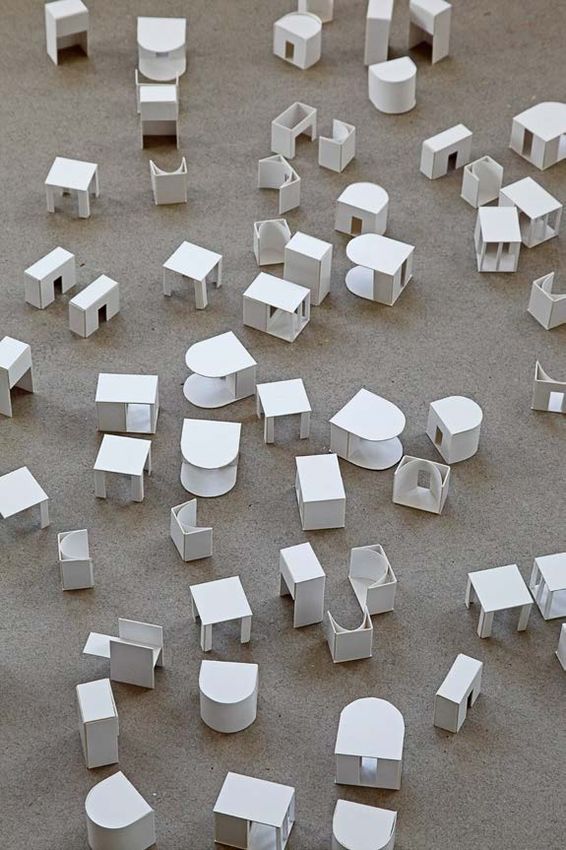
The Qualities and Aesthetics
of Undefined Spaces in Housing.
- An Investigation. Jonas Frick, Basic Design Studio, Diploma Project May 2013.
This project represents a continuous process, where the spaces of the home are being investigated and questioned.
The ambition of the project is to analyse the image and the idea of the home, convinced that there is not an objective truth
about how we are supposed to live within the home. The concept of the home is a social construction, where the nuclear
family is the norm.
The reality shows something different.
How can we create spaces that are more flexible and generous in their use?

In the process I have been working with the following questions;

“How can a home be defined and adapted by those who use it, rather than for us to adapt to the home?”

“Can a home be a place where the residents have the freedom to adapt it to their own needs?”

“How can a home reflect changes in family structures in a longer-term perspective? Can rooms be
expanded into, or subtracted from another?

“In contemporary residential architecture, the rituals of the home are predetermined. Can spaces be left open for
interpretation?”

“Can we create something that is more flexible and sustainable over time, where different activities and
lifestyles can occur and fill the rooms with new meanings?”

”The ideal home no longer exists: there are thousands of ideal homes. The one permanent ideal has been supplanted
by many temporary ones. It seems as though people buy homes instead of houses, rather than turning a house into a
home for themselves.”
-MVRDV
The process is an investigation of how architectural objects can generate a housing-typology that is more free and open for
the residents to interpret.
A vast area divided by architectural components creates a continuous embroidery of specific spatial situations, zones and
compositions.
The aesthetics of everyday life arises against an abstract background.

                                                                          94 %

                                                                                                         60 %

 5%           30 %           30 %         30 %    5%                                                                  40 %

                                                              6%

 1:or         2:or           3:or          4:or   5:or
                                                                   1940                                         Today

                                                                                                                                                                                                         Small objects placed in a space. Different zones and possibilities occurs.
Strategy for new-build houses in Sweden 2013.                Single-households in Sweden in 1940 and today.

                                                                          Public Area
                                       Living-
  Kitchen         Bathroom                         Bedroom
                                       Room
                                                                          Undefined
                                                                           Space

                                                                            Private

                             Bedroom

                             Bedroom
                                                                                                                                 The chinese puzzle. Small units are being composed into larger forms.
                                                                                                                                 What happends in the in-between space?

                                                                                                                                                                                                                       Small private spaces interacts with larger, generating a
                                                                                                                                                                                                                       semi-private space.

The norm of the nuclear-family.                               Is it possible to erase the border betwen different households ?
Small bedrooms are added, when larger apartments are being    How can we interact?
planned.

       Interiors from the late 1800s until today. (Sweden)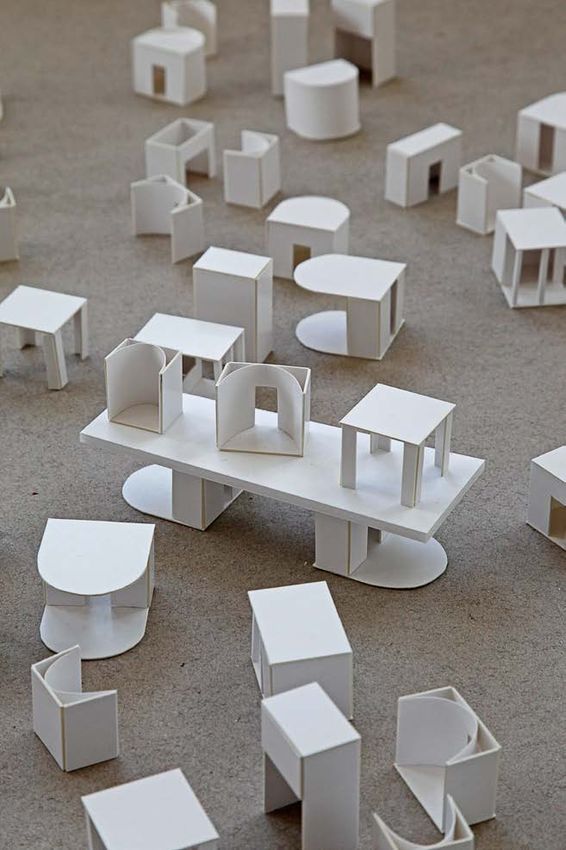
CASE-STUDY- Viggbyholm Garden City 1918.

Specific spaces -Plan Structure. 1:200.

Conceptual Diagrams- Plans. Specific rooms generates undefined spaces.

15 sqm. 45 sqm. 75 sqm. 1:400.

Strategy in Plans. Specific rooms generates undefined spaces.

15 sqm. 45 sqm. 75 sqm. 1:200
Specific spaces/Undefined zones
DEVELOPED PLANS-Specific Rooms generates Undefined Spaces.

            Type 1. 1:200. Plan & Axonometric.                                                                                                        Type 2. 1:200. Plan & Axonometric.
            A sequence of specific spaces creates a complex variation of narrow                                                                       Specific spaces surrounds a larger room. The smaller spaces can be
            and wide,open and enclosed.                                                                                                               inluded with, or subtracted from that space.

            Type 3. 1:200. Plan & Axonometric.                                                                                                                      Type 4. 1:200. Plan & Axonometric.
            Specific spaces generates a sequence of undefined zones.                                                                                                Specific spaces collected i a box. The activities and functions
                                                                                                                                                                    within that box,have the possiblity to continue out in the surrounding space.

        Components- fragmented, small components, generates a flexible plan.

                                           Type 1. 1:100.                                                               Type 2. 1:100.
                      A small apartment i two levels, where the concentrated                  The apartment becomes a flexible space where the lack of hierarchy
                     areas are defined by flooring materials, and sliding doors.             becomes a quality. The transparency towards the surroundings is clear.

                                           Type 1:2. 1:100.                                                              Type 2:2. 1:100.                                                                                          Type 3. 1:100.
               A second example of type 1. The fireplace and the double ceiling-height            The open space creates a social and interacting floor-plan.                                              A symmetric plan, with an open, divideable space surrounding
           creates a transparency towards the surroundings. A semi-public space works as a     The possibility to divide the space with moveable doors and fabric                                                a round room. Different zones are being created
                                   continuation of the private space.                                                 generates a flexibility.                                                                  with colorful floors, glazed parts, and sliding doors.

                            The Components; generates a patchwork of zones.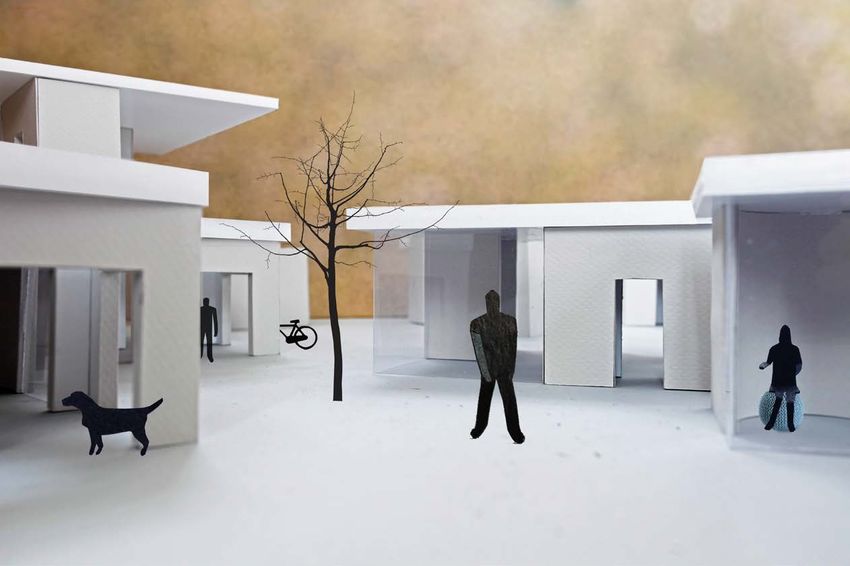
WORKSHOP- Model-Studies.

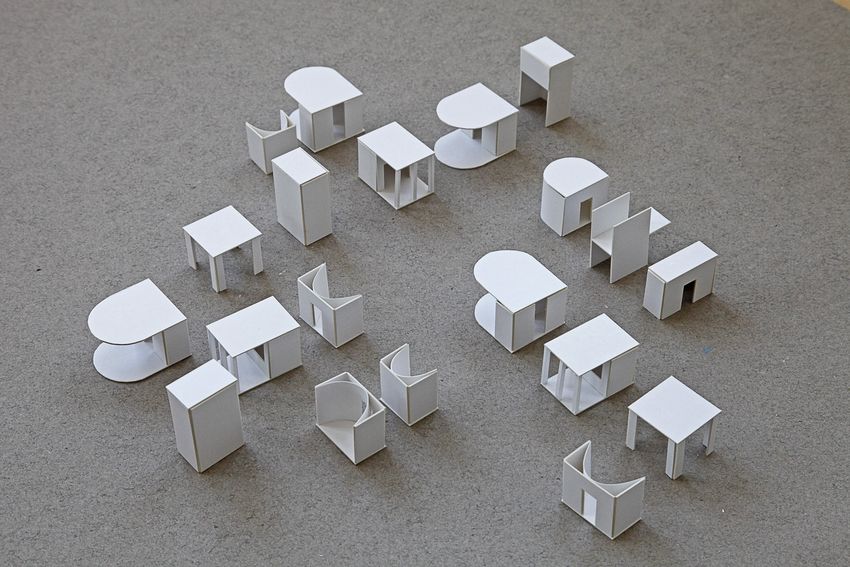
  Components. Objects that can be composed in many different ways. (Photo; Models Scale 1:50)   Components. What type of structure can be created? (Photo; Model Scale 1:100)

  Compositions (Photos; Models Scale 1:50)

Conecpt.- Specifically Undefined Spaces.
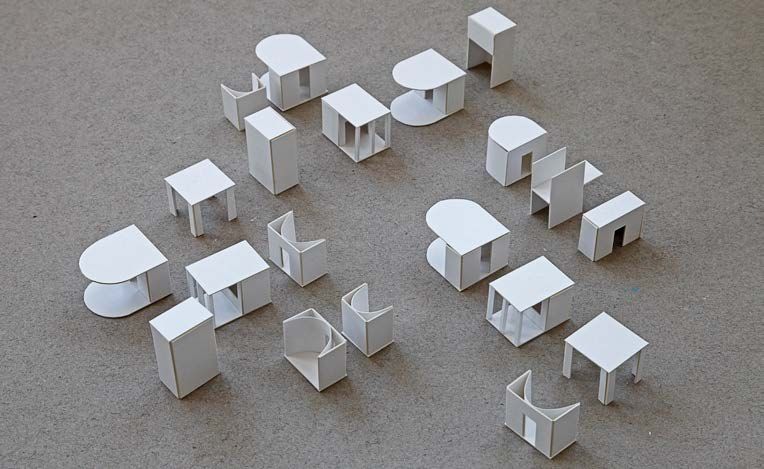
THE COMPONENTS.

12 Components. Light Grey polished concrete. (Plans; 1:100)
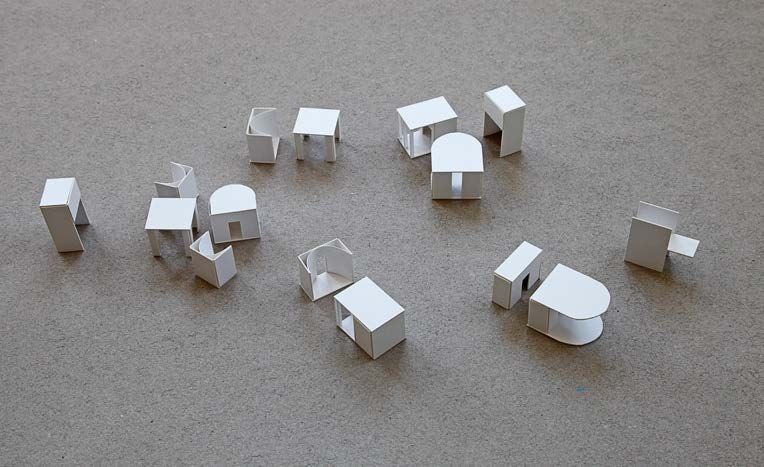
THE COMPONENTS- Finding a system.

                                                                                                                                                                                            1.

                                                                                                                                                                                            2.

      Models.
      By composing the small models, changing the distances and the relations between the them, a plan and a structure was developed.
      The components generates a variety of spatial situations.
      The of specific objects (components) relates to eachother in many different ways, enclosed by glass, and covered with green roofs,
      as uplifted trays with flowers.
      The objects are scattered all over the vast area, (1) and by adding another level, the inbetween-space becomes more intimate and the project gets a
      new dimension.
      Different compositions (2&3) was a way of understanding the scale (3&4) and interpret the abstract objects in many ways.
      The aesthetics of everyday life arises against an abstract background.

                                                                                                                                                                                       3.   4.

                                                                                                                                                            Model 1:50. Axonometric.

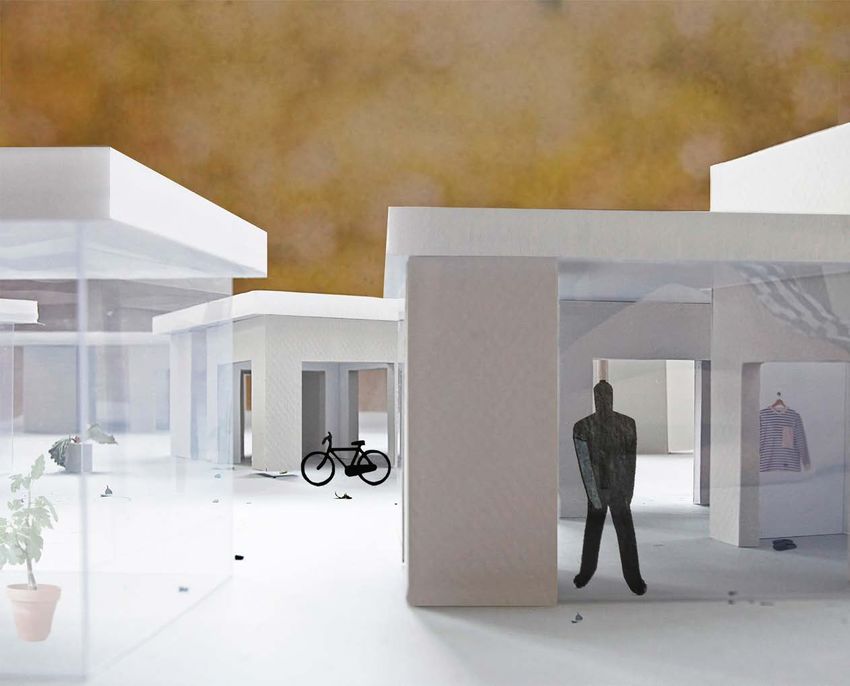
Model 1:50. The image shows the proposal on the site in Gröndal. The roof s are added. Scattered over the site,
the Components creates an embroidery of specific architectural situations and zones.
THE SITE-GRÖNDAL.
Site-plan 1:800. Roofplan and plan of upper level.
597 m2
368 m2
169 m2
453 m2
196 m2
Images of the Site. By the Church. By the Tram (Tvärbanan) View of the mountain.
378 m2
597 m2
225 m2
368 m2
169 m2
1 630 m2
453 m2
196 m2
378 m2
597 m2
1 525 m2
225 m2
368 m2
169 m2
453 m2
196 m2
1 630 m2
Different types of typologies on the site.
378 m2
225 m2
1 630 m2
1 525 m2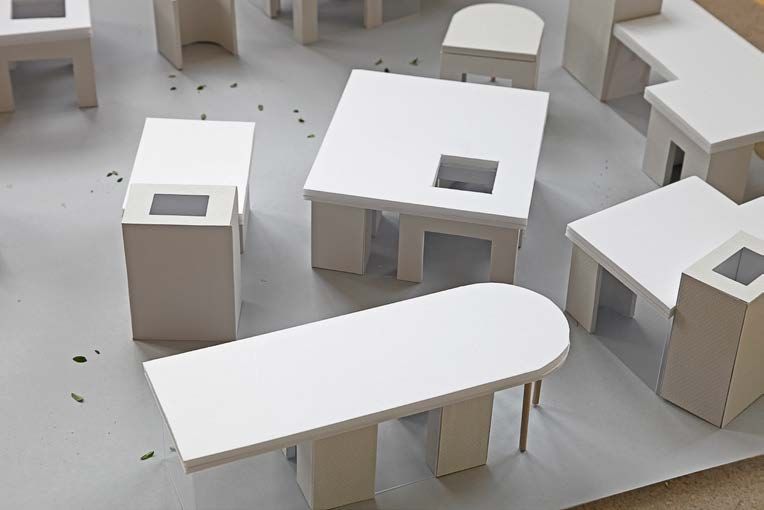
AXONOMETRIC. 1:500

                                                                                                                             11.                                                          1.

+28

                                                                                                                                                                            Park

                                                                                                                                                                                                          2.

                                                                                                                                                                   e
                                                                                                                                                                ad
                                                                                                                                                             fac
                                                                                                                                                        of
                                                                                                                                                   ew
                                                                                                                                                Vi

      +5                                                                                   Public Square                                                 3.
                                                                                                                                   Tram.                               4.

                                                                                                      9.                 r
                                                                                                                    e nte
                                                                                                                 tyC
                                                                                                              Ci

                                                                                                                                           5.
                                                                                     8.

                                                                                                                                   6.

                                                                                                                       7.

           (1-7.) Images of buildings from the surroundings. A rich variation of color, material
           and epoques.
           8. A building from the late 1800s. Visible in one ofthe images of the site. (eralier)
           9. A private property. A future Café-Pavilion will be erected.

           Gröndal Church. (1)                                                                        (6&7)                                                                  (2,3,4,5) Terrace-houses and Row Houses on top.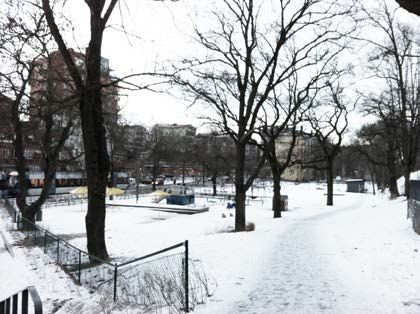
Home Office
                                                                                                                (Ground Floor)

PUBLIC SQUARE
                                                                                     Laundry
                                                                                                                                 PARC
                                   Laundry

                                                                                               Home Office
                                                                                               (Ground Floor)

                   Studio

                                             Studio

                            TRAM

Plan 1:100.

   Public Square                                      Facade towards Tram- Station                                                      Parc

Facade 1:100.
You can also read


