The quarterly magazine of the British Association for Psychological Type - BAPT CONFERENCE 15-17 APRIL 2021 100 YEARS OF TYPE DETAILS INSIDE - The ...
←
→
Page content transcription
If your browser does not render page correctly, please read the page content below
T YPE F A CE
The quarterly magazine of the
British Association for Psychological Type
LINKING THE TYPE COMMUNITY

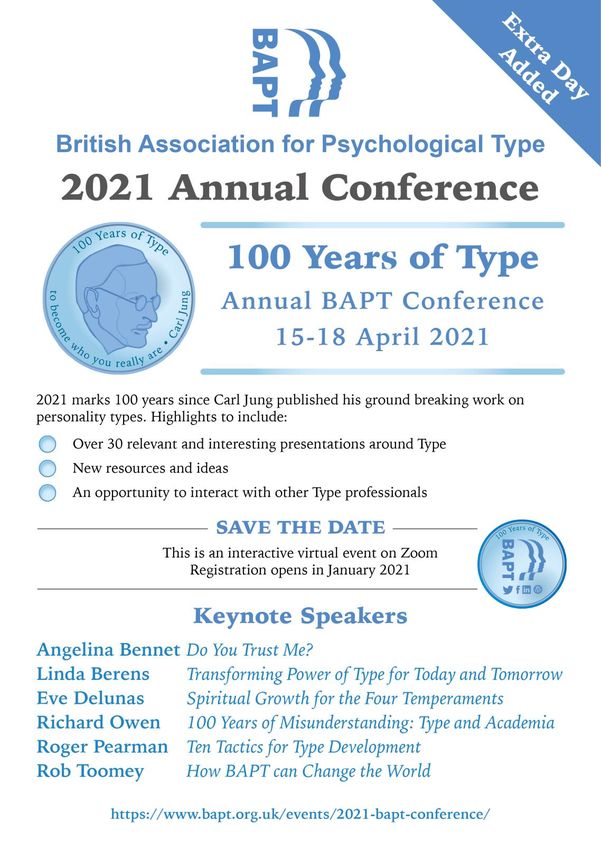
                                              BAPT CONFERENCE

                                               15-17 APRIL 2021

                                              100 YEARS OF TYPE

                                               DETAILS INSIDE

                             Volume 32 No.1       Winter 2021
TYPEFACE

        BRITISH ASSOCIATION FOR PSYCHOLOGICAL TYPE (BAPT)
                                                Registered Charity No. 1045772

                      BAPT, c/o Champleys Accountants, Champleys Mews, Market Place, Pickering YO18 7AE.
                                                 Email: contact@bapt.org.uk
                                                       www.bapt.org.uk

BOARD OF TRUSTEES                                                TYPEFACE TEAM
President & Chair of Board                                       Editor
Sarah Perrott (ESFJ)                                             Gill Clack (ENFJ)
president@bapt.org.uk                                            gill.clack@kcl.ac.uk

Director of Events                                               Assistant Editor

Susan M Nash (ENFJ)                                              Nancy Silcox (ENTJ)
events@bapt.org.uk                                               nancysilcox@hotmail.com

Director of Finance
                                                                 INTEREST AREA CO-ORDINATORS
Richard Owen (INTJ)
payments@bapt.org.uk                                             Careers & Occupations

Director of Member Services                                      Christine Rigden (INFP)
                                                                 christine@insightsforchange.co.uk
Catherine Stothart (INTP)
membership@bapt.org.uk                                           Diversity & Multicultural Issues

Board Secretary                                                  Paula Aamli (ENTP)
                                                                 peaamli@gmail.com
Jerry Gilpin (INTJ)
sec@bapt.org.uk                                                  Education, Learning & Development
                                                                 David Hodgson (ENFP)
WEBMASTER                                                        buzz.hodgson@gmail.com

Christine Rigden (INFP)                                          Psychotherapy & Counselling
tech@bapt.org.uk
                                                                 POST VACANT

                                                                 Management & Organisational Development
BAPT LOCAL AREA GROUPS
                                                                 Susan M Nash (ENFJ)
                                                                 susan.nash@em-power.com
MIDLANDS GROUP
Charles Worth (INFP)                                             Religion & Spirituality
Charles@perceivetraining.co.uk                                   Graham Osborne (INTJ)
                                                                 revgdo@gmail.com
NORTH WEST GROUP (NW TYPE)
Manchester
Ian Jenner (INFP) & Robin Hills (ENFP)
ianrayjenner@gmail.com & Robin@Ei4change.co.uk

Cover Photographs: BAPT Conference Keynote Speakers (Top)
                      BAPT Board (Bottom)
Cover Design: Salmon Consulting Ltd. Graphic Design: Angelina Bennet. Printing: Proteus Print Ltd, Bedworth.

       Volume 32, No. 1                                      1                                       Winter 2021……...
TYPEFACE

Contents
President’s Column (Sarah Perrott) ..     ..       ..    ..     ..       ..   ..     ..    ..   ..   ..      ..     ..    4

BAPT ‘In Conversation with ….. ‘ Webinar ..        ..    ..     ..       ..   ..     ..    ..   ..   ..      ..     ..    5

BAPT Virtual Conference: 15-18 April, 2021 – “100 Years of Type”
    Welcome to the Conference (Susan Nash)         ..    ..     ..       ..   ..     ..    ..   ..   ..      ..     ..    6
    Conference Programme            ..    ..       ..    ..     ..       ..   ..     ..    ..   ..   ..      ..     ..    7
    List of Sessions with Presenters      ..       ..    ..     ..       ..   ..     ..    ..   ..   ..      ..     ..   11
    Keynote Sessions – Summaries
         100 Years of Misunderstanding: Type & Academia (Richard Owen ) ..           ..    ..   ..   ..      ..     ..   15
         Pitfalls and Pathways to Spiritual Growth for the Four Temperaments (Eve Delunas)..    ..   ..      ..     ..   16
         100 Years of Type: Taking Type Ethically into its Second Century (Jerry Gilpin)   ..   ..   ..      ..     ..   17
         Ten Tactics for Type Development (Roger Pearman) ..             ..   ..     ..    ..   ..   ..      ..     ..   18
         The Transformational Power of Type for Today and Tomorrow (Linda Berens)          ..   ..   ..      ..     ..   19
         How BAPT can Change the World (Rob Toomey)             ..       ..   ..     ..    ..   ..   ..      ..     ..   20

TypeFace Archive – ‘MILO’ at CAPT ..      ..       ..    ..     ..       ..   ..     ..    ..   ..   ..      ..     ..   21

Diversity & Multicultural Issues:   ..    ..       ..    ..     ..       ..   ..     ..    ..   ..   ..      ..     ..   22
On Not Being “Casual with our Power” (Paula Aamli)

Australian APT National Conference: 28-31 October, 2021.        ..       ..   ..     ..    ..   ..   ..      ..     ..   25

Management & Organisational Development:           ..    ..     ..       ..   ..     ..    ..   ..   ..      ..     ..   26
The Importance of Trust (Angelina Bennet)

Two Ps in a Pod cartoon (Rob and Heather Toomey)         ..     ..       ..   ..     ..    ..   ..   ..      ..     ..   27

Religion & Spirituality:     ..     ..    ..       ..    ..     ..       ..   ..     ..    ..   ..   ..      ..     ..   28
Psychological Type and Responding to COVID-19: an Enquiry among
lay Anglicans (Leslie Francis & Andrew Village))

Spotlight on Research (John Hackston)     ..       …     …      ..       ..   ..     ..    ..   ..   ..      ..     ..   31

Words of Wisdom from the Master! (Carl Jung) ..          ..     ..       ..   ..     ..    ..   ..   ..      ..     ..   33

Typewatching at the Cinema:         ..    ..       ..    ..     ..       ..   ..     ..    ..   ..   ..      ..     ..   34
“Words on Bathroom Walls” (Peter Malone)

Types of Books (Nancy Silcox)       ..    ..       ..    ..     ..       ..   ..     ..    ..   ..   ..      ..     ..   36

BAPT Annual Conference: 100 Years of Type - 15-18 April, 2021            ..   ..     ..    ..   ..   ..      ..   Back Cover

        Volume 32, No. 1                                             2                                    Winter 2021……...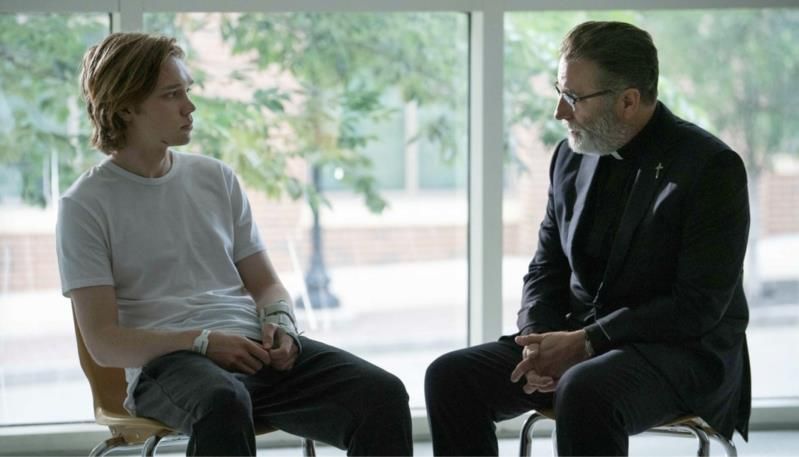
TYPEFACE

EDITOR’S NOTE
GILL CLACK (ENFJ)

This issue contains a good mix of offerings – I hope you will find it stimulating and of interest. We start with Sarah’s President’s
Column where she discusses the importance of having a Beginner’s Mindset, i.e. an open mind to new ideas. She then goes on
to outline the fabulous number of contributions to the next Conference from all over the world which should make it a
memorable event.
Next is a notice reminding you of the upcoming ‘In Conversation’ webinar where Sarah will be discussing with Richard Owen his
‘Personality Parts’ approach to type from a depth typology standpoint. This takes place on 9 th March.
Then we have a feature relating to the BAPT 2021 Virtual Conference to be held 15-18 April. The first piece is a Welcome to the
Conference from Susan Nash, Conference Chair, which is followed by a copy of the programme and a list of the sessions with
presenters. Then we have short pieces from the six keynote speakers: 100 Years of Misunderstanding: Type & Academia
(Richard Owen), Pitfalls and Pathways to Spiritual Growth for the Four Temperaments (Eve Delunas), 100 Years of Type: Taking
Type Ethically into its Second Century (Jerry Gilpin), Ten Tactics for Type Development (Roger Pearman), The Transformational
Power of Type for Today and Tomorrow (Linda Berens) and How BAPT can Change the World (Rob Toomey). These will give you
a real flavour of what is on offer. We do hope you’ll join us to enjoy them.
We then have three articles from our Interest Area Groups. The first is a Diversity & Multicultural Issues group article by Paula
Aamli entitled On Not Being ‘Casual with our Power’ followed by an article under Management & Organisational Development
by Angelina Bennet on The Importance of Trust a theme she will be developing further in her Keynote presentation at the
Conference. Then from Religion & Spirituality Leslie Francis and Andrew Village share with us their research on Psychological
Type and Responding to COVID-19: an Enquiry among lay Anglicans.
This is followed by our regular Spotlight on Research by John Hackston where he reports this time on research that has been
undertaken on Personality and perception in the COVID-19 pandemic; To (Brexit) deal or not to deal?; Enhancing the security of
cyber-security; Does Personality vary across countries, sectors, and organisations? and finally draws your attention to CAPT’s
Research Digest for 2020.
Then Peter Malone reviews the movie Words on Bathroom Walls which features Adam, a teenager who is schizophrenic and the
characters with whom he interacts.
This is followed by Nancy Silcox’s regular ‘Types of … ‘ column where this time she speculates on the types of books individuals
with the different type preferences might be drawn to. Do you agree with her conclusions?
Throughout the issue, you will find some shorter pieces: the latest type cartoon produced by Rob and Heather Toomey the 2 Ps
in a Pod and Words of Wisdom from the Master with a saying from Carl Jung. We also would like to remind you of the date of
the next AusAPT Conference which will be held with the New Zealand type community from 28-31 October, 2021, in Auckland.
We hope you’ll enjoy reading these pieces.

GILL

                                       EDITORIAL & ADVERTISING POLICY FOR TYPEFACE

Publication of an advertisement in TypeFace is not an endorsement by BAPT of the advertiser of the product or service offered.
Potential advertisers should contact the Editor for a list of prices and discounts for multiple insertions.
No part of TypeFace may be reproduced in any manner without written permission from BAPT. Write to the Editor in the first
instance. Myers-Briggs Type Indicator® and MBTI® are registered trademarks of the Myers-Briggs Type Indicator Trust in the
United States and other countries.
                           DEADLINE FOR CONTRIBUTIONS FOR SPRING 2021 ISSUE: 1st APRIL 2021

       Volume 32, No. 1                                          3                                          Winter 2021……...
TYPEFACE

                            PRESIDENT’S COLUMN
                            SARAH PERROTT (ESFJ)

                            Happy New Year to you all. Here is very        broad group of highly experienced and
                            much hoping that 2021 is a good, healthy       knowledgeable practitioners, literally from
Sarah Perrott works as a    and positive year for us all.                  across the globe. So much so that we have
                            I was talking to an experienced HRD in a       extended our Conference from three half
consultant and executive
                            global company recently who was sur-           days to four half days. So, our dates run
coach with individuals,                                                    now from Thursday 15th April through to
                            prised that her organisation was using
teams and groups. She       Type in the HR team worldwide as a devel-      Sunday 18th April. As already stated, we are
has been working with       opmental tool. She said to me, I trained in    running a virtual interactive Conference
Type for 18 years and is    Myers Briggs® over 15 years ago and am         due to the ongoing pandemic. There are
passionate about            surprised that we are using it, I would have   several real positives about this situation
                            thought that there was something more          as, unlike last year’s day virtual event, this
enabling others to                                                         is a full Conference. So there are the usual
                            recent and current, something new. As
flourish. She is APECS                                                     Keynotes and we are running two tracks of
                            you can imagine we had a lengthy discus-
accredited with an MSc in   sion about this. It reminded me of the ex-     talks over the four half days. We have Rich-
Coaching & Behavioural      pression Beginner’s Mindset. Beginners         ard Owen, Eve Delunas, Roger Pearman,
Change, FCIPD and BPS       mind is a concept from Zen Buddhism            Linda Berens, Angelina Bennet and Rob
                            called Shoshin: “having an attitude of         Toomey delivering Keynotes over the Con-
accredited, licensed NLP
                            openness, eagerness, and lack of precon-       ference. Plus twenty six seminars. The sub-
practitioner and licensed                                                  jects in the seminars vary from Type and
                            ceptions when studying a subject, even
HeartMath coach.            when studying at an advanced level, just       leadership, Type and Emotional Intelli-
Email: president            as a beginner in that subject would”. Some     gence, Interaction Styles Conflicts and Con-
                            tips to cultivate a beginner’s mind at work    nections and Coaching via nature and nur-
@bapt.org.uk
                            would be to 1. Question everything; 2. Try     ture. And that is to name just a few. This is
                            a perception shift; 3. Challenge convic-       definitely a Conference not to be missed.
                            tions; 4. Consider a lateral approach, and     One of the comments that we often have
                            5. Find a reverse mentor. I was talking to     had after conferences is how difficult it has
                            another client who said a beginner’s mind-     been to choose between the options on
                            set was the crucial criteria that he looks     offer in the various tracks. The entire Con-
                            for when hiring new executives into his        ference will be recorded, and the record-
                            top team. So quite the opposite of the         ings available afterwards to all Conference
                            completely experienced, been there and         attendees. Those of you who have said, “I
                            done that mindset.                             wanted to attend all the seminars and
                            As we know and has been my recent expe-        found it difficult to choose”. Now you will
                            rience Type has such breadth of applica-       not have to choose, you can attend one
                            tion. We can use different lenses and work     seminar and then review the simultaneous
                            with our and other’s Type preferences in a     seminar on the recording afterwards. A real
                            myriad of ways. And there is always some-      win/win. The BAPT Board have priced the
                            thing fresh and new to discover. Just be-      Conference at a very competitive £125 for
                            fore Christmas, and before our third lock-     members and £150 for non-members
                            down, I facilitated a workshop with a Type     (including optional membership for the
                            knowledgeable group and introduced In-         time to October) for the four half days. For
                            teraction Styles. I was wearing a mask, in a   Conference attendees this can be your con-
                            huge room with a senior team of eight          tinuous professional development over the
                            people socially distanced. Fortunate that I    entire year with the recordings that you will
                            have a loud voice. The executive team          have ongoing access to. The speakers at our
                            strongly resonated with Interaction Styles     2021 ‘100 years of Type’ Conference are
                            and found it very useful and discussed         detailed later in the magazine. I am so look-
                            ways of applying it personally and within      ing forward to attending the Conference
                            their team.                                    and hearing the latest thinking, fresh appli-
                                                                           cations, new ideas, research in and use of
                            The BAPT Board have been completely
                                                                           Type. My encouragement is for us all to
                            thrilled with the response to the call for
                                                                           adopt a beginner’s mindset and see what
                            papers for our Annual Conference. We
                                                                           transpires.
                            have had very strong submissions from a

       Volume 32, No. 1                                 4                                          Winter 2021…...
TYPEFACE

                      ANNOUNCING
             BAPT ‘In Conversation...’ Webinars

Personality Parts: BAPT In Conversation with Richard Owen
Tuesday 9th March 2021

                                                                          .

             DID YOU KNOW?
 All of our In Conversation With… sessions are accessible via our web site, and also
 directly from a YouTube playlist.
 You may have meant to sign up for a session and forgot, or perhaps you were interrupted and
 had to leave. Maybe one was just so interesting that you’d love to hear it again.

 Visit the In Conversation archive page:
                   www.bapt.org.uk/resources/in-conversation-with-archive/

 Or browse the In Conversation playlist on YouTube:
                               https://bit.ly/36Ysl3v-conversations

                                                       No login required. Enjoy your browse!

            Get more details and REGISTER for access at bapt.org.uk/events

     Volume 32, No. 1                              5                                 Winter 2021……...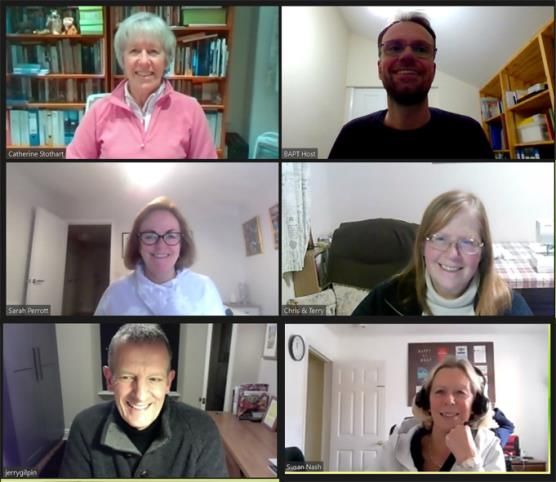
TYPEFACE

                            Welcome to the BAPT 2021 CONFERENCE!
                                   SUSAN NASH - PROGRAMME CHAIR

I am very excited to share with you information about the upcoming BAPT Virtual Conference on April 15-18, 2021 with
the theme of 100 Years of Type (as you know, it is 100 years since the printing of Jung’s book Psychological Type).

 We have been delighted with the volume of proposals as well as the quality of presenters from all around the world:
the line-up looks rather like a Who’s Who in the Type Community! As a result, we have made the decision to extend the
Conference to four days (now April 15-18th, 2021), and to run two “virtual tracks” – a new technological project for us!

We know that this is a lot of content and yet, because of the ability to record and play back sessions, this offers a unique
opportunity this year to record ALL 32 sessions. These recordings will be included in the Conference price (£125 pounds
for any Type Association member – approximately $170). That works out at about 4 pounds per session – a great invest-
ment!

We are running seven “mini keynotes” when both tracks will be in one virtual workshop: see the list below.

Our plenary speakers are:

   •    Richard Owen will kick off the Conference looking at “100 Years of Misunderstanding: Type and Academia”
   •    Eve Delunas will present “Pitfalls and Pathways to Spiritual Growth for the Four Temperaments”

   •    The BAPT Board will facilitate a session on “Taking Type Ethically into its Second Century”

   •    Roger Pearman will present “Ten Tactics for Type Development”

   •    Linda Berens will present on “The Transformational Power of Type for Today and Tomorrow”

   •    Angelina Bennet will present on “Do you Trust Me?”

   •    Rob Toomey will conclude the Conference presenting on “How BAPT can change the world”

Angelina has written more about her presentation in an article in the Management and OD section (see p. 26), while the
rest of the speakers have contributed stand-alone articles (see p. 15-20}. Feel free to read these articles to understand
more about what to look forward to!

The detailed programme and details of the presenters and their sessions follow (this information is also on our web site:
www.bapt.org.uk). Content is really diverse and will cover theoretical subjects (such as paradigms of polarity, Schiller’s
work, etc.), a discussion of type instruments, other theories (such as E.Q., Saboteurs, etc.), multiple models
(Temperament, Interaction Style, Cognitive Processes and Type Development) type application (such as Type and physi-
cal activity, preferences, facilitation principles, working with Techies, etc.) and many other approaches to Type in the
year 2021.

Roger Pearman is also planning to run a Pre-Conference workshop introducing the Pearman Personality Integrator for
£85 – more information will be up on the web site soon. Participants will take the assessment and be guided through
the reports and application of this assessment tool.

  Volume 32, No. 1                                          6                                           Winter 2021……...
TYPEFACE

                               Thursday April 15, 2021

Time                          Track One                                  Track Two

1:00 – 2:00 pm                                   Richard Owen
                             100 Years of Misunderstanding: Type & Academia
                                                      All

2:30 – 3:30 pm              Mark Majors                                Cindy Paris
                   Type Development and Psycho-             The Four Principles of Facilitating
                     metrics Through the Years                    Psychological Type
                                 All                                        All

4:00 – 5:00 pm             Mina Barimany                          Jane Kise & Ann Holm
                   Exploring Paradigms of Polarity          Coaching Via Nature AND Nurture
                           in Type Theory                          (Type Saboteurs)
                             Advanced                                       All

5:30 – 6:30 pm              Dario Nardi                               Laura Viriglio
                    Overcoming One-sidedness                Leadership Development w/ EI &
                                                                   Personality Type
                                                                            All
                     Intermediate and Advanced

7:00 – 8:00 pm                                    Eve Delunas
                   Pitfalls and Pathways to Spiritual Growth for the Four Temperaments
                                                      All

                      All times are British Standard Time (BST)

Volume 32, No. 1                             7                                         Winter 2021……...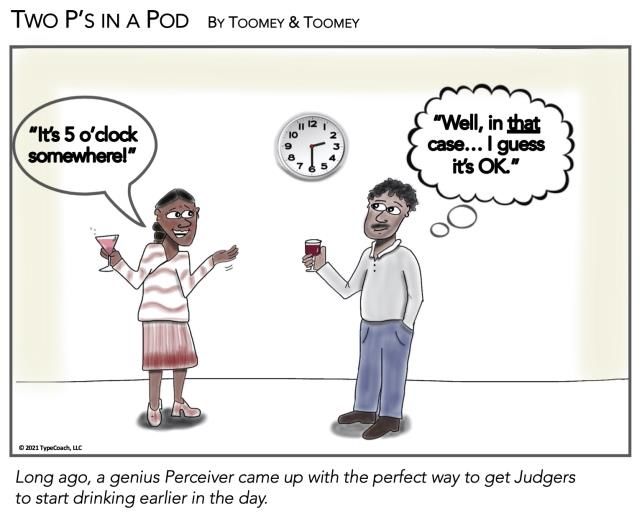
TYPEFACE

                                Friday April 16, 2021
Time                          Track One                                 Track Two

1:00 – 2:00 pm                            Jerry Gilpin and BAPT Board
                               Taking Type Ethically into its Second Century
                                                      All

2:30 – 3:30 pm             David Hodgson                             Markey Read
                   How is Happiness and Well-being          Tap your Superpowers to Launch
                           Linked to Type                       and Grow your Business
                                 All                                      All

4:00 – 5:00 pm      Anne Bulstrode & Susan Geary                     Gerald Otis
                    The Evolution of Temperament            Physician Careers and the MBTI
                                 All                          Intermediate and Advanced

5:30 – 6:30 pm               David Pool                              Cash Keahey
                           Schiller's Ideas                 Lifetime of Type Development:
                        on the Type Problem                 What Leader Biographies Reveal
                                 All                          Intermediate and Advanced

7:00 – 8:00 pm                                     BAPT AGM

                       All times are British Standard Time (BST)

Volume 32, No. 1                               8                                    Winter 2021……...
TYPEFACE

                                 Saturday April 17, 2021
Time                           Track One                                     Track Two

1:00 – 2:00 pm                                    Roger Pearman
                                        Ten Tactics for Type Development
                                                           All

2:30 – 3:30 pm               Carol Linden                                 Teresa Moon
                   Type with Techies: Being Effective            Be Careful What You Wish For:
                        with Technical Clients                     The MBTI on Social Media
                      Intermediate and Advanced                                All

4:00 – 5:00 pm              John Hackston                                 Sterling Bates
                          100 Years of Type -                      Easiest Tips to Avoiding
                           and of Pandemics                      100 Years of Type Objections
                               Beginner                            Beginner and Intermediate

5:30 – 6:30 pm            Catherine Stothart                          Maryanne Sutherland
                          Defusing Conflict                           The World We Live In:
                        with Interaction Styles                        Reality of the 2000s
                                  All                                          All

7:00 – 8:00 pm                                        Linda Berens
                        The Transformational Power of Type for Today and Tomorrow
                                                           All

9:00 – 10:00 pm                Sue Blair                                 Terri Connellan
                    Invoking the Inferior Function                   What 100 Years of Type
                                                                     Can Teach Us as Writers

                             Intermediate                                      All

                       All times are British Standard Time (BST)

Volume 32, No. 1                                  9                                        Winter 2021……...
TYPEFACE
Sunday April 18, 2021
Time Track One Track Two
1:00 – 2:00 pm Angelina Bennet
Do You Trust Me?
All
2:30 – 3:30 pm Vicky Jo Varner & Robin Wiley Julie Benesh
Process Work and Typology Type Development and
the Micro-memoir
All All
4:00 – 5:00 pm Katherine Hirsh Jean Luc Dupont
At Play Among the Opposites: Small Type Difference,
Archetypal Energies Big Relationship Impact
Intermediate and Advanced Intermediate and Advanced
5:30 – 6:30 pm Suzanne Brue Laurie Lippin
Type and Physical Activity EQ and MBTI: Type is NOT destiny!
Preferences
All Beginner and Intermediate
7:00 – 8:00 pm Rob Toomey
How BAPT can change the world
All
All times are British Standard Time (BST)
Volume 32, No. 1 10 Winter 2021……...TYPEFACE
Exploring Paradigms of Polarity in Type Theory - Mina Barimany
This session will begin with a presentation of empirical research on the various polarities
embedded in Jung's theory followed by a critical inquiry of the research and discussion of
results. Implications of the results on Type development will be highlighted.
Easiest Tips to Avoiding 100 Years of Type Objections - Sterling Bates
Common objections when people are introduced to type include comments like “Why can’t I be
both?” or “Don’t put me in a box!” We will discuss how to deliver the key benefits of type to your
clients before (or even without!) presenting the full four-letter type code.
Type Development and the Micro-memoir - Julie Benesh
Join us in reading and writing micro-memoirs that can facilitate personal transformation and type
development. The facilitator has presented at four APTI conferences, worked with type since the
80s, and is a professor, OD practitioner, writer and creative writing teacher.
Do You Trust Me? - Angelina Bennet
The events of this past year have caused me to focus on the concept of Trust. How important is trust for
individuals and for teams? How can we use Type to build trust? In this session the link between trust and
performance will be explored in the context of recent changes in working practices.
The Transformational Power of Type for Today and Tomorrow - Linda Berens
and practitioners use, teach, and apply type in ways that meet the needs of the emerging future. Find the
transformational power of type in a chaotic world.
Invoking the Inferior Function - Sue Blair
Discover how to maximise the potential of your inferior function. What role does it play? What
advice does it give? What questions should we ask? This session will reveal a new approach to
this often much dismissed function.
Type and Physical Activity Preferences - Suzanne Brue
Does your type influence your exercise preferences? Research shows that individuals tend to en-
joy and stay with exercise that aligns with their perceiving process. This session will describe the
motivation, approach, environments, and interpersonal connections of each type.
The Evolution of Temperament - Anne Bulstrode & Susan Geary
Just as Type has evolved over the last 100 years so has Temperament. You
will be taken on a journey through the evolution of Temperament looking at
milestones along the way. Your journey will conclude by exploring the latest
developments in Temperament and Wellness.
Volume 32, No. 1 11 Winter 2021……...TYPEFACE
What 100 Years of Type Can Teach Us as Writers - Terri Connellan
As psychological type practitioners, we are also often writers. How can insights from 100 years
of type help us grow as writers? Using frameworks from type, creativity and writing, we look at
writing identity, strengths and growth opportunities to increase productivity.
Small Type Difference, Big Relationship Impact - Jean Luc Dupont
What happens when two persons have one letter difference in their type? Should the relationship
be easy? Which mate is easier for an INFP? ENFP? ISFP? INTP? INFJ? Let’s explore the different
cases and find what richness / challenges each combination can bring!
Pitfalls and Pathways to Spiritual Growth for the Four Temperaments - Eve Delunas
Your temperament is one predictor of the kinds of tricks your ego may employ to derail you from
a path of spiritual growth. Come learn about the various ego thought traps associated with each
temperament and what you can do to avoid becoming ensnared by them.
100 Years of Type - and of Pandemics - John Hackston
2021 marks 100 years of type and just over 100 years since ‘Spanish Flu’. We will use recent
research into how type relates to reactions to COVID-19 to explore how the earlier pandemic
influenced society and ideas around type, and how we can cope with the current pandemic.
At Play Among the Opposites: Archetypal Energies in Animus and Anima - Katherine Hirsh
Join me to engage in a reflective dialogue on how we can update Jung's archetypes of the
persona, animus and the anima for our time and thereby harness their energy for our
individual journey to wholeness.
How Are Happiness and Well-being Linked to Type? - David Hodgson
David will introduce seven key discoveries from the field of positive psychology. Break-out groups
(divided by temperaments) will discuss the impact of type on these keys to happiness. Partici-
pants will be provided with a personal template for building happiness.
Lifetime of Type Development: What Leader Biographies Reveal - Cash Keahey
What is revealed about type development in the biographies of leaders--specifically certain U.S.
Presidents? Is there a predictable order in which we come into greater awareness and use of the
eight cognitive processes? If so, how does that inform my own type development?
Coaching Via Nature AND Nurture - Jane Kise & Ann Holm
Jung posed that our preferences for perception and judgment are innate. They're part of our
nature. But we all know that people of each type show great diversity. Explore with us how
Positive Intelligence, a "nurture' framework, enhances type-based coaching.
Type with Techies: Being Effective with Technical Clients - Carol Linden
In this session, you will learn: * the typical type spreads in different kinds of high-tech groups and
how that affects working with them * how to engage them more fully and how not to turn them
off * which teaching points from Type and Temperaments more apply to their typical issues.
Volume 32, No. 1 12 Winter 2021……...TYPEFACE
EQ and MBTI: Type is NOT destiny! - Laurie Lippin
All types can be leaders but not all types have emotional Intelligence competency. Explore the
connection between EQ and MBTI. STEPII facets are useful behavioural guideposts for coaching
leaders to greater excellence. Useful personally as well as professionally.
Type Development and Psychometrics Through the Years - Mark Majors
Introduction; Early years of type assessment and conversations with: Harold Grant, Otto Kroger,
& Mary McCully; The Indicator and its progression: Forms J, F & G and my personal work with
Forms M, Q and Step III; Majors PTI and PTE development as a continuation of Jung.
Be Careful What You Wish For: The MBTI on Social Media - Teresa Moon
This year I braved the shark-infested waters of social media – and survived! I found users are
widely aware of their MBTI type, but are not using the knowledge in a way that Isabel could ever
have imagined. Come and learn what I discovered, and discuss what it means for us.
Overcoming One-Sidedness - Dario Nardi
Jung's ‘Psychological Types’ focused on the problem of one-sidedness. We will explore his words
of wisdom here, look at two brain-based type facets that reflect our developmental biases, learn
a daily way to assess one-sidedness, and get pointers for regaining balance.
Physician Careers and the MBTI - Gerald Otis
This presentation offers an assortment of statistically significant findings relating Psychological
Type (as measured by the MBTI) to various aspects of medical education, medical career choice
and degree of satisfaction in different medical career niches.
100 Years of Misunderstanding: Type & Academia - Richard Owen
Richard explores some differences between type & trait views of personality, and how they con-
tributed to widespread negativity from mainstream academic psychologists. We also consider
whether misunderstandings by Jung & Myers-Briggs theory may have added to the confusion.
The Four Principles of Facilitating Psychological Type - Cindy Paris
This workshop identifies four principles from Jung's theory that can be easily incorporated into
your introductory workshops - with a few nuanced tweaks and techniques - to help your clients
grasp the true dynamic nature and power of Type system.
Ten Tactics for Type Development - Roger Pearman
Presentation of the ten tactics interspersed with small group chats on specific questions and
tactics for illustrative personal stories. Data, examples, and small group chats will provide
insights on the ten tactics.
Schiller's Ideas on the Type Problem - David Pool
Chapter II of Psychological Types lays a foundation for Jung's "critical psychology". This talk will
facilitate an understanding of types by examining Schiller's ideas, which Jung credited as the first
"to attempt a conscious differentiation of typical attitudes" in 1795.
Volume 32, No. 1 13 Winter 2021……...TYPEFACE
Tap Your Superpowers to Launch & Grow in Business - Markey Read
Come learn how to connect the inherent talents of your type to the success of your business by
looking at marketing messaging, the kinds and styles of services to include, and what to watch for
as you launch, grow, and prosper as a solopreneur.
Defusing Conflict with Interaction Styles - Catherine Stothart
Interaction Styles is a wonderful tool for communicating in an emotionally intelligent way. We
will explore the core drives and beliefs of each Style - how these can lead to conflict and how to
manage your emotions and adapt your behaviour to build connections with others.
The World We Live In: Reality of the 2000's - Maryanne Sutherland
One hundred years of type is significant in itself but the generation we live in also dramatically
affects and influences how each personality adapts or not to the world we are currently living in.
Are certain types more adapted to the 200's than others???
How BAPT Can Change the World - Rob Toomey
An interactive discussion to discover ways we can make the link between the knowledge within
the type community and the hundreds of millions of curious amateurs who learn about their type
online.
Leadership Development with EI & Personality Type - Laura Virgilio
Explore how to incorporate personality type & emotional intelligence when developing leaders.
Build a business case to use emotional intelligence in the workplace, see how these two tools can
combine to paint a more vivid picture for yourself and others.
Process Work and Typology - Vicky Jo Varner & Robin Wiley
This experiential session will introduce you to ways in which Mindell’s Process
Work can be applied to typology.
Volume 32, No. 1 14 Winter 2021……...TYPEFACE
BAPT VIRTUAL CONFERENCE 2021
KEYNOTE PRESENTATION
100 YEARS OF MISUNDERSTANDING: TYPE & ACADEMIA
RICHARD OWEN (INTJ)
Current BAPT Director of It is a true honour to open this special BAPT Whilst I enjoy genuinely constructive critical
Finance, Richard Owen, M.Sc. 2021 Conference, celebrating the cen- thinking, and am well aware that traditional
tenary of Carl Gustav Jung’s book Psycho- Type theory and practice is imperfect in many
(INTJ) is an independent
logical Types (first published in German as ways, it often seems that there is a deeper
practitioner, delivering Psychologische Typen by Verlag Rascher & level to the conflict I see out there. There is an
workshops and coaching in Co in 1921). It is very possible that without elephant in the room, or unarticulated funda-
London, Brighton and online. that momentous event BAPT would never mental assumptions and viewpoints that un-
He uses a depth typology have existed. derpin the attacks on the surface. So I have
approach to personal My own story with Type began somewhere spent a lot of time trying to fully understand
around 2007, inspiring a career change and the academically favoured trait models of per-
development; helping clients
lasting passion for psychology, self- sonality, and the roots of Type, to see how
address challenges in they might be reconciled.
understanding and especially Jung’s work. I
relationships and life
enjoyed studying, through MBTI® Certifica- The situation is complex; especially because
transitions through his tion and wider Type literature, to an MSc in Jung’s original work was so difficult to under-
Personality PartsTM model. Organisational Psychology including a the- stand. Furthermore there are 100 years of
Richard holds an M.Sc in sis on Big 5 trait facets. Next came certifica- differing interpretations and expansions:
Organisational Psychology, an tion in coaching and various other Type and • C.G. Jung’s original writings
trait assessments. However, along the way
Accredited Diploma in • Post Jungians (Von-Franz, Hillman, Spoto,
it became clear that not everyone shared
Transformational Coaching and Beebe, etc)
my enthusiasm for Type.
is certified with MBTI® and a • Official MBTI® theory and materials
Despite the fact that there were many dec-
range of other Type and Trait
ades of widespread popularity of MBTI® in • Academic research articles (mainstream
assessments. the corporate world, and a wealth of re- journals and CAPT)
search using it (second only to Big 5 re- • Practitioner based publications (APT con-
Email: ferences and practitioner books)
search), there was reluctance amongst aca-
richard@personalityparts.com. demics to take psychological type seriously • Socionics (Jungian typology’s Russian off-
or to research it further. Some were indi- spring)
vidually supportive of Type use in practice • #MBTI (Enthusiasts blogging on social me-
through their personal and work experi- dia)
ence, however a growing ‘generally accept- To really understand the claims of Type theory,
ed’ anti-Type narrative within Journals and one must navigate this diverse maze of materi-
on social media had become well en- al to see the assumptions, divergence and evo-
trenched. Therefore positive voices gener- lution along the way. There are differences in
ally stayed quiet to fit in and avoid conflict, theory between these areas, between authors
unbalancing the discourse. within each area, and even contradictions over
At worst the vocal minority of extreme time for individual authors (as we sometimes
Type detractors, often professional psy- see with Jung himself). It is no wonder that
chologists and other scientists, can be quite critics get confused if there isn’t even a unified
offensive towards anything Type related. narrative to draw from. At the Conference we
Social media articles and posts sometimes shall look at some possible misunderstandings
descend into a kind of intellectual bullying, that have crept into our conception of Type
with Type (or more often specifically the over time.
MBTI®) becoming like the unpopular kid in We haven’t even touched on the history of the
the playground, with the mean kids bond- Big 5 and trait personality here, but it is equal-
ing through collaborative persecution, and ly as complex. In my Conference session we
gaining kudos from kicking the victim while shall explore some of the fundamental ways
they’re down. Crucially, many of the attacks which mainstream academia prefers to investi-
are based on misrepresentations and mis- gate and define personality, and why those
understandings of good Type theory and perspectives come into tension with the un-
practice. derlying foundations of Type.
Volume 32, No. 1 15 Winter 2021……...TYPEFACE
BAPT VIRTUAL CONFERENCE 2021
KEYNOTE PRESENTATION
PITFALLS AND PATHWAYS TO SPIRITUAL GROWTH
FOR THE FOUR TEMPERAMENTS
EVE DELUNAS (ENFJ)
Eve Delunas, PhD, has been As we enter the Age of Aquarius, our human Although every cell in Janelle’s body is explod-
applying psychological type family is going through a time of accelerated ing with excitement over the possibility that
theory to catalyze positive spiritual evolution. More and more of us are she could be doing something that would be
changes in clinical and consciously choosing to disconnect from our fulfilling, challenging, growth enhancing, and
organizational settings for 40 ego selves—the “little me” within each of us the opportunity of a lifetime, her ego sees this
years. She is recognized that is all about judgment, comparison, sepa- potential change as a threat to the status quo.
internationally for her work ration, and fear—and align instead with the And so, while Janelle’s inner guidance is urging
on the relationship between light, love, and infinite potential of our true her to move in the direction of her heart’s
personality and dysfunctional selves, our divine Essence. longing, her ego begins to work overtime to
behavior, as presented in her convince her to remain at her present job.
This is easier said than done. We are natural-
book, Survival Games ly programmed to have our egos “run the Hence, Janelle finds herself repeatedly enter-
Personalities Play. Eve first show,” and there is good reason for that. taining thoughts that changing jobs is far too
became interested in type After all, our egos specialize in keeping us big a risk to take with no guarantees that it
and temperament as a physically and emotionally safe. And they will work out. She is flooded with memories of
student of David Keirsey and excel at doing so through the use of carefully all of the times in the past when things did not
Marilyn Bates, while pursuing curated “fear tactics” and other forms of dis- go the way she would have hoped. She begins
her Masters degree in traction and self-deception. to envision “worse case scenarios,” in which
Counseling. She went on to she loses the new job, and ends up homeless.
The problem is that the ego’s strategies for
work with David Keirsey for She recalls her mother often telling her “You
keeping us from experiencing failure, embar-
10 years. Eve’s newest book, are always trying to be too big for your
rassment, injury, humiliation, loss, uncertain-
New Science, New Brain, breeches.” And Janelle concludes that she is
ty, abandonment, or heartbreak, end up cre-
New You, is a do-it-yourself better off staying where she is and declines
ating greater suffering in the long run.
guidebook for clearing the job offer.
subconscious limiting beliefs, What’s more, they wall us off from the very
Like Janelle, each of us is likely to encounter
igniting your goals, and part of us that can bring us the joy, love,
internal roadblocks capable of derailing us
moving out of the “survival peace, wisdom, and wellbeing we are seek-
from our path of personal and spiritual
mode.” In addition to offering ing—our spiritual Essence.
growth. And each temperament is more vul-
workshops internationally, The more our egos are “running the show,” nerable to certain of the ego’s mind tricks
Eve conducts virtual classes the greater the likelihood we will end up feel- than others.
and individual sessions to ing stuck, miserable, hopeless, and unfulfilled
Once you are aware of the mental thought
identify and dissolve in our lives.
traps most often associated with your temper-
subconscious limiting beliefs, So, what does this have to do with the four ament, you can avoid getting ensnared by
increase self-love, awaken temperaments? them by strengthening your connection to the
intuition, and attract greater
Your temperament is one predictor of the courage, clarity, inspiration, wisdom, and
abundance of every kind. She
kinds of tricks your ego may use to attempt higher guidance of your spiritual Essence.
can be found online at:
to maintain control and dissuade you from In this program, we will address the following:
evedelunas.com.
opening to the wonderment, beauty, and
Email: expansion that is your true nature. • What it means to align with your spiritual
evedelunas@gmail.com. Essence and how it can be helpful;
For example, Janelle, a “Get Things Going
Stabilizer (ESFJ),” is miserable in her excellent • How to discern the voice of your inner
-paying job as a data clerk for a shipping com- guidance from that of your ego;
pany. All day she sits alone in a cubicle at her • Which ego mind tricks are most likely to
computer and tabulates critical information derail someone with your temperament
for her organization. Recently, she was preferences from a path of spiritual
offered a job at Google working in human growth; and,
resources. Although the pay is slightly less • How someone with your temperament
than that of her current job, she would be preference can enhance your capacity to
utilizing her Bachelor’s Degree in HR, and align with and express the highest and
coordinating the screening of new applicants best within you.
with various departments throughout the
company.
Volume 32, No. 1 16 Winter 2021……...TYPEFACE
BAPT VIRTUAL CONFERENCE 2021
KEYNOTE PRESENTATION
100 YEARS OF TYPE: TAKING TYPE ETHICALLY
INTO ITS SECOND CENTURY
JERRY GILPIN (INTJ)
Secretary on behalf of the BAPT Board
Jerry Gilpin (INTJ) is a coach,
coaching supervisor and
facilitator who has been This year we’ve all been forced to take a So a key piece of work for us this year has
using Type as a core part of step or two back from what we used to been to create an ethical statement of best
his work since he set up his think of as ‘normal’; lots of my friends and practice, which we offer in outline here in
coaching business in 2007. clients have told me that there has been a advance of the Conference.
He has a background in bit more time to reflect and to read, and
BAPT Ethical Statement
education and the Church of that mirrors my own experience. As part
of this reflection, it’s been a privilege to be BAPT offers the following principles for
England, and works with
able to spend time with my fellow BAPT professional type practice:
individuals and groups in
education and the Third Board members taking a step back to look Focus on the Person
Sector as well as with a at a strategy for the organisation; both for • The individual determines their best fit
range of small, medium and where we might want to get and to how type
large businesses. His we want to get there. We’ve had specific
• All type preference combinations are
interests include literature strategy-focussed conversations every
equally valuable
and music, and the work of couple of months since the AGM in April.
• The individual exists in a broad context
neuroscientist and The first thing we tried to clarify was:
philosopher Iain McGilchrist, Use the Language of Preference
what sort of organisation are we, and
which he finds grounds and what do we want to be known for? Quite • Preferences and whole type are dy-
contextualises type as a quickly we came up with four words: we namic, not static and definitional
model. He took on the role of wanted BAPT to be accessible, inclusive, • Preferences are not skills or compe-
BAPT Board Secretary sustainable and ethical. Accessible is all tencies
following the AGM in 2020. about being the sort of organisation that • Preferences are not predictive of be-
Email: sec@bapt.org.uk. people can feel comfortable interacting havioural traits
with; making type and the great resources
that we have available. It’s closely related Put Type into Practice
to us being inclusive – not only inclusive • In your own behaviour, choice of lan-
of the great diversity in our society (race, guage and use of examples
gender, orientation and so on) but also • In standing for ethical use of type
inclusive of people at different stages on
• In modelling the use of type as a tool
their ‘type journey’. And BAPT needs to be
in the larger endeavour of human de-
sustainable as well – not only trying to do
velopment
things in a way that doesn’t harm the
planet, but also making sure that BAPT can The Conference Session
be around for long enough to take care of
the type community into the future; so we In a shared and collaborative session to-
need to pay attention to things like in- gether at the Conference, we shall offer a
come and succession planning. bit more detail on the points above and, as
a Board, we are sure you will want to share
Most of all, the key thing we felt should your views on this and to make this state-
mark BAPT out was a commitment to an ment come alive with examples, applica-
ethical approach to type; to using type tions and implications. After all, all of us, as
well; to modelling best practice and en- members of BAPT, can contribute to ena-
couraging us all to use type in this way. bling type to be better used and under-
After all, we all know the liberating power stood. A hundred years on from Jung’s
that the model has; but we have probably seminal work, it’s BAPT and our fellow or-
all heard stories of it being used poorly to ganisations around the globe who can take
limit and stereotype, and this damages this precious resource into the future. So
individuals and as a result, it damages the join us as a type community in April, and
model as well and its credibility. take your part in the conversation.
Volume 32, No. 1 17 Winter 2021……...TYPEFACE
BAPT VIRTUAL CONFERENCE 2021
KEYNOTE PRESENTATION
TEN TACTICS FOR TYPE DEVELOPMENT
ROGER PEARMAN (INFP)
Roger Pearman is a Talent
Development Consultant and Even though we know a great deal • Brain rules—using them to person-
Coach, who started his career about individual growth and change, al advantage in development
as Director of a University the desired outcome is as Myers’ sug- • Utilizing competing commitments
Learning Center, worked as gested 50 years ago: “to make our per-
• Idea adventures
CHRO in a Financial Services ceptions clearer and judgments more
company, then started various sound.” Myers had in mind that we • Using lessons of experience
companies, including needed to be clear about our own • Feedback for feedforward infor-
qualifying.org, the first blended mation
type pattern and understand the full
learning company for MBTI®
and other assessment
scope of mental functions available to There are specific techniques for each
certifications. He is a Past us. If you relied on Introverted Intui- of these and there are obstacles for
President of APT International tion (for example), you would benefit each of these that vary by type. And of
(APTi), is a Myers Research from knowing about the other three course, if we know the challenge ahead
Award and Life Time perceptual lenses (such as Introverted of time, we are better able to reduce
Contribution Award recipient Sensing, Extraverted Intuiting and Ex- the effect this might have on what we
and also a Professional traverted Sensing). If you consistently are trying to do.
Contribution Award from the utilized Extraverted Thinking (as an-
Wake Forest University If it was as simple as saying, “I want to
other example), then your decision developing my Thinking functions more
Graduate School. Currently he
making would be enriched by taking deeply,” then we would do it. But it is
is the Managing Partner for
TeamTelligent, LLC. He is the
into account the other three strategies more complicated than having a target-
Senior author for: I’m Not (such as Extraverted Feeling, Introvert- ed goal. Firstly, we need to understand
Crazy, I’m Just Not You; YOU: ed Thinking and Introverted Feeling). and explore the function in detail—in
Being More Effective in Your Of course, this is much easier said than other words, we have to make sense of
MBTI Type; The People Skills actualized in everyday life. what it means beyond the label and a
Handbook: Action Tips for When we think about all of the evi- few descriptive words. Secondly, iden-
Improving Your Emotional dence on how the brain works and
Intelligence and author of
tifying exemplars and experts who ex-
what is required for shifting perspec- hibit the use of the function we most
HardWired Leadership,
Enhancing Leadership tives and behaviors, we know that the deeply want to understand deepens
Effectiveness through result is enhanced clarity and focus. our understanding. Thirdly, creating
Psychological Type, From Jung to Kegan, these tremen- and implementing little experiments
Introduction to Type and dous thinkers have pointed out that for the use of the function provides a
Emotional Intelligence and there are multiple strategies and tac- basis of experiencing the full power of
Personality for Dummies. iPad tics that we can employ to enhance the function. Finally, we have to give
Applications: TEAMOSITY, our development. In my work over ourselves a challenge requiring a pro-
Careerfitosity, RELATE! all the years, I’ve found the following ac- nounced use of the function so we can
integrate type into learning
tions make the biggest difference: begin to integrate the nature of the
tips.
• Intentional learning with goals in function in our approach to daily life.
Email: mind Jung pointed out many times that we
pearmanroger@gmail.com • Experiential engagement need to learn to consciously use all of
• Churning, which requires skill, our mental functions or our one-
effort, and focus sidedness would create a great many
problems for us individually and collec-
• Active Imagination
tively. And if not addressed, then our
• Playing—getting in the zone of fun one-sidedness would get in the way to
and creativity clearer perceptions and sounder judg-
ments.
Volume 32, No. 1 18 Winter 2021……...TYPEFACE
BAPT VIRTUAL CONFERENCE 2021
KEYNOTE PRESENTATION
THE TRANSFORMATIONAL POWER OF TYPE
FOR TODAY AND TOMORROW
LINDA V. BERENS, Ph.D. (INTP)
Linda V. Berens, Ph.D. is I am really looking forward to connecting with • Made complex information simple
recognized internationally for type practitioners and type enthusiasts at the enough to be applicable and useful
her Multiple Model and BAPT 2021 Conference where we can cele- • Had the power to transform lives and
developmental approach to brate 100 Years of Type. I do want to point out heal individuals and relationships
type—integrating the works that type is over 25 centuries old, as its roots
This start of the type movement seems similar
of Jung, Beebe, Keirsey, and go back much farther than Jung’s work. If you
to where it is today when many self-taught,
her own model of Interaction are interested in the foundations of type as
non-credentialed individuals are creating
Styles to help individuals own we know it today, you can read my whitepa-
more and more content online. 100 years
their strengths and transcend per, The Leading Edge of Psychological Type.
[https://uploads.strikinglycdn.com/files/71b0a471-
later type awareness is still of high value.
their limitations. She has
been a thought leader in the 6af5-4b31-afe4-fddc7bcb38e6/Copy%20of% About 18 years ago, I was going through a
type community since the 20Leading%20Edge%20of%20Psych.%20Type% challenging time with my business and a
20CORE.9.13.pdf] friend asked me, “What does evolution want
1970s and remains on the
leading edge of addressing I have been in the type world since 1975 when from you?” I didn’t really understand what he
the complexity of David Keirsey introduced his students to his meant, but it has been a good question and
understanding individual Temperament theory and how that relates to has led me to a clearer sense of my purpose
differences in the dysfunctional behavior as well as functional on the planet. I’m not as interested in the
InterStrength™ Certification behavior. Doing my dissertation under his historic events as much as I’m interested in
programs and written guidance (and critiquing!), I had to read many exploring the evolutionary purpose of a move-
materials. Type enthusiasts books from the 1920s. Jung was one of many ment like the personality type movement and
and practitioners alike look to great thinkers in the 1920s who described what changes it may have been serving.
her skill and expertise to different typologies. I’m really not a history • What evolutionary purpose has type
clarify their own best fit types fan, but the history of the development of served over these years?
and learn to facilitate the type was fascinating to me as I saw how so
• What did type information help people
transformative approach that many of the type theories fit together and
do in the beginning?
enables us to better navigate how some just didn’t.
this complex world. • How have the theories and uses of type
David told me he didn’t create temperament
changed as the times have changed?
Email: theory, he just ‘fit’ it all together. It is easy to
see how introverted Thinking was at work in • Are they what we need now?
linda@lindaberens.com.
his contributions. And with my INTP prefer- • What do we need going forward in this
ences I’ve continued to see what fits and what increasingly polarized world?
doesn’t fit as I’ve developed other ways of We’ve come a long way since the Myers-
looking at the 16 personality type patterns Briggs Type Indicator® enabled people to have
using a multiple lens approach to understand- a language to talk about their individual differ-
ing each of the types. ences. Today’s world is increasingly complex
Isabel Myers sparked the ‘type movement’ and some of the habitual ways of talking
and made Jung’s work more accessible. That about type may need to change.
she was a lay person who worked diligently to I hope you join me at the Conference to ex-
create a self-report psychological instrument plore these questions and identify some key
was groundbreaking. This break from tradi- practices and principles that will help us—as
tional psychology and psychiatry continued type enthusiasts and as type practitioners—
when David Keirsey self-published Please Un- use, teach, and apply type in ways that meet
derstand Me and linked his Temperament the needs of the emerging future. How can
Theory to the 4-letter type code. Both of these we move from polarization to honoring diver-
groundbreaking events have some similarities. sity to unity and inclusion? I believe type can
They: help us if we recognize the rich complexity of
• Ignited separate, yet integrated move- being human and balance the challenge of
ments being me and still being a part of the larger
• Put previously professionally controlled ‘we’.
information in the hands of lay people
Volume 32, No. 1 19 Winter 2021……...TYPEFACE
BAPT VIRTUAL CONFERENCE 2021
KEYNOTE PRESENTATION
HOW BAPT CAN CHANGE THE WORLD
ROB TOOMEY (ENTP)
Thinking back 20 years, it is hard to imag- additional clarification around
Rob is the President of ine that we would witness the recent ex- one’s best-fit type
TypeCoach plosion of mainstream interest in the topic
(www.typecoach.com), c. Knowing one’s 4 letter code is
of personality type. Sites like 16personali-
which offers online tools for the end of the journey (when
ties.com and truity.com have millions of
type practitioners to use we all know that it is merely the
users each month seeking to learn basic
with their clients to improve beginning)
principles of the Jung/Myers framework.
communication among 16personalities alone has had more than d. Type is not an amusing parlour
teams, salespeople and 344 million people complete their pro- game, but a foundational ele-
leaders. Over the past 16 gram, with a dramatic acceleration of us- ment in allowing our best selves
years, Rob has delivered live age during the pandemic. and lives to emerge.
and virtually, facilitated
sessions to more than And yet, this surge in interest has not 4. That if we act now and with vigour, we
50,000 participants. A proud meaningfully intersected with any of the can, in some time period less than 20
supporter of BAPT, Rob well-established global communities of years, make a meaningful impact on
keynoted the 2014 psychological type experts, including BAPT. the lives of millions of people by allow-
Conference in Greenwich I believe this leaves us with a conundrum: ing them to leverage the insights
and, along with his sister, how can global type experts enrich and offered by personality type in virtually
contributes the Two Peas in advance the proper application of typology all aspects of their lives.
a Pod cartoon series for within this growing mass of people? With
Some of our answers likely lie in technolo-
BAPT’s TypeFace magazine. hundreds of millions of people raising their
gy since the sheer scale required to mean-
hand to indicate their interest in learning,
ingfully engage with this number of people
how can we effectively and ethically share
will require it. However, as we have seen
Email: rob@typecoach.com. the collective knowledge and wisdom safe-
through the pandemic, the world has em-
guarded within the international type com-
braced new mediums of communication
munity?
and learning (Zoom, etc.) that can be lever-
I do not believe there are easy answers to aged in new ways. Some of our answers
these questions, however I do believe: will likely require the type community to
rethink how it has traditionally disseminat-
1. There is enormous value that the type
ed information – not technologically speak-
community can and should seek to
ing, but substantively speaking. How can
share with the mass of people who
we re-shape the delivery of our knowledge
currently have just enough infor-
in such a way as to be dramatically more
mation to be dangerous.
digestible and applicable to new learners –
2. We should be considering the likely learners who may not have the time to
harm to the perceived value, relevan- devote to a theory-based approach or the
cy and validity of typology to have so appetite to learn in the traditional man-
many people who are provided with ners. For example, might we as a communi-
the incorrect 4 letter type through ty consider emphasizing applications of
these sites – and what we might do as type to commonly faced day-to-day chal-
a community to address this issue. lenges while de-emphasizing things like the
hierarchy of functions (at least for intro-
3. That with sufficient creativity and curi-
ductory level learning)?
osity, we can find ways to engage with
this new audience and shift the com- My hope in raising this topic here and dur-
monly-held beliefs that: ing my session at the BAPT Annual Confer-
ence is to initiate a dialogue that may take
a. A free question-based quiz can
years to complete but which I believe is
correctly identify someone’s 4
worthwhile for the reasons above. I look
letter code
forward to hearing what additional con-
b. There is no need or benefit in cerns, ideas or suggestions you have!
Volume 32, No. 1 20 Winter 2021……...You can also read


