THE TRIPLE NEXUS IN SOUTH SUDAN - Learning from Local Opportunities - MAECENATA FOUNDATION - Martin Quack
←
→
Page content transcription
If your browser does not render page correctly, please read the page content below
THE TRIPLE NEXUS
IN SOUTH SUDAN
Learning from Local Opportunities

Martin Quack and Ralf Südhoff

October 2020

               An institution of
               MAECENATA FOUNDATION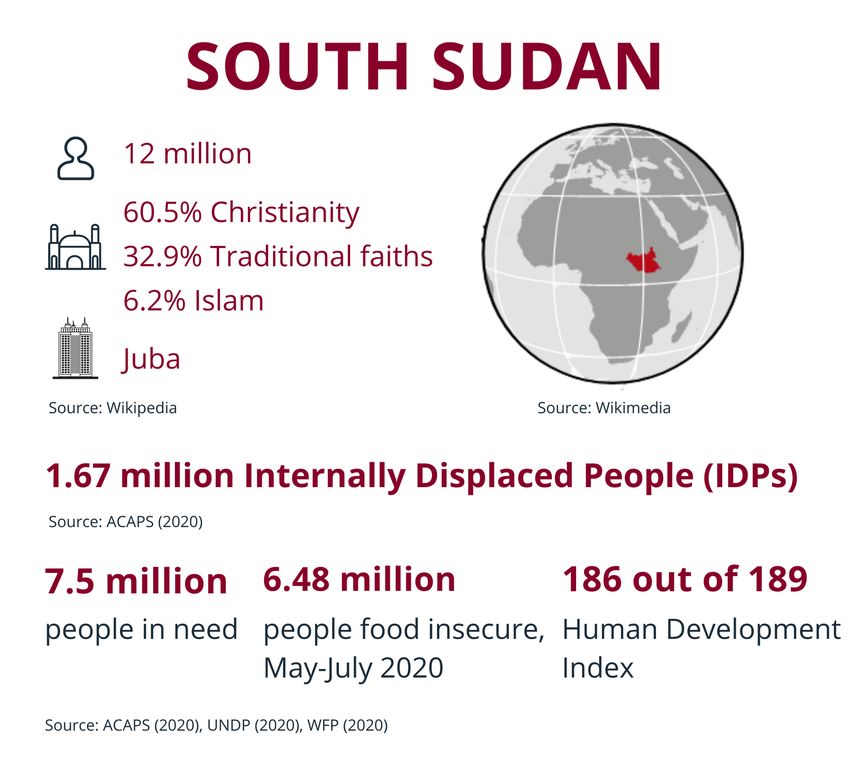
The Triple Nexus in South Sudan

Abstract

                                                                                   THE TRIPLE NEXUS
South Sudan is a poignant case study for understanding the opportunities
as well as the more controversial ideas within the Humanitarian-Develop-
ment-Peace Nexus. The characteristics of the protracted crisis in the country,
its root causes and the long-standing experience with a pragmatic, integrated
approach on community level make the Triple Nexus for local actors an inter-
esting way forward. While an integrated Triple Nexus approach poses risks of
                                                                                   IN SOUTH SUDAN
instrumentalising humanitarian action, humanitarian actors do not perceive
humanitarian principles to be in danger in South Sudan. The call for more
locally-led humanitarian action and the related localisation processes are
further reasons to take the Triple Nexus idea seriously in this context where
                                                                                   Learning from Local Opportunities
international agencies can learn from local actors and the latter’s capacities.
A Triple Nexus approach in South Sudan provides substantial potential given
that a series of criteria are met which further CHA research has identified as
relevant for analysing in which local contexts the Nexus can result in a helpful
overcoming of silos: With local ownership, local capacities, a peace-related
UN approach and limited external security interests in place, South Sudan
has the potential to become a concrete example of action in the so far rather
abstract Triple Nexus debate. However, an identified ‘triple donor paradox’
might represent a major obstacle to progress, with donors promoting a Triple
Nexus approach while keeping budget lines in silos, inflexible and limited.        Martin Quack and Ralf Südhoff

                                                                                   October 2020

                                                                                                                                                     3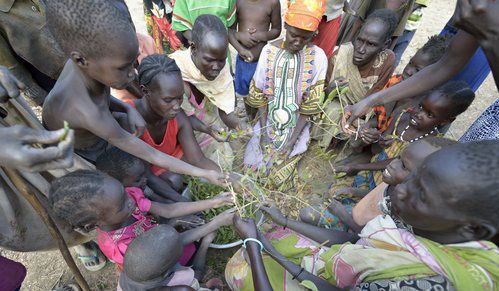
The Triple Nexus in South Sudan

                   1. Introduction
                   Few debates on international cooperation currently generate as much mo-
                   mentum and controversy simultaneously as the discourse around the Triple                                                    A
                   Nexus. However, the discussion on better cooperation embedded within the
                   framework of a 'Humanitarian-Development-Peace' Nexus remains mostly
                   abstract and theoretical. The lack of analysis and debate on the Triple Nexus
                   from a practical perspective is striking both in German-speaking countries as
                   well as in the international arena.
   The lack of
  analysis and     The Centre for Humanitarian Action (CHA) has therefore dedicated one of its
                   three priority areas in its work plan (2019-2021) to the analysis of the ´Triple
 debate on the     Nexus in Practice´. So far CHA has issued an introductory paper (Hövelmann
  Triple Nexus     2020b), a policy brief on the CHA Triple Nexus analysis model (Südhoff et
                   al 2020), while undertaking studies on three very different country settings
from a practical   making them relevant due to their specific as well as representative char-
 perspective is    acteristics: Pakistan (Hövelmann 2020a), Mali (Steinke fortc.) and, with this
    striking.      paper, South Sudan.

                   Both in the interplay of these three country studies, as well as in its stand-
                   alone analysis, South Sudan is a particularly interesting and yet so far under-
                   exposed example within the Triple Nexus debate:

                   South Sudan is representative of a multitude of different crises and shocks.
                   Continuous conflict has driven millions of people into a state of poverty and
                   hunger has reversed developmental gains and made humanitarian needs
                   escalate in cycles. In addition, regular weather disaster like droughts and
                   floods, as well as the high developmental needs resulting from the establish-
                   ment of South Sudan as an independent state in 2011, have further contrib-
                   uted to the country´s millionfold people in need. These humanitarian chal-
                   lenges could only be overturned by obtaining sustainable progress on both
                   peace and development issues – while vice versa the so far predominantly
                   humanitarian response could in theory contribute to faster progress on the
                   development and peace sides by an integrated Nexus approach.

                   At the same time, in South Sudan the interplay of peace, development and
                   humanitarian issues is far less impacted by external, for example, European
                   security- or migration-related policies, as it can be noticed, for instance, in
                   Mali (Steinke fortc.) or other countries in the Sahel and Mediterranean re-
                   gions. Moreover, Nexus-relevant policies and agendas are neither heavily im-
                   pacted by a strong, dominant state compromising civil society actors’ space
                   in this field, as, for example, in Nigeria or Pakistan (Hövelmann 2020a).

                                                                                             Figure A:
                                                                             Infographic South Sudan.
                                                               Source: Centre for Humanitarian Action.

                   4                                                                                                                       5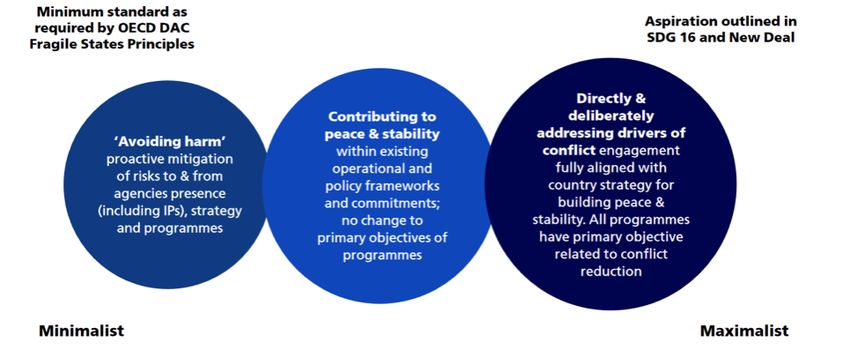
The Triple Nexus in South Sudan

                      Hence, in South Sudan the approaches and perspectives of essential local          Most importantly, the implementation and operationalisation of the Triple
                      civil society actors have more scope to come into play, including their inter-    Nexus in practice as well as the conceptualisation of the ‘peace’ element re-
                      action with international aid organisations, a fairly noncontroversial UN mis-    main rather vague. While some organisations are taking a pragmatic lead
                      sion, and international donors with limited strategic interests in the country.   to implement Triple Nexus projects, neither a common definition of what
      All these       Besides, the limited pronounced interests of the international community in       peace means in these contexts exists, nor of ‘peace-related approaches’
                                                                                                                                                                                                 On a practical
    facets make       South Sudan also make it an interesting case to study how this reflects on the    which range from conflict reconciliation programmes to indirectly related                level, thus far
    South Sudan       common donor rhetoric in favour of an integrated Nexus approach and ac-           programmes on education, social cohesion or economic opportunities. At                   the discourse
                      cordingly needed integrated donor policies, or whether contradictions arise.      times also a blurring of concepts between peacebuilding, security, and sta-
   hypothetically                                                                                       bilization can be noticed: While many civil society actors understand peace              is limited and
  representative      All these facets make South Sudan hypothetically representative and an in-        as a community-level reconciliation or coherence process, states or donors                 oftentimes
                      structive case-study for examining the risks, as well as the opportunities at-    may take a broader interpretation including security, counterterrorism, and
and an instructive    tributed to an integrated Triple Nexus approach:                                  stabilization (Südhoff, Hövelmann, and Steinke 2020).
                                                                                                                                                                                                evolving around
   case-study for                                                                                                                                                                                humanitarian-
   examining the      While the Triple Nexus is not a completely new concept (Mosel and Levine          In short, on a theoretical level the Triple Nexus is associated with great ex-           development
                      2014; Macrae 2019; Macrae and Harmer 2004; Kocks et al. 2018), it is rooted       pectation and concern by a wide range of actors, while the debate remains
  risks, as well as   since 2016 in two policy approaches which have gathered a lot of momentum:        fairly abstract and characterised by vague and diverse understandings and                 issues only.
the opportunities     the New Way of Working, initiated by the United Nations (UN) and the World        definitions. On a practical level, thus far the discourse is limited and often-
                      Bank (WB), as well as the Grand Bargain, a set of commitments to reform the       times evolving around humanitarian-development issues only, which have
  attributed to an    humanitarian system, emerging from the World Humanitarian Summit 2016.            been discussed for decades in the context of Dual Nexus approaches, while
 integrated Triple                                                                                      neglecting the ‘peace’ leg and peace actors’ perspectives. This paper intends
Nexus approach.       The Humanitarian-Development-Peace Nexus as a policy concept envisions            to make a contribution to closing said gaps by sharing a concrete and par-
                      a stronger collaboration and coordination among actors from the fields of         ticularly relevant country example from South Sudan. The study relies on
                      development cooperation, humanitarian action and peacebuilding (OECD              desk research, secondary literature review as well as interviews and direct
                      2019). With this approach, the international community has identified a need      observations conducted in South Sudan in October 2019.
                      for an interlinked, systemic approach to deal with the overburdened aid sys-
                      tem. In times of escalating crises, increasingly protracted conflict, and large
                      numbers of people on the move, the pressure to achieve better outcomes
                      by working in a more integrated, effective and efficient way is high. Recurrent
                      and frequent weather-related disasters, as well as the fact that 80% of hu-
                      manitarian funding is channeled into regions of protracted conflicts (Churru-
                      ca Muguruza 2015, 20), highlight the challenge of dealing simultaneously with
                      recurrent humanitarian emergencies, development backlashes and settings
                      of war and conflict.

                      At the same time, the Triple Nexus approach and its operationalisation are
                      discussed controversially (DuBois 2020). While some regard it as a long over-
                      due reform to siloed approaches, others see the Triple Nexus as a threat
                      to impartial and neutral humanitarian action. They caution that humanitari-
                      an assistance could be politicized by peace or security actors, resulting in a
                      loss of independence as well as impartiality. This, alongside compromising
                      adherence to the core humanitarian principles, could negatively affect the
                      respect of their needs-based humanitarian work and their ability to negotiate
                      for access. Similarly, subsuming humanitarian action into broader (state-led)
                      frameworks may risk undermining humanitarian space and principles in con-
                      texts where the state or the UN might be perceived as conflicting party.

                      6                                                                                                                                                                     7
The Triple Nexus in South Sudan
2. Country Background
The Republic of South Sudan gained independence from Sudan following a
referendum in 2011. In spite of hosting around 75% of former Sudan’s to-
tal oil reserves, the country’s development needs have been immense from
the beginning while it faces considerable humanitarian challenges which have B
periodically increased since the violent escalation of the domestic conflict in Gedaref
December 2013. SOUTH SUDAN
El Fashir Wad Medani
Singa
"It is South Sudan’s President Salva Kiir accused his former Deputy Riek Machar Undetermined boundary
and Machar’s supporters of attempting a coup d'état, and the resulting fight-
unacceptable for ing led to a civil war. After several waves of conflict, a revitalised peace agree-
Abyei region
South Sudanese ment had been signed in 2018 by President Kiir, Deputy Machar and several
armed groups. However, crucial issues had not been solved and agreed time- SUDAN
to continue lines for its implementation were broken in the follow-up.
bearing the
In February 2020, the leaders of the two main parties to the conflict agreed
burden and on a fragile deal. A national unity government has been formed and a cabinet
consequences established. Regarding the conflict about the number and the formation of
Malakal
states, it has been agreed to divide the country into 10 states, two administ-
of this conflict rative areas and one area with special administrative status, while integrating
Bentiu
including military forces. However, until September 2020, cabinet meetings have been Aweil
impunity, rape, held irregularly and “almost no movement” on security sector reform is noted. ETHIOPIA
² At the same time, the Transitional National Legislative Assembly has yet to be Kuacjok
severe hunger, Wau
reconstituted, which is delaying progress on the Constitution.³
displacement and CENTRAL
Thus, local experts like James Okuk from Juba-based think tank Center for Rumbek
almost complete AFRICAN Bor
Strategic Policy Studies judged: "The revitalization of the peace agreement
lack of services." has not progressed as expected and the two years have been wasted […]." ⁴ REPUBLIC
The Women Monthly Forum, a pressure group of South Sudanese peace ad- Yambio Juba
vocates criticized: "It is unacceptable for South Sudanese to continue bearing
the burden and consequences of this conflict including impunity, rape, severe Torit
hunger, displacement and almost complete lack of services".⁵ According to Administrative
observers, ongoing high regional and international pressure will be necessary boundary
to implement the agreements (International Crisis Group 2020). DEMOCRATIC REPUBLIC UGANDA KENYA
Ongoing conflict and insecurity result in an escalating humanitarian crisis and OF THE CONGO
significantly increasing needs.⁶ The legacy of civil war and chronic underdeve- 100 km
lopment heavily impact the ability of the new nation to provide basic services
Map Sources: UNCS, SIM, Natural Earth.
and to respond to humanitarian needs, while South Sudan ranks 186 out of The boundaries and names shown and the designations used on this map do not imply official
the 189 countries on the Human Development Index (UNDP 2019). Many endorsement or acceptance by the United Nations. Final boundary between the Republic of
communities are vulnerable to the effects of insecurity, displacement, food Sudan and the Republic of South Sudan has not yet been determined. Final status of the
shortages and outbreaks of disease. In September 2020, more than 7.5 mil- Abyei area is not yet determined. Map created in Jan 2012.
lion people were in need of humanitarian assistance, a level close to what was
seen in 2017 when a famine hit the country. Recent flooding affected another
500,000 citizens, while official numbers on COVID-19 cases are fairly low, with
2,578 cases being recorded as of September 2020.⁷ However, testing capacity
is very limited and the virus produces social stigma, therefore incentives for
Figure B.
Map South Sudan.
Source: OCHA 2012.
8 9The Triple Nexus in South Sudan
downplaying cases might play a role in these statistics. Besides, the assumed between different rebel movements – mostly mobilised along ethnic lines –
indirect impacts of the pandemic like “disruption to vaccinations, maternal from the independence war. Aid agencies are closely linked to this conflict
health services or routine treatments for curable diseases like malaria, diarr- level because they are often engaged in providing basic services.
hoea and pneumonia will result in a devastating increase in deaths”.⁸
3. Community conflicts over resources: Many communities in South Su-
At the same time, South Sudan remains “one of the most dangerous places in dan are strongly affected by local-level conflicts over resources like water,
the world to be an aid worker” and access is often not granted: In 2019, seven grazing areas and land. These conflicts are partly fuelled by gender norms
aid workers were killed and another 144 evacuated as a result of threats to that associate masculinity with success in warfare, community defence and
their security, while aid supplies have been looted on at least 17 occasions.⁹ cattle raids. Historically, the chiefs were responsible for adjudicating disputes
within and between communities. However, their authority has diminished
In sum, the humanitarian crisis in South Sudan is the result of multiple inter- because the traditional forms of justice hardly keep pace with the scale of
acting factors, with conflicts being a crucial root cause next to weather-related violence. Furthermore, the chiefs themselves may not be responsive to the
disasters such as droughts or floods, of which humanitarian action can only needs of different groups and they are not always neutral arbiters as they are
alleviate some symptoms. As in other crises, development and peacebuilding politicised or benefit from violence. Community-level conflicts become even
efforts are necessary to prevent and address the root causes of humanitarian more problematic across ethnic lines, especially if they are manipulated by "There is a
needs, which raises the question of appropriate linkages in a Triple Nexus political or military elites. In these cases, community level conflicts can play a conspiracy on
approach to bring together actors from humanitarian action, development critical role in sustaining national level conflict. Aid agencies are often affected
cooperation and peacebuilding. those three
by these conflicts in their projects, and vice versa can have an impact on the
To analyse its potential in South Sudan it is key to distinguish various levels dynamics depending for example on conflict sensitive programmes and a sys- elements."
of conflicts in the country, as well as the different concepts of peace and se- tematic “Do No Harm” approach’ (CSRF 2017, 5–6).
curity in a Triple Nexus context. These links between the different levels of conflict were confirmed by re-
search for this article and in interviews with various stakeholders: “There is a
conspiracy on those three elements”, a UN representative analysed. “We have
Levels of conflict in South Sudan the conflict on the top level”, an INGO leader said, but it is impacting at the
community level by enforcing for example conflicts over natural resources like
It is important to differentiate at least three different levels of conflict which water and pastures in land where farming opportunities are already limited.
have characterised South Sudan’s conflict dynamics for decades. The three Whilst on the other side, fights along ethnic lines on the community level can
levels are inter-linked: what happens at one level can impact on conflict at feed into the national conflict, and “young people joining forces provide hu-
It is important others. The reputable locally-based Conflict Sensitivity Resource Facility (CSRF) man resources on higher levels.”
analyses the three key levels in the following way:
to differentiate On the positive side, said interdependence can create both reenforcing con-
at least three 1. Elite political-military competition over the state: South Sudan (and flict dynamics as well as opportunities to break vicious cycles. Accordingly,
Sudan before that) has a history of military contestation for the state. This has some actors have the potential to impact on various levels, for example, “chur-
different levels created a tendency for zero-sum and militarised politics with shifting allian- ches whose massive coverage can influence this”10 due to their broadly held
of conflict ces between different leaders. The control of the oil fields is a key asset for legitimacy and relatively low levels of corruption when compared to govern-
any faction because they are the main source of income for the state. Politi-
which have cal negotiations and international interventions to resolve this conflict over
ment authorities on various levels. The same legitimacy is also held by traditio-
nal and other religious leaders as well as civil society organisations as they are
characterised the state have tended to focus on elite level power-sharing. South Sudan’s crucial to “create trust between communities, as well as between government
South Sudan’s neighbours are heavily affected by the conflicts, while they have political and agencies and citizens, and open up space for dialogue and political discourse”
economic interests in the country and have been involved in South Sudan’s on all levels (Maihack and Reuss 2019).
conflict dynamics conflicts in different ways. Individual aid agencies rarely directly influence this
for decades. macro level conflict.
2. Citizen-state conflict: South Sudan provides few services such as educa-
tion or health care to its citizens which therefore perceive their state as ab-
sent. The local authorities and especially local chiefs serve as their main inter-
face with the state but only a very small percentage of resources reaches the
county or community level. People feel that it is necessary to have a commu-
nity member in a position of power to get access to state resources. Groups
which are under-represented in government therefore feel marginalised. In
addition, the country’s political system suffers from the legacy of antagonism
10 11The Triple Nexus in South Sudan
Looking beyond internal conflict dynamics, South Sudan has a history of fo-
reign engagement related to relief as well as to peace and security. These
interventions have mainly addressed the macro-level conflict (Agensky 2019),
with the UN and the ‘Troika’ states (USA, Norway and the former colonial
In order to power UK) having been particularly engaged. On the regional level, the In-
tergovernmental Authority on Development (IGAD: Djibouti, Eritrea, Ethiopia,
understand the Kenya, Somalia, and Uganda) and the African Union (AU) are exerting their C
South Sudan influence. At the same time, major Western donors like the German govern-
ment have a very small embassy and representation in South Sudan with only
set-up, the role of four German staff members, limiting its political engagement.
the UN mission
In order to understand the South Sudan set-up, the role of the UN mission is
is key. also key. The United Nations Mission in South Sudan (UNMISS) was establis-
hed by the Security Council in 2011 with South Sudan’s independence (before
it was the United Nations Mission in Sudan – UNMIS). UNMISS mandate is
“to consolidate peace and security, and to help establish the conditions for
development in the Republic of South Sudan”.11 In August 2020, it encompas-
sed around 14,000 soldiers, 1,750 police officers as well as around 560 civil
experts and staff.12
UNMISS’ peace and protection mandate proved to be crucial when civil war
broke out in December 2013 and many people sought refuge particularly in-
side the UNMISS bases. These so-called ‘Protection of Civilians’ (POC) sites
probably saved tens of thousands of lives (Briggs 2017). While UNMISS might
phase out its POC role in the foreseeable future given the improved security
situation, in September 2020 there are still more than 181,000 civilians living
in POC sites.13
Moreover, today UNMISS is acting as a peace mediator, by engaging in pro-
jects and negotiations, as well as a donor in its relatively new role in coordi-
nating The South Sudan Reconciliation, Stabilization, and Resilience Trust Fund
(RSRTF, see chapter 3).
An understanding of the role and engagement of the UN mission in diverse
areas like military engagement, peacebuilding, reconciliation, protection and
Trust Fund management is crucial for conducting a Triple Nexus analysis in
South Sudan. This is particularly significant considering the UN’s substantial
engagement in peace- and security-related matters (see the box below to
understand the difference between these two terms).
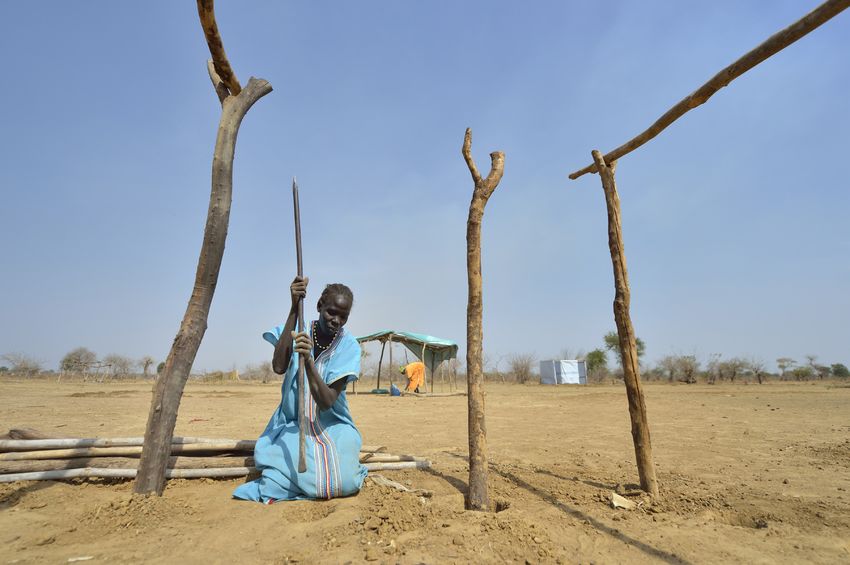
Figure C.
A woman digs holes as she begins the construction
of a shelter in the internally displaced persons
camp in Turalei, South Sudan.
Source: Paul Jeffrey/ Diakonie Katastrophenhilfe.
12 13The Triple Nexus in South Sudan
Different logics of peace and security
On the contrary, many local NGOs in South Sudan come from a Triple Ne-
The terms ‘peace’ and ‘security’ are often used interchangeably, but, according xus-oriented practice and tradition, and consider a peace-integrated ap-
to Birckenbach (2012), it is essential to clearly differentiate both concepts. proach as an obvious and pragmatic choice. A recent study on faith based
1. Peace at its core is an inclusive concept (‘peace with someone’), which is local actors in South Sudan highlights the latter’s approach to have worked
based on trustful relations. for many years in an integrated way on the community level targeting peace
building, development goals and humanitarian issues at the same time. Only
2. Security at its core is an exclusive concept (‘security from someone or so as they have internationalised, local actors have been asked by partners and
mething’), which is based on the defence against external threats. donors to work in silos, leading to the implementation of humanitarian-only,
development-only or peace-only projects. Now, to them the Triple Nexus is
Peace and security are both very important objectives, but they entail very
different logics of action:
presented as a new trend proposing a way of working that many local actors “Here in
have previously practiced. Therefore, many local actors appreciate the Nexus
approach (Wilkinson, de Wolf, and Alier 2019, 14). South Sudan
Peace: Building trustful relations – peacebuilding – includes a reflection about
the own role and responsibility for existing problems, tensions or violence. is a different
When speaking under condition of confidentiality, these local civil society
By reducing violence and increasing justice and trustful relations, the ‘logic of views have also been mirrored by some authorities. Interviewees stated that situation. We
peace’ can reduce perceived threats based on a long-term perspective. “there is a need to integrate peacebuilding” in aid work, and they see the compromised
Triple Nexus as “an opportunity”. Even an interviewee from a government
Security: The defence against perceived threats typically locates the respon-
authority advised to “listen to local people, not politicians” because “we have on humanitarian
sibility for the threat (and potential violence) externally. The ‘logic of security’
entails a high risk of escalation and takes a rather short-term perspective, political people here who are very toxic” and who instrumentalise the local principles but
while it is a basic human need and must be taken very seriously. communities. with no harmful
One way of balancing peace and security is to set the ‘logic of peace’ as the Even controversial challenges to the Triple Nexus such as the blurring of lines impact on the
in particular between impartial humanitarian action and more political are-
overarching principle, and to try to keep the ‘logic of security’ as narrow as
nas, such as development and peace, are handled in a fairly pragmatic way
humanitarian side
possible in order to not exacerbate the initial problem.
in South Sudan. Surprisingly, in one of the most sensitive fields of interaction, so far.”
civil-military cooperation, many local actors take a pragmatic approach. For
example, in the POC sites humanitarian assistance is provided by all kinds of
NGOs, including Médecins Sans Frontierès (MSF) or German Welthungerhilfe,
3. The Triple Nexus in South Sudan – under permission and protection of UNMISS military.
opportunities, capacities and risks
As an INGO country director of an agency, which is internationally rather criti-
3.1. Civil society perspectives cal of the Triple Nexus, pointed out, “Here in South Sudan is a different situa-
tion. We compromised on humanitarian principles but with no harmful impact
on the humanitarian side so far.” Comparing the country with settings like
In Western capitals, civil society actors often perceive the Triple Nexus as an Somalia and Afghanistan he underlined that “there we had no UN relations at
initially UN and donor-driven agenda which often raises the question of who- all, also for our own safety as they have been a target. Here we attend country
se interests it might serve. Interestingly, among civil society actors in South team meetings hosted by OCHA and the Humanitarian Coordinator, share
Sudan there is substantial support for a Triple Nexus approach both from information and it is helpful for us.”
local and international NGOs. “If there is no peace, we can’t even work“, said a
South Sudanese NGO manager. “It is unavoidable to integrate peacebuilding As an example of fruitful cooperation, civil society actors shared the experien-
and elements of resilience into the humanitarian response”, remarked a staff ce of effectively dealing with gender-based violence, a widespread challenge
member of an INGO. As the conflict is protracted, “it is a must to have this in South Sudan. When a health-related INGO shared information of rapidly
Nexus.” Some international aid workers even underlined that “a peace com- escalating numbers of abuse cases in one hospital, UNMISS substantially ex-
ponent would be fantastic.” panded patrols in the region and numbers went down rapidly.
A push for more both local and international peace engagement as well as The pragmatism of civil society actors is mirrored by a pragmatic multilevel
developmental engagement in South Sudan has been a common narrative role of UNMISS potentially blurring mandate lines by its broad activities in
in interviews. Local actors hardly associate the Triple Nexus with a Western protection, peace, security, humanitarian and donor-related roles.
agenda or a donor-driven policy following a security or migration policy-domi-
nated framework. While more than 2.2 million South Sudanese have fled to
neighbouring countries, it is neither a major origin of migration to Europe nor
a migration hub. “We don’t feel pressed towards the Nexus, so far it is rather
a buzzword”, an INGO Country Director indicated.
14 15The Triple Nexus in South Sudan
3.2. The UN mission’s role
For many aid practitioners the mixed roles of UNMISS in South Sudan is not
very controversial. They consider UNMISS as strategically positioned, better
resourced and more neutral than domestic institutions. UNMISS is neither of-
ficially a ‘stabilisation mission’ nor under suspicion of serving mainly Western
D
security interests.
While due to UNMISS` major protection role, in particular in POC sites in the
past, it has been considered at times as being rather “pro-opposition”. For
civil society actors this is not a major issue today and most aid agencies co-
“UNMISS operate with the mission. “UNMISS is doing a lot of mediation work”, an INGO
is doing a lot of staff member stated appreciatively. A government representative also added
when guaranteed anonymity that “there is not much cooperation with the
mediation work.” government, while the mission is seen as a protection force”, and the mission
does “good work in this field”. Accordingly, analysts count on UNMISS as a
credible player, for example, with respect to protection of opposition leaders
in the capital Juba in times of ongoing peace deal negotiations (International
Crisis Group 2019).
The UN mission has another specific role in South Sudan, as it is co-managing
a relatively new fund, The South Sudan Reconciliation, Stabilization, and Resilien-
ce Trust Fund (RSRTF). It has the objective “to provide strategic financing to in-
tegrated programmes that together lessen the destructive drivers of conflict
and develop more peaceful and, ultimately, self-reliant communities”. It aims
at durable intra- and inter-community reconciliation and stable environments
in which communities can engage constructively on resilience. Through an
area-based programming approach, the RSRTF brings together UN agencies,
NGOs and UNMISS to collectively work with communities and is sometimes
informally called “the UNMISS Fund”.
The fund consists of three essential elements which are there to lessen the
destructive effects of the conflict and contribute to more self-reliant and pea-
ceful communities:
Reconciliation: Restore trust and support peaceful coexistence and social cohesi-
on through gender and age sensitive communal conflict management, prevention,
mitigation and reconciliation.
Stabilization: Deter violence, restore security, and reinforce the rule of law and
equitable access to justice, supported by strategic use of existing peacekeeping ca-
pability.
Resilience: Invest in community capacities and resources and promote equality,
agency and self-reliance to meet basic needs sustainably without reliance on exter-
nal assistance.15
Figure D.
Hungry people eat leaves of the lalob tree in a camp for
internally displaced people in Manangui, South Sudan.
Source: Paul Jeffrey/ Diakonie Katastrophenhilfe.
16 17RSRTF at a glance
Upper Nile
Malakai
Bentiu
Bahr El
$14.4m
Northern Ghazal
The general idea of the Triple Nexus is clearly articulated for the RSRTF:
Aweil Kuajok
Warrap
Unity
2019 Contributions Wau
“In South Sudan’s fluid and fragmented context, the notion of a linear continuum
Western Bahr
El Ghazal Lakes
Jonglei
or transition from conflict and acute humanitarian need to reconciliation, reco- Rumbek
Norway $6.2m
Bor
very and development is unrealistic. The complementary elements supported by Western Central
Equatoria Equatoria
the Fund aim to enable more flexible and adaptive programming responsive to Yambio Juba
Eastern
Equatoria
the inevitable shifting dynamics of the context, resulting in changeable sequencing Germany 5.5m
Torit
and gradations of the three RSR elements over time as changing circumstances Peace linkages sites
dictate.” 16 Sweden $2.7m
“Though donors RSRTF programme areas
put money RSRTF so far has allocated $25.4 mio funded by the governments of Germany,
into UNMISS
Sweden and Norway, while key implementing partners are three UN organisa- $25.4m $11.2m
tions and five NGOs (see graphic). 2018–2020 contributions Allocations
hands, there “Though donors put money into UNMISS hands, there is no relevant discus-
is no relevant sion about humanitarian principles”, an INGO representative said. “NGOs are
discussion about quite happy with the way the fund is handled”, another INGO leader indicated.
Civil society actors are also represented in its consortium, and agencies ap- Germany $11.2m
humanitarian preciate its flexibility: “It is also a flexible approach to get out of the silos and
principles.” pitching it you really need to hit all three areas.”
UN 50%
Another Triple Nexus and UN-related fund is The Partnership for Recovery and Sweden $8m
Resilience (PfRR)’, by which a group of donors, UN Agencies and NGOs aim at NGOs 50%
“working together to reduce vulnerability and increase the resilience of peo-
Norway $6.2m
ple, communities and institutions in South Sudan on their way to achieving
the Sustainable Development Goals.”17 The PfRR framework highlights local 8
ownership, a commitment to peace and recovery, and a conflict sensitivity Implementing organizations
“across the humanitarian-peace-development nexus/continuum in line with 3 3 United Nations entities: UNMISS, FAO, IOM
the ‘New Way of Working’”.18 Projects supported 5 International NGOs:
World Relief, CARE, Mercy Corps,
As both initiatives are relatively new instruments, it needs to be seen how Danish Refugee Council and World Vision
they materialise on the ground and how UNMISS’ role as a donor will evolve. 2 area-based projects:
Both RSRTF and PfRR focus on area-based programming, i.e. using not only Koch County (Unity) $0.6m
Tonj, Gogrial, Wau Thematic
needs-based criteria as humanitarian action should according to the principle (Western Bahr El Ghzal,
Warrap) programming
of impartiality, as it has been criticised by some humanitarian actors.19 At the
1 thematic project:
same time INGOs apply for the funds, and these are often mentioned by civil Civic participation
$10.6m
society actors as practical expressions of the Triple Nexus in South Sudan. and governance Area-based
multisectoral
A view shared by operating UN agencies in South Sudan, who consider the programming
Triple Nexus as a natural part of good programming if done in an appropriate Executive summary | 5
way.20
Figure E.
RSRTF at a glance.
Source: 2019 Annual Report South Sudan
Reconciliation, Stabilisation and
Resilience Trust Fund.
18The Triple Nexus in South Sudan
3.3. Local capacities
Above a fairly broad agreement has been analysed that key actors in South On the operational side, the substantial capacities and experience of faith-ba-
Sudan see in principle potential for a fruitful Triple Nexus approach. But how sed actors have also been highlighted: “Catholic Relief Services, for example, is
does this correspond with local actors’ capacities and respective roles? really well-based on local level, they know all counsellors, know who to invite,
While the UN’s role in is perceived as rather uncontroversial and supportive
and do, for example, large cash programs in a very conflict-sensitive way”, “They are there
an INGO Country Director praised, while highlighting the basis for such an
to peace efforts in the country, there is broad consensus that local actors are for 50 years and
The importance the basis for achieving peace in South Sudan on various levels of conflict. For
impact: “They are there for 50 years and have tea with everybody every other
day.” have tea with
of local actors humanitarian actors, “the key to peacebuilding is to work with local actors“,
as an INGO interviewee underlined. Local actors are crucial as they have the Faith-based actors bring in an additional element to humanitarian action, de- everybody every
is recognised
in-depth understanding and insights of specific local and conflict related con- velopment and peacebuilding: spiritual aspects of life and the need for spiri- other day.”
by international texts and as another interviewee put it: “The three most important issues for tual support in all three sector, “the other side of human being” (Wilkinson, de
actors who are aid programming are: context, context, context.” 21 Wolf, and Alier 2019, 21). Spiritual aspects are particularly relevant in psycho-
social responses in conflict-driven South Sudan and beyond, for example to
confident in the The role of local (and in general domestic) actors has been in the focus of the heal trauma.
capabilities and ‘localisation’ debate in the humanitarian sector. Accordingly, for humanitarian
actors there is a close link between localisation and peacebuilding. Local ac- However, while humanitarian-development, as well as development-peace
experience of tors are closer to the people in need and to the relevant conflict parties (proxi- programs take place to some extent, humanitarian-peace work is conceived
local actors in mity). They can have different kinds and sometimes higher levels of credibility by international actors to be most challenging, as humanitarian principles
and legitimacy (for example, trust is particularly important for peacebuilding), might be at odds with the potentially political nature of peacebuilding and
South Sudan. and some of them can work on different levels of society, including the com- the potential lack of neutrality of local actors. With respect to South Sudan,
munity level. Several interviewees pointed out that aid agencies cannot influ- some interviewees indicated: “Groups are usually so rooted in specific ethnics
ence macro-level issues, but against this backdrop solutions must come from or local roots that you always need to balance”, an INGO Country Director
the community level. indicated. This can have also very practical impacts, an INGO staff member
underlined: “To partner and work locally is a chance to build relations, while
The importance of local actors is recognised by international actors who are it comes with challenges”. Mere contracting relations can illustrate such chal-
confident in the capabilities and experience of local actors in South Sudan. lenges; as an NGO representative confessed, even tenders cannot always be
“In villages often structures are there, conflict mechanisms are there and its done properly: “If a contractor from the West wins a tender for implementing
working”, an INGO leader appreciated. “South Sudan has a history of strong a project in an Eastern region, we know before he won’t be able to do it, as he
NGOs, as INGOS did not have access”, another INGO Country Director emp- won’t be accepted”.
hasized, ”and once you get routine to work together, it is fine”.
While this is a concern often raised well beyond the South Sudan context, for
These views have also been confirmed by recent research focussing on domestic actors the humanitarian principles might play a different role than
faith-based actors in South Sudan (Wilkinson, de Wolf, and Alier 2019). Wilkin- for international ones (Schenkenberg 2018, 65–68): Humanitarian principles
son et al. (2019) note that many local actors work in multi-sectoral, integrated of independence and neutrality can also be seen as instruments to leverage
programs, often incorporating humanitarian, development, and peace activi- access to people in need and achieve the principle of impartiality, which is of-
ties that constitute the Triple Nexus approach. Many local actors are engaged ten considered as the core of humanitarian action. If local actors have access
in peacebuilding, including INGO-related bodies, such as the Nonviolent Pea- and reach those most in need, the principle of neutrality might be less import-
ceforce (NP). Examples of activities on the community level include training in ant (Slim 2020). For South Sudan, such an approach has been confirmed, for
alternative coping mechanisms for food security and in mediation to prevent example, in interviews with both an INGO and a UN agency which consider
cattle raids, as well as cash transfers which enable people to pay off their that balancing partners with different allegiances could be a way of dealing
debts and reduce violent coping mechanisms (Wilkinson, de Wolf, and Alier with the principle of neutrality.
2019).
The crucial role of particularly faith-based actors in South Sudan has been
underlined by further research regarding the macro level of conflict as well as
judgments from an operational perspective by interviewees. Thinking of a “re-
ligion-governance interface calls attention to the unique ways religious agency
impacts the ‘Peace-Humanitarian-Development Nexus’” in South Sudan and
other African countries (Agensky 2019, 293; Moro 2015). Regarding the vari-
ous levels of conflict, a representative of a non-faith-based INGO underlined:
“International church agencies already work with domestic churches […] and
actors with such massive coverage like churches can influence this”.
20 21The Triple Nexus in South Sudan
The potential of local-level capacities for a Triple Nexus in South Sudan can be need a closer examination. Some question its truly peace-related content
further underlined when looking at the different levels of conflict: On the local due to a widespread pattern of re-labelling pre-existing activities. Some in-
community level, various kinds of peace initiatives can be identified, while con- terviewees confirmed that a lot of “re-labelling” is taking place, highlighting for
flicts on this level are impacted but not fully dependent on the other conflict example that “every market opened in the country is now a ‘peace market’”.25
levels. At the same time, the community level is often not considered enough
by donors and aid agencies. “People don’t look into those initiatives, although Moreover, the scope of operational UN agencies and their partly untapped
they can be more sustainable than on the macro level”, an INGO staff mem- potential has been emphasised with regard to the Triple Nexus. As an INGO
ber stressed. For instance, such initiatives can lead to cooperation on an aid Country Director put it, the WFP, for example, expands its conditional assis-
transportation cross line, agreements between chiefs or other reconciliation tance by linking nutrition training with cash assistance, but the impact could
measures. Moreover, while aid organisations rarely influence the macro-level be broader by joining forces with the Food and Agriculture Organisation (FAO)
conflict, many aid workers agree that they should engage in peacebuilding to link humanitarian support and agricultural output.
at lower levels: “We have to work directly on it, otherwise we don’t create the Even if one looks at the baseline of operations in conflict settings, to ensure
necessary pressure [at the macro-level].”23 conflict sensitivity and Do No Harm as guiding principles and tools, various
Aid practitioners point out additional links between the levels of conflict and interviewees admitted that “there is a lot of box ticking ongoing” versus real “There is a lot
the related Triple Nexus arenas in South Sudan: For example, as long as com- analysis.26 of box ticking
munities have sufficient resources (harvest, communal dams, etc.), the local Moreover, most aid programmes in South Sudan are so far rather stuck in hu- ongoing.”
mechanisms to deal with conflicts work rather well. But when basic means manitarian efforts and even struggle to re-switch to development approaches,
or services by the state are not provided, and result in pushing people to let alone to integrate peace efforts. While this is partially related to inflexible
the brink of famine or extreme poverty, conflicts easily escalate. Therefore, donor policies (see 3.4.), it needs to be noted that investments in know-how
“linking, for example, assistance with material resources and peacebuilding and staff capacities are needed. This is even more true as the South Sudan
efforts” can gather substantial momentum in a Nexus-related way, if it is done context also offers Triple Nexus-related potential with respect to facilities and
in a sustainable and appropriate manner.24 know-how, as the issue of conflict sensitivity can shed light on (see box).
INGO capacities
Untapped capacity potentials -
A broad consensus on the substantial capacities and capabilities of local civil
society actors and, in particular, faith-based actors in South Sudan for imple- the example of Conflict Sensitivity
menting a Triple Nexus approach has been outlined above. It needs to be no-
ted that so far international NGOs do not match these profiles, though many
consider a Triple Nexus approach an opportunity, if not a must in the country. Humanitarian assistance or development assistance delivered in such a com-
plex, highly contested and conflict-affected context like South Sudan is not
“The Triple Nexus One INGO even reported to having been approached by local partners to
only strongly influenced by conflict dynamics, but aid has an impact on tho-
engage jointly in a Triple Nexus project but had to turn down the offer due to
is a good chance a lack of capacity. se conflict dynamics as well. These impacts may be direct or indirect, inten-
to combine tional or unintended, and conflict easing or enforcing. Conflict sensitivity is
“The Triple Nexus is a good chance to combine efforts, and we should do an approach that helps humanitarian and development actors maximise the
efforts, and we much better on this. But we don’t have the expertise, we would not know whe- potential positive and minimise any potential negative impacts of their inter-
should do much re to start”, an INGO Country Director admitted. Other INGOs confessed that ventions on conflict (CSRF 2017). To deal with this challenge, a spectrum from
even a dual Humanitarian-Development Nexus is by no means a programme a minimalist (avoiding harm) to a maximalist approach (addressing drivers of
better on this. reality. “Sometimes there are different components for different groups of conflict) can be made use of:
But we don’t have people, but the projects themselves are either humanitarian or development”,
Source: CSRF 2017, 6.
the expertise, we another INGO representative explained. So, on the one hand, some Nexus-re-
lated projects can be identified, such as the World Food Programme (WFP)
would not know project combining local food purchases and infrastructure investments with a
where to start.” nutrition and food assistance programme. The International Rescue Commit-
tee (IRC) implements social cohesion projects as well as programmes combi-
ning livelihood support for conflicting farmers and pastoralists with commu-
nity protection, educational radio programmes and reconciliation measures
to prevent revenge killings. Similarly, the Norwegian Refugee Council (NRC)
combines educational programmes and vocational training with Community
Conflict Resolution trainings.
On the other hand, overall a very self-critical narrative characterised the feed-
back by interviewees. A Western government agency admitted frankly: “Until
2016 we did not work very conflict sensitively, and only in 2018 we started
peace work”. Having said that, ‘peace’ work in South Sudan and beyond may
22 23The Triple Nexus in South Sudan
3.4. Risks
Many organisations in South Sudan and beyond work with experienced staff This research has so far highlighted aspects representing a substantial poten-
and try to work in a way that is sensitive to ongoing conflicts. However, this tial for a Triple Nexus approach in South Sudan, and the local call to move in
research has confirmed that major international actors in the country (and in this direction. At the same time, country-specific risks of implementing the
other CHA-researched contexts) lack a systematic, conflict sensitive approach, Triple Nexus need to be noted, in particular with respect to its instrumenta-
while without explicit analysis these actors can hardly know whether they are lisation.
unintentionally doing harm or preventing the latter. When making it explicit,
outcomes will often surface that an organisation was not aware of its both Even if only a few aid actors pointed out the related risks, in the words of a
positive and harmful effects, so this effort can also lead to a confirmation of conflict sensitivity expert, “the risk of instrumentalisation is the very definition
positive approaches. However, as a peace expert confirmed, “you’d be surpri- of a complex political emergency”. “There is a history of such instrumentali-
sed how few organisations do it”. sation”, the expert added, highlighting the example of the Operation Lifeline
Sudan (OLS),28 which has been criticised for various reasons. “Some observers
At the same time, South Sudan offers substantial opportunities in this regard argue that the UN’s willingness to care for those displaced in and from the “The risk of
by partnerships as well as facilities for aid actors. For example, it could pay South meant that there was less incentive for the southern factions to resolve instrumentalisation
off substantially for the latter to make use of resources such as the Conflict their differences and stop their own fighting than they might have had other- is the very definition
Sensitivity Resource Facility (CSRF). wise” (Maxwell, Santschi, and Gordon 2014, 5).
of a complex political
CSRF is an institution initiated in 2016 to support the use of conflict sensitivity Moreover, by OLS negotiating and cooperating with southern rebel groups,
in donor strategies and programmes in South Sudan by common guidelines the latter used this as legitimisation which contributed probably to their ne-
emergency.”
and principles, research and analysis, training and capacity building for do- gotiating position. While many observers might consider the southern oppo-
nors and aid agencies, learning and best practices. The CSRF is implemented sition’s cause resulting in independence a legitimate request in the former
by the British NGO Saferworld and the research institute Swisspeace, and Sudan context, this impact of OLS ‘impartial’ humanitarian efforts remains a
funded by the governments of UK, Switzerland, Canada and the Netherlands. principle-related dilemma, as the strengthened negotiation position of the
It provides trainings and comprehensive organisational assessments of qua- opposition might have prolonged the conflict (Maxwell, Santschi, and Gordon
lity, for example, for WFP at the time of this research. As NGO practitioners 2014, 5).
confirmed: “They do very good papers and offer a six-months-mentorship”.
At the same time, this research has identified civil society organisations who Today, there are several issues prone to a potential instrumentalisation of
have neither made use of such resources, nor conflict sensitive approaches aid and humanitarian action in South Sudan. These include: the agreement
already in place. on and implementation of borders of the new states; the cantonment of ar-
med opposition groups; land issues (for example property rights of displaced
Hardly any aid agency would argue against conflict sensitivity – and nobody people); the return and resettlement of displaced people (such as ethnic se-
did in the interviews. But putting it into practice in a systematic way can be gregation).
hampered by high workloads, lacking continuity in volatile settings or rapid
turnover of expats as in South Sudan. Human resources challenges, like the Some interviewees also see deficits, for example, with regard to aid organisa-
rapid turnover of expats, mean that capacity building within an organisation tions involved in supporting people to leave POC sites, which could result in
may tend to focus on hiring and training national staff to the extent possible. politically-driven “ethnic redistribution” if people are not allowed to return to
Individually, “conflict analysis is their daily life”,27 which makes this an asset their homes. Besides, a political push to move fast on POC resettlement pro-
for an organisation, particularly if this task is identified as a priority, and as a grammes to showcase that the peace process is progressing has been named
separate one: as an issue to closely monitor.
Conflict sensitivity experts do not recommend extending existing security On the operational side, aid agencies named a few examples of a potential
analyses by regular security staff towards conflict sensitivity. They point out blurring of lines between principled humanitarian assistance and peace-rela-
that understanding conflict dynamics and their interaction with aid activities ted efforts. For example, an INGO representative reported that he has been
is something very different to keeping staff and assets safe, as the concepts of asked to support former soldiers in need with food assistance and medical
peace and security are very different (see box above). “It tells you a lot when support. He declined this request. Others mentioned limited targeting or cor-
so-called conflict sensitive programme approaches of an INGO in fact only ruption in aid flows as a risk which can escalate conflicts. For example, in
focus on the safety of their own assets and stuff”, as an INGO evaluator put it. regions controlled by the opposition, INGOs have to pay twice – to the go-
vernment and the opposition. Local chiefs sometimes feel very powerful and
independent of Juba, and they often have substantial personal interests.29
24 25The Triple Nexus in South Sudan
On the flip side of the coin, an aversion to taking risks has also been named The issue of continuously siloed budgets makes South Sudan a cautionary
as a key issue. In particular, this is seen as an obstacle to dealing with INGOs tale for a concern which goes well beyond this country’s Triple Nexus challen-
and donors. Even if the Triple Nexus seems appealing for the South Sudanese ges. While donors push for integrated programmes and projects, few donor
context, several aid workers warned that there is more theoretical discussion policies reflect a Dual or Triple Nexus related approach which would overco-
than willingness to take the risks needed. “This risk aversion to change pro- me funding silos (Poole and Culbert 2019). Leading donors like the European
grammes is not sensible”, a UN representative stressed, “otherwise you feed Commission and Germany remain largely stuck in institutional silos of separa-
them forever, which is the greatest risk”. te budget lines, differing funding timelines and often quite different working
“This risk Both this UN agency as well as the vast majority of civil society actors closely
cultures. Only a few donors like the UK and Sweden are at times appreciated
as piloting more flexible approaches, with DFID being named in the South Su-
aversion to change linked this to another key risk: a lack of donor engagement, funding and fle- dan context as one of only a few donors linking resilience, recovery and peace
programmes xibility. “There is no capacity whatsoever to deal with this. The conflict is still aside of UNMISS and the related Trust Fund.
in full blow, and you are fooling yourself if you think you can influence this”
is not sensible, with the given means, warned a UN representative.30 This challenge of donor Views on other donor policies are straightforward: “At donor level things have
otherwise you policies and engagement can be summarised as a donor paradox, which is to change”, an INGO Country Director underlined, and various examples have
not a singular issue in South Sudan, but manifests itself in various ways within been shared on the impact of siloed donor policies. “For example, regarding
feed them forever, the country. shelter for IDPs, which as expected needed to stay on for a long time, we tried In South Sudan,
which is the from the beginning to provide building stuff, do cash for work and resilience a triple donor
greatest risk.” measures”, another INGO representative highlighted, “but on the donor side paradox
Donor paradox such transition stuff falls often in between”. An implementing body of a Wes-
is identifiable.
tern government reported that work even stopped in 2017 in the middle of
Although donors have been pushing the Triple Nexus debate in South Sudan the conflict due to limited flexibility of budget lines.
and beyond, aid workers criticise that aid funding is very limited, and it re-
mains largely in silos. In sum, in South Sudan, a triple donor paradox is identifiable. While donors
keep pushing for a Triple Nexus approach, the same donors neither provide
In September 2020, the Humanitarian Response Plan for South Sudan had sufficient funding nor budget flexibility, and even a transition from a humani-
been funded by only a third for the same year,31 while the needs were rising tarian to development effort is blocked. This multiple donor paradox is one
due to latest floods and Covid-19 impacts. At the same time, the political sta- of the greatest risks for a Triple Nexus approach in South Sudan. “We are
lemate created another country-specific donor paradox for aid workers. On trapped”, as an INGO representative summarised.
the one hand, the international community is in agreement that it is time to
overcome a solely humanitarian response in times of fading conflict, which is
why in particular humanitarian donors push for a shift. On the other hand, de- 4. Conclusion
velopment donors are reluctant to engage as they do not see the necessary
political conditions in place and decline to take the risks of failing program- The idea of the Triple Nexus, to link humanitarian action and development
mes. This makes aid agencies trapped between the silos, with the humanita- with peace, is relevant in the case of South Sudan. The perspectives presen-
rian silo running out of stocks, while the development and peace silos refuse ted here provide key insights and lessons that are relevant beyond this case
to open doors and budgets. study. For one, the concept is much less controversial in South Sudan than
in other conflict settings. The characteristics of the protracted crisis in South
For example, the returns of IDPs from POCs to their home region has already Sudan, its root causes and the long-standing experience with a pragmatic, in-
been highlighted as a major issue in this regard. While humanitarian actors tegrated approach on a community level make the Triple Nexus an interesting
declined to fund the rehoming once they had left POCs, development donors approach which is requested by local actors.
refused to take over and hinted to the government’s responsibility for this
“public job”. An INGO Country Director complained about the missed oppor- While an integrated Triple Nexus approach by its nature poses risks of instru-
tunities in these contexts, which would involve major peace elements due mentalising humanitarian action for other goals, humanitarian actors do not
to social cohesion components for returnees and resettled South Sudanese. perceive the protection of humanitarian principles as a key obstacle in South
“This will create an emergency situation for years, and we are back to humani- Sudan.
tarian support, which so far nobody is ready to fund.”
26 27You can also read


