Venus Atmospheric Maneuverable Platform (VAMP)
←
→
Page content transcription
If your browser does not render page correctly, please read the page content below

Venus Atmospheric
Maneuverable Platform (VAMP)
                          A Concept for a Long-Lived Airship at Venus

                                                                    Kristen Griffin
                                               NGAS Team: Ron Polidan, Daniel Sokol,
                                                Dean Dailey, Greg Lee, Steve Warwick

                               L’Garde Team: Nathan Barnes, Linden Bolisay,
                                         Billy Derbes, Yuki Michii, Art Palisoc

    Approved for Public Release. NGAS Case 13-1131 dated 6/10/13.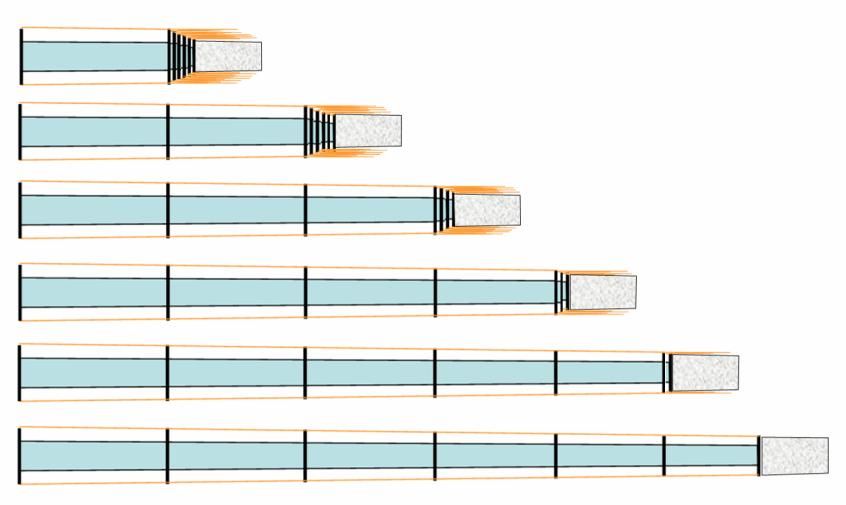
Venus Atmospheric Maneuverable Platform (VAMP)
Concept Development

    • Possible new approach to Venus upper atmosphere exploration found by combining:
        – Recent (non-NASA) Northrop Grumman and L’Garde development programs
        – Awareness of the challenges associated with Venus upper atmosphere science missions

    • A solution may exist in the form of a long-lived, maneuverable, semi-buoyant aircraft

    • Northrop Grumman and L’Garde have extensive corporate investment and history in:
        –   Aircraft and autonomous air vehicles
        –   Science and other space missions
        –   Large deployables
        –   Reentry systems

    • In 2012 we initiated a feasibility study for a semi-buoyant maneuverable vehicle that
      could operate in the upper atmosphere of Venus
        – Results presented here are the products of that small feasibility study
        – We have just begun a more in-depth engineering and science applicability effort that should
          run most of 2013
        – Effort is funded utilizing only Northrop Grumman and L’Garde internal funds

2
                                        Approved for Public Release. NGAS Case 13-1131 dated 6/10/13.
VAMP Integrates Diverse Capabilities into a
      Unique Planetary Exploration Vehicle
        L’Garde and Northrop Grumman
            stowing, deployment, and                                                                                        Northrop Grumman LEM-V
           inflatable entry technology                                                                                         semi-buoyant vehicle
                                                                                                                              (First flight Aug 2012)

 Stowing
cannister

• Exoatmospheric deployment of large structures                                                                              • Semi-buoyant flight
• Inflatable and low ballistic coefficient entry                                                                             • Long on-station time
                                                                                                                             • Reduced aerodynamic requirements

                                                                                                                           Northrop Grumman Global Hawk
            JPL, Glenn & Others                                                                                         unmanned aircraft in production and use
 Venus exploration technology development

                        NASA

            NASA
                                                                                                                               • Long duration flight
      • Environmentally compatible materials/systems                                                                           • Automated science observation
      • Variety of flight plans (ConOps), mission risk, science return
  3
                                                        Approved for Public Release. NGAS Case 13-1131 dated 6/10/13.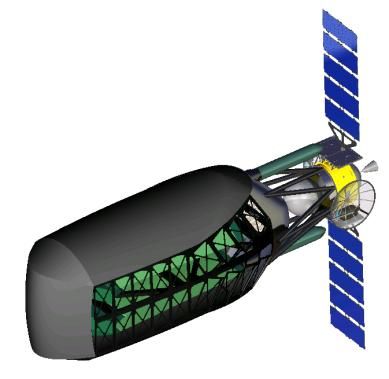
Introduction to the Concept

• Semi-buoyant propelled aerial vehicle
      – Cruise at 70 km, ~10% buoyant with propellers providing 90% of lift
      – Sinks to 55 km, 100% buoyant for passive flight when propellers off
                                                                                                                                Top view

• Power source is some (TBD) combination of solar, ASRG, and batteries

• Key advantages of VAMP in Venus exploration
                                                                                                                         Underside view
      1.   Entry into Venus atmosphere without an aeroshell
      2.   Maneuverability in altitude, latitude, and longitude
      3.   Lifetime of months to years
      4.   Enhanced payload accommodation capability
      5.   Reduced mission risk

• Supported by orbiting satellite                                                                           Space
      – Orbiter delivers VAMP to Venus                                                                      Vehicle

      – Orbiter serves as data and communications relay with Earth

• Results shown here are early products of an
  ongoing effort and may change with further analysis
                                                                                                                      Stowed
                                                                                                                      Airship
4
                                            Approved for Public Release. NGAS Case 13-1131 dated 6/10/13.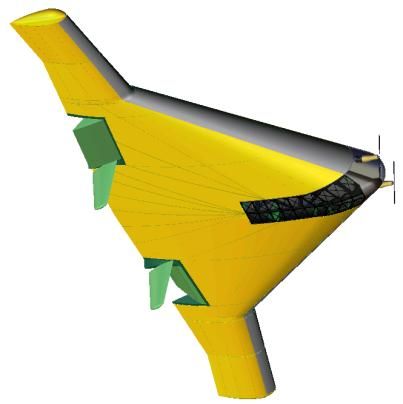
1. Ultra-Low Ballistic Coefficient Entry:
     Mission and Entry ConOps
                                                                                                                                        Mission to Venus Highlights
                                                                                                                                        • VAMP deploys in orbit
 Cruise Mode
                                                                                                                                        • Lower orbit by either:
                            Containment System                                                                                               • Traditional delta-V burn
                                Jettisoned                                                                                                   • Use VAMP for aerobraking
                                                  VOI Delta V Burn

                                                                               Rudders deployed
                                                                                  on booms
                                                                                                                                              Aerobraking possible
     Non-deployed nose structure contains solar                                                                                               using VAMP vehicle
      arrays, propulsion system, avionics, and                                                      VAMP deployed in orbit
           non-deployed parts of payload

VAMP Entry Highlights
• Large surface area produces
benign loads during entry                                                                                                                         VAMP enters
                                                                                                                                                  atmosphere
• No aeroshell needed, maximizing
                                                                                                                                                            Space vehicle
mass available to science payload                                                                                                                        re-establishes orbit

• Benign entry enables data collection
during descent

 5                                                                                                                 Space vehicle                             Space vehicle
                                    Approved for Public Release. NGAS Case 13-1131 dated 6/10/13.              performs de-orbit burn                     separates from VAMP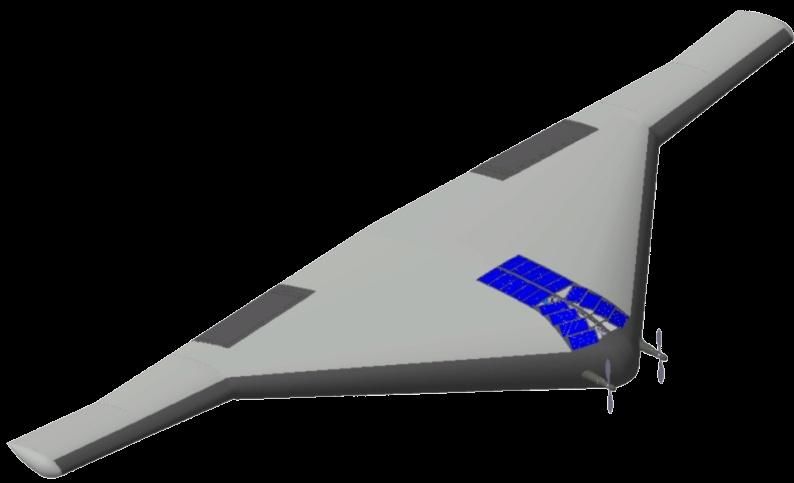
1. Ultra-Low Ballistic Coefficient Entry:
    Deployment Design Analysis
One possible interior structure and in-space deployment concept (study in progress)
                                                                                                                          Deployment
                                                                                                                           direction
                        Stowed View
         Inter ribs (brown) stack against each other
                   and house spars (green)

                                                                                                             Deployed View

                                                                                                                                       Prototype deployed wing at L’Garde
                                                                                                                                         for other (non-NASA) programs

Deployment is driven via pressure inflation of spars
                                                                                                               Deployment Sequencing (Side View)
               Spar Cross-Section
                                                                                                                       Spar
                                                                                                                                   Stowed Interlocked Ribs
                                                                                         Start
                                                                                                                                               Foam Wing Tip
                                                                                                                                               (Supports Skin)

                                                                                                                                                          Stowed Wing Skin

                                                                                          End
6
                                                       Approved for Public Release. NGAS Case 13-1131 dated 6/10/13.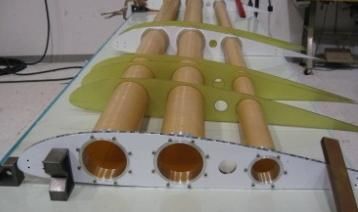
1. Ultra-Low Ballistic Coefficient Entry:
    Entry Loads

                                                                                                                                    Entry configuration
                                                                                                                                    • Leading edge reinforced
                                                                                                                                    • Propellers stowed
                                                            Maximum temperature at
                                                                                                                                    • No aeroshell
                                                            leading edge is 1100 K                                                  • Ballistic coefficient 4 kg/m2 at
                                                                                                                                    30 deg angle of attack

                                                                                                                     Maximum heating rate of 5-8 W/cm2
                                                                                                                      is 0.1-0.2% that of Pioneer Venus

       Altitude = 150 km
                                                                             Altitude = 70 km
                           Altitude = 120 km   Altitude = 90 km

7
                                                     Approved for Public Release. NGAS Case 13-1131 dated 6/10/13.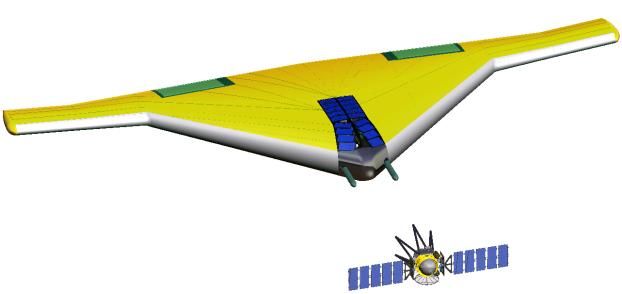
1. Ultra-Low Ballistic Coefficient Entry:
    Entry Loads

                                                                                                   Entry configuration
                                                                                                   • Leading edge reinforced
                                                                                                   • Propellers stowed
                                                                                                   • No aeroshell
                                                                                                   • Ballistic coefficient 4 kg/m2 at
                                                                                                   30 deg angle of attack

                           Gravitational loads on the
                             payload are minimal

                                                                                             Data collection can begin at
                                                                                                 very high altitudes

8
                             Approved for Public Release. NGAS Case 13-1131 dated 6/10/13.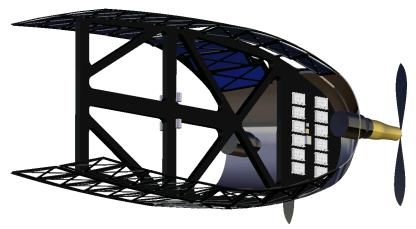
2. Maneuverability in Altitude, Latitude, Longitude

Direction     Range            Controlled By                           Range Limited By                                          Notes

                               • Propeller speed (varies lift          • Vehicle buoyancy                                        • Range = 55-70 km during day
Altitude      55-70 km
                               contribution to buoyancy)               • Lift capability                                         • Constant altitude of 55 km at night

                               • Elevons and rudders                   • Flight speed (to counteract stronger                    • Range extends to 90 deg in one
Latitude      +/- 20 deg
                               • Ambient winds                         poleward winds at higher latitudes)                       hemisphere in final month of mission

                               • Ambient winds (dominant)                                                                        • Ability to return periodically to same
Longitude     All                                                      N/a
                               • Elevons and rudders                                                                             location for monitoring

                                                                                                     Propellers provide flight
                                                                                                     speeds of up to 10 m/s
                                                                                                     relative to wind flow

       Elevons (+/- 30 deg) and
       rudders (+/- 30 deg)
       control pitch, roll, and yaw                                                Interactive (but not in real time) control of flight path
                                                                                  allows for maneuvering at will to accomplish surveys of
                                                                                       large areas and/or focus on regions of interest
 9
                                                                Approved for Public Release. NGAS Case 13-1131 dated 6/10/13.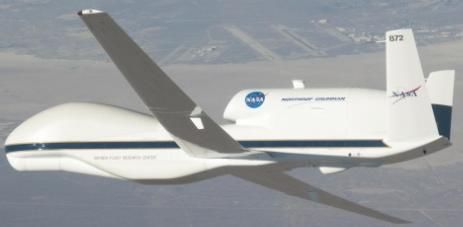
3. Lifetime of Months to Years

                  •     Primary (equatorial) mission
                           –   Occurs within +/- 20 deg latitude of equator
                           –   UAV can be navigated in latitude at will
                  •     Lifetime in this region is limited only by gradual loss of buoyant gas through envelope and/or environmental effects

                      Sample Altitude Trajectory in 1 Venusian Day                                                                                    Available Solar Power

                               NIGHT                            DAY                                                                  Full power to propellers by 18 m2 solar array

                                                                                                             Incident Power (W/m2)
Altitude (km)

                                                                          Cruise at 70 km                                            Full power to propellers by 36 m 2 array
                                                                      (Lift is 10% buoyancy,
                            Balloon-like float at lower                   90% propelled)
                            altitude throughout night
                                                                                                                                     Full power to propellers by 73 m 2 array

                   As sunset approaches, power            Sunrise powers propellers and
                reduction causes VAMP to sink to            raises altitude accordingly
                altitude of 100% buoyancy (55 km)

                                         Time (Earth days)                                                                                                      Time (Earth days)

                      Day-side ConOps: variations in propelled speed vary                                                            400 m2 planform provides more than enough
                      lift and allow selection of altitudes in 55-70 km range                                                        real estate to house sufficient solar arrays

                      Night-side ConOps: passive floatation at 55 km                                                                 Choice of array size determines what fraction
                                                                                                                                     of day-time flight occurs at max flight speed
  10
                                                                               Approved for Public Release. NGAS Case 13-1131 dated 6/10/13.
3. Lifetime of Months to Years
• Final (poleward) mission
– Covers either Northern or Southern hemisphere, from 20 deg latitude to the pole
– Hemisphere can be chosen at the conclusion of equatorial mission
• Lifetime in this region is limited by the poleward winds, which push VAMP to the polar vortex in ~1 month
DAY NIGHT
Multi-month equatorial mission provides frequent re-
sampling of equatorial atmospheric and surface regions
1 month poleward mission provides coverage
of large range of latitudes and longitudes
11
Approved for Public Release. NGAS Case 13-1131 dated 6/10/13.4. Payload Accommodation Capabilities
Current baseline is Venus Flagship DRM balloon payload
– Mass 20 kg
– Power 50 W
Changes in payload can be traded against:
– Total vehicle mass
• +2 kg total mass per +1 kg payload mass
• +1.6 kg total mass per +1 W payload power
• Driver is additional volume, buoyant gas, and lift
from propellers to support added payload
or solar array mass
-- OR -- Current Baseline
– Maximum altitude achievable
Cruising Altitude (km)
• -8 m altitude per +1 kg payload mass
• -13 m altitude per +1 W payload power
• Driver is decreased vehicle buoyancy
from additional payload or solar array mass
Additional Payload Mass (kg)
12
Approved for Public Release. NGAS Case 13-1131 dated 6/10/13.5. Reduced Mission Risk
• Simple day-night ConOps and power cycling
• Safe mode / power failure / propulsion failure all produce passively floating state
– VAMP sinks to 55 km (100% buoyancy)
– Over 30 days for recovery until ambient winds sweep vehicle into polar vortex (likely end of
mission)
• Possibility for reduced night-time power risk with downward-facing solar panels
• Design is relatively insensitive to payload mass creep
• Terrestrial demos can retire most technology risks
13
Approved for Public Release. NGAS Case 13-1131 dated 6/10/13.5. Reduced Mission Risk
Laboratory Testing with Sub-scale Engineering Model
Materials testing of exposure to chemical environment
Permeability testing
Wind tunnel testing of vehicle shape behavior with entry, wind shear, etc
Stowing, deployment, and inflation testing with modeling
Balloon Release of Demo Vehicle at Altitude
Inflation process demonstration
In-flight behavior, including navigation, shape response to atmosphere, and ConOps
Altitude control and 3D maneuverability
Day/night power cycling
Payload accommodations (with science enhancement opportunity for Earth Science)
Sounding Rocket Release of Demo Vehicle Exo-atmospherically
Deployment, inflation, and rigidization in space
Entry loads and effects on vehicle, materials, and subsystems
Entry localization error ellipsoid
Entry-to-operational transition
14
Approved for Public Release. NGAS Case 13-1131 dated 6/10/13.Ongoing Vehicle Design Effort:
Feasibility Study and Trades Completed in 2012
• Day-only vs day/night vehicle
– Driving parameters: power requirements
• Altitude range of flight
– Driving parameters: vehicle volume and mass, atmospheric temperature
• Buoyancy
– Driving parameters: atmospheric density, time spent in day vs night,
latitude range accessible, vehicle mass
Current Design
Max Altitude: 70 km
Buoyancy: 9%
Wing Span: 46 m
Volume: 567 m3
Mass: 450 kg
15
Approved for Public Release. NGAS Case 13-1131 dated 6/10/13.Altitude Range Trade Study
• Study of day-time (maximum) cruise altitude attainable
• At all buoyancies, mass and volume of vehicle rise steeply above 70 km due to the
fall off of atmospheric density
– Order of magnitude increase on vehicle volume to increase flight altitude from 70 km and 80 km
Max Altitude: 80 km
Wing span doubles
Volume increases by factor 15
Max Altitude: 70 km
16
Approved for Public Release. NGAS Case 13-1131 dated 6/10/13.Vehicle Buoyancy Trade Study
Buoyancy at 70 km 4% 6% 8% 10% 12% 14% 16%
ALTITUDE
Max flight altitude (day) ~ 71 km 71 km ~ 70 km 70 km ~ 70 km < 70 km < 70 km
Buoyant altitude (night) 47 km 51 km 54 km 56 km 57 km 58 km 59 km
Temperature at night altitude 373 K 342 K 313 K 292 K 283 K 275 K 269 K
CONOPS
Max overnight time (equator) 90 hr 83 hr 79 hr 76 hr 75 hr 73 hr 72 hr
Min overnight time (critical latitude) 82 hr 78 hr 74 hr 72 hr 70 hr 69 hr 68 hr
Latitude range accessible for v=10 m/s -25o to +25o -21o to +21o -19o to +19o -19o to +19o -18o to +18o -18o to +18o -18o to +18o
SIZING (at z=70 km)
Mass 444 kg 443 kg 446 kg 452 kg 459 kg 467 kg 475 kg
Flight speed at mass~450 kg ~60 m/s in progress in progress 11 m/s in progress in progress ~ 7 m/s
Max stagnation heating rate on entry higher higher higher 8 W/cm2 lower lower lower
0.2% of that of Pioneer Venus (~4 kW/cm2)
17
Approved for Public Release. NGAS Case 13-1131 dated 6/10/13.Ongoing Vehicle Design Effort:
Work in Progress in 2013
• Vehicle shape analysis
• Night-time power source trade study
• Entry scenario options and impact on VAMP, space vehicle design, and SV orbit
• Flight speed trade with buoyancy and vehicle mass
• Detailed deployment design
• Environmental effects analysis
– Chemical environment and envelope membrane
– Entry conditions and TPS material
• System architecture
– Detailed VAMP architecture
– Space vehicle architecture
– VAMP – SV interface, including comm, data, and navigation
• Etc!
18
Approved for Public Release. NGAS Case 13-1131 dated 6/10/13.Initial Vehicle Shape Analysis
Planform Heritage Pros Cons
Large planform area
Large planform area
Trapezoidal* • Higher structural mass to
• Low ballistic coefficient
support span
Traditional “flying wing” Performance • Long leading edges for
• Tailorable airfoil lift and entry heating
Similar to terrestrial UAVs
moment characteristics
Deployment
• Efficient cruise for reduced
• Shape may dictate complex
propulsion requirements
deployment sequence
Lenticular*
Small planform area
Small planform area
• Less efficient lift
• Less unsupported span
1960’s manned re-entry • Higher ballistic coefficient
• Less structural mass
vehicle studies by NASA
Performance
Similar to terrestrial airships Deployment
• Symmetry leaves fewer
• Simple shape for easier
options to tailor lift and
deployment
moment characteristics
19
* Shape comparison evaluated at equal vehicle volumes Approved for Public Release. NGAS Case 13-1131 dated 6/10/13.Night-Time Power Source Trade Study
Night-Time Power Science Operations
Heritage Power Density In Situ Source?
Source at Night?
Rechargeable 1 W/kg
High No No
batteries (Assuming 75 hr night)
Mission insertion
6 W/kg
ASRG opportunity for ASRG Yes No
(Not including cooler)
Minimal tech dev required
High if sufficient 175 W/kg
Downward- upwards visible flux
facing Yes (Including installation; Yes
solar panels Medium if require assuming spectrum of
enhanced IR sensitivity upward flux is ~solar)
Thermo-
acoustic Components high,
Stirling Yes 5-10 W/kg Maybe
Heat System low
Combines RPS with
Engine pulse-tube cooler
20
Approved for Public Release. NGAS Case 13-1131 dated 6/10/13.Summary & Future Plans
• Our initial feasibility study identified VAMP as a promising approach for
Venus atmospheric exploration
– Semi-buoyant, propelled aerial vehicle with a mission lifetime of months to years
– Supports enhanced payload; minimal performance consequences with increased
payload mass and/or power
– Deploys/inflates in orbit and has a benign entry into Venus, requiring no aeroshell
– Fly at altitudes 55-70 km and covers a wide range of latitudes and all longitudes
– Safe mode and failure modes result in easily recoverable, passively floating vehicle
• 2013 is an exciting year for VAMP!
– Complete on-going trade studies and define focus areas of 2014 effort
– Extensive stowing and deployment analysis
– Study of behavior in relevant environment, including winds and chemical exposure
– System architecture for VAMP, space vehicle, and their interface
21
Approved for Public Release. NGAS Case 13-1131 dated 6/10/13.You can also read


