Wairarapa DHB 2017/18 Annual Plan - INCORPORATING THE 2017/18 STATEMENT OF PERFORMANCE EXPECTATIONS - Wairarapa District Health Board
←
→
Page content transcription
If your browser does not render page correctly, please read the page content below
Wairarapa DHB
                           2017/18
                          Annual Plan
         INCORPORATING THE 2017/18 STATEMENT OF
               PERFORMANCE EXPECTATIONS

 Crown copyright ©. This copyright work is licensed under the Creative Commons Attribution 4.0 International licence. In essence, you are free to
 copy, distribute and adapt the work, as long as you attribute the work to the New Zealand Government and abide by the other licence terms. To
view a copy of this licence, visit http://creativecommons.org/licenses/by/4.0/. Please note that neither the New Zealand Government emblem nor
the New Zealand Government logo may be used in any way which infringes any provision of the Flags, Emblems, and Names Protection Act 1981 or
 would infringe such provision if the relevant use occurred within New Zealand. Attribution to the New Zealand Government should be in written
                                  form and not by reproduction of any emblem or the New Zealand Government logo.
Table of Contents

SECTION 1: Overview of Strategic Priorities ..................................................................... 4
   Strategic Intentions/Priorities .................................................................................................................... 4
   Message from the Board Chair ................................................................................................................. 4
   Message from the Chief Executive .......................................................................................................... 5
   Message from Te Oranga o Te Iwi Kainga Chair .................................................................................. 6
SECTION 2: Delivering on Priorities and Targets .............................................................. 8
   Government Planning Priorities ................................................................................................................ 8
   Financial Performance Summary ........................................................................................................... 24
   Local and Regional Enablers .................................................................................................................. 28
SECTION 3: Service Configuration .................................................................................... 29
   Service Coverage ..................................................................................................................................... 29
   Service Change......................................................................................................................................... 29
SECTION 4: Stewardship .................................................................................................... 32
   Managing our Business ........................................................................................................................... 32
   Building Capability .................................................................................................................................... 32
SECTION 5: Performance Measures ................................................................................. 34
APPENDIX A ......................................................................................................................... 39
2017/18 Statement of Performance Expectations ........................................................... 39
APPENDIX B ......................................................................................................................... 52
System Level Measures Improvement Plan 2017/18 ....................................................... 52

                                                                                                                                                            2
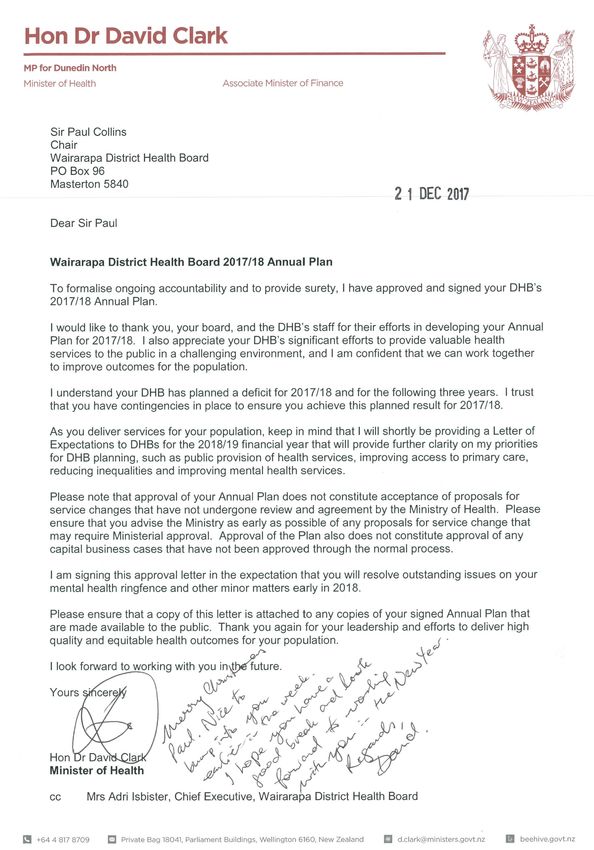
Minister’s 2017/18 Letter of Approval to Wairarapa DHB

                                                         3
SECTION 1: Overview of Strategic Priorities
Strategic Intentions/Priorities
This Annual Plan articulates Wairarapa DHBs commitment to meeting the Minister’s expectations, and our
continued commitment to our Board’s vision of Well Wairarapa – better health for all.
We reaffirm our commitments to the Treaty of Waitangi, the New Zealand Health Strategy, the Healthy
Ageing Strategy, the UN convention on the Rights of Persons with Disabilities, and Ala Mo’ui: Pathways to
Pacific Health and Wellbeing 2014-2018.
Wairarapa DHB has worked with staff, health partners and intersectoral partners to consolidate our strategic
priorities for the 17/18 year. An Annual Planning workshop with representatives from across the community
including primary and secondary health care, mental health, Iwi, pharmacy, ambulance, NGOs, contracted
and private providers, welfare, education and local Councils determined the following areas of priority:
Equity of health outcomes Working with all our partners
Proactive and preventative care Social determinants of health
Promoting leadership capability Smarter patient flow
Access to services Quality
Message from the Board Chair
In this, my first term as Chair of Wairarapa DHB I am pleased to present this concise Annual Plan for the 17/18
year. Despite the considerable challenges ahead, I believe it firmly focuses, in a fiscally responsible way, on
our key priority of improved health and wellbeing for the people of the Wairarapa.
As Chair, I acknowledge the responsibility of the Board to operate within the legislative environment and live
within our means. I believe a vital part of ensuring this is the promotion of leadership capability in our
workforce, and capacity and capability in our operations.
Real gains cannot be made in this sector by health alone. A concerted effort to work with all our stakeholders
- Iwi, District Councils, primary and secondary health providers, welfare, education, justice and most
importantly our whānau and community will bring about real and sustained change to improve the health of
our population.
Grasping the opportunities provided by improved technology is also a key plank. Not just for diagnostic and
treatment purposes, but also better collection and use of data; to understand the population we serve and
design services to prevent ill health and maintain wellness. The replacement of the DHB’s legacy Patient
Management System and Financial Management System will undoubtedly bring large leaps in more efficient
patient care and use of time and resources.
Working with our neighbours in the Lower North Island has the potential to improve the quality and range
of services we offer our population. The enduring benefits of shared services in mental health, laboratory, IT
and, increasingly, imaging continue to be demonstrable.
Bringing care closer to home, whether through ‘care in place’ in a person’s home or local healthcare centre,
or through introduction of new hospital based outreach services like chemotherapy remains an important
priority of the Board.
Our Business Plan for 2017/18 is for a deficit of $3.1 million which compares to a forecast deficit for 2016/17
of $2.9 million.
4While we will receive additional funding of $6.2 million we do have uncontrollable cost increases of $5.5
million in Inter District Flows, costs of the pay equity settlement, capital costs (interest, depreciation and
capital charges), and costs associated with national employment contract settlements.
We are firmly focused on achieving quality health outcomes for our community and been as efficient and
effective as we can be in delivering these. There is no silver bullet but this Plan has the twin objectives of
continuing to do what we do well whilst looking at new initiatives aligned to our vision of " Well Wairarapa-
better health for all".
Not withstanding the risks posed by our aging workforce and population, legacy systems, deferred
maintenance, and vulnerability to IDF fluctuations I look forward to the progress we will make in the 17/18
year.
Message from the Chief Executive
Wairarapa is a region that has the advantage of a caring community, large parts of which share our vision of
‘better health for all’. This vision is driven by our values of respect, integrity, self determination, co-operation
and excellence. These values are what drive our behaviour within the services we provide and contract for.
Last year, Wairarapa, Hutt Valley and Capital & Coast Boards all acknowledged the valued, sustainable
relationships and services created through integration and reviewed organisational structures focussed on
local leadership. This transformed and refreshed leadership in the Wairarapa DHB. In tandem with this, the
Ministry of Health re-launched the NZ Health Strategy, setting the framework for the Health System and
expectations of future direction. It particularly highlights the need for change.
The Strategy describes an environment where Kiwis can live well, stay well and get well. The themes of this
are expectations we place on the work that we do; ‘people powered’, ‘care closer to home’, ‘value and high
performance’, ‘one team’ and ‘smart systems’. The ultimate goal of Wairarapa DHB is for greater system
integration that puts the patient and their whānau at the core of every decision that is made.
The world is shifting and changing. Wairarapa DHB is ready to come to the table and work with our sector
partners on equity, lowering smoking, childhood obesity, adult obesity, access to services, place of care and
particularly the health of our children.
There are three key strategies that will direct our efforts in this and the coming years. Improving equity of
health outcomes; the ‘triple aim’ of balancing patient experience with quality and safety and wise use of
resources; and taking an intersectoral approach to improving the health of our population. The DHB will be
paying closer attention to the social determinants of health and this will enable us to think differently about
service development.
While we have made improvements for our population, we have not been able to address the difficult
challenge of obtaining the level of intersectoral partnerships and service development needed to improve
equity of health outcomes. Wairarapa DHB has invested in this. Our high needs population creates high
demand on our system and we propose to generate a path of meaningful change. We have a good
partnership with our Māori Relationship Board, Te Oranga O Te Iwi Kainga and this both steers and supports
the work we are doing. We have embedded the priorities identified in our Māori Health Plan in this Annual
Plan for 2017/18. We intend to identify and analyse issues within the community and propose different ways
to interact. Community based smart health is right care, right people, right place, right time; technology is
an enabler to ‘democratise’ innovative health solutions and enhance self care.
Equity of health outcomes is critical. We are learning from others and will find ways to simply and effectively
communicate with our partners, whānau and communities. Smart use of tools already being used today will
help us create better access, more care, more people served, lower cost and greater equity.
5Message from Te Oranga o Te Iwi Kainga Chair
Te Oranga o Te Iwi Kainga (Te Iwi Kainga) is the Māori Relationship Board to the Wairarapa District Health
Board. It is made up of eight members mandated by the Manawhenua tribes of the district – Ngāti Kahungunu
and Rangitāne.
Across every health indicator that the Ministry tracks, Māori fare worse than non-Māori and this has been
the case since data was first collected. Some progress has been made but more is required.
This District Annual Plan now incorporates the Annual Māori Health Plan which was a stand-alone document.
With the inclusion of the Maori Health Plan into the District Annual Plan, Te Iwi Kainga expects that the
combined plan will raise the importance of Māori health across all activities.
The initiatives within this plan will go some way to improving Māori health but the plan does not cover all
determinants that impact on the health and wellbeing of whānau. To address these determinants, Te Iwi
Kainga has identified the following priorities: better access to health care, improving health literacy amongst
whānau, workforce development both Māori and non-Māori, improving cultural competency for all health
workers, investment in our Māori providers, affordable and safe housing, improved air and water quality,
regional employment and the prevention of diseases e.g. smoking, diabetes and oral disease.
Te Iwi Kainga also recognises the opportunities that will come for both iwi as they move into their post-Treaty
Settlement phases and the impact that this will have for whānau. There are exciting and positive times ahead.
Being co-signatories to this Annual Plan is a further commitment to the partnership between Manawhenua
and the Crown (via the DHB Board) and to the ongoing improvement of Māori health.
621 December 2017
__________________________________________________________
Sir Paul Collins Date
Board Chair
Wairarapa District Health Board
21 December 2017
__________________________________________________________
Adri Isbister Date
Chief Executive
Wairarapa District Health Board
21 December 2017
__________________________________________________________
Kim Smith Date
Chair
Te Oranga o Te Iwi Kainga
7SECTION 2: Delivering on Priorities and Targets
Government Planning Priorities
Link to Wairarapa DHB Key Response Actions to Deliver Improved Performance
Government Planning NZ
Priority Health
Focus Expected for Wairarapa DHB Strategy Activity Milestones Measures
1. Continue provision of School Based Health Services
Value and high performance
(SBHS) in decile one to three secondary schools,
teen parent units and alternative education
facilities. Target Māori, Pacific and low decile youth 1. Ongoing
populations.
Commit to continue activity to deliver on EOA PP25: Prime Minister’s
Prime Minister’s Youth 2. Improve follow-up in primary care of youth aged 2. Ongoing
the Prime Minister’s Youth Mental Health Youth Mental Health
Mental Health Project Project. 12-19 years discharged from secondary mental Project
health and addiction services by providing follow-
up care plans to primary care providers.
3. Implement actions to meet waiting time targets for 3. Ongoing
access to CAMHS and Youth AOD services.
Key: EOA = Equity of Outcome Action: specifically identified actions aimed at improving equity of health outcomes. 8Link to Wairarapa DHB Key Response Actions to Deliver Improved Performance
Government Planning NZ
Priority Health
Focus Expected for Wairarapa DHB Strategy Activity Milestones Measures
1. Continue school based health services in low decile 1. Ongoing
secondary schools.
EOA 2. Ongoing
2. Continue to build culturally competent services
through Youth Kinex and Carterton Medical’s free
sexual health services to young people. EOA 3. Ongoing
3. Maintain the Wairarapa primary sexual health
People powered
subsidy scheme to general practices for under 20
Reducing Unintended Continue to build on the substantive year olds (20 & 21 year olds with a Community PP38: Delivery of
activities identified in your 2016/17 annual Services Card) and free for all ages for sexually
Teenage Pregnancy BPS response actions
plan to reduce unintended teenage transmitted infections. agreed in annual plan
(contributory activity) 4. Ongoing
pregnancy. EOA
4. Monitor the impact of effective service delivery
through pregnancy, birth and termination rates; 5. Ongoing
and through engaging with whānau.
5. Work with secondary schools to develop their
Health Plans, so they are effective for all rangatahi,
specifically for young men.
Key: EOA = Equity of Outcome Action: specifically identified actions aimed at improving equity of health outcomes. 9Link to Wairarapa DHB Key Response Actions to Deliver Improved Performance
Government Planning NZ
Priority Health
Focus Expected for Wairarapa DHB Strategy Activity Milestones Measures
1. Continue VIP training for all health professionals 1. Q1-4
2. VIP continuous quality audit activity. 2. Reporting Q2
3. Support Maternal Care, Wellbeing and Child and Q4
Protection Multi-Agency Group and work with Iwi. 3. Ongoing
One team
DHBs must commit to continue activity to
Supporting Vulnerable contribute to the reduction in assaults on 4. Work with health, education, social and justice 4. Ongoing PP27: Supporting
Children BPS Target children. agencies and Iwi groups to address issues with the Vulnerable Children
most vulnerable populations in specific
communities
5. Implement iMoko for 500 identified children. 5. Q1
EOA
1 Through the Wairarapa Maternity Clinical 1. Q2 & Q3
Governance Group, identify barriers to early
enrolment and possible options for addressing
these, with specific consideration of the needs of
Please identify two or three actions and Maori, Pacific and young women. EOA
associated milestones you will be
undertaking that will support delivery of the 2. Work with local stakeholders and the Ministry of 2. Q3 PP38: Delivery of response
One team
target: Health to consider options for a new model of
Healthy Mums and Babies integrated maternal, child and family health that is actions agreed in annual
BPS Target By 2021, 90% of pregnant women are sustainable and flexible and develops a workforce plan (section 1)
registered with a Lead Maternity Carer in that can flex to meet community and secondary
the first trimester, with an interim target of care requirements.
80% by 2019, with equitable rates for all
population groups. 3. Consulation with relevant stakeholders on the 3. Q4
proposed options.
Key: EOA = Equity of Outcome Action: specifically identified actions aimed at improving equity of health outcomes. 10Link to Wairarapa DHB Key Response Actions to Deliver Improved Performance
Government Planning NZ
Priority Health
Focus Expected for Wairarapa DHB Strategy Activity Milestones Measures
1. Establish a Wairarapa intersectoral group, including 1. Q1
Iwi representation, to develop collaborative
approaches to the wellbeing of children
EOA
2. Q1
2. Implement the iMOKO programme for 500
vulnerable children
EOA
Please identify two or three actions and
3. Q3
associated milestones you will be
undertaking that will support delivery of the
One team
3. Engage with B4SC teams to proactively target any
target: PP38: Delivery of response
Keeping Kids Healthy BPS inequity of access and referral rates for Maori
By 2021, a 25% reduction in hospital 4. Ongoing actions agreed in annual
Target EOA
admission rates for a selected group of plan (section 1)
avoidable conditions in children aged 0 - 12
years, with an interim target of 15% by 4. Continue to support and promote the Breathe Easy
2019. and Healthy Skin programmes provided by Whaiora
in collaboration with GPs 5. Q4
EOA
5. Work with providers and community to focus
specifically on Maori whanau declining
immunisations
EOA
1. Continue to provide confirmation and exception 1. Ongoing
system
Smart
Reducing Rheumatic reports on progress in following up rheumatic PP28: Reducing Rheumatic
Ensure systems are in place to effectively
fever cases. Fever
Fever BPS Target follow-up rheumatic fever cases.
Key: EOA = Equity of Outcome Action: specifically identified actions aimed at improving equity of health outcomes. 11Link to Wairarapa DHB Key Response Actions to Deliver Improved Performance
Government Planning NZ
Priority Health
Focus Expected for Wairarapa DHB Strategy Activity Milestones Measures
1. Assess the value of opportunistic and regular 1. Q2
immunisation services being delivered after hours Assessment
or on weekends, where demand for outreach Q4
immunisation services is high and seek to Implemen-
implement an appropriate service. tation
2. Implement a ‘week day’ review of inpatients and 2. From Q1
‘weekly’ review of outpatients to identify
unvaccinated children and, where clinically
People powered
appropriate, provide immunisations by paediatric
Increased Immunisation Continue current activity, in accordance nurses; or refer the child to general practice or
Immunisation Health
with national immunisation strategies and outreach.
BPS and Health Target Target
service specifications, to maintain high
PP21: Immunisation
(target) coverage rates for all immunisation
Services
milestones
3. Work with providers and community to support 3. Q2
track and tracing of individual children and co-
visiting where relevant for Immunisation.
EOA
4. Q4
4. Work with providers and community to focus
specifically on Māori whānau declining
immunisations.
EOA
Key: EOA = Equity of Outcome Action: specifically identified actions aimed at improving equity of health outcomes. 12Link to Wairarapa DHB Key Response Actions to Deliver Improved Performance
Government Planning NZ
Priority Health
Focus Expected for Wairarapa DHB Strategy Activity Milestones Measures
1. Embed the admission to a short stay bed policy for 1. Q1
those patients who do not need to be admitted but
who require further investigation or treatment to
ensure comfort and safety of these patients. This will
Value and high performance
ensure target continues to be met.
2. Triage bypass of all category 3, 4, 5 patients directly 2. Q1
Shorter Stays in to Nurse Practitioners during peak demand periods.
Emergency Queues will be minimised and target maintained.
Provide a prioritised list of the service
EOA 3. Q4
Departments Health improvement activities you will implement
3. Undertake workshops and process mapping to ED Health Target
Target in 2017/18 to improve acute patient flow
within your hospital(s). establish dual flow models to allow expediting
both First in First Out and Order of Acuity patient
streams to ensure wait times minimised. 4. Q4
4. Over the 2017/18 financial year determine the
feasibility of establishing an integrated urgent care
service in partnership with primary care on the
hospital site. This may form part of a longer term
approach to sustainable acute care models built upon
the embedded Nurse Practitioner Model.
1. Recruit an ophthalmologist to improve access to 1. Q1
ophthalmology services.
Value and high performance
Electives Health Target; SI4:
2. Deliver 2,417 elective surgical discharges in order to 2. Q4 Standardised Intervention
meet both the Health Target and Elective Initiatives Rates
targets.
Improved Access to OS3: Inpatient Length of Stay
Deliver agreed service volumes in a way 3. Manage patient flow by working with primary care, 3. Q1-Q4 (Electives)
Elective Surgery Health whānau and community, to promote equity of access
that meets timeliness and prioritisation Electives and Ambulatory
Target requirements and improves equity of while meeting ESPI targets. EOA Initiative
access to services. 4. Continued development and implementation of 4. Q1-Q4 Bariatric Initiative
primary care referral pathways in order to maximise Additional Orthopaedic and
efficiencies of patient flow. General Surgery Initiative
5. Revise communication with patients and whānau 5. Q1-4 Elective Services Patient
(channels and collateral) to enhance health literacy, Flow Indicators
and reduce late presentation and DNA rates
EOA
Key: EOA = Equity of Outcome Action: specifically identified actions aimed at improving equity of health outcomes. 13Link to Wairarapa DHB Key Response Actions to Deliver Improved Performance
Government Planning NZ
Priority Health
Focus Expected for Wairarapa DHB Strategy Activity Milestones Measures
1. Weekly case reviews between cancer care co-ordinator 1. Q1-4
and CMO, and between care co-ordinator and surgeons.
2. Identify and remove all barriers that may increase cancer
waiting times, particularly for Māori. 2. Q2
Cancer Health Target
EOA Identify
Faster Cancer Treatment PP30: Faster Cancer
One team
Identify the sustainable service 3. Most cancer treatment services are dependent on other Q4
Treatment (31 day
Health Target improvement activities you will implement DHBs. Regular communication made to expedite cancer Remove
indicator)
to improve access, timeliness and quality of treatment wherever possible.
PP29: Improving waiting
cancer services. Note: Given small numbers, it is noted that only 1- 2 3. Q1-4
times for diagnostic
breaches will have significant negative effect on overall
services - CT & MRI
performance figures. 4. Q1-4
4. Work with other DHBs and their support services to
ensure whānau receive support/information; increase
literacy about services they can access.
1. Continue to support our Business As Usual ‘bottom up’ 1. Q1-4
approach to screening so that achievement against
targets is consistent and enduring.
Smart system
Better Help for Smokers 2. Smoking cessation: Directed approach towards
Provide an integrated approach to delivery Tobacco Health Target
to Quit Health Target supporting priority groups (Māori women and pregnant 2. Q1-4
of ABC between primary care services. PP31: Better Help for
women).
Smokers to Quit in Public
EOA
3. Q1-4 Hospitals
3. Review and focus outcomes against the overall
trajectory of Quit rates, by ethnicity and across the
district, towards ‘Smokefree NZ by 2025’.
EOA
1. Engage with health providers to proactively target any 1. Ongoing
Identify what actions you will take to ensure inequity of access and referral rates for Māori, Pacific
that the clinical referral pathway and
Closer to home
and other risk populations.
Raising Healthy Kids processes established in 2016/17 achieves EOA 2. Q2
the Raising Healthy Kids target by
Health Target December 2017.
2. Continue to monitor, review and refine referral Healthy Kids Health
pathways to address any real or perceived barriers to 3. Q2 Target
referral
3. Provide training to support and improve Primary Care
teams and whānau weight management approaches. 4. Ongoing
Key: EOA = Equity of Outcome Action: specifically identified actions aimed at improving equity of health outcomes. 14Link to Wairarapa DHB Key Response Actions to Deliver Improved Performance
Government NZ
Planning Priority Health
Focus Expected for Wairarapa DHB Strategy Activity Milestones Measures
1. Committing to implementation of 2017/18 rollout as per 1. Q1-4
Value and high performance
standards and embed pathways and protocols that will increase
access across all endoscopy services for Māori. PP29: Improving
2. Establish baseline quality data that can be broken down by 2. Q1
Implement requirements for Tranche 1 of the waiting times for
ethnicity for ongoing performance monitoring, improvement diagnostic services –
national bowel screening programme,
and reporting, then implement monitoring. Colonoscopy
incorporating quality, equity and timeliness
Bowel Screening expectations and IT integration activity, while 3. Develop a range of strategies (communications and National Bowel
3. Q1-4
ensuring appropriate access across all engagement) for ongoing whānau participation giving Screening quality,
endoscopy services. consideration to equity. EOA equity and
4. Collaborate with sector IT stakeholders to integrate register performance
4. Q3-4
changes + national Bowel Screening solution. indicators
5. Transition plan preparation that ensures patient care and 5. Q1-2
greater access for whānau.
1. Access decision support analysis of the last three years data, 1. Q1
including ethnicity breakdown, to understand and reinforce the
downward trend in CTOs in Wairarapa.
EOA 2. Q1-3
2. Work with our clinical teams, primary care and Iwi to determine PP36: Reduce the
People powered
ways to reduce CTOs. Hui undertaken by end Q3 3. Q4 rate of Māori on the
Improve the quality of mental health services EOA mental health Act:
including reducing the rate of Māori under 3. Ensure all MHAID Service 3 DHB staff attend core cultural section 29
Mental Health community treatment orders. competence training on employment, and at skills and refresher community
4. Q1-4
training. treatment orders
EOA 5. Q4 relative to other
4. Increase Māori employment in mental health services by ethnicities.
implementing the new positive employment protocol
EOA
5. Raise the profile of addiction services to facilitate early
engagement of addiction clients and their whānau.
Key: EOA = Equity of Outcome Action: specifically identified actions aimed at improving equity of health outcomes. 15Link to Wairarapa DHB Key Response Actions to Deliver Improved Performance
Government NZ
Planning Priority Health
Focus Expected for Wairarapa DHB Strategy Activity Milestones Measures
Improve population mental health, especially 1. Investment approach: Develop the whole of system approach 1. Q4
for Mental Health, Addictions and Intellectual Disability that
Value and high
for priority populations including vulnerable
performance
children, youth, Māori and Pacifica, by supports the Closing the Loop approach, develops integrated PP38: Delivery of
increasing uptake of treatment and support health and social service approaches and guides earlier response actions
earlier in the course of mental illness, further interventions using a locality based approach commencing in agreed in annual
integrating mental and physical health care, the Porirua area. plan.
and co-ordinating mental health care with EOA
wider social services.
Key: EOA = Equity of Outcome Action: specifically identified actions aimed at improving equity of health outcomes. 16Link to Wairarapa DHB Key Response Actions to Deliver Improved Performance
Government NZ
Planning Priority Health
Focus Expected for Wairarapa DHB Strategy Activity Milestones Measures
The DHB commits to participating in national developments
related to implementation of the outcomes of the IBT settlement
agreement and the equal pay negotiations.
We confirm that we will implement relevant actions to deliver of
the DHB’s Regional Service Plan commitments.
Service development will align with the priorities for action for
the Healthy Ageing Strategy. The DHB will work towards a
sustainable, culturally appropriate and person-centred approach
for supporting the health and wellbeing of people as they
age.EOA
1. Ongoing
1. Continue to support and educate older people and their
Deliver on priority actions identified in the Healthy whānau to age safely and as independently as possible in
Ageing Strategy 2016, where DHBs are in lead and their own home and community (Ageing well). 2. Ongoing
supporting roles, including: 2. Enable increased uptake of having Enduring Power of
Closer to Home
Attorney (EPOA) arrangements through education,
- working with ACC, HQSC and the Ministry of PP23: Improving
Healthy Ageing promotion and enabling an assistance scheme (Living Well
Health to further develop and measure the Wrap Around
with Health Conditions).
progress of your integrated falls and fracture Services – Health
EPOA information for older people promoted through
prevention services as reflected in the associated of Older People
Age Concern contract, Primary Care, Iwi NGOs and Expo
Outcome Framework and Healthy Ageing Strategy
in October 2017.
- working with the Ministry and sector to develop Promotion of Advanced Care Planning, particularly to
future models of care. whānau. 3. Q1-4
3. Use interRAI data to identify carer stress and match to
allocation and usage of culturally appropriate services to
support them (Support for people with high and complex
needs).
Quarterly cohort analysis by ethnicity, TLA, relationship
to carer, usage of support and entry to ARC.
4. Q4
4. Implementation of the Falls Risk Assessment and Reduction
Health Pathway (Acute and Restorative care). 5. Q2
5. As the first stage of adopting the interRAI Palliative care depending
assessment tool, Implement interRAI Palliative care (PC) on national
assessment for older people with palliative care needs training
(respectful end of Life). availability
Key: EOA = Equity of Outcome Action: specifically identified actions aimed at improving equity of health outcomes. 17Link to Wairarapa DHB Key Response Actions to Deliver Improved Performance
Government NZ
Planning Priority Health
Focus Expected for Wairarapa DHB Strategy Activity Milestones Measures
1. Promote integrated and proactive care planning in 1. Q2
primary health for people living with diabetes. Identify
the baseline number and ethnicity of patients identified
at high risk of complications and/or hospitalisation who
have interdisciplinary team input into their care plan
within the primary health setting.
EOA 2. Q1:
Describe target
population, actions to
2. Use self-assessment against the Quality Standards for improve access,
Diabetes Care to inform service development: expected outcomes
PP20: Improved
Complete pathways development for Diabetes Q4: achieve outcomes
management
screening & management.
for long term
Closer to home
EOA
conditions
Continue to implement the actions in Living Well 3. Q4
(CVD, acute
Living Well with with Diabetes – a plan for people at high risk of or
heart health,
Diabetes living with diabetes 2015-2020 in line with the 3. Use self-assessment against the Quality Standards for
diabetes and
Quality Standards for Diabetes Care. Diabetes Care to inform education in practices:
stroke) - Focus
CPD in retinal screening guidelines for referral – GPs
area 2:
& PNs.
Diabetes
CPD in the benefit of how to diagnose early blood services
ketones and prevent the onset ketoacidosis in
patients already diagnosed as having type 1
diabetes.
CPD in proactive planning for long term conditions
(“year-of-care”) that is appropriate for all whanau. 4. Q1: Describe
target population,
4. Self-management education for patients and their actions to improve
whānau. Introduce Snomed for recording self- access, expected
management education session in practices. outcomes
EOA Q4: achieve
outcomes
Key: EOA = Equity of Outcome Action: specifically identified actions aimed at improving equity of health outcomes. 18Link to Wairarapa DHB Key Response Actions to Deliver Improved Performance
Government Planning NZ
Priority Health
Focus Expected for Wairarapa DHB Strategy Activity Milestones Measures
1. Continue to develop and deliver culturally appropriate 1. Q1-4
B4SC checks for whānau and further integrate with
primary care to ensure appropriate referrals are made
to services.
2. Q1-4
2. Continue to support the Triple P family activity
programme.
Closer to home
3. Promote and support the Green Prescription
3. Q1-4
programme. PP38: Delivery of response
Commit to progress DHB-led initiatives from EOA
Childhood Obesity Plan the childhood obesity plan. 4. Q1
actions agreed in annual
4. Establish a Wairarapa intersectoral group that includes plan
Iwi representation to guide development of
collaborative community-based options to support
healthy lifestyles. 5. Ongoing
EOA
5. Health providers use every touch point where whānau
enter the healthcare pathway as an opportunity to
promote healthy lifestyles.
EOA
1. Undertake analysis to identify barriers for accessing 1. Q3
Value and High Performance
Undertake planning and diagnostic work to timely care for young people and their families who
identify barriers for accessing timely care for are served by Oranga Tamariki, specifically focusing on
young people and their families who are Māori and Pacfic populations.
served by Oranga Tamariki. EOA 2. Ongoing PP38: Delivery of response
Child Health Commit to support national work under way 2. We commit to support national work under way to actions agreed in annual
to improve the health outcomes for improve the health outcomes for children, young plan
children, young people and their families people and their families serviced by Oranga Tamariki,
serviced by Oranga Tamariki, particularly particularly young people in care.
young people in care.
Key: EOA = Equity of Outcome Action: specifically identified actions aimed at improving equity of health outcomes. 19Link to Wairarapa DHB Key Response Actions to Deliver Improved Performance
Government Planning NZ
Priority Health
Focus Expected for Wairarapa DHB Strategy Activity Milestones Measures
1. Workforce Development- Disability Literacy 1. Q1-4.
Education: Use eLearning, video scenarios and
staff training across all disciplines to increase
disability education. Introduce mandatory
training, including cultural competency, for staff
using these tools as part of disability policy.
Focus on tools/mechanisms for clinical settings.
Identify the mechanisms and processes you Encourage understanding of critical support
currently have in place to support people needs of people, particularly Māori, with long
with a disability when they interact with term conditions and/or impairments, when
hospital based services (such as inpatient, receiving acute medical or rehabilitation
outpatient and emergency department services.
attendances). These could include: 2. Q1: Investigate
2. Dashboard of Indicators: Develop a qualitative
- communication tools (particularly for Q2: Collect
those with an intellectual disability or dashboard, including ethnicity breakdown, to
info from Q2.
One team
better understand the patient journey at
sensory impairment) PP38: Delivery of response
Disability Support - training for ward staff in individual specific
Wairarapa DHB including tracking use of the new
health passport and staff and patient feedback. actions agreed in annual
Services personal care plan
Links to overall sub regional disability plan
- clarification of the role of the persons
support workers/caregivers during a performance framework.
hospital appointment or inpatient stay
3. Co Design through Consumer Engagement: 3. Q1-4
(both formal and informal)
Increase community and whānau engagement of
- other issues you have addressed
locality leads on the SRDAG (governance group
(informed consent, supported decision
reporting to CPHAC/DSAC and Boards).
making etc).
Involvement of Wairarapa consumers in the
design of new projects and consumer
council.EOA
4. Q2: Investigate
4. Improve service access for people with a Q3: Design
learning disability. Develop a resource targeted Q4: Implement
to staff working with whānau with learning
disabilities in collaboration with quality team and
other staff.
Key: EOA = Equity of Outcome Action: specifically identified actions aimed at improving equity of health outcomes. 20Link to Wairarapa DHB Key Response Actions to Deliver Improved Performance
Government Planning NZ
Priority Health
Focus Expected for Wairarapa DHB Strategy Activity Milestones Measures
1. Establish a Wairarapa intersectoral group that 1. Q1
includes Iwi representation to guide
development of collaborative community-based
options to support healthy lifestyles, including
culturally appropriate options for Māori and
Pacific populations in order to improve equity of
health outcomes. EOA
DHBs must describe activity to demonstrate 2. Implement an integrated, transparent and 2. Q3
Closer to home
how they are working with their district clearly defined acute and urgent service flow for
alliances to move care closer to home for the community and whānau, using place as the PP22: Delivery of actions to
people through improved integration with organising system for health. improve system integration
the broad health and disability sector (eg including SLMs
primary care, disability services, ambulance 3. Based on the evaluation of the Carterton 3. Q1
services). Integration Pilot, implement an integrated
community model of care in other Wairarapa
centres.
Primary Care Integration 4. Leverage existing projects to move and co-locate
community focussed services within the broader 4. Q1 - 4
health and disability sector.
Establish an outreach chemotherapy service
at Wairarapa DHB
The following targets are included in our 17/18
System Level Measures Plan:
Value and high
performance
1. ASH rates 0-4 year olds. EOA 1. Q1 Define
Please reference your jointly developed and 2. Acute hospital bed days per capita. actions to PP22: Delivery of actions to
agreed with all appropriate stakeholders 3. Patient experience of care. close equity improve system integration
System Level Measure Improvement Plan 4. Amenable mortality rates. gap. including SLMs
that is attached as an Appendix. 5. Proportion of babies who live in a smoke-free
household at six weeks post-natal.
6. Youth System Level Measures.
Key: EOA = Equity of Outcome Action: specifically identified actions aimed at improving equity of health outcomes. 21Link to Wairarapa DHB Key Response Actions to Deliver Improved Performance
Government Planning NZ
Priority Health
Focus Expected for Wairarapa DHB Strategy Activity Milestones Measures
Wairarapa DHB commits to implementation of decisions flowing
from pharmacy contracting arrangements.
Wairarapa DHB will:
1. Undertake a needs analysis of local pharmacist services 1. Q1
requirements, including how they work with Iwi, by August
One team
2017. PP38: Delivery of
Commit to implement any decisions made 2. Q2
2. Determine priorities and a strategy for local pharmacist response actions
Pharmacy Action Plan during 2017/18 in relation to pharmacy
agreed in annual
contracting arrangements services in the community by 30 November 2017 in
conjunction with the Alliance Leadership Team. plan
3. Q4
3. Undertake a procurement process for local culturally
appropriate priority pharmacist services in 2017/18 by 30 April
2018.
EOA
1. Review and establish a process for regular and in-depth review 1. Q1
and organisation wide sharing of national patient experience
survey data by ethnicity and results that will identify focus
areas as part of the continuous quality improvement plan.
Value and high performance
Demonstrate, including planned actions, 2. Q2
2. Identify opportunities to improve patient experience of
how you will improve patient experience as communication. Develop and implement a plan to improve
measured by the Health Quality & Safety
our capability in customer care and culturally appropriate
Commission's national patient experience services, investigating the use of patient stories to do so.
surveys. You can do this by selecting one of PP38: Delivery of
EOA response actions
Improving Quality the four categories of the adult inpatient
survey to focus on and providing actions to 3. Q3 agreed in annual
3. Actions to be taken to develop actual plan will include plan
improve patient experience in this area. consultation with consumers, liaison with Māori Health
Commit to either establish (including a date Directorate, working in consultation with HR to identify
for establishment) or maintain a consumer training opportunities
council (or similar) to advise the DHB.
4. Q3
4. Develop Terms of Reference and implement a Consumer
Forum/ Council, acknowledging the role of Iwi māori and the
cultural diversity of our whole community
EOA
Key: EOA = Equity of Outcome Action: specifically identified actions aimed at improving equity of health outcomes. 22Link to Wairarapa DHB Key Response Actions to Deliver Improved Performance
Government Planning NZ
Priority Health
Focus Expected for Wairarapa DHB Strategy Activity Milestones Measures
Wairarapa DHB is committed to:
1. Operating within agreed budget targets. 1. Q1-4
performance
Commit to manage your finances prudently,
Value and
and in line with the Minister’s expectations, 2. Strengthening the financial accountability
Living Within our Means and to ensure all planned financials align through the organisation.
2. Q1-4 Agreed financial templates.
with previously agreed results.
high
3. Investing in technology to improve process and 3. Q1-4
gain efficiencies eg: risk management.
1. Cardiac: improve access to vulnerable 1. Q1-4
echocardiography services by developing joint
DHB ownership of shared echo waiting lists in
the region.
2. Stroke: achieve 8% or more of eligible patients 2. Q4
Identify any significant DHB actions the DHB
is undertaking to deliver on the Regional thrombolysed.
Service Plan priorities of: 3. Major Trauma: Develop agreed regional clinical 3. Q4
Delivery of Regional - Cardiac Services
NA.
guidelines and inter-hospital transfer processes NA.
Service Plan - Stroke to manage major trauma patients within the
- Major Trauma region, ensuring whānau care is supported..
- Hepatitis C.
4. Hepatitis C: Support the implementation and use
of a clinical Healthcare Pathway, for 4. Q4
identification, assessment and treatment of
patients with Hepatitis C .
EOA
Key: EOA = Equity of Outcome Action: specifically identified actions aimed at improving equity of health outcomes. 23Financial Performance Summary
PROSPECTIVE STATEMENT OF FINANCIAL PERFORMANCE (COMPREHENSIVE INCOME) FOR THE FOUR YEARS ENDED
30 JUNE 2018, 2019, 2020 AND 2021
2015/16 2016/17 2017/18 2018/19 2019/20 2020/21
Audited
Statement of Comprehensive Income Forecast Plan Plan Plan Plan
Actual
$000 $000 $000 $000 $000 $000
Revenue
Mi ni s try of Hea l th Revenue 138,727 141,791 148,496 150,956 153,458 156,003
Other Government Revenue 2,338 2,433 2,277 2,311 2,334 2,357
Other Revenue 5,334 5,307 4,490 4,537 4,582 4,628
Total Revenue 146,399 149,530 155,263 157,804 160,375 162,988
Expenditure
Pers onnel 45,421 46,805 47,644 48,470 49,310 50,280
Outs ourced Servi ces 3,825 5,023 3,628 3,564 3,503 3,443
Cl i ni ca l Suppl i es 10,169 10,106 10,286 9,978 9,678 9,388
Infra s tructure a nd Non Cl i ni ca l 8,064 8,097 9,079 8,807 8,543 8,287
Pa yments to Non-DHB Provi ders 43,679 43,871 47,313 48,023 48,743 49,475
Inter Di s tri ct Fl ows 34,166 35,666 36,552 37,100 37,657 38,221
Interes t, Depreci a tion a nd Amortis a tion 2,990 2,827 3,918 3,918 3,918 3,918
Total Expenditure 148,314 152,393 158,422 159,861 161,353 163,013
Total Comprehensive Income/(Deficit) (1,915) (2,863) (3,159) (2,056) (978) (24)
PROSPECTIVE STATEMENT OF MOVEMENT IN EQUITY FOR THE FOUR YEARS ENDED 30 JUNE 2018, 2019, 2020 AND
2021
2015/16 2016/17 2017/18 2018/19 2019/20 2020/21
Audited
Statement of Movement in Equity Forecast Plan Plan Plan Plan
Actual
$000 $000 $000 $000 $000 $000
Balance at 1 July
Pri or yea r equi ty cl os i ng ba l a nce correction 6,078 7,165 31,045 33,886 31,830 30,852
Net s urpl us / (defi ci t) for the yea r (1,915) (2,863) (3,159) (2,056) (978) (24)
Other Movements i n Equi ty 2 0 0 0 0 0
Total comprehensive income (1,913) (2,863) (3,159) (2,056) (978) (24)
Equi ty i njection from the Crown 3,000 26,743 6,000 0 0 0
Movements in equity for the year 3,000 26,743 6,000 0 0 0
Balance at 30 June 7,165 31,045 33,886 31,830 30,852 30,828
Total comprehensive income attributable to:
Wa i ra ra pa Di s tri ct Hea l th Boa rd (1,915) (2,863) (3,159) (2,056) (978) (24)
24PROSPECTIVE STATEMENT OF FINANCIAL POSITION (BALANCE SHEET) FOR THE FOUR YEARS ENDED 30 JUNE 2018,
2019, 2020 AND 2021
2015/16 2016/17 2017/18 2018/19 2019/20 2020/21
Audited
Statement of Financial Position Forecast Plan Plan Plan Plan
Actual
$000 $000 $000 $000 $000 $001
Equity
Crown equi ty 42,037 68,780 74,780 74,780 74,780 74,780
Reva l ua tion res erve 5,558 5,558 5,558 5,558 5,558 5,558
Retai ned ea rni ngs (40,430) (43,293) (46,452) (48,508) (49,486) (49,510)
Total equity 7,165 31,045 33,886 31,830 30,852 30,828
Liabilities
Term l oa ns & borrowi ngs 19,802 235 152 56 (0) (0)
Empl oyee benefi ts (non-current) 620 619 619 619 619 619
Trus t funds 274 318 318 318 318 318
Total non-current liabilities 20,696 1,172 1,089 993 937 937
Current liabilites
Ca s h & ca s h equi va l ents - Overdra ft 1,412 1,937 2,520 4,466 5,264 4,963
Interes t-bea ri ng l oa ns & borrowi ngs 6,324 74 79 85 85 (0)
Pa ya bl es & a ccrua l s 9,345 10,810 10,531 10,531 10,531 10,531
Empl oyee benefi ts 7,720 7,961 8,041 8,041 8,041 8,041
Total current liabilities 24,801 20,782 21,170 23,122 23,920 23,534
Total liabilities 45,497 21,953 22,259 24,115 24,857 24,471
Total equity & liabilities 52,662 52,998 56,145 55,945 55,709 55,299
Assets
Property, pl a nt & equi pment 45,197 45,517 45,277 45,124 45,135 44,872
Intangi bl e a s s ets 1,089 915 4,351 4,304 4,057 3,910
Inves tments 917 949 949 949 949 949
Total non-current assets 47,203 47,380 50,577 50,377 50,141 49,731
Ca s h & ca s h equi va l ents 8 4 4 4 4 4
Inventori es 903 1,024 1,024 1,024 1,024 1,024
Tra de & other recei va bl es 4,498 4,540 4,540 4,540 4,540 4,540
As s ets cl a s s i fi ed a s hel d for s a l e 50 50 0 0 0 0
Total current assets 5,459 5,618 5,568 5,568 5,568 5,568
Total assets 52,662 52,998 56,145 55,945 55,709 55,298
25PROSPECTIVE STATEMENT OF CASHFLOW FOR THE FOUR YEARS ENDED 30 JUNE 2018, 2019, 2020 AND 2021
2015/16 2016/17 2017/18 2018/19 2019/20 2020/21
Audited
Statement of Cashflow Forecast Plan Plan Plan Plan
Actual
$000 $000 $000 $000 $000 $001
Cash flows from operating activities
Opera ting recei pts :
Government & crown a gency revenue 140,600 144,983 151,177 153,677 156,206 158,778
Other 5,213 4,504 3,998 4,038 4,079 4,119
Pa yments to s uppl i ers & empl oyees (144,611) (148,384) (154,423) (155,941) (157,434) (159,094)
Ca pi tal cha rge pa i d (226) (281) (2,179) (1,900) (1,900) (1,900)
Income tax pa i d 0 0 0 0 0 0
Goods a nd Servi ces Ta x (net) (61) 68 0 0 0 0
Net cash flows from operating activities 915 889 (1,427) (126) 951 1,904
Cash flows from
Proceeds frominvesting activities pl a nt &
s a l e of property,
equi pment (2,854) (1,765) (5,142) (1,795) (1,759) (1,585)
Interes t recei ved 50 57 64 65 65 66
Di vi dends recei ved 107 8 24 24 24 25
Inves tment (28) 12 0 0 0 0
Net cash flows from investing activities (2,726) (1,687) (5,054) (1,706) (1,669) (1,494)
Cash flows from financing activities
Equi ty i njected 3,000 1,000 6,000 0 0 0
Repa yments of l oa ns (63) (68) (78) (90) (56) (85)
Interes t pa i d (1,032) (663) (24) (23) (24) (24)
Net cash flows from financing activities 1,905 269 5,898 (113) (80) (109)
Net increase / (decrease) in cash held 95 (530) (583) (1,945) (798) 301
Ca s h & ca s h equi va l ents a t begi nni ng of yea r (1,499) (1,404) (1,934) (2,516) (4,462) (5,259)
Cash & cash equivalents at end of year (1,404) (1,934) (2,516) (4,462) (5,259) (4,959)
Financial Assumptions
The assumptions are the best estimates of future factors which affect the predicted financial results. As such there
is necessarily a degree of uncertainty about the accuracy of the predicted result, which is unable to be quantified.
Factors which may cause a material difference between these prospective financial statements and the actual
financial results would be a change in the type and volume of services provided, significant movement in staff levels
and remuneration, plus unexpected changes in the cost of goods and services required to provide the planned
services.
Revenue
PBFF Increase as per Funding Envelope
IDF levels based on Funding Envelope or agreed changes within the sub-region.
Expenditure
Personnel expenditure increase assumed to be 2% and as per contracts
Supplies and expenses based on current contract prices where applicable
Provider Arm 2016/17 achieved baseline savings targets are included in 2017/18 where these are on-going
Depreciation includes base, plus work in progress, plus new purchases
Capital Charge at 6% payable half yearly
Total Capital Expenditure of $5.1 million is planned for 2017/18
26Capital Plan
The operational capital funding requirements for the Provider Arm will be met from cash flow from depreciation
expense and prioritised with the clinical leaders both within the Directorates and across the Provider Arm. Only
items of a legal & safety nature, or essential to support the District Annual and Strategic Plans, have been included
in the CAPEX budget. The baseline CAPEX for 2017/18 of $1.6 million and $3.5 million for strategic CAPEX is required
to be funded externally. The DHB anticipates the two major strategic IT projects, i.e. national (NOS); regional (RHIP);
sub-regional (MH); and local (webPAS), will require additional capital support.
Debt & Equity
Equity Drawing
Wairarapa DHB anticipates $6.0 million deficit support will be required for the 2017/18 financial year.
Working Capital
The Board has a working capital facility with the Westpac bank, which is part of the national DHB collective banking
arrangement negotiated by NZ Health Partnerships Limited. This facility is limited to one month’s provider’s
revenue, to manage fluctuating cash flow needs for the DHB.
Gearing and Financial Covenants
No gearing or financial covenants are in place.
Asset Revaluation
Current policy is for land and buildings to be revalued every 5 years. A revaluation was last completed in the year
ended 30 June 2013.
Strategy for disposing of assets
The DHB regularly reviews its fixed asset register, and undertakes fixed asset audits in order to dispose of assets
which are surplus to requirements. This ensures that the DHB reduces its level of capital to the minimum consistent
with the supply of contracted outputs.
Disposal of Land
All land that has legally been declared to be surplus to requirements will be disposed of following the statutory
disposal process defined in the Public Works Act 1991, the Health Sectors Act 1993, the New Zealand Public Health
and Disabilities Act 2000, the Reserves Act 1977 and the Māori Protection Mechanism Regulations set up to fulfil
the Crown’s obligations under the Treaty of Waitangi.
27Local and Regional Enablers
Link to WAIRARAPA DHB Key Response Actions to Deliver Improved Performance
Local and
Focus Expected for NZ
Regional Measures
WAIRARAPA DHB Health
Enabler Activity Milestones
Strategy
1. Regional alignment: 1. Q1-4
Stage 1 of transition onto the Regional Clinical Portal - Data Migration to enable a
Demonstrate how the single consolidated regional health record for patients in the region.
DHB is regionally aligned Replace current pharmacy system (Windose) with the regionally agreed common
and where it is leveraging Pharmacy Information System (ePharmacy).
digital hospital Complete transition to the Regional Radiology Information System.
Smart system
investments.
Add to their plans when 2. Implement access to NZePS community dispensed medication for medicines 2. Q1-4 Quarterly
IT Order Entry, ePA and reconciliation. reports from
CPOE will be implemented 3. Begin analysis and planning for hospital ePrescribing & Administration and electronic regional leads.
3. Q4: Implementation
(not all expected in nursing documentation and observations.
plan.
2017/18). 4. Improvements to discharge prescription quality and discharge summary medications
Complete ePharmacy and 4. Q1-4
information. EOA
Nursing documentation 5. Q4: Implementation
5. Implement Electronic Laboratory Orders in the hospital.
implementations. plan.
6. Contribute to the development of the business case for Single Electronic Health
6. Q1-4
Record.
Identify any particular 1. Supporting the Graduate Workforce – increasing the number of Graduates employed 1. Implementation
workforce issues that need beyond those funded by HWNZ. throughout 2017,
One Team
to be addressed at a local 2. Increasing the representation of Māori within our workforce through the review of measure Q1 and Q3
Workforce level around capability and the recruitment strategy, and on the job development. 2. Q2: Assess NA.
capacity (numbers) and EOA Q3: Implement,
include key actions and 3. Maintaining a healthy and robust workforce; including the implementation of a Q4: Measure
milestones. organisational wellness framework. 3. Same as per 2 above.
1. Support contracted providers to optimise training opportunities provided by the DHB Implementation throughout
Identify actions to
(e.g. principles of palliative care) 2017
regularise and improve PP23:
2. Work with providers to establish baseline of knowledge about kaiāwhina workforce 1. Q4 measure
the training of the Improving
qualifications with regard to Level, 2, 3 or 4 New Zealand Certificate in Health and
kaiāwhina workforce in Wrap Around
Wellbeing from an NZQA-accredited provider or the equivalent care and support 2. Q2 measure
home and community Services –
qualifications.
support services as per Health of
3. Work with the Ministry and providers in developing the details for implementation of 3. Q4 measure
Action 9a of the Healthy Older People
the action as it relates to worker qualifications and skills-related remuneration in the
Ageing Strategy.
light of the Terra Nova settlement agreement.
Key: EOA = Equity of Outcome Action: specifically identified actions aimed at improving equity of health outcomes. 28SECTION 3: Service Configuration
Service Coverage
All DHBs are required to deliver a minimum of services, as defined in The Service Coverage Schedule, which is
incorporated as part of the Crown Funding Agreement under section 10 of the New Zealand Public Health and
Disability Act 2000, and is updated annually.
Responsibility for service coverage is shared between DHBs and the Ministry. DHBs are responsible for taking
appropriate action to ensure that service coverage is delivered for their population, including populations that may
have high or different needs such as Māori, Pacific and high-needs groups. Wairarapa DHB may, pursuant to section
25 of the New Zealand Public Health and Disability Act 2000, negotiate and enter into, or amend any current
agreement for the provision or procurement of services.
Wairarapa DHB is not seeking any formal exemptions to the Service Coverage Schedule in 2017/18.
Service Change
Service changes have been divided into two categories: 1) Active Services Changes and 2) Anticipated Service
Reviews.
Active Service Changes
The table below describes all active service changes that have been approved or proposed for implementation in
2017/18.
Change for
local,
Change Description of Change Benefits of Change regional or
national
reasons
Ophthalmology Continue nurse training to enable them Improved access for patients Local
to administer Avastin injections Reduced cost
Improved long term outcomes for
patients
Outreach Cancer Provision of a new outreach Improved access for patients and Local
Service chemotherapy clinic in Masterton whānau
Reduced cost for DHB (IDFs)
Bowel Cancer Tranche 1 Implementation of bowel Improved detection, management National and
Screening cancer screening service and equity of outcomes for Local
Programme people with bowel cancer
Radiology Services Evaluate clinical and financial viability of More responsive services 3DHB Sub-
publicly-funded radiology services across Improved patient access regional
the three DHBs, including services More efficient services
provided by both the DHBs and private
providers. Develop proposed future
options to improve radiology services
across the system (community and
hospital services).
Community More responsive local services National
Pharmacy Implement the national pharmacy
Improved integration
contracting arrangements and develop
More patient centred services
local services once agreed.
Reduce inequalities of access
29You can also read


