West Virginia University at Parkersburg - West ...
←
→
Page content transcription
If your browser does not render page correctly, please read the page content below
West Virginia University at Parkersburg
                   Surgical Technology Program

Surgical Technology Student Handbook
                            2021 - 2022

    This program is accredited by The Commission on Accreditation of Allied Health
    Education Programs (CAAHEP) 9355 113th Street N, #7709, Seminole, FL 33775
Phone: 727-210-2350             Fax: 272-210-2354          Website: www.caahep.org
Table of Contents Introduction .................................................................................................................................................. 1 Mission Statement ........................................................................................................................................ 1 Program Student Learning Outcomes....................................................................................................... 1 Accrediting, Credentialing and Professional Bodies ..................................................................................... 2 Application .................................................................................................................................................... 3 Requirements for admission ..................................................................................................................... 3 Physical Standards .................................................................................................................................... 3 Working Conditions................................................................................................................................... 4 Travel requirements.................................................................................................................................. 4 Health status ............................................................................................................................................. 5 Student Work Policy.................................................................................................................................. 5 Academic Map ............................................................................................................................................. 6 Course Descriptions ...................................................................................................................................... 8 Progress and Performance ............................................................................................................................ 9 Dress code ................................................................................................................................................... 10 Student attendance for classroom, clinical and campus labs ..................................................................... 11 Tardiness ..................................................................................................................................................... 12 Testing Policy .............................................................................................................................................. 13 Clinical Documentation ............................................................................................................................... 13 Clinical Evaluations...................................................................................................................................... 14 Accident/injury during surgical rotation .................................................................................................... 14 Electronics ................................................................................................................................................... 15 Cellphones...............................................................................................................................................15 Withdrawal ................................................................................................................................................. 16 WITHDRAWAL FORM .............................................................................................................................. 17 Re-admission to the Surgical Technology Program .................................................................................... 18 Social Justice Policy ..................................................................................................................................... 19 Graduation Checklist ...................................................................................................................................20 Graduation Requirements .......................................................................................................................... 21 Student Procedures Academic Honesty ..................................................................................................................................... 26
Chain of Command...................................................................................................................................... 28

Clinical Readiness ........................................................................................................................................ 29

Clinical Unsatisfactory Performance ........................................................................................................... 33

Communicable Disease Prevention ............................................................................................................ 35

Dismissal from Surgical Technology Program ............................................................................................. 36

Drug and Alcohol Policy ..............................................................................................................................37

Infection Control Measures ........................................................................................................................ 40

Latex Allergy ............................................................................................................................................... 42

Needlesticks ................................................................................................................................................ 45

Professional Standards and Safe Clinical Practice Standards .................................................................... 47

Remediation Referral ................................................................................................................................. 49

Service Learning Requirements ..................................................................................................................51

Social Media and Social Networking ........................................................................................................... 54

Student Code of Conduct ........................................................................................................................... 56

Testing Policy ............................................................................................................................................. 58

Student Forms

Admission Waiver of Risk Form ................................................................................................................ 61

Authorization to Release Information to Clinical Agencies ....................................................................... 62

Change of Contact Information ................................................................................................................. 63

Confidentiality Statement .......................................................................................................................... 64

Hepatitis B Vaccination Waiver .................................................................................................................. 65

Medical Release Form ................................................................................................................................. 66

Statement of Agreement ............................................................................................................................67

Student Consent for Release of Information .............................................................................................. 68

Clinical Time Sheet ..................................................................................................................................... 69
Introduction
        The Associate of Applied Science (AAS) Degree in Surgical Technology prepares qualified
individuals to work under the supervision of a surgeon to assist the safe and efficient performance of
invasive surgical procedures, make certain that the operating room environment is safe, that equipment
functions properly, and that the operative procedure is performed under optimal conditions that
ensures patient safety. As an integral member of the surgical team, the surgical technologist works with
surgeons, anesthesiologists, registered nurses, and other surgical personnel, delivering patient care and
assuming appropriate responsibilities before, during and after surgery.

        Through a combination of classroom presentations, campus laboratory practice and clinical
experiences, the student will develop a knowledge of the surgical environment, instrumentation,
procedures and supplies necessary to ensure safe care of the surgical patient. The program includes
courses in general and technical education. Clinical experiences are offered under faculty and mentor
supervision at selected community agencies.

Mission Statement
       The mission of the West Virginia University at Parkersburg (WVUP) AAS Degree in Surgical
Technology is to prepare competent entry-level surgical technologists in the cognitive (knowledge),
psychomotor (skills), and effective (behavior) learning domains.

Program Student Learning Outcomes:
        At the completion of the program, the graduate surgical technologist will be able to:

1. Maintain a safe environment as a surgical team member throughout the peri-operative experience
   by applying principles of asepsis and practicing sterile technique.
2. Apply basic scientific principles related to anatomy, physiology and pathophysiology when preparing
   surgical procedures and providing care to the surgical patient.
3. Incorporate legal/ethical principles in decision-making when applying problem-solving strategies in
   the care of the surgical patient.
4. Individualize communication techniques to support interpersonal relationships with patients and
   surgical team members
5. Uphold the professional standards defined by the Association of Surgical Technologists (AST).

A.A.S. Surgical Technology Program Handbook
2021-2022
Revised 7/2021
                                                                                                  Page 1
Accrediting, Credentialing, and Professional Bodies
The Accreditation Review Committee on The North Central Association of Colleges and
Education in Surgical Technology and Surgical Schools, The Higher Learning Commission
Assisting (ARC-STSA) (NCAC-HLC)
19751 E Mainstreet Suite 339 30 North LaSalle Street, Suite 2400
Parker, CO 80138 Chicago, IL 60602-2504
1.303.694.9262 1.800.621.7440
www.arcstsa.org Fax 1.312.263.7462
www.ncahlc.org
The Association of Surgical Technologists (AST) The Commission on Accreditation of Allied Health
6 W. Dry Creek Circle, Suite 200 Education Programs (CAAHEP)
Littleton, CO 80120 9355 - 113th Street N #7709
1.800.637.7433 Seminole, FL 33775
Fax 1.303.694.9169 1.727.210.2350
www.ast.org Fax 1.727.210.2354
www.caahep.org
The National Board of Surgical Technology and
Surgical Assisting (NBSTSA)
3 W. Dry Creek Circle
Littleton, CO 80120
1.800.707.0057
Fax 1.303.325.2536
www.nbstsa.org
The National Board of Surgical Technology and Surgical Assisting (NBSTSA) is responsible for all decisions
regarding certification for surgical technologists and surgical assistants. To be eligible for national
certification, the student must be a high school graduate or equivalent, and be a graduate of an
accredited school of surgical technology.
It is a requirement that all ST students take the NBSTSA certification Examination for Surgical
Technologists on the West Virginia University at Parkersburg campus upon successful completion of the
ST program. The fee for the certification exam is included in the lab fees. In order to receive
certification exam results, the student must submit one of these three items to the NBSTSA:
o Official transcripts from WVUP including the college’s graduation date
o Unofficial transcripts from WVUP including the college’s graduation date
o Copy of the WVUP diploma including the college’s graduation date
A.A.S. Surgical Technology Program Handbook
2021-2022
Revised 7/2021
Page 2Application
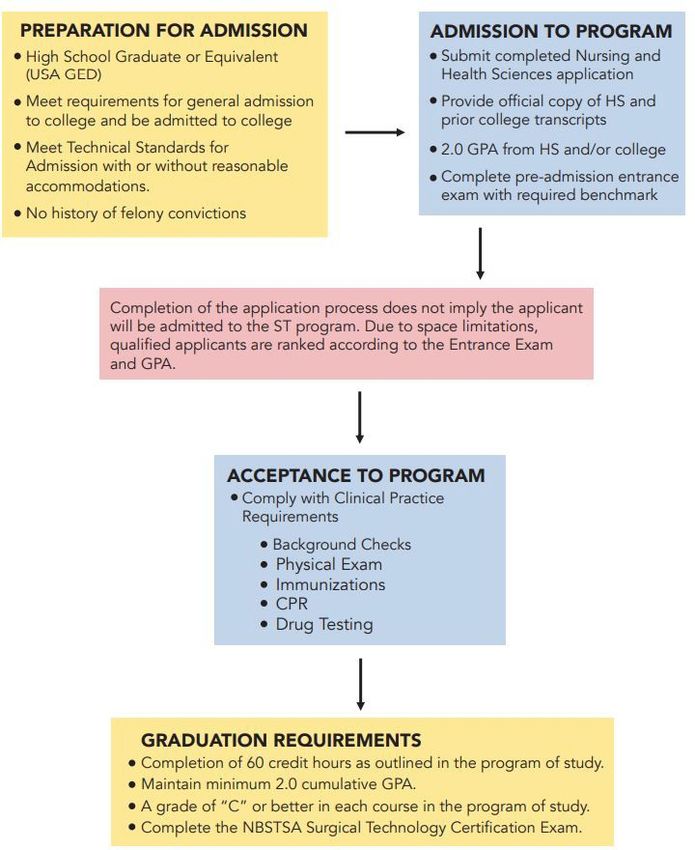
Applicants requesting admission to the A.A.S. Degree in Surgical Technology (ST) must first meet the
requirements for general admission to the college and be admitted to the college. The highest ranked
applicants meeting the ST program’s admission requirements before the May 1st deadline will be
admitted first; other qualified applicants will be placed on a waiting list. The first day of class, the
waiting list is dissolved. Because of the competition for space, meeting the admission requirements
does not guarantee admission to the ST program. Applicants who are not accepted and wish to be
considered for the following year will need to update their application by contacting the Nursing &
Health Sciences office.
Requirements for admission
1. Submit a completed Surgical Technology application to the Nursing & Health Sciences office.
a. http://www.wvup.edu/academics/health-sciences/surgical-technology/
2. Provide an official copy of High School transcript or a GED, and all prior college transcripts.
3. 2.0 grade point average (GPA) from high school or college courses.
4. Complete HESI A2 exam with a composite (overall) score of 65 or higher.
5. Be of good moral character and have no history of felony conduct or convictions.
6. Complete this process before the May 1st deadline.
7. The applicant must be able to engage in educational and training activities in a manner that
does not endanger themselves or others.
HESI A2 composite score must be within the last three (3) years to be valid. HESI A2 exam may be taken
one time per admission cycle for a maximum of three times for consideration for admission.
Physical standards
Important: The ability to perform under pressure in stressful and emergency situations is a
required attribute for surgical team members. Manual dexterity and physical stamina are essential.
Many of the responsibilities of the surgical technologist require standing, often for a number of hours;
therefore, the applicant must demonstrate the ability to fulfill these job requirements. As a surgical
technologist the student may be required to:
• Stand, bend, stoop and/or sit for long periods of time in one location with minimum breaks.
• Lift a minimum of 20 pounds.
• Refrain from nourishment or restroom breaks for periods up to 6 hours.
• Demonstrate sufficient visual ability to load fine suture onto needles and needle holders
with/without corrective lenses and while wearing safety glasses.
• Demonstrate sufficient peripheral vision to anticipate and function while in the sterile surgical
environment.
• Hear and understand muffled communication without visualization of the communicator’s
lips/mouth and within 20 feet.
• Hear activation/ warning signals on equipment.
• Detect orders sufficient to maintain environmental safety and patient needs.
Page 3• Manipulate instrument, supplies, and equipment, with speed, dexterity, and good hand-eye
coordination.
• Ambulate/ move around without assistive devices.
• Assist with and/or lift, move, position, and manipulate with or with assistive devices, the patient
who is unconscious.
• Communicate and understand fluent English both verbally and in writing.
• Be free of reportable communicable diseases and chemical abuse.
• Possess short and long term memory sufficient to perform tasks such as, but not limited to,
mentally tracking surgical supplies, and performing anticipation skills intra-operatively.
• Make appropriate judgments and decisions.
• Demonstrate the use of positive coping skills under stress.
• Demonstrate calm and effective responses, especially under emergency situations.
• Exhibit positive interpersonal skills in patient, staff, and faculty interactions.
(Derived from: AST, Surgical Technology for the Surgical Technologist, 5th edition, 2018, Delmar
Cengage Learning)
Working conditions
Students should expect the following working conditions while at the clinical sites:
• Exposure to anesthetic agents, radiation, and electrical energy may occur frequently.
• Exposure to extremes in humidity and temperature.
• Working around heavy, moving machinery.
• Exposure to solvents, grease, and oils.
• Working on uneven walking surfaces that may be slippery.
• Working with flames and burning items.
• Exposure to noise and vibrations.
• Exposure to blood and other potential infectious material.
• Wearing of safety glasses, face mask/shield, and protective clothing and gloves.
• Exposure to nudity and internal human anatomy.
Travel requirements
Students will be expected to attend surgical rotation off WVUP campus to maximize education
opportunities. Students will be expected to provide their own transportation to the facility providing
the opportunity for the student to complete surgical rotation. WVUP and the Surgical Technology
department are not liable for any motor vehicle accidents during off campus surgical rotation. Location
and duration of surgical rotations will be assigned at the discretion of the Program Director throughout
the program.
A.A.S. Surgical Technology Program Handbook
2021-2022
Revised 7/2021
Page 4Health status
Maintenance of personal health is the responsibility of each student for the protection of the student,
the patients and West Virginia University at Parkersburg. Therefore, the following must take place:
1. The completed physical form supplied by the Nursing & Health Sciences Division must be
submitted to this office by the deadline date specified in the admission letter. Failure to submit
the form will result in the student being dropped from the program,
2. All students are expected to submit proof of vaccinations and/or immunity for all required
immunizations as outlined in the clinical practice requirements,
3. Students who have not completed the Hepatitis B series prior to the first day of clinical will be
required to sign the Hepatitis B vaccination waiver form. Failure to sign the form will prevent
the student from attending clinical,
4. In the event that a student has a change in their health status, the Nursing & Health Sciences
chairperson must be notified as soon as possible. The student will not be permitted in the
clinical area until they submit a Nursing & Health Sciences Division Medical Release Form from
their health care provider. This form must state that the student can participate without
restrictions and can provide and can provide direct patient care safely with regard to themselves
and their patients.
5. Failure to have the form submitted to the Nursing & Health Sciences office by 4pm the day
before clinical will prevent the student from attending clinical.
6. West Virginia University at Parkersburg does not provide individual health and accident
insurance. The student is responsible for any expense incurred as a result of illnesses or
accidents including those that might occur in the clinical area.
7. Due to the exposure of certain chemicals and x-rays while in the clinical setting, the Surgical
Technology Program Director/Instructor must be notified when pregnancy is confirmed. The
health care provider must submit the Nursing & Health Sciences Medical Release Form stating
the expected date of delivery. The student must submit the same form when returning to
clinical post-partum.
Student Work Policy
Due to the academic and time requirements of the ST curriculum, students are encouraged to limit work
while they are enrolled in the ST program.
Students will not be excused from scheduled classroom, campus lab, or clinical experiences to go to
work. All activities required in the program must be educational and students must not be substituted
for staff. The student shall not be paid by the clinical agency during the clinical component of the
program. If a student is hired by a clinical agency, it is the student’s responsibility to schedule work
hours that do not interfere with assigned clinical experiences.
It is strongly recommended that hours worked are not night shift preceding a class, clinical, or
laboratory day. Class, campus lab, or clinical assignments will not be adjusted due to a work schedule.
A.A.S. Surgical Technology Program Handbook
2021-2022
Revised 7/2021
Page 5ACADEMIC MAP
Surgical Technology, A.A.S
Semester 1 The Associate of Applied
Science in Surgical Technology
COURSE CR COMMENTS prepares students to work under
COLL 101 ORIENTATION TO COLLEGE 1 the supervision of a surgeon to
assist the safe and efficient
BIOL 109 ANAT & PHYS FOR ALLIED HEALTH 4
performance of invasive surgical procedures
ST 100 INTRO TO SURGICAL TECHNOLOGY 6 and ensure the operative procedure is
ST 102 SURG INSTRUMENT, EQUIP & SUPPL 3 performed under optimal conditions for patient
NURS 153 Medical Terminology for Healthcare Careers 3 safety
TOTAL: 17 FIELD/CLINICAL COURSE: These
Semester 2 courses have a clinical
component that require a
COURSE CR COMMENTS background check on admission,
MATH 120 Quantitative Literacy (or higher) 3 drug testing, active CPR card,
and current immunizations.
ST 113 Pathophysiology of the Surgical Patient 4
ENGL 101 ~COMPOSITION 1 3 CAPSTONE COURSE:
ST 110 PATIENT CARE CONCEPTS 1 6 The course includes a 360- hour
preceptorship and a review for
TOTAL: 16
the NBSTSA Certification Exam.
Semester 3
COURSE CR COMMENTS NBSTSA Surg cal Technology Certification
ST 211 PATIENT CARE CONCEPTS 2 8 Exam is a course requirement of ST 212.
ST 114 PHARMACOLOGY FOR THE SURGICAL TECHNOLOGIST 3 Successful students earn the credential of a
Certified Surgical Technologist (CST)
COMM 112 SMALL GROUP COMMUNICATION 3
TOTAL: 14 Students should average 15
Semester 4 credit hours per semester, or 30
per year, to graduate on time.
COURSE CR COMMENTS
ST 212 SURGICAL TECHNOLOGY CAPSTONE 10
SOCIETY, DIVERSITY & CONNECTIONS GENERAL EDUCATION ELECTIVE 3
TOTAL DEGREE CREDITS:
TOTAL: 13
60
2021-2022General Education Courses
2021-2022Course Descriptions
ST 100 Introduction to Surgical Technology (6 hours)
This course is designed to introduce the student to the role, working environment, and required
skills of the ST. Asepsis, sterile technique, and surgical case management are emphasized in structured
campus laboratory and in the clinical setting. (Pre-requisites: Admission to the program; Co-requisites:
ST 102; Pre/Co-requisites: BIOL 109/109L)
ST 102 Surgical Instrumentation, Equipment, and Supplies (3 hours)
This course is designed to introduce students to the different classifications of instrumentation,
equipment, and supplies required to perform surgical procedures. Assembly of instrumentation will
help refine students’ manual dexterity and anticipatory skills. (Co-requisites: ST 100; Pre/Co-requisites:
BIOL 109/109L)
ST 110 Patient Care Concepts I (6 hours)
Diagnostic and surgical procedures in various surgical specialties will be discussed. The clinical
component will focus on developing skills in assisting team members and the organization of work by
learning to use economy of time, motion, and materials. ST 110 will introduce incisions, diagnostic and
surgical procedures, in various surgical specialties. (Pre-requisites: ST 100, ST 102, BIOL 109/109L. Co-
requisites: ST 113. Pre/Co-requisites: MATH 120)
ST 113 Pathophysiology of the Surgical Patient (4 hours)
This course will enable students to effectively communicate as a surgical team member utilizing
medical terminology. Introduction of disease and tumors will be discussed. Surgically treatable diseases
and disorders are emphasized. (Pre-requisites: ST 100, ST 102, BIOL 109/109l. Co-requisites: ST 110.
Pre/Co-requisites: MATH 120)
ST 114 Pharmacology for the Surgical Technologist (3 hours)
This course is designed to introduce the surgical technology student to their role in handling of
medications and solutions in the surgical setting. A discussion of medication use during the peri-
operative period will assist the learner in understanding patient response to various medications. (Pre-
requisites: ST 110, ST 113, MATH 120, ENGL101)
ST 211 Patient Care Concepts II (8 hours)
This course is a continuation of ST 110. The ST 211 clinical component provides solo scrub
experiences that promote anticipating needs and minimizing the patient’s exposure to trauma. (Pre-
requisites: ST 110, ST 113, MATH 120, ENGL 101. Co-requisite: ST 114)
ST 212 Surgical Technology Capstone (10 hours)
Independent first scrub roles and medication preparation in the clinical setting are emphasized.
Students will display the manual dexterity and physical stamina required in the employment setting.
Concentration will be directed toward anticipatory socialization and adaption to aid role transition from
student to graduate. (Pre-requisites: ST 211, ST 114, COMM 202. Certification Exam)
A.A.S. Surgical Technology Program Handbook
2021-2022
Revised 7/2021
Page 8Progress and Performance
Students may not withdraw from BIOL 109 or ST 102 and remain in ST 100. If a student withdraws from
any one of these courses, the student must withdraw from the other 2 courses. The student must earn
a minimum grade of “C” in BIOL 109, ST 100 and ST 102 before progressing to ST 110 and ST 113.
Students may not withdraw from ST 113 and remain in ST 110. If a student withdraws from any one of
these courses, the student must withdraw from the other course. The student must earn a minimum
grade of “C” in ST 110 and ST 113 before progressing to ST 114 and ST 211.
Students may not withdraw from ST 114 and remain in ST 211. Students must earn a minimum grade of
“C” in ST 114 and 211 before progressing to ST 212.
Students enrolled in WVU Parkersburg’s Associate Applied Science Degree Surgical Technology Program
must earn at least 78% of the total points possible for each of the surgical technology courses in order to
pass the course. Failure to achieve a 78% will result in a surgical technology course failure.
Grade Scale
A 92-100
B 85-91.99
C 78-84.99
D 70-77.99
F 0-69.99
A.A.S. Surgical Technology Program Handbook
2021-2022
Revised 7/2021
Page 9Dress Code
Definition: The West Virginia University at Parkersburg expects students to reflect professionalism
and maintain high standards of appearance and grooming in the clinical setting. While in
uniform, the student must be clean, neat, pleasant, and reflect good health. Clinical
faculty has final judgment on the appropriateness of student attire and corrective action
for dress code infractions. Students not complying with this policy will not be allowed to
participate in clinical and will receive an unsatisfactory clinical day for each incident.
Procedure:
• A navy blue scrub top and navy blue scrub pants are worn while in attendance at select clinical
and campus labs and scheduled activities.
• All students are required to maintain high standards of personal cleanliness. The student must
report to clinical well - groomed with clean hair, clean teeth and fresh breath and absent of
bodily odors. Deodorant/antiperspirant is a must. Students are not permitted to wear perfume,
colognes or body sprays in the clinical area. Makeup should conform to general body tones
avoiding extreme colors. Severe skin problems must receive medical treatment.
• Students are expected to come to the clinical area in full uniform. Full uniform includes:
• A pressed and freshly - cleaned uniform
• Hems of uniform bottoms must clear the floor
• Neutral colored undergarments
• White hose or socks (full length white hose will be worn with a dress or skirt uniform)
• Student college ID name tag are to be worn at all clinical sites
• Uniform shoes must be worn during the clinical experience. They are to be dark brown, dark
blue, black or white. The shoes must be clean and free of damage. Choose shoes that are
comfortable to stand in for long periods of time. The shoes must be leather; no canvas, mesh or
suede-like material is permitted. The shoe must be closed toe and closed heel. “Crocs are not
permitted. Shoes are to be carried into the clinical site.
• Jewelry is not permitted in the OR suite or campus lab. The student is advised to not wear any
jewelry as most facilities do not provide a safe place to lock up belongings.
• Fingernails must be clean and not extend beyond the tips of the fingers. Nail polish and artificial
fingernails are not permitted.
• Moustaches and beards must be neatly groomed and relatively close to the face to avoid
contaminating the work environment.
• Hair must be kept neat and clean. Hair should be tucked behind the ear to avoid contaminating
the work environment. If hair is shoulder length or longer, it must be restrained off of the collar.
Hair should conform to natural hair colors and avoid extreme styles. Hair restraints must be of a
neutral color and plain in design. Bows, ribbons, yarn or bandanas are not permitted.
• Students should refrain from getting a new tattoo on the areas of the hands and arms that
would be scrubbed. This open wound would be an infection control issue that would prevent
the student from scrubbing in during the campus lab or clinical setting, resulting in an
unsatisfactory for the days missed.
• Once in the OR suite, the student is to don hospital issued scrubs, jacket, shoes, and name
badge. The college uniform is not to be worn in the OR suite. Hair and shoe covers are to be
worn while in the OR suite.
A.A.S. Surgical Technology Program Handbook
2021-2022
Revised 7/2021
Page 10o Hospital issued scrubs are to be worn only in the hospital and not permitted outside of the
clinical facility. STS are not permitted to take home hospital issued scrubs.
o The STS is required to wear a hospital issued jacket, eye protection, and shoe and hair
covers while in the OR suite.
• Any student who does not follow these guidelines will not be permitted in the clinical area and
will receive an “Unsatisfactory” for that day.
• Personal Protective Equipment (PPE) must be worn and used appropriately. Any safety violation
is an “Unsatisfactory” for that day, and may be grounds for immediate dismissal from the
program.
Student Attendance for classroom, clinical and campus labs
Faculty must report class attendance in order for students to receive financial aid for the specific classes
of enrollment for the current semester. If students do not attend per class attendance policies, they risk
losing financial aid for this specific course. The Nursing & Health Sciences division subscribed to the
same attendance policies, as defined in the Handbook for West Virginia University at Parkersburg. As
noted in the Handbook, students are required to attend all classes.
Classroom and Clinical
Classroom attendance is expected. As stated in the West Virginia University at Parkersburg’s Student
Handbook, “Students must understand that final course grades can be adversely affected by a record of
excessive absences on the part of the student. Such a record of absence from class may result in a
student receiving a course grade of F.” The student is responsible for all content that they missed during
their absence. Classroom attendance will be taken weekly. All students will be graded on attendance (5
points per class session)
• Students are required to fax a weekly clinical time sheet from their assigned clinical site to the
Nursing and Health Sciences Division included in the Student Handbook by Friday of that
week.
• Excessive absences from clinical, defined as absences that exceed 6 hours for ST 100, 8 hours for
ST 110, 15 hours for ST 211 and 24 hours for ST 212 will result in the student repeating the
course.
• If clinical absences occur, the student will be administratively withdrawn.
• If a student is unable to attend a clinical experience, the Program Director/Instructor and clinical
site must be notified 1 hour prior to the start of clinical. The student will get the name of the
person to whom they reported their absence to at the facility. If the student does not call off to
report the absence, the student will receive an “Unsatisfactory” clinical day.
• Clinical make-ups will be scheduled at the discretion of the Program Director. The type of
clinical experience for the make-up will be determined by the Program Director. The student
will be required to submit a form signed by the preceptor at that facility to verify that the
A.A.S. Surgical Technology Program Handbook
2021-2022
Revised 7/2021
Page 11student attended the make-up day. If is possible that the Program Director will visit the site to
check on the students’ attendance.
• Faculty may deny a student attendance for the following reasons:
o Student is unprepared for patient care.
o Student appears either physically and/or psychologically ill.
o Student appears to be under the influence of drugs and/or alcohol.
o Student is unaware of his/her own limitations or fails to seek help when he/she recognizes
his/her limitations.
o Student exhibits illegal, unethical, or unprofessional behaviors.
o Student exhibits behaviors that jeopardizes safety towards themselves, patients or others.
In the event that the college cancels classes due to issues affecting the campus facilities/buildings, such
as a bomb threat, water line break, all Nursing & Health Sciences clinical scheduled off campus will
continue as scheduled. The student will be expected to attend and failure to do so will result in an
absence.
In the event that the college closes the campus due to severe weather, all classes, clinical and campus
labs will also be cancelled and will not count toward the student’s absences and will not be required to
be made up. If the instructor and students arrive to the off-campus clinical site after the college has
announced that the campus is closed, the instructor will decide if the experience will continue as
scheduled or if the experience will be cancelled. This decision will be made in consultation with the
Program Director and the Division Chairperson.
Campus lab
• Attendance is expected at all assigned campus labs. Any missed competency check off will be
rescheduled at the discretion of the instructor.
• It is the expectation that the student attends the assigned scheduled campus lab. Failure to do
so will result in an absence.
• A student who is absent from a campus lab needs to notify the Program Director/Instructor
prior to the start of the campus lab. The student is responsible for all information and skills
when absent from the campus lab. All campus labs will be made up at the convenience of the
Program Director/Instructor. Excessive absences from campus lab is 3 or more hours.
• Any test given in lab will be made up at the discretion of the instructor.
• After 3 unsatisfactory campus lab absences the student will be administratively withdrawn.
Tardiness
It is the expectation that the student will be on time for classroom, campus labs, and clinical. Any
student who is not in the OR suite, dressed and ready at the start of the shift designated by the clinical
facility will be considered late. This time will be counted toward the number of hours allotted to be
missed as described for each course.
A.A.S. Surgical Technology Program Handbook
2021-2022
Revised 7/2021
Page 12Testing Policy
It is the expectation that scheduled exams be taken on the scheduled day and time. Students unable to
take the exam are expected to notify the Program Director/Instructor by phone or email prior to the
scheduled start time of the exam. If the student fails to follow the testing procedure, the student’s
exam score will be reduced by 10% of the total exam points. Three or more missed exams will result in a
grade of “0” for those exams. The exception to this testing policy is ST 102 – Surgical Instrumentation,
Equipment, and Supplies. Any instrument test missed during ST 102 will not be available for a retake
exam and will result in a “0” for that exam. Students who earn less than 78% on an exam must
complete remediation which may include, but is not limited to, mandatory review of the exam
immediately after submission, study guides, case studies, tutoring sessions, and/or recommendation to
make an appointment with the Student Counseling Center.
If it is determined that a student has violated test security, program dismissal may be a consequence.
Evaluations and assessments will be based on the required resources approved by the Nursing & Health
Sciences division. If a student discovers a discrepancy between content presented in the classroom and
content within the required resources, it is the expectation that the student will report the discrepancy
to the Program Director/Instructor in writing for clarification. See the Testing Procedure in the
appendix.
Clinical Documentation
According to the current ARC-STSA Standards Interpretive Guide (SIG) Section III: Resources;
Standard III. C. Curriculum- Clinical Case Requirements, “Student clinical case logs must clearly indicate
the number and type of cases completed, the role of the student in each case, as defined in the CCST6e,
and the ability to verify each case (student, preceptor, [if applicable] and faculty signatures [or other
mechanism(s)/methods to ensure validity of log documentation] and dates).”
Surgical rotation case requirements for satisfactory completion of the surgical technology program
at West Virginia University at Parkersburg include:
Participation in a minimum of 120 surgical procedures
• 30 cases are required in general surgery, of which 20 cases must be in the first scrub role.
• 90 cases are required in surgical specialties, of which 60 cases must be in the first scrub role and
evenly distributed between a minimum of four surgical specialties. The maximum number of
cases that can be counted in any one surgical specialty is 15.
• Of the 90 cases required in the first scrub role, 60 are to be performed solo.
• The maximum number of second scrub cases that can be applied towards the 120 required
cases is 10 general surgery cases and 30 surgical specialty cases.
• The maximum number of 10 diagnostic endoscopy cases and 5 vaginal delivery cases can be
applied toward the second scrub role.
• Observation roles are to be documented on the Clinical Case Log but are NOT counted towards
the 120 required cases.
A.A.S. Surgical Technology Program Handbook
2021-2022
Revised 7/2021
Page 13It is the student’s responsibility to ensure that the clinical preceptor accurately records all clinical
case experiences in the Surgical Technology Clinical Case Log. Failure to comply with the established
clinical case requirements for the successful completion of this program will result in a clinical failure
as the final outcome for capstone course ST 212. The student is required to come to clinical prepared
with all of the appropriate materials (ID badges, attire, evaluations, case logs, etc.) necessary for clinical
assignments. Failure to come to clinical prepared can result in an ‘unsatisfactory’ on the Clinical
Performance Evaluation. In order to complete the ST program and be eligible to sit for certification
exam, the student must fulfill the prescribed number and type of cases.
Clinical evaluations
• Students will be evaluated periodically by the instructors on their performance of clinical
behaviors that reflect progress toward the achievement of the program and course outcomes.
Each program outcome is listed on the Clinical Performance Evaluation with expected behaviors
to be practiced by students and observed by instructors. Students will receive a formal graded
Clinical Performance Evaluation at mid-term and end-of-term for each semester of the program.
Students will be graded with a “5” for meets objective with no assistance, “4” for meets
objectives with assistance, a “3” for meets objectives with occasional assistance, or a “1” for
meets clinical objectives with repeated assistance. A student may receive a “2” at midterm
which indicates needed improvement for a satisfactory completion of the clinical components.
A “0” on the end-of-term evaluation indicates a clinical failure.
• A Daily Preceptor Evaluation on attainment of behavioral objectives will be initiated by the
student and completed by the clinical preceptor daily. These will be for a completion grade.
o All preceptor evaluations need to be returned to the ballot boxes provided to each
clinical facility by the college.
o The student will receive an average of the preceptor evaluations periodically throughout
each semester.
o An unsatisfactory clinical day indicated by the preceptor may result in an unsatisfactory
progression of clinical objectives on the Clinical Performance Evaluation.
o Any student who receives three (3) unsatisfactory clinical days on preceptor evaluations
within a course will receive a clinical failure for that course and will be required to
repeat the course the following academic year.
Accident/injury during clinical/campus lab
The student must follow this policy and procedure if they acquire a sharps injury, such as a
needle stick or cut by the surgical knife blade, during the surgical rotation. This does not pertain to an
injury acquired in the campus laboratory.
• Student is to immediately notify the preceptor and circulating nurse, wash the area of the injury,
and then report to the charge nurse.
• The student may be required to fill out the clinical facility’s incident report and go to the ER for
blood testing. It is the student’s responsibility to follow the facility’s policy on this matter.
A.A.S. Surgical Technology Program Handbook
2021-2022
Revised 7/2021
Page 14• The student must report to the WVUP Surgical Technology Program Director and complete an
Accident/ Injured Person Report on the day of the injury.
• The student is to give the program director a typed description of the occurrence which needs
to include the date and approximate time of the incident, clinical facility name, witnesses (if
any), brief description of the incident. A copy of the report will be kept in the student’s file
with the surgical technology program and in the Health Sciences Division Office.
• Any medical fees accrued from health care treatment provided to the student in response to the
incident are the student’s responsibility.
• Test will be graded with an 10% grade reduction from the earned score and the student has 3
class days to make up the exam. No student will be able to make up a third or fourth missed
test and will receive a score of zero for the missed test score.
• Students will be assigned seating for examinations.
Electronics
Cellphones
• Cell phones are not permitted in an OR setting. Cell phones should be left in a secured locker or
in the student’s vehicle. The University and/or clinical facilities will not be held responsible for
any lost, stolen, or damaged cell phones and/or other personal items.
• Cell phones, PDAs, or any other smart phone device are not permissible during tests and
quizzes. Any student caught using one of the previously mentioned devices during a test or
quiz will be subjected to the disciplinary actions mentioned for cheating in the Academic
Integrity policy of the Surgical Technology Student Handbook.
• Cell phones are not permitted to be out and used during class. Failure to do so will result in the
reduction of class attendance points for that day.
A.A.S. Surgical Technology Program Handbook
2021-2022
Revised 7/2021
Page 15Withdrawal
Once a student is admitted to the Surgical Technology Program at West Virginia University at
Parkersburg, it is expected that the program be completed in the prescribed 16 months. The maximum
length of time to complete the program can be no longer than two calendar years from the date of
initial admission to the program.
Any student who wishes to withdraw from the Surgical Technology Program must meet with the
Program Director/Instructor for guidance. Student’s failure to comply may result in the denial of future
re-admission requests to the program. If a student withdraws from the Surgical Technology Program,
they may apply for re-admission.
A.A.S. Surgical Technology Program Handbook
2021-2022
Revised 7/2021
Page 16West Virginia University at Parkersburg
Nursing and Health Sciences Division
Surgical Technology Program
Withdrawal Form
Student Name Student ID Number
Address
Phone Number
Reason for Failure to Progress:
Personal Reasons: Academic Reasons:
Career Change Theory Failure
Health Class Absence
Family Clinical Failure
Stress Clinical Absence
Financial Transfer
Job Other
Failure to progress from Course (s): (Circle) ST 100, ST 102, ST 110, ST 113, ST 114, ST 211, ST 212
Date
Eligible to Return? YES NO
Do you plan on returning to the program? YES NO
Action plan for return to program:
Please note you must notify the program in writing prior to intended date of return.
Date of notification of intent to re-enter program
I understand that I must apply for readmission to the program by the required date and that
readmission to the surgical technology program is based on availability of space and a review of my
records.
Signatures:
Student
Director
Date
A.A.S. Surgical Technology Program Handbook
2021-2022
Revised 7/2021
Page 17Re-admission to the Surgical Technology Program
Readmission to the ST program is based on availability of space, a review of past records, and
evidence that the student difficulty has been resolved. The student must submit a written request with
an action plan stating how they will be successful via an email to the chairperson of the Admission,
Progression and Graduation (APG) committee with 5 days of release of final grades in OLSIS.
A student who is readmitted to the ST program will be held to the current college catalog and
the ST Handbook in effect at the time of readmission.
A student may be granted readmission once as long as the program can be completed in the
required two (2) calendar years. A student unable to progress to the next semester, regardless of the
reason (withdrawal or course failure), for a second time, or exceeds the two calendar year limit for
completion, will be dismissed from the ST program. A ST course may only be repeated once. A student
who withdraws or earns less than the passing grade of “C” or 78% in the same ST course twice will be
dismissed from the ST program. Dismissal from the ST program renders the student ineligible for
readmission or return to the program. A student who is dismissed has the right to appeal. A grade of
“C” or better in all ST and required general education courses is required to qualify for graduation.
Students who have withdrawn from the ST program for more than once year must demonstrate
proficiency in order to return. The student is required to schedule time with the Program
Director/Instructor in order to determine the level of retention of information from the most recent
program course successfully completed by the student. The student is required to:
1. Take the final exam of the last semester the student successfully completed
a) The student will have two hours to complete the proctored, computerized exam
b) The student must pass the exam with a minimum score of 78%
2. Take a 200 point instrumentation exam in which the student will have to identify the
instruments, indicate the functions and specify the surgical specialties in which they are
used.
a) The student will have two hours to complete the exam
b) The student must pass the exam with a minimum score of 78%
3. The student will have to demonstrate competencies in lab skills required for the last
course they successfully completed or as directed by the Program Director.
a) The student will have the opportunity to repeat each skill once if they did not
successfully demonstrate proficiency on the first attempt
b) The student must perform each skill with a 95% accuracy by the second attempt
c) The student will have two hours to complete the assigned proficiency testing
4. Upon completion of all of the aforementioned requirements, the student’s retention
Scores and files from previous program enrollment will be submitted to the APG
committee for recommendation of readmission to the ST program.
A.A.S. Surgical Technology Program Handbook
2021-2022
Revised 7/2021
Page 18Social Justice Policy
West Virginia University at Parkersburg is committed to social justice as an Equal Opportunity/
Affirmative Action Institution. The Surgical Technology program concurs with that commitment and
expects to maintain a positive learning environment based upon open communication, mutual respect,
and non-discrimination. Our University does not discriminate on the basis of race, sex, age, disability,
veteran status, religion, sexual orientation, color, or national origin in the administration of any of its
educational programs, activities, or with respect to admission or employment. Any suggestions as to
how to further such a positive and open environment in this class will be appreciated and given serious
consideration. Further, faculty, staff, students, and applicants are protected from retaliation for filing
complaints assisting in an investigation under the WVU at Parkersburg Equal Opportunity Policy/
Affirmative Action Plan.
A.A.S. Surgical Technology Program Handbook
2021-2022
Revised 7/2021
Page 19Graduation Checklist
When you reach your final semester of coursework, there are a number of important tasks you
will need to be responsible to complete. For your convenience the following checklist was
created. It is your responsibility to insure you complete each step.
1. APPLY FOR GRADUATION
$25.00 Graduation Fee (non-refundable)
Complete an online graduation application by logging into your OLSIS account.
Deadline for December graduation: (See Center for Student Services).
Deadline for May graduation: (See Center for Student Services).
Failure to apply for graduation by the deadline date will result in a delay of graduation
by one semester or more.
Don’t forget to order your graduation regalia through the bookstore. Deadlines will
be posted throughout the college.
2. GRADUATION PICTURES
Price to be determined.
Class pictures are taken early in the last semester of the program - arrangements will be
made by the Nursing and Health Sciences Division Office.
3. COMMENCEMENT
Commencement ceremony is held at the completion of finals week in December and
May. You may participate in commencement after completion of the course of study.
The total college family participates, so seating is typically limited to a small number of
guests for each graduate.
Graduation regalia is available through the bookstore. You must place your order by the
posted deadline prior to graduation.
9. CELEBRATE!!!!!!!!!!!!!!!!!!!!!!!!!!!!!!!!!!!!!!!!!!!!!!!!
**All prices are subject to change.
A.A.S. Surgical Technology Program Handbook
2021-2022
Revised 7/2021
Page 20Graduation Requirements
1. Complete 60 credit hours as outlined in the Course of Study.
2. Maintain an overall grade-point of C (2.0) or higher in all courses required for the
associate applied science degree in surgical technology.
3. Complete the following courses in the curriculum with a grade of “C” or better. (ST 100,
102, 110, 113, 114, 211, 212; BIOL 109, ENGL 101; COLL 101, COMM 112, MATH 120,
Society, Diversity, and Connections Gen Ed Elective).
4. Complete a minimum of 15 credit hours with a minimum 2.00 grade point average at
WVU Parkersburg.
5. Complete an online graduation application by logging into your OLSIS account.
A.A.S. Surgical Technology Program Handbook
2021-2022
Revised 7/2021
Page 21Student Procedures
West Virginia University at Parkersburg
                             Nursing and Health Sciences Division

Procedure: Academic Honesty
Department: Surgical Technology                   Section: Student Procedures

Definition: Health Care professionals are to be open and honest, act with integrity and
  uphold the reputation of the profession. The people receiving health care must be able
  to trust the Health Care Provider with their health and wellbeing. Dishonesty is never
  justified.

Procedure:

   1. The student will maintain academic honesty when completing all learning activities.

   2. The student is expected to demonstrate honesty and integrity in all aspects of
      interaction with patients and their families; nurses, physicians, and other members
      of the health care team; instructors and college personnel; and colleagues.

   3. The student will admit to all errors involving patient care immediately to the clinical
      instructor.

   4. Violations of academic honesty include:

       Plagiarism:
       a. Representing the work of others as their personal work,
       b. Failure to use quotation marks when directly quoting from the work of others,
       c. Failure to document the ideas of others if paraphrasing a citation,
       d. Inventing or providing false documentation of sources,
       e. Use of a paper/assignment completed in one course as a paper/assignment in
          another course without disclosing to the faculty,
       f. Purchasing a paper online or from another student and submitting as your own.

       Cheating:
       g. Use of any unauthorized assistance in taking quizzes or examinations,
       h. Use of any unauthorized sources in written assignments or carrying out assignments
       i. Sharing test content with other students who are to take the test,
       j. Unauthorized possession of a test or portion of a test prior to, during, or after
          completion of an examination or quiz,
       k. Falsifying or altering attendance records, grades, and/or other official documents,
       l. Falsifying all or part of any clinical record,
m. Giving assistance to others who are participating in dishonest behaviors,
n. Failure to report known or suspected academic dishonesty.
Other:
o. Stealing, modifying or destroying materials which other students may need access to
such as computer discs or library material,
p. Failure to report patient-care errors to the instructor in the clinical setting,
q. Copying and removing client records from the clinical setting,
r. Failure to maintain client confidentiality, and
s. Stealing drugs or clinical agency supplies.
This list of offenses is not intended to be fully exhaustive of all potential instances of
academic dishonesty. Faculty and administrators may identify cases of academic
dishonesty not herein contemplated.
5. A violation of this policy will result in the initiation of the Academic Dishonesty
Policy found in the WVU Parkersburg College Catalog.
6. WVU Parkersburg has zero tolerance regarding academic dishonesty. Students in
violation of this policy will be dismissed from the WVU Parkersburg’s Nursing
Program and receive the grade of an “F” for the course.
7. Students dismissed from the surgical technology program are not eligible to
reapply for readmission.West Virginia University at Parkersburg
Nursing and Health Sciences Division
Procedure: Chain of Command
Department: Surgical Technology Section: Student Procedures
Definition: Students may have concerns during their educational experiences within the surgical
technology experience. Any student enrolled in the surgical technology program who
believes he/she has been treated unfairly or has encountered an injustice has the right to
address the situation. Dealing with issues and concerns is a vital component of the surgical
technology profession and is an important part of a student’s professional development.
Any surgical technology student enrolled in a course that develops any issues or concern is
encouraged to resolve their issue/concerns in a timely manner following their chain of
command.
Procedure: Steps to follow within the Chain of Command for unresolved issues:
Step 1: Unresolved issues should first be discussed with the person or instructor with whom you
have the issue. Concerns and issues need to be presented with objective data in a constructive
manner.
Step 2: If the issue remains unresolved, the student will request a meeting with the Surgical
Technology Program Director.
Step 3: If the issue remains unresolved, the teaching team will facilitate a meeting between the
Nursing and Health Science Division Chair, teaching team and student.
Step 4: If the issue remains unresolved, the student will consult the West Virginia University at
Parkersburg’s Student Handbook for Answer Book Policy #VI-3 Student Concerns and Answer Book
Policy #V-13 Student Academic Rights and Responsibilities.
Only the student involved in the unresolved issue will be permitted to be present during Steps 1-3
above
When students seek assistance from someone outside the procedure as outlined, the individual
contacted should listen to the student(s) concerns, inform them of the appropriate mechanism for
dealing with the concern, and identify with the student the appropriate person(s) to contact and
process to follow.
Under no circumstance should an issue be shared with students or faculty not involved in the
situation.You can also read


