Westfield Primary Academy - Phonics Policy Review Date: November 2020 Next Review Date: Autumn 2021
←
→
Page content transcription
If your browser does not render page correctly, please read the page content below
WF Phonics Policy 2020-21

    Westfield Primary Academy

                      Phonics Policy
                    Review Date: November 2020
                  Next Review Date: Autumn 2021

                     Phonics Lead: Sarah Abbott
     English Strategic Lead: Fiona-Catherine Thompson
WF Phonics Policy 2020-21

                        Westfield Primary Academy’s Phonics Policy

                                         INTENT
At Westfield Primary Academy our aim is:
   • To establish consistent teaching, progression and continuity in the teaching and
     learning of phonics throughout the school.
   • To provide a language rich environment that encourages and develops oracy
     and literacy skills that are the cornerstone of our curriculum, starting the Nursery
     Class and continuing throughout the school.
   • To ensure that systematic synthetic phonics, following the Letters and Sounds
     programme, is taught to children to enable pupils to:

           -   Recognise, say and write all phonemes within each phase 2-5 of Letters and
               Sounds.
           -   Apply and understand spelling patterns , e.g suffixes, prefixes, that are
               taught through phase 3 in year 2.
           -   Use their phonic knowledge to blend and segment phonetically decodable
               words.
           -   Use their phonic knowledge to read complex words and to recognise from
               sight ‘Tricky Words’ (High Frequency Words).
           -   Read with fluency for both pleasure and to retrieve information.
           -   Write clearly, accurately and coherently using phonic knowledge.

   •   For pupils to apply their phonic knowledge in their reading and writing across the
       whole curriculum when they enter Key Stage 2.
   •   To have robust assessment procedures to regularly check progress and identify
       pupils in need of intervention.
   •   To promote reading for pleasure with exposure to a range of texts.
                                    IMPLEMENTATION
In order to implement our intent, we have a scheme of work (Letters and Sounds) that is
used throughout the school to teach phonemes, tricky words and specific and relevant
vocabulary related to phonics.
    • Phase 1 phonics is taught in Nursery to embed listening skills, sound identification
      and rhyming and rhythm awareness. There is large emphasis on develop speech
      and language skills and teaching oral blending and segmenting.
    • Daily 20 minute phonic sessions in Reception and KS1 and regular small group
      interventions in KS1 and 2.
    • Well planned discrete phonics sessions taught using the ‘sequence of teaching’
      structure as set out in the Letters and Sounds document:
              Revisit – recap on previously taught sounds.
              Teach – teach a new sound or word.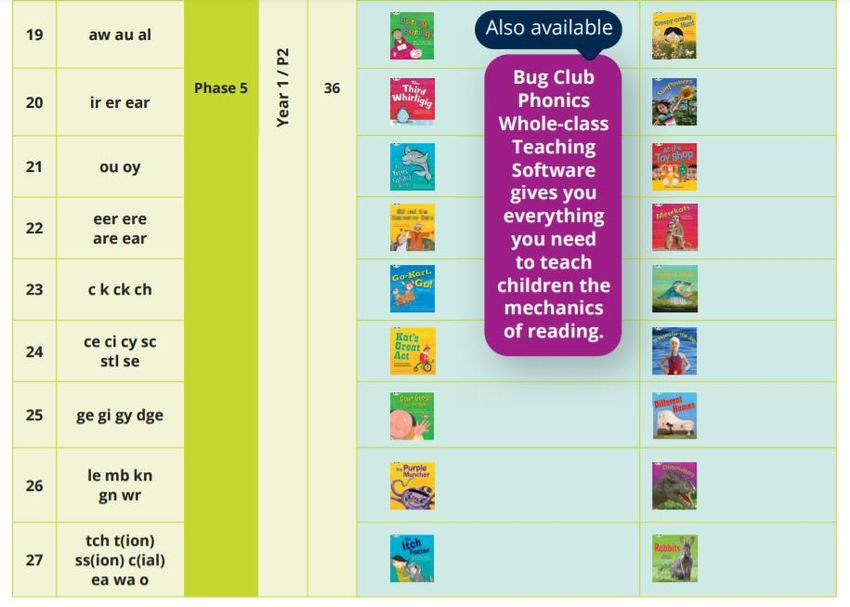
WF Phonics Policy 2020-21

           Practise – provide opportunities to practise saying and reading the sound
           through games and activities for children.
           Apply – apply the new skill to read and write words, captions and
           sentences.
•   A school overview of which order and when to teach each phase from Letters
    and Sounds (see Appendix A).
•   Fast paced, multi-sensory lessons, encompassing visual, auditory and kinaesthetic
    activities to engage children and keep lessons fast paced and exciting.
•   New phonemes are introduced and modelled using a pre-agreed action (see
    Appendix B)
•   Lessons will use cooperative learning techniques to ensure all children participate
    fully.
•   High frequency words (or tricky words) are taught as set out in Letters and Sounds.
•   Phonetic vocabulary is explicitly taught and referred to by staff and pupils within
    lessons, e.g. digraph, trigraph, tricky words, phonemes.
•   Ensure sounds taught are ‘pure’ and soft sounds. e.g. sss not ‘suh’ as this is central
    to phonics teaching and the children’s ability to blend and segment sounds in
    words.
•   Arrange seating carefully during sessions, so that pupils are seated where they
    can clearly see the adult’s mouth to support the correct pronunciation of sounds.
•   Phoneme buttons are used in phonics teaching to
    distinguish the sounds within words and support
    reading.
•   Ensure Staff are trained, supported and regularly
    observed to ensure consistency of teaching across the school.
•   Developed working wall, phonics displays that include previously learnt
    phonemes and tricky words and display the sound being taught in each lesson.
    Children will be encouraged and taught to engage with these displays to
    reinforce their learning in the daily sessions and to support writing and reading
    across the curriculum.
•   Flash cards and displays follow pre cursive or cursive font to reflect our
    handwriting policy.
•   LSAs involved within the daily phonics sessions to support pupils in their phonics
    activities and to help the teacher to assess the pupil’s phonic abilities.
•   a thorough assessment procedure to track and monitor children’s progress in
    developing and applying their phonics knowledge. Children are tracked using the
    Letters and Sounds assessment sheets and Trust agreed assessments which include
    Year 1 pupils completing a sample phonics screening past paper each half term.
    Children in Year 2, who did not pass the phonics screening test in Year 1 will also
    complete a past paper each half term. The data from these assessments is
    analysed and used to identify gaps and inform planning for interventions. Staff
    submit tracking sheets to Phonics Subject Lead and the English Leader for
    monitoring and guidance.
•   Regular interventions that are carefully planned are delivered regularly for
    children in Year 1 and 2 by experienced class teachers and LSAs. Interventions
    continue into KS2 if children do not pass the phonics screening test in Year 2.
WF Phonics Policy 2020-21

•   Books within the school are phonetically decodable and include tricky words.
    They are sequenced in the same order as the Letters and Sounds Programme and
    children are provided range of texts including fiction, non-fiction and traditional
    tales. (Appendix C)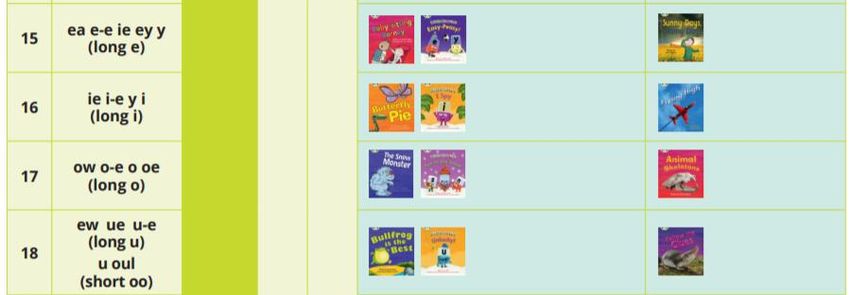
WF Phonics Policy 2020-21

           Appendix A:

                                       Appendix A:

Reception

Autumn
Term

Reception

Spring Term

Reception -
Summer
Term

Year 1

Autumn 1

Year 1

Spring &
Summer
Term
WF Phonics Policy 2020-21

Appendix B:

              Actions used to accompany introduction of phonemes.
s ss - Weave hand in an s shape, like a snake, and say sssss
a - Wiggle fingers above elbow as if ants crawling on you and say a.
t - Turn head from side to side as if watching tennis and say t.
i - Pretend to be a mouse by wriggling fingers at end of nose and squeak i.
p - Pretend to puff out candles and say p.
n - Make a noise, as if you are a plane - hold arms out and say nnnnnn.
c k (c, k) - Raise hands and snap fingers as if playing castanets and say ck
e - Pretend to tap an egg on the side of a pan and crack it into the pan, saying eh.
h - Hold hand in front of mouth panting as if you are out of breath and say h
r - Pretend to be a puppy holding a piece of rag, shaking head from side to side,
and say rrrrrr.

m - Rub tummy as if seeing tasty food and say mmmmmm.
d - Beat hands up and down as if playing a drum and say d.
g - Spiral hand down, as if water going down the drain, and say g.
o - Pretend to turn light switch on and off and say o.
u - Pretend to be putting up an umbrella and say u.
l, ll - Pretend to lick a lollipop and say l
f, ff - Let hands gently come together as if toy fish deflating, and say f.

b –Pretend to hit a ball with a bat and say b.
ai - Cup hand over ear and say ai
j - Pretend to wobble on a plate and say j.
oa - Bring hand over mouth as if you have done something wrong and say oh!
igh - Stand to attention and salute, saying ie.
ee or - Put hands on head as if ears on a donkey and say eeyore.z,

z zz - Put arms out at sides and pretend to be a bee, saying zzzzzz.
w - Blow on to open hand, as if you are the wind, and say wh.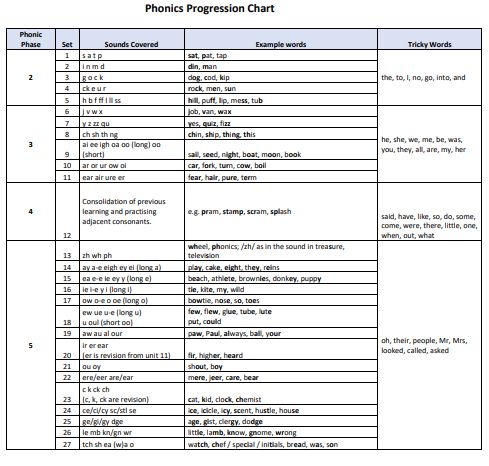
WF Phonics Policy 2020-21

ng - Imagine you are a weightlifter, and pretend to lift a heavy weight above your
head, saying ng.

v-   Pretend to be holding the steering wheel of a van and say vvvvvv.

oo oo - Move head back and forth as if it is the cuckoo in a cuckoo clock, saying
u, oo (little and long oo).

y - Pretend to be eating a yogurt and say y
x - Pretend to take an x-ray of someone with an x-ray gun and say ks.
ch - Move arms at sides as if you are a train and say ch.
sh - Place index finger over lips and say sh.
th - Pretend to be naughty clowns and stick out tongue a little for the th, and further
for the th sound (this and thumb).

qu - Make a duck's beak with your hands and say qu.
ow-   Pretend your finger is a needle and prick thumb saying ow

oi -Cup hands around mouth and shout to another boat saying oi!
er -Roll hands over each other like a mixer and say er.
ar - Open mouth wide and say ah. (Flap hands as if a seal, say ar.
ur - Hold knee as if hurt and say ur,

air - Brush hair and say air.
ear - Touch ear and say ear.
ure - Hold nose as if you were smelling manure and say ure.

(Each class teacher and LSA to have a supporting PowerPoint)
WF Phonics Policy 2020-21

Appendix C:

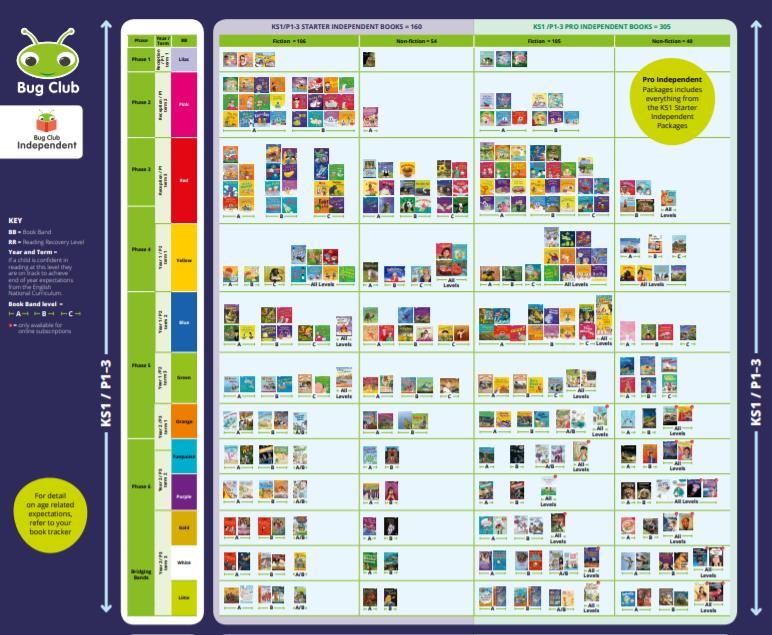
                            Bug Club Reading Scheme
WF Phonics Policy 2020-21 Appendix D:
WF Phonics Policy 2020-21
You can also read


