What is adaptive radiation? - Mugberia Gangadhar ...
←
→
Page content transcription
If your browser does not render page correctly, please read the page content below
NEET (/neet/) > NEET Study Material (/neet/neet-study-material/) > NEET Biology (/neet/neet-biology/) > Adaptive Radiation (/neet/important-notes-of-biology-for-neet-
adaptive-radiation/)

       What is adaptive radiation?

Adaptive radiation is the evolutionary diversification of many related species from a common ancestral species in a relatively short
period. Osborne (1902) coined the term “Adaptive Radiation”. He stated that each large and isolated region, with sufficiently varied
topography, soil, vegetation, climate, will lead to organisms with diverse characteristics. Darwin had called it “Divergence”, i.e. the
tendency in an organism descended from the same ancestor to diverge in character as they undergo changes. Adaptive radiation
plays a significant role in macroevolution. Adaptive radiation gives rise to species diversity in a geographical area.

Adaptive Radiation Causes:
Adaptive radiation is more common during major environmental changes and physical disturbances. It also helps an organism to
successfully spread into other environments. Furthermore, it leads to speciation. Moreover, it also leads to phenotypically dissimilar,
but related species. Major causes of adaptive radiation are:
       Ecological opportunities: When an organism enters a new area with lots of ecological opportunities, species diversify to
       exploit these resources.
            When a group of organism enter a new adaptive zone then organisms tend to adapt themselves differently. It results in
            adaptive divergence
              An adaptive zone is an unexploited area with numerous ecological opportunities, e.g. nocturnal flying to catch small
              insects, grazing on the grass while migrating across Savana, and swimming at the ocean’s surface to filter out Plankton
              Vacant adaptive zones are more common on islands, as fewer species inhabit islands compared to mainland
              When adaptive zones are empty, they get filled by species, which diversify quickly, e.g. Cichlids of African Great Lakes,
              Darwin’s Finches of Galapagos island, Hawaiian honeycreepers, etc.
       Mass extinction: When there is mass extinction due to major environmental changes or physical disturbances it may lead to
       adaptive radiation due to various reasons.
           Extinction produces empty adaptive zones which provide new opportunities to species that remain, e.g. after the
           extinction of dinosaurs, mammals quickly diversified and exploited various adaptive zones
              As a result of the extinction of competition, species that remain, flourish, e.g. mammals had coexisted with reptiles but
              they were very small so that they could hide and save themselves from giant dinosaurs
       Acquisition of novel adaptive traits: Evolutionary innovation may trigger adaptive radiation.
           Evolutionary novelties are a variation of pre-existing structures, called “preadaptations”. A change in the basic pattern
           produces something unique, which adapts to a different role. E.g.
                 Feathered wings on birds, which evolved from reptilian scales, represent preadaptation of flight
                       Flowers on plants speeded up the ability to engage in sexual reproduction and took great advantage of terrestrial
                       animals for pollination and increased the reproduction rate
                       Amniotic egg
                       Wings on insects
              A slight alteration in regulatory genes or gene mutation can result in major structural changes in the organism, e.g. adult
              of some salamander species retain external gills and tail fin throughout life (pedomorphosis), which is found only in larval
              stages. These features alter salamander’s behavioural and ecological characteristics. It is caused due to gene mutation
              which blocks the production of hormones responsible for metamorphosis. The pedomorphic forms can escape their
              typical terrestrial predators.

Adaptive Radiation Examples:
1. Adaptive Radiation in Mammals:
       Adaptive radiation in placental (eutherian) mammals: Placental mammals illustrate a great example of adaptive radiation,
       where multiple diverse forms have developed from the common lineage of a primitive, short-legged,, insectivorous, rat-like
       creature, that coexisted with dinosaurs. Extinction of dinosaurs triggered a global adaptive radiation event that resulted in the
       rich mammal diversity that exists today. Adaptive radiation in mammals followed 5 different lines with respect to limb
       structure:
                i. Arboreal: Limbs adapted to live on trees (scansorial legs), e.g. squirrel, monkeys, etc.
               ii. Aerial: Limbs adapted for flying, eg. bats. Gliding mammals like flying squirrels
              iii. Cursorial: Limbs suitable for rapid movement
1. Plantigrade– walking with the whole sole on the ground, e.g, bears, primates, human beings
2. Digitigrade– Digits touch the ground, e.g. lion, tiger, cat, leopard, dog
3. Unguligrade– animals having hoofs. They walk on the tips of their fingers or toes, e.g.
a. Artiodactyls– They have double hoofs, e.g. cattle, buffaloes, sheep, etc.
b. Perissodactyls– They have one hoof, e.g. horses, zebras
iv. Fossorial: Burrowing mammals, e.g. moles, badgers
v. Aquatic: Limbs adapted for living in water, e.g whales, porpoises. Seals, walrus, sea lions can move on land as well.
Polar bears can walk and swim equally well
Adaptive radiation is also applied to teeth structure or mode of feeding in mammals.
Adaptive radiation in marsupial (metatherian) mammals: Australian Marsupials show a great diversity. They are a classic
example of adaptive radiation. There is a wide variety of marsupials that evolved on the Australian continent
1. Grazing – Kangaroo
2. Burrowing- Marsupial moles
3. Arboreal- Koala, tree kangaroo
4. Teeth like rodents- Wombats, marsupial rats
5. Rabbit-like – Hare wallabies
. Wolf-like – Tasmanian wolves
7. Ant eating – Banded anteater
. Badger-like – Tasmanian Devil
Marsupials exhibit adaptive radiation into varieties of animals. Each of which appears to be similar to the corresponding
placental mammal. This is called “convergent evolution”. It happens when the two unrelated species develop the same
features because they live in similar habitats.
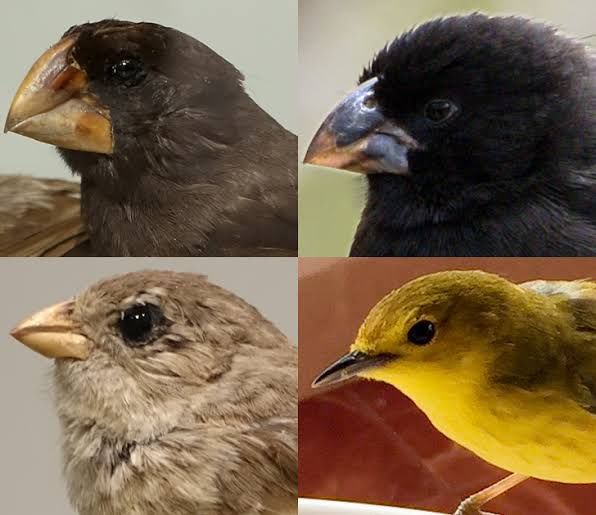
2. Adaptive radiation in Darwin’s Finches:
Darwin’s Finches
Galapagos Islands are a chain of islands resulting from volcanic action. These islands were never connected to mainland South
America. Darwin’s finches descended from small sparrow-like birds that once inhabited the mainland and migrated to Galapagos
islands.
There are around 14 distinct species present, each well adapted to a specific niche
Not all the species are found on each island
Size and shape of their beaks differ markedly which correlates to their feeding habits
Some are specialised for crushing seeds (ground finches) whereas others to eat insects (tree finches)
Small beaked finch feed on small grass seed, those feeding on hard fruit have large beaks, cactus eating finches have thicker,
decurved, flower-probing beaks
Woodpecker finch possesses a stout straight beak3. Cichlids of African Great Lakes: There are more than 2000 species of cichlids fishes found in these lakes, which are a
remarkable example of adaptive radiation. They have varied morphological characteristics and play various roles like predators,
herbivore, scavengers. Their head shape and dentition varies according to their dietary habits.
4. Adaptive radiation in reptiles: Adaptive radiation in reptiles occurred between the Permian and Cretaceous era. They ruled over
the land in the Mesozoic era, which is also referred to as the “Age of Reptiles”. The initial success of the reptiles is due to the
evolutionary shift from aquatic to completely terrestrial development, i.e. amniotic eggs of reptiles. Variety of reptiles blossomed
from Cotylosauria (stem reptile).
5. Adaptive radiation in Hawaiian honeycreepers: These are a group of related birds found in the Hawaiian Islands. Honeycreepers
diversified quickly and occupied the available adaptive zones. There were more than 50 species found, of which only 17 species
remain today. Many species went extinct after the discovery and subsequent colonisation of the island. Their beaks are specialized
to satisfy their dietary requirements. Some are curved to extract nectar out of tubular flowers, whereas others are short and thick to
rip away bark of trees in search of insects.
6. Adaptive radiation in Hawaiian silverswords: There are 28 species of closely related plants found in the Hawaiian Islands. There
were diverse environmental conditions present, such as cool, arid mountains, shady moist forests, wet bogs, dry woodlands,
exposed lava flows, which were unoccupied when the ancestor of silverswords reached the Islands. Silverswords rapidly diversified
in structure and physiology to occupy the main adaptive zones. The diversity of their leaves is a good illustration of adaptive
radiation.
Leaves of the plants in shady and moist areas are large, whereas silverswords in arid areas have small leaves
The leaves of silverswords present on volcanic slopes are covered with dense silvery hairs that may reflect intense UV
radiation off the plant
NEET Related Links
Top Medical Colleges in India (https://byjus.com/neet/top-medical-colleges-in-
NEET Application Form (https://byjus.com/neet/neet-application-form/)
india/)
NEET 2018 Question Paper (https://byjus.com/neet/neet-2018-question-paper/) NEET Question Paper (https://byjus.com/neet/neet-question-papers/)
NEET Question Paper 2019 (https://byjus.com/neet/neet-2019-question-paper/) NEET 2020 Exam Date (https://byjus.com/neet/neet-exam-date/)
NEET Biology Mcq (https://byjus.com/neet/neet-biology-mcq/) NEET Sample Paper (https://byjus.com/neet/neet-sample-papers/)
NEET Preparation (https://byjus.com/neet/neet-preparation/) NEET Syllabus (https://byjus.com/neet/neet-syllabus/)
(https://byjus.com/byjus-classes-jee-neet-features-free-trial/?utm_source=website&utm_medium=neet&utm_campaign=NEET-sidebar)
Popular Articles
NEET 2021 (https://byjus.com/neet/neet-2021/)
NEET Syllabus (https://byjus.com/neet/neet-syllabus/)
NEET Application Form 2021 (https://byjus.com/neet/neet-application-form/)
NEET Admit Card (https://byjus.com/neet/neet-admit-card/)
NEET Registration 2021 (https://byjus.com/neet/neet-registration/)NEET Preparation Tips (https://byjus.com/neet/neet-preparation-tips/) NEET Question Papers (https://byjus.com/neet/neet-question-papers/) NEET Sample Papers (https://byjus.com/neet/neet-sample-papers/) NEET Books (https://byjus.com/neet/neet-books/)
(https://students.byjus.com/oauth/authorize?
redirect_uri=https%3A%2F%2Flearn.byjus.com%2Fcallback%3Freferrer%3Dmx_Source_of_Lead%253DByjusWeb%2526mx_Campaign_Type%253D_UTM_CAMPAIGN_TYPE_%
(https://students.byjus.com/oauth/authorize?
redirect_uri=https%3A%2F%2Flearn.byjus.com%2Fcallback%3Freferrer%3Dmx_Source_of_Lead%253DByjusWeb%2526mx_Campaign_Type%253D_UTM_CAMPAIGN_TYPE_%

Join BYJU'S Learning Program
 Name

 Mobile Number

 City / Town
Grade/Exam

     Email Address

     Submit

Leave a Comment
Your Mobile number and Email id will not be published. Required fields are marked *
                                                                                                                                                                  *

    Mobile Number                                                                                                                                Send OTP

                                                                                                                                                                  *

   Please don't use any HTML or external links in the comment box.

   Post Comment

COURSES                                                                              EXAMS

CBSE (/cbse/)                                                                        CAT Exam (/cat/exam-info/)

ICSE (/icse/)                                                                        IAS Exam (/ias-exam/)

CAT (/cat/)                                                                          UPSC Syllabus (/ias/upsc-syllabus/)

IAS (/ias/)                                                                          UPSC 2021 (/free-ias-prep/upsc-2021/)

JEE (/jee/)                                                                          Bank Exam (/bank-exam/)

NEET (/neet/)                                                                        Government Exams (/govt-exams/)

Commerce (/commerce/)
                                                                                     CLASSES
JEE Main (/jee/jee-main/)

NCERT (/ncert/)                                                                      Class 1st - 3rd (/disney-byjus-early-learn/)

JEE Advanced (/jee-advanced/)                                                        Class 4th - 5th (/class-4-5/)

CBSE Sample Papers (/cbse/cbse-sample-papers/)                                       Class 6th - 10th (/class-6-10/)

CBSE Question Papers (/cbse-study-material/cbse-previous-year-question-paper/)       Class 11th - 12th (/class-11-12/)

EXAM PREPARATION                                                                     COMPANY

Free CAT Prep (/free-cat-prep/)                                                      About Us (/about-us/)

Free IAS Prep (/free-ias-prep/)                                                      Contact Us (/contact-us/)

Maths (/maths/)                                                                      Investors (/our-investors/)

Physics (/physics/)                                                                  Careers (/careers-at-byjus/)

Chemistry (/chemistry/)                                                              BYJU'S in Media (/press/)

Biology (/biology/)                                                                  Students Stories - The Learning Tree (https://blog.byjus.com/the-learning-
                                                                                     tree/)

RESOURCES                                                                            Faces of BYJU'S – Life at BYJU'S (https://blog.byjus.com/life-at-byjus/)

Blog (https://blog.byjus.com/)                                                       Social Initiative - Education for All (/educationforall/)
Videos (/videos/)                                                                    BYJU'S APP (/byjus-the-learning-app/)
( ) ( yj g pp )
All Products (https://shop.byjus.com)
DSSL (/about-dssl/)
FREE TEXTBOOK SOLUTIONS STATE BOARDS
(/textbook-solutions/) Maharashtra (/msbshse/)
NCERT Solutions (/ncert-solutions/)
Gujarat (/gseb/)
NCERT Exemplar (/ncert-exemplar/)
Tamil Nadu (/tn-board/)
NCERT Solutions for Class 6 (/ncert-solutions-class-6/)
Karnataka (/kseeb/)
NCERT Solutions for Class 7 (/ncert-solutions-class-7/)
Kerala (/kbpe/)
NCERT Solutions for Class 8 (/ncert-solutions-class-8/)
Andhra Pradesh (/ap-board/)
NCERT Solutions for Class 9 (/ncert-solutions-class-9/)
Telangana (/telangana-board/)
NCERT Solutions for Class 10 (/ncert-solutions-class-10/)
Uttar Pradesh (/upmsp/)
NCERT Solutions for Class 11 (/ncert-solutions-class-11/)
Bihar (/bihar-board/)
NCERT Solutions for Class 12 (/ncert-solutions-class-12/)
Rajasthan (/rajasthan-board/)
RD Sharma Solutions (/rd-sharma-solutions/)
Madhya Pradesh (/mp-board/)
RS Aggarwal Solutions (/rs-aggarwal-maths-solutions/)
West Bengal (/west-bengal-board/)
ICSE Selina Solutions (/icse/selina-solutions/)
FOLLOW US
(https://www.facebook.com/byjuslearningapp/) (https://in.linkedin.com/company/byjus)
Disclaimer (/disclaimer/) Privacy Policy (/tnc_app/#privacydesc) Terms of Services (/tnc_app/#tncdesc) Sitemap (/sitemap.xml)
© 2021, BYJU'S. All rights reserved.You can also read


