What's next for Financial Services in Canada? - Banking and the new digital era: A Commercial Real Estate Perspective - GWL Realty ...
←
→
Page content transcription
If your browser does not render page correctly, please read the page content below
Banking and the new digital era:
What’s next for Financial
Services in Canada?
A Commercial Real Estate Perspective
DECEMBER 2016

                                  A COLLABORATIVE REPORT FROM:
At a 3. WHAT IS THE REAL ESTATE
GROWTH OUTLOOK FOR
5. WHY TORONTO
IS IMPORTANT
Glance FINANCIAL SERVICES?
It is expected that the Financial Services sector will
continue to be a key driver of demand for office
Toronto continues to strengthen as a key Financial
Services hub. Over the last 15 years, Toronto has
accounted for over half of all Financial Service job
space over the long term. Short term sector growth growth in Canada. Centralization of head office
however, will be at a slower pace than what has been employment, a clustering of financial technology
1. REPORT FOCUS seen in the past. While financial institutions con- activity and new risk management and compliance
tinue to bolster their technology and compliance functions has been driving this trend. Accordingly,
This report between GWL Realty Advisors and staff, they are also consolidating and automating Toronto will continue to be a focal point for real
CBRE Limited takes a detailed look at Financial processes where possible. Financial Services will be estate demand for the sector. In other cities, Finan-
Services, focusing on key trends and themes for defined by efficient growth going forward. cial Services will still be an important source of
the sector and their expected real estate impacts. office demand, but industries such as Technology,
Health Care and Professional and Business Ser-
vices are expected to play increasingly larger roles.
4. THE IMPACT OF
TECHNOLOGY
2. HOW WELL IS THE
CANADIAN FINANCIAL Technology continues to play an important but
complex role in the sector. Financial institutions are
SERVICES SECTOR
PERFORMING? investing significant amounts of capital to modern- 6. WHAT ARE THE
ize operations due to the rise of digital technologies IMPLICATIONS?
Generally, the Financial Services sector is in a stage and a changing consumer demographic. A new
of slow but stable growth in terms of financial category of financial technology or “Fintech” firms For real estate managers and investors, there is a
performance and employment. The sector added have also emerged, changing the composition of wide range of market opportunities and recom-
35,200 new jobs over the last five years represent- the industry. As for the expected impact of Fintech, mendations. A focus on accommodating changing
ing a 5.1% growth rate. This is in contrast to the some firms are competitive to traditional financial workplace strategies will be integral. New devel-
pre-Global Financial Crisis total of 98,300 new jobs institutions, while some are collaborative—there is opment, as well modernization of existing office
and 17.8% growth from 2003-2008. New risk man- no single path as to how the sector will evolve. Over- assets will be important to this strategy. With
agement and compliance rules, as well as a slower all, a key expectation is that the Financial Services Financial Services becoming more technological-
Canadian economy continue to impact sector ex- sector will become more technologically-oriented. ly-oriented, a wider range of office space that will
pansion. As such, a focus on operational efficiency Finance and technology are becoming increasingly be in demand from tenants. This will have impli-
remains a top priority for the sector with invest- integrated and the sector is expected to act more like cations on how and where real estate investors
ments in technology a key aspect of that strategy. technology firms in terms of innovation, employee should position themselves in the future.
retention/attraction and workplace strategies.
2 | Banking and the new digital era: What’s next for Financial Services in Canada? GWL Realty Advisors | CBRE LimitedIntroduction: Financial
Services—A Diverse
and Complex Industry
This report between GWL Realty Advisors and CBRE Limited
takes a detailed look at Financial Services, focusing on key
trends and themes for the sector and their expected real estate
impacts. Key to this report is an understanding of sector prior-
ities and structural changes that will impact Financial Services
over the long term. The Financial Services sector is comprised
of three major industries (Banking, Investments and Insurance)
and is a major source of office demand across Canada. Pri-
mary and secondary research, as well as interviews with leas-
ing agents, consultants and industry experts formed the basis
of our report findings.
3 | Banking and the new digital era: What’s next for Financial Services in Canada? GWL Realty Advisors | CBRE LimitedThe Financial Services sector is an important compo-
nent of the Canadian economy, accounting for a major
source of job growth and economic output. Accounting
for over 720,000 direct jobs in Canada—4.0% of national DEFINING THE FINANCIAL
employment—the sector also accounts for a quarter of
the profits generated in the private sector (Burt, 2015).
SERVICES SECTOR
Comprised of a wide range of industries such as Bank-
ing, Securities, Portfolio Management and Insurance,
the Financial Services sector plays a key role in credit Based on Statistics Canada, three major INVESTMENT (NAICS 523): The Investment
intermediation and capital management activities. industries comprise the Canadian Financial category has the smallest share of employ-
Like many other business industries, a myriad of com- Services sector: 1) Banks, 2) Insurance and ment at 17.1% of total Financial Services
peting, diverse and complimentary factors influence how 3) Investment. These categories are based sector jobs (totalling over 120,000 people).
Financial Service firms are expected to operate and grow on standard NAICS (North American Indus- This industry is quite diverse and includes
in the future. The Global Financial Crisis brought about
try Classification System) codes: investment banking and securities broker-
a new era of tougher regulation and compliance for the
global banking system, while the Canadian economy, in age, commodities/exchanges and portfolio
BANKS (NAICS 522): The Banking industry
its low and slow state, continues to impact sector growth. management.
is the largest among the three, making up
Technological innovation is a key priority as the sector
embraces a new digital economy and an increasingly on- over 360,000 jobs and 51.4% of Financial It is important to note that the Real Estate
line customer base. Labour retention and attraction are Services employment. Major banks and and Leasing industry is not formally a part
also important as Financial Services continue to compete credit unions make up a majority of this of the Financial Services sector. However,
with other sectors of the Canadian economy for talent,
industry. Also within this category are firms at the Census Metropolitan Area (CMA)
especially among the growing millennial workforce.
involved in credit issuance, financing, lend- level, Real Estate and Leasing does form the
As a result of these factors, the Financial Services sector
ing and mortgages, and financial transac- larger Finance, Insurance and Real Estate
is expected to chart a new path with their commercial
real estate occupancy needs and workplace strategies. tion processing and clearing. (FIRE) industry sector as defined by Statis-
Efficient growth will define the Financial Services sector tics Canada.
INSURANCE (NAICS 524): The Insurance in-
moving forward as they focus on operational efficiency
while accommodating technological advancement. For dustry is the second largest within the sec-
real estate investors and managers, this means position- tor with an estimated 220,000 employees
ing themselves in the right locations and assets that are making up 31.4% of the Financial Services
best suited to accommodate this change.
sector. This industry includes insurance Source: Statistics Canada Survey of Employee Payroll
providers as well as insurance brokers and and Hours (SEPH); data as of September 2016
intermediaries.
4 | Banking and the new digital era: What’s next for Financial Services in Canada? GWL Realty Advisors | CBRE LimitedKey Trends Driving the
Financial Services Sector
With the Global Financial Crisis still a fresh
memory, the Canadian Financial sector moves
into a new phase defined by slow but stable
growth with a focus on operational efficiency to
drive profits. A relatively stagnant global econo-
my and new rules impacting the ways financial
firms conduct their lending and investment activi-
ties have shifted operational strategies. Improve-
ments in technology, risk management and talent
retention are key focus areas.
5 | Banking and the new digital era: What’s next for Financial Services in Canada? GWL Realty Advisors | CBRE LimitedWHAT IS DRIVING New emphasis on compliance,
regulation and risk management
FIG. 1: FINANCIAL PERFORMANCE INDICATORS: CANADIAN BANKS
AND OTHER CREDIT INTERMEDIARIES
THE FINANCIAL One factor shaping the Financial Services sector 2002-2007:
Strong economic
2008-2010:
Global Financial
2011-2016:
Slow growth
Q2 2016
Performance
SERVICES SECTOR? has been a heightened regulatory environment
since 2010. Insolvency among major global banks
expansion in
Canada
Crisis - credit,
liquidity freeze
economy, commodity
slowdown and low
(12-month
trend)
interest rates
The Canadian Financial Services sector continues due to inadequate capital levels was a common
to witness significant change. Highlighted in this theme during the Global Financial Crisis. Since Average Annual
section are key trends driving the sector and their then, stricter regulations and the introduction of Return on Equity 9.7% 7.7% 9.1% 8.8%
expected real estate impacts based on research Basel III1 in 2010 have resulted in banks and re-
Average Annual
and dialogue with industry experts. lated groups bolstering their compliance and risk
management capabilities while also adding more
Operating Profit
Growth
13.7% -3.4% 7.3% 0.1%
A phase of slow but stable growth conservatism to lending practices. As a result,
Average Annual
In the aftermath of the Global Financial Crisis,
the Canadian financial system was revered for
compliance and risk management employment
at financial institutions has grown substantially
Operating
Revenue Growth
6.7% -3.6% 3.6% 0.6%
its stability. Canadian banks, supported by high since the Basel III introduction in 2010, phase-in
capital levels, strong balance sheets and strict in 2013 and full adoption in 2015. Source: Statistics Canada (NAICS 5221,5222, 5223 Combined - CANSIM Table 187-0002), 2016.
lending practices, showed their resilience through
the worst global recession in decades. In contrast,
bail-outs, bankruptcies and mergers defined As a whole, Canadian banks
the Banking industry in many other parts of the responded to the slowing FIG. 2: NATIONAL FINANCIAL SERVICES OPERATING PROFITS
(ALL SECTORS)
world—a trend that still reverberates in the mar- economy, restructuring $35,000 40%
ket today. some operations to increase $30,000 30%
The years leading up to the credit crisis (2002- efficiencies, streamline their $25,000 20%
2007) were a period of strong financial perfor- cost base and become fitter,
mance for the industry - profit growth and return faster organizations. They will $20,000 10%
($MM)
on equity, important metrics tracking profitabil- most likely continue to do so $15,000 0%
ity for Canadian banks, was 13.7% and 9.7%,
respectively (Figure 1). This is the converse of the
by keeping their focus on core $10,000 -10%
years during (2008-2010) and since (2011-2016) productivity measures and $5,000 -20%
the Global Financial Crisis where growth has been increased risk management. $0 -30%
more modest. Streamlining operations by phasing – PWC (2016) Embracing the Fintech Movement
-$5,000 -40%
out inefficient or declining business lines, merg-
Q1 2002
Q4 2002
Q3 2003
Q2 2004
Q1 2005
Q4 2005
Q3 2006
Q2 2007
Q1 2008
Q4 2008
Q3 2009
Q2 2010
Q1 2011
Q4 2011
Q3 2012
Q2 2013
Q1 2014
Q4 2014
Q3 2015
Q2 2016
ing complimentary departments and consolidat-
ing labour where possible continues to be a trend 1
Basel III is a global, voluntary framework on capital adequacy, stress testing
and liquidity risk and measures the amount of capital a financial institution Insurance Investment & Securities Banks
for the industry given current profit patterns. must hold relative to leverage, as well as the ability to convert assets to cash.
Exceeding the tests suggest firms are able to withstand economic and financial % Change (Y/Y) - 4 Qtr Average Rolling
market shocks in the future. Canadian Financial Institutions—although all ready
well exceeding minimum standards—adopted Basel III rules for capital and
liquidity officially in 2015. Source: Statistics Canada (NAICS 522, 523, 524 Combined - CANSIM Table 187-0002), 2016.
6 | Banking and the new digital era: What’s next for Financial Services in Canada? GWL Realty Advisors | CBRE LimitedManaging international exposure The digital economy is bringing a
A key trend for Canadian Financial Service firms over major shift to financial services. My FIG 3: ESTIMATED SHARE OF NON-DOMESTIC
the last 15 years has been their tremendous growth view is that in less than five years, REVENUE SOURCES - MAJOR CANADIAN
BANKS (2014):
internationally. Major Canadian financial institutions the financial services industry won’t
now derive 20 - 50% of their revenue from non-domestic be the same as it is today. That puts
sources (Figure 3). Financial institutions have achieved CIBC
this through foreign direct investment, including acqui-
a lot of pressure on us and the other
sitions of existing firms or through the export of Finan- financial institutions to adjust, adapt
cial Services. Financial Service exports in particular, have and change. BMO
more than tripled since 1999. Today, Canadian financial - Monique F. Leroux CEO Desjardin Group – From
institutions are carefully managing this expansion, rec- PWC Canadian Banks 2015 TD
ognizing that the diversification has provided a signifi-
cant revenue stream, but with added risk exposure. RBC
Talent attraction and retention
The digital economy
Talent attraction and retention continues to be a key SCOTIABANK
An increasingly tech-savvy customer base is changing
priority for the Financial Services sector. Recent studies
how financial institutions think about their marketing
highlight that emerging knowledge industries such as 0% 10% 20% 30% 40% 50%
and technology investments. In similar respects to what
Technology and Life Sciences appear to be gaining ground Source: Conference Board of Canada, 2015.
is happening in the retail sector, e-commerce and mobile
on Finance in terms of job recruitment among graduates
communications are changing how customers conduct
and millennial professionals. This poses a challenge for
their banking, insurance and investment activities.
Financial Service firms, especially as they begin to grow
their expertise in technology, digital communications and
We’re in the technology business. risk management (Universum, 2016).
- Brian Porter, CEO, Scotiabank (2016)
Accordingly, the Financial Services sector is looking at
Financial institutions accordingly, are starting to invest a wide variety of ways to attract and retain talent with a
significant amounts of capital to modernize operations. focus on employee lifestyle, amenities and socialization.
Big data is allowing firms to track financial markets Given that office space is the physical outcome of these
and their customers better. Software innovations are strategies, Financial Service firms are looking at more
streamlining operating processes and automating simple flexible, collaborative office environments while also
analytical tasks. Innovations in digital communications embracing health and wellness and sustainability initia-
are making financial transactions more efficient. While tives (CBRE, 2016). Collaboration is also an important
costly, financial institutions are recognizing that these consideration, and Financial Service firms are exploring
investments in technology are critical in order to keep new ways to attract talent—university partnerships and
pace with their customers. Staffing efforts are also reflec- digital innovation labs are notable examples as will be
tive of this shift—financial institutions now emphasize highlighted in the next section of this report.
their need to hire roles in software, media and data sci-
ence (Universum, 2016). The digital economy accordingly
is shifting the Financial Services sector towards more
progressive, technologically-based operational strategies.
7 | Banking and the new digital era: What’s next for Financial Services in Canada? GWL Realty Advisors | CBRE LimitedNATIONAL EMPLOYMENT TRENDS
Mirroring Financial Services sector profits and revenues, cities. This trend is largely reflective of the ongoing shift FIG. 4: ANNUAL FINANCIAL SECTOR EMPLOYMENT
GROWTH, CANADA
national Financial Services sector employment has grown towards creative, knowledge work across Canada. Con- (EMPLOYMENT 12-MONTH ROLLING AVERAGE)
at a slower pace in the last several years. Looking at Figure versely, Toronto’s Financial Service sector has grown at a 5.0%
4, which shows the annual employment growth rate of the pace well above the national average, adding 78,000 jobs 4.5%
entire Canadian Financial Services sector, growth since 2011 since 2006 and representing a 27.2% growth rate. Cana- 4.0%
3.5%
has averaged just 0.9% annually. This is markedly lower in da as a whole has only grown by 9.0% over the same time 3.0%
comparison to the 10-year annual average of 1.9% and the period. To put this into further context, when compared 2.5%
pre-recession (2003-2008) average of 2.5%. With the Finan- to other major cities, Toronto now accounts for 32.0% of 2.0%
1.5%
cial Services sector accounting for over 8.0% of all services all national FIRE employment, followed by Montreal and 1.0%
employment, this current growth trajectory has implications Vancouver with 12.2% and 8.7%, respectively (Figure 8). 0.5%
for real estate demand going forward. 0.0%
Overall, Toronto continues to reinforce itself as a major
2003
2004
2005
2006
2007
2008
2009
2010
2011
2012
2013
2014
2015
YTD 2016
At the regional level however, diverging employment financial hub. This is mainly supported by four trends
trends are also apparent. Financial Services in cities such based on analysis findings: 1) ongoing consolidation
as Montreal and Vancouver have been losing their share nationally of head-office positions, 2) centralization and Source: Statistics Canada (CANSIM Table 281-0023), September 2016.
of regional employment to other faster growing service expansion for technology and digital economy roles, 3)
industries. In particular, Business and Professional ser- domestic management of foreign affiliates and services
vices, Healthcare and Technology are growing faster than exports and 4) growth in compliance and risk manage-
Financial Service employment and also now command ment functions.
a larger share of total employment in these and other
FIG. 5: AVERAGE ANNUAL FINANCIAL SERVICES JOB GROWTH FIG. 6: FIRE EMPLOYMENT AS A % OF TOTAL SERVICE EMPLOYMENT
TOP CMAS BY TIME PERIOD
8% 14%
4% 12%
10%
0%
8%
-4% 6%
-8% 4%
SEP-2014
SEP-2015
SEP-2016
SEP-2012
SEP-2013
SEP-2010
SEP-2011
SEP-2008
SEP-2009
SEP-2002
SEP-2003
SEP-2004
SEP-2005
SEP-2006
SEP-2007
VAN CAL EDM TOR OTT MTL
Vancouver Calgary Edmonton
2016 YTD 2011 -2015 2008 -2010 2003 -2007
Toronto Ottawa Montreal
Source: Statistics Canada (CANSIM Table 282-0130), September 2016.
Source: Statistics Canada (CANSIM Table 282-0130), September 2016.
8 | Banking and the new digital era: What’s next for Financial Services in Canada? GWL Realty Advisors | CBRE LimitedFIG. 7: SELECT INDUSTRIES AS A % OF TOTAL SERVICE EMPLOYMENT
(BUSINESS SERVICES, PROFESSIONAL SERVICES, HEALTH CARE AND INFO-CULTURE)
40.0%
INDUSTRY OUTLOOKS 37.5%
Banking:
35.0%
Banks as a whole have grown by 13.1% the last 10 years, representing a net gain of
42,000 jobs. Most of this growth took place prior to the Global Financial Crisis – aver-
age annual employment growth from 2003 to 2008 was 2.7%, compared to 0.4% from 32.5%
2011 to 2016 (Figure 9). Employment data through company filings for the six largest
banks in Canada confirms this trend: bank employment has slowed the last several
30.0%
years and is well below the pace of growth seen prior to 2009 (Figures 10 - 11). Average Vancouver Calgary Edmonton Toronto Ottawa Montreal
job growth among the major banks between 2011 and 2015 has been 3.1%, slower
than the 5.0% growth experienced from 2005 to 2009. 2001 2006 2011 2016
Source: Statistics Canada (CANSIM Table 282-0130 - Data as of September 2016)
Insurance: FIG. 8: NATIONAL FIRE EMPLOYMENT SHARE BY CMA
In contrast to banking, the insurance sector has grown at a much steadier pace the Toronto, ON
last decade. From 2003 to 2008, average annual employment growth was 1.8%, just Montréal, QC
above the 2011 to 2016 average of 1.7% (Figure 9). Over the 10 year period, the sector 32.2% 32.0%
Vancouver, BC
has added 33,000 new jobs representing 18.0% growth in total employment. Typically Calgary, AB
considered a more mature, stable and slow growth industry, the insurance sector has Edmonton, AB
benefitted from emerging business lines such as cyber security and risk management Ottawa-Gatineau, ON/QC
according to PwC (2016) and EY (2016). Québec, QC
2.3% 12.2%
Winnipeg, MB
Investments: 2.4%
3.0%
8.7%
Source: Statistics Canada (CANSIM Table 282-0130,
3.3% Rest of Canada 282-0131), September 2016.
3.8%
Investments, the smallest industry in the Financial Services sector, posted strong 10 year
total growth of 24% or 23,000 net jobs. However, in similar respects to banking, most of FIG. 9: AVERAGE FINANCIAL SERVICE EMPLOYMENT GROWTH BY SECTOR
the growth has been prior to the Financial Crisis. Average annual employment growth be- (Y-O-Y, 12-MONTH ROLLING AVERAGE)
tween 2003 and 2008 was 3.4%, compared to 0.9% from 2011 to 2016 (Figure 9). Notably, 15%
the 12-month average (to September 2016) was -0.7% for the industry.
10%
There appears to be a tale of two markets emerging within the Investments industry:
groups tied to trading and securities continue to face challenges with growth, while
portfolio management continues to expand. The rise of automated trading platforms 5%
putting downward pressure on fees, the rise of well capitalized traditional banks as
direct competitors, and ongoing volatility in core business industries such as energy 0%
and mining continue to impact the Investment sector (Kiladze, 2016; McGee, 2016).
According to data from the Investment Industry Association of Canada, 25.0% of
investment firms have closed or been acquired in distress since 2013 (Schecter, 2016).
-5%
Conversely, in relation to portfolio management, global assets under management
Banks Investments Insurance
will grow from $63.9 trillion in 2016 to $101.7 trillion by 2020 according to PwC -10%
(2014). Portfolio management accordingly continues to grow along with expansion of
Sept 2003
Sept 2004
Sept 2005
Sept 2006
Sept 2007
Sept 2008
Sept 2009
Sept 2010
Sept 2011
Sept 2012
Sept 2013
Sept 2014
Sept 2015
Sept 2016
Mar 2004
Mar 2005
Mar 2006
Mar 2007
Mar 2008
Mar 2009
Mar 2010
Mar 2011
Mar 2012
Mar 2013
Mar 2014
Mar 2015
Mar 2016
global asset management activities.
Source: Statistics Canada (CANSIM Table 282-0130), September 2016.
9 | Banking and the new digital era: What’s next for Financial Services in Canada? GWL Realty Advisors | CBRE LimitedFIG. 10: TOP SIX CANADIAN BANKS – ANNUAL EMPLOYMENT CHANGE FIG. 11: MAJOR CANADIAN BANK EMPLOYMENT, U.S. AND
FIG10
CANADA, (TD, RBC, BMO)
10% 140,000
8% 120,000
6% 100,000
4% 80,000
2% Canada
60,000
0% 40,000
-2% U.S.
20,000
-4% -
2000
2001
2002
2003
2004
2005
2006
2007
2008
2009
2010
2011
2012
2013
2014
2015
1999
2000
2001
2002
2003
2004
2005
2006
2007
2008
2009
2010
2011
2012
2013
2014
2015
Source: Company Filings, GWLRA, 2016. Source: Company Filings, GWLRA, 2016.
THE RISE OF FINTECH
Though formal definitions vary2, Fintech refers to a new The rise of Fintech is expected to influence the market in Everyone from Apple to Facebook
category of flexible and scalable companies focused various ways. Some Fintech companies compete with tra- is encroaching on the territory of
on using technology to provide financial products and ditional financial institutions in core market segments
services (Figure 12). They differ from traditional finan- such as wealth management and payments (Castaldo,
traditional lenders, and the threat of
cial firms such as banks due to their primary reliance on 2016). Other Fintech companies provide complimentary competition from these unusual rivals
digital technologies and software to operate. Based on services such as data, security and management software has forced financial institutions to
data from OMERS Ventures (2015), there are approximate- that help traditional financial services firms become invest in a flurry of innovations...
ly 100 known Fintech firms existing in Canada, with over more efficient. Entirely new financial markets and – Globe and Mail. (Kiladze, 2014)
60 located in Toronto. Funding for Fintech companies products such as blockchain and cryptocurrency are also
is often used as a barometer for the growth of the sector being created by firms in the Fintech sector.
and as of 2015, total global investment in Fintech firms
Traditional Financial industries most at profit risk from
totaled $22.3 billion according to Accenture (2016), nearly
Fintech are those where revenues are broker based such
an eleven-fold increase since 2010. Canada conversely,
as payments, investment trading/advisory and credit
has attracted $1.0 billion in capital from 2010 to 2015.
lending. Disintermediation highlights the role of technol-
Many Fintech companies begin as independent start-ups
ogy in replacing middle-people that traditionally brought
through venture capital, funded partnerships or incubator
sellers and buyers together. Industries in the Financial
programs. However, a wider range of technology compa-
Services sector that face the least impact from Fintech
nies are also entering the Financial Services sector, with
are those that require specialization, such as corporate
Apple and other tech giants emerging as Fintech competi-
and institutional banking. It is expected that major
tors (Kiladze, 2014).
banks will continue to play a dominant role in credit 2
Note that Fintech is a broad term referring to companies using technology to
intermediation such as loans and deposits. provide financial services. Good resources on defining Fintech include Daily
Fintech and MaRS.
10 |Banking and the new digital era: What’s next for Financial Services in Canada? GWL Realty Advisors | CBRE LimitedIs Fintech a disruptor as many in the financial in- FIG. 12: MAJOR FINTECH CATEGORIES
dustry claim? Yes and No. Our view is that Fintech
companies will be collaborative and competitive Example Firms
Category Technology Evolution
to traditional financial institutions depending on in Canada
the market segment. Fintech is not going away,
Business to Lending, Making the transaction between those seeking donations, insurance, loans, debt FinanceIt,
but how this industry evolves will also not be Consumer crowdfunding or equity and those giving them more efficient by moving the marketplace and Grow.,
linear: some firms will partner or be acquired by (B2C) & market transactions process online. Receivers can access digital marketplaces for money Ratehub,
larger financial institutions, while others will grow intermediaries more efficiently, while providers no longer have to be corporations – they can be Kanetix
independently and be major competitors to in- individuals (e.g. Peer to Peer).
cumbents. As a result of this, financial institutions
are also active developing their own competitive Payments, Billing and New technologies are allowing consumers the ability to pay for products and services or Apple Pay,
Transfers transfer money without the use of physical money or credit cards. Payfirma
Fintech products and digital innovations to stay
relevant to consumers.
Personal Finance & Within the realm of investing, the development of algorithms and analytics platforms Wealth Simple,
It is important to note that the Fintech industry is Asset Management to monitor securities are shifting traditional portfolio management and advisory re- WealthBar,
relatively new and that a variety of trends will affect sponsibilities to computers and artificial intelligence (e.g. Robo-advisors). Consumers BMO Investor
its growth and trajectory. Growing consumer de- looking for investment advice no longer have to rely on humans – investing advice Line
and trading can be done digitally.
mand for Fintech products is an obvious one, but
increasing regulation of new financial technologies
Digital Currency & The development of internet-based, non-physical currencies that can be used to Ethereum,
and marketplaces, changing economic conditions
Ledgers purchase goods and services. Most common forms of digital currency are known Blockstream
and sustainable profits are also indicators to as “cryptocurrency” which involves the use of cryptography and chains/ledgers to
watch. Nevertheless, a key conclusion is that the validate the currency.
financial sector is generally becoming more tech-
nologically-oriented and diverse with Fintech and Business to Client management, Development of client interfaces and marketing tools to enhance both a customer’s Zafin, D+H
supporting innovations a key part of this shift. Business marketing & analytics experience as well as derive more information on customer habits, issues and poten-
(B2B) tial business needs. Mobile technology has been key to this trend.
NOTABLE FINTECH PART- Institutional tools &
“Core” Software
Software aimed primarily at making “back of house” operating processes more
efficient.
Fiserv, SunGard
NERSHIPS AND INCUBATOR
PROGRAMS IN CANADA Data Management/ Software and related product solutions aimed at storing, disseminating, analyzing Data Center Inc.,
Analytics and optimizing vast quantities of data and information. MarketIQ
• MaRS: FinTech Cluster (Toronto)
• RBC and University of Toronto: Cyber Security The development of tools and processes to reduce loss, fraud or theft of data given Crealogix,
ONRamp (Toronto) the movement of financial activities online. Securekey
• TD Bank: Communitech (Kitchener-
Waterloo)
InsurTech Insurance A emerging sub-sector of FinTech that focuses on the development of technology Clark
• BMO and Ryerson University: DMZ Technologies and digital tools for the insurance industry. Key segments included data analytics (Germany)
(Toronto)
of clients and markets, as well as the development of customer facing sales and TruMotion
• BC Tech Association: BC FinTech management platforms. (U.S.)
Program (Vancouver)
Source: GWLRA, 2016.
11 |Banking and the new digital era: What’s next for Financial Services in Canada? GWL Realty Advisors | CBRE LimitedToronto’s Financial Services
Footprint
This section highlights office market trends occurring in
Downtown Toronto3—Canada’s largest Financial Services
hub. Directly employing over 243,000 people in the Fi-
nancial sector, Toronto is home to over a third of Financial
Services employment in Canada and 43.0% of all head
office jobs. Furthermore, 31.0% of all Financial Service
firms with offices in Canada are headquartered in Toronto
(Burt, 2015). Ranked 8th globally and 2nd in North Amer-
ica in terms of sector importance by the Global Financial
Centres Index (2015), Toronto’s peers on the index include
New York, London, Tokyo and San Francisco.
3
With limited data on office trends in the relatively diverse and large suburban office market in Toronto, this report
focuses on occupier trends occurring in Toronto’s downtown core that is comprised of 69 million SF across seven
submarkets.
12 ||Banking
Banking and the new digital era: What’s next for Financial Services in Canada? GWL Realty Advisors | CBRE LimitedTORONTO AS A GLOBAL
FINANCIAL SERVICES HUB:
With Canada’s five leading financial institutions 34.6%, respectively. The major Canadian banks are a
NOTABLE EMPLOYMENT
located in the city’s Financial Core and surrounding key source of office demand, totalling over 12 million TRENDS
area, Downtown Toronto continues to be a top choice sq. ft. or 17.9% of the total occupied space within
among Financial Service firms. Access to a large work- Downtown Toronto. (Fig. 13-15)
force, high transit accessibility and a base of com-
plementing commercial activities continue to drive Toronto’s advantages are • Since 2001, Toronto’s FIRE sector has grown
by 60%, representing a total growth of 135,000
location decisions. With over 200,000 people passing numerous. For example, it has a net jobs and is among the highest across all
through Toronto’s Union Station transportation hub skilled, sizable, and multicultural sectors. The five year (2011-2016) job trend is
every day and over 27,000 residential units either in
pre-construction, under-construction or being market-
workforce. As well, Canada has similar with Toronto’s FIRE sector growing by
ed Downtown, urbanization continues to help drive
a high degree of financial sector 20% (net 60,000 jobs).
office growth in and around the Financial Core. liberalization and solid corporate • Since 2001, Toronto has accounted for 55% of
Tenant data from CBRE shows that the Financial
governance, further benefiting all FIRE employment growth in Canada.
Services sector makes up 39.6% of the Downtown
Toronto. Supporting the [Financial • Toronto’s FIRE sector as a share of all FIRE
office market (Figure 16). This is largely concentrated Services] sector is a vibrant employment in Canada stands at 32%, an
within three of the seven Downtown submarkets, all of network that includes many of increase of 6.4% since 2001 suggesting a rise
which have greater than 25% of their space occupied Canada’s top lawyers, accountants, in sector concentration. This trend has been
particularly impressive since 2014, increasing
by Financial Service firms (Figure 17). Most notably, administrators, technology firms, by 3.2% over the short two year period.
Financial Service firms are highly concentrated within
the Financial Core, making up 52.3% of the tenant
and academic institutions.
• Within Toronto, the FIRE sector represents
– Conference Board of Canada (2014)
base. Other major concentrations are in the Down- 11.1% of regional employment, an increase of
town South and Greater Core, representing 41.3% and 2.3% since 2001.
FIG. 13: TOTAL EMPLOYMENT GROWTH, TORONTO CMA (2000 – YTD 2016) FIG14
FIG. 14: FIRE EMPLOYMENT - TORONTO CMA AS A % SHARE OF THE NATIONAL TOTAL
Health care and social assistance 34%
Educational services 32.0%
Finance, Insurance & Real Estate 32%
Construction
Professional, scientific and technical services
30%
Natural Resources (Oil & Gas)
Business Services
Total employed, all industries
28%
Transportation and warehousing
Wholesale and retail trade 26%
Utilities
Info-culture 24%
Mar 2001
Sep 2001
Mar 2002
Sep 2002
Mar 2003
Sep 2003
Mar 2004
Sep 2004
Mar 2005
Sep 2005
Mar 2006
Sep 2006
Mar 2008
Sep 2008
Mar 2009
Sep 2009
Mar 2010
Sep 2010
Mar 2011
Sep 2011
Mar 2012
Sep 2012
Mar 2013
Sep 2013
Mar 2014
Sep 2014
Mar 2015
Sep 2015
Mar 2016
Sep 2016
Mar 2007
Sep 2007
Manufacturing
-30% -20% -10% 0% 10% 20% 30% 40% 50% 60% 70%
Source: Statistics Canada (CANSIM Table 282-0130), September 2016. Source: Statistics Canada (CANSIM Table 282-0130, 282-007), September 2016.
13 |Banking and the new digital era: What’s next for Financial Services in Canada? GWL Realty Advisors | CBRE LimitedFIG15
FIG. 15: TORONTO FIRE 12% FIG. 16: DOWNTOWN
EMPLOYMENT TORONTO
- % SHARE 11.1% OCCUPIED 5.0% Banks
OF TOTAL SPACE BY 19.3%
TORONTO CMA
11% SECTOR Other Financial Services
EMPLOYMENT (Q3 2016)
Insurance
10% 39.7%
15.4% Business Services
Legal
9%
4.6% Other Industries
11.2%
8%
9.8% Vacant
Sep 2001
Sep 2002
Sep 2003
Sep 2004
Sep 2005
Sep 2006
Sep 2007
Sep 2008
Sep 2009
Sep 2010
Sep 2011
Sep 2012
Sep 2013
Sep 2014
Sep 2015
Sep 2016
Mar 2001
Mar 2002
Mar 2003
Mar 2004
Mar 2005
Mar 2006
Mar 2007
Mar 2008
Mar 2009
Mar 2010
Mar 2011
Mar 2012
Mar 2013
Mar 2014
Mar 2015
Mar 2016
Source: CBRE Research, Q3 2016.
Source: Statistics Canada (CANSIM Table 282-0130), September 2016.
KEY MARKET TRENDS
Toronto is expected to remain an important location for Right-sizing and a trend of It is important to note however, that while this trend
national Financial Services employment growth. Given “efficient growth” towards efficiency continues, it is also being offset by
the large concentration of Financial Service firms in positive job growth overall. As mentioned, Toronto’s
Data on office-occupying4 job
the Toronto office market, what are the trends looking total service sector employment is forecast to grow by
growth and occupied space
forward? Our research findings point to the following 251,000 people over the next five years with financial
confirms the phenomenon of
themes. services accounting for 10,000 direct jobs alone. This
right-sizing within the Financial
2004-2008 total growth, regardless of ongoing space rationalization
Market demand from Financial Services will Services sector. From 2004 to
remain strong
1 JOB 2008, the total occupied space
in the Financial sector will still drive expansion of the
88 SF in Downtown Toronto grew by
office market.
Financial Service employment growth is a good indicator 6.6 million sq. ft., compared to
2011-2016
for office space demand. Looking at the 15 year cycle, FIG. 17: 60%
1 JOB only 1.9 million sq. ft. from 2011
DOWNTOWN
Downtown Toronto office net absorption has generally
23 SF to 2015. This is despite the fact TORONTO 50%
moved in line with Financial Services sector employ- that 2011-2015 witnessed more TOTAL
OCCUPIED 40%
ment growth (Figure 18). The 2004 to 2008 period was an total job growth (84,400 people) BY FINANCIAL
especially strong period of both sector job growth and than 2004-2008 (75,600 people). As Figure 19 notes, SERVICE 30%
FIRMS
absorption for Downtown Toronto. Net absorption in one office-occupying job equated to 87.6 sq. ft. of office (Q3 2016) 20%
Downtown Toronto since 2010 has also performed very space from 2004 to 2008, decreasing to 23.0 sq. ft. from 10%
well, save for a short period of negative net absorption in 2011 to 2016. Discussions with industry experts further
0%
2013. confirm this finding – major banks and insurance firms Financial Greater Downtown Downtown Downtown Downtown Liberty
Core Core South West North East Village
Looking ahead, the Conference Board of Canada es- continue to rationalize space by consolidating multiple
offices while also focusing on workplace design and Source: CBRE Research, Q3 2016.
timates that Toronto will add another 10,000 jobs in
the Financial Services sector between 2016 and 2020. layout efficiencies.
Overall service sector employment is forecast to grow by 4
For this report, “office-occupier” groups comprise of the following NA-
251,000 jobs over the same time period. Both numbers ICS-based industries: FIRE, professional scientific and technical services,
business services and info-culture.
bode well for the office market in Toronto.
14 |Banking and the new digital era: What’s next for Financial Services in Canada? GWL Realty Advisors | CBRE LimitedFIG. 18: DOWNTOWN TORONTO NET ABSORPTION AND TORONTO FIRE
SECTOR JOB GROWTH 4-QUARTER MOVING AVERAGE
600 12%
New office supply impact
400 8%
The Financial Services sector continues to be a main driver of new office develop-
200 4% ment in Downtown Toronto. In the last two development cycles (2009-2011 and
Net Absorption (000s sq. ft.)
2014-2017), banks and related groups respectively made up 31.1% and 42.0% of total
Employment Growth
- 0%
pre-lease commitments (Figure 20).
-200 -4%
Looking forward, Financial Service firms will continue looking for buildings that can
-400 -8% provide the most efficiency and latest in technology and amenities. Corporate stan-
dards for health and wellness, as well as energy use and IT are increasingly rigorous.
-600 -12%
New office buildings are expected to meet or exceed these standards. Landlords of
-800 -16%
existing space will accordingly need to focus on capital improvements and upgrades
Q1 2002
Q3 2002
Q1 2003
Q3 2003
Q1 2004
Q3 2004
Q1 2005
Q3 2005
Q1 2006
Q3 2006
Q1 2007
Q3 2007
Q1 2008
Q3 2008
Q1 2009
Q3 2009
Q1 2010
Q3 2010
Q1 2011
Q3 2011
Q1 2012
Q3 2012
Q1 2013
Q3 2013
Q1 2014
Q3 2014
Q1 2015
Q3 2015
Q1 2016
Q3 2016
to remain competitive.
Net Absorption Y-o-Y FIRE Employment Growth This trend is expected to define the Toronto office market going forward for two
Source: Conference Board of Canada, CBRE Research, 2016. reasons. First, compared to other cities in Canada, tenants in Toronto are typically
larger and have the physical capacity to benefit from these workplace strategies. The
large size of financial firms in Toronto also limits them to a select number of market
FIG. 19: DOWNTOWN TORONTO – OFFICE-OCCUPIER AND OCCUPIED SPACE
CHANGE options further making new development attractive. Second, given the large concen-
tration of Financial Service headquarters in Toronto, tenants are also better capital-
Total Net Job Growth (000s) DT Toronto Occupied Growth (SF) Occupied Space to Jobs Ratio ized and funded to invest in their premises.
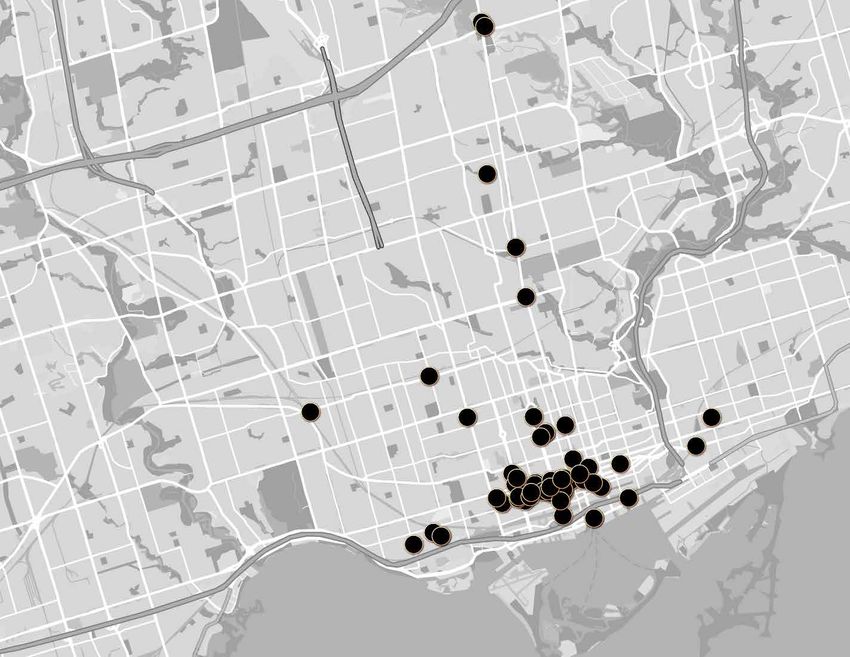
2004-2008 75.6 6,621,996 87.6 Fintech firms are not a significant driver of office space…yet
Given the relatively small size of the Canadian Fintech market, the industry is not
2011-2015 84.4 1,938,434 23.0 expected to be a significant driver of office demand over the short term. According
to CBRE Research, standalone Fintech companies occupy in total approximately
Source: Conference Board of Canada, GWLRA, CBRE Research, 2016.
260,000 sq. ft. in Downtown Toronto with the average tenant less than 10,000 sq. ft.
Most of these tenants are fairly dispersed across Downtown Toronto (Figure 21), with
FIG. 20: DOWNTOWN TORONTO – PRE-LEASE COMMITMENTS BY INDUSTRY many occupying incubators and shared offices. Part of the popularity of incubators
Banks and shared office space for Fintech companies is due to their unpredictable growth.
2014-2017 Some Fintechs scale very quickly and standard leases and covenant requirements are
CONSTRUCTION Other Financial Services
15.6% 26.4% 18.0% 19.7% 16.6% 17.8% not always accommodative to their business structure.
CYCLE Business Services
3.7% Legal Over the long term, new small to mid-sized tenant opportunities may start to emerge
Creative Industries from Fintech companies and related technology firms as they mature. This has been
2009-2011
CONSTRUCTION 20.1% 11.0% 18.6% 13.3% 9.5% 25.2% Other Industries the case with other technology sectors such as software and digital media. Venture
CYCLE capital funding is often correlated to office demand for office markets with a high
Vacant/Available
2.4% exposure to technology (CBRE, 2016), and will also be a key indicator to monitor.
TORONTO
DOWNTOWN -
EXISTING 20.2% 15.1% 10.8% 10.0% 36.4%
BUIDLINGS
2.4% 5.0%
Source: CBRE Research, Q3 2016.
15 |Banking and the new digital era: What’s next for Financial Services in Canada? GWL Realty Advisors | CBRE LimitedFIGURE 21: TORONTO FINTECH LOCATIONS
60+ Fintech Firms
and their Locations in
Toronto
Source: CBRE Research, 2016.
16 |Banking and the new digital era: What’s next for Financial Services in Canada? GWL Realty Advisors | CBRE LimitedReal Estate Impacts
Looking Ahead
Real estate will continue to play an integral role for
Financial Service firms, especially as office space
becomes increasingly used for branding and talent
attraction. However, with technology, innovation
and efficiency defining the financial services industry
in Canada, property investors will need to take an
evolved view of the sector—one defined by diversifi-
cation within the industry, as well as a more modest
outlook for overall growth moving forward.
17 |Banking and the new digital era: What’s next for Financial Services in Canada? GWL Realty Advisors | CBRE LimitedMARKET THEMES
The industry will be more efficient from a Financial Services will be part of an Toronto continues to strengthen as a global
growth perspective increasingly diverse service economy and national financial centre
Financial institutions will continue to be an integral part It is expected that cities across Canada will continue to Toronto is expected to strengthen as a Financial Services
of the office market in Canada. Recent trends however, diversify as Technology, Health Care and Professional hub. Over the last several years, Toronto has increased
suggest slower office demand from this sector in the service sectors grow in importance. Financial Services its concentration of Financial Service activity and global
short term. Consolidation, automation and a focus on accordingly, will be part of a more dynamic office market presence. Employment growth accordingly, highlights
operating efficiency is expected to continue defining the from a tenant perspective. The growing influence of this shift—the Toronto area alone drives over half of all
industry. This is not to say the Financial Services sector technology in financial services also highlights diver- Financial Sector employment growth in Canada. Looking
will not grow at all—it merely indicates that the pace sification within the sector as well—a wider range of ahead, Toronto’s office market will stand to benefit from
of growth will be slower than in past years. The typical groups will be associated with Financial Services such this ongoing trend.
150-200 sq. ft. per new employee ratio accordingly, will as Fintech, software and data management. Banks and
continue trending lower. Insurance groups will remain major players for the office
market, but new leasing opportunities will also emerge
with these other groups.
18 |Banking and the new digital era: What’s next for Financial Services in Canada? GWL Realty Advisors | CBRE LimitedIMPACTS ON REAL ESTATE REQUIREMENTS
Location considerations OFFICE
Evolving office demand in Financial Services is expected
to create additional opportunities for property inves-
tors. Downtown locations, where many major financial
The primary drivers of workplace
strategy are talent attraction and AS THE
NEW
institutions are located, will continue to be in demand— retention, collaboration and cost
urbanization and transit access remain positive drivers. savings. While the latter seems to
The growth of Fintech is also driving demand for “brick be a perennial driver, the first two
BRAND
and beam” spaces in urban-fringe locations. While brick are certainly a direct result of a
and beam space is already common among other tech-
nology-oriented sectors, it does present a wider range of
much more mobile society. – CBRE
America’s Occupier Survey (2016)
office investment opportunities related to the Financial
Services sector.
A focus on talent: “Office as the New Brand”
A decentralization effect is also taking hold as firms in
Based on research findings, Financial Service firms are
the industry think more broadly in terms of location. Sat-
increasingly focused on three goals with respect to their
ellite offices, incubators, co-working spaces and innova-
real estate needs:
tion labs near universities and other life science districts
are other emerging investor opportunities. This trend is • Attracting and retaining talent;
expected to drive office demand in secondary cities with
• Corporate branding (both internal and public); and
burgeoning technology and education clusters as well.
• Optimization of technology and resources.
Office space accordingly, is increasingly used as an
MARS FINTECH CLUSTER attraction point. Creating and utilizing space that allows
employees to work independently, but also promoting in-
teraction is an emerging priority for firms in the industry
The MaRS FinTech Cluster is a program that
(Deloitte, 2015). Effective spaces are ones that can create
connects start-ups with financial institutions
the opportunity for collaboration and interaction, and
and is located in the MaRS Discovery District
leverage technology for a flexible and mobile workforce.
in Toronto. CIBC, TMX Group and PayPal are
According to Citrix’s Workplace of the Future report (Ci-
notable groups that have opened permanent
trix, 2012), 89% of global organisations by 2020 will offer
offices within the Discovery District to
flexible work options enabled by mobile technology5. Fi-
collaborate more effectively with FinTech
nancial institutions will be a key part of this digital shift.
startups.
5
This global market research report surveyed 1,900 senior IT decision makers
in August 2012. They largely represent organizations with more than 1,000
employees across 19 countries across the globe.
19 |Banking and the new digital era: What’s next for Financial Services in Canada? GWL Realty Advisors | CBRE LimitedFlight to quality and support for new
supply
Consolidation, centralization and a focus on
technology and talent attraction among Financial
Services firms are expected to continue driving
demand for new office space. Investors and
managers who have a strong office development
program will benefit from this, particularly in
downtown and urbanizing locations. For existing
buildings, capital investments in building sys-
tems and technology upgrades will be necessary
to stay competitive.
Embracing tenant collaboration and
partnerships
The relationship between landlords and tenants
is also changing, with collaboration and part-
nership an emerging theme. Tenant retention is
just as important as talent retention and build-
ing owners should understand both leased and
common spaces are critical in fostering a positive
work environment for occupants. To have a suc-
cessful leasing program, investors and managers
will need to collaborate with tenants on technol-
ogy and amenity needs, sustainability require-
ments and workplace strategies.
20 |Banking and the new digital era: What’s next for Financial Services in Canada? GWL Realty Advisors | CBRE LimitedConclusion:
A Spectrum of Opportunities
For investors and managers, the changes that are taking place in Financial
Services will create a spectrum of opportunity in terms of office investment and
development. On one end of the spectrum, Fintechs and technology firms will
lead demand for non-traditional and non-core office in emerging urban areas
and will drive new leasing models such as co-working spaces and technolo-
gy clusters. On the other end of the spectrum are large, established banking,
investment and insurance firms with significant downtown footprints. Property
investors will need to decide what end of the spectrum they want to be in de-
pending on size, covenant and management expertise.
21 |Banking and the new digital era: What’s next for Financial Services in Canada? GWL Realty Advisors | CBRE LimitedBIBLIOGRAPHY
Canadian Bankers Association. (2014). Total bank employment by provinces . Toronto: Canadian Bankers Citrix. (2012). Workplace of the future: a global market research report. Citrix. Retrieved from https://www.citrix.
Association. com/content/dam/citrix/en_us/documents/products-solutions/workplace-of-the-future-a-global-market-
research-report.pdf
Accenture. (2016). Fintech and the evolving landscape: landing points for the industry. Accenture.
Dapp, T. (2015). Fintech reloaded: traditional Banks has digital ecosystems . Frankfurt: Deutsche Bank .
Accenture. (2016). InsurTech Invesment Trends. Accenture. Retrieved from https://www.accenture.com/
t20161011T031410__w__/ca-en/_acnmedia/PDF-15/Accenture-FinTech-Evolving-Landscape- Deloitte. (2015). The London Business Footprint: The Evolving Financial Sector. London: Deloitte.
Infographic.pdf
Denning, S. (2014, June 24). Understanding disruption: insights from the history of business. Forbes. Retrieved
Ansari, S. (2015, April 2). New workspaces blow office design wide open. Toronto Star. Retrieved from https:// from Forbes: http://www.forbes.com/sites/stevedenning/2014/06/24/understanding-disruption-
www.thestar.com/business/2015/04/02/new-workspaces-blow-office-design-wide-open.html insights-from-the-history-of-business/#3093a96330e0
, K. (2015, December 9). Could a robot take your job? . Retrieved from The conference Board of Canada: http:// EY. (2016). 2016 Canadian life insurance Outlook. Toronto: EY .
www.conferenceboard.ca/economics/hot_eco_topics/default/15-12-09/could_a_robot_take_your_job.
aspx Griffith, A. (2014, September 25). Why startups fail, according to their founders. Retrieved from Fortune: http://
fortune.com/2014/09/25/why-startups-fail-according-to-their-founders/
Berman, D., & McGee, N. (2016, April 13). Scotiabank launches new round of job Cuts as consumers move
online. The Globe and Mail. Retrieved from http://www.theglobeandmail.com/report-on-business/ Hammer, J. (November, 9 2015). Why fintech startups aren’t killing banks - yet. Retrieved from Crunch Network:
streetwise/scotiabank-launches-new-round-of-jobs-cuts-as-consumers-move-online/article29626579/ https://techcrunch.com/2015/11/09/why-fintech-startups-arent-killing-banks-yet/
Bouw, B. (2015, February 17). Next big sector to face disruption? Financial services. The Globe and Mail. Holloway, A. (2016, February 4). How Janet Ecker plans to keep the financial services industry ahead of
Retrieved from http://www.theglobeandmail.com/report-on-business/small-business/sb-money/next- challenges being thrown at it. Financial Post. Retrieved from http://business.financialpost.com/financial-
big-sector-to-face-disruption-financial-services/article23025801/ post-magazine/how-janet-ecker-plans-to-keep-the-financial-services-industry-ahead-of-challenges-
being-thrown-at-it
Burt, M. (2015). An engine for growth. 2015 report card on Canada and Toronto’s Financial Services sector.
Toronto: The conference Board of Canada . Kiladze, T. (2014, December 29). Too big to disrupt? The Globe and Mail. Retrieved from http://www.
theglobeandmail.com/report-on-business/feature-too-big-to-disrupt/article22163574/
Campbell, D., & Son, H. (2016, June 7). Wall Street is doing just fine with fewer workers. Bloomberg. Retrieved
from http://www.bloomberg.com/news/articles/2016-10-19/fired-bond-traders-stung-anew-as-bank- Kiladze, T. (2016, August 26). Why Bay streets bad boys are disappearing. The Globe and Mail, p. 2016.
profits-soar-without-them
Kornack, M., Chung, D., & Shah, A. (2016). Landlord/tenant relationships increasingly important as office space
Canadian Bankers Association. (2015). Database of domestic Banks financial results fiscal year-end 2006-2014 . Evolution continues. Toronto: National Bank.
Toronto: Canadian Bankers Association.
Madhavi, A., & Yew, T. (2016, December 8). Profits shrink as banks face regulation, slow growth. Toronto Star.
Canadian Bankers Association. (2016). Global banking regulations and banks in Canada . Toronto: Canadian
Bankers Association. Marino, J. (2016, January 5). Big banks are joining forces with the firms that were supposed to be disrupting
them. Retrieved from Business Insider: http://www.businessinsider.com/big-banks-are-backing-online-
Canadian Bankers Association. (2016). Select delivery Channel statistics - transaction volumes . Toronto: lenders-2015-12
Canadian Bankers Association.
Marino, J. (2016, May 4). Online lenders are taking a beating. Retrieved from CNBC: http://www.cnbc.
Castaldo, J. (2016, May 17). Fintech firms are battling banks—and the banks are winning. Canadian Business. com/2016/05/04/online-lenders-are-taking-a-beating-on-deck-lending-club-fintech-startups.html
Retrieved from http://www.canadianbusiness.com/investing/fintech-firms-are-battling-banks-and-the-
banks-are-winning/ Marowits, R. (2016, October 27). Montreal-based National Bank of Canada cutting up to 600 jobs amid shift in
banking industry. Retrieved from Global News: http://globalnews.ca/news/3028790/montreal-based-
CBRE. (2016). America’s occupier survey 2015/16. CBRE. national-bank-of-canada-cutting-up-to-600-jobs-amid-shift-in-banking-industry/
22 |Banking and the new digital era: What’s next for Financial Services in Canada? GWL Realty Advisors | CBRE LimitedYou can also read


