Willard R. Daggett, Ed.D Susan Gendro
←
→
Page content transcription
If your browser does not render page correctly, please read the page content below
Common Core State Standards Initiative
             Classroom Implications for 2014

                                                         Willard R. Daggett, Ed.D
                                                         Susan GendroO


  Rigor, Relevance, and Relationships for ALL Students
                                                         www.LeaderEd.com
Common Core State Standards Initiative
                                          Classroom Implications for 2014

                                              N
                                                     early a decade ago, No Child Left Behind (NCLB) presented states with a
                                                     daunting mix of challenges that supported the creation of statewide standards and
                                                     assessments and rigorous accountability requirements. Yet, as a nation, the United
                                              States still lags behind other countries in student academic achievement and in preparing
                                              its young people to succeed beyond the classroom. In 2014, the U.S. Department of
                                              Education expects the gap between American students and students from top performing
                                              countries to begin to close.

       Four                                   As we complete the first decade of the 21st century, American educators must understand
                                              that students need a different and more diverse set of skills than their parents were taught
    Assurances                                a generation ago. The changing nature of work, technology, and competition in the global
                                                      job market has far outpaced what the U.S. education system provides for students,
    1. Adopting standards and                         despite the ongoing efforts of educators and communities to improve their schools.
       assessments to better
       prepare students for careers                  Recognizing this, the federal government has placed new mandates on schools
       and college                                   receiving funding through the American Recovery and Reinvestment Act of
                                                     2009 (ARRA), which has allocated $100 billion for school improvement efforts.
   2. Getting high-quality teachers                  Of that, the $4.3 billion Race to the Top (RTTT) fund is targeted at innovative
      into classroom                                 education reform divided into four areas prioritized in the ARRA, the four
   3. Turning around low-                            assurances. Moreover, the administration has called for new steps to better align
                                                     the Elementary and Secondary Education Act (ESEA) in support of college- and
      performing schools
                                                     career-ready standards.
   4. Creating data systems to
      track performance                              Whether educators are directly involved in the chase for competitive RTTT awards
                                                     or other grants from the stimulus fund, the impact of these federal initiatives will be
                                                     felt by everyone in education.

                                              Common Core State Standards Initiative
The changing nature
                                              The majority of states have not only recognized the impact of the federal support, but also
of work, technology,
                                              realized the urgent need to work collaboratively to develop a culture of excellence that
and competition in the                        challenges every student to acquire the necessary skills to succeed in today’s competitive
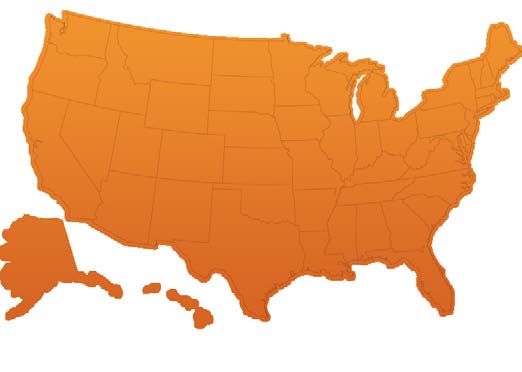
global job market has                         global society. As of August 2010, most states had opted to adopt or adapt the Common
far outpaced what the                         Core State Standards:
U.S. education system
provides for students,
despite the ongoing
efforts of educators
and communities
to improve their
schools.

                                                                District of Columbia           Puerto Rico                   Guam
     To view this map in more detail, visit
    www.corestandards.org/in-the-states
                                                                American Samoa Islands         U.S. Virgin Islands   Northern Mariana Islands
                                                                                                                                                2
Copyright © August 2010, January 2014 by International Center for Leadership in Education. All rights reserved.
During the past year, governors and state education commissioners from 49 states, two
                                             territories, and the District of Columbia came together to help draft a set of common
                                             academic standards for students in grades K-12. Called the Common Core State
                                             Standards Initiative: Preparing America’s Students for College & Career, the collaboration
                                             is a nationwide, state-led effort coordinated by the National Governors Association Center
                                             for Best Practices (NGA Center) and the Council of Chief State School Officers (CCSSO).
                                             In June, after more than 10,000 comments elicited from the public, a final version of the
                                             Common Core State Standards for English and math was released. (CCSSO and NGA
                                             Center, on behalf of the participating states, also plan to develop common core standards
                                             in science and social studies.)

Standards do not                             Of course, standards do not tell teachers how to teach and cannot by themselves ensure
                                             the quality of our nation’s education system. However, they constitute an important starting
tell teachers how to
                                             point in helping schools determine the knowledge and skills that ALL students must be
teach and cannot by                          equipped with upon graduation. In essence, thoughtfully written standards provide an
themselves ensure                            accessible roadmap for teachers, students, and parents.
the quality of our
nation’s education
system.                                      Reaching a Higher Level of Performance
                              The United States is one of the few developed countries that lack national education
                              standards. Currently, standards vary widely from state to state. NCLB left it to states to
                              determine what students ought to learn in reading, math, and science; how they ought
                              to be tested; and what levels of achievement determine proficiency. For example, what
                                            constitutes proficiency for grades 4, 8, and 10 in one state might be lower
                                            or higher than in another state. State benchmarks vary so significantly that
  Adoption of the Common Core State         it is difficult to compare test scores from different states. Yet, all students in
                                            America deserve the same level of rigorous and relevant education.
  Standards is a voluntary decision made
  at the individual state level. Some
                                                              To compound the problem, many states have lowered their proficiency
  states will adopt the standards through
                                                              levels in recent years to make it easier for schools to avoid sanctions under
  their state boards of education, while                      NCLB, but this can affect students negatively for the rest of their lives.
  others will adopt them through their
  state legislatures.                                   Consider one recent study, Mapping State Proficiency Standards onto NAEP
                                                        Scales: 2005-2007, released by the U.S. Department of Education, which
  Common Core State Standards Initiative
  www.corestandards.org/frequently-asked-questions
                                                        found  that 31 states had set proficiency scores for 4th grade reading that
                                                        were lower than the cutoff for the Basic level of performance on the National
                                                        Assessment of Educational Progress (NAEP). NAEP is the common test
                                                        scale for mapping state performance standards at the Proficient level. For 8th
                                          grade, 15 states set standards lower than the Basic level. In grade 4 math, seven states
                                          set standards lower than the Basic level. In grade 8 math, eight states set standards that
                                          were lower than Basic.

                                             Some testing experts have challenged the study’s methodology. They said that the
Crossing a state line                        standardized tests that states now use and the more rigorous NAEP— the congressionally
does not change                              mandated program known as the “Nation’s Report Card”— are too different to put on the
the level of reading,                        same scale. But that’s just the point. There is no uniform alignment of education standards
writing, or math                             to define what every student across America is expected to know and be able to do.
proficiency an                               Crossing a state line does not change the level of reading, writing, or math proficiency an
                                             individual needs for success in higher education, the workplace, the home, or in life.
individual needs for
success in higher                            The new standards will be used to revise curricula and state tests to make learning more
education, the                               uniformly rigorous across the country, so that students in Louisiana, for instance, have the
workplace, the home,                         same learning opportunities as students in Massachusetts. In short, consistent standards
or in life.                                  will provide appropriate benchmarks for all students, regardless of where they live.

                                                                                                                                      3
Copyright © August 2010, January 2014 by International Center for Leadership in Education. All rights reserved.
The movement to common standards and more rigorous new generation assessments
                                             comes at a critical juncture for students who have been identified as needing special
                                             education services. When NCLB first placed the spotlight on the performance of student
                                             subgroups, many educators believed that expecting students with disabilities to achieve
                                             proficiency was unrealistic and unfair. However, as these students have gained access to
                                             the general education curriculum and participated in state assessment programs, more
                                             of them have met standards each year. The special education population is comprised
                                             primarily of students with learning disabilities, speech and language disabilities, and
                                             emotional disabilities. These students have the capability to learn but often need
                                             specialized instructional approaches. Providing these students full access to the general
                                             education curriculum will require that schools and districts to:

                                              assist these students to be successful in the core content through a combination of
                                                  highly qualified content experts and specialized instructional supports

                                              incorporate the needs of these students up front in policy planning and program
                                                  design and not take the approach of addressing their needs later

                                              be deliberate in assuring that these students have exposure to the new assessment
                                                  designs early and continually as part of their specialized services

                                                    The Common Core State Standards provide a clear and consistent framework to
  The best understanding of                         prepare students for college and careers. The standards are designed to be robust
  what works in the classroom                       and relevant to the real world, reflecting the knowledge and skills that students need
  comes from the teachers                           for success after high school. Key features include:
  who are in them. That’s why
  these standards will establish
  what students need to learn,
  but they will not dictate
  how teachers should teach.                                Key Features of the Common Core Movement
  Instead, schools and teachers
  will decide how best to help
  students reach the standards.
                                                          33 aligned with college and work expectations
  Common Core State Standards Initiative
  www.corestandards.org/about-the-
  standards/myths-vs-facts                                33 clear, understandable, and consistent

                                                          33 rigorous content and application of knowledge through
                                                               higher-order skills

                                                          33 built upon strengths and lessons of current state
                                                               standards

                                                          33 informed by other top-performing countries so that all
                                                               students are prepared to succeed in the global economy
                                                               and society

                                                                                                                                    4
Copyright © August 2010, January 2014 by International Center for Leadership in Education. All rights reserved.
There are three main sections of the Common Core: K-5 (cross-disciplinary), 6-12
                                             (English language arts), 6-12 (literacy in history/social studies, science, and technical
                                             subjects). There is an obvious shared responsibility among all teachers for students’
                                             literacy development including reading, writing, speaking, listening, and language. Media
                                             skills are integrated throughout the grade levels. Included in the appendices are research
                                             and evidence, a glossary of key terms, reading text exemplars (sample performance
                                             tasks), and annotated student writing samples.

                                             The focus on literacy will require students to read more complex texts. Text complexity is
                                             measured by three factors:

                                              qualitative evaluation of the text: levels of meaning, structure, language
                                                  conventionality and clarity, and knowledge demands

                                              quantitative evaluation of the text: readability measures and other scores of text
                                                  complexity

                                              matching reader to text and task: reader variables (such as motivation, knowledge,
                                                            and experiences) and task variables (such as purpose and the complexity
                                                            generated by the task assigned and the questions posed)
  To learn more about the Common
  Core State Standards, visit                               More detailed information on text complexity and how it is measured is
  www.corestandards.org.                                    included in Appendix A of the Common Core State Standards.

                                             The following chart describes text complexity in terms of Lexile ranges (see www.
                                             lexile.com for more information). In three years, students will be expected to read and
                                             comprehend at higher levels (CCR = college and career ready).

                                               Text Complexity Grade B                                            Lexile Ranges Aligned to
                                                                                         Old Lexile Ranges
                                                 and in the Standards                                                CCR Expectations

                                                             K-1                                  N/A                       N/A

                                                             2-3                               450-725                    450-790

                                                             4-5                               645-845                    770-980

                                                             6-8                              860-1010                   955-1155

                                                            9-10                              960-1115                  1080-1305

                                                          11-CCR                             1070-1220                  1215-1355

           International benchmarking played a significant role in both sets of standards. In fact,
           the college and career ready standards include an appendix listing the evidence that
           was consulted in drafting the standards and the international data consulted in the
           benchmarking process is included in this appendix. More evidence from international
           sources will be presented together with the final draft.

           Common Core State Standards Initiative
           www.corestandards.org/about-the-standards/myths-vs-facts

                                                                                                                                      5
Copyright © August 2010, January 2014 by International Center for Leadership in Education. All rights reserved.
Accountability: Now More Than Ever
                                             In conjunction with the release of the new standards, the Smarter Balanced Assessment
                                             Consortium (SBAC) and the Partnership for Assessment of Readiness for College and
                                             Careers (PARCC), each of which is supported by a group of affiliated states, are in the
                                             process of developing assessments built around the new standards on behalf of states.
                                             Both consortia have submitted applications for part of the $350 million from the Race to
                                             the Top fund, which the Obama administration has set aside to encourage states to design
                                             and adopt high-quality common assessments for grades 3-8 and at least once in high
                                             school for implementation in 2014. A third consortium, the State Consortium on Board
                                             Examination Systems, submitted an application in response to the request to design a
“States are leading the                      new end-of-course high school assessment for 12 states.
way in creating new
standards designed to                        Assessment over the next 3-7 years will evolve to be more rigorous (i.e., require analysis,
                                             synthesis and evaluation as identified by the Knowledge Taxonomy of the Rigor/Relevance
ensure that students
                                             Framework® – see Appendix) and more real-world relevant (i.e., interdisciplinary, real-
graduate from high                           world predictable or unpredictable situations as identified by the Application Model of
school ready for success                     the Rigor/Relevance Framework). When assessments include highly rigorous and highly
in college and careers                       relevant content, they fall in Quadrant D of the Rigor/Relevance Framework.
… To fully realize this
vision, states need                                                                                  Rigor/Relevance Framework®
new assessments that                                        Evaluation      6                          Assimilation                      Adaptation
measure a broader
range of students’                                          Synthesis       5
knowledge and skills.”
                                                                                Knowledge Taxonomy

                                                            Analysis        4
U.S. Secretary of Education
Arne Duncan                                                 Application     3
                                                                                                       Acquisition                       Application

                                                            Comprehension   2

                                                            Knowledge/      1
                                                            Awareness

                                                                                                                   Application Model

                                                                                                        1              2            3              4            5

                                                                                                      Knowledge      Apply in     Apply         Apply to      Apply to
                                                                                                      in one         discipline   across        real-world    real-world
                                                                                                      discipline                  disciplines   predictable   unpredictable
                                                                                                                                                situations    situations

                                             Typically, state tests and local assessments use closed responses such as multiple-
                                             choice items, resulting in low rigor/low relevance, characterized as Quadrant A on the
                                             Rigor/Relevance Framework. Designing new assessments will be a challenge for the
                                             three consortia mentioned above. Preparing students now to be ready for these types
                                             of assessments is the reality for classroom teachers in the next few years. Assessments
                                             will include performance-based tasks, such as conducting a science experiment or writing
                                             more short answers to open-ended questions designed to show deeper levels of learning

                                                                                                                                                                              6
Copyright © August 2010, January 2014 by International Center for Leadership in Education. All rights reserved.
and thinking than multiple-choice or other closed-response items can measure. Students
                                             need to be prepared to read and analyze more complex texts to be successful on these
                                             tests. Here are three samples of those types of items:

                                             NAEP, 12th Grade Science
                                             Is a hamburger an example of stored energy? Explain why or why not.

Preparing students
                                             A Rich Task: Science and Ethics Confer (Queenland, Australia)
now to be ready
for these types of                           Students must identify, explore and make judgments on a biotechnological process to which there
assessments is the                           are ethical dimensions. Students identify scientific techniques used as well as significant recent
reality for classroom                        contributions to the field. They also research frameworks of ethical principles for coming to terms
teachers in the next                         with an identified ethical issue or question. Using this information, they prepare pre-conference
                                             materials for an international conference that will feature selected speakers who are leading lights
few years.                                   in their respective fields.

                                             In order to do this, students must choose and explore an area of biotechnology where there are
                                             ethical issues under consideration and undertake laboratory activities that help them understand
                                             some of the laboratory practices. This enables them to:

                                             a. Provide a written explanation of the fundamental technological differences in some of the
                                                  techniques used, or of potential use, in this area (included in the pre-conference package
                                                  for delegates who are not necessarily experts in this area).

                                             b. Consider the range of ethical issues raised in regard to this area’s purposes and actions
                                                  and scientific techniques and principles and present deep analysis of an ethical issue
                                                  about which there is a debate in terms of an ethical framework.

                                             c. Select six real-life people who have made relevant contributions to this area and write a
                                                  150-200 word précis about each one indicating his/her contribution, as well as a letter of
                                                  invitation to one of them.

                                             Applying Knowledge and Reasoning Skills to Real-World Situations
                                             (Sweden, year 5)
                                             Carl bikes home from school at four o’clock. It takes about a quarter of an hour. In the evening,
                                             he’s going back to school because the class is having a party. The party starts at 6 o’clock. Before
                                             the class party starts, Carl has to eat dinner. When he comes home from school, his grandmother,
                                             who is also his neighbor, calls. She wants him to bring in her post before he bikes over to the class
                                             party. She also wants him to take her dog for a walk, then to come in and have a chat. What does
                                             Carl have time to do before the party begins? Write and describe below how you have reasoned.

                                                                                                                                               7
Copyright © August 2010, January 2014 by International Center for Leadership in Education. All rights reserved.
The federal government also is challenging states to transition to a growth model rather
                                             than a proficiency model of assessment and to design an assessment proposal that would
                                             measure growth in individual students’ learning over time, specifically year-over-year. For
                                             example, if a 4th grade student is reading at a 2nd grade level, but then he or she makes a
                                             year’s worth of growth during grade 4, this achievement would receive recognition.

                                             Part of the assessment process also includes documenting that students are on track
                                             to becoming college- and career-ready by the time they graduate from high school. This
                                             aspect of the assessments means that higher education institutions will be partners in the
                                             development of the new high school tests to ensure the assessment system is anchored
                                             to what it takes to be successful in college and careers. The assessments must reflect
                                             and support good instruction and include all students from the outset, including English
                                             learners, economically disadvantaged students, and students with disabilities. Therefore,
                                             students will not only learn from a more rigorous and relevant set of standards, but also
                                             be introduced to a new type of assessment that is significantly different from most current
   Evolutionary                              state tests.
        vs.
   Revolutionary
                                             Planning Begins Now
    Leaders must begin
   building instructional                    States, districts, schools, and teachers need to begin planning now for how the new
                                             standards will impact instruction and assessment. Making the appropriate changes to
   capacity within their                     reflect these standards along with overall school reform should be evolutionary rather than
   system in order to                        revolutionary in preparation for full implementation by 2014. Leaders must begin building
   ensure successful                         instructional capacity within their system in order to ensure successful roll-out of the new
   roll-out of the new                       standards and assessments. Schools and districts will need a focused transition plan and
   standards and                             a process to implement the plan.
   assessments. Schools
                                             A solid program of work involves a comprehensive approach and strategic tools.
   and districts will need                   Leadership teams should begin discussions today around their plan of action. That
   a focused transition                      plan should include specific goals over the next three years to achieve successful
   plan and a process to                     implementation. With almost 20 years of experience in working with schools to reach their
   implement the plan.                       goals, the International Center has a clear understanding of how to support transitions
                                             like this and believes that the following objectives are essential to achieving this work:

                                             1.   Determine a scope of work, timeline, and quality assurances.

                                             2. Build awareness, understanding, and ownership of the Common Core State
                                                  Standards, new assessments, and the need for change.

                                             3. Position district leaders, teachers, parents, and communities for successful
                                                  implementation of the Common Core State Standards and new assessments.

                                             4. Develop a gap analysis to compare existing standards, assessments, instructional
                                                  programs, technology use, accountability measures, and student achievement levels
                                                  to those required for the implementation of Common Core State Standards and
                                                  assessments.

                                                                                                                                   8
Copyright © August 2010, January 2014 by International Center for Leadership in Education. All rights reserved.
Standards, Instruction, and Assessment
                                             Aligning state and local standards with the Common Core State Standards is the first
                                             step in identifying what needs to be taught. The process of crosswalking state and
                                             local standards to Common Core State Standards will identify gaps in curricula. This
                                             crosswalk then informs the instruction that should take place. The Common Core State
                                             Standards will require teachers to go deeper into the content, in contrast to the breadth
                                             of the overcrowded curriculum. Cross-disciplinary lessons and project-based learning will
                                             help prepare students for the new assessments, which will, in part at least, be different
                                             from current assessments and include performance tasks and extended constructed
                                             responses. The development of these types of assessments can be guided through the
                                             use of the Rigor/Relevance Framework and are found in high rigor/high relevance lessons
                                             (known as Gold Seal Lessons, www.leadered.com/gslresources.html).

                                             Creating Awareness
                                             Parents, community members, and students need to understand the shift that is occurring
                                             and the expectations this places on all students. The impact of the Common Core State
                                             Standards will extend beyond the classroom walls. Discussion should begin now and
                                             continue over the next three years. Explaining the need for change can be done through
                                             examples of how rapidly technology is changing how we learn, work, and live. The skill set
                                             needed by a high school graduate today is much different from that of the 20th century.

                                             Take Control Rather Than Feeling Controlled
                                             The implications for educators of the Common Core State Standards are both exciting
                                             and daunting. Educators will need to shift how they teach and how they assess students
                                             within the next three years. Students will need to adapt to those instructional changes and
                                             cannot be expected to do so overnight. The transition to new standards and assessments
                                             will require vision, gaining commitment and consensus, planning, time, and increased
                                             instructional capacity to support teachers in developing an expanded repertoire of skills in
                                             anticipation of these new measurements of achievement.

                                             School and district leaders must build capacity within their system and begin preparing
                                             now for the new standards and assessments. The International Center for Leadership
                                             in Education is already assisting a number of state, district, and school leaders in
                                             transitioning to the Common Core State Standards and related assessments. The
                                             collaborative experience and the expertise being shared are providing insights that
                                             can be leveraged to support your own jurisdiction’s preparations for the transition. The
                                             International Center can support this work by providing a focused program of transition
                                             planning and implementation of the plan through the use of strategic tools and tailored to
                                             the unique needs and resources of each school or district.

                                               The challenge is great, but so is the opportunity. We can help.
                                               International Center for Leadership in Education
                                               1587 Route 146 ● Rexford, NY 12148
                                               (518) 399-2776 ● fax (518) 399-7607
                                               www.LeaderEd.com ● info@LeaderEd.com

                                                                                                                                    9
Copyright © August 2010, January 2014 by International Center for Leadership in Education. All rights reserved.
Appendix
Rigor/Relevance Framework®
The Common Core State Standards movement aligns with the higher order thinking and doing skills reflected in
Quadrant D learning and instruction, as described in the International Center’s approach to rigor and relevance.
The Rigor/Relevance Framework is a planning tool to help educators develop grade-level learning expectations
and standards by aligning curriculum, instruction, and assessment.
The Framework’s has two dimensions for higher standards and student achievement:
1. The Knowledge Taxonomy, is represented as a vertical continuum based on the six levels of Bloom’s
Taxonomy and describes the increasingly complex ways in which we think. The lower end involves acquiring
knowledge and being able to recall or locate that knowledge. The high end labels the more complex ways in
which individuals use knowledge, such as taking several pieces of knowledge and combining them in both
logical and creative ways.
2. The second continuum, known as the Rigor/Relevance Framework®
Application Model and represented Evaluation 6 Assimilation Adaptation
on a horizontal axis, stresses use of
knowledge. Its five levels describe ways
to apply knowledge to solve problems.
Synthesis 5
While the low end is knowledge acquired
Knowledge Taxonomy
for its own sake, the high end signifies Analysis 4
use of that knowledge to solve complex
real-world problems and to create unique Application 3
projects, designs, and other works for Acquisition Application
use in real-world situations. Comprehension 2
The two dimensions are divided into four
Knowledge/ 1
quadrants, labeled A-D, to characterize Awareness
the learning or student performance in that
mode. Application Model
1 2 3 4 5
In Quadrant A (Acquisition) students
learn and store bits of knowledge and Knowledge Apply in Apply Apply to Apply to
information. in one
discipline
discipline across
disciplines
real-world
predictable
real-world
unpredictable
situations situations
Quadrant B (Application) requires A B C D
students to use their acquired knowledge Students have the competence
to solve practical problems. Students gather and store bits
Students use acquired
knowledge to solve problems,
Students extend and refine
to think in complex ways and
to apply their knowledge and
their acquired knowledge to skills. Even when confronted
of knowledge and information. design solutions, and
be able to use that knowledge with perplexing unknowns,
Students are primarily expected complete work. The highest
automatically and routinely to students are able to use
In Quadrant C (Assimilation), students to remember or understand this
knowledge.
level of application is to
apply knowledge to new and
analyze and solve problems
and create solutions.
extensive knowledge and skill
to create solutions and take
extend their acquired knowledge to use unpredictable situations.
action that further develops
their skills and knowledge.
it automatically and routinely to analyze
problems and create unique solutions.
When working in Quadrant D (Adaptation), students have the competence to think in complex ways and apply
their knowledge and skills when confronting perplexing unknowns and creating solutions.
10
Copyright © August 2010, January 2014 by International Center for Leadership in Education. All rights reserved.You can also read


