Women's Digital Financial Inclusion in Africa - A G7 PARTNERSHIP FOR - Gates Foundation
←
→
Page content transcription
If your browser does not render page correctly, please read the page content below
July 2019

A G7 PARTNERSHIP FOR

Women’s Digital
Financial Inclusion
in Africa
Report prepared at the request of the G7 French Presidency

Foreword

It is expensive to be poor. This was made                      This report is a blueprint for closing that gap of
                                                               400 million and creating a world that is both more
crystal clear to me more than a decade ago
                                                               prosperous and more equal for everyone.
when I was a guest at a women’s group
                                                               This year, the French Presidency of the G7 chose a
meeting in the village of Misungwi in
                                                               theme based on a big, bold, important idea: fighting
Tanzania. The members took turns telling                       inequality. Like most ideas, though, it is abstract. Digital
me what they used to do when they                              financial inclusion is a practical strategy for helping the
needed money. The best option was to sell                      marginalized move toward the center. In short, what you
                                                               are about to read amounts to a practical plan for equality
a chicken for whatever they could get                          that we can start implementing right away.
(and do without the eggs). The worst option
                                                               The report draws on the lessons our foundation has
was to pay the astronomical interest                           learned about financial services for the poor since
rates charged by the moneylender.                              we started investing in the area about 15 years ago.
                                                               It identifies five key ways in which G7 countries can
                                                               support African countries as their leaders seek to include
Then they dug into their pockets for shillings to deposit
                                                               more than 400 million people in the digital economy for
in the group’s cashbox. They had joined, they said,
                                                               the first time.
because they wanted to take control of their financial
lives and their futures. Now they had savings when they        •   First, build an interoperable digital payment
needed them. If a business opportunity presented itself,           infrastructure so that you can transact with anyone
they could get credit and take advantage of it. In case of         else, even if you have different service providers.
disaster, they were insured.
                                                               •   Second, build equitable digital identification systems
At the end of the meeting, as a security measure, three            that cover each and every individual on the continent,
members secured the cashbox with three different                   giving all people the formal proof of identity they
padlocks.                                                          need to open and use financial accounts.

Since then, innovation has made it possible for women          •   Third, update financial regulations to make space
around the world to conduct much more sophisticated                for digital products and services while keeping the
transactions in an instant using only a mobile phone.              financial system secure.
African countries have been some of the pioneers in
digital finance, and yet, across the continent, 400 million    •   Fourth, help countries identify investments and
people, most of them women, don’t have access to                   policies that enable them to maximize the social
digital financial services. They are stuck in the era of the       and economic returns from digital technologies and
moneylender and the forced chicken sale. As a result,              infrastructure while minimizing potential harms.
they are less likely to be able to lift themselves and their
                                                               •   Fifth, research the best ways to design digital
families out of poverty.
                                                                   financial systems and deliver digital financial
                                                                   services to maximize gender equality.
If African countries are able to take all five steps, the            Luckily, we don’t have to. We are at a pivotal moment
benefits will be sweeping. People living in poverty, who             in history. The old, analog financial system is being
lack opportunity as much as money, will have more                    disrupted by a new, digital one. We have the opportunity
power to plan for the future instead of reacting to                  to build this modern financial system from its
financial needs as they happen. The poor countries in                foundations to include and empower everyone.
which they live will generate economic growth based on
widespread prosperity—that is, the kind of growth that               The world has one chance to seize this opportunity—
lasts and strengthens the social fabric.                             and that chance is now. We cannot wait, or else the
                                                                     inequalities of the past will insinuate themselves
For centuries, that social fabric has been frayed by                 into the future. I urge the leaders of the G7 to commit
the fact that women are not treated equally. Indeed,                 themselves to taking the practical steps outlined in the
a majority of the Africans trapped in the informal                   following pages. If they do, they will help the world’s
economy are women. With access to digital financial                  poorest people build a pathway to prosperity for their
services, they will have the ability to earn money and               families and their nations.
to choose how to spend it. Millions of entrepreneurial
women will be able to get startup capital, do business
efficiently without layers of middle men, save, and invest
in priorities like health and education that supercharge
development.

The women in Misungwi Village told me how they
invested the money they’d saved—a tin roof to replace                             MELINDA GATES
the thatched one, for example, or supplies of cloth for                           Co-Chair and Trustee,
their dressmaking business. But they also told me                                 Bill & Melinda Gates Foundation
about what it felt like. They said that, now that they felt
able to manage daily financial risks, they were starting
to dream of the future for the first time in their lives.
They said that being partners with their husbands
about household finances made them more equal in
their marriages. What they were telling me about was
empowerment.

The old financial system was built to exclude. It excluded
the poor, whose transactions were too small to matter.
It excluded the rural, who lived too far away from bank
branches. It excluded women, whose husbands were
supposed to make the decisions. It is very hard to
retrofit an exclusive system to be inclusive.

A G7 Partnership for Women’s Digital Financial Inclusion in Africa                                                              1
Executive Summary

Executive Summary                                                             I. Infrastructure
                                                                              Pillar 1: Interoperability
African governments are at the forefront                                      Between 2014 and 2017, the share of sub-Saharan African
of efforts to harness digital technologies                                    adults with a mobile money account nearly doubled
                                                                              (from 12 percent to 21 percent), and a growing number of
to build more inclusive economies.
                                                                              people are using these accounts to pay bills, move money,
Double-digit growth in mobile phone                                           and buy goods.2 Sub-Saharan Africa is also home to the
ownership in the first half of this decade                                    10 economies worldwide where more adults now have
has triggered a surge of innovative                                           mobile money accounts than have accounts at a financial
                                                                              institution.3 However, even those who can access digital
digital tools and services across the                                         finance often find that the system is not as valuable,
continent.1 However, the benefits of the                                      reliable, or affordable as it could be because individuals
digital age are not being shared equally.                                     can only send and receive money with users of the same
                                                                              service.4 To accelerate the development of inclusive,
Women—especially those living in poor                                         interoperable payment systems, the G7 can support efforts
and marginalized communities—are                                              such as the work of the African Development Bank’s Africa
most likely to be on the wrong side of a                                      Digital Financial Inclusion (ADFI) facility. This facility
                                                                              seeks to assist African central banks and commercial
persistent digital divide.
                                                                              actors in the design and build-out of interoperable payment
                                                                              infrastructure, so that everyone can transact with everyone
This year, the Group of Seven (G7) outlined an agenda to                      else, regardless of who provides the service they’re using.
fight inequality. As part of this agenda, the G7 Partnership
for Women’s Digital Financial Inclusion in Africa will
                                                                              Pillar 2: Digital Identification
support African governments, central banks, and financial
institutions in their efforts to build more inclusive,                        More than 400 million African adults do not have access
sustainable, and responsible digital financial systems,                       to the formal financial tools that are transforming the
ensuring that 400 million more African adults are financially                 way people in the region manage their money. One critical
included—nearly 60 percent of whom are women. Essential                       barrier to women’s financial inclusion is the inability to
to efforts to expand digital financial inclusion to women                     prove one’s identity. The G7 can support initiatives such as
in Africa are five pillars that fall into three categories:                   the World Bank Group’s Identification for Development
infrastructure, regulation, and planning (see Figure 01).                     (ID4D) initiative to improve access to digital identification.
                                                                              This will underpin the design and build-out of secure digital
                                                                              identification (ID) systems that cover every individual on the
                                                                              continent, giving all people the proof of identity they need to
                                                                              open and use financial accounts.

Figure 01

Five pillars to advancing digital financial inclusion

1   Build inclusive
    digital payment
    infrastructure
                              2    Expand digital ID
                                   systems to reach
                                   excluded women
                                                             3       Create enabling
                                                                     policy and
                                                                     regulatory
                                                                                         4    Assess overall
                                                                                              digital readiness
                                                                                              to maximize
                                                                                                                    5    Evaluate how
                                                                                                                         governments
                                                                                                                         can best use
                                                                     environments             social and                 payments and ID
                                                                     to support               economic returns           systems reforms
                                                                     innovation                                          to impact
                                                                                                                         women’s lives

A G7 Partnership for Women’s Digital Financial Inclusion in Africa                                                                          2
Executive Summary
II. Regulation Although each of these pillars will have an important
impact on its own, it is the interaction of these initiatives, as
Pillar 3: Regulation much as the initiatives themselves, that will determine the
collective impact of this G7 effort. For example, ADFI and
Although digital financial technologies hold potential
ID4D will work together to help countries build integrated
to accelerate women’s economic empowerment, they
payment and ID systems that combine interoperable
also pose considerable risks—from overindebtedness
payment functionality with a biometric ID database,
to digitally-enabled fraud. It is thus critical that financial
enabling previously excluded women to easily transact
regulations keep pace with technology innovations.
with one another and verify who is on the other side of a
The G7 can help by supporting efforts like the United
given transaction. At the same time, diagnostics developed
Nations Capital Development Fund (UNCDF) Africa Policy
by the Pathways to Prosperity Commission will assist
Accelerator, and the Alliance for Financial Inclusion (AFI),
countries in the development of national digital strategies,
which assist African regulators in their efforts to design
which will inform and embed the work of ID4D and ADFI
regulatory frameworks that harness emerging payment and
in broader digital systems. In turn, UNCDF will support the
ID technologies and advance women’s financial inclusion,
development of financial regulations that keep pace with
while mitigating the downside risks associated with these
the infrastructure enhancements supported by ADFI and
new technologies.
ID4D. As new payment and ID technologies are introduced,
J-PAL Africa will carefully test how governments can best
use these technologies to advance women’s empowerment,
III. Planning informing the policy and infrastructure programs of the
other four pillars.
Pillar 4: Assessment of Digital Readiness
G7 members have a long track record of advancing financial
Digital financial inclusion efforts should not be conducted
inclusion in Africa. Agence Française de Développement
in isolation. Instead, they should be anchored within a
(AFD), for example, has long supported African
country’s broader digital strategy, including national
governments, central banks, and financial institutions
efforts to expand the electricity grid or increase broadband
in their efforts to build more inclusive, sustainable, and
coverage. As a first step, countries should carry out
responsible financial systems. The task now is to harness
assessments of their digital readiness through research
emerging payment and identity technologies to accelerate
into the state of their digital networks and the actions
these efforts. The G7 Partnership for Women’s Digital
needed to address digital infrastructure gaps. Through
Financial Inclusion in Africa aims to achieve this by
the country diagnostic framework developed by the
making the critical infrastructure, regulatory, and planning
Pathways for Prosperity Commission at Oxford University’s
investments that will ensure that women are not left behind
Blavatnik School of Government, the G7 can support
by this digital revolution.
African governments in their efforts to prioritize digital
investments and develop supportive policies to ensure that
they maximize the social and economic returns from digital
technology while minimizing its harms.
Pillar 5: Gender-Specific Research
Governments must also undertake gender-specific
research to ensure that digital interventions do not leave
the poorest women behind. The G7 can help address the
evidence gap by supporting rigorous research—such as that
led by the J-PAL Africa Digital Identification and Finance
Initiative—which evaluates how African governments
can best use payments and ID technologies to increase
household welfare and women’s economic empowerment,
while minimizing the downside risks associated with these
technologies.
A G7 Partnership for Women’s Digital Financial Inclusion in Africa 3Introduction
CONTENTS
Introduction
Global economies—from Nairobi
INTRODUCTION 4 to Beijing—are undergoing a rapid
transformation, with digital
I. INFRASTRUCTURE 8 technologies changing the way
PILLAR 1: INTEROPERABILITY people communicate, work, bank,
PILLAR 2: DIGITAL IDENTIFICATION
and access information.
Today, small businesses in China are using e-commerce
II. REGULATION 11
platforms to sell their products across the world.
PILLAR 3: REGULATION Previously unbanked households in Kenya can now access
instant credit over their mobile phones. Rural households
III. PLANNING 14 in Senegal are lighting their homes by linking their bank
accounts to off-grid solar energy systems. Government
PILLAR 4: ASSESSMENT OF DIGITAL READINESS officials in India are combining digital payment and ID
technologies to deposit money directly into the accounts
PILLAR 5: GENDER-SPECIFIC RESEARCH
of citizens living in distant villages, increasing the
transparency and efficiency of social welfare programs.
CONCLUSION 19
These and other digital innovations are creating
opportunities for countries to build more inclusive,
productive, and prosperous societies. The McKinsey Global
Institute estimates that widespread adoption and use of
digital payments and financial services could increase
the GDP of all emerging markets by $3.7 trillion by 2025.
This additional GDP could create up to 95 million new jobs,
raise overall productivity and investment levels, and make
government spending more efficient.6
No one stands to benefit more from
this growth than women.
Women and girls shoulder the global burden of poverty.7
Decades of research show that poverty deprives women
of vital health, education, and socioeconomic opportunities
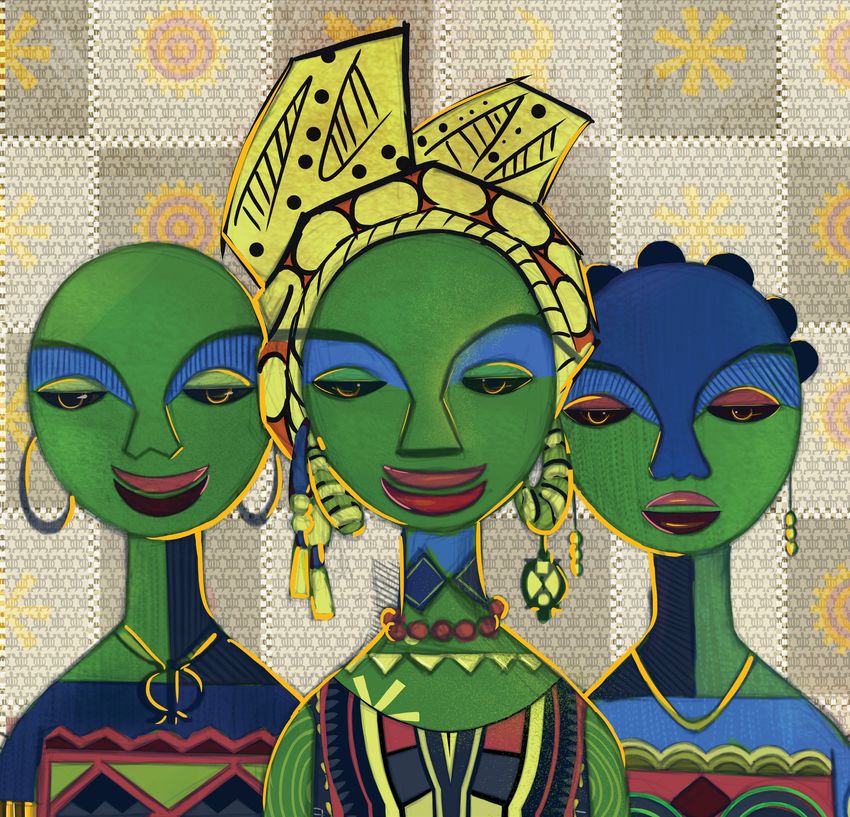
ABOUT THE C OVER A RT
throughout their lives. As a result, women earn less, own
The front cover illustration is inspired by fewer assets, and are underrepresented in economic and
symbols and images from the West African political decision-making. This inequality means they
region. Background elements encompass the experience fewer benefits from economic growth and
Adinkra symbols of adaptability, community, suffer more of the challenges of life lived in poverty.
leadership, strength, and vigilance. The three
women figures are based on akua’ba fertility
dolls, which represent hope and positivity. The
dolls are said to embody important qualities of
womanhood: beauty, willpower, and wisdom.
A G7 Partnership for Women’s Digital Financial Inclusion in Africa 4Introduction
For women in low- and middle-income countries, digital an equalizing force. For example, in Côte d’Ivoire, the gender
savings, credit, and payments services can provide them gap in access to financial institutions grew by 90 percent
with a critical link to the formal economy and a gateway to between 2014 and 2017, yet the gender gap on mobile
greater economic security and personal empowerment. An money decreased by 35 percent.11 Despite this progress,
emerging body of evidence shows this also pays dividends women remain disproportionately excluded from the formal
for their families in the form of better health and education. financial sector. As shown in the table on page 6, complex
When women-headed households in Kenya adopted mobile social, cultural, economic, and legal barriers stand in their
money accounts, poverty dropped, savings rose, and way. For example, Cameroon, Chad, Gabon, and Niger have
185,000 women left agricultural jobs for more reliable, regulations that prevent women from opening a bank
higher paying positions in business or retail.8 In Niger, account in the same way as men.12
distributing government benefit payments through a mobile
phone instead of cash helped give women who received the Digital financial exclusion is not merely an access problem.
transfers more decision-making power in their households.9 Although digital technologies hold vast potential to
improve human welfare, they also pose considerable risks,
Overall, strong progress has been made with financial from the establishment of digital monopolies to cyber-
inclusion in Africa. Between 2011 and 2017, the share of attacks to digital fraud. As previously excluded women
adults with financial accounts in the region grew from 23 become first-time users of digital technologies, they are
percent to 43 percent, driven largely by growth in mobile particularly exposed to these and other risks, such as new
money. Although East Africa has seen the most dramatic forms of gender-based violence, abuse, and harassment
gains, West and Central Africa have also seen rapid uptake in digital contexts. Our global challenge, therefore, is not
in recent years, bolstered by enabling regulatory policies. merely to close the digital divide, but also to establish
sound regulatory and supervisory frameworks to ensure
Many of these countries also experienced a sharp uptick that vulnerable citizens reap the benefits from digital
in financial inclusion rates among women. Between 2011 technologies without suffering from their potential adverse
and 2017, the number of women with their own account effects. The rest of the report describes the infrastructure,
doubled in Kenya and Ghana and increased seven-fold in regulation, and planning interventions required to advance
Senegal.10 In some countries, mobile money has emerged as this vision.
Figure 02
Where are the biggest increases in women’s account ownership?
WOMEN WITH AN ACCOUNT 2011 2014 2017
% Change
(2011–17)
Senegal +605%
Uganda +250%
Gabon +213%
Lesotho +175%
Kenya +98%
0% 20% 40% 60% 80% 100%
Source: Global Findex Database 2017. Note: Men and women refers to people ages 15+.
A G7 Partnership for Women’s Digital Financial Inclusion in Africa 5Introduction
Barriers to women’s financial inclusion13
DEMAND SIDE AND SOCIAL SUPPLY SIDE LEGAL AND REGULATORY
NORM BARRIERS BARRIERS BARRIERS
• Lack of bargaining power within • Inappropriate product offerings • Account opening requirements
the household that disadvantage women
• Lack of gender-specific policies
• Concentration in lower-paying and practices for product design • Barriers to obtaining formal
economic activities and marketing identification
• Competing demands on • Inappropriate distribution • Legal barriers to owning and
women’s time related to unpaid channels inheriting property and other
domestic work collateral
• Lack of assets for collateral • Lack of gender-inclusive credit
reporting systems
• Lack of formal identification
• Lack of market and user data
• Reduced mobility due to time for design of targeted policy
constraints and social norms interventions
• Lower rates of mobile phone
ownership among women
• Lower rates of digital literacy
among women
An All-Hands-on-Deck Approach to Advancing Women’s
Financial Inclusion in Africa
The interventions outlined in this proposal will address can build on the work outlined in this report by providing
many of the market failures inhibiting women’s access financing, technical assistance, and regulatory support
to digital financial services in Africa. They also provide to increase the flow of credit to women entrepreneurs in
critical foundational infrastructure necessary to establish Africa. Moreover, partners such as the World Bank, the
and expand the reach of important complementary efforts; Consultative Group to Assist the Poor (CGAP), the Better
however, they do not cover the full landscape of efforts Than Cash Alliance (BTCA), GSMA Mobile for Development,
needed to advance women’s economic empowerment in and the Financial Sector Deepening Network14 (among
Africa. For example, although this proposal aims to expand others) are already advancing many of the pillars outlined
access to payments and ID technologies among poor and in support of financial inclusion. Achieving widespread
marginalized women, it does not include mechanisms women’s economic empowerment in Africa will require
to ensure that banks and microfinance institutions use an all-hands-on-deck approach involving governments,
this digital infrastructure to deliver credit to women financial and telecoms regulators, businesses, civil
entrepreneurs. This is where other initiatives—such as the society, and a range of donor-funded initiatives.
Affirmative Finance Action for Women in Africa (AFAWA)—
A G7 Partnership for Women’s Digital Financial Inclusion in Africa 6Introduction
Figure 03
The state of financial inclusion across the world
A D U LT S W I T H A N AC C O U N T = 2011 = 2017
North America 94%
Europe and
Central Asia
81%
East Asia and Pacific 74%
South Asia 70%
Latin America and
the Caribbean 55%
Middle East and 48%
North Africa
Sub-Saharan Africa 43%
0% 20% 40% 60% 80% 100%
World (2017)
Source: Global Findex Database 2017. Note: Men and women refers to people ages 15+.
Figure 04 Figure 05
Where do adults in sub-Saharan Africa Sub-Saharan Africa:payments made
without a financial account live? in cash vs. accounts
ADULTS WITHOUT AN ACCOUNT, 2017 ACCOUNT 2017 CASH
GENDER GAP IN ACCOUNT OWNERSHIP -2% 24%
Wages
South Sudan How have people received their wage
6.7m 100% payments in the past 12 months?
Niger
P R O P O R T I O N O F T H E P O P U L AT I O N W I T H O U T A N AC C O U N T, 2 0 1 7
Madagascar
9m 12.4m 62% World 31%
Congo, Rep. Congo, Dem. Rep. Sub-Saharan Africa
80% 45% 49%
2.2m 32.4m
Nigeria Ethiopia
40.7m Government payments
64.5m
60% How have people received government
Mozambique payments in the past 12 months?
9.6m Tanzania
16.8m 70% World 15%
Lesotho
40% 57% Sub-Saharan Africa 29%
0.8m
Uganda
South Africa
9.1m
12.4m Utility bills
Namibia 20% How have people paid their utility
Kenya
5.5m 0.3m bills in the past 12 months?
Mauritius 40% World 52%
0.1m 0%
31% Sub-Saharan Africa 59%
Source: Global Findex Database 2017. Note: Only countries
with data shown. Men and women refers to people ages 15+. Source: Global Findex Database 2017.
A G7 Partnership for Women’s Digital Financial Inclusion in Africa 7Infrastructure
I. Infrastructure
The Opportunity: So-called “open-loop,” interoperable
payment systems are more valuable for customers,
governments, and businesses—expanding access,
More than 400 million African adults, functionality, and choice. Initially, service providers were
not convinced that sharing a payment platform would be
nearly 60 percent of whom are good for business and that a platform could sustainably
women, do not have access to the address the low-value transactions undertaken by the
digital financial services that are poor. Today, however, a growing number of companies
and banks are seeking to expand interoperability on
transforming the way people in the systems that provide a more convenient and beneficial
region manage their money. In places service capable of sustainably facilitating transactions for
where people can take advantage of all users. We believe it is possible and critical to design
inclusive payment systems that provide the infrastructure
formal finance, systems are often not for delivering savings, credit, and insurance services to
as valuable, reliable, or affordable marginalized communities, while also unlocking innovation
as they could be because of a lack of in new pro-poor services, such as pay-as-you-go (PAYGO)
interoperability. rural solar home systems.15
The Call to Action: Given the complexity and urgency of
setting up interoperable and inclusive payment systems,
In other words, where digital payment systems exist at
governments, donors, and the private sector must each do
all, individuals can often only send and receive money
their part. Donors can provide technical assistance, fund
with other users of the same service. Another critical
research, and share best practices. Governments can set
barrier to financial inclusion and the use of available
up conducive regulatory and policy frameworks (discussed
financial accounts is an inability to prove one’s identity.
in more detail in the next section) and provide incentives
Donors and national governments have an opportunity
for the private sector to collaborate. One promising effort
to address both barriers by building integrated systems
is the African Development Bank’s Africa Digital Financial
that combine payments interoperability with a biometric
Inclusion (ADFI) facility, which is focused on promoting
ID database, enabling previously excluded women to
pro-poor payment infrastructure across Africa. With the
easily transact with one another and verify who is on the
Agence Française de Développement (AFD) as one of
other side of a given transaction.
its founding members, women’s financial inclusion was
We address both of these infrastructure pillars below. defined as an ADFI priority from the start. ADFI will design
targeted initiatives that address the specific needs and
challenges women face, including government-led efforts
to digitize government-to-person (G2P) payments in a
Pillar 1: Interoperability gender-intentional manner. To accelerate the development
of inclusive payment systems, the G7 should support
Build Inclusive Digital Payment
technical and financial assistance to governments
Infrastructure through the ADFI.
The Challenge: Most digital finance systems in Africa do
not allow customers to transact with anyone they choose.
As a result, the vast majority of digital transactions
are still peer-to-peer money transfers within the same
network. What does this mean in practice? A healthcare
worker who receives her wages in a closed-loop mobile
money account is likely to withdraw funds in cash—often
traveling long distances and incurring fees—to buy
food for her family, pay her bills, and send money to
her son who lives in a neighboring country. Closed-loop
systems thus cause many customers to underutilize their
accounts or revert entirely to cash-based financial tools.
A G7 Partnership for Women’s Digital Financial Inclusion in Africa 8Infrastructure
FIVE CONDITIONS FOR PRO-POOR DIGITAL PAYMENT SYSTEMS
1 Extensive use of real-time push payments. Payments are initiated by customers rather than merchants, and help to
reduce risk, improve reliability, and lower costs.
2 A wider, more diverse range of financial services providers. Nonbank players may have an advantage when it comes
to reaching large numbers of people at a very low cost.
3 True interoperability among providers. Interoperability ensures that the system is as useful as possible, allowing
customers to transact with as many people, merchants, and businesses as possible, regardless of their mobile phone
network or service provider.
4 A not-for-loss or cost-recovery model at the infrastructure level. Such a model enables sustainable delivery
of services.
5 Shared services for fraud detection. Sharing services dramatically improves efficiencies and reduces risks, lowering
costs even more.
Pillar 2: Digital Identification The Opportunity: The World Bank’s ID4D initiative
estimates that 1 billion people around the world are unable
Expand Digital Identity Systems to to prove their identity, with over half living in Africa.18 The
Reach Excluded Women nature of the problem varies across African countries.
Botswana, Kenya, and Rwanda, for example, have relatively
The Challenge: A person’s ability to prove their identity is advanced ID systems in terms of coverage, robustness,
fundamental to participating in modern life. A formal ID and utility. Some, such as Nigeria and Tanzania, are in
is often a prerequisite to accessing healthcare, receiving intermediate stages of development, while others, such
government services, gaining formal employment, voting, as the Democratic Republic of the Congo, Ethiopia, and
and opening a bank account. However, many low- and Liberia, have nonexistent or newly emerging ID systems.19
middle-income countries do not have ID systems with the With the right policy and regulatory frameworks in place,
capacity to provide secure and trustworthy ID credentials to advances in digital technology, such as biometrics, provide
the entire population, nor the necessary legal and technical an opportunity for countries to build inclusive ID systems.
safeguards to prevent the misuse of data or other privacy
breaches. As a result, nearly 38 percent of the population Policies that close gender gaps in accessing IDs can also
in low-income countries lack a foundational or national ID, promote women’s economic empowerment and gender
compared to 5 percent of adults in high-income countries.16 equality goals. Across sub-Saharan Africa, men are 9
Women are disproportionately affected: 45 percent of percentage points more likely than women to have a formal
women in low-income countries lack a formal ID compared ID, and the gaps are twice as large in some economies,
with only 30 percent of men. such as Ethiopia and Niger. Furthermore, mutual
recognition of IDs among countries can accelerate regional
Designing and implementing a well-functioning ID system integration, which can create economic empowerment for
is not the only challenge: gender-based legal differences women. Use of a national ID card in lieu of a passport for
and nationality laws that discriminate against women limit travel between Kenya, Rwanda, and Uganda has allowed a
women’s ability to obtain identification for themselves greater number of women traders to cross borders more
and their children. In Benin, Cameroon, Congo, Mauritius, often and through regular channels, which has improved
and Namibia, for example, married women are subject their safety and increased business.20 This approach is also
to additional requirements to obtain an ID card, such as being trialed in West Africa, beginning in Côte d’Ivoire and
providing supporting documentation to establish their Guinea, with great potential to drive regional economic and
husband’s name.17 social integration.21
A G7 Partnership for Women’s Digital Financial Inclusion in Africa 9Infrastructure
The Call to Action: Building a digital ID system is no
small feat—it is a complex challenge demanding financial
investment, technical capacity, sustained leadership,
CASE STUDY: and cross-sectoral coordination.24 Fortunately, there is
India’s Aadhaar global experience that can provide lessons about how to
develop a digital ID system that is economically viable
Identification System and able to manage risks. The World Bank’s ID4D initiative
has spearheaded the development of principles on
When the Government of India set out to identification for sustainable development and produced
increase financial inclusion, it recognized detailed guidelines, diagnostic tools, and frameworks for
identification as a key issue to be addressed. designing and building such systems.25 The initiative also
The government developed Aadhaar, a biometric provides technical assistance to African governments as
they develop national ID strategies and roll out inclusive
ID system for all residents. 1.2 billion people
digital ID systems. The G7 can help build more inclusive
have been registered under Aadhaar, giving
digital ID systems across Africa by supporting the ID4D
some residents their first opportunity to access
initiative’s work.
formal financial services. Aadhaar is integrated
with an electronic know-your-customer (e-KYC)
45
system, which increases access for consumers
%
and reduces costs for providers. The rollout of
Aadhaar—combined with an ambitious national
financial inclusion campaign that included
policies specifically targeted at women—closed
the gender gap in formal financial account
ownership from 20 percent in 2014 to 6 percent
in 2017.22 Aadhaar also made it possible of women in low-income
to direct payments specifically to women’s countries lack a formal
accounts and ensure that women, through their
ID compared with only 30
foundational ID, had control over their funds. At
the same time, the Aadhaar program has faced percent of men.
criticism over data privacy concerns and the
exclusion of genuine beneficiaries, prompting
the Indian Supreme Court and government
agencies to introduce measures aimed at
protecting user privacy, increasing user control
over personal data, and preventing genuine
beneficiaries of government programs from
being denied benefits.23
A G7 Partnership for Women’s Digital Financial Inclusion in Africa 10Regulation
II. Regulation
Although digital financial technologies CASE STUDY:
hold potential to advance financial Mobile Money Regulations
inclusion and accelerate women’s in Ghana28
formal status and economic
empowerment, they also pose Between 2014 and 2017, mobile money
penetration in Ghana tripled, from 13 percent
considerable risks—from predatory
to 39 percent, while overall account access
lending to digitally-enabled fraud. It is increased from 41 percent to 58 percent.29
thus critical that financial regulations The primary catalyst for this growth was the
keep pace with infrastructure Bank of Ghana’s introduction of new agent
improvements and technology and electronic money regulations in July
2015.30 The new regulations permitted non-
innovations to mitigate these and banks, such as mobile operators, to own
other risks. and run mobile money businesses that offer
payments, deposit accounts, and cash-in/
cash-out services, but not loans. Providers
Pillar 3: Regulation must back customer funds in trust accounts
held at commercial banks to ensure that
Create an Enabling Policy and they do not take on any credit risk. The new
Regulatory Environment for regulations also introduced a three-tiered
Financial Inclusion know-your-customer (KYC) system, lowering
the documentation requirements for entry-
The Challenge: African nations have been global leaders level, low-value accounts, with increased
in innovative regulatory and policy approaches to digital
documentation requirements as customers
financial services. However, in many countries, policy has
seek to maintain or transfer higher amounts.
not kept up with practice, entrenching inequitable access
Ghana’s regulatory reforms demonstrate
and use of financial services. The Consultative Group to
Assist the Poor (CGAP), a global think tank dedicated to how central banks can help expand financial
financial inclusion, has identified four basic regulatory access, while maintaining the safety and
enablers of digital financial services:26 1) allowing for the soundness of the financial system.
safe entry of new nonbank players; 2) permitting the use
of agents as distribution channels; 3) introducing tiered
ID requirements; and 4) developing strategies to protect Overall account
consumers. access in Ghana
increased from
Beyond financial services regulation, digital ID programs
41% to 58%
must be accompanied by strong policy measures that
include appropriate data protection, an individual’s right
between 2014
to consent, design principles for privacy, a documented and 2017.
privacy policy, and an independent body for privacy
oversight.27
A G7 Partnership for Women’s Digital Financial Inclusion in Africa 11Regulation
The Opportunity: Creating room for new market players,
such as electronic money issuers, can unlock the expansion
African leaders are
of digital financial services. Equally, easy access to agents, poised to accelerate and
such as shopkeepers who can facilitate the exchange of
mobile money for cash, is especially important for women
expand digital financial
because they tend to be less mobile than men and may services across the
require multiple in-person interactions to build trust in
the service. Risk-adjusted ID requirements for opening
continent, making way
accounts will allow more women and other vulnerable for strong, inclusive
populations to benefit from digital financial services.
Effective consumer protection is vital: Basic rules for
digital economies
transparency, fair treatment, effective recourse, and benefiting millions,
service delivery are all needed to build consumer trust
and create a safe and sound DFS sector over the long especially women.
term. Women are especially at risk of unfair treatment,
because they tend to be more vulnerable to abusive and
aggressive business practices.31 The G20’s 2011 High-
level Principles on Financial Consumer Protection calls
out the importance of addressing the needs of vulnerable
groups for protection and education.32 At the regional level,
regulatory harmonization can enable commerce and trade
initiatives—much like the mutual recognition of IDs among
countries can accelerate regional integration and benefit
women traders.
160+
The Call to Action: A variety of global and regional partners
are working together to address the remaining regulatory
and policy barriers to digital financial inclusion. The
Alliance for Financial Inclusion (AFI), for example, has
launched a multi-donor facility that combines peer learning
among African regulators, public-private dialogue, capacity
building, and in-country policy implementation to advance
digital innovation, gender-inclusive finance, and inclusive financial inclusion
green finance across the continent.33 Between 2016 and
2018, over 160 financial inclusion policies and regulations
policies and regulations
were implemented by African policymakers through were implemented by
engagement in AFI, and an increasing number consider
gender-inclusive finance to be a high priority. In addition, African policymakers
the newly launched UNCDF Africa Policy Accelerator builds between 2016 and 2018.
on AFI’s peer learning and regulatory capacity-building
efforts by providing African regulators with sustained,
in-country technical support. The Africa Policy Accelerator
will make use of UNCDF’s strong country and regional
presence across Africa to ensure that local regulators have
the technical inputs they need to implement strong and
inclusive digital financial regulations. G7 members should
help scale up efforts like these, supporting regulators in
African markets to create incentives to reduce the gender
gap and establish a conducive regulatory environment
that is mindful of local realities.
A G7 Partnership for Women’s Digital Financial Inclusion in Africa 12Regulation
Legal Barriers to Women’s
Financial Inclusion
17
Inequitable or regressive legislation can be an underlying cause of women’s
economic or financial exclusion. For example, laws that require a husband’s
permission for activities, such as getting an ID card, registering a birth, or
obtaining a loan, act as major barriers to economic empowerment. These
laws directly hinder a woman’s ability to access financial services, find
employment, or even own a cellphone.
In 17 countries, married women cannot legally travel outside the home in the
countries
same way as men, which restricts women’s ability to find and attend work, restrict women’s
access banking or other social services, or live in a place that offers economic ability to legally
opportunities for them. Legal restrictions on driving can have similar impacts.
travel outside
In addition, accessing financial services, starting or registering businesses,
and obtaining credit or loans often requires capital or assets as collateral. A
the home in
number of countries have legislation that prevents women from building up the same way
capital or owning assets. These include unequal divorce laws where unpaid as men.
care work is not recognized as a household contribution, and so marital
assets are not split equally, leaving the woman at a significant disadvantage.
Inequitable inheritance laws that favor boys and men over girls and women
have the same effect of depriving women and girls of their fair share of
property and capital. These laws perpetuate intergenerational poverty and
discrimination. They are exacerbated by “head of household” laws that exist in
31 countries, which designate that a man be in charge of property, decisions,
and family assets. These laws can mean a woman is not entitled to receive
government financial support, or cannot be allocated land, for example.
Similarly, lack of land rights for women is a major barrier to accruing assets
and property.
The 2019 Gender Equality Advisory Council (GEAC) is committed to
documenting global examples of laws that address barriers to women’s
economic empowerment, including women’s financial inclusion. The GEAC will
then ask G7 and other world leaders to demonstrate commitment to gender
equality by repealing regressive laws and adopting progressive laws in their
own countries.
A G7 Partnership for Women’s Digital Financial Inclusion in Africa 13Planning
III. Planning Pillar 4: Assessment of
Digital Readiness
Digital financial inclusion efforts should Identify Actions Needed to Address
not be conducted in isolation. Instead, Infrastructure Gaps
they should be anchored in a country’s Mobile access is a basic precondition for mobile money
broader digital strategy, from efforts to systems, but it is not spreading quickly or evenly enough
across the region. Mobile subscriber growth has slowed in
expand the electricity grid to policies recent years as the industry confronted the challenges of
to increase broadband coverage. As a affordability and a younger population. Growth rates in the
first step, countries should carry out region have fallen well below the double-digit annual rates
seen in the first half of the decade and are projected to stay
assessments of their digital readiness low for at least the next five years.34
to better understand the state of their
The Challenge: Most people in Africa use mobile Internet
digital networks and the actions needed to get online. Yet sub-Saharan African nations have some
to address infrastructure gaps. of the lowest mobile connectivity index scores in the world,
as measured by the GSMA.35 The number of subscribers
If the fundamentals of digital readiness are not in place, has quadrupled since the start of this decade, but by 2025
efforts to financially include women may have the around 800 million people will still not be connected,
unintended consequence of only benefiting the privileged mainly women and those in underserved rural and low-
few who already have access to technology and the skills income populations.36 In sub-Saharan Africa, women are 15
and financial resources to use it. National governments percent less likely to own a mobile phone and 41 percent
and donors must undertake additional gender-specific less likely to use mobile Internet than men.37
research to ensure that interventions do not leave the
poorest women on the wrong side of a digital divide. This The Opportunity: How can mobile adoption rates be
research includes evaluations of existing programs, to improved, particularly for unconnected women? Mobile
ensure that lessons from these programs inform the other network coverage is one piece of the puzzle. Although
pillars of work. Africa has achieved near-universal 2G coverage, mobile
broadband networks reach only about two-thirds of the
population. This means about 400 million people live in
areas without mobile broadband services. Reaching these
underserved populations requires public and private
sector investment; more innovation in efficient connectivity
solutions such as infrastructure sharing, satellites, and
drones; and supportive government policies, such as
the effective use of Universal Service Funds and other
incentives.38
Digital devices and services also need to become more
affordable. Among women in Africa, affordability is cited
as the top barrier to mobile ownership.39 Countries in
sub-Saharan Africa have some of the world’s highest total
costs of mobile ownership40 as a proportion of income. The
total cost of mobile ownership is on average 10 percent
of monthly income, well above the 5 percent threshold
recommended by the U.N. Broadband Commission.41
A G7 Partnership for Women’s Digital Financial Inclusion in Africa 14Planning
Assessing inclusive digital readiness: an illustrative framework
INFRASTRUCTURE HUMAN CAPITAL FINANCE AND POLICY AND
AND LABOR MARKETS BUSINESS MODELS REGULATION
• Hard infrastructure • Growth of skills • Affordability of key • Policy and regulatory
(e.g., electricity, relevant to digital technologies environment (e.g.,
communications) economies tax, IP, and data
• Access to finance for standards)
• Soft infrastructure • Labor market tech startups
(e.g., payments and flexibility
identity)
• Social protection
Although the cost of phones has been declining, sector- Through the country diagnostic framework and broader
specific taxes in some markets are affecting the process developed by the Pathways for Prosperity
affordability of devices and services. A careful review of Commission, the G7 should support national governments
what is driving costs in each market is needed to inform in creating the right environment for digital technologies
appropriate action. to contribute to inclusive growth and equality—investing
in necessary infrastructure and capabilities and guiding
The Call to Action: In addition to continued support for markets toward innovation through careful regulation,
the GSMA’s efforts to expand mobile Internet access for policies, and partnerships.
women and other underserved populations, the G7 should
help expand cross-sector initiatives for digital readiness.
Partners collaborating at Oxford University’s Blavatnik
School of Government under the Pathways for Prosperity
Commission on Technology and Inclusive Development
have developed a four-component framework for assessing
inclusive digital readiness, including: infrastructure; human
capital and labor markets; financing and business models;
and tax and competition policy/regulation for innovation,
with an assessment of inclusion, including gender inclusion,
embedded in all four components.42 Above, an illustration
provides a high-level snapshot of these four components.
Failure to progress in any one of these areas will undermine
the overall contribution of digital technologies to inclusive
growth. Although each country will (and should) determine
its own approach to development in the digital age, there
has been considerable demand from policymakers for
operational guidance on the issues and decisions they are
facing. This diagnostic tool is part of a three-step process
to 1) develop practical, effective, and inclusive digital
strategies to address the identified gaps; 2) assess the
distributional impacts of potential policies; and 3) set out
priorities for implementation.
A G7 Partnership for Women’s Digital Financial Inclusion in Africa 15Planning
Figure 06
The mobile phone ownership gender gap
SUB-SAHARAN AFRICA, 2017
Men with a mobile phone
71%
Women with a mobile phone
13%
58%
Gender gap
Source: Global Findex Database 2017. Note: Men and women refers to people ages 15+.
Pillar 5: Gender-Specific Research The Opportunity: One promising area of research is the
impact of digitizing government-to-person (G2P) payments.
With about 80 million unbanked women in developing
Undertake Gender-Specific
economies receiving government transfers in cash,43 a
Research to Determine How Payment tremendous opportunity exists to financially include and
and ID Technologies Can Improve empower women on a massive scale. Three elements are
Women’s Lives essential to ensuring that women realize the full benefits
of these payments: digitizing G2P payments, directing
Women’s financial inclusion is a powerful lever for them to women specifically, and designing the program to
advancing gender equality, but significant progress meet women’s unique needs. Emerging research on the
will not be made if we do not truly understand the impact of digitized G2P payments for women’s economic
impact of emerging digital financial service solutions empowerment is promising, but it has not yet captured the
on women’s lives. realities of African governments at various stages of ID and
payment infrastructure development.
The Challenge: More and better data is needed so that
policymakers can adopt and invest in proven models and Another promising area of research is the role of digital
track the benefits over time. The World Bank has been literacy and account facilitation in enabling previously
a leader on this front: Sex-disaggregated data from the excluded women to access and use financial services.
Global Findex and ID4D databases underpin many of Though conventional classroom-based approaches to
the recommendations and calls for action in this report. financial education have not proven successful in imparting
Rigorous research into the collective impact of digital lasting knowledge or in changing people’s financial
financial inclusion reforms, including much more sex- behavior, there is some evidence that simple, personalized,
disaggregated data, will be a critical investment for any and timely digital literacy and account facilitation
country seeking to reap the benefits of digital financial interventions can improve uptake and usage of financial
inclusion for all. services (see the Madhya Pradesh case study on page 18).44
There is thus considerable opportunity to rigorously test
which digital literacy and account facilitation interventions
have the greatest impact on connecting unbanked women
to formal financial services and encouraging appropriate
usage of those services.
A G7 Partnership for Women’s Digital Financial Inclusion in Africa 16Planning
The Call to Action: In addition to providing financial
resources to conduct gender-specific research, political
A tremendous
advocacy to ensure that women are front and center in opportunity
research and data collection initiatives is a must. Profiling
successful global partnerships, such as the Women’s
exists to financially
Financial Inclusion Data (WFID) Partnership hosted at include and
Data2X,45 is an important way to spur more action on
developing gender data and research strategies. The empower women on
J-PAL Africa Digital Identification and Finance Initiative a massive scale.
aims to partner with African governments to rigorously
test how African governments can use payments and ID
infrastructure to improve the efficiency of public services,
reduce corruption, increase fiscal space, and boost
the welfare impact of public programs, particularly for
marginalized groups and women. The G7 should help
to address the evidence gap by supporting rigorous
research into the impact of payment and ID reforms on
women’s economic empowerment.
Figure 07
Where are the biggest and smallest gender gaps in account ownership?
G E N D E R GA P, 2 0 1 7
25% More men with accounts
0%
Na uth
Co ibia rica
M o,
M aga em
Zi riti car ep
Gu bab
So ea e
Gh th S
Ke na dan
M ya
Se awi
Ce ega
Ni tral
Ca r fric
Ta ero
Si an n
Bo ra
Ga wa one
Co on
Rw go
M nd ep
Cô rita
Za e d' ia
Et bia oire
Ug opi
Ch nda
To d
Li
Bu ria
M kina
M am as
Be i ique
Ni in
ad D
au s . R
al
au a .
oz F
al b o
m us
be
er ia
hi
ge A
ge
nz o
go
m Iv
n l
ng
n
t n
m
n
u
a
n
n
ts Le
b na
r
Le
So tho
in w
a u
a a
m Af
a ,R
ria
so
an
Re
.
p.
25% More women with accounts
Source: Global Findex Database, 2017. Note: Only countries with data shown. Men and women refers to people ages 15+.
A G7 Partnership for Women’s Digital Financial Inclusion in Africa 17Planning
CASE STUDY:
Women’s Economic Empowerment
in Madhya Pradesh, India46
In a randomized controlled trial in Madhya Pradesh,
India, researchers varied whether women’s wages
from a public workfare program—the National Rural
Employment Guarantee Scheme (NREGS)—were
directly deposited into their own individual bank
account instead of the husband’s account. A random
subset of these women also received training about
how to access and use their accounts. One year
later, women who received direct deposit into their
own accounts plus account training increased their
participation in both the public and private labor
markets, despite no change in market wages. Women
that benefited from the reform were also more likely
to agree that a working woman is a better caretaker, Directing payments into
mother, and wife than were those that were excluded women-held accounts,
from the reform, and their husbands were less likely to
rather than those of their
perceive social costs from having wives that worked.
In sum, directing payments into women-held accounts
husbands, improved
improved incentives for women to participate in the incentives for women
NREGS workfare program, which in turn affected to participate in the
social norms concerning women’s work more broadly, workforce.
unlocking the economic potential of women well beyond
the NREGS program itself.
A G7 Partnership for Women’s Digital Financial Inclusion in Africa 18Conclusion
Conclusion
African leaders are poised to accelerate The French Presidency of the G7 and G7 countries
and expand digital financial services have a historic opportunity to support these African
government-led efforts to harness digital technologies
across the continent, making way for that promote financial inclusion, broad economic
strong, inclusive digital economies growth, and women’s economic empowerment. This
benefiting millions, especially women. can be achieved through strong political leadership and
modest but high-impact resources targeted to strategic
Africa’s already thriving mobile money areas where the opportunity to advance digital financial
markets are fertile ground for this inclusion for women in Africa is greatest.
expansion, and the African Union’s This report profiles five pillars for extending digital
agenda for a unified and integrated financial inclusion to African women—interoperability,
Africa provides a framework for digital identity, regulation, assessment of digital
readiness, and gender-specific research—and highlights
this progress, including harmonized
selected initiatives from the African Development Bank,
regulations and a pan-African payment the World Bank, J-PAL Africa, UNCDF, the Alliance for
system, which will support trade, Financial Inclusion, and Oxford University’s Blavatnik
economic growth, and development School of Government. Together, these offer clear
pathways for G7 governments to help reduce inequality
across the continent’s eight regional and close the gender gap across the African continent.
economic communities.
Already, the G7 has demonstrated that it can play a
critical role in complex global development challenges
It is essential that women are not left that affect the world’s most vulnerable citizens, from
behind by this digital revolution. planting the seeds of The Global Fund to end the AIDS,
tuberculosis, and malaria epidemics to setting up a new
mechanism with U.N. agencies to reduce maternal and
infant mortality. Members now have another opportunity
to help unleash a new generation of financially
empowered women by spearheading a catalytic set of
interventions to support African governments on the path
to digital readiness and women’s financial inclusion.
Access to digital financial services may seem like a
small step in the broader context of inequality, but to
the woman walking all day to collect her paycheck, or
watching as others make financial decisions for her, a
mobile wallet can be a passport to economic opportunity.
And, when women can fully participate in the economy,
they don’t just benefit from growth, they drive it.
A G7 Partnership for Women’s Digital Financial Inclusion in Africa 19You can also read


