2016 2018 Community Service Plan - NewYork-Presbyterian/Queens - NYP.org
←
→
Page content transcription
If your browser does not render page correctly, please read the page content below
NewYork-Presbyterian/Queens
Community Service Plan

2016 - 2018

www.nyp.org/queens
2016-2018 Community Service Plan
Service Area:
Queens County
Participating Local Health Department:
New York City Department of Health & Mental Hygiene
42-09 28th Street
Long Island City, NY 11101
Participating Hospital:
Name of Facility: NewYork-Presbyterian/Queens
Address: 56-45 Main Street
City: Flushing
County: Queens
Department of Health Area Office: Metropolitan Area Regional Office
President: Jaclyn Mucaria, MPA, NewYork-Presbyterian/Queens
CSP Contact Person:
Camille G. Glotzbecker, MPA
Title: Administrative Director
Email: cap9074@nyp.org
Page |1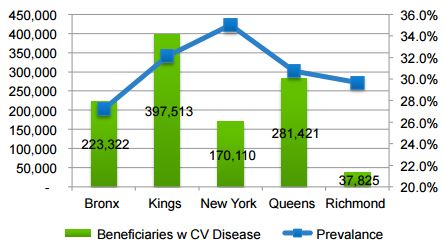
2016-2018 Community Service Plan

Table of Contents
SECTION 1: EXECUTIVE SUMMARY ......................................................................................... 3

SECTION 2: MISSION STATEMENT .......................................................................................... 5

SECTION 3: DEFINITION OF SERVICE AREA .............................................................................. 6

SECTION 4: HEALTH ISSUES OF CONCERN ............................................................................. 11

SECTION 5: IDENTIFICATION OF PREVENTION AGENDA PRIORITIES ...................................... 17

SECTION 6: THREE YEAR PLAN OF ACTION ............................................................................ 18

SECTION 7: MAINTAINING ENGAGEMENT & TRACKING PROCESS ......................................... 20

SECTION 8: DISSEMINATION OF THE REPORT TO THE PUBLIC ............................................... 20

Appendix A: Hospital Sites and Community Programs .......................................................... 22

Appendix B: Community Benefit Activities ........................................................................... 26

                                                                                                               Page | 2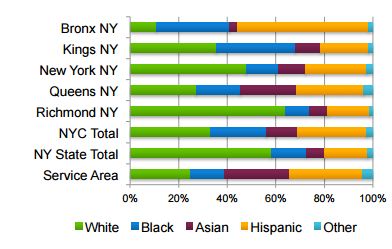
2016-2018 Community Service Plan

SECTION 1: EXECUTIVE SUMMARY

NewYork-Presbyterian/Queens (NYP/Queens), located in Flushing, New York, is a 535-bed tertiary care
community teaching hospital affiliated with Weill Cornell Medicine that serves Queens and metro New
York residents. The NYP/Queens mission is to provide our greater community with excellence in clinical
care, patient safety, education, clinical research, and science. As part of this mission, NYP/Queens
continually monitors the priority health needs of Queens’ residents and provides preventive, diagnostic,
treatment, and rehabilitation services to meet those needs.

The primary service area is located in one of the most ethnically and racially diverse county in the United
States. 1 Racial and ethnic minority groups account for 64% of the total population of Queens.
Approximately 48% of area residents are foreign-born, representing over 100 countries. NYP/Queens’
service area has a high concentration of Asian residents compared to other geographies; more than 40%
of all Asians living in New York City reside in the NYP/Queens catchment area.

The 2016 Three Year Action Plan builds on the accomplishments of the three preceding years and
advances new goals and objectives. NYP/Queens’ 2013 Community Service Plan prioritized the
prevention of chronic disease and the promotion of healthy women, infants, and children. Hospital
initiatives focused on these two issues lay the groundwork for long-term, sustainable results; each
project has become self-sufficient and is no longer in need of targeted support from NYP/Queens’
workgroups. The success of the preceding initiatives has enabled NYP/Queens to focus and build on two
issues that greatly affect a growing number of community residents.

The NYP/Queens 2016-2018 Community Service Plan is informed by data collected from the
NYP/Queens Delivery System Reform Incentive Program’s (DSRIP) Community Health Needs Assessment
(CHNA), the NYC Department of Health and Mental Hygiene’s (NYCDOHMH) Community Health Profiles,
and the NYCDOHMH’s Epiquery Database. An analysis of this data along with feedback from a wide
range of community stakeholders, resulted in the selection of the following two priority areas:

           Priority #1: Increase access to high-quality chronic disease preventative care and management
           in both clinical and community settings, with a focus on Increasing screening rates for
           hypertension and heart disease

           Priority #2: Prevent HIV and STDs, with a focus on increasing screening rates for Hepatitis C.

Priority #1 - Chronic Disease: High blood pressure (hypertension) directly increases the risk of coronary
heart disease and stroke. In Queens County, heart disease is a leading cause of death. A CHNA focus
group discussed the physical health issues of the community and found that living in New York, chronic
diseases are caused by a multitude of environmental stresses. The prevalence of chronic disease in the

1
    “The NYC Experience: Queens, One Campus NYC, www.nyc.gov.
2
    “The NYC Experience: Queens, One Campus NYC, www.nyc.gov.
3
                                                                                                               3
    US Census via Missouri Census Data Center. (2014). ACS Profiles, Cornell Program on Applied Demographics
2016-2018 Community Service Plan
community within NYP/Queens service area is higher than NY State (NYS) (see Section 4). This was a
significant source of concern cited by both the key informant interview and the focus group regarding
health conditions that affect people in the communities where they live and work. The groups
highlighted, among other risk factors: hypertension and heart disease, and HIV were of critical concern
in their community.
NYP/Queens is committed to addressing the concern of hypertension and heart disease by aligning with
the NYP/Queens DSRIP Performing Provider System (PPS) Cardiovascular Disease Project, which
provides hypertension screenings as prescribed by the U.S. Preventative Service Task Force (USPSTF).
The USPSTF recommendations are preventive, evidence-based guidelines about clinical services such as
screenings, counseling services, and preventive medications. Additionally, the NYP/Queens Community
Health Initiatives Group has committed to provide resources for hypertension screening at several
community health events throughout the year. NYP/Queens is also developing a relationship with the
Queens Public Library to host permanent hypertension screening booths. NYP/Queens will monitor the
success of these initiatives by tracking the number of screening events, the number of patients
screened, and the number of patients connected to care. In order to mitigate socioeconomic and
linguistic barriers as well as limitations to access of care, NYP/Queens will host free screenings in venues
that are in easily accessible to the community.
HIV and STDs: HIV is a growing concern for the community. It is often a comorbity associated with
Hepatitis C (HCV). Early detection and proper follow-up care can dramatically reduce the mortality of
patients with HCV and HIV. Without the availability of screening programs and linkages to care, patients
with HCV and HIV commonly go untreated until they end up in the NYP/Queens emergency room with
end-stage liver disease. NYP/Queens started a new initiative: HIV, HBV and HCV Testing Model in an
Urban Hospital Setting, which screens individuals for Hepatitis B virus (HBV), HCV and HIV so people
living with any of these diseases can become aware of their status and linked to care. The program
offers testing for HBV, HCV and HIV to all eligible individuals, 21 years or older, at NYP/Queens
Emergency Department and the outpatient Ambulatory Care Center. Patients who test positive will be
linked to a primary care physician or the appropriate medical specialists for follow-up care.
It is anticipated that patients screened for HIV, HBC, and HCV in the Emergency Department and
Ambulatory Care Center will reflect the ethnic and sub-ethnic communities served by NYP/Queens. For
instance, chronic HBV has steadily increased among foreign-born populations in Queens, particularly
immigrants from China. The NYP/Queens Triple Viral Taskforce will track the number of patients
screened for HCV, HBV, and HIV and the number of patients connected to care, e.g. NYP/Queens and
local primary care physicians and local clinics. The information will be shared with the NYCDOHMH
Hepatitis C Coalition members, who will utilize NYP/Queens data for best practices and dissemination to
other sites across NYC.
42016-2018 Community Service Plan
SECTION 2: MISSION STATEMENT
This document represents the 2016-2018 Community Service Plan for NYP/Queens, a regional hospital
of NewYork-Presbyterian Regional Hospital Network, located in Flushing, New York. NYP/Queens is a
community teaching hospital affiliated with Weill Cornell Medicine that serves Queens and metro New
York residents. The 535-bed tertiary care facility provides services in 12 clinical departments and
numerous subspecialties, including 15,000 surgeries and 4,000 infant deliveries each year. With its
network of affiliated primary and multispecialty care physician practices and community-based health
centers, the hospital provides approximately 162,000 ambulatory care visits and 124,000 emergency
service visits annually.
The history of NYP/Queens goes as far back as the nineteenth century, as one of the first facilities
operated by the Salvation Army. It served patients in Manhattan for over 60 years, re-naming itself
Booth Memorial Hospital. The hospital uprooted from its Manhattan location in the 1950’s, when they
noticed a shortage of local general hospital facilities in the vast farmland communities located to the
east of the East River, namely Queens. From the beginning, the Salvation Army instilled a great sense of
service and patient-centered care at the hospital, a spirit that lives on in the institution to this day.
In July 2015, The New York Hospital Medical Center of Queens (also known as New York Hospital Queens
– NYHQ) and NewYork-Presbyterian joined forces to improve access to state-of-the-art care for
residents of Queens. NYHQ, a member of the NewYork-Presbyterian Network for more than 22 years,
was renamed NewYork-Presbyterian/Queens, effective July 1, 2015.
The NYP/Queens mission is to provide our greater community with excellence in clinical care, patient
safety, education, clinical research, and science. As part of this mission, NYP/Queens continually
monitors the priority health needs of Queens’ residents and provides preventive, diagnostic, treatment,
and rehabilitation services to meet those needs wherever feasible.
Values:
NYP/Queens strategic initiatives support our ultimate goal: We Put Patients First. This means that in
everything we do, we must make patients our first priority and strive to provide them with the highest
quality, safest, and most compassionate care and service. Our values are summarized through the 7 C’s:
Caring and Compassion
Commitment to Quality and Service
Caution
Candor
Courage
Competence
Continuous Learning
The NYP/Queens Board of Trustees approved this plan on December 14, 2016.
52016-2018 Community Service Plan
SECTION 3: DEFINITION OF SERVICE AREA
For the purposes of the CHNA, the service
area is derived using hospital patient origin;
specifically zip codes that represent ~75% of
outpatient clinic patients in the most recent
year. The white colored area of the map to
the right depicts NYP/Queens service area,
following this definition from NYS.
Description of Community Served
Queens County is the largest, in area, of the
five boroughs of New York City, with a
population of approximately 2.31M people. It
is often referred to as the most ethnically
diverse urban area in the world.2
The NYP/Queens service area comprises 33
of 52 Queens County zip codes. The service
area currently has 1.59M people. Assuming
the expansion of NYP/Queens’ service area is
consistent with the 0.5% growth rate of
Queens County, the number of residents
living in the service area will increase to 1.66M by 2020.3
Race and Ethnicity:
Queens County and the NYP/Queens service area cover the two most diverse geographies in NYC. As
shown below, racial or ethnic minority groups account for up to 30% of Queens County and service area
population.4 Having a significant population base of all major races and ethnicities impacts the provision
of health services in the following ways: cultural issues, language and health literacy, disease
prevalence, and disease manifestation.
2
“The NYC Experience: Queens, One Campus NYC, www.nyc.gov.
3
US Census via Missouri Census Data Center. (2014). ACS Profiles, Cornell Program on Applied Demographics
http://census.missouri.edu/acs/profiles/ http://pad.human.cornell.edu/counties/projections.cfm
4
US Census via Missouri Census Data Center. (2014). ACS Profiles [dataset application].
http://census.missouri.edu/acs/profiles/.
62016-2018 Community Service Plan
Language:
The languages spoken at home by NYP/Queens patients mirrors the racial and ethnic diversity
represented throughout the NYP/Queens service area. 38% of the service area population primarily
speaks English, compared with 43.4% in the rest of Queens County, 51.4% of New York City, and 70.0%
of New York State. The NYP/Queens catchment area has a much higher rate of Asian, Indo-European
and Spanish speakers than does the city or state.
72016-2018 Community Service Plan
Employment and Income:
There are 80k unemployed persons in the area, for a rate of 9.6%. This rate is higher than NYS, but lower
than NYC average.
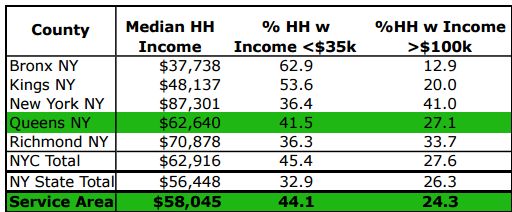
Queens County median income of approximately $62k is higher than the NYS median of $56k, and
approximately equal to the New York City median of $63k. The NYP/Queens service area; however, has
a much lower median income than Queens County, at $58k. The percentage of NYP/Queens service area
households with a low income (less than $35k per household) is 44.1%. This rate is higher than the
Queens County and NYS rates of 41.5% and 32.9%, respectively. Conversely, the percentage of
households with high income is lower in the service area than in the County or State.5
5
US Census via Missouri Census Data Center. (2014). ACS Profiles [dataset application].
http://census.missouri.edu/acs/profiles/
82016-2018 Community Service Plan
Poverty:
Poverty is an issue of concern for this population – particularly the disparity in poverty rates across the
service area. Some portions of the service area see as much as one fourth of the population living in
poverty. There is great geographic disparity in the percent of families living in poverty. Queens County
has a lower percentage of families in poverty (14.4%) than Bronx, Kings and New York Counties, but
higher than Richmond. Within the service area alone, the percentage of families living in poverty ranges
from 4.6% in Whitestone to 23.8% in one zip code within Jamaica.6
Medicaid Beneficiaries:
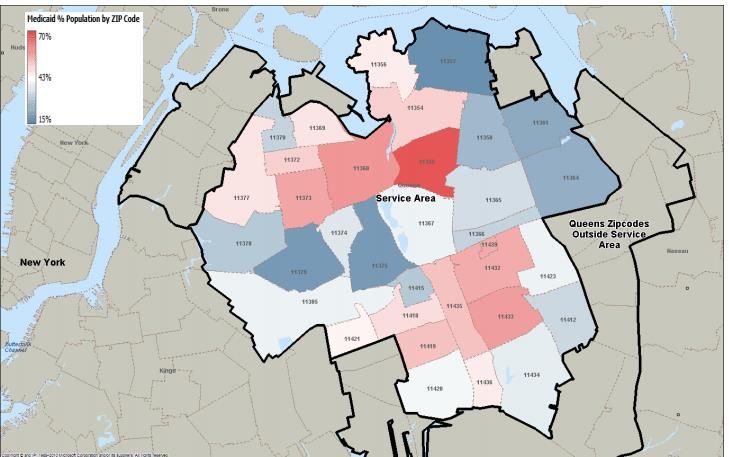
There are approximately 916,000 Medicaid beneficiaries in Queens County, and approximately 692,000
Medicaid beneficiaries in the NYP/Queens service area. These numbers translate to 41% of the
population in Queens County and 43% in the service area.
The percent of population enrolled in Medicaid ranges from 18% in Whitestone to 69% in Flushing
(which is, notably, NYP/Queens zip code). The service area appears to have two areas of high Medicaid
concentration, separated by an area of low Medicaid population. Corona, Elmhurst and one of the two
6
US Census via Missouri Census Data Center. (2014). ACS Profiles [dataset application].
http://census.missouri.edu/acs/profiles/.
92016-2018 Community Service Plan
Flushing zip codes each have more than 50k Medicaid beneficiaries. The Jamaica zip codes have a high
percentage of individuals receiving Managed Care Medicaid or Medicaid HMO.7
Uninsured:
Estimates of the uninsured rate ranges from 9.9% in
Richmond County to 24.2% in NYS, with Queens County
at 19.2%. While lower than the State, Queens County
has the highest uninsured rate of any NYC County, at
19.2% or 431k persons. Assuming NYP/Queens’s service
area uninsured rate is similar to Queens County rate,
the service area has approximately 306k uninsured.8
In aggregate, there are 1.9M persons in the service area
7
Health Data NY, New York State Department of Health http://health.data.ny.gov/Health/Medicaid-Beneficiaries-
Inpatient-Admissions-and-Em/m2wt-pie4?
8
U.S. Census Bureau/Small Area Health Insurance (SAHIE) Program/March 2014 via
http://www.census.gov/did/www/sahie/data/20082012/index.html
102016-2018 Community Service Plan
who are either Medicaid beneficiaries or uninsured. The uninsured rate for Queens County is estimated
at 19.2% with a total of 430,385 individuals compared to a NYS estimate of 24.2%, totaling 4.6M
individuals.
SECTION 4: HEALTH ISSUES OF CONCERN
Beginning in October 2014, NYP/Queens engaged in a four-month-long, comprehensive, and
collaborative development of a CHNA, led by the DSRIP CHNA Project Workgroup, with significant input
from the NYP/Queens PPS Project Advisory Committee. Vast amounts of quantitative and qualitative
data were collected, refined, and analyzed. Thirteen stakeholders and over 80 residents provided
valuable qualitative information on their health concerns and health care access and services in Queens.
Quantitative data used throughout this analysis was obtained from more than 30 sources.
The Center for Evaluation and Applied Research (CEAR) at The New York Academy of Medicine (NYAM)
conducted the primary data portion of the CHNA, which included surveys of community residents, and
focus groups and interviews with Queens residents, providers, and other stakeholders. The protocol was
developed in collaboration with selected PPS in Queens, Brooklyn, the Bronx, and Manhattan and was
approved by the NYAM Institutional Review Board (IRB).
A NYP/Queens Community Health Service Plan Workgroup comprised of representatives from External
Affairs, Community Medicine, Community Health Initiatives, Corporate Health, and Community Benefits
and Services was convened to review the CHNA and the public health data to select the priorities for
collaborative action.
In addition to the CHNA and community focus groups, additional data was examined from a wide variety
of sources:
NYS Prevention Agenda 2013 – 2016 indicators
NYCDOHMH Community Health Indicator Reports
County Health Indicators by Race/Ethnicity
Access to state, county, and city information collected by Census or American Community
Survey
NYS Behavioral Risk Factor Surveillance System
NYC EpiQuery Database
112016-2018 Community Service Plan
The health indicators selected for this report were based on a review of available public health data and
NYS priorities promulgated through the Prevention Agenda for a Healthier New York. Additionally, in
cooperation with the NYCDOHMH, one of the health indicators was selected as a direct response to
their top five health concerns for Queens County.
Given the service area’s racial and ethnic diversity, stakeholders and residents emphasized the need for
culturally and linguistically appropriate care, particularly within the hospital setting. Poverty is an issue
of concern for this population, particularly the disparity in poverty rates across the service area. Poverty
rates are highest in neighborhoods within Jamaica, Corona, and Elmhurst. Focus group participants
reported that they often delay or avoid seeking health care due to cost.
Additionally, the NYP/Queens CHNA found that one of the most significant areas of concern from a
morbidity or disease prevalence perspective is heart disease. The New York City Community Health
Indicator Profile shows cardiovascular disease as the leading cause of death in Queens County.9
Leading Causes of Death in Queens Number of Deaths Death Rate (per 100,000)
County, 2014
Cardiovascular disease 4,464 175
Cancer 3,360 130
Pneumonia and Influenza 655 25
Stroke 558 22
Chronic Lower Respiratory Disease 504 20
Cardiovascular Disease:
Cardiovascular disease is a serious chronic health issue for the NYP/Queens service area. In Queens County, it is
the leading cause of mortality. Several risk factors are attributable to developing heart disease. These factors
include hypertension, smoking, cholesterol, and diabetes, among others. Uncontrolled hypertension is a major
contributor to cardiovascular disease and is easily identifiable. Yet, in NYS, over 65% of adults are not told they
have high blood pressure.10
9
New York State Department of Health County Health Indicator Profiles, 2014 (22)
10
Centers for Disease Control and Prevention, National Center for Chronic Disease Prevention and Health
Promotion, Division of Population Health. BRFSS Prevalence & Trends Data [online].
2015. URL: https://www.cdc.gov/brfss/brfssprevalence/.
122016-2018 Community Service Plan
More than half of all people over the age of 65 have hypertension (high blood pressure). Typically, hypertension
has no symptoms, which is why the condition has been
dubbed “the silent killer.”
The following table highlights the avoidable hospitalizations
within the specific areas in Queens that fall within the
NYP/Queens service area. It demonstrates that Hollis,
Jamaica, Jamaica Center, North Springfield Gardens,
Rochdale, South Jamaica, and St. Albans have the highest
burden of the disease. 33% of the population is diagnosed
with hypertension and a rate of 134.3 per 100,000 for
avoidable hospitalizations.11
HYPERTENSION
Locations in Queens Avoidable Hospitalizations per Percentage of
100,000 Population (%)
Hollis, Jamaica, Jamaica 134.3 33.2
Center, North Springfield
Gardens, Rochdale, South
Jamaica , St. Albans
Corona, Corona Heights, 89.2 29.1
Elmhurst, LeFrak City
Howard Beach, Lindenwood, 86.2 26.4
Old Howard Beach, Ozone
Park, South Ozone Park
11
PHIP, UHF, and DOHMH: “A Strategy for Expanding and Improving the Impact of the Medical Home Across New
York City”
132016-2018 Community Service Plan
Astoria, Astoria Heights, 76 26.1
Queensbridge, Dutch Kills,
Long Island City,
Ravenswood, Rikers Island
(BX) , Steinway
Blissville, Hunters Point , 76 26.1
Long Island City, Sunnyside,
Sunnyside Gardens,
Woodside
East Elmhurst, Jackson Heights, North 86.7 24.7
Corona
Glendale, Maspeth, Middle 66.1 26.4
Village, Ridgewood
Forest Hills, Forest Hill 79.5 22.6
Gardens, Rego Park
Auburndale, Bay Terrace, 49.1 24.8
Beechhurst, Clearview,
College Point, Downtown
Flushing, East Flushing,
Flushing, Malba, Murray Hill,
Queensboro Hill, Waldheim,
Whitestone
Briarwood, Fresh Meadows, 60.4 24.8
Hillcrest, Holliswood,
Jamaica, Jamaica Estates,
Jamaica Hills , Kew Gardens
Hills, Pomonok, Utopia
Kew Gardens, Ozone Park, Richmond 74.6 31.9
Hill, Woodhaven
Auburndale, Bayside, Douglaston, Hollis 42.9 22.9
Hills, Little Neck , Oakland Gardens
Although the rate of Hypertension hospitalization for adults 18 and older living in Queens of 7.6 is less
than NYC’s rate of 9.5, it is higher than the NYS’s rate of 6.8.12
12
New York State Community Health Indicator Reports - Cardiovascular Disease Indicators
142016-2018 Community Service Plan
In Queens County, approximately 281k Medicaid beneficiaries (30.7%) have cardiovascular disease. This
prevalence rate is in the middle of comparative geographies, but is higher than the NYS rate of 29.2%. In
2012 in Queens County, cardiovascular disease was the primary driver of 197,816 Medicaid inpatient
admissions and 144,585 Medicaid emergency visits13
In Queens, the prevalence of Cardiovascular disease at 30.7% is greater than NYS rate at 29.2%. 14
Racial Disparities in Cardiovascular Disease
The American Heart Association highlights that racial/ethnic minority groups more frequently lack
health insurance and have limited access to quality healthcare. Statistically, high blood pressure is more
prevalent in certain racial/ethnic minority groups in the US, especially blacks.15 This further emphasizes
the need to have hypertension screenings at health events in high-risk neighborhood such as Jamaica
and Hollis area of Queens, which has a sizeable population of black residents.
13
https://health.data.ny.gov/Health/Medicaid-Chronic-Conditions-Inpatient-Admissions-a/wybq-m39t
14
Health Data NY, New York State Department of Health https://health.data.ny.gov/Health/Medicaid-Chronic-
Conditions-Inpatient-Admissions-a/wybq-m39t
15
Angeles J, Somers S. From Policy to Action: Addressing Racial and Ethnic Disparities at the Ground-Level. Issue
Brief. Center for Healthcare Strategies, Inc August 2007
152016-2018 Community Service Plan
Local Health Department
For uncontrolled hypertension, the local health department seeks to improve the quality of health care
delivery by engaging 17 community pharmacies in activities that will drive the prevention and control of
high blood pressure. They will provide technical assistance and quality improvement support to increase
awareness of the impact of high blood pressure, promote evidence based strategies that increase the
rate of blood pressure control, and increase the demand for pharmacist directed care. Additionally, they
run or support a variety of healthy eating and physical activity programs, both of which can help patients
control their blood pressure.16
HIV and STDs
Although the rates of HIV are not highest among the NYP/Queens population, the service area contains
several high-risk population for HIV infection. The Center for Disease Control (CDC) reported a steep
spike in the mortality of Hepatitis cases in their 2013 Surveillance for Viral Hepatitis report with New
York City foreign-born Asians ranking one of highest in mortality rates in HBV.17
During the 2010 State of the Hospital presentation at NYP/Queens, Dr. Mitchell Chorost, then-Director
of Surgical Oncology, revealed that Queens County has “an unusually high rate of Hepatitis C among
Asian and Pacific Islanders with nearly 14 of every 100,000 Queens men have liver cancer, and 4.5
among females.”18 A growing population of first-generation Asian immigrants has driven an increase in
the overall rate of HBV, which has an “infection rate 35 times higher than is found in the general U.S.
population”.19 With early detection and proper follow-up care, the percentage of HBV and HCV can be
dramatically reduced. Without the availability of screening programs and linkages to care, patients with
Hepatitis commonly go untreated until they end up in the NYP/Queens emergency room with end-stage
liver disease.
NYCDOHMH 2013 report, Geographic Co-occurrence of HIV/AIDS and Viral Hepatitis, ranked Queens in
the top 25% of zip codes with multiple diseases (HBV, HCV, HIV/AIDS,).20 According to the report, HBV
disproportionately impacts NYP/Queens’ service area with 12 Queens zip codes in the top quintile for
16
NYCDOHMH TCNY 2020 Community Priorities and related DOHMH services in Queens; Aug. 31, 2016
17
U.S. 2013 Surveillance for Viral Hepatitis – United States, 2013, Center for Disease Control: Division of Viral
Hepatitis, May 31, 2015. Statistics & Surveillance
18
Mitchell, MD. High Hepatitis C, Liver Cancer Rate In Queens, NYC: Russians & Asians: 2010. NewYork-
Presbyterian/Queens State of the Hospital Presentation
19
Mitchell, MD. High Hepatitis C, Liver Cancer Rate In Queens, NYC: Russians & Asians: 2010. NewYork-
Presbyterian/Queens State of the Hospital Presentation
20
Geographic Co-occurrence of HIV/AIDS, Viral Hepatitis, Sexually Transmitted Diseases and Tuberculosis in New
York City. Epi Data Brief: New York City Department of Health and Mental Hygiene. December 2012.
162016-2018 Community Service Plan
Hepatitis B.21 Neighborhood-level interventions have been found to be most effective as Hepatitis often
impacts individuals concentrated in distinct communities. Queens residents who are most at-risk for
HIV/AIDS and Hepatitis like Jackson Heights and Elmhurst, have less access to the health care system
and can easily be lost due to lack of follow-up care, or may never return to the testing site to learn of
their lab results. Co-occurrence of HIV/AIDS and Hepatitis increases the risk of death from liver and non-
liver related diseases. For instance, HIV/HCV coinfection was associated with “40% higher mortality
compared with HIV monoinfection.”22
SECTION 5: IDENTIFICATION OF PREVENTION AGENDA PRIORITIES
NYP/Queens identified two Prevention Agenda Priorities as well as disparities in both priority areas. The
plan of action will be working towards addressing these disparities in both prevention priorities. The
selection was based on the data, input, and feedback from both internal and external stakeholders.
The quantitative research indicates that a number of chronic diseases are prevalent in the NYP/Queens
service area. In addition, the data points to health disparities including the increasing hepatitis rates in
the Asian community.
In consideration of the aforementioned quantitative and qualitative data, NYP/Queens has chosen the
following two NYS Prevention Agenda Priority areas:
1. Prevent Chronic Diseases
2. Prevent HIV, STDs, Vaccine Preventable Diseases and Healthcare-Associated Infections
21
Geographic Co-occurrence of HIV/AIDS, Viral Hepatitis, Sexually Transmitted Diseases and Tuberculosis in New
York City. Epi Data Brief: New York City Department of Health and Mental Hygiene. December 2012.
22
Geographic Co-occurrence of HIV/AIDS, Viral Hepatitis, Sexually Transmitted Diseases and Tuberculosis in New
York City. Epi Data Brief: New York City Department of Health and Mental Hygiene. December 2012.
172016-2018 Community Service Plan
SECTION 6: THREE YEAR PLAN OF ACTION
NYS PREVENTION AGENDA OUTCOME INTERVENTIONS, STRATEGIES, PROCESS PARTNER PARTNER BY DISPARITY
PRIORITY AREAS OBJECTIVE (S) & ACTIVITIES MEASURES ROLE RESOURCES WHEN ADDRESSED
PRIORITY 1: PREVENTING CHRONIC DISEASES
FOCUS AREA 3: INCREASE - Increase the - Incorporate hypertension - # of - Outreach - NY Public 12/31/17 Socioeconomic
ACCESS TO HIGH QUALITY percentage of screening at community health community venues Library Disparity -
CHRONIC DISEASE adults 18 initiative outreach events. health Hypertension
PREVENTIVE CARE AND years and - Refer patients to ambulatory screenings. - Access to - NYP/Queens screenings will
MANAGEMENT IN BOTH older who primary care sites for follow up. - # of the Ambulatory be provided for
CLINICAL AND COMMUNITY have a blood - Partner with NY Public Library patients community Care Sites free at
SETTINGS pressure and set up booths for screened. community
screening. hypertension screenings. - # of - Data - Community outreach events;
- GOAL #3.1: Increase - Promote that all primary care patients resource Health locations of
screening rates for - Increase the practices follow the U.S. connected Initiatives clinical practices
cardiovascular disease percentage of Preventative Service Task Force to care. partners are in high-need
among disparate adults with Recommendations in locations and
populations. hypertension Hypertension Screening. this will ensure
who have - Identify patients who have clinical practices
-GOAL #3.2: Promote use controlled repeated elevated blood in the
of evidence-based care to their blood pressure readings in the community and
manage hypertension. pressure. medical record but do not have ambulatory care
a diagnosis of hypertension and settings use
schedule them for a evidence based
hypertension visit. strategies to
- In addition to targeting improve
general population for management of
screening, NYP/Queens will cardiovascular
also do outreach for the disease.
indicated minority groups.
182016-2018 Community Service Plan
PRIORITY 2: PREVENT HIV, STDs, VACCINE PREVENTABLE DISEASES, AND HEALTH-CARE ASSOCIATED INFECTIONS
FOCUS AREA 1: PREVENT HIV - Increase the - Incorporate the testing as - # of - Community - NYDOHMH 12/31/17 Racial Disparity:
and STDs volume of part of the workflow at patients Resource Hep C Approximately
adults, 21 Emergency Department (ED screened. Coalition 80% of
- GOAL #5: Increase and years and and the Ambulatory Care - Disseminate NYP/Queens
coordinate Hepatitis C Virus older, who Center (ACC). - # of data - Community patient
(HCV) prevention and have a Hep C - Use the electronic medical patients Clinic population are
treatment capacity in New screening. record (EMR) to identify eligible connected - Clinical Care immigrants, with
York State. patients, capture all needed to care. - Community Chinese foreign-
- Increase the data which will be used as tools Physician born immigrants
# of infected for continuous quality representing
patients improvement. nearly 50
connected to - Test 20% of eligible patients percent of
proper care in the ED and 30% of eligible NYP/Queens
patients at ACC, which is the patients.
outpatient site. NYP/Queens has
- Identify and provide witnessed
community resources and unusually high
connect HCV positive patients rates of Hepatitis
to care at NYP/Queens, C among the
community clinics, or growing
community primary care population of
physicians. first-generation
Asian
immigrants.
192016-2018 Community Service Plan
SECTION 7: MAINTAINING ENGAGEMENT & TRACKING PROCESS
NYP/Queens is committed to improving the health of the community it serves. Each of the community
health improvement focus areas will have a task force which will address the operational concerns
required to successfully implement the strategies noted. These workgroups will be charged with tracking
and monitoring the interventions committed in this Community Service Plan. Their data submissions will
be used to provide annual updates.
Additionally, NYP/Queens has multiple formal committees, such as the Community Advisory Council.
The NYP Queens Community Advisory Council (CAC) provides the opportunity for community leaders
and residents to directly engage Hospital senior leadership. The focus of the Council is to enhance
communication and collaboration between the Hospital and diverse sectors of the community. The CAC
is comprised of 20 community leaders and residents who meet with senior Hospital leadership five times
a year to discuss new programs/services, and address relevant health care issues impacting patients and
the community.
In addition to the community needs addressed in this year’s community service plan, NYP/Queens has
several ongoing community programs that help foster community engagement and address gaps in care
that are highly needed. Many of these activities and groups directly support components of the NYS
Prevention Agenda, Take Care New York, and the US Healthy People 2020 goals. Appendix B includes a
table summarizing current efforts.
SECTION 8: DISSEMINATION OF THE REPORT TO THE PUBLIC
Distribution of and access to NYP/Queens 2016-2018 Community Service Plan is as follows:
Instructions for obtaining access to the documents will be posted on the hospital’s public
website (www.nyp.org/Queens), publish in local newspapers, and distribute via internal
communications such as NYPress.
The Community Service Plan will be posted to the www.nyp.org/Queens website at the specific
address http://www.nyp.org/Queens/Community_Service_Plan. It can also be found through
accessing the general www.nyp.org/Queens site and clicking the “About the Hospital” link and
scrolling to the “Our Commitment to the Community” hyperlinked text.
The Community Service Plan will be mailed out in hard copy to members of the NYP/Queens
Board, as well as provided to the Community Advisory Committee, community leaders and
elected officials.
NYP/Queens will announce through its multiple social media platforms the availability of the
Community Service Plan which will be available through the following feeds:
o Facebook: https://www.facebook.com/NewYorkPresbyterianQueens/
o Twitter: https://twitter.com/NYPQueens
o Instagram: https://www.instagram.com/nypqueens/
The public can also make inquiries about the plan and obtain a printed copy of the Executive
Summary by contacting the Department of External Affairs at 718-670-1065.
202016-2018 Community Service Plan
PLAN CONTACT INFORMATION
Name of Facility: NewYork-Presbyterian/Queens
Address: 56-45 Main Street
City: Flushing
County: New York
DOH Area Office: Metropolitan Area Regional Office
CEO/Administrator: Jaclyn Mucaria, MPA
Title: President
CSP Contact Person: Camille Glotzbecker, MPA
Title: Director, Community Benefits and Services Planning
Phone: (718) 670-1248
Email: cap9074@nyp.org
212016-2018 Community Service Plan
Appendix A: Hospital Sites and Community Programs
Main Site
NewYork-Presbyterian/Queens 56-45 Main St.
Flushing, NY 11355
School Based Services
PS 24Q 141-11 Holly Avenue Flushing, New York 11355
Queens College 65-30 Kissena Blvd, Flushing, NY 11367
St. John's University 8000 Utopia Pkwy, Jamaica, NY 11439
PS /IS 499 148-20 Reeves Avenue, Flushing, NY 11367
St. Francis Preparatory High School 6100 Francis Lewis Blvd, Fresh Meadows, NY 11365
Holy Cross High School 26-20 Francis Lewis Blvd, Flushing, NY 11358
The Mary Louis Academy High School 17621 Wexford Terrace, Jamaica, NY 11432
Monsignor McClancy High School 71-06 31st Ave, East Elmhurst, NY 11370
Flushing High School Football 35-01 Union Street, Flushing, NY 11354
Programs
SNAP Oral Cancer Screening
Queens Medicaid Office Pediatric Advocacy Coalition
NYS DOH Cancer Services Program of Queens Korean Community Services of Metropolitan New York, Inc.
American Cancer Society Eastern Division
God’s Love – We Deliver Sky View Medical Center
Meals on Wheels Haitian American United for Progress
Monthly Physician Lecture Series (Mel Breite, M.D.) Japanese American Social Services, Inc
Healthy Baby Program Grameen VidaSana
Safety and Fall Prevention Program St. Paul Chong Ha-Sang Roman Catholic Church
Community Health Initiative (Screenings, Lectures, Educational NYU School of Public Health Prevention Research Center
222016-2018 Community Service Plan
Outreach) (MAHABAR Project)
Weight Loss Management Program Memorial Sloan Kettering Cancer Center (AMBER Project)
Queens Library HealthLink Chinese Christian Herald Crusades
Richmond Hill Economic Development Council YWCA Flushing
FDNY Engine 274 & Battalion 52, Flushing, Queens, NY NYC Poison Control
Breastfeeding Coordinator Chinese Planning Council Early Child Development Program
AAP Chapter 2 Child Center of NY
NYPQueens PPS DSRIP Asthma Coalition
NYPQ Trauma Services Garden of Hope
Women, Infants, and Children (WIC) Nutrition Programs
WIC Flushing
Services for Older Adults
Alzheimer’s Association Catholic Charities Bayside Senior Center
Specialized Services
NYP Emergency Department Telepsych Comunilife
AIDS Center of Queens County God's Love - We Deliver
Asian Americans for Equality Lexington Center for Mental Health Services
Medicaid Matters Mental Health Provider of Western Queens
New York City Department for the Aging One Flushing
Queensborough Hill Neighborhood Association Silvercrest Center for Nursing and Rehabilitation/Silvercrest
Housing
NYP/Queens OPAT Unit
Support Groups
Trauma Support Group (Annual Trauma Survivors Program) Breast Feeding Support group
Cancer Survivors Group (Annual Survivors Symposium) Diabetes Education and Support Group
Caregiver Symposium Treatment Options to Fit your Lifestyle (Kidney Disease)
Stroke Symposium Bariatric Support Group
Pink Ribbon Club- Chinese language based breast cancer support
group
232016-2018 Community Service Plan
NYP PPS PAC Membership as of 9-7-2016
Maureen Buglino, RN MPH (Chair) Maria D'Urso, MSN (Co-Chair)
MEMBERS:
Adele Agin John Lavin
Rahchel Bien Rosemary Lopez
Mark Bienstock Russell Lusak
Lorraine Breuer Jonathan Mawere
Maureen Buglino Daniel Muskin
Valentine Cruz Faivish Pewzner
Christine Duffy Ashook Ramsaran
Lianna Lee Mary Anne Rose
Maria D'Urso Issac Rubin
David Friedman Richard Sherman
Veronica Gonzalez David Tavares
David Grayson Alissa Wassung
Marianne Kennedy David Gross
Amy Shah Christina Coons
PRIMARY CARE PROVIDERS AND OTHER SPECIALTY
PROVIDERS*
* See attached list
POST-ACUTE CARE PROVIDERS**
**See attached list
PHARMACY PROVIDERS
World's Fair Pharmacy
COMMUNITY-BASED ORGANIZATIONS
Queens Library Catholic Charities
Community Board 7 Selfhelp Community Services
Community Board 11 Jewish Association Serving the Aging (JASA)
Queens Chamber of Commerce Charles B. Wong Community Health Center
242016-2018 Community Service Plan
FAITH-BASED ORGANIZATIONS
Etz Chaim Congregation Queens Jewish Community Council of Queens
Hindu Temple Society of North America Hatzolah of Queens
St. Michael's Roman Catholic Church Chesed 24/7
Flushing United Methodist Church Bikur Cholim of Queens
Queens Jewish Center Flushing Union Bible Church
Board of Trustees
Chairman
Gary Zuar
Vice Chair
Laura Forese, MD
Trustees
William W. H. Chiang
Arthur D. Dawson, PhD (Effective, 1/1/2017 – will be Chairman of the Board)
Kerry S. DeWitt
Joseph R. Ficalora
Phyllis R.F. Lantos
Jaclyn Mucaria
Michael Nochomovitz, MD
Cam Patterson, MD
Brian K. Regan, PhD
Karen Westervelt
252016-2018 Community Service Plan
Appendix B: Community Benefit Activities
Addresses a Healthy People 2020
Supports the NYS Social Determinant of Health
Community Benefit Activity Prevention (Education, Social & Community Context,
Agenda Economic Stability, Neighborhood & Built
Environment, Health & Health Care)
American Cancer Society Making Strides
Against Breast Cancer Walk
American Diabetes Walk
Blood Drives
Breast Feeding Support group x X
Patient Navigator Program x X
Caregiver Symposium x X
Caregivers Support Group x X
Charity Care and Financial Aid
Community Health Initiatives x X
Physician Lecture Series x X
Community Sponsorships
Diabetes Support Group x X
Falls Prevention x
Cancer Services Program of Queens x X
Lactation Room x X
NYP/Queens Green Initiatives X
Healthy Baby Fair x X
Smoking Cessation x X
Stroke Risk Assessment Day x
Childhood Obesity Program x X
Trauma Support Group (Annual Trauma
x
Survivors Program)
Cancer Survivors Symposium
Cancer Survivor Group x X
Oral Cancer Screening X
NICU Event
Stroke Symposium x X
Queens Pride (Queens Gay Pride Parade in
June)
National LGBTQ Healthcare Equality Index x X
Sports Medicine and Rehabilitation
x
Community Outreach
Diabetes Education and Support Group x X
Treatment Options to Fit your Lifestyle
x X
(Kidney Disease)
262016-2018 Community Service Plan
Addresses a Healthy People 2020
Supports the NYS Social Determinant of Health
Community Benefit Activity (continued) Prevention (Education, Social & Community Context,
Agenda Economic Stability, Neighborhood & Built
Environment, Health & Health Care)
Bariatric Support Group x X
Pink Ribbon Club- Chinese language based
x X
breast cancer support group
Weight Loss Management Program x X
Career Days
Risk Assessment and Genetic Counseling
x X
Community Outreach
Pediatric Advocacy Coalition X
Hong Kong Dragon Boat Festival
Flushing YMCA x X
Queens Night Market
Buhkarian Festival x X
Community Health Fair Participation x X
Queens Botanical Garden Community
Partnership
St. John’s University Community
Partnership
Queens College (CUNY) Corporate
Educational Program and Community
Partner
Korean Community Services of
Metropolitan New York, Inc. Lecture x X
Series
Queens Library Healthlink Lecture Series x X
Grants Writing Workshop
Community Collaboration Workshop
Evaluation Workshop
Triple Viral Testing x
Community Clinical Integration project x X
Bone Health Community Presentations x X
27Orthopedics and Sports Medicine
FRESH MEADOWS Center WHITESTONE
Fresh Meadows Surgical and 163-03 Horace Harding Whitestone Primary Care
Primary Care Expressway, 4th Fl. 14-02 150th Street
75-68 187th Street Fresh Meadows, NY 11365 Whitestone, NY 11357
Fresh Meadows, NY 11366
(866) 670-OUCH (6824) Main Entrance
(718) 445-0220 Orthopedics Neurology / (718) 670-1512
General / Endocrine Surgery Justin A. Classie, MD Gary L. Bernardini, MD, PhD
Bruna Babic, MD Aditya Derasari, MD Suja Johnkutty, MD
General / Bariatric Libi Galmer, DO Family Medicine / Internal Medicine
Stephen Merola, MD Alexander Golant, MD (718) 353-8933
Colorectal Elan M. Goldwyn, MD Adina Benitez, MD
Steven Chao, MD Jason Hu, MD Lisa Chang, DO
Christopher Foglia,MD Kevin N. Jiang, MD Ambrose Pipia, MD
Olga Yakobov, PAC Raymond B. Pahk, MD Urology / (718) 303-3720
Colorectal / Proctology
Kevin I. Pak, MD Farshad Shafizadeh, MD
Howard Tiszenkel, MD
Tony N. Quach, MD
Jeffrey E. Rosen, MD Side Entrance
(718) 303-6100 Cardiology / (347) 625-6214
Vascular Gregory Pontone, MD
Fresh Meadows Diabetes and
Rajeev Dayal, MD Cardiology / (718) 631-0500
Endocrinology Care
Satish Kedika, MD David Revere, MD
174-15 Horace Harding Expressway
Andy Lee, MD
Fresh Meadows, NY 11365
Gautam Shrikhande, MD
Jo Ann Eisinger, PA (718) 762-3111
Jessica Phair, NP Endocrinology JACKSON HEIGHTS
Loli Huang, MD Orthopedics and Sports Medicine
(718) 670-1185 Center
Nicola Kreglinger, MD
Breast 72-06 Northern Boulevard, 2nd Fl.
Daniel Lorber, MD
Melissa Hughes, MD Jackson Heights, NY 11372
Siu-Ling Ma, MD
Joseph Tibaldi, MD
(718) 297-3788 (866) 670-OUCH (6824)
General / Breast Orthopedics
NewYork Presbyterian Medical
James Satterfield, MD Justin A. Classie, MD
Group/Queens OB/GYN
Amandeep Sohal, NP Aditya Derasari, MD
61-34 188th Street, 2nd Fl.
Libi Galmer, DO
Fresh Meadows, NY 11365
(718) 670-1837 Alexander Golant, MD
Neurosurgery (718) 454-3200 Elan M. Goldwyn, MD
Ning Lin, MD Obstetrics and Gynecology Jason Hu, MD
Jong Ok Yun, NP Jason Fong, MD Kevin N. Jiang, MD
Lisa Rosenberg, MD Feliks Koyfman, MD
(718) 303-3720 Michael Lerario, MD
Urology Jaime Nieto, MD
Michael Amirian, MD Raymond B. Pahk, MD
David Green, MD Kevin I. Pak, MD
Gerald Wang, MD Tony N. Quach, MD
Elizabeth Cabezon, PA Jeffrey E. Rosen, MDBayside Primary Care
44-02 Francis Lewis Blvd, Suite A
ASTORIA Bayside, NY 11358
FOREST HILLS
Astoria Primary Care Primary Care and Multi-Specialty
41-01 30th Ave 112-05 Queens Blvd., 1st Fl.
(718) 631-0500
Astoria, NY 11103 Forest Hills, NY 11375
Primary Care
Peter Barra, MD
(718) 204-9886 (718) 732-1550
John Coman, MD
Family Medicine / Internal Primary Care
Svetlana Fuzaylova, MD
Medicine Ambika Deb, MD
Sudha Dubey, MD Dionysia Mamais-Raptis,
Zoohra Mashriqi MD
MD
Melvina Patel, MD Demetrios Paidoussis, MD
Ion Oltean, MD
Ambrose Pipia, MD Mikhail Yakubov, DO
Pulmonary Medicine Calina Pavlovici, MD
Rheumatology
Joseph Cooke, MD Gregory Pontone, MD Tehila Zuckerman, MD
Cardiology
(718) 670-2399
(718) 281-2001 Sahadeo (Dave) Ramnauth,
Internal Medicine Gastroenterology
MD
Panagiotis Pagonis, MD Ari Bunim, MD
Jonathan Ruan, MD
Bayside Pediatric Multispecialty
(718) 303-6100
Astoria Cardiology Care Care
Vascular Surgery
30-18 37th Street #1 26-19 Francis Lewis Blvd, 2nd Fl.
Satish Kedika, MD
Astoria, NY 11103 Bayside, NY 11358
(718) 303-3725
(718) 278-0100 (718) 670-2468
Gynecologic-Oncology
Pediatric Gastroenterology
Cardiology David Fishman, MD
Emmanuel Troulakis, MD Suma Kamath, MD
Long Nguyen, MD
Melissa Rose, MD
Tarah Pua, MD
Astoria Cardiology Care Aaron Turkish, MD
27-47 Crescent Street, Suite 101 Pediatric Cardiology
(718) 651-2929
Astoria, NY 11102 Alexandra Channing, MD
Breast Surgery
Maria Thanjan, MD
Kap-Jae Sung, MD
(718) 606-6800 Pediatric Neurology
Cardiology Sabiha Merchant, MD (718) 445-0220
Marios Gagaos, DO Pediatric Endocrinology Endocrine Surgery
Alexis Feuer, MD Bruna Babic, MD
Pediatric Surgery
Stephen Oh, MD
BAYSIDE Nitsana Spigland, MD
Bay Terrace Primary Care Pediatric Urology
23-91 Bell Blvd, Suite 201 Jeremy Wiygul, MD
Bayside, NY 11361
(212) 746-2363
(718) 224-2743 Pediatric Neurosurgery
Internal Medicine Caitlin Hoffman, MD (Weill
Melvin Breite, MD Cornell)Surgical Services
FLUSHING MASPETH
142-43 Booth Memorial Avenue
Breast Center Maspeth Multispecialty Care
Flushing, NY 11355
58-04 Main Street 72-41 Grand Avenue
Flushing, NY 11355 Maspeth, NY 11378
(718) 539-7230
General Surgery
(718) 670-1185 (718) 458-0261
Talat Addasi, MD
Breast Surgery Pulmonary Medicine
Melissa Hughes, MD Anthony Smith, MD
Primary Care on Oak Avenue
Manmeet Malik, MD Pediatric Gastroenterology
163-03 Oak Avenue
Beth Siegel, MD Suma Kamath, MD
Flushing, NY 11358
Jacqueline Tsai, MD Aaron Turkish, MD
Eileen Costello, APRN (718) 445-2298
Cardiology
Jianan Qiao, PA Gregory Gustafson, MD
Primary Care
Elaine Lin Kow, MD
John Sciales, MD
Flushing Surgical Services Emmanuel Moustakakis, MD
133-47 Sanford Avenue, Suite 2C Flushing Primary Care
Flushing, NY 11355 196-03 42nd Avenue (718) 303-3720
Flushing, NY 11358 Urology
(718) 359-8787 Farshad Shafizadeh, MD
Surgery (718) 281-2001
Lou-Fu Ni, MD Internal Medicine
Panagiotis Pagonis, MD
Neurosurgery
56-20 Main Street Cardiology Electrophysiology at
Flushing, NY 11355 New York Presbyterian/Queens
56-45 Main Street, 3 South
(718) 670-1837 Flushing, NY 11355
Neurosurgery
Ning Lin, MD (718) 670-2388
Jamie Nieto, MD Cardiology
Celandia Bart, NP Seth Goldbarg, MD
Jong Ok Yun, NP Joon-Hyuk Kim, MD
David Slotwiner, MD
(718) 670-1512 Hua Yang, MD
Neurology
Feliks Koyfman, MD
Michael Lerario, MD
Urological Services
58-42 Main Street
Flushing, NY 11355
(718) 303-3720
Michael Amirian, MD
David Green, MD
(718) 353-3710
Robert Farrell, MD
Albert Tarasuk, MDPOST-ACUTE CARE PROVIDERS
SNFs
Chapin Home For The Aging
Cliffside Rehabilitation and Residential Health Care Center (a Trade Nm of Cliffside Nrsng Hm Inc)
Cypress Garden Center for Rehabilitation and Nursing (formerly Flushing Manor Care Center)
Dry Harbor Nursing Home
Elmhurst Care Center
Fairview Nursing Care Center Inc
Forest Hills Care Center
Forest View Center for Rehabilitation and Nursing
Franklin Center for Rehab and Nursing
Grace Plaza
Highland Care Center, Inc.
Hillside Manor Rehabilitation and Extended Care Center
Little Neck Nursing Home
Long Island Care Center
Margaret Tietz Nursing and Rehab Center
Meadow Park Rehabilitation and Health Care Center
New York Center for Rehabilitation and Nursing
New York Hospital Queens-TCU 7S
Northwell Health Stern Family Center for Rehabilitation (Formerly NSLIJ)
Ozanam Hall of Queens Nursing Home, Inc.
Parker Jewish Institute of Healthcare and Rehabilitation
Queens Boulevard Extended Care Facility
Regal Heights Rehabilitation and Healthcare Center
Rego Park Health Care Center
Sapphire Center For Rehabilitation And Nursing(Formerly Flushing Manor Nursing & Rehab)
The Grand at Queens (formerly Queens Center)
The Pavilion at Queens Rehabilitation and Nursing (Formerly Dr.William O. Benenson Rehab)
The Silvercrest Center for Nursing and Rehabilitation
Trump Pavilion Nursing and Rehab/Medisys Health Network, Inc.
Union Plaza Care Center
Waterview Nursing Care Center
Woodcrest Rehabilitation and Residential Health Care Center
Assisted Living Residence
Atria of Forest Hills
Sutton Gardens
Atria Assisted Living-Kew Gardens
Acute Care - Rehab
Burke Rehabilitation Hospital
Rusk Institute of Rehabilitation Medicine/Hospital for Joint D.
Queens Hospital Acute Rehab
Home Hospice
Calvary Hospital-Hospice
MJHS Hospice and Palliative Care - Outpatient
Hospice of New York
VNSNY/Visiting Nurse Service of New York (All)
Psychiatric Hospital
South Oaks Hospital Northwell Health (Formerly NSLIJ)
Gracie Square Hospital
Brunswick Hospital-Psych Unit
Zucker Hillside Hospital Northwell Health (Formerly NSLIJ)
New York Presbyterian Hospital-Payne Whitney Westchester
Page 1 of 2Home Health Care Services
AgeWell New York
Girling Health Care Inc. - Brooklyn
CenterLight Certified Home Health Agency/CenterLight Health Systems
Extended Home Care
Personal Touch Home Aides Of NY Inc (CHHA)
SeniorBridge - Great Neck
Catholic Home Care / Catholic Health Services of Long Island
Alternate Staffing Inc
Northwell Health Home Care Network (Formerly NSLIJ)
Revival Home Health Care
MJHS Home Care (Formerly Metropolitan Jewish Home Care-Central Intake - Brooklyn)
Americare Certified Special Services
VNSNY/Visiting Nurse Service of New York (All)
Centers Plan for Healthy Living
HomeFirst
Wellcare Advocate MLTC
CenterLight Healthcare
GuildNet
Dialysis Services
Flushing Manor Dialysis Center, Llc
Kew Gardens Dialysis Center
FMC - Bayside/Fresenius Medical Care
FMC - Queens NYDS\Fresenius Medical Care
The Rogosin Institute Auburndale Dialysis
Queens Dialysis - South Flushing
Queens Artifical Kidney Center
Rogosin Institute - Queens Dialysis Center
Trude Weishaupt Dialysis Facility
Page 2 of 2You can also read


