2018-19 DEPARTMENT OF FOREIGN AFFAIRS AND TRADE CORPORATE PLAN - August 2018
←
→
Page content transcription
If your browser does not render page correctly, please read the page content below
2018–19 DEPARTMENT OF FOREIGN
AFFAIRS AND TRADE CORPORATE PLAN
August 2018

Statement of Preparation
I, as the accountable authority of the Department of Foreign Affairs and Trade, am pleased to present the
2018–19 Department of Foreign Affairs and Trade Corporate Plan. This covers the period 2018–19 to
2021–22, as required under paragraph 35(1)(b) of the Public Governance, Performance and Accountability
Act 2013.

Frances Adamson
Secretary

Creative Commons
With the exception of the Commonwealth Coat of Arms and where otherwise noted all material presented in
this document is provided under a Creative Commons Attribution 3.0 Australia licence, available at:
http://creativecommons.org/licenses/by/3.0/au/. The details of the relevant licence conditions are available
on the Creative Commons website (accessible using the links provided) as is the full legal code for the CC BY
3.0 AU licence, available at: http://creativecommons.org/licenses/by/3.0/au/legalcode.
Commonwealth of Australia, Department of Foreign Affairs and Trade, 2018–19 Department of Foreign
Affairs and Trade Corporate Plan, August 2018
ISBN: 978‐1‐74322‐463‐2 (PDF)
ISBN: 978‐1‐74322‐464‐9 (Word)

Contact
Enquiries about this document should be directed to:
Director, Corporate Planning Section
Executive Branch
Department of Foreign Affairs and Trade
R G Casey Building
John McEwen Crescent
Barton ACT 0221
Australia
Phone +61 2 6178 5121

                                                           2018–19 DEPARTMENT OF FOREIGN AFFAIRS AND TRADE Corporate Plan   i
CONTENTS

INTRODUCTION                                                                                 2

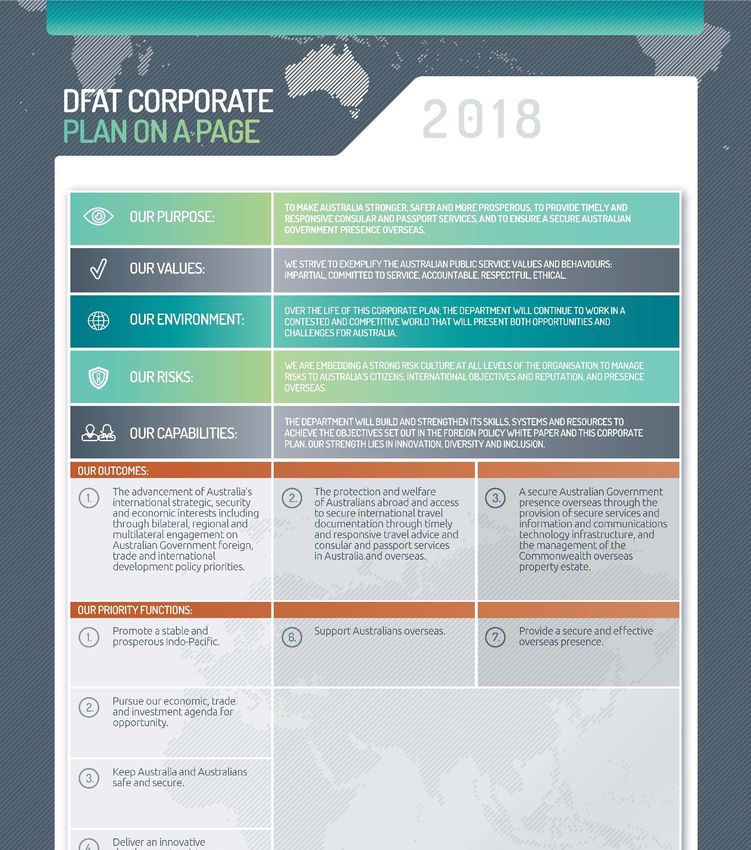
CORPORATE PLAN ON A PAGE                                                                     3

OUR PURPOSE                                                                                  4

OUR OPERATING ENVIRONMENT                                                                    5

MANAGING OUR RISK                                                                            6

SHAPING OUR CAPABILITY                                                                       7

OUR PERFORMANCE                                                                              9

                            2018–19 DEPARTMENT OF FOREIGN AFFAIRS AND TRADE Corporate Plan       1
INTRODUCTION

I am pleased to present the Department of Foreign Affairs and Trade’s (DFAT) 2018–19 Corporate Plan – the
department’s primary planning and performance document. This is our first corporate plan since the launch of
the Foreign Policy White Paper in November 2017.
As the first comprehensive review of Australia's international engagement for 14 years, the White Paper
provides a framework for Australia’s prosperity and security by guiding our international engagement over the
next decade and beyond.
The 2018–2019 Corporate Plan outlines how DFAT will advance the policy objectives in the White Paper. The
department is at the forefront of Australia’s international engagement and the corporate plan highlights the
broad scope of our work.
Importantly, the plan also sets out the department’s efforts to reshape itself and align its capabilities to seize
opportunities and protect Australia’s interests in the face of global complexity and uncertainty.
We need a resilient, flexible and dynamic department to serve the government and Australian people. As
Secretary, I am committed to ensuring we project Australia’s diversity in all aspects of our work.
DFAT does not operate in isolation. We will continue to work hand‐in‐hand with our portfolio and
Commonwealth Government partners, state and territory governments, Australian businesses and civil society
to advance Australia’s prosperity and security.
As we do this, we need to assess our performance, highlighting challenges, successes and where we fall
short. This corporate plan—and our internal planning and performance processes—enables us to do exactly
that. Every DFAT officer will play a part in its implementation.

Frances Adamson

Secretary

                                                              2018–19 DEPARTMENT OF FOREIGN AFFAIRS AND TRADE Corporate Plan   2
2018–19 DEPARTMENT OF FOREIGN AFFAIRS AND TRADE Corporate Plan 3

OUR PURPOSE
Purpose
The purpose of the department is to make Australia stronger, safer and more prosperous, to provide timely and
responsive consular and passport services, and to ensure a secure Australian Government presence overseas.
Key outcomes
To achieve this purpose, the department has three key outcomes (set out in the Portfolio Budget Statements
2018–19):
The advancement of Australia’s international strategic, security and economic interests including
through bilateral, regional and multilateral engagement on Australian Government foreign, trade and
international development policy priorities.
The protection and welfare of Australians abroad and access to secure international travel
documentation through timely and responsive travel advice and consular and passport services in
Australia and overseas.
A secure Australian Government presence overseas through the provision of security services and
information and communications technology infrastructure, and the management of the
Commonwealth’s overseas owned estate.
Priority functions
We will pursue these outcomes through seven priority functions over the life of this corporate plan (2018–19
to 2021–22). These priority functions align with the Foreign Policy White Paper.
1. Promote a stable and prosperous Indo‐Pacific.
2. Pursue our economic, trade and investment agenda for opportunity.
3. Keep Australia and Australians safe and secure.
4. Deliver an innovative development assistance program.
5. Advance global cooperation.
6. Support Australians overseas.
7. Provide a secure overseas presence.
2018–19 DEPARTMENT OF FOREIGN AFFAIRS AND TRADE Corporate Plan 4
OUR OPERATING ENVIRONMENT

Throughout the life of this corporate plan, Australia will continue to advance its interests in a more contested
and competitive international environment.
The 2017 Foreign Policy White Paper charts powerful drivers of change that are converging in ways that
challenge Australia’s interests. Economic growth in Asia is reshaping our strategic landscape. Protectionism,
nationalism and geo‐political competition are testing the rules and institutions that support economic growth
and guide global cooperation. Mega trends like technological change and climate change continue to shape
our world and demand policy responses. Keeping Australia and Australians safe from threats such as terrorism,
cyber attacks and WMD proliferation is an enduring priority.
In this dynamic environment, Australia will need to be competitive and agile to take advantage of the
opportunities that will come from Asian economic growth and technological and scientific advances. At the
same time, we will act determinedly to protect our interests in the face of complexity and uncertainty. The
seven priority functions in this Corporate Plan respond to these challenges.
No long‐term foreign policy objective is more important to Australia than ensuring the Indo‐Pacific evolves
peacefully and without an erosion of the fundamental principles on which the region’s prosperity and
cooperative relations are based. We will promote an open, inclusive and prosperous region in which the rights
of all states are respected. The Indo‐Pacific encompasses our most important economic partners and most
complex bilateral relationships. They remain first order priorities for the department. In our near region, we
are stepping up support for a more resilient Pacific and Timor‐Leste.
Linkages between globalisation, technological change and new forms of production, consumption and trade are
shaping economies and societies in profound ways. This presents Australia with significant trade and
investment opportunities. We will maximise these by ensuring the lowest possible barriers to our trade and
investment, standing firm against protectionism and working with Australian businesses to advance our
commercial interests.
Technological change, the reach and vulnerabilities of the internet and state fragility are among global trends
amplifying threats to our people, borders and economy. The Government’s first duty is to do everything
possible to keep Australians safe and protect our freedoms, our way of life and our values. We will work closely
with a wider range of partners in our region and globally to address threats and strengthen the cooperation
that helps tackle transnational security challenges.
Australia’s development assistance is focussed on the Indo‐Pacific and supports the national interest by
contributing to sustainable economic development and poverty reduction. We will continue to invest in the
region’s prosperity and stability by advancing economic reforms, improving governance, fighting threats such
as extremism and infectious diseases and building resilience to natural disasters.
At a time of significant strain on the multilateral system, we will promote and protect the international rules
and institutions that support stability and prosperity and enable global cooperation to tackle global challenges.
In an uncertain world, the strength and diversity of our bilateral partnerships beyond the Indo‐Pacific builds our
influence and spreads risk. We will continue to invest in these relationships.
Australians are travelling overseas in unprecedented numbers. This has substantially increased both the
demand for—and complexity of—passport and consular assistance. Support for Australians overseas will remain
one of our most important responsibilities.
Looking ahead, Australia will continue to develop fit‐for‐purpose diplomatic capabilities built around a secure
and effective overseas Australian Government presence. We are investing in efficient and cost‐effective
technologies to support our overseas engagement and are ensuring our people have the skills they need to
advance and protect Australia’s national interests in a changing world.

                                                             2018–19 DEPARTMENT OF FOREIGN AFFAIRS AND TRADE Corporate Plan   5
MANAGING OUR RISK

A strong risk culture
Our dynamic operating environment requires the department to embrace innovation and opportunity to
promote our interests. In doing so, we need to engage actively with risk. We are embedding a strong risk
culture at all levels, and providing practical tools, guidance and strong governance.
In 2017–18, we released a set of eight ‘positive risk culture behaviours’ which encourage staff to make
decisions informed by risk and to pursue opportunity. In 2018–19, we will assess our innovation and risk
management culture, and identify areas requiring improvement through regular surveys. We will continue to
assist DFAT officers at all levels to access risk management training and help divisions and posts with smart risk
management.

Governance
DFAT’s Risk Management Guide sets out the overarching principles for our approach to risk. It details our key
responsibilities and provides practical guidance on risk assessment. It enables staff to accept uncertainty where
there is evidence that the benefits outweigh the risks.
Members of the DFAT Departmental Executive, a range of departmental governance committees, the
Enterprise Risk Section and key risk areas work together to oversee activities and to help staff. The Audit and
Risk Committee delivers independent assurance to the Secretary and ensures DFAT’s approach is appropriate
and fit for purpose, including by endorsing amendments to our Risk Management Guide.

Managing critical risks
The department deals with risks that could impact on its strategic and operational goals through a Critical Risk
List. Critical risks include staff capability, cybersecurity, aid governance and the safety and security of our staff,
as well as strategic risks in the trade, aid and foreign policy areas. The Secretary reviews and endorses the
Critical Risk List twice a year. We continue to refine our approach to critical risks to ensure DFAT’s
Departmental Executive has appropriate oversight.

Shared risks
The department handles a variety of shared risks across the portfolio with partners in government, the private
sector and civil society. These are managed through memoranda of understanding, service level agreements,
contracts or bilateral partnership agreements. While our partners sometimes manage shared risks, they can
still impact on the department’s objectives. Staff take a pro‐active approach to ensuring that partners are
managing and reporting on shared risks.

                                                               2018–19 DEPARTMENT OF FOREIGN AFFAIRS AND TRADE Corporate Plan   6
SHAPING OUR CAPABILITY
DFAT will build and strengthen its organisational capability to achieve the objectives set out in the Foreign
Policy White Paper and the 2018–19 Corporate Plan. In doing so, the department must reconcile the ambition
of our policy agenda within the reality of tight fiscal and human resource constraints. The department will
continue to examine its culture, capability and operating model to ensure it is fit for purpose now and into the
future.
Organisational reform
The department has revised its organisational structure to better align its resources with the strategic direction
and priorities of the White Paper. Five newly established groups headed by deputy secretaries align with the
White Paper's priorities and harness the services and capabilities required for their effective
implementation. This new group structure promotes shared corporate leadership, and enables greater
contestability and improved prioritisation and resource allocation to meet the department’s objectives. It also
enables the department to work most effectively with our government partners in support of our shared
international objectives. Governance structures are also being improved to better harness performance and
risk information, inform judgements and priorities.
Innovation, agility and foresight are central to the department’s ability to operate effectively. The
innovation Xchange is finding ways to achieve better outcomes with finite resources, and to respond to new
policy, program and service delivery challenges. Our new Strategic Policy, Contestability and Futures Branch
gives the department better global horizon scanning and capability to think about and plan for the future.
Abroad, DFAT’s overseas network is changing as the department designs the modern Australian
embassy. Through its reDESIGN Strategy, DFAT is exploring new ways of delivering services through regional
hubs and flexible operating models in its overseas network. For example, the roll out of the first six hubs in
Europe, North America, South and West Asia, North Asia and Southeast Asia is streamlining administrative
processes, and reducing duplication. DFAT needs to be able to accesses modern, efficient and cost‐effective
technologies to support its work at home and abroad, especially as the diplomatic network expands.
Soft power
Key to the department’s ability to implement the White Paper will be harnessing Australia’s soft power—the
ability to influence the behaviour or thinking of others through the power of attraction and ideas. To maintain
Australia’s strength in this area, the department must think creatively and ensure its capabilities keep pace with
changes in technology and digital communications. During the life of this corporate plan, DFAT will lead a
whole‐of‐government review into Australia’s soft power. At the same time, the department will continue to
build the capability of staff in modern diplomatic tradecraft and to influence with confidence at home and
abroad.
People capability and workforce planning
Workforce Strategy
Our Workforce Strategy 2018‐22 focuses on having the people with the right capabilities, in the right place and
at the right time working to their full potential. Implementation will focus on the development of expertise,
knowledge and language skills. Realising the full benefits of the Strategy will take time.
2018–19 DEPARTMENT OF FOREIGN AFFAIRS AND TRADE Corporate Plan 7Diplomatic Academy
We need strong diplomatic capabilities to help us maximise opportunities, advance our interests, respond
quickly to crises and emerging issues, and ensure domestic policy is informed by developments overseas. The
new Diplomatic Academy helps develop that expertise and knowledge in DFAT, as well as across
government. The Academy is a leading‐edge learning and development hub. Its nine‐faculty curriculum aligns
closely to the department’s operational and capability needs. It is progressively building international
engagement skills and proficiencies across the Australian Public Service, particularly in the areas of advocacy,
negotiation, forecasting and strategic planning.
Diversity and inclusion
Valuing diversity and promoting inclusion are integral to advancing Australia’s national interests, driving
innovation, and reflecting Australian values of fairness and equality. The White Paper identifies the diversity of
Australian society as a core national strength. Our Women in Leadership Strategy, Disability Action Strategy,
Reconciliation Action Plan, Cultural and Linguistic Diversity (CALD) and LGTBI networks and other measures
have driven cultural change in the department and opened up new ways of working. They are helping staff to
reach their full potential and enhance productivity. The department’s measure of success is an inclusive
workplace where all staff feel valued and able to contribute to the best of their ability.
Effective leadership
Leadership is fundamental to our ability as a department to adapt and achieve outstanding results for the
government and people of Australia. The research is clear that when employees are supported and
empowered, it leads to higher organisational performance, productivity and innovation. The department
encourages all staff to demonstrate strong leadership as they carry out their work. The department’s Senior
Executive and staff at all levels will work together to achieve the targets set out in this corporate plan.
Capital investment strategy
DFAT has a significant capital budget that reflects its diverse functions. Strategic capital planning is focused on
what capabilities need to be enhanced or replaced to meet evolving strategic priorities. The department’s
regular monitoring of capital expenditure provides oversight, helps us manages risks and maintains investment
momentum in information and communications technology (ICT), physical security and property. DFAT
prioritises ICT‐related activities that offer the highest strategic value to the department and its partner
agencies.
The department provides ICT services to 44 partner agencies under a memorandum of understanding. DFAT is
improving and expanding its services, and increasing the number of agencies receiving these. In building more
responsive and capable ICT solutions, the department is focussed on challenging the status quo, employing
new technologies to improve our digital capability, and sharing and leveraging solutions from partner agencies
and industry to support our innovation.
Collaboration between our property, security and ICT areas to secure suitable and fit‐for‐purpose
accommodation is integral to the expansion of our diplomatic footprint. DFAT manages over $3.2 billion worth
of Commonwealth‐owned estates, in Australia and overseas. Consistent with the government’s 2017–18
Budget decision, the department has also consolidated the Commonwealth’s overseas property functions and
centrally manages expenditure. The department protects Australia’s domestic and overseas property assets by
providing safe, secure and functional work environments for our staff across owned and leased properties
globally. The department also facilitates delivery of classified and unclassified material to Australian diplomatic
posts.
2018–19 DEPARTMENT OF FOREIGN AFFAIRS AND TRADE Corporate Plan 8OUR PERFORMANCE
This section sets out the priority functions and delivery strategies that contribute to the department’s purpose.
It includes performance indicators over the next four years. It should be read in conjunction with the 2018–19
Portfolio Budget Statement, the 2018–19 Portfolio Additional Estimates Statements (expected to be released in
early 2019) and the 2017–18 Annual Report (expected to be published in October 2018).
In this plan, we seek to measure our performance in a way that provides a clear line of sight between the
department’s purpose and priorities. Performance measures are being reviewed and refined iteratively. This
includes aligning this corporate plan with the performance targets in the Portfolio Budget Statements. The
performance measures are designed to enable the department’s internal planning and performance reporting.
Measuring policy performance is inherently difficult. The department seeks to ensure that where judgements
on policy performance are made, they are supported by verifiable evidence.
Methodology – glossary of terms
Term Description
Where the department makes an assessment on performance based on
Assessment
verifiable evidence and informed judgments.
Where information is sought from delivery partners and/or external
stakeholders to understand the results of an activity. Where practical,
Survey
surveys should be benchmarked or look to establish internal
benchmarks.
The delivery of a specific measure, supported by verifiable evidence –
Delivery
based, where practical, on data mining information.
The systematic and objective assessment of an investment, program or
Evaluation policy aimed at providing credible evidence, which informs major
decisions and highlights important lessons.
An independent examination—internal or external—to assess and
Audit
verify whether a stated performance measure is or is not on track.
2018–19 DEPARTMENT OF FOREIGN AFFAIRS AND TRADE Corporate Plan 9Priority Function 1: Promote a stable and prosperous Indo‐Pacific
Australia’s security and prosperity are best served by an open, inclusive and prosperous Indo‐Pacific region in
which the rights of all states are respected. The department will continue to encourage Australia’s most
important partners—the United States and China—to engage the region in a manner that promotes security
and prosperity. We will also look to strengthen our key regional partnerships—including with Japan, Indonesia,
India and the Republic of Korea—while enhancing our relationships throughout Southeast Asia. The
department will also work to build collaboration in the Indo‐Pacific. Wary of the developing regional fault lines
as potential sources of instability, we will also cultivate and deepen our engagement in the region to promote
stability, good governance, open markets and respect for international rules and norms.
We will enhance Australia’s engagement with Papua New Guinea, other Pacific island countries and Timor‐
Leste. We will focus on promoting economic cooperation and greater integration, tackling security challenges
and strengthening people‐to‐people links, skills and leadership.
Foreign Policy White Paper chapters Portfolio Budget Statements programs
A stable and prosperous Indo‐Pacific 1.1 Foreign Affairs and Trade Operations
A shared agenda for security and prosperity 1.4 Payments to International Organisations
Partnerships and soft power 1.5 New Colombo Plan
1.6 Public Information Services and Public Diplomacy
Delivery partners
Effective regional engagement will require ongoing coordination and partnership with a broad range of
Australian Government agencies, such as our portfolio partners (the Australian Trade and Investment
Commission, Austrade; Tourism Australia; the Export Finance and Insurance Corporation, Efic; and the
Australian Centre for International Agricultural Research, ACIAR), the departments of Defence; Home Affairs;
the Attorney‐General’s (AGD), Education and Training; and the Australian Federal Police. We also work with
like‐minded countries and relevant international organisations.
Delivery and performance
Delivery strategy
Shape a positive strategic and economic context for Australia in the Indo‐Pacific region through deepened
and diversified bilateral and multilateral relationships, influence and programs.
2018‐19
2019‐20
2020‐21
2021‐22
Performance measure Method
The department’s efforts in the Indo‐Pacific advance the
interests of Australia and Australians. • • • • Assessment
High level of satisfaction of ministers and key
stakeholders with the quality and timeliness of advice,
briefing and support in relation to Australia’s • • • • Survey
international objectives.
2018–19 DEPARTMENT OF FOREIGN AFFAIRS AND TRADE Corporate Plan 10Delivery strategy
Promote a shared agenda for security and prosperity with Papua New Guinea, other Pacific island countries
and Timor‐Leste through economic, security and development engagement.
2018‐19
2019‐20
2020‐21
2021‐22
Performance measure Method
The step‐up in Pacific and Timor‐Leste engagement
supports stronger and more resilient economies,
capability and regional security.
• • • • Assessment
Delivery strategy
Increase engagement with the Indo‐Pacific through the New Colombo Plan.
2018‐19
2019‐20
2020‐21
2021‐22
Performance measure Method
New Colombo Plan engagement delivers enduring
people‐to‐people, institutional and business links. • • • • Assessment
2018–19 DEPARTMENT OF FOREIGN AFFAIRS AND TRADE Corporate Plan 11Priority Function 2: Pursue our economic, trade and investment agenda for
opportunity
Australia’s prosperity relies on the competitiveness of our economy, our ability to seize opportunities globally
and the continuing openness of global markets. The department will resist protectionism, and maintain and
build on global rules that promote economic growth, trade liberalisation and free markets. We will lower
barriers to our trade and investment, including through modern free trade agreements, and work with
Australian businesses to advance our commercial interests in overseas markets. We will support inflows of
productive investments that create Australian jobs and increase living standards.
Foreign Policy White Paper chapters Portfolio Budget Statements programs
Our agenda for opportunity 1.1 Foreign Affairs and Trade Operations
Global cooperation 1.4 Payments to International Organisations
Delivery partners
We are working to support a more competitive and resilient Australian economy and to facilitate trade. We do
this through our work with Austrade, Tourism Australia, the Export Finance and Insurance Corporation (Efic),
the Australian Centre for International Agricultural Research (ACIAR) and a range of departments, including
Home Affairs, Industry, Innovation and Science, Agriculture and Water Resources, Education and Training, and
the Treasury.
Delivery and performance
Delivery strategy
Advocacy and negotiations to open markets, resist protectionism and support the rules‐based trading
system.
2018‐19
2019‐20
2020‐21
2021‐22
Performance measure Method
Effectiveness in supporting the global rules‐based
trading system and opening markets. • • • • Assessment
Delivery strategy
Supporting Australian businesses to secure opportunities globally, including through free trade
agreements and advancing regional trade and investment integration.
2018‐19
2019‐20
2020‐21
2021‐22
Performance measure Method
Increased opportunities for Australian businesses.
• • • • Assessment
Concluded free trade agreements with countries that
account for over 80 per cent of Australia’s trade by
2020.
• Delivery
2018–19 DEPARTMENT OF FOREIGN AFFAIRS AND TRADE Corporate Plan 12Delivery strategy
Contribute to domestic economic policy that improves Australia’s international competitiveness.
2018‐19
2019‐20
2020‐21
2021‐22
Performance measure Method
Extent to which international competitiveness on trade
and investment is factored into Australian economic
policy settings.
• • • • Assessment
Delivery strategy
Strengthen economic and commercial diplomacy to support Australian businesses, and ensure domestic
advocacy to build support for trade and investment.
2018‐19
2019‐20
2020‐21
2021‐22
Performance measure Method
Positive trade and investment outcomes supported by
the department’s economic and commercial diplomacy,
and domestic advocacy efforts.
• • • • Assessment
2018–19 DEPARTMENT OF FOREIGN AFFAIRS AND TRADE Corporate Plan 13Priority Function 3: Keep Australia and Australians safe and secure
We work to protect our borders and ensure Australia remains one of the safest countries in the world, despite
the diverse range of risks that threaten our security, our freedom and our values. The department will continue
to ensure the strength and vitality of our alliance with the United States. We will also enhance our diplomatic
engagement on a broad range of security issues—including preventing and countering the use of nuclear,
chemical and biological weapons, securing stronger counter‐terrorism and counter violent extremism
cooperation, and reducing the threat of people smuggling and incidences of human trafficking in the Indo‐
Pacific. Key to this will be the ongoing efforts of the department’s Ambassadors for Counter‐Terrorism, Cyber
Affairs and People Smuggling and Human Trafficking.
Foreign Policy White Paper chapters Portfolio Budget Statements programs
Keeping Australia and Australians safe, secure and 1.1 Foreign Affairs and Trade Operations
free 1.4 Payments to International Organisations
Global cooperation
A shared agenda for security and prosperity
Delivery partners
We will continue to work closely with a range of Australian agencies interested in the international and
domestic security space – including Home Affairs, Defence, = Australian intelligence agencies, the Attorney‐
General’s Department, the Australian Federal Police, state police, and state and territory governments. The
department also works with agencies to guard against attempts by foreign governments and their proxies to
exert inappropriate influence on Australia, and to undermine our sovereign institutions and decision‐making.
Delivery and performance
Delivery strategy
Work with international and domestic partners to promote Australia’s counter‐terrorism interests through
effective international advocacy, cooperation and capacity building.
2018‐19
2019‐20
2020‐21
2021‐22
Performance measure Method
Effective counter‐terrorism outcomes delivered through
international and domestic engagement that promote
Australia’s security interests.
• • • • Assessment
Delivery strategy
Promote international norms of safe, orderly and regular migration.
2018‐19
2019‐20
2020‐21
2021‐22
Performance measure Method
Increased participation by states and United Nations
agencies in the Bali Process, Alliance 8.7 and other
multilateral migration organisations and agreements in • • • • Assessment
line with Australia’s interests.
2018–19 DEPARTMENT OF FOREIGN AFFAIRS AND TRADE Corporate Plan 14Delivery strategy
Implement the International Cyber Engagement Strategy, including a program of cyber capacity building
assistance.
2018‐19
2019‐20
2020‐21
2021‐22
Performance measure Method
Australia’s advocacy for an open, free and secure
cyberspace helps shape a peaceful and stable online
environment, and enhances the ability of regional • • • • Assessment
partners to take advantage of online opportunities.
Delivery strategy
Maintain and strengthen global weapons of mass destruction (WMD) non‐proliferation and conventional
weapon arms control arrangements.
2018‐19
2019‐20
2020‐21
2021‐22
Performance measure Method
Successful promotion of Australia’s strategic interests
related to WMD and conventional weapon risks, including
through our multilateral engagement, implementing our
related treaty obligations, and effectively chairing the
• • • • Assessment
Australia Group.
2018–19 DEPARTMENT OF FOREIGN AFFAIRS AND TRADE Corporate Plan 15Priority Function 4: Deliver an innovative development assistance program
Australia’s development assistance program is a reflection of our values and an investment in the stability and
prosperity of our region and the world. Our assistance alleviates suffering and serves Australia’s national
interests by helping countries to advance economic reform, build resilience to natural disasters and economic
shocks, guard against the spread of infectious diseases and counter growing violent extremism. We will
continue to support better state capability to improve governance, reduce poverty and promote inclusive
economic growth.
The development program will also magnify the influence Australia brings to bear on pressing regional and
global problems, including efforts to meet the Sustainable Development Goals. The department will continue to
lead Australia’s efforts to help prepare for, and respond to, disasters, particularly in the Indo‐Pacific.
The department reports annually on aid effectiveness through the Performance of Australian Aid report.1
Foreign Policy White Paper chapters Portfolio Budget Statements programs
A stable and prosperous Indo‐Pacific 1.2 Official Development Assistance (ODA)
Global cooperation 1.3 ODA – Multilateral Replenishments
A shared agenda for security and prosperity
Partnerships and soft power
Delivery partners
The department will continue to work with numerous entities across our portfolio, the Australian Government,
state and territory governments, business and civil society.
Delivery and performance
Delivery strategy
Focus Australia’s development assistance predominately on the Indo‐Pacific to promote the national
interest of a stable and prosperous region.
2018‐19
2019‐20
2020‐21
2021‐22
Performance measure Method
Australian interests are promoted by our development Assessment,
program, including enhanced sustainable economic including
growth and poverty reduction in the Indo‐Pacific. evaluations,
• • • • Aid Quality
Checks and Aid
Program
Performance
Reports
90 per cent of country attributable aid spent in the Indo‐
Pacific. • • • • Delivery
1
http://dfat.gov.au/about‐us/publications/Pages/performance‐of‐australian‐aid‐2015‐16.aspx
2018–19 DEPARTMENT OF FOREIGN AFFAIRS AND TRADE Corporate Plan 16Delivery strategy
Manage the aid program effectively, efficiently and transparently to deliver results and value for money.
2018‐19
2019‐20
2020‐21
2021‐22
Performance measure Method
An effective, transparent and efficient aid program in line Assessment,
with the Australian aid program’s performance including
framework, Making Performance Count. evaluations,
• • • • Aid Quality
Checks and Aid
Program
Performance
Reports
Delivery strategy
Lead the government’s response to humanitarian crises and conflicts in the Indo‐Pacific and beyond, and
enhance the capacity of national governments, regional and multilateral organisations, and community
organisations to be better prepared, able to manage displaced populations, and able to respond and
recover from crises.
2018‐19
2019‐20
2020‐21
2021‐22
Performance measure Method
Timely and effective responses to humanitarian crises, Assessment,
including an enhanced Indo‐Pacific ability to prepare,
respond and recover from crises.
• • • • including
evaluations.
2018–19 DEPARTMENT OF FOREIGN AFFAIRS AND TRADE Corporate Plan 17Priority Function 5: Advance global cooperation
Australia’s interests are strongly served by acting with others to support a rules‐based international order. We
will work with major powers and like‐minded partners, and in coalitions to advance and protect Australia’s
interests, including in multilateral fora. The department will promote and protect the international rules that
support stability and prosperity and enable cooperation to tackle global challenges. We will use a systematic
and sophisticated approach to soft power to increase our influence and project an accurate, positive and
contemporary image of Australia and our policies.
Foreign Policy White Paper chapters Portfolio Budget Statements programs
A stable and prosperous Indo‐Pacific 1.1 Foreign Affairs and Trade Operations
Global cooperation 1.4 Payments to International Organisations
A shared agenda for security and prosperity 1.5 New Colombo Plan
Partnerships and soft power 1.6 Public Information Services and Public
Diplomacy
Delivery partners
As with our efforts to promote a stable and prosperous Indo‐Pacific, global cooperation will require ongoing
coordination and partnerships with a broad range of Australian Government agencies, bilateral and multilateral
donors, private sector organisations, non‐government organisations and civil society groups.
Delivery and performance
Delivery strategy
Further Australia’s interests, including to promote and protect the rules and institutions that support
stability and prosperity, and enable cooperation tackle global challenges.
2018‐19
2019‐20
2020‐21
2021‐22
Performance measure Method
Australia helps shape the evolution of institutions, rules
and forms of cooperation in line with our national
interests.
• • • • Assessment
Delivery strategy
Pursue a regionally integrated and global approach to key cross‐cutting and transitional issues, such as
education, health, human rights, gender equality, disability inclusion, stability, and environmental
problems that directly affect Australia’s interests.
2018‐19
2019‐20
2020‐21
2021‐22
Performance measure Method
Australian bilateral, regional and multilateral
engagement successfully promotes Australia’s interests
and values, including in the Indo‐Pacific, Europe, the • • • • Assessment
Middle East, Latin America, North America and Africa.
2018–19 DEPARTMENT OF FOREIGN AFFAIRS AND TRADE Corporate Plan 18Delivery strategy
Project a positive and contemporary image of Australia, and promote a clear understanding of Australian
policies, objectives and engagement with the Indo‐Pacific region through the department’s soft power
activities.
2018‐19
2019‐20
2020‐21
2021‐22
Performance measure Method
Soft power initiatives further Australia’s interests and
influence. • • • • Assessment
Delivery strategy
Effective diplomatic engagement with other foreign services, including through ensuring the security and
protecting the dignity of foreign representatives in Australia.
2018‐19
2019‐20
2020‐21
2021‐22
Performance measure Method
The diplomatic and consular corps posted or accredited
to Australia are satisfied with the delivery of protocol
services.
• • • • Survey
2018–19 DEPARTMENT OF FOREIGN AFFAIRS AND TRADE Corporate Plan 19Priority Function 6: Support Australians overseas
Australians are travelling overseas in unprecedented numbers. The department aims to ensure this
engagement progresses as smoothly as possible.
To this end, the Australian Passport Office (APO) will continue to provide Australians world‐class, secure and
interoperable passports. The department’s consular services will provide information and advice to empower
Australians to help themselves while overseas. When Australians face problems, the department will provide
appropriate consular services – including during crises. The department will cooperate with private sector and
international partners, as well as across government, to broaden our reach and extend our capacity to advise
and assist. The department’s Global Watch Office will provide a 24/7 capability to monitor and initiate response
to international events that affect Australian interests.
Foreign Policy White Paper chapters Portfolio Budget Statements programs
Keeping Australia and Australians safe, secure and 2.1 Consular Services
free 2.2 Passport Services
Delivery partners
We partner with Australia Post to make passport services, including applications and interviews, more efficient
and convenient for Australian citizens. The Department of Human Services manages our telephone client
services. Overseas, Austrade and Canadian missions provide passport and consular services in locations without
a DFAT presence.
Delivery and performance
Delivery strategy
Provide Australians with timely access to secure international travel documentation through the delivery
of high‐quality passport services.
2018‐19
2019‐20
2020‐21
2021‐22
Performance measure Method
The department maintains a high standard in processing
passport applications, investigating and prosecuting
fraud:
95 per cent of passports processed within 10
business days
98 per cent of priority passports processed within
two business days
100 per cent of identified high risk passport
• • • • Delivery
applications scrutinised by specialist staff
90 per cent of administrative investigations finalised
within five business days, and
95 per cent of referrals to prosecuting authorities
accepted for prosecution
2018–19 DEPARTMENT OF FOREIGN AFFAIRS AND TRADE Corporate Plan 20Clients are satisfied with passport services – including
online services – and the department’s security
standards (report against objectives outlined in the
2017‐18 DFAT Portfolio Budget Statements):
70 per cent of applications online
85 per cent satisfaction rate with Australian
• • • • Delivery, survey
Passport Information Service from client survey, and
85 per cent satisfaction rate of overall passport
service from client survey
Australian passport security remains world leading, Assessment,
including through the delivery of the Passport Series R
by 2020–21. • • • • delivery of
Passport Series R
Delivery strategy
Provide Australians with high quality consular and travel advisory services.
2018‐19
2019‐20
2020‐21
2021‐22
Performance measure Method
Timely, effective delivery of consular services to
Australians overseas, including during crises. • • • • Assessment
Timely and accurate travel information provided to the
public. • • • • Assessment
Delivery strategy
Coordinate whole‐of‐government responses to large‐scale crises involving conflict, civil unrest, natural
disasters or terrorist incidents. Prepare for crises through Crisis Action Plans (CAPs) and through consular
contingency planning for major events and high‐risk scenarios.
2018‐19
2019‐20
2020‐21
2021‐22
Performance measure Method
Timely, effective and well‐coordinated implementation
of whole‐of‐government responses to large‐scale crises
overseas.
• • • • Assessment
2018–19 DEPARTMENT OF FOREIGN AFFAIRS AND TRADE Corporate Plan 21Priority Function 7: Provide a secure and effective overseas presence
Crucial to Australia’s influence is the quality and reach of our diplomacy. Australia’s global diplomatic network
enables Australia to pursue its interests and help Australian business and citizens overseas. The department
operates at 107 posts overseas and in every Australian state and territory.
The department will work to ensure a secure Australian Government presence overseas through the provision
of: security services, protected information and communications technology infrastructure, and an efficiently
managed overseas property estate that meets the government’s requirements.
Foreign Policy White Paper chapters Portfolio Budget Statements programs
Foundations for success 1.1 Foreign Affairs and Trade Operations
3.1 Foreign Affairs and Trade Security and IT
3.2 Overseas property
Delivery partners
The department works closely with all other portfolio and government agencies that form part of the Australian
overseas network. Austrade plays a key role in managing a number of Australia’s overseas missions, including
security, ICT and property requirements.
Delivery and performance
Delivery strategy
Strengthened protective security measures commensurate with the evolving international security
environment.
2018‐19
2019‐20
2020‐21
2021‐22
Performance measure Method
Effective protective security guided by the DFAT Assessment, and
Security Framework.
• • • • implementation of
ANAO
recommendations
Delivery strategy
Contemporary and innovative security training and communications program, and widespread use of the
DFAT Security Framework, contributing to a robust security culture across the department’s global
network.
2018‐19
2019‐20
2020‐21
2021‐22
Performance measure Method
Staff engagement with security materials and
Assessment, and
products, and evidence of risk‐based decision making
on security issues using the DFAT Security Framework • • • • delivery of ANAO
recommendations
security risk management tools.
2018–19 DEPARTMENT OF FOREIGN AFFAIRS AND TRADE Corporate Plan 22Delivery strategy
Deliver and maintain accessible, reliable and secure ICT systems and infrastructure that meet Australian
Government requirements.
2018‐19
2019‐20
2020‐21
2021‐22
Performance measure Method
Fit‐for‐purpose and secure ICT systems which support
enhanced efficiencies. • • • • Assessment
Delivery strategy
Efficient and effective management of the overseas and domestic estates that meets the government’s
requirements and maintains property conditions and building services.
2018‐19
2019‐20
2020‐21
2021‐22
Performance measure Method
The construction and refurbishment of departmental
overseas property estate completed within agreed
timeframe.
• • • • Assessment
Asset Management Plans are in place for all owned
properties in the overseas estate. • • • • Delivery
Satisfaction ratings on the performance of the service
provider and the Overseas Property Office. • • • • Survey
Management and refurbishment of the domestic
property portfolio, including the State and Territory
Offices, to meet government requirements and • • • • Assessment
deliver operational efficiencies.
2018–19 DEPARTMENT OF FOREIGN AFFAIRS AND TRADE Corporate Plan 23You can also read


