2018-2019 Programme Budget - unfccc
←
→
Page content transcription
If your browser does not render page correctly, please read the page content below

2018-2019 Programme Budget

           UNFCCC secretariat
Contents of the presentation

  1.   Budget documentation and communication designed to enhance transparency

  2.   Key features of the 2018-2019 proposed budget and the zero growth scenario

  3.   Next steps

Budget documentation and communication
designed to enhance transparency

Outline of the budget documentation and communication

The budget is presented in document FCCC/SBI/2017/4 and its two addenda:

•     Main document - Programme budget for 2018-2019

•     Addendum 1 - Work programme for the secretariat for 2018-2019

•     Addendum 2 - Trust Fund for the International Transaction Log

Additional documentation and communication on the UNFCCC website:*

•     Details of projects proposed to be funded under the Trust Fund for Supplementary Activities.

•     Unaudited financial statements for 2016.

•     An update on budget implementation.

•     Backgrounders on the organization of conferences/meetings and on the action agenda.

•     Questions and answers in relation to the 2018-2019 budget. Will be posted before and

      during the SBI session.

                  * http://unfccc.int/secretariat/unfccc_budget/items/9928.php
The main document. FCCC/SBI/2017/4

•   The main document contains the budget for the biennium

•   The document contains information on inter alia:

    o       The budget context and approach (chapter III);

    o       The budget by cluster, by object of expenditure and in terms of posts (chapter IV for the

            proposed budget and annex III for the zero growth scenario);

    o       Resource requirements for the Trust Fund for Supplementary Activities (chapter V and annex I)

•   Synthesis table: Core budget, Trust Fund for Supplementary Activities, Other trust funds (annex II)

•   The mandated zero nominal growth scenario (annex III)
        .
FCCC/SBI/2017/4/Add. 1. Presentation of the work programme by cluster and by programme
FCCC/SBI/2017/4/Add.1. A fully results-based approach to budgeting: Objectives, expected results, performance
indicators, baselines, targets…
Table 11
Objective 1 of the Mitigation, Data and Analysis programme: support the implementation of the current
measurement, reporting and verification framework, with an emphasis on transparency and mitigation
ambition, and the development and implementation of the Paris Agreement rule book, in particular for RBB
transparency, nationally determined contributions and response measuresa
Expected results Performance indicators
Implementation of the measurement, reporting and Number of multilateral assessment summary reports of
verification framework for developed and developing developed country Parties made available on the
countries UNFCCC website in the biennium within the mandated
time frame. Baseline: 44. Target: 44
Number of records of facilitative sharing of views of
developing country Parties made available on the
UNFCCC website in the biennium within the mandated
time frame. Baseline: not applicable.b Target: 48
Number of greenhouse gas inventory reviews for Annex I
Parties conducted during the biennium within the
mandated time frame. Baseline: 88. Target: 88
Number of technical assessment reports made available
on the REDD-plusc web platform within the mandated
time frame. Baseline: not applicable.d Target: 16
Support is provided for the development of the guidelines, Arrangements for mandated technical working sessions
rules and modalities (the rule book) of the Paris such as workshops or round tables, and the preparation of
Agreement, and for the transition to their implementation, the related documentation (such as workshop reports),
with a focus on transparency, nationally determined undertaken within the mandated time frames. Baseline:
contributions and response measures not applicable.e Target: 100% for all arrangements
Percentage of mandated inputs from Parties, such as
submissions of views or proposals, processed and made
publicly available within three working days of their
receipt in intersessional periods and within one working
day during sessional periods. Baseline: not applicable.e
Target: 100% for all inputs
FCCC/SBI/2017/4/Add. 1. New feature of the work programme 2018-2019 designed to enhance transparency

 Planned outputs are provided for each objective to enhance transparency
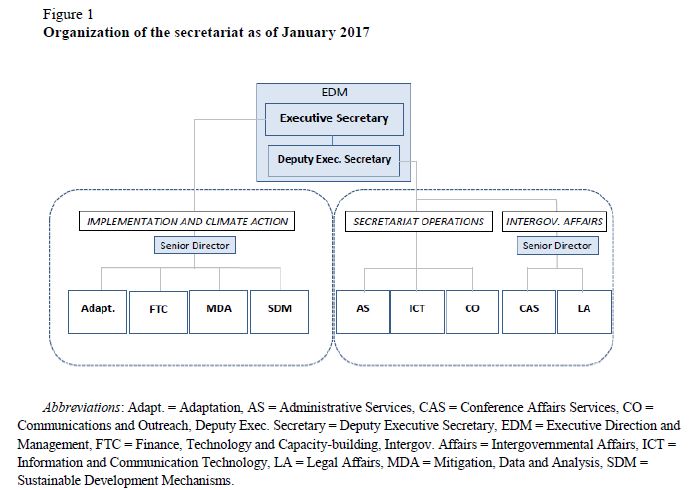
FCCC/SBI/2017/4/Add.1. Other features designed to enhance transparency: Organizational charts for the secretariat
and for each programme.
FCCC/SBI/2017/4/Add.1. Other features designed to enhance transparency: Core budget posts by cluster and
programme as compared to the current biennium
Key features of the 2018-2019 proposed budget and the zero growth scenario
Vision

             NDCs and NAPs lead to
             concrete actions, policy
          interventions and investment
               plans without delay

            Participation of all actors,
          governments, United Nations
         entities and the many non-Party
             stakeholders, as well as
         enhanced coordination of those
           efforts for maximum impact
Four objectives of the secretariat
Provide effective technical expertise and technical support to Parties to
facilitate ongoing negotiations under the Convention and its Kyoto
Protocol and the swift completion of the Paris Agreement rule book
Enable and support Parties in the implementation of the Convention,
the Kyoto Protocol and the Paris Agreement and the mobilization of
climate action as an integral element of the 2030 Agenda for
Sustainable Development
Provide optimal support to the UNFCCC intergovernmental process in
its oversight of the global response to climate change
Strengthen the secretariat’s capacity to respond to the evolution of the
international climate change regime by adapting skill sets, streamlining
services, adopting innovative approaches to work and enhancing its role
as the global hub for official data and information on climate changeTable 1 of the main budget document. A key element of the budget decision to be taken by the COP (as presented or
as amended)
Table 1
Proposed core budget for 2018–2019 by programme/cluster
2018 (EUR) 2019 (EUR) Total (EUR)
A. Appropriations
New feature: by 1 490 010 1 490 010 2 980 020
Executive Direction and Management
programme/clus
14 773 894 14 591 594 29 365 488
ter Implementation and climate action
Intergovernmental affairs and secretariat 9 802 798 9 899 720 19 702 518
operations
26 066 702 25 981 324 52 048 026
Expenditures
3 388 671 3 377 572 6 766 243
B. Programme support costs (overheads)a
175 278 - 175 278
C. Adjustment to working capital reserveb
29 630 651 29 358 896 58 989 547
Total (A + B + C)
Income
Contribution from the Host Government 766 938 766 938 1 533 876
28 863 713 28 591 958 57 455 671
Indicative contributions
29 630 651 29 358 896 58 989 547
Total income
a Standard 13 per cent applied for administrative support. See annex VI to this document.
b In accordance with the financial procedures (decision 15/CP.1), the core budget is required to maintain a
working capital reserve of 8.3 per cent (one month of operating requirements).
FCCC/SBI/2017/4Key features of the proposed budget: Enhanced delivery
Support to (constituted bodies) AC, SCF, TEC, PCCB for their expanding work plans
Support through core resources for three meetings per biennium of the AC, the TEC, the SCF,
the CGE, the Executive Committee of the Warsaw International Mechanism for Loss and Damage,
the Compliance Committee of the Kyoto Protocol and the LEG
Strengthening the technical support provided to Parties in their preparation, communication and
implementation of NDCs, and preparing analyses and technical documentation in support of
related activities, including the dialogues and partnerships
Supporting the implementation of the MRV framework and its transition to the transparency
framework under the Paris Agreement
A more coherent approach to the engagement of a broad range of stakeholders and the
showcasing of their climate action as an important complement to Party action on implementation
Enhancing mobilization of public and private actors and collaboration with relevant United
Nations entities to assist implementation by Parties at the national level, including in relation to
delivery of and access to climate finance and technology and the building of lasting partnerships
Strengthening the support to the activities of the ad hoc technical expert groups on response
measures, including the development of a training programme and the preparation of technical
papers and guidelinesThe zero nominal growth scenario
Table 8
Zero nominal growth scenario for 2018–2019 by cluster
2018 (EUR) 2019 (EUR) Total (EUR)
A. Appropriations
1 480 010 1 480 010 2 960 020
Executive Direction and Management
13 376 340 13 098 140 26 474 480
Implementation and climate action
Intergovernmental affairs and secretariat 9 488 405 9 426 393 18 914 798
operations
24 344 755 24 004 543 48 349 298
Programme expenditures (A + B)
3 164 818 3 120 591 6 285 409
B. Programme support costs (overheads)a
13 777 - 13 777
C. Adjustment to working capital reserveb
27 523 350 27 125 134 54 648 484
Total (A + B + C )
Income Zero
percent
Contribution from the Host Government 766 938 766 938 1 533 876
growth
26 756 412 26 358 196 53 114 608
Indicative contributions
27 523 350 27 125 134 54 648 484
Total income
a
Standard 13 per cent applied for administrative support. See annex VI to this document.
b
In accordance with the financial procedures (decision 15/CP.1), the core budget is required to maintain a
working capital reserve of 8.3 per cent (one month of operating requirements).Comparison of tables 1 and 8 (proposed budget and zero growth scenario)
Proposed core budget for
Zero nominal growth scenario
2018–2019 by
for 2018–2019 by cluster
programme/cluster
Total (EUR) Total (EUR) Increase in percent
Indicative
Indicative
contributi € 53,114,608.00 €57,455,671.00
contributions
ons 8.2%
Total
€ 54,648,484.00 Total income €58,989,547.00
income 7.9%The proposed staffing table: Six additional posts (1 P-2, 1 P-3, 3 P-4, 1 P-5), but 2 existing posts to be defunded
Secretariat-wide staffing funded from the core budget
I. 2017 2018 2019
Professional category and aboveª
USG 1 1 1
ASG 1 1 1
D-2 2 2 2
D-1 7 7 7
P-5 15 16 16
P-4 35 38 38
P-3 43 44 44
P-2 16 17 17
Subtotal Professional category and 126b
120 126b
above
Subtotal General Service category 53.5
53.5 53.5
Total 173.5 179.5 179.5
a Under-Secretary-General (USG), Assistant Secretary-General (ASG), Director (D) and
Professional (P).
b One post at the P-3 level and one at the P-4 level will not be funded in order to partly absorb
the increase in actual staff costs.Kyoto Protocol share. Scales of indicative contributions
• The Kyoto Protocol share for the 2018–2019 core budget requirements is prorated at 15.0
per cent of the overall proposed budget, compared with 28.2 per cent in the biennium
2016–2017.
• There will continue to be two scales of indicative contributions: one for the Convention
and the Paris Agreement, and the other for the Kyoto Protocol.Proposed core budget by commitment item
Table 2
Proposed core budget by commitment item
Commitment item 2016–2017 (EUR) 2018–2019 (EUR) Difference (%)
Staff costs 37 844 705 40 070 687 5.9
Consultants 1 697 786 2 206 486 30.0
Travel of staff 1 436 256 1 208 451 (15.9)
Experts and expert groups 1 852 926 2 045 420 10.4
General operating expenses 3 392 577 3 888 887 14.6
Supplies, materials, equipment, furniture 1 139 924 1 010 383 (11.4)
Training 392 222 387 672 (1.2)
Contributions to common services 1 195 840 1 230 040 2.9
Grants and contributions (IPCC) 489 510 - (100.0)
Lump sum adjustmenta (1 043 200) - 100.0
Total core programme budget 48 398 546 52 048 026 7.5
Programme support costs 6 291 811 6 766 243 7.5
Adjustment to working capital reserveb (41 873) 175 278
Grand total 54 648 484 58 989 547 7.9
Abbreviation: IPCC = Intergovernmental Panel on Climate Change.
a
A lump sum adjustment was made to non-staff costs during the consideration by the Subsidiary
Body for Implementation at its forty-second session of the budget for the biennium 2016–2017 to
achieve the targeted overall amount.
b In accordance with the financial procedures (decision 15/CP.1, annex I, para. 14), the working
capital reserve will increase to EUR 2,444,796 in 2018 and will be kept at that level in 2019.Core budget requirements and anticipated expenditures under other trust funds for the biennium 2018-2019
Trust fund for
supplementary
Core Budget activities Other Trust Funds Total (Euro)
Total 58,989,547 52,915,055 45,518,198 157,422,800
% of total
Budget 37% 34% 29% 100%
Other trust funds includes:
- Trust fund for the Clean Development Mechanism
- Trust fund for the special Annual contribution from the Government of Germany (Bonn Fund)
- Trust fund for the International Transactions LogNext steps
Next steps

•   Questions from Parties will be posted on the UNFCCC website together with answers
    from the secretariat;
•   It is expected that a contact group be established and hold its first meeting on the first day
    of the session of the SBI;
•   It is expected that a split-off group will consider the proposed budget for the ITL;
•   The SBI is expected to recommend the programme budget and the ITL budget for
    adoption by the COP23/CMP13;
•   The secretariat will notify Parties of their indicative contributions for 2018 in
    August/September 2017.
Questions and Answers
You can also read


