2019 Event Program and Session Guide - February 20-22, 2019 San Antonio, Texas - Texas Transition Conference
←
→
Page content transcription
If your browser does not render page correctly, please read the page content below
2019 Event Program and Session Guide
                        February 20-22, 2019                      San Antonio, Texas
 The 2019 Texas Transition Conference is sponsored by
the Center on Disability and Development at Texas A&M
 University, the Texas Secondary Transition/Post-School   SFP=Student-Focused Planning | FI=Family Involvement | PS=Program Structure
   Results Network, and the Texas Education Agency                            IC=Interagency Collaboration | SD=Student Development
CONTENTS                                                201 9 CO N F E R E N C E S C H E D U L E
    Conference Schedule....................... 2            W E D N E S D AY, F E B R UA R Y 20, 2019
    Contact Us........................................ 2        9:00 a.m.                Registration Open
                                                                11:00 a.m.               Pre-Conference Keynote
    Sponsors........................................... 2
                                                                12:00 p.m.               Lunch On Your Own
    Hotel Map.......................................... 3       1:15 p.m.                Pre-Conference Session I
                                                                2:15 p.m.                Break
    Try SCHED.ORG................................ 3
                                                                2:30 p.m.                Pre-Conference Session II
    Pre-Conference Sessions.............. 4-5                   3:15 p.m.                Break
                                                                3:45 p.m.                Pre-Conference Session III
    Breakout Session Overview.......... 6-7
                                                                8:00 p.m.                Registration Closed
    Keynote Sessions............................. 8
                                                            T H U R S D AY, F E B R UA R Y 21, 2019
    Breakout Session Descriptions
                                                                7:00 a.m.                Registration Open
    Thursday, February 21                                       7:00 a.m.                Vendor Exhibits Open
                                                                7:30 a.m.                Breakfast
         Breakout Session I................. 9-10
                                                                8:30 a.m.                Welcome
         Breakout Session II.............. 10-12                9:00 a.m.                Keynote
         Breakout Session III............. 12-14                10:30 a.m.               Break
                                                                10:45 a.m.               Breakout Sessions I (60 minutes)
    Friday, February 22                                         12:00 p.m.               Luncheon and Keynote
         Breakout Session IV............ 14-16                  1:30 p.m.                Break
                                                                2:00 p.m.                Breakout Sessions II (90 minutes)
         Breakout Session V............. 16-17                  3:00 p.m.                Vendor Exhibits Closed
    Vendors/Exhibitors.................... 18-19                3:15 p.m.                Break
                                                                3:45 p.m.                Breakout Sessions III (60 minutes)
    CPE Credit & Certification.............. 21                 5:00 p.m.                Registration Closed
    Conference Evaluation................... 23
                                                            F R I D AY, F E B R UA R Y 22, 2019
                                                                7:30 a.m.                Registration Open
                                                                7:30 a.m.                Vendor Exhibits Open
                                                                7:30 a.m                 Breakfast
                                                                8:30 a.m.                Keynote
                                                                10:15 a.m.               Break
    CO N TAC T U S                                              10:30 a.m.               Breakout Sessions IV (60 minutes)
                                                                11:30 a.m.               Break
    Conference Assistance                                       11:45 a.m.               Breakout Session V (60 minutes)
    CONTACT: CherylGrenwelge,                                   12:00 p.m.               Registration Closed
    Conference Director                                         12:45 p.m.               Vendor Exhibits Closed
    EMAIL: cgrenwelge@tamu.edu                              The 2019 Texas Transition Conference (TTC) is sponsored by The Center
    PHONE: 979.458.1593                                     on Disability and Development at Texas A&M University, The Secondary
    WEB: ttc.tamu.edu                                       Transition/Post-School Results Network, and the Texas Education Agency.

    Transition Assistance
    Please contact the Secondary                                                                                               The Secondary Transition/
                                                                                                                               Post-School Results Network
    Transition Specialist in your
    region. A statewide directory
    can be found online at
    www.transitionintexas.org.

                                                            PUBLICITY NOTICE
                       Scan the QR code to                  Photos and video may be taken of participants during professional development sessions and meetings
                       enhance your conference              offered by the 2019 Texas Transition Conference (TTC) for promotional use by the Texas A&M University
                       experience                           and The Secondary Transition/Post-School Results Network. Promotional use may include, but is not
                                                            limited to, the Texas Transition Website, Facebook, and Twitter accounts as well as printed materials at
                                                            the TTC conference, and The Center on Disability and Development at Texas A&M University.

2   2019 TEXAS TRANSITION CONFERENCE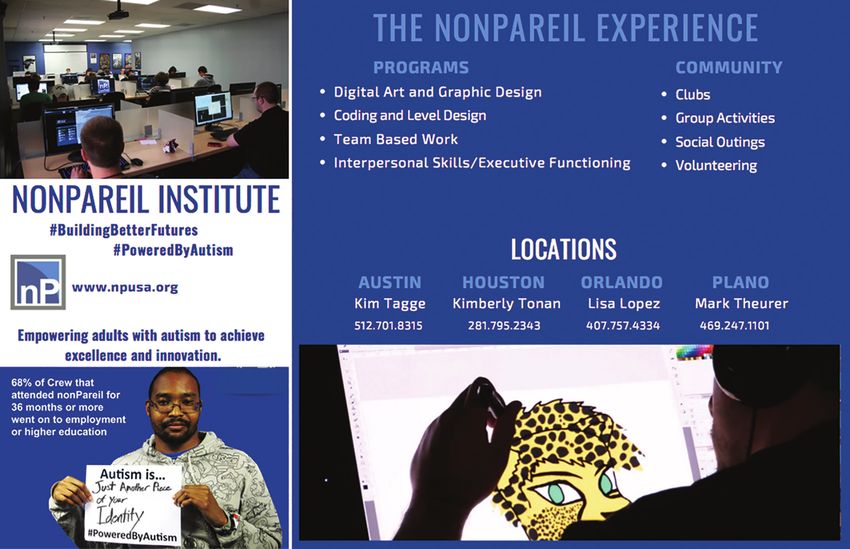
H OT E L / CO N F E R E N C E M A P

The Wyndham San Antonio Riverwalk
Second Floor                                            Third Floor

                              M                          Executive Salon 2        Blue
                                                                                 Bonnet

                                                                                          Executive Salon 1
         A                    W

    Texas
   Ballroom                                             Boardroom                                        W
                                                                                                                Pool
         B                                                                                                      Sundeck
                                                                                                         M      Health Club
                                                        Executive
                                                         Salon 3
                                                                                           San Antonio
         C                                                                                  Ballroom
                        Preconvene
                                                                           Executive
                                                        ExecutiveSalon 4
  Directors Directors                                                       Salon 5
  Room 1 Room 2

 Your 2019 Texas Transition
Lobby Level        Lower Level
 Conference Concierge                                                           175’

 Crack the Code!
 Scan
   Lonethe QR code to enhance your                                          Section 1
   Star
 conference experience.
To experience TTC Concierge, you will need a Smartphone

                                                    Fiesta Pavilion
equipped with a universal QR Code Scanner application. To
Download a QR Code Reader, follow these steps:
  Access the store or market for downloadable apps.
  Search the desired QR Reader* app to your Smartphone.
  Download the desired QR Reader to your Smartphone.                       Section 2
                                           Registration
To use your QR Code Reader, follow these steps:
                                                                             88’
  Open the app on your Smartphone.
  Using the guide bars, position the QR in the middle
  The QR Code Reader will automatically focus on the code and upload the desired website.
  View the site content as normal

                                                                                           2019 TEXAS TRANSITION CONFERENCE   3
W E D N E S D AY, F E B R UA R Y 20, 2019
                                                                           SFP=Student-Focused Planning | FI=Family Involvement | PS=Program Structure
                                                                                               IC=Interagency Collaboration | SD=Student Development

     A Holistic Approach to Infusing Self-                       Trauma Informed Support for Individuals
     Determination into the PreK-Postsecondary                   with Intellectual Disabilities
     Continuum                                                   Karyn Harvey, Ph.D. Director of Development and
     Sharon Field, Ed.D., Founder, 2BSD: Resources for Self-     Programs Park Ave Group
     Determination                                                   Pre-Conference Session I:
          Pre-Conference Keynote:                                    1:15 p.m. - 2:15 p.m.                                Texas Ballroom B
          11:00 a.m. - 12:00 p.m.         Texas Ballroom A&B     This presentation will describe the particular sources
     Self-determination is essential to successfully navigate    of trauma unique to individuals with intellectual
     transitions from early childhood to postsecondary           disabilities. It will talk about the psychiatric and
     settings. Self-determination also helps to maximize         biological effects of this trauma and ways in which
     achievement and post-school outcomes. This session          those effects manifest behaviorally. Various therapeutic
     will equip participants with materials and strategies       interventions that are evidenced based will be
     to implement self-determination instruction and             discussed. Programmatic interventions will also be
     supports in inclusive and specialized settings across       recommended.
     the educational continuum. Participants will have
     the opportunity to review a variety of instructional
     materials and learn how to choose and create tools for      Barriers vs. Obstacles: Supporting
     their settings. They will learn how to use assessment
                                                                 Students with Complex Needs
     tools to determine specific school-wide and classroom
     needs related to self-determination instruction and to      Kim Osmani, M.Ed., Extension Associate, Cornell
     assess individual students’ strengths and weaknesses        University, Vocational Rehabilitation Youth Technical
                                                                 Assistance Center
     related to self-determination.
                                                                 Michael Stoehr, M.S. Ed., Knowledge Development
                                                                 and Technical Assistance Specialist, National Technical
                                                                 Assistance Center on Transition
     Effective Strategies for Promoting Inclusion                    Pre-Conference Session II:
     Across the Lifespan of Transitions Through                      2:30 p.m. - 3:30 p.m.                                Texas Ballroom A
     Access, Participation, and Supports                         Students with complex needs often require supports
     Sondra Stegenga MS, OTR/L, M.Ed., Research Fellow/
                                                                 from multiple service systems and agencies; however,
     Ph.D. Candidate University of Oregon                        even with the best coordination, there are still
          Pre-Conference Session I:
                                                                 barriers students encounter. How we identify those
                                                                 “barriers”and approach knocking down those barriers
          1:15 p.m. - 2:15 p.m.              Texas Ballroom A
                                                                 may make all the difference in the world. This session
     Recent position statements on inclusion emphasize           will engage participants in a discussion about specific
     access, participation, and supports as key elements         barriers to outcomes for students with the most
     for ensuring authentic inclusion (e.g. DEC & NAEYC,         significant disabilities and provide examples of effective
     2009; US DHHS & US DoE, 2015). This session will            practices to enhance the implementation of transition
     discuss the importance of inclusion related to school
                                                                 services.
     and life outcomes including benefits for the child,
     family, and communities. In addition, it will discuss key
     considerations for transitions. The presenter brings a
     wide range of real world examples and activities from
     her work as an occupational therapist, home visitor,
     and school administrator for promoting inclusion across
     a range of environments and lifespan of transitions
     through a discussion-based session approach.
                                                                                  http://tea.texas.gov
4   2019 TEXAS TRANSITION CONFERENCE
W E D N E S D AY, F E B R UA R Y 20, 2019
                                                                        SFP=Student-Focused Planning | FI=Family Involvement | PS=Program Structure
                                                                                            IC=Interagency Collaboration | SD=Student Development

                                                            be at the center of planning their own lives. The value of
                                                            person-centered planning has meant an improvement in
                                                            communication with students. The structured planning
Demystifying Family Engagement:                             methodology supports learning about the individual
Concepts, Strategies, and Action Steps                      requirements of each student by celebrating their gifts,
                                                            and by helping students learn how they can be actively
Sean Roy, Training Associate TracsCen, Inc.                 involved in their outcomes for a good life. The Charting
    Pre-Conference Session II:                              the LifeCourse (CtLC) framework helps individuals and
    2:30 p.m. - 3:30 p.m.                Texas Ballroom B   families develop a vision for a good life by thinking
Engaging families in the transition and employment          about what they need to know and do -- and identify
process continues to be a struggle for many educators       how to find or develop support. It conceptualizes key
and professionals. One reason is that “family               principles to ensure that all people have the right to live,
engagement” is an ill-defined concept and that lack of a    love, work, play, and pursue their life aspirations in their
common understanding creates barriers to action. This       community. This session includes an overview of the
highly interactive session will outline current concepts    (CtLC) framework with an emphasis on one of the key
related to family engagement such as the dual-capacity      (CtLC) principles, the LifeCourse Trajectory.
model and Charting the Life Course. Attendees will then
use group work to identify their professional reasons for
needing to engage families and examine if those reasons
align with authentic relationship building and family       Culturally Relevant Programs and Practices
and student support.                                        from Birth to Adult
                                                            June Gothberg
                                                                Pre-Conference Session III:
Support for Youth and Families in Planning                      3:45 p.m. - 4:45 p.m.                                  Texas Ballroom B

for the Future                                              This interactive session engages participants in learning
                                                            and small group discussion of evidence-based and
Lisa S. Meyer, Consultant, National Charting the            promising practices for working with CLD youth and
LifeCourse Team, Coach/Facilitator
                                                            their families. We will highlight best practices, discuss
National Person Centered Thinking Trainer, Mentor           baseline findings, and also share the processes and tools
    Pre-Conference Session III:                             used to create this hybrid model of learning. Participants
    3:45 p.m. - 4:45 p.m.                Texas Ballroom A   will leave with increased knowledge of CLD and take
Parents are usually the driving force for change in a       home free resources and tools to implement their own
student’s life. Planning in a way that is centered around   professional development.
the youth along with the support and participation of
family, practitioners, secondary and post-secondary
educators, and potential employers will help students

 PATHS prepares individuals for jobs as Direct Support
 Professionals, Para-Professionals, or Child Care Professionals.
 After completing the summer program and two semesters at Texas
 A&M University, participants earn a certificate that combines
 classroom instruction with practical career building experiences.

   Now Taking                                 Deadline is
  Applications!                      February 28, 2019
                                                                                                    2019 TEXAS TRANSITION CONFERENCE            5
B R E A KO U T S E S S I O N O V E R V I E W
                                                                                    THURSDAY                                FRIDAY
                                                                                          9:30a   10:45a   2:00p   3:45p   10:30a   11:45a        LOCATION

                             Person-Centered Approaches To Teaching Youth Self-                                                              San Antonio
                             Determination                                                                                                   Ballroom
  STUDENT-FOCUSED PLANNING

                             The Legal Framework: Your Fast Lane To Special                                                                  Executive Salon 4
                             Education Law
                             Barriers vs. Obstacles: Supporting Students With Complex                                                        San Antonio
                             Needs                                                                                                           Ballroom
                             Stepping-up Transition: A Framework to Write Indicator 13                                                       Executive Salon 3
                             Compliant IEPs
                             Texas Graduation Requirements For ALL Students                                                                  Executive Salon 2

                             What’s Missing In Your IEP?                                                                                     Executive Salon 1

                             How To Be Actively Involved In My IEP Using Bell Ringers                                                        Executive Salon 4

                             EVERYONE Has A PLACE and A PURPOSE In Their                                                                     Executive Salon 5
                             Community! ...Yes, EVERYONE!
                             Effective Strategies For Promoting Inclusion Across The                                                         San Antonio
                             Lifespan Of Transitions Through Access, Participation, and                                                      Ballroom
                             Supports

                             Beyond Advocacy: A Model For Developing Youth and                                                               Texas Ballroom C
                             Parent Leaders
                             Welcoming and Engaging Families In The Transition                                                               Executive Ballroom
                             Planning Process                                                                                                5
INVOLVEMENT

                             Working Together: Partnering With Families To Improve                                                           Texas Ballroom B
   FAMILY

                             Employment Outcomes For Youth
                             Demystifying Family Engagement: Concepts, Strategies,                                                           Texas Ballroom B
                             and Action Steps
                             Texas ABLE Program: A Savings Program For Texans With                                                           Texas Ballroom C
                             Disabilities
                             Transition From Tots To Teens                                                                                   Executive Salon 3

                             Benefits and Work Incentives: Essential Supports For                                                            Texas Ballroom B
                             Employment Success!

                             Transition Coalition Self-Study (TCSS): Professional                                                            Executive Salon 1
STRUCTURE

                             Development For Your Team
 PROGRAM

                             Trauma Informed Support                                                                                         Executive Salon 3

                             Inclusion Classrooms: Who’s In?                                                                                 Texas Ballroom B

                             Tools For Creating Successful Transitions Across The                                                            Texas Ballroom C
                             Lifespan
                             Transition Education In Time Efficient Manner-Transition                                                        Executive Salon 4
                             Bell Ringers

6            2019 TEXAS TRANSITION CONFERENCE
B R E A KO U T S E S S I O N O V E R V I E W
                                                                                  THURSDAY                             FRIDAY
                                                                                     9:30a   10:45a   2:00p   3:45p   10:30a   11:45a         LOCATION

                        The Texas Technology Access Program (TTAP) :                                                                    Executive Salon 4
                        What Do We Do?
                        Interagency Collaboration:                                                                                      Executive Salon 1
COLLABORATION
 INTERAGENCY

                        The Pixie Dust That Makes It Magic!
                        Working Together - United We Work                                                                               San Antonio Ballroom

                        The Final Frontier: Establishing Interagency Collaboration                                                      Texas Ballroom A

                        Building and Sustaining Your “A” Team                                                                           San Antonio Ballroom

                        Innovative Pre-ETS Practices and Partnerships                                                                   Executive Salon 2

                        Transition In Texas Town Hall Session                                                                           Executive Salon 5

                        CIRCLES: A Research-Based Model To Facilitate                                                                   Texas Ballroom C
                        Interagency Collaboration

                        18+ Transition Program for D/HH: Adult Curriculum for                                                           Executive Salon 5
                        Community, Employment and Social Skills (ACCESS)
                        Mobile Apps To Support Students To Be Independent, On                                                           Executive Salon 2
                        Task, Centered, and Included
                        The Job Coaching Academy For Special Education                                                                  Executive Salon 5
                        Teachers and Paraprofessionals
                        Assessing Non-Academic Skills Critical To Post-High                                                             Texas Ballroom A
  STUDENT DEVELOPMENT

                        School Education and Employment Success
                        Building Personal Accountability In Transitioning Young                                                         Executive Salon 2
                        Adults
                        Keeping Your Cool: Strategies For Self-Management                                                               Executive Salon 3

                        Mobile Apps To Support Students To Be Independent, On                                                           Texas Ballroom C
                        Task, Centered, and Included
                        Promoting Self-Determination In The Community                                                                   Executive Salon 1

                        FREE Resources To Enhance Student Career Exploration                                                            Executive Salon 2

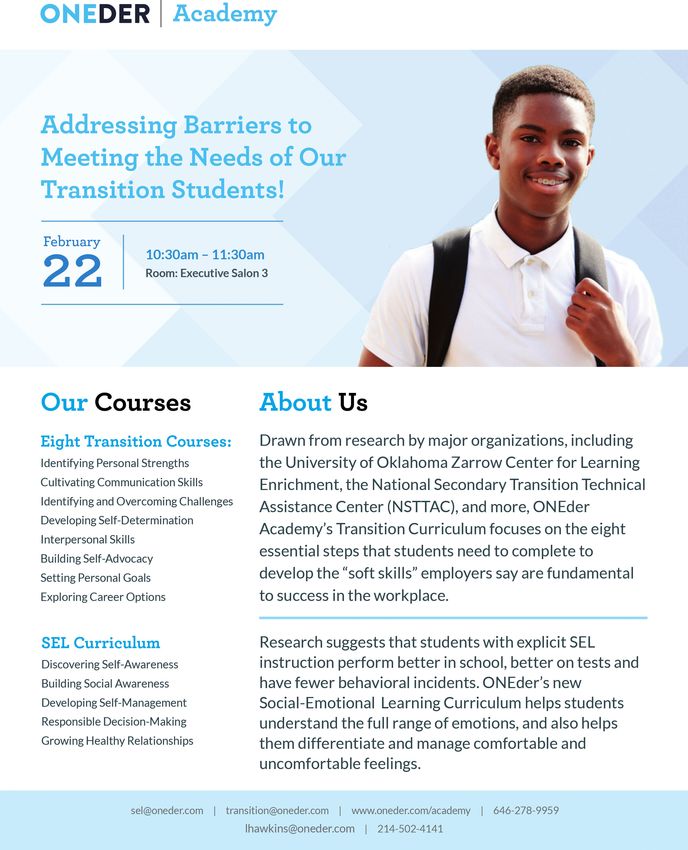
                        Addressing Barriers To Meet The Needs Of Our Transition                                                         Executive Salon 3
                        Students!
                        Paid Employment For Students With Autism, Intellectual                                                          Texas Ballroom A
                        Disabilities, and Mental Health Issues
                        Where’s My Voice?... Here It Is!                                                                                Executive Salon 1

                        A Whole School Approach To Transition                                                                           Executive Salon 4

                        Texas Guardianship Reforms and Transition Planning                                                              Texas Ballroom A

                            ADVERTISING SPACES ARE AVAILABLE FOR THE
                                2020 TEXAS TRANSITION CONFERENCE
                                                           For more information please contact
                                                           Aimee Day, Program Coordinator
                                             Center on Disability and Development at Texas A&M University
                                                                       aday@tamu.edu
                                                                                                                           2019 TEXAS TRANSITION CONFERENCE   7
SFP=Student-Focused Planning | FI=Family Involvement | PS=Program Structure
                                                                                               IC=Interagency Collaboration | SD=Student Development

    T H U R S D AY,                                              F R I D AY,
    F E B R UA R Y 21, 2019                                      F E B R UA R Y 2 2 , 2 0 1 9
    Creating Successful Transitions Across                       Collaboration Across The Continuum:
    The Lifespan                                                 Strategies To Improve Outcomes For
    June Gothberg, PhD. Assistant Professor, Education,          Students With Disabilities
    Leadership, and Research; Director, Connecting Careers       Valerie L. Mazzotti, PhD Associate Professor University of
    Research Center (CCRC), Sharon Field, Ed.D., Founder,        North Carolina
    2BSD: Resources for Self-Determination, Sondra Stegenga
                                                                     8:30 a.m.-10:00 a.m.
    MS, OTR/L, M.Ed., Research Fellow/Ph.D. Candidate
                                                                     Texas Ballrooms A, B, C
         9:00 a.m.-10:30 a.m.
         Texas Ballrooms A,B,C
                                                                 Collaboration is a key component, not only in the
                                                                 transition planning process, but across the continuum
    This year’s keynote brings a focus on practices proven
                                                                 to ensure students with disabilities successfully
    to provide success for students with disabilities as they
                                                                 transition from elementary to middle school, middle
    navigate the numerous transitions that occur from birth
                                                                 school to high school, and high school to post-school
    to young adulthood. Ways to bridge the educational
                                                                 life. It is important stakeholders understand strategies
    divide between settings (pre-K to postsecondary)
                                                                 for facilitating collaboration across the continuum.
    will be addressed. An overview of evidence based
                                                                 This keynote session will provide participants with:
    practices (EBPs) across the lifespan that emphasize the
                                                                 (a) Knowledge about predictors of post-school success
    importance of instruction and supports to foster student
                                                                 to facilitate collaboration in the transition planning
    and family self-determination will be offered. The
                                                                 process; (b) Understanding of the importance of
    role educators play in setting the stage for successful
                                                                 collaboration across the continuum to support effective
    transitions and positive outcomes will be addressed.
                                                                 transitions for children and youth with disabilities;
    Practical strategies and materials to support EBPs
                                                                 and (c) Resources to facilitate collaboration among
    across the lifespan will be included.
                                                                 stakeholders to improve outcomes for students with
                                                                 disabilities.

    Youth Voices: Tools to become Determined
    John McNaught: State Director I’m Determined Project
    Youth Leaders: Emily Lesuer, Betsy Barnett,
    Cayden Stump
         12:00-1:30 p.m.               Texas Ballrooms A, B, C
    I’m Determined Youth leaders will share how they
    became determined and discuss strategies they
    used to overcome barriers on their journey to self-
    determination. This session will lead participants
    through three of the I’m Determined tools: the One-
    Pager, the Good Day Plan, and the Goal Setter.

                                                                  The W.A.C.O. project at TAMU is a 5-week program
                                                                  held from June 2019 through July 2019 for students
                                                                  who are blind or have low vision. Participants receive
                                                                  instruction in professionalism, self-determination,
                                                                  teamwork, and learn about college opportunities.
                                                                        http://cdd.tamu.edu/waco-project
8   2019 TEXAS TRANSITION CONFERENCE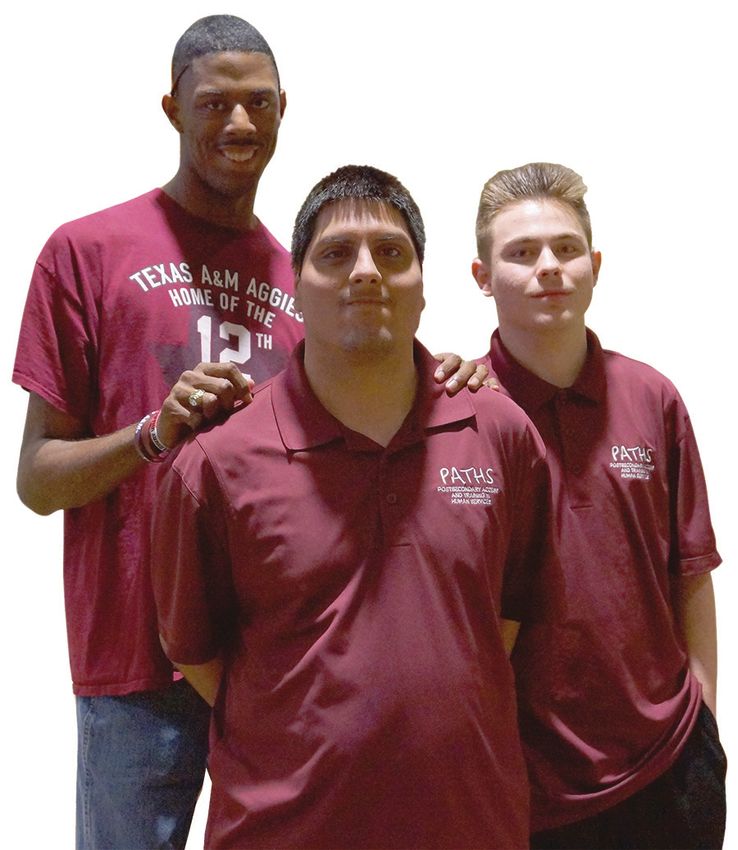
T H U R S D AY, F E B R UA R Y 21, 2019
                                                                            SFP=Student-Focused Planning | FI=Family Involvement | PS=Program Structure
                                                                                                IC=Interagency Collaboration | SD=Student Development

                                                               Trauma Informed Support
                                                               Karyn Harvey, Ph.D., Director of Development and
                                                               Programs Park Ave Group, and Aimee Day, Program
SESSION I                                                      Coordinator, Center on Disability and Development at Texas
                                                               A&M University
Transition Coalition Self-Study (TCSS):                            10:45-11:45 a.m.                                       Executive Salon 3
Professional Development For Your Team                         This session will explore the elements of trauma seen in
Dana L. Lattin, MS Ed, Research Project Director, Transition   the lives of many students with intellectual disabilities.
Coalition - University of Kansas                               Dr. Karyn Harvey will discuss the effects of that trauma
    10:45-11:45 a.m.                      Executive Salon 1    and the strategies that are most effective in reducing
Learn about the TCSS, team-based professional                  the behavioral manifestations of that trauma. Aimee
development designed for teams to learn, practice, and         Day will share how using person centered thinking and
evaluate a transition-related topic together and create        trauma informed care has helped to create a supportive
something as a team that improves overall transition           environment for her son at school which had led to
programming. The Transition Coalition provides materials       increased independence and self-advocacy skills.
(print and online) as well as coaching to support to your
team to implement the TCSS.
Participants will receive an overview of the TCSS process,     The Texas Technology Access Program
see some of the TCSS materials, as well as how TCSS has
                                                               (TTAP) : What Do We Do?
been used in some Texas schools. Evaluation results will
be shared that highlight the positive impact on building       Ana Canevaro, Ph.D. and Olivia Rains, Texas Technology
and district change.                                           Access Program, The University of Texas at Austin
                                                                   10:45-11:45 a.m.                                       Executive Salon 4
                                                               The Texas Technology Access Program (TTAP) leads the
                                                               state’s efforts to carry out the federal Assistive Technology
Mobile Apps To Support Students To Be                          Act of 2004. The mission of the Texas Technology
Independent, On Task, Centered, and                            Access Program is to increase access for people with
Included                                                       disabilities to Assistive Technology (Assistive Technology).
                                                               This access will provide them more control over their
Marsha Threlkeld, Owner PIVOTAL
Consulting and Training LLC                                    immediate environments and an enhanced ability to
                                                               function independently. In this presentation, we will
    10:45-11:45 a.m.                      Executive Salon 2
                                                               discuss our services: (a) Demonstrations for Assistive
There are multiple ways students can use mobile apps           Technology (AT) devices;(b) Short Term AT Device Loans;
and features. Students can be supported to understand          (c) AT Reuse equipment, and (d) The “Double Click”
their daily schedule in words, pictures, or voice prompts.     Computer Project
Students can be supported with tasks broken down into
understandable steps and have this information with
them anywhere. Students can be supported to set goals
and self-regulate. Students can be supported to have tools
to help them stay centered and at their best throughout
the day. Students can learn how to introduce and share
about themselves. To ignore the power of apps sets
students apart rather than assisting them to
join the mainstream.                                            Camp LIFE creates an inclusive, barrier-
                                                                free setting in which children with disabilities
                                                                (ages 5 and up) and their siblings (ages
                                                                5-12) can participate in the activities of their
                                                                choice. This weekend camp is held twice
                                                                each year at Camp for All, centrally located in Texas

                                                                                                        2019 TEXAS TRANSITION CONFERENCE            9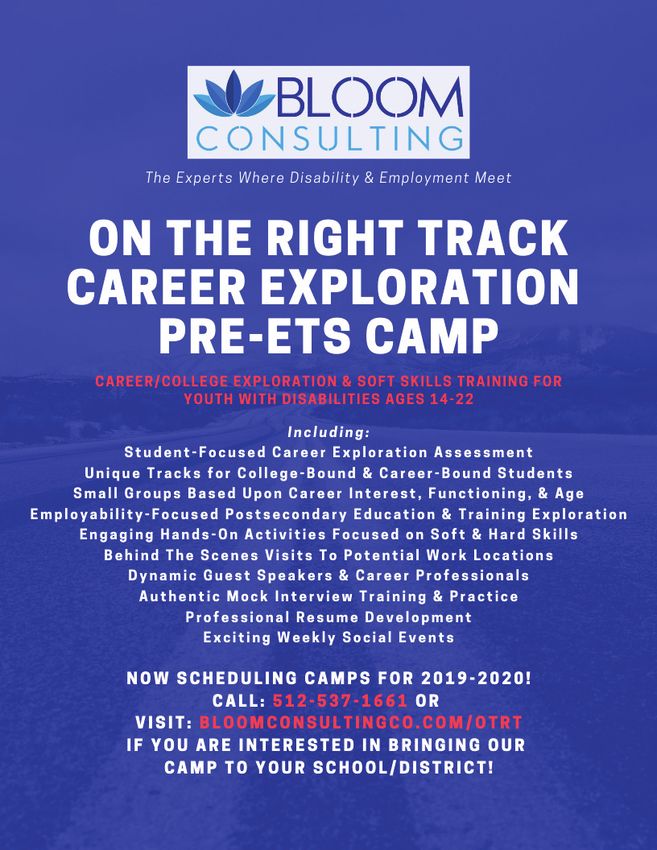
T H U R S D AY, F E B R UA R Y 21, 2019                               SFP=Student-Focused Planning | FI=Family Involvement | PS=Program Structure
                                                                                               IC=Interagency Collaboration | SD=Student Development

     18+ Transition Program For D/HH: Adult                      set expectations, bridge social connections, and present
     Curriculum For Community, Employment                        perspectives of the world that either promote or hinder
                                                                 identity formation, future mapping, and community
     and Social Skills (ACCESS)
                                                                 inclusion. If parenting plays an essential part in
     Beth Smiley, ACCESS Supervisor,                             shaping the youth experience, then practitioners and
     April T Giauque, M.Ed.                                      communities must mindfully consider the mechanisms
         10:45-11:45 a.m.                    Executive Salon 5   used to develop capabilities associated with autonomy-
     Informative presentation explaining the ACCESS              supportive parenting and parent leadership.
     program and what we do to transition students out to
     the real world. We will explain more in depth about
     what the program looks like and review. For example,        SESSION II
     student’s day to day schedule, enrichment activities,
     and dorm activities. The idea is to share transition        Interagency Collaboration: The Pixie Dust
     resources on how students benefit from our program          That Makes It Magic!
     or other similar programs to enrich their skills that are
     important for their future based on                         Jacque Hyatt, M.Ed. and Ruth Allison, MBA, Senior
                                                                 Research Associates, TransCen, Inc.
     individual need.
                                                                     2:00-3:30 P.M.                                       Executive Salon 1
                                                                 There never has been a better time for education,
     Person-Centered Approaches To Teaching                      Vocational Rehabilitation, and other partners to
     Youth Self-Determination                                    coordinate and collaborate in providing services to
                                                                 students with disabilities. To improve post-school
     Lisa S. Meyer, Consultant, B.S., M.Ed., Person Centered
     Thinking Mentor, National Charting the LifeCourse
                                                                 outcomes and enhance services for students with
     Ambassador, Facilitator & Coach                             disabilities when they are in secondary education,
         10:45-11:45 a.m.                San Antonio Ballroom
                                                                 stakeholders must work more effectively and efficiently
                                                                 in their respective roles and responsibilities. This
     Planning in a way that is centered around the youth
                                                                 interactive session will provide an overview of practices
     along with the support and participation of family,
                                                                 that improve collaboration, examine why partnerships
     practitioners, secondary and post-secondary educators,
                                                                 often fail, and provide strategies, tools, and resources to
     and potential employers will help students be at the
                                                                 enhance and sustain your current partnerships
     center of planning their own lives. Ms. Meyer will
     demonstrate and provide examples of how people are
     using Person Centered Thinking Tools and Charting the
     LifeCourse Principles in achieving their outcomes for a     Texas Graduation Requirements For ALL
     good life. Students are taught methods to take charge of    Students
     their own lives, to actively participate in IEP meetings,
                                                                 Sam Gonzalez, Special Education Consultant-Transition
     to set goals, to evaluate options, to make choices,
                                                                 ESC 20
     and to achieve their goals.
                                                                     2:00-3:30 P.M.                                       Executive Salon 2
                                                                 This session will include state laws and rules as
                                                                 they apply to graduation requirements, including
     Beyond Advocacy: A Model For Developing                     19 TAC Chapter 89.1070 (Commissioners rules for
     Youth and Parent Leaders                                    graduation requirements for students who receive
     John McNaught, M.Ed., Co-Director, James Madison Univ.      special education services), PEIMS codes for courses
                                                                 with modified content, including those for students
         10:45-11:45 a.m.                     Texas Ballroom C
                                                                 who take an alternate assessment (STAAR Alternate 2).
     Parents contribute invaluable resources in                  Additionally, information will be shared on:
     constructing social environments that promote youth
                                                                 1) Language Other Than English (LOTE) substitutions;
     access, opportunity, and the develop.m.ent of self-
     determination. Carter (2014) makes a case that parents      2) Courses of Study;
     may be among the most powerful forces in shaping the        3) Personal Graduation Plans (PGPs);
     employment related experience and outcomes of their         4) Students who do not pass all end of course exams
     child. Parents are the engineers of opportunity. They
                                                                                                                         Continued on page 11
10   2019 TEXAS TRANSITION CONFERENCE
T H U R S D AY, F E B R UA R Y 21, 2019
SFP=Student-Focused Planning | FI=Family Involvement | PS=Program Structure
IC=Interagency Collaboration | SD=Student Development
and who may qualify for graduation under an Individual The Job Coaching Academy For Special
Graduation Committee (IGC); and Education Teachers and Paraprofessionals
5) Graduation requirements for the Foundation Plan
Carly B. Gilson, Ph.D., Assistant Professor of Special
including, endorsements, performance acknowledgements Education, Texas A&M University, Doctoral Students:
and distinguished level of achievements. Kristina E. Ingles M.A.S.L., M.A.T., Kaitlyn E. Stein M.Ed.,
and Malena A. Nygaard, Undergraduate Student
2:00-3:30 P.M. Executive Salon 5
Stepping-up Transition: A Framework to We will share the findings of an experimental pilot
study focusing on the implementation of the Job
Write Indicator 13 Compliant IEPs
Coaching Academy (JCA), a semester-long professional
Malarie Deardorff, M.Ed., University of Oklahoma development series for 50 special education teachers and
2:00-3:30 P.M. Executive Salon 3 paraprofessionals working in high school and transition
Indicator 13 of IDEA mandate transition plans include settings across three ISDs in southeastern Texas. We
(a) measurable post-secondary goals, (b) the use of age- used a randomized pretest-posttest control group
appropriate transition assessments, (c) annual transition design to evaluate the effects of JCA on the participants’
IEP goals, (d) transition services including course of mindsets toward job coaching as well as their fidelity of
study, (e) student invitation to the meeting, and (f) evidence-based instructional strategies. Attendees will
outside agency representation at IEP per parent approval. learn the most effective evidence-based practices in job
The step by step process of Stepping-Up is visually coaching strategies. Educators can adapt highlights of this
guided and gives explicit examples for each step to help curriculum to fit within their specific
ensure educational stakeholders meet each mandate of professional settings.
indicator 13. This framework does not require a specific
IEP software program and emphasizes student-led
planning.
Barriers vs. Obstacles: Supporting Students
With Complex Needs
The Legal Framework: Your Fast Lane To Kim Osmani, Extension Associate, M.Ed., Cornell University,
and Michael Stoehr, M.S. Ed., Knowledge Development and
Special Education Law
Technical Assistance Specialist
Lee Lentz-Edwards B.A., M.Ed., M.B.A., ESC Region 18 2:00-3:30 P.M. San Antonio Ballroom
Desiree Caddell, ESC Region 18
Students with complex needs often require supports
2:00-3:30 P.M. Executive Salon 4
from multiple service systems and agencies; however,
Addressing the complexities of the special education even with the best coordination, there are still barriers
process can be overwhelming. The Legal Framework students encounter. How we identify those “barriers”
is here to be your personal assistant in following state and approach knocking those down barriers may make
and federal laws for transition, locating your Transition all the difference in the world. This session will engage
Employment Services Designee, complying with required participants in a discussion about specific barriers
timelines, as well as defining special education acronyms to outcomes for students with the most significant
and terms. Join us as we explore the Legal Framework disabilities and provide examples of effective practices to
and leave confident that you can navigate the process enhance the implementation of transition services.
with clarity.
Love is Friendship on Fire- How Free Workshop Series for Parents,
March 7, 2019 Will You Teach Your Child to Stay
Family Members and Children
Safe In The Flames?
with Exceptionalities
April 4, 2019 It Takes A Village- Finding
Resources and Support First Thursday of every month
May 2, 2019
Safety Is No Accident- Teaching from 6:00-7:30 p.m.
Safe Actions at Home and In
The Community Central Church, Fellowship Room
http://cdd.tamu.edu/service-outreach/purposeful-life-family-training-series 1991 FM 158 Rd., College Station
2019 TEXAS TRANSITION CONFERENCE 11T H U R S D AY, F E B R UA R Y 21, 2019 SFP=Student-Focused Planning | FI=Family Involvement | PS=Program Structure
IC=Interagency Collaboration | SD=Student Development
Assessing Non-Academic Skills Critical their instructional programs and daily routines to
To Post-High School Education and infuse EBPs. They will have the opportunity to view
and discuss several curricula and assessment materials
Employment Success
targeted toward improving transition outcomes. A
James Martin, Ph.D., Emeritus Zarrow Family Professor special emphasis on social emotional development and
University of Oklahoma’s Zarrow Center self-determination will be included related to successful
2:00-3:30 P.M. Texas Ballroom A family engagement and transitions across
This presentation will focus on transition assessment the lifespan.
methods to assess critical non-academic skills predictive
of post-high school education and employment success.
The presentation will first identify these critical student SESSION III
skills and experiences and will then explain and
demonstrate various means to assess these skills. Pros What’s Missing In Your IEP?
and cons of various assessments will be discussed. Aimee Day, Program Coordinator, Center on Disability
Participants will leave with a listing of easily accessible and Development at Texas A&M University
assessments along with information on how to 3:45-4:45 p.m. Executive Salon 1
obtain them. Your ARD team knows what accommodations and
modifications you need to be successful at school
but do they know what you need to feel valued and
Inclusion Classrooms: Who’s In? respected? Do they know how to support you when
you are having a tough day? During this presentation,
April T Giauque, MS ED, Texas School for the Deaf
you’ll learn how to discover information about yourself
2:00-3:30 P.M. Texas Ballroom B
so that you can have a voice in the way that others
What does inclusion in the transition classroom look support you at school, home and in your
like? Learn classroom strategies and social supports
community.
to help build and maintain predictability and stability
for your students. Communication and consistency are
the keys to building their trust. We will go beyond the
checklist of do’s and don’ts. Head’s up, this is not a tips Building Personal Accountability In
and tricks on how to deal with those types of Transitioning Young Adults
students. It’s about relationships. Scott Adams, Executive Director and Co-Founder,
ADVANCE Immersive Transition Program
3:45-4:45 p.m. Executive Salon 2
Nuts and Bolts of Creating Successful How do you get higher compliance for skills that help
Transitions Across the Lifespan transitioning young adults the most? Better goal setting
coupled with a well-organized progress plan can reduce
June Gothberg, PhD., Assistant Professor, Education,
your clients anxiety while building personal satisfaction
Leadership, and Research; Director, Connecting Careers
and accountability. Tips you can use regarding
Research Center (CCRC), Western Michigan University,
Sondra Stegenga MS, OTR/L, M.Ed., Graduate Research assessment, goal setting, and a functional process.
Fellow/Ph.D. Candidate University of Oregon, and
Sharon Field, Ed.D., Founder, 2BSD: Resources for Self-
Determination
Keeping Your Cool: Strategies for Self-
2:00-3:30 P.M. Texas Ballroom C
Management
This session will build on the “Creating Successful
Transitions” keynote session through an interactive Lori Doucet, BCBA, LABA, Site Director and Case
and hands on approach to help participants become Supervisor of the Center for Community Inclusion,
familiar with available materials and strategies to Including Kids Inc.
promote evidence-based practices (EBPs) for successful 3:45-4:45 p.m. Executive Salon 3
transitions from birth to young adulthood. Participants This presentation will introduce the concept of self-
will also learn how to identify opportunities within management and detail the steps involved in creating
Continued on page 13
12 2019 TEXAS TRANSITION CONFERENCET H U R S D AY, F E B R UA R Y 21, 2019
SFP=Student-Focused Planning | FI=Family Involvement | PS=Program Structure
IC=Interagency Collaboration | SD=Student Development
a successful self-management plan. The presenter will go Working Together - United We Work
over a Self-Monitoring scale that individuals can use to Ellen Feagin, Special Education Coordinator and TED at
identify their current level of Lubbock ISD, Shelley Campbell (co-presenter), SELCO SSA
self-monitoring ability. Transition and Employment Designee
3:45-4:45 p.m. San Antonio Ballroom
Transition Education in Time Efficient This presentation will provide a step by step process
of how Lubbock ISD, SELCO SSA, Texas Work Force
Manner-Transition Bell Ringers Commission, and the Lubbock Amerigroup work together
Mindy Lingo, Advanced Doctoral Student, M.Ed., and to plan, organize, and implement a yearly job shadow
Malarie Deardorff, Advanced Doctoral Student, M.Ed., experience and skill building activity that has grown
Zarrow Center for Learning Enrichment, The University of from 20 student participants to 80 student participants.
Oklahoma This includes the key organizers, student applications,
3:45-4:45 p.m. Executive Salon 4 recruiting employers, logistics of safely
Special education teachers repeatedly report the lack of moving 80 students to work sites, organizing meals,
time and material to teach transition focused curriculum. recruiting additional community members to assist with
The Transition Bell Ringers provide educators a means skill building activities, and measuring success.
to overcome lack of instructional time and provide a
cost-free transition education resource. In as little as
10-minutes weekly, the Bell Ringers allow teachers an
efficient and effective means to teach self-determination The Final Frontier: Establishing Interagency
oriented transition skills with-in an academic setting Collaboration
without impacting academic coursework instructional
Kendra Williams-Diehm, Ph.D., Interim Zarrow Family
time. The presentation will provide the background Chair in Learning Enrichment
on why the curriculum is important, examples of the 3:45-4:45 p.m. Texas Ballroom A
curriculum, and other beneficial bell ringers (modified,
Let’s face it, interagency collaboration is hard. Everyone
fundamental transition, and financial literacy) available
is busy and getting multiple people in the same room to
for practitioners.
collaborate on the same transition plan is difficult. Plus,
no one person or even one agency can provide students
with all the supports they need after high school.
Welcoming and Engaging Families In The There has to be a way we can promote interagency
Transition Planning Process collaboration both better and smarter. Research clearly
states that increased interagency collaboration increases
Rosemary Alexander, PhD, Transition Coordinator, Texas
positive post-school outcomes (Noonan, Morningstar,
Parent to Parent, Vickie Mitchell, Ed.D, Eleanor and Charles
Garrett Endowed Chair in Special Education, Ivy Goldstein,
& Gaumer, 2008; Test et al., 2009). This session will
BSBA, State CSHCN Health Coordinator present evidence-based strategies. This session will equip
3:45-4:45 p.m. Executive Ballroom 5
educators with the basic skillset necessary to promote
adult agency collaboration to ensure a more seamless
Families need to know they are welcome at the
transition from high school.
transition planning table and their ideas will be heard.
Research demonstrates the relationship between parent
involvement and positive student outcomes. How can
teachers and transition specialists encourage meaningful Working Together: Partnering With Families
parent engagement in the challenging work of transition To Improve Employment Outcomes For
planning? This session, presented by parents and a
Youth
university-level transition professional, offers a plan
to put parents at ease, value their input, and relay Sean Roy, Training Associate TransCen, Inc.
information in a friendly, culturally effective way. You 3:45-4:45 p.m. Texas Ballroom B
will take away a quick-to-use planning tool for helping Families want what is best for their youth with a
families and students identify priorities and disability. This includes the opportunity to be a part of
envision the future. the community through employment. Some families may
Continued on page 14
2019 TEXAS TRANSITION CONFERENCE 13T H U R S D AY, F E B R UA R Y 21, 2019 SFP=Student-Focused Planning | FI=Family Involvement | PS=Program Structure
IC=Interagency Collaboration | SD=Student Development
be apprehensive to explore competitive employment.
Others may see bright futures, but don’t know how to Mobile Apps To Support Students To Be
support their student in preparing for it. This session Independent, On Task, Centered, and
will highlight the importance of family involvement, Included
while providing strategies for professionals to better Marsha Threlkeld, Owner PIVOTAL Consulting and
engage families in the employment process. Topics Training LLC
will include understanding the family perspective, 3:45-4:45 p.m. Texas Ballroom C
addressing apprehension in exploring community-based
There are multiple ways students can use mobile apps
employment, and strategies for helping families play a
and features. Students can be supported to understand
key role in career readiness.
their daily schedule in words, pictures, or voice prompts.
Students can be supported with tasks broken down
into understandable steps and have this information
with them anywhere. Students can be supported to set
FOR ADVERTISING SPACES goals and self-regulate. Students can be supported to
have tools to help them stay centered and at their best
Please contact Aimee Day throughout the day. Students can learn how to introduce
and share about themselves. To ignore the power of apps
aday@tamu.edu sets students apart rather than assisting them to join the
mainstream.
F R I D AY, F E B R UA R Y 22, 2 0 1 9
SESSION IV resources can be used by students, parents, teachers,
and counselors alike. Whether you simply want to
Promoting Self-Determination In The expose your students to the world of work, or take your
Community class on a deep dive into career research, TWC has
tools for that.
Kathy Higginbotham-Jones, OMEGA and Adult Transition
Services Program Specialist, Adult Transition Teachers:
Stacy Beard, BS, Elizabeth Franklin, BA, Tabitha
Shine, BS, and Donald Zelenka, VAC, MS of Education Addressing Barriers To Meet The Needs Of
Administration
10:30-11:30 a.m. Executive Salon 1
Our Transition Students!
This session will focus on promoting self-determination Linda Hawkins, Oneder Educational Partnership Manager
in students and young adults while in the community. 10:30-11:30 a.m. Executive Salon 3
Research-based strategies and examples of decision This will be an engaging session with participants first
making, problem solving, and self-advocacy are discussing concerns and barriers they are currently
just some of the topics that will be addressed in facing when meeting the needs of their Transition
this interactive, fun-filled presentation. The goal Students. A live demo will provide participants with 2
of this session is to help educators assist students new content rich curricula built to align specifically to
become successful members of their community by meet the goals of our Transition students. This curricula
implementing Michael Wehmeyer’s was created by educators for educators. The key author
model of self-determination. of the curriculum not only utilized the rich research
around meeting the goals of students 14-22 years old
bracket, but also applied her knowledge as a parent of
FREE Resources To Enhance Student a Transition student to create this work. The importance
Career Exploration of progress monitoring at all points with collaboration
will be demonstrated and discussed in non-negotiable
Malisa Barnes, M.Ed., Education Outreach Specialist
terms. With the correct tools, student goals can be met
Texas Workforce Commission
and data tracking collaboratively in real time can close
10:30-11:30 a.m. Executive Salon 2
gaps in student learning.
Experience and examine the career education tools
available through the Texas Workforce Commission. All
14 2019 TEXAS TRANSITION CONFERENCEF R I D AY, F E B R UA R Y 22, 2 0 1 9 SFP=Student-Focused Planning | FI=Family Involvement | PS=Program Structure
IC=Interagency Collaboration | SD=Student Development
How To Be Actively Involved In My IEP Using Building and Sustaining Your “A” Team
Bell Ringers Jacque Hyatt, M.Ed., Senior Research Associate, TransCen,
Mindy Lingo, Advanced Doctoral Student, M.Ed., Malarie Inc., Ruth Allison, MBA, Senior Research Associate
Deardorff, Advanced Doctoral Student, M.Ed. TransCen, Inc.
10:30-11:30 a.m. Executive Salon 4 10:30-11:30 a.m. San Antonio Ballroom
Students will be given a brief pre-assessment of their Seamless transition depends upon effective partnerships
knowledge regarding their IEPs in a fun and engaging among schools, VR, and an array of adult services
manner. Then through the use of mini-lessons (bell and community agencies. People often come together
ringers) the students will build foundational knowledge from multiple agencies to share what they are doing
and self-determination in the areas of self-awareness, individually and identify community needs in providing
disability awareness, postsecondary goals, and student led transition supports and services. But how do you take the
IEPs. During these mini-lessons students will discuss and next step to taking action on the needs and sustaining
collaborate with others on the various topics, while also a cross agency team over time. This session will provide
learning the important communication skills associated strategies and tools that cross agency teams have found
with being an active participant in their IEP. At the to be effective in creating sustained effort through use
conclusion of the sessions, student will take a quick post- of student data, supporting policy change and redefining
assessment to see the benefit of their participation in the roles and responsibilities.
session.
Paid Employment For Students With Autism,
EVERYONE Has A PLACE and A PURPOSE In Intellectual Disabilities, and Mental Health
Their Community! ...Yes, EVERYONE! Issues
Robin Fields M.A. -Principal, Nellie Reddix Center, Leah Wood, MA BS, ESC 19 Transition Services Coordinator
Northside ISD, Melissa Cornelius-Freyre M.A. -Transition 10:30-11:30 a.m. Texas Ballroom A
Specialist, Nellie Reddix Center, Northside ISD, Mark Feeling frustrated about the prospects for your students
Marcik -Spec. Ed. Campus Coordinator, Nellie Reddix after graduation? This session will focus on strategies that
Center, Northside ISD, Abby Hughes -Teacher, Nellie Reddix
SISD has used to improve student employment success
Center, Northside ISD, Barbara Dierker - Teacher, Nellie
Reddix Center, Northside ISD
after graduation. We will look at what these strategies are
and how they can be implemented
10:30-11:30 a.m. Executive Salon 5
in your classrooms.
Transition is NOT a checkbox! It is a process that can
lead to young adults with disabilities leading fulfilling
adult lives. When educators and families focus on the 5 Demystifying Family Engagement: Concepts,
areas of transition, make detailed plans together for what
Strategies, and Action Steps
the future looks like, partner with organizations in the
community, and use the tools and training necessary to Sean Roy, Training Associate, TracsCen, Inc.
reach that future, success can be achieved. It is never a 10:30-11:30 a.m. Texas Ballroom B
question of whether or not an individual with a disability Engaging families in the transition and employment
can be part of their community. The only question is how process continues to be a struggle for many educators
much support they will need to be successful. and professionals. One reason is that “family engagement”
is an ill-defined concept and that lack of a common
understanding creates barriers to action. This highly
interactive session will outline current concepts related to
family engagement such as the dual-capacity model and
Charting the Life Course. Attendees will then use group
work to identify their professional reasons for needing to
Supports individuals with disabilities and their families to be change engage families and examine if those reasons align with
agents who are valued, contributing community members, as self- authentic relationship building and family
defined, through education, research, and knowledge dissemination. and student support.
CDD.TAMU.EDU
2019 TEXAS TRANSITION CONFERENCE 15F R I D AY, F E B R UA R Y 22, 2 0 1 9
SFP=Student-Focused Planning | FI=Family Involvement | PS=Program Structure
IC=Interagency Collaboration | SD=Student Development
Texas ABLE Program: A Savings Program Training, Work Readiness, and Self-Advocacy for
For Texans With Disabilities 14-22-year-old students with disabilities. In addition,
they will include examples of past, current, and future
Anna Mallett, B.A. Communications, Texas State Univ.
Pre-ETS partnerships they have created and how similar
10:30-11:30 a.m. Texas Ballroom C
programs can be created through collaboration within
The Achieving a Better Life Experience (ABLE) Act, and outside of their community.
creates 529 tax advantaged savings accounts for
disability-related expenses. This allows earnings to
grow tax deferred and account owners the ability to
withdraw earnings to use toward qualified disability Transition From Tots To Teens
expenses. Account contributions are limited to $15,000 Sam Gonzalez, Education Consultant-Transition,
per year; however, beneficiaries who are employed can Education Service Center, Region 20
potentially have a higher yearly contribution limit of up Sarah Ford, Education Consultant-PPCD, Education
to $27,140 due to the ABLE to Work Act. Assets in your Service Center, Region 20
account do not affect eligibility for federal or Texas 11:45 a.m-12:45 p.m. Executive Salon 3
means-tested benefits programs like SSI or Medicaid. The transition process for special education students is
ABLE. an integral part of the educational process. This session
will target self-advocacy skills in early childhood,
setting up the transition process in the early years,
SESSION V connecting teachers, students and families with
effective transition awareness, planning, and supports
Where’s My Voice?... Here It Is! for the future. It’s never too early to start the
Shaunta L. Singer, Ph.D. Assistant Professor & Extension transition process!
Specialist, TAMU
11:45 a.m-12:45 p.m. Executive Salon 1
This interactive workshop will give participants the A Whole School Approach To Transition
opportunity to explore their commonalities while at the
Susan Hoyer, Internship and Job Skills Specialist,
same time recognizing that their individual differences Assistive Technology Coordinator
are important to life and getting the support they need 11:45 a.m-12:45 p.m. Executive Salon 4
to be successful. Participants will review the importance
This presentation will cover a whole school
of speaking up and out about themselves and their
multidisciplinary approach to fitness, social-emotional
needs in various situations.
learning, job skills, and academics to prepare the
student for adulthood. Practical examples, backed
up by research-based methods can be immediately
Innovative Pre-ETS Practices and incorporated in your own setting or classroom.
Partnerships
Dr. James Williams, CRC, ACAS, Chief Operating Officer/
Vocational Expert, Bloom Consulting, Bruce Bloom, Transition In Texas Town Hall Session
M.Ed., CRC, IPEC, CAS, Chief Executive Officer/Vocational
Meagan Orsag, Ph.D., Associate Director, Center on
Expert, Bloom Consulting
Disability & Development at TAMU, Cheryl Grenwelge,
11:45 a.m-12:45 p.m. Executive Salon 2 Ph.D. TAMU, Sean Roy, Training Associate TracsCen, Inc.,
Using a collaborative and solution-focused approach, Vickie Mitchell, E.D., Garrett Center, Sam Houston State
the presenters will focus on innovative practices that University
can be used by K-12 and Higher Education institutions 11:45 a.m-12:45 p.m. Executive Salon 5
to build Pre-ETS program partnerships with providers, Drs. Cheryl Grenwelge, Meagan Orsag, and Vickie
employers, and vocational rehabilitation agencies Mitchell along with family involvement expert Sean
based upon their practitioner experience and the Roy, will lead participants through a town hall session
current legislative and policy trends. All five Pre-ETS in which feedback will be recorded and shared with
domains will be covered including Career Exploration, participants and conference staff. The goal is to instill
Work-Based Learning, Counseling on Post-Secondary
Continued on page 17
16 2019 TEXAS TRANSITION CONFERENCEF R I D AY, F E B R UA R Y 22 , 2 0 1 9
SFP=Student-Focused Planning | FI=Family Involvement | PS=Program Structure
IC=Interagency Collaboration | SD=Student Development
deeper-level change by understanding the needs of the Benefits and Work Incentives: Essential
community related to transition and setting aside time to Supports For Employment Success!
brainstorm ways to address those needs.
Sara Kendall, Program Specialist, Texas Workforce
Commission-Vocational Rehabilitation Division, Nehtra
Davis, Program Specialist, Texas Health and Human
Effective Strategies For Promoting Inclusion Services Commission
11:45 a.m-12:45 p.m. Texas Ballroom B
Across The Lifespan Of Transitions Through
Overview of Supplemental Security Income and Title II
Access, Participation, and Supports
disability benefits; the work incentive programs attached
Sondra Stegenga MS, OTR/L, M.Ed., Research Fellow to each; how working will affect cash benefits and
11:45 a.m-12:45 p.m. San Antonio Ballroom Medicaid and/or Medicare; and who to contact to get
Recent position statements on inclusion emphasize assistance with understanding these programs.
access, participation, and supports as key elements
for ensuring authentic inclusion (e.g. DEC & NAEYC,
2009; US DHHS & US DoE, 2015). This session will
discuss the importance of inclusion related to school CIRCLES: A Research-Based Model To
and life outcomes including benefits for the child, Facilitate Interagency Collaboration
family, and communities. In addition, it will discuss key Valerie L. Mazzotti, PhD Associate Professor University of
considerations for transitions. The presenter brings a North Carolina
wide range of real world examples and activities from 11:45 a.m-12:45 p.m. Texas Ballroom C
her work as an occupational therapist, home visitor, and The CIRCLES model involves three levels of interagency
school administrator for promoting inclusion across a collaboration, including Community Level Team, School
range of environments and lifespan of transitions through Level Team, and IEP Team. While each team has a specific
a discussion-based session approach. purpose, the teams work together to address transition
planning needs and issues of youth with disabilities
in order to improve both in-school and post-school
Texas Guardianship Reforms and Transition outcomes (Aspel, Bettis, Quinn, Test, & Wood, 1999;
Povenmire-Kirk et al., 2015). The target population of
Planning
the intervention is youth with disabilities who may need
Steven Aleman, Policy Specialist, Disability Rights Texas support from multiple adult service agencies in order
Jeffrey Miller, Policy Specialist, Disability Rights Texas to experience successful post-school outcomes. This
11:45 a.m-12:45 p.m. Texas Ballroom A presentation will provide participants with an overview
Students with disabilities approaching adulthood need of the CIRCLES model, including information to facilitate
planning and preparation that maximize their ability to implementation of CIRCLES.
make their own life choices and decisions. This session
reviews what administrators, ARD committee members
and families need to know about new changes in Texas
law on guardianship and transition planning. The
implications of new transition planning requirements for
ARD committees will also be discussed.
Provides training and experiences to youth with disabilities to develop
leadership and advocacy skills during a 10-day summer program.
Participants learn the history of the disability rights movement, engage in
career activities and explore assistive technologies. They gain exposure
to legislative activities at the Texas Capitol testimonies.
Two Sessions: June or July
cdd.tamu.edu/project-leap
2019 TEXAS TRANSITION CONFERENCE 17V E N D O R S / E X H I B I TO R L I S T I N G
24 29 Acres Our newest services include TWC-Funded Pre- workforce development leaders to help all students
www.29acres.org ETS Career/College Camps focusing on preparing realize their potential. Education Associates believes
The 29 Acres supported living community was students 14-22 years old with the skills they need to everyone can become “Job Ready and Life Ready”
founded to meet the need for having quality be successful employees whether their path leads to live the vibrant, independent lives they deserve.
programming and safe housing for adults with through college or not. 3 Family to Family Network/Texas
autism. Our housing community is research- 8 CapTel Outreach Project FIRST
based and features safety and security, www.oeius.org www.texasprojectfirst.org
including 24/7 supervision and a state-of-the-art CapTel Outreach provides captioned telephones. Providing families with accurate and consistent
technology platform to enhance safety and further 15 College Living Experience information on the special education process.
independence. 29 Acres offers two main avenues: www.experiencecle.com 4 Imagine Enterprises
Enrich 29 and the 29 Acres Transition Academy. All www.imagineenterprises.org
College Living Experience (CLE) provides
programming is customized and evidence-based
individualized services to young adults with learning Imagine Enterprises believe all people with
allowing for success, personal growth and greater
differences and varying disabilities in the areas of disabilities can work, achieve self-determination,
independence.
academics, independent living, social skills and and obtain control over their resources with Social
12 Advance Houston career development. Security benefits planning, financial management
www.advancehouston.org 20 Curriculum Transition services and employment consultation.
ADVANCE Immersive Transition Program is a Consultants 14 Independent Living Experience
catalyst for young adults with learning, social and gwest@ctconline.net www.independentlivingexperience.com
critical thinking differences as they transition from
Transition and life skills publishing company. Independent Living Experience (ILE) is a community
adolescence to lives of significance and personal
3-8 Disability Rights Texas based, customized support service provider for
accountability. We endeavor to create a program that
www.disabilityrightstx.org adults with disabilities desiring a life of independence
allows young adults to engage in employment that
Disability Rights Texas is the Protection and in their living, working, and social environments.
fulfills and expands their lives, rather than merely
accommodating their differences. We provide Advocacy Agency for People with Disabilities in 18 Marbridge Foundation
immersive, real life experiences where Advance Texas. Protection and advocacy agencies (P&As) www.marbridge.org
students practice skills that lead to personal, social, were created in the early 1970s, following a media Marbridge is a non-profit residential community that
and economic independence. investigation of Willowbrook, a New York State offers transitional and lifetime care to adults with a
26 Amerigroup institution for children with mental disabilities. In wide range of cognitive abilities and provides them
response, Congress passed legislation in 1975 opportunities to learn, experience a whole new life.
www.amerigroup.com
designating an organization within each state to We offer over 150 class room opportunities and 12
Amerigroup Texas helps improve health care
protect and advocate for the rights of people with special Olympics to our residents. We are teaching
access and quality for approximately 800,000
disabilities. Disability Rights Texas opened its job skills, independent living skill and social skills.
Texans by developing innovative care management
doors in 1977 with the mission of helping people 28, 29 MOSAIC - Humble ISD
programs and services. Members are assured care
with disabilities understand and exercise their www.designsbymosaic.com
that is not only accessible, but also accountable,
rights under the law, ensuring their full and equal Transition Program with Humble ISD - MOSAIC.
comprehensive, integrated and patient-centered.
participation in society.
Amerigroup Texas provides ongoing community 19 nonPareil Institute
relations and outreach to encourage members to 27 Down Home Ranch www.npitx.org
become active participants in their health care. www.downhomeranch.org
nonPareil Institute (nP) provides technical training
Through health education programs, members are Down Home Ranch is a 410 acre working farm east to post-high school adults (“Crew members”)
empowered to choose and sustain a healthy lifestyle. of Austin, Texas. Our mission is to empower the with autism. nP is located in Plano and Houston,
2 Attainment Company, Inc. lives of people with intellectual and developmental with expansion sites in Austin and Orlando. The
disabilities through social, educational, residential instruction at nP makes use of artistic software,
www.attainmentcompany.com
and vocational opportunities. code generation products, 3D animation studio
Attainment Company provides accessible blended
learning solutions with technology and curricula (E- 5 Education Associates tools, digital sound applications and other creativity
12+) in ELA, Math, Science, Social Studies, Career www.educationassociates.com enabling tools. Crew members also receive training
Readiness, Social-Personal Skills, and Transition Education Associates is the developer of Project in interpersonal skills and executive management
Skills. Discovery, the leading comprehensive career to empower them to succeed in the workplace and
21 Bloom Consulting education, job preparation, and life skills programs personal environments. nP is a community where
for all learners, including those with special needs. crew members bond over social events, gaming, and
www.bloomconsultingco.com
Education Associates empowers educators and shared experiences. It’s a safe place for each Crew
Based in Austin, Texas,
member to be themselves while working to tap in to
we are a full-service
vocational rehabilitation Texas Foyer - 2nd Floor their full potential.
firm that utilizes age-
appropriate, peer-
reviewed methodology 6 5 4 3 2 1
to evaluate, plan,
and facilitate the 7
30
most meaningfully 22 29 19 20 21
Registration
independent life 8 18
possible for a person 23 28
with a disability. We 17
9
provide comprehensive 24 27
25 26 16
vocational services
10 Elevators
including testing,
training, and counseling.
11 12 13 14 15
Simply put, we are the
experts where disability
and employment meet.
18 2019 TEXAS TRANSITION CONFERENCEYou can also read


