Coronavirus COVID-19: Perspectives for school systems - Florida Education Association
←
→
Page content transcription
If your browser does not render page correctly, please read the page content below

Coronavirus COVID-19:
Perspectives for school
systems
This Document is Current only as of April 24, 2020
This Document is Solely Intended to Provide Insights and Best Practices for the Client – This Document does not Constitute Client Advice

CONFIDENTIAL AND PROPRIETARY
Any use of this material without specific permission of McKinsey & Company
is strictly prohibited

COVID-19 is, first and foremost, a global humanitarian challenge
Thousands of health professionals are heroically battling the virus, putting their own lives at risk. Governments and
industry are working together to understand and address the challenge, support victims and their families and
communities, and search for treatments and a vaccine.

The spread of the virus has led to school system closures around the world
The global spread of COVID-19 is accelerating, with half a million confirmed cases in 199 countries and territories. In
response, over 165 countries have closed schools country-wide leaving over 1.5 billion children out of school

School systems face uncertainty as to how long this will last and when schools
can reopen
While recognizing the uncertainties inherent in discussing any timeline for returning to pre-outbreak normalcy, this
document strives to lay out key considerations towards reopening K-12 schools once the outbreak starts to subside. In
doing so, it focuses on two main questions
• When can the schools be re-opened and what approach could be followed to reach the decision?
• How can the K-12 stakeholders facilitate and operationalize school reopening with a primary focus on health and
  safety measures?

                                                                                                                          McKinsey & Company   2
Current as of April 22, 2020

Countries are at different stages when it comes to deciding
whether schools should be closed / opened
                                                                                                                                                                    Non-exhaustive list of examples

     Country-wide initial school closure for at least one level                           Local initial school closure for at least one level
                                                                                                                                                191 Country-wide school closures
                                                                                                                                                affecting ~1.6billion students

                                                                                                                                                   Schools that stayed open
                                                                                                                                                   • Taiwan1
                                                                                                                                                   • Cuba
                                                                                                                                                   • Sweden2
                                                                                                                                                   • Turkmenistan
                                                                                                                                                   • Tajikistan
                                                                                                                                                   • Belarus

                                                                                                                                                   Schools3 that recently opened
                                                                                                                                                   • Denmark
                                                                                                                                                   • Norway
                                                                                                                                                   • Japan
                                                                                                                                                   • China (e.g., Zhejiang)
                                                                                                                                                   • Israel4

                                                                                                                                                   Plan for schools to be reopened5
                                                                                                                                                   • Germany
                                                                                                                                                   • France
1.    Holidays were extended by a few weeks.
2.
3.
      Primary and secondary schools were open as of April 16; however, the country did close them for students older than 16.
      At least one level at the national scale.
                                                                                                                                                   • New-Zealand
4.    Special education schools reopened on April 21.
5.    Some deep-dives available in Appendix.

Source: UNESCO; press search.                                                                                                                                          McKinsey & Company            3
Most of the states in the US are closed for the academic year and are
planning for reopening in Fall 2020 if situation improves
                                                                                                                                                                                           Coronavirus & school building closure

                                                                                                                                                                                              Closed into April
                 Washington
                                                                                                                                      Massachusetts                                           Closed into May

                                              Montana                                                                                New Hampshire                                            Closed for academic year
                                                               North Dakota
                                                                                                                                                                            Maine
                                                                                                                                           Vermont                                            Closed until further notice
              Oregon                                                              Minnesota
                               Idaho                                                                                                       Connecticut                            Rhode       Recommended closure
                                                                                                                                                                                  Island
                                                               South Dakota                      Wisconsin
                                                Wyoming                                                                                                   New York
                                                                                                                         Michigan
                                                                                       Iowa
                                                                                                                                                 Pennsylvania
                                                                 Nebraska                                                                                                New
                     Nevada                                                                                                                                              Jersey
                                                                                                                                    Ohio
                                       Utah                                                               Illinois    Indiana                                           Delaware
        California                                  Colorado                                                                                West
                                                                                                                                           Virginia                       Maryland
                                                                      Kansas            Missouri                           Kentucky                   Virginia         District of
                                                                                                                                                                       Columbia
                                                                                                                                              North Carolina
                                                                                                                     Tennessee
                               Arizona                                 Oklahoma
                                                                                        Arkansas                                           South Carolina
                                               New Mexico
                                                                                                                     Alabama

                                                                                                                                    Georgia

                                                                   Texas                            Mississippi
                                                                                              Louisiana

                              Alaska
                                                                                                                                                Florida

                                                                                                                                                                     Puerto Rico

                 Hawaii

                                                                                                                                                                                                 McKinsey & Company          4
Current as of April 22, 2020

Education system response to the pandemic could be
approached along 5 key steps

                                                                                                                   Reform
                                                                                          Reimagine
                                                               Return                                              Be clear how the
                                                                                          Re-imagine the “new      environment for
                                       Resilience                                                                  education could evolve
                                                                Create a detailed plan    normal” – implications
               Resolve                                                                    for how the education
                                                                to return the education
                                       Address near-term                                  system could reinvent
                                                                system back to scale
Description     Address the immediate challenges, and broader quickly
                challenges that        resiliency issues during
                                                                                                                   Progress to SDG #4
                COVID-19 represents to virus-related shutdowns
                students, teachers,                                                       Education innovations    Policy decisions
                staff, and community                            School reopening and      to be sustained
                                       Remote learning and      re-enrollment             Vision for the new
Main            School closures and    assessment               Remediation               normal
education       health measures        Support to vulnerable    Resurgence preparation
priorities                             students                 and planning
                                       Financial stress testing

                                                          Nerve center
       Managing across the 5Rs requires a new architecture to plan, coordinate, manage stakeholders and external partnerships

                                                                                                                        McKinsey & Company            5
School systems have to address four priorities across these steps.
The focus of this deck is the return phase

                         Resolve                       Resilience         Return                                      Reimagine               Reform
    Maintain health      School closures and physical distancing          School reopening health & safety plan and   School healthcare infrastructure and
                         Nutrition / school meals                         protocols                                   resilience
    and safety of                                                         Mental health support                       Partnerships for enhanced healthcare at
                         Vulnerable student diagnostic and response
    students, staff &    Special needs support
                                                                                                                      school
    the community        Remote mental health support

    Maximize student     Parent communication and activation              Remediation strategies for lost learning    Progress to SDG #4
                         Device / internet distribution                   Robust blended learning                     Learning innovations to be sustained
    learning and
                         Robust remote learning
    thriving             Grading and assessment
                         Incoming and graduating class transitions

    Support teachers     Teacher training, support, and collaboration     Teacher re-integration                      Teacher innovations to be sustained
                         Redeploying unutilized staff                     NGOs, volunteers partnerships for support
    and staff to adapt
                         Sick leave policies                              Professional development
    to the new reality

    Ensure a strong      Data privacy and online safety                   Reopening operations                        Budgets for new economic reality
                         Vendor communications                            Budget strategy and reallocation            Policy changes for the new normal
    operational and
                         Scenario planning and financial stress testing
    financial future     Remote administrative infrastructure

                                                                                                                                       McKinsey & Company       6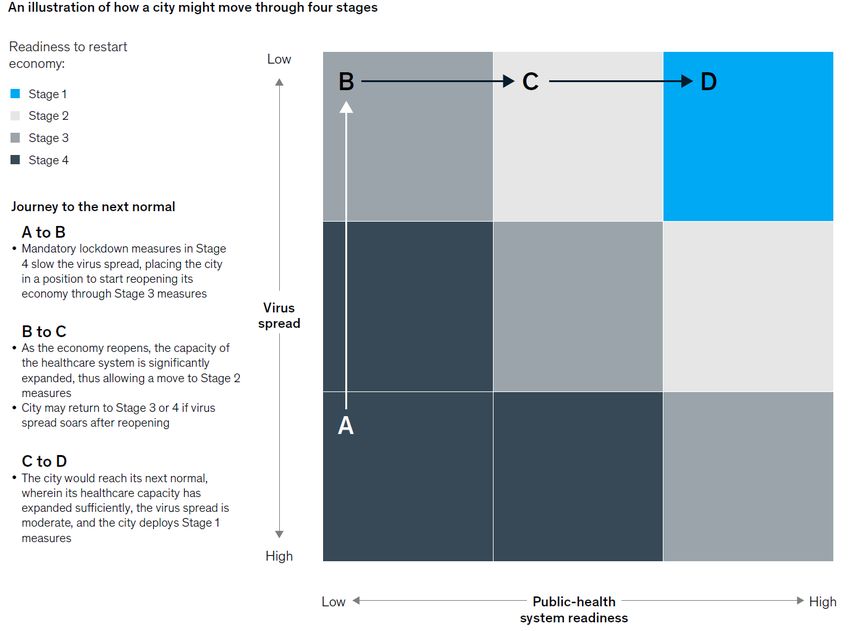
Preliminary insights; non-exhaustive

Re-opening schools important                                                                                                    ...but risks need to be duly
for societal continuity...                                                                                                      considered and mitigated

Benefits                                                                                                                        Risks
•     Allows pupils to resume their learning and                                                                                • Health of pupils, their families and teachers could be
      development from qualified teachers and together                                                                            at risk if the pandemic is still not completely under
      with peers                                                                                                                  control
•     Beyond formal learning, re-activate the socialization                                                                     • The regional / national transmission rate might
      function of schools (i.e. teaching basic rules of living                                                                    increase as a result of the relaxation of strict
      together)                                                                                                                   confinement measures for both children and
                                                                                                                                  teachers1
•     Enables parents to return to work and reopen the
      economy by extension                                                                                                      • Parents may not send children to school yet and
                                                                                                                                  teachers may not yet come to work, if they do not feel
•     Safeguards support for vulnerable children that lack                                                                        it is safe to do so, causing a wedge among pupils,
      access to nutritious meals, safe environment,                                                                               classes (teachers) and workers (parents)
      academic support, or effective/ affordable remote
      learning                                                                                                                  • Premature reopening may leave schools ill-equipped
                                                                                                                                  to provide essential services, leading to more
•     Put an end to the negative psycho-affective effects                                                                         disruption among children
      that result from the social isolation imposed by
      confinement measures

1.   Depending in part on the ability to deploy and constantly apply protective measures (e.g., social distancing) at school.                                               McKinsey & Company     7
There are three main elements to consider when considering
school re-opening
Preliminary insights

 A When do you reopen and for whom?                                         B How do you get ready to reopen?

                       • Trade-offs would have to be weighed in on
                         following parameters:                                                       Health & Safety
                         — Public health risks: Impact of school
                              reopening on virus transmission                                               1
     When to             — Economic activity: Dependency on childcare
     reopen?                  for parents to return to work
                         — Impact on students learning and thriving              Resurgence
                                                                                                       Reopening               Re-
                         — Ability to safeguard school systems with             preparation &    4                     2
                                                                                                        schools             enrollment
                              health and safety protocols                         planning

                       • Contextual information will define different
    For whom             approaches:                                                                        3
      do you             — Regional context
     reopen?             — Student demographics                                                       Remediation

                       C        What kind of structures do you put in place to monitor and streamline the process?
                                          (e.g. Team structure, governance, tools, communications strategy)

                                                                                                                           McKinsey & Company   8
Current as of April 22, 2020
A
Deciding on reopening requires weighing public health risks
against economic activity, student impact and ability to safeguard
Extent and weight of risks will vary across countries and regions
Not Exhaustive
Factors Key questions
Public health risks To what extent can the health of students, families, staff and the Considering the inputs of
general population be safeguarded while opening schools? 3 key stakeholders
— Parents
Criticality for To what extent does school closure contribute to GDP loss
economic activity and unemployment by preventing reopening the economy? — Teachers
— Students
Impact on student To what extent is student learning falling behind when schools
learning & thriving are closed?
To what extent are inequities exacerbated during school closures?
Ability to To what extent are school systems ready to reopen with the right
safeguard schools health & safety measures in place?
McKinsey & Company 9Current as of April 22, 2020
A
There is a continuum of approaches and timelines to reopen
schools across different countries
Preliminary insights
Schools among the
Schools among the last of
first of sectors to open
sectors to open
Schools reopening considered critical Schools could reopen in parallel with other sectors; Schools reopening considered too risky
to continue student learning and most countries following a phased approach to for controlling transmission and not core
reopening economy and precedes all gradually bring selected student groups back on to reopening economy; schools opened
or most other sectors on reopening campus (e.g. vulnerable students, students in low- only after most/all of non-essential sectors
risk areas, younger students and high school
students, children of “essential workers”)
Japan and China have Denmark and Norway are German regions might France and Switzerland Spain, Italy and Greece Colorado, Florida and
reopened most schools reopening kindergarten reopen schools on May will gradually reopen might not reopen schools Texas are not expected
in low-risk areas1 (after (and primary schools) 4, initially for students in starting with before the start of the to reopen schools for the
more than a month of ahead of other sectors their final years of kindergarten and primary school year in September. rest of the academic
closure) (after ~3 weeks of closure) primary or secondary schools followed by Other sectors of the year whereas they have
school (after ~5 weeks of secondary schools, on economy will be (partially) reopened hair salons,
closure) May 11 (after ~6-8 reopened before beaches and retail
weeks of closure) stores respectively
1. Japan and China are opening schools on a rolling basis – in low risk areas schools are reopened with safety protocols in place but they remain closed in high risk areas in Tokyo and Wuhan
Source: Press search - e.g., The Guardian, “Merkel announces plans to reopen schools and shops in Germany”, April 15, 2020; USA Today, “US reopening: What states are relaxing social distancing restrictions McKinsey & Company 10
and moving away from lockdowns?”, April 22, 2020; Le Monde, “Comment le gouvernement envisage la réouverture des écoles : un étalement sur trois semaines, des classes de 15 élèves et
un « protocole sanitaire », April 21, 2020; Washington Post, « In glimpse of life after lockdown, some countries begin to reopen schools”, April 18, 2020; Financial Times, « Denmark plans to reopen primary schools”, April 6, 2020.Current as of April 22, 2020
A
School systems will need to gauge the risks and identify trade-offs
to determine the approach for school reopening
Not Exhaustive and Preliminary insights
Schools among the SchoolsSchools
among the last the
among of
first of sectors to open last ofsectors
sectorstotoopen
open
What do you have to believe to make a decision for school reopening?
Public health risk Risks for children and teachers themselves Risks for children themselves considered Reopening of the schools can pose a
as well as for asymptomatic transmission moderate; reopening schools still seen as a significant risk to both children and others
through children considered limited risk due to likelihood of asymptomatic
transmissions
Criticality for Schools are a critical prerequisite to Economic activity can return through slow, Most parents can continue to work from
economic activity allowing parents to return to work; systematic / staged reopening of schools home or most households can arrange for
significant portion of workers rely on caregivers (including through government-
childcare provided care)
Impact on student Significant learning loss with remote Blended learning works for some subjects Remote learning allows students to
learning and learning especially for vulnerable students and grade levels; in-person lessons continue learning at acceptable levels
thriving Broader risks to students in staying home required for others
(nutrition, domestic violence)
Ability to safeguard Health & Safety measures can adequately Health & Safety measures are insufficient Very difficult to safeguard schools given
schools mitigate the risk of infection in schools to prevent the spread of the disease if inherent characteristics of children, plus
schools return to full capacity shortages of supplies and budgets
Source: Danish ministry of education guidelines, Danish prime minister press conference (April 6), Norwegian ministry of education guidelines, Austrian ministry of education press conference (April 8) McKinsey & Company 11A Schools reopening is critical for economic activity as ~16% of US
workforce (~26M) is dependent on childcare
% of workforce dependent on childcare
12% 23%
Washington
(0.6M) Massachusetts (0.6M)
Montana New Hampshire (0.1M) (0.1M)
North Dakota
(0.5M) Maine
(0.1M) (0.1M)
Oregon Vermont (0.05M)
Minnesota
Idaho Connecticut (0.3M) Rhode
(0.3M) (0.1M)
Island
(0.1M) Wisconsin (1.5M)
South Dakota
Wyoming (0.5M) (0.8M)
(0.1M) New York
(0.05M) Michigan
Iowa
Pennsylvania
Nebraska (0.3M) New
(1.0M) (0.8M)
Nevada Jersey
(0.2M) Ohio
(0.2M) Utah Indiana
Illinois (1.0M) (0.1M) Delaware (0.1M)
California (0.3M)
Colorado (1.1M) (0.6M) West
Virginia (0.7M) Maryland (0.5M)
(3.0M) (0.5M) Kansas Missouri Kentucky Virginia District of
(0.3M) (0.05M)
(0.5M) (0.4M) Columbia
North Carolina
Tennessee (0.9M)
Arizona Oklahoma (0.6M)
Arkansas South Carolina
New Mexico (0.4M)
(0.5M) (0.3M) Alabama (0.4M)
(0.2M)
(0.4M)
(0.3M) Georgia
(0.9M)
(0.4M)
Texas Mississippi
(2.4M) Louisiana
Alaska
Florida
(0.1M)
(1.5M)
Puerto Rico
Hawaii
(0.1M)
McKinsey & Company 12Current as of April 22, 2020
A COVID-19 Education Reopening Readiness Dashboard
Illustrative
Score Domain performance metrics
Protective equipment (e.g., masks, gloves) availability New active cases
Foundational
public
health
23 Testing capability
Tracking and tracing capability
Share of hospitalized patients
Mortality rate
Public health
risk Health Protective equipment (e.g., masks, gloves) availability Clinical workforce (e.g., doctors, nurses) availability
system 54 Regular beds availability
Intensive care beds availability
Treatment availability
Ability to scale up healthcare capacity and PPE
capacity
Number of workers dependent upon childcare Share of consumer spending generated by workers
32
Criticality for Economic
School substitutes (e.g., older children) availability dependent upon childcare
economic health Bankruptcies risk for companies employing
Share of GDP generated by workers dependent upon childcare2
activity workers dependent upon childcare
Remote Device and Internet availability Online assessment results
Impact on
learning 15 Remote learning attendance
Target curriculum coverage / learning pace
Online tutoring availability
Parents, teachers and students satisfaction
effectiveness
student
learning and Performance gap per student pre- and during quarantine Access gap between different socio-economic
25
Impact on
thriving Performance gap across students during quarantine groups
equity
Cases of domestic violence and child abuse
School PPE available per school employee and student
Ability to
safeguard
safeguarding 76 Compliance with physical distancing and sanitation rules
Compliance with health checks
McKinsey & Company 13Preliminary insights , outcomes are evolving as situation changes
A As governments attempt to slow the spread of
virus, school systems could identify the stage
and readiness for their regions
An illustration of four readiness stages for a regional school system Key reopening stages
• At A, the stage 4 health system likely requires
school closures to comply with social
distancing guidelines1 and lockdown
measures1
• Moving from A to B may require systems to
prepare policies and infrastructure to put in
place during stages 3 and 2 once the epidemic
situation allows reopening
• Moving from B to C as the virus is brought
under control may require careful planning to
ensure the agility to swiftly move ahead to D,
or back to A if virus spread soars after
reopening
• Moving from C to D would likely require
protocols and capacity expansion to open all
schools under the next normal, being mindful
of possible virus resurgence
• To move to D / reopening, cases reported
should have declined steadily for the last two
weeks; local healthcare providers should have
ability to provide testing, treatment, and
isolation for all seeking care, or coordinated
local mobile surge capacity
1. There is mixed research on whether keeping students at home helps reduce transmission significantly (e.g. see details below for two different researches)
Source: Russell M Viner et al. “School closure and management practices during coronavirus outbreaks including COVID-19: a rapid systematic review”, McKinsey & Company 14
The Lancet, April 6, 2020; Ferguson, N., et al. Strategies for mitigating an influenza pandemic. Nature 442, 448–452 (2006).Preliminary insights , outcomes are evolving as situation changes
A Example – What a potential path could look like
Illustrative
Stage 4 (all schools closed) Stage 3 Stage 2 Stage 1 (all schools open)
School closure type • All school types likely closed • Primary schools may reopen • Both primary and secondary • All schools open
and instruction except (potentially) for certain • Secondary schools likely schools could be open • Learning resumes in the
delivery narrow segments (e.g. closed • Blended learning to be classrooms
children of critical workers) provided, majority of the
• Blended learning could be • Best practices to be retained
• Remote learning more likely provided, large portion of delivery could potentially be from remote learning phase
to be provided based on local curriculum taught through conducted in person
guidelines remote learning
• Policies around assessments
and grades to be defined
Activities conducted • Strict closure could • Potentially reduced school • Full school days • Full school days
potentially reduce spread days • Limited extra-curricular • Educational activities return
• No activities may be • Possible focus on core- activities may be allowed to normal
conducted in school except curriculum classes (e.g., no • Based on national protocols,
transition to remote learning gym, arts class) events to be conducted e.g.
graduation, field trips
Safety & Health • Social distancing and • Strict safety protocols likely • There might be a switch to • Basic hygiene and health and
lockdown measures set by to be implemented less strict safety protocols safety protocols to be
government implemented
• Policies for staff, teachers • Dynamic plan likely to be
and infrastructure to be put in required to have the agility
place for closedown if virus
resurges
McKinsey & Company 15Current as of April 22, 2020
A
While considering for whom do you reopen, four archetypes
can be identified based on global examples
Opening Partial opening
Preliminary insights
Archetype 1. No reopening 2. Targeted groups 3. Targeted levels 4. Targeted years
Higher Higher Higher Higher
Secondary Secondary Secondary Secondary
segments
segments
segments
Specific
Specific
Specific
Primary Primary Primary Primary
Pre-primary Pre-primary Pre-primary Pre-primary
Rationale Considerable pressure Schools to open or remain Schools to open as a Prioritized opening for
on health care system open for specific segments that means to provide students in grades that
and risks of resurgence are disproportionately impacted childcare for parents, have high stake exams
calls for schools to by school closures (e.g. special enabling them to go back to allow progression to
remain closed till the end education schools, vulnerable to work and open other next level
of school year (July) population) sectors
Examples1
Spain Italy Estonia United Israel Denmark Norway Germany Portugal France
Kingdom
1. Examples based on public reports, and includes likely scenarios announced in the press
McKinsey & Company 16Current as of April 22, 2020
B
Once reopening decision is made, readiness depends on four key
elements; health & safety becomes a pre-requisite
Deep-dive
Preliminary insights
Health & Safety Re-enrollment Remediation Resurgence
planning
1 2 3 4
Key safeguards to be put Critical to re-enroll students Planning required to fill Advanced preparation for
in place with respect to back to school especially academic and non- schools to be able to
following categories: those who are at a higher academic gaps created continue education for
• Physical infrastructure risk of dropping out and during school closure students in case second
• Transportation and food the ones who have not kept leading to loss of learning wave of virus resurges;
service in touch with teachers or other socio-emotional readiness for blended
• Scheduling and staffing during the lockdown disadvantages learning for all students
• Health and behavioral
norms
McKinsey & Company 17Current as of April 22, 2020
B1
In deciding which health and safety measures to implement schools are
facing difficult trade-offs between effectiveness and feasibility
Preliminary insights
Effectiveness Feasibility
Feasibility
Physical infrastructure
Effectiveness in
reducing virus spread Infrastructure feasibility
Some measures will
Budget feasibility be common across
Transportation and
food service systems and levels of
Effectiveness in Supply chain feasibility education, but many
providing childcare Staffing feasibility will need to be tailored
to each system’s
Scheduling and Behavioral feasibility unique circumstances
staffing (parents, teachers, students)
Effectiveness in
delivering learning
Health and behavioral
norms
McKinsey & Company 18Current as of April 22, 2020
B1
Illustration of example measures that schools in
countries are taking to ensure health and safety (1/3)
Non-exhaustive
Changes to ensure Establish controlled entrances and exits (e.g. based on grade levels, students and teacher entry) and flows (e.g. one-way traffic in
physical distancing tight corridors)
Restrict access to places that allow larger gatherings (e.g. cafeteria, staff rooms, libraries) or close these entirely
Grid off sections for common spaces and lunch areas to help students separate and reduce seating to ensure >6ft physical distance
Separate partitions in open spaces with high risk of interaction/ contact (e.g. playground, blacktop)
Add plastic barriers and guards between desks (students and teachers)
Physical
infrastructure
Changes to enable health Install no-touch bathroom fittings, no-touch trash cans
and sanitization protocols Install hand-sanitizing stations at entrances, common areas in the school
Discontinue vending machines
Changes to create healthy Improve building conditions and airflow (e.g., ventilation per OSHA guidance)
buildings
Changes to transportation Increase number of bus routes to reduce occupancy on each bus
forms, routes, and Change bus schedules to bring students in batches that align to cohorts (grade-level, floors)
sanitization procedures
Sanitize school transportation after each use
Subsidize parking/ sponsor carpools / create safe bike/walking routes to encourage use of private transport
Transportation
and food service
Changes to food service to Ensure all food items and choices are fully boxed and no food can be directly touched by students; enforce ‘take what you touch’
reduce cross- Package cutlery, seasonings, sauces and napkins in single serve packages
contamination
Stagger lunch times by class to ensure physical distancing; add markings on ground to prevent crowding
McKinsey & Company 19Current as of April 22, 2020
B1
Illustration of example measures that schools in
countries are taking to ensure health and safety (2/3)
Non-exhaustive
Scheduling adaptations Create staggered schedule for students to attend school on different days (alternating days) or different parts of the day (morning/
that reduce number of afternoon)
students on campus at Place fewer than 50% students in the classroom to allow physical distancing
any time
Creation of cohorts to Create staggered schedule for cohorts to start/end at different times to avoid contact
minimize number of people Develop learning schedule in cohorts to minimize contact with broader group of students (e.g. in primary reduce mixing for electives)
Scheduling and each student/teacher
Stagger recess, lunch hours to avoid contact between cohorts
staffing interacts with (e.g.
by grade, by floor)
Avoidance of large groups Cancel assemblies and other large gatherings
and gatherings to reduce
mixing
Behavioral norms Establish physical distancing (>6ft) protocol at all times (either just teachers, or teachers and students)
Enforce wearing of masks (either just teachers, or teachers and students)
Set up regular schedules for hand washing and sanitation
Health and Enforce no sharing of supplies, lunches among students
behavioral
norms Training of staff, parents Use promotional programs around hand washing and other best practices (e.g., “masks are cool” campaign)
and students Set up trainings for current staff on health protocols
Educate parents/ communities on school protocols and frequently share updated policies
McKinsey & Company 20Current as of April 22, 2020
B1
Illustration of example measures that schools in
countries are taking to ensure health and safety (3/3)
Non-exhaustive
Sick leave policies Review attendance policy for students (ensuring students stay home in case of symptoms exhibited individually or for a family
member)
Set up sick leave and remote teaching policies for teachers to accommodate schedules of different grade levels
Procedures on entering Establish controlled entrances and exits (e.g. based on grade levels, students and teacher entry)
the school site Check and log body temperature (with contactless thermometer, thermal camera) for all employees, visitors, and students
Limit visiting hours from external members (incl. parents)
Adjust protocols on receiving mail, deliveries, etc.
Health and
behavioral Enhanced cleaning and Enhanced hygiene protocols on school ground with a focus on common touch points (e.g., doors, stairwell handles, light switch,
norms sanitization elevator switch)
Promote hand-washing multiple times a day (create schedule to avoid over-crowding for washing)
Contact tracing, Notify health officials of suspected or confirmed positive cases
emergency and disease Set up policies for closing classes, cohorts, or entire institution and for managing symptomatic students
management
Set up protocols for contact tracing if cases are detected in school/ community
Set up isolation facility to handle emergencies in case of cases detected on campus
Partner with local communities, health institutions to be first point of contact during emergencies
Schedule regular inspection in line with COVID-19 health protocols
McKinsey & Company 21B1 Each system can aim towards comprehensive health safeguards,
but may have to adapt to realities on the ground
Safe interactions Healthy school operations Healthy learning environment
Illustrative deep-dives on a few measures Preliminary insights, outcomes are evolving as situation changes
Best-practice health safeguards Feasibility challenges Potential compromises1
Ensuring teachers and students stay 6 feet It will be immensely challenging to keep children – especially Accept that children will physically touch and double down on handwashing and other hygiene
apart at all times younger ones - physically apart from each other in a schooling measures; enforce distancing between school staff
environment Create cohorts of students that interact only with each other
Prioritize quick test and tracing with return to confinement of all class group in case of detected case
Reordering school days to reduce the Part-time programs will not completely solve the childcare issue Prioritize instruction or organize all day childcare for vulnerable children and children of back-to-work
number of students present on-premises at nor allow optimal learning parent with no other non-working adult at home
any one time
Requiring antibody tests for each teachers In the current situation, and for several months, the majority of Protect older and immunocompromised teachers by asking them to stay at home and run remote
and staff as prerequisite to return teachers might not have yet been exposed to the virus learning; mandate other teachers return to school
Accuracy of serology test and degree / length of immunitization is Require that teachers and staff strictly follow preventive and diagnostic measures to limit risk of spread
currently unknown” 2
Conducting temperature checks with There might not be contactless thermometers to conduct Allow children to be tested at home or bring own device; stagger start times to enable standard
contactless thermometers on entry to the temperature available for every school thermometer checks as students enter; or consider using pulse oximeters instead
school campus daily Most children are asymptomatic Prioritize quick test and tracing with return to confinement of all class group in case of detected case
Enforcing no-touch bathrooms at all times Installing “no-touch bathrooms” is a meaningful infrastructure Increase frequency of bathroom sanitization
change and may not be feasible based upon contractor Further invest in sanitizing stations
availability and school budget
Have bathrooms shifts by class groups3 with cleaning in between
Enforcing personal protective equipment It is unlikely that systems will be able to enforce mask use for Ensure masks and gloves are available for teachers and staff
(e.g., facemasks, gloves) at all times younger children; even if enforcement was possible, availability Run campaigns to make mask wearing cool (Frozen II masks) but likely still hard to enforce
of PPE may lag demand
School systems will have to constantly and rigorously assess time-cost tradeoffs and make decisions that will not cause acceptable threats to school populations health safety
1. NB: do not constitute recommendations
2. NB: On April 17, the head of WHO’s emerging diseases and zoonosis unit warned that there was no evidence that antibody tests now being developed would show if a person has immunity or is no longer at risk of becoming re-infected by the Covid-19 virus.
3. NB: with exception in case of urgency.
Source: McKinsey analysis. McKinsey & Company 22Current as of April 22, 2020
B
Once reopening decision is made, readiness depends on four key
elements; health & safety becomes a pre-requisite
Deep-dive
Preliminary insights
Health & Safety Re-enrollment Remediation Resurgence
planning
1 2 3 4
Key safeguards to be put Critical to re-enroll students Planning required to fill Advanced preparation for
in place with respect to back to school especially academic and non- schools to be able to
following categories: those who are at a higher academic gaps created continue education for
• Physical infrastructure risk of dropping out and during school closure students in case second
• Transportation and food the ones who have not kept leading to loss of learning wave of virus resurges;
service in touch with teachers or other socio-emotional readiness for blended
• Scheduling and staffing during the lockdown disadvantages learning for all students
• Health and behavioral
norms
McKinsey & Company 23B2
Re-enrollment needs …and a process that includes and
tailored approach… addresses concerns of all stakeholders
Details follow
Schools may need to develop tailored
approaches to address concerns of…
• Parents who are unwilling due to inadequacy of
health & safety measures at schools or
increased transmission risk
• Students who may need to go to workforce over Interventions and Policy and
education after the lockdown, in particular due Tracking and data measures coordination
to worsening of economic conditions
Identify key metrics / gaps and Lay out a set of interventions Develop a well-functioning
• Students who may choose to learn remotely track key census data related to facilitate re-enrolment after implementation policy tailored
over attendance at brick-and-mortar school to re-enrolment, including: the outbreak including to local conditions through:
• Students who have dropped out or reduced • Number of students whose measures on: • Stakeholder engagement
engagement with their schools/teachers during families may have moved • Raising awareness and inputs from local
remote learning out / changed districts • Communications and communities on school
• Number of students who/ tracking needs
• Students who are traumatized by the virus
outbreak experience and unwilling to go to whose families may need • Economic support / • Regular communication
school additional economic stipends and coordination across
support to continue their local institutions on
• Students migrating to inaccessible areas • Community support
education logistics and funding
• Enforcing negative needs
• Students demotivated due to falling behind their • Number of students who incentives
curriculum over the remote learning period did not have access to • Increased private sector
remote learning or fell • Partnerships engagement
behind their curriculum
during the remote learning
period
McKinsey & Company 24B2 Schools can take a number of measures to support re-enrollment
Lever Potential measures Example interventions from past incidents
Raising awareness • Brochures on learning and precautions being taken schools to ensure students are not at risk
After the Ebola outbreak in DRC in 2018,
• Conduct introductory webinars for parents and virtual tours for students UNICEF trained 7,200 teachers in
measures of prevention against Ebola and
dispatched handwashing points, soaps,
Offering community • Community outreach by schools through emails, text, phone calls to ensure parents understand the and thermometers to affected schools;
incentives enrolment/re-enrolment process and dates schools also received information on
• Leverage community volunteer groups to help establish community-based social uplift methods of transmission / prevention
• Peer-to-peer network (buddy system) to keep students engaged
After Idai tropical cyclone, an NGO
Online pre-learning / • Offer additional flexibility on enrolment deadlines; provide clear online enrolment guidance and support constructed two disaster-resilient schools
• Offer online pre-enrolment learning options for incoming students (and personalized support) in Sofala province with improved Wash
(water, sanitation, health) facilities by
working with local communities
School-initiated • Regular 1:1 check-in from teachers with students and parents
engagement • Visit with student families (if needed and possible) After the Ebola outbreak, Liberia provided
• Additional engagement by schools with at-risk students (in coordination with parents) -- 73% of high subsidies to private schools for recovery, in
school dropouts indicated their parents tried to talk them into staying compared to 37% indicating their addition to full funding of public schools,
school tried to talk them into staying according to a 2017 survey in US1) enhancing learning infrastructure and re-
enrolment
Economic support • (Conditional) cash transfers and stipends for families/students in need
Davis Joint Unified School District (CA)
• Free school meals / equipment offers online re-enrolment resources for
• Private school vouchers / subsidies parents, including an FAQ section in both
• Strengthen enforcement of laws requiring enrolment English and Spanish
• Strengthen enforcement of bans on child labour
During the 2015 floods in Costa Rica,
Education Minister asked school directors
Partnerships • Community partnerships and increased private sector engagement of more than 400 schools to check in with
• Agricultural incentives where applicable families to make sure they “don’t lose one
boy or girl in the classroom”
1. Educationdata.org (2017)
Source: The New York Times, “As School Moves Online, Many Students Stay Logged Out, April 8, 2020; edsurge.com “What Will K-12 Schools Look Like Post-Coronavirus?”, April 3, 2020;
magnushealth.com, “How K-12 Schools Manage Prospective Students, Enrollment, And Student Health During COVID-19”, March 20, 2020; National Center for Education Statistics (2016); McKinsey & Company 25
Gilroy, Davis, Lancaster, and FLVS websites; UNICEF, educationdata.org, OECD, allhandsandhearts.orgCurrent as of April 22, 2020
C
An operational lead and tight governance could enable effective
monitoring and quick decision-making during reopening process
Dedicated capacity supporting leadership at each level - the “nerve center” - to ensure that
response is coordinated and carefully monitored, and to enable decision-making
Strong relationships and partnerships at policy and operational levels with other relevant
government entities (e.g. department of health, local clinical services) and non-government (e.g.
transport providers, catering services)
Clear, ongoing communication with important stakeholder groups, especially parents
Effective data and monitoring systems to track implementation of health measures within
schools, levels of attendance, and overall sentiment among teachers and students
Effective supporting functions, especially IT, finance, and supply chain (for PPE and otherwise)
McKinsey & Company 26C1 Regional / District Nerve Centers could enable effective
monitoring and decision-making during the reopening process
Levels and report lines may vary depending on geographies
Responsibilities
Federal level
Gives green light to reopen schools at national / regional level
Central Nerve Center
Central /
Education Team Sets national guidelines for health & safety measures to adopt
Defines and allocates funding
Handles supply distribution at intermediary and / or local level or
sets up procurement guidelines (it may differs across geographies)
Regional / District Nerve Center
Intermediate Regional / District
Mandate: organize, coordinate, resolve issues, Responsibilities
communicate with central and school levels
Defines key KPIs, metrics / triggers
Organizes, operates and monitors schools reopening
process
Escalates recommendations to Central Nerve Center
level
about school closures
Communicate procurement needs expressed by schools
Operations (e.g., to Nerve Center
Strategy (e.g., data Reopening Task Force
Healthcare Support functions Others Task Forces
analysis, regional Health expert Conducts scenario planning at district / regional level
procurement / supply, (e.g., Finance, (e.g., Remediation,
guidelines, Data expert and communicates these to Nerve Center
coordination, Communication) Remote learning)
recommendations)
monitoring & tracking) Program manager
Local
level
School principals in the Region / District
Source: McKinsey analysis. McKinsey & Company 27C1 When facing a crisis like COVID-19, Regional / District Nerve
Centers can provide clear benefits
Regional / District Nerve Centers provide a centralized, integrated body to help meet the needs at Central / federal and local levels
Benefit Needs Role of the Regional / District Nerve Center
Make sure any updates relating to national guidelines Cascade national guidelines at school level and advise
Continuous update on (e.g., new measured / target KPIs) rapidly flow from schools on how to facilitate adoption
national guidelines central to local level
Close monitoring of Ensure that schools comply with national guidelines and Monitor schools reopening processes and frequently
compliance to meet target KPIs update central level (e.g., weekly basis)
guidelines
Efficient supply Ensure efficient supply distribution / procurement across Communicate procurement needs expressed by
distribution/ schools / districts thanks to increased visibility over schools to Central Nerve Center and handle distribution
procurement evolution of stocks / needs / procurement process for schools
Rapid school Minimize amount of time between communicated, Escalate recommendations to Central Nerve Center
shutdown process recommended and official school shutdown1 about potential school closures following reported lack
of compliance / appearance of positive case2 and vice
versa
Nation-wide, Collect and analyze a wide range of information from Provide a centralized data collection and analysis
systematic data schools level (e.g., attendance rate, reported new cases, capability for descriptive analytics and projections; such
gathering best sanitary practices) to fuel national dashboard analyses will be the basis of local dashboards and fuel
national dashboards
1. NB: assuming decision to shut down a school is made at Central level.
2. NB: assumption made that one positive case within school will lead to a shutdown.
McKinsey & Company 28
CONFIDENTIALC1 Choose and monitor key indicators to track successful
implementation
Illustrative dashboard at school level
Example Output
Gap1 1 2 3 4
Selected school/district
Compliance Preventive Protective equipment (e.g., masks, gloves,
to national measures hand sanitizers) daily coverage per school
0.93 National average To monitor successful
guidelines implementation a set
1 = Needs improvement
Daily use of protective equipment 1.04
2 = Emerging
of indicators needs
Number of reported cases of insufficient social 3 = Established to be chosen. These
0.86
distancing (i.e. 6 feet apart) / day 4 = Exceptional can be both process-
Daily frequency of classroom sanitization 0.96
oriented (e.g., use of
Size of gap1
Small gaps (Backup
McKinsey & Company 30Current as of April 22, 2020
A Archetypes of reopening – examples of countries that are
considering doing so (1/2)
Country Measures
Spain Spanish schools and universities closed when state of emergency was announced (source)
Experts advising government officials predict there will be no return before September 2020 (source)
Rationale is that schools will need to comply with physical distancing norms, which is not possible, and need masks and combined face-to-face and
online curriculum (source)
Italy Schools will not reopen in May, Italy's education minister Lucia Azzolina said in an interview with an Italian newspaper on 17 April. The comments by the
Minister come amid the increasingly likely scenario that Italy's schools will not reopen until September
Estonia plans to reopen schools to “smaller groups of children” starting on May 15, with considerable vagueness around how it will be done (source)
Estonia
Rationale is that government would like to begin phasing out homeschooling, get children out of their homes with hikes and activities (source)
Teachers will choose students to be in small groups who need more individual approach or for whom distance learning has not proven effective or
through parents input (source)
United While majority of UK schools are without a solid date for reopening, alternative provision (AP) schools remain open--schools for children who have been
Kingdom expelled or are at risk of expulsion (vulnerable and difficult children) (source), including those with an assigned social worker, those on welfare, at risk
for domestic violence
AP students make up 0.6% of total public school students (source)
Rationale is that the school might be the only safe place for these students to go, where they are safe from abuse and can get meals
Israel Israel shut down schools and universities, but has reopened special education classes and pre-schools for ~52K students (source)
Prioritizing special education children to ease pressure off of parents who have had to work with children out of school for a significant amount of
time (source)
McKinsey & Company 31Current as of April 22, 2020
A Archetypes of reopening – examples of countries that are
considering doing so (2/2)
Country Measures
Denmark Denmark becomes the first country in Europe to relax coronavirus restrictions; children upto age of 11 (5th grade) are returning to nursery schools and
primary schools (source)
• InstitutingCurrent as of April 22, 2020
... reopening schools gradually with health &
B1 China began... safety measures1 starting from early March
Not Exhaustive
Separate entrances provided for students of different grades
China has over 200 million Physical Well-ventilated classrooms
K-12 students infrastructure Tables with separating partitions in cafeteria
As the origin of the outbreak,
China both closed and began to Some classes eat in classroom while other dine in cafeteria
reopen its K-12 schools earlier Transportation and Canteen tables tagged with serial numbers for each student
than other countries affected by food service Tables with separating partitions in cafeteria
COVID-19
Several provinces, including
Yunnan and Guizhou in south- Classes end at different times to avoid group gatherings
Scheduling and
east China, have reopened Same-floor bathrooms used in turns by classes
staffing
secondary and primary schools Fewer than 30 students in each classroom to avoid crowdedness
after ~4 weeks of closure
Shanghai to reopen schools Students required to keep safe distances in class
gradually between April 27-May Simulation by teachers to show processes like walking in, attending classes,
6 depending on any resurgence handwashing
in COVID-19 Staff carried out drills, including on taking temperatures, disinfection and mask-
Health and wearing
behavioral norms Identifying, isolating and hospitalizing pupils with high temperatures
Students and teachers are required to wear masks
1. These reflect a combination of measures taken by
Shelves placed outside classrooms with disinfection sprayers, thermos bottles,
various K-12 schools / provinces and the set of cleaning cloths
measures taken at each K-12 school would not
necessarily be the same
Source: Xinhua, “Schools begin to reopen in China McKinsey & Company 33
amid strict measures”, March 30, 2020Current as of April 22, 2020
...reopening schools1,2 in late March under
B1 Japan began... guidelines provided by Ministry of Education
Not Exhaustive
Physical Thorough ventilation
Japanese Ministry of Education infrastructure
issued a list of guidelines on
March 24 for schools to reopen Transportation and Thorough hand-washing before eating lunch
after ~5 weeks of closure
food service
Schools opened in many
prefectures starting from April 6
Scheduling and Students are divided into groups, with different groups going for health
for certain grades
staffing checks at different times3
Schools in other prefectures /
cities expected to be opened
gradually under a state of Students and staff need to avoid conversing with others at close quarters
emergency which gives local Physical distancing takes place at all times (2 meters), including during
authorities extended powers morning assembly and recess
Students and staff need to check their body temperature frequently
Students and staff need to wear face masks
Health and If an infection is confirmed, the infected individual and those who were in
behavioral norms close contact are to be suspended
1. Does not apply to all regions as a number of prefectures /
In case of infection, temporary closure of classes or the entire school
cities still have not reopened schools and some that are
reopened may also be closed again in the case of an
may also be recommended
observed resurgence in virus
2. These three sets of measures would not necessarily be the
same at each reopened K-12 school
3. In the context of the measure set up by the Hokkaido
Prefectural Government for students to come to school
during the closures to check their health conditions as of
March 9th. Possible to assume that such a measure was
maintained post-opening.
Source: Japan Times, “Guidelines on curbing virus issued McKinsey & Company 34
as Japan's schools set to reopen”, March 24, 2020Current as of April 22, 2020
...reopened kindergarten and primary
B1 Denmark... schools after the Easter holiday
Not Exhaustive
Physical New classroom setups that include desks spaced six feet apart1
infrastructure Lessons conducted in gymnasiums1
The Danish Ministry of
Education issued a list of
Transportation
guidelines on April 6 for Students have lunch at their individual, spaced out desks
and food service
school reopening after ~3
weeks of closure
Kindergarten and primary Class size is reduced, and students will attend school on alternating days
schools reopened across the Scheduling and to facilitate physical distancing
country on April 15 staffing
Indoor play only allowed between children of pre-defined groups
Schools reopened for
students with special needs
Physical distancing takes place at all times (2 meters), including during
from all grades (where the morning assembly and recess
individual local councils
consider it safe) Employees and students with high-risk family members are not expected
to attend classes
Matriculating classes in the
upper two levels of Schools face strict guidelines on frequently sanitizing surfaces and objects
Health and
across the school
secondary school also behavioral norms
resumed classes on April 15 Staff is required to educate younger pupils on proper hygiene and ensure
they observe safety directives
If an infection is confirmed, the infected individual and those who were in
close contact are to be suspended
1. for children in daycare and primary school.
Source: Danish government website regeringen.dk, April 6. Danish McKinsey & Company 35
police website politi.dk “first step of controlled reopening”, April 6Current as of April 22, 2020
...is gradually reopening schools under strict
B1 Norway... safety guidelines
Not Exhaustive
Physical Loose carpets should be removed to facilitate cleaning
infrastructure
The Norwegian government
published a set of directives Children and staff should wash hands before and after meals
on April 7 to allow school Children should not share food and drink, bring packed lunches
reopening after ~5 weeks of Transportation and Children should eat in their cohorts
closure food service In the case of joint dining room, the cohorts should eat at different times
Tables and chairs should be washed off after each group
Kindergartens reopened on
April 20 Cohorts (i.e. fixed groups of children and employees, which are least mixed with other groups) are created
If the reopening proves Scheduling and Class size is halved, and classes will attend school on alternating days
successful, primary schools staffing Fewer meetings and gatherings take place
will gradually begin
reopening on April 27 Physical distancing takes place at all times (2 meters), including during morning assembly and recess
Secondary school Schools face strict guidelines on frequently sanitizing surfaces and objects across the school, with some
items to be cleaned hourly; failure to comply to these guidelines risks school closure
reopening will be decided Children and adults should wash hands frequently and thoroughly for at least 20 seconds; hands are then
later wiped with disposable paper towels
Health and Staff is required to be trained in and educate younger pupils on proper hygiene and ensure they observe
safety directives; children cannot bring toys from home
behavioral norms
If an infection is confirmed, the infected individual and those who were in close contact are to be
suspended
In case of infection, temporary closure of classes or the entire school may also be recommended
Source: Norwegian government website; press search (e.g., The McKinsey & Company 36
Local, “What you need to know about Norway’s kindergarten
reopening”, April 9, 2020).You can also read


