2020 Student Name . Form - Sporty.co.nz
←
→
Page content transcription
If your browser does not render page correctly, please read the page content below
2020

Student Name: .................................................................................. Form: ....................
Welcome to Mount Maunganui College. The focus of this booklet is to provide you with the
information needed for course completion in the Year 2020. You should read this booklet
thoroughly so you are aware of the issues, which may affect you. You also need to sign and return
the last page to your form teacher.
What is NCEA?
        New Zealand’s national qualification for secondary school learners is the National Certificate
        of Educational Achievement. NCEA is a qualification on The New Zealand Qualifications Framework
        (NZQF). It sits alongside more than 800 other national qualifications. Because the NZQF is benchmarked
        internationally, NCEA is recognised overseas.

        How does NCEA work?
        NCEA is achievement-based. Standards have been set in each area of learning. When students achieve
        these standards they earn credits toward their NCEA qualification. In school curriculum subjects they
        can do more than achieve a standard – they can achieve with merit or excellence grades.
        In each subject, different skills, knowledge and understanding are assessed separately. Each aspect
        can earn a different number of credits. So results about each student’s efforts are detailed, giving a
        profile of their achievements.
        The assessments are designed to suit the skill or knowledge being assessed. Many of them are internal
        standards and this means that the school sets and marks the particular assessment. Students who
        achieve the standard are awarded their grade and the NZQA are notified of the result by the school.
        Some standards are external standards and these are assessed at the end of the year by examinations
        set and run by the Qualifications Authority. Students will be notified of their results from external
        standards in January of the following year.

        What is the difference between unit standards and
        achievement standards?
        Unit standards are all internally assessed (they are completed at school by the students). These
        standards are still on the NZQF and still gather credits for the National Certificates of Achievement.
        Achievement standards are both internally and externally assessed. Students can be awarded grades
        of Achieved, Achieved with Merit and Achieved with Excellence. An achievement standard is worth
        no more than unit standards when gathering credits for NCEA. Some school subjects offer either unit
        and achievement standards, some offer only achievement or unit standards. Students should read
        their Senior Pathway Booklet very carefully to ensure they meet course pre-requisites.
2
PAGE

       Mount Maunganui College Assessment Information Booklet 2020
How do students complete a qualification?
There are three NCEA qualifications: Level 1, Level 2 and Level 3.
For a student to be awarded NCEA Level 1 they must achieve 80 credits. Of these 80 credits, 10 specific
literacy credits must be achieved in order to meet the literacy requirements and 10 credits must be
achieved in specified numeracy standards. Students can meet these requirements by achieving unit
standards in literacy and numeracy or by achieving specified achievement standards.
For a student to be awarded NCEA Level 2 they must achieve:
• 60 credits at Level 2 or above; plus
• 20 credits at any level, even if gained for any other National Qualification.
• Level 1 literacy and numeracy
For a student to be awarded NCEA Level 3, they must achieve:
• 60 credits are Level 3 or above; plus
• 20 credits at Level 2 or above, even if gained for any other National Qualification.
• Level 1 literacy and numeracy
Students are able to gain NCEA certificates endorsed with Merit or Excellence. A student who has
gained 50 credits at Merit and / or Excellence level will qualify for the respective endorsement.
Course Endorsement
A course endorsement provides recognition for a student who has performed exceptionally well in
an individual course. The key objective of a course endorsement is to motivate students to achieve
their potential in one or more courses.
Students will gain an endorsement for a course if, in a single school year, they achieve:
• 14 or more credits at Merit and / or Excellence at the lower level that supports the endorsement
• at least 3 of these credits from externally assessed standards and 3 credits from internally assessed
standards (with the exception of some subjects such as Visual Arts or Physical Education)
Reporting Not Achieved Results
If students do not achieve internal assessments for unit or achievement standards, this will be
reported on their Record of Achievement.
In addition, school-leavers can also see their School Results Summary, which will list every standard
attempted by students during their time at school, and what results they achieved. This will include
not achieved results.
Updated information about NCEA can be found at:
www.nzqa.govt.nz/ncea/understanding-ncea/
3
PAGE
Mount Maunganui College Assessment Information Booklet 2020What qualifications do I need to gain entry to a NZ
University?
NCEA Level 3, requires a minimum of 14 credits at Level 3 or higher in each of three subjects from
the “approved subject” list.
UNIVERSITY APPROVED LIST:
• Accounting • Health Education
• Biology • History
• Business Studies (Marketing) • Home Economics
• Chemistry • Mathematics with Calculus
• Classical Studies • Mathematics
• Dance • Music Studies
• Design (Practical Art) • Painting (Practical Art)
• Design & Visual Communication (Graphics) • Photography (Practical Art)
• Digital Technologies • Physical Education
• Drama • Physics
• Earth & Space Science • Science
• Economics • Statistics
• English • Technology (General Education)
• Geography • Te Reo Rangatira or Te Reo Maori
• Literacy - a minimum of 10 credits at Level 2 or above made up of:
» 5 credits in reading
» 5 credits in writing
• Numeracy - 10 credits at Level 1 or above made up of:
» achievement standards – specified achievement standards available through a range of
subjects, or
» unit standards - package of three numeracy unit standards (26623, 26626, 26627- all three
required).
Once you have met the requirements for University Entrance it will appear on your Record of
Achievement.
Updated information about University Entrance can be found at:
www.nzqa.govt.nz/qualifications-standards/awards/university-entrance/
4
PAGE
Mount Maunganui College Assessment Information Booklet 2020Ranking Students for the Purpose of Identifying Top
Achievers and Awarding Excellence
Historically we have used normative means for comparing learning. However, the under-pinning
purpose of the National Certificate of Educational Achievement (NCEA) is that it is standards based
and shows what an individual can do, but not in any comparative way with other students. How then
do we rank students in this school for the purposes of identifying excellence and making awards?
We will hold a Senior Prize giving in November each year. At this prizegiving, three types of awards
exist:
Subject Awards
First overall in subject. With multi-level study, the award shall go to the top student. In the case of
where the recipient is a Year 10 student, such presentations shall be made at the Junior Prize giving.
Subject awards will be decided by a Grade Point Average, calculated by the KAMAR database, on
the basis of the students results across all Achievement and Unit Standards weighted according to
the credit value of each Standard. Where the Achievement Standards are externally examined, the
student’s grades from our school examinations held in Term 3 are used instead. All derived school
grades must be completed for consideration.
Where there is a tie the following count back system will be used in the following order:
• The number of Excellences achieved
• The quality of the Excellence grades (High as opposed to low Excellences)
• The number of Merits achieved
• The quality of Merit grades
• The quality of the Achieved grades (mainly for Unit Standard based courses)
• The results of initial submissions
• The number of unjustified absences
Aggregate Awards
Awarded to the top students in Year 11 and 12.
Year 11
• Best GPA achieved in four subjects
• Grades must have been achieved in at least TWO compulsory subjects (English, Math, Science)
Year 12
• Best GPA achieved in four subjects. These subjects must be on the University Entrance list of
approved subjects (page 4).
Where there is still a tie, the same process shall be used except that the results of initial submissions
of assessments will be considered.
5
PAGE
Mount Maunganui College Assessment Information Booklet 2020Special Year 11 Awards
For Year 11 students there are two major awards in addition to first in each subject:
• Highest Aggregate
» The Highest Aggregate award goes to the highest achieving Year 11 academic student who
will be awarded the Holmes Family Academic Award.
• Second Highest Aggregate
» This student will be the second placed student and will receive the Mount Maunganui
Academic Award.
Special Year 12 Awards
For Year 12 students there are two major awards in addition to first in each subject:
• Highest Aggregate
» The Highest Aggregate award goes to the highest achieving Year 12 academic student who
will be awarded the Holmes Family Academic Award.
• Second Highest Aggregate
» This student will be the second placed student and will receive the Mount Maunganui
Academic Award.
• Best All Round Year 12 Student
» The Yule family trophy will be awarded to a student for academic, culturally and sporting
excellence.
Special Year 13 Awards
For Year 13 students there are four major awards in addition to first in each subject:
• Dux of the School
» The Dux is the highest achieving academic student in the school and is awarded the Dux
trophy. The winner will come from a shortlist comprising the top 5 academic students based
on their best four subject aggregate. These subjects must be on the University approved list
and be at 301 level of study. The curriculum committee will make a recommendation as to the
Dux awardee and the Principal will make the final decision.
• Proxime Accessit
» This student will be the second placed student. Once again the same rules will apply as for the
subject awards and the aggregate awards.
• Top Science Scholar
» This student will be determined by taking the student’s best two science subjects from –
Biology, Chemistry, Physics or Science. The two GPA’s for these subjects will be aggregated
and the highest overall GPA from two subjects will be the award recipient.
• Top Arts Scholar
» This student will be the highest aggregate in any three of the listed Arts subjects, with at least
two subjects from the list of Core Art Subjects.
6
PAGE
Mount Maunganui College Assessment Information Booklet 2020• Best All Round Year 13 Student
» The Aiken family award will be awarded to a student for academic, culturally and sporting
excellence.
Core Arts Subjects:
Classical Studies, Dance, Drama, Economics, English, French, Geography, History, History of Art,
Japanese, Maori, Music.
Applied Arts Subjects:
Design, Graphics, Media Studies, Painting OR Photography OR Sculpture.
Notes:
1. Subjects taken by correspondence are eligible for inclusion in aggregates but are not eligible for
subject awards.
2. Students studying a Level 3 subject internally must sit the term tests and complete the assignments
to have their report mark eligible for inclusion in subject and aggregate awards.
3. Years 9, 10 and 11 students doing multilevel study are eligible for a Subject award out of their
chronological level provided that they have completed the same term work and examinations as
other students in that course.
4. Senior students who change subjects after mid year shall have their mid year mark carried over
into their new subject for prize giving purposes. Such a transferee cannot be awarded 1st in that
subject.
5. Grade Point Averages are calculated on the basis of work completed in the current calendar year,
and cannot be carried over from previous years if a course is repeated. Nominations for the above
awards will be accepted and forwarded to an Academic Awards Committee (convened by the
Deputy Principal in charge of assessment) for discussion and consideration. The Principal shall
make a final decision on awards after considering the committee’s recommendations.
How much are the fees for 2020?
Fees are now free. This includes NCEA Scholarship Examinations.
If you are an international fee paying students (generally a non-resident of New Zealand), a different
fee structure applies. The NCEA fee for 2019 was $383.30. Additional Scholarship subjects in 2019 was
$102.20 per subject.
School Assessment Procedures
Absences Due to Accident, Illness or Bereavement
All absences must be explained by a communication to the school from the parent or guardian of the
student concerned.
7
PAGE
Mount Maunganui College Assessment Information Booklet 2020Where a student is ill on the day of a test or on the day an assignment is due:
• the school must be notified of illness by guardian
• the guardian / student is to set up an alternative arrangement with the teacher
• an absence (abs) is recorded in the mark book / mark sheets
• a medical certificate may be required
Missed Assessments
Where assessments are not able to be completed for some valid reason, the student will not be
awarded credits for this particular achievement standard and a consequence of not submitting a
standard (for non valid reason) will be a Not Achieved grade awarded. However, students may re-sit
the assessment if the subject provides a further assessment opportunity.
Catch-up Work
Where tests are missed the teacher will record the student as absent in the mark book. Catch up
work will be essential, including the need to re-sit a test missed if a further assessment opportunity
is offered.
Willful Absence
Satisfactory attendance is needed to complete a course. All students must attend 90% of classes.
Students will be informed at the beginning of the year of the above requirements for satisfactory
course completion, and a warning will be given where unexplained absence occurs.
Course Requirements
The following are school requirements.
• You must show a responsible attitude to work, fulfill assignment requirements including practical
work and field work as set out in the assessment statement, year plan and course outlines.
• Written warnings will be given to a parent or guardian of a student who is not fulfilling course
completion requirements. This includes failure to hand in assignments. Such warnings will state
that repetition of such behavior will jeopardise course completion.
Senior Assessment Week
Externals may not be covered during internal examinations and may be completed during regular
class time.
For practice external examinations you are expected to complete all papers provided to you. NZQA
rules will apply. If you do not touch an exam paper you will receive a “student not assessed grade”.
However, this will have an impact on your derived grade mark.
Work on internal standards also take place during senior assessment week. It is an expectation that
you turn up to all assessment slots that are asked of you.
8
PAGE
Mount Maunganui College Assessment Information Booklet 2020Review of Marks and Grades
In School Review Procedures
The school will aim for a climate of open dialogue between subject teacher and student, and students
should feel able to ask for an explanation of assessment methods and practice. Students should be
assisted to comprehend the mark or grade that they are awarded for any assessment and to know
their approximate level of achievement in relation to the rest of the class. Any dispute with the mark
should be dealt with immediately and students should be encouraged to seek clarification on the day
that the marked assessment is returned. In any dispute or review, the student should approach, in the
first instance, the class teacher.
Students are able to appeal any assessment decision.
If, however, a student is dissatisfied with an assessment he/she should:
• approach the subject teacher for an explanation of the reasons for the assessment.
• seek a review from the HOD or Dean. This must be commenced within five school days of the
return of the work involved.
• seek a review from the Assessment Committee through the Deputy Principal (Assessment).
Grade Reviews and Appeals
• Where a student is dissatisfied with the final grade awarded, he/she should approach the teacher
in charge of the subject concerned to ensure that correct procedures in awarding the grade or
achievement level have been followed. If a genuine error is found, or grounds for a review are
substantiated, the school will report a new result.
Extensions
Extensions must be arranged with the teacher involved prior to the due date of the assessment.
Extensions provided will be entered by the classroom teacher into the student’s pastoral files in
KAMAR.
Tracking
Students are expected to use moodle, KAMAR, the NZQA website and dreamcatcher to keep track of
their assessment results and to monitor the accuracy of data entry.
Derived Grades for Externally Assessed Standards
Definition
If students are seriously impaired during the examination period, derived grades are grades generated
by the school that indicate probable student results should the student have been in a fit state to
complete the examination.
9
PAGE
Mount Maunganui College Assessment Information Booklet 2020Impairments
Impairments must be of a serious nature. Claims of impairment are not considered for stress
due to examinations, family disturbances and holidays, minor illness. Medical certificates supporting
the claim must be provided. There are generally no grounds for derived grades if the impairment
is long term. Impaired candidates should sit the assessment wherever reasonable and practical. If
the application is for bereavement the school reserves the right to have the student assessed by the
school counsellor. The final decision will be made by the Deputy Principal Assessment.
Failure to Take the Assessment
Students who fail to appear at the scheduled time of an examination are not eligible for derived
grades unless it can be established that the circumstances were completely beyond the student’s
control.
Estimating Achievement Levels
Any achievement level estimate must be of expected assessment performance, had it not been
for the impairment. An estimate may be made based on the actual performance of the student
in the Term 3 examinations. (See below – Reassessment and Reconsideration of NCEA Achievement
Standards). If other evidence is available to teachers this can be taken into account also.
Further information can be found at:
www.nzqa.govt.nz/providers-partners/assessment-and-moderation-of-standards/managing-
national-assessment-in-schools//derived-grades/4-schools-pns/process/
Ensuring Originality and / or Authenticity of Work:
Every department within the school requires students to complete an authenticity verification for
internally assessed assignments (i.e. completed outside the classroom).
Authenticity of Work:
In all situations students must be able to attest to the authenticity of their work. Work presented for
assessment which is not authentic will not be considered as part of the body of evidence on which
an assessment is based and may be classed as a breach of originality. Plagiarism is a breach of the
rules when work of others is passed off as your own work. It is the responsibility of the student to
ensure originality, if the student is unsure of what constitutes original work they must check with
their subject teacher. It is important that work adheres to standard assessment conditions outlined
for each standard.
Breaches of Originality:
Where evidence indicates that work is not original to the student a reference list and / or bibliography
must be included. Where a teacher suspects that the assessment item is not authentic, the teacher
will retain the evidence of the breach and inform the Head of Department. The Head of Department
will make the final decision as to whether the work submitted by the student(s) suspected of
breaching originality should count towards the unit / course. Where the Head of Department finds
that a serious breach has occurred the Head of Department will notify the parent / caregiver and the
student’s work will be awarded a Not Achieved. The Head of Department may refer to the Deputy
Principal (Assessment). In all cases of breaches of originality the school reserves the right to review
10
all students assessment, past and future.
PAGE
Mount Maunganui College Assessment Information Booklet 2020Further Assessment Opportunities and Reconsideration
of NCEA Achievement Standards
1. Assessment opportunities for each standard:
» assessment of internal standards
» resubmission of internal standards
2. If practical:
» reassessment of internal standard (different assessment / context)
» resubmission.
3. Subject areas will include a reassessment statement in their annual assessment schedule
detailing which Achievement Standards will be reassessed (and when). This information is to be
available to students from the start of Term 1 in each year.
Graduation to the Next Level
To move to a higher level next year you must attend at least 90% of all your classes and have completed
90% of assessed activities.
In order to be eligible to study at Level 2, 60 credits must have been gained in Level 1. In order to be
eligible to study at Level 3, 40 credits must have been gained in Level 2.
• Note: Regardless of the amount of credits gained in a particular year, course pre-requisites will be
the determining factor as to whether a student is eligible for that subject in the following year.
Enjoy your year in 2020 and if you have any questions please do not hesitate to contact your year level
Dean.
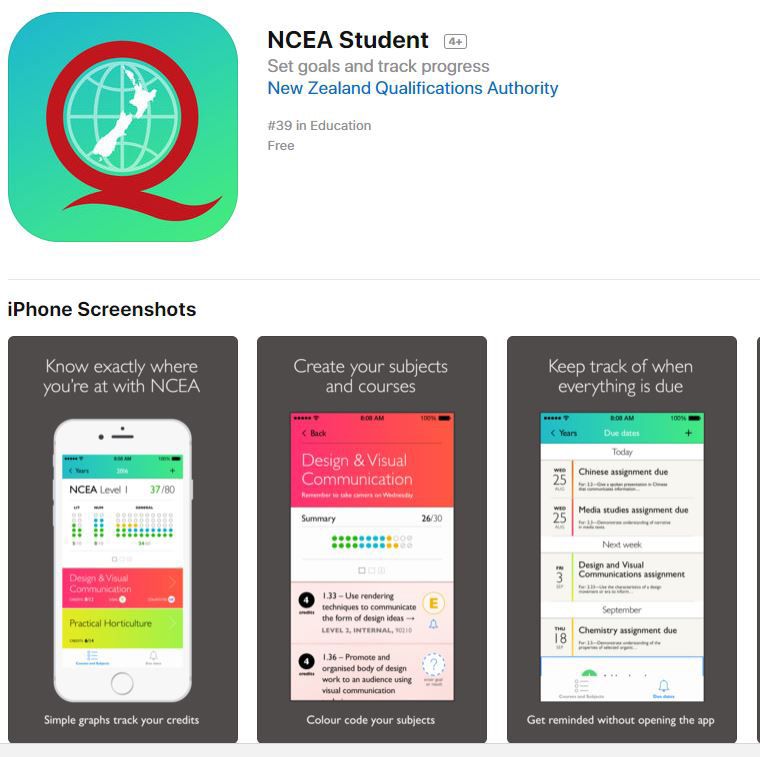
NZQA APP
NCEA Guide: Mobile App
To help students better understand NCEA,
NZQA has developed an app designed for
mobile devices - phones and tablets.
Called NCEA Student, the app is for
students and provides quick and easy
access to key information about NCEA and
helps students keep track of their progress
towards qualifications.
11
PAGE
Mount Maunganui College Assessment Information Booklet 2020The staff you should be aware of in the Guidance Network is:
Ms D Shepherd
Year 11 Dean..........................Extension 810
Mr H Lacey
Year 12 Dean..........................Extension 812
Mrs J Harray
Year 13 Dean..........................Extension 811
Mrs C Wilson
Guidance Counsellor
Monday, Tuesday, Thursday, Friday......................... Extension 814
Mr R Wigelsworth
Guidance Counsellor
Wednesday...................................................................... Extension 814
Monday, Tuesday, Thursday, Friday ........................ Extension 878
Mrs K Taylor
Guidance Counsellor
Wednesday, Thursday, Friday ................................... Extension 815
Mrs J Doherty
Careers Co-ordinator ..........Extension 817
Mr R Clark
Attendance Officer ..............Extension 808
12
PAGE
Mount Maunganui College Assessment Information Booklet 2020You can also read


