TEACHERS PACK V1 JULY 2020 - A NEW CAREER-FOCUSSED ALTERNATIVE TO A LEVELS
←
→
Page content transcription
If your browser does not render page correctly, please read the page content below

Page 1
TEACHERS PACK V1
JULY 2020

 A NEW CAREER-FOCUSSED ALTERNATIVE TO A LEVELS

Page 2

PURPOSE OF THIS PACK
This pack has been created to provide information on T Levels - a new
employer-designed, technical alternative to A Levels comprising 80%
classroom study and 20% on a meaningful industry placement.

This pack is for teachers and careers staff, equipping them with
the information needed to understand the new courses and be able to
engage with parents and pupils about T Levels.

An accompanying presentation and script have been created for
teachers and careers staff to use when delivering presentations about
T Levels, visit: www.amazingapprenticeships.com/TLevels

Contents

1)    Introduction to T Levels			                                       03
2)    Why T Levels?								                                             04
3)    Which kind of students might want to do T Levels?		               05
4)    Key facts about T Levels 			                                      06
5)    Structure of a T Level		                                          08
6)    Industry placement				                                            10
7)    Testimonials				                                                  11
8)    How do T Levels compare with other post-16 options 		             13
9)    Phasing of T Levels & possible destination roles & careers        14
10)   Frequently Asked Questions					                                   16
11)   Useful resources and links					                                   18

Further information:

      T Level website plus how to find your nearest T Level provider,
      visit www.tlevels.gov.uk
      For information on the introduction of T Levels on gov.uk, visit
      www.gov.uk/dfe/t-levels
      For course content and consultations, visit The Institute
      for Apprenticeships and Technical Education:
      https://www.instituteforapprenticeships.org/t-levels
      For T Level resources for teachers, visit
      www.amazingapprenticeships.com/TLevels

Contact us
If you require further information or guidance on T Levels, please
contact us (we aim to answer all enquiries within 5 working days)
RoutesReadiness.TE@education.gov.uk
Page 3

INTRODUCTION TO T LEVELS
WHAT ARE T LEVELS?                   WHEN WILL T LEVELS COMMENCE?
T Levels are a brand-new             These are part of long-term
qualification choice that will       government reforms to technical
follow GCSEs and give students       education, and plans are already
a head start towards the career      in place for the phased rollout of
they want. They will suit students   T Levels, starting in September
who wish to start working towards    2020 and continuing over following
a skilled occupation, prefer a       years.
practical approach to learning and
want a predominantly classroom-
based course.

Drawing on features of the world’s
best technical education systems,
these 2-year courses have been
designed in partnership with
employers to ensure students
gain the knowledge, skills and
experience businesses need so they
are ready to get good jobs when
they qualify.

    Drawing on features of the
    world’s best technical
    education systems

WHAT DO T LEVELS INCLUDE?
T Levels combine classroom
learning, practical skills
development and a substantial
industry placement and will
support progression into skilled
employment, an apprenticeship or
into further related study. Each
T Level begins with core theory,
concepts and skills relating to
an industry area and students will
then be able to choose one or more
occupational specialism(s).
Page 4

WHY T LEVELS?
WHY DO WE NEED T LEVELS?              POST-16 QUALIFICATIONS REVIEW
A key priority for the government     Alongside T Levels, the government
is to deliver world-class             is reviewing qualifications at
technical education to help           Level 3 and below to ensure that
address the skills gap and boost      every single qualification approved
economic productivity. Developing     for public funding is high
a skilled home-grown workforce        quality, has a clear purpose, and
is more important than ever and       supports progression to positive
T Levels will play a key role in      outcomes. This review, alongside
this.                                 the development of T Levels, is
                                      central to building a world-class
There is currently a large array      technical education system.
of technical and vocational
qualifications available which can    We want as many young people as
be confusing for students and         possible to benefit from T Levels,
employers. Reforms to technical       just as many thousands on the
education aim to streamline           academic route already benefit
the qualifications available,         from our world class, rigorous
simplifying the landscape for         and internationally respected A
students, teachers and employers.     Levels. This is why we propose to
                                      remove funding for qualifications
T Levels aim to raise the prestige    that overlap with T Levels and A
of technical education, which has     Levels in order to ensure clarity
often been seen as second best to     for students and employers.
the academic option. Designed by
employers and with longer teaching    The first stage consultation set
hours and a substantial industry      out our principles for change.
placement, these high-quality         The second, due for publication
qualifications will ensure students   later in 2020, will set out more
have the skills and knowledge         detail about the future range of
businesses are looking for.           qualifications we expect to fund
                                      alongside A levels and T Levels.

    Every single qualification
    approved for public funding
    is high quality, has a
    clear purpose, and supports
    progression
Page 5

WHICH KIND OF STUDENTS MIGHT
WANT TO DO T LEVELS?
A differentiating factor of T
Levels is the combination of both
classroom learning and development
and practical application of
occupationally-specific skills.
As such, a T Level would suit a
student who wants to enter skilled
employment at the end of their
course.

Although T Levels are primarily
designed for entry into skilled
employment, they will also allow
progression to an apprenticeship
or to further study / higher
education in a related area. This
is different to the academic
route, where qualifications tend
to be more knowledge-based and
the purpose is typically entry to
higher education.

Students should normally have a
clear idea about which industry
they want to get into, and an idea
of the type of job role they’d
like to explore.

Page 6

KEY FACTS ABOUT T LEVELS
1. CAREER-LED                        7. WIDE RANGE OF EMPLOYERS
Brand-new, two-year technical        Around 300 employers have
courses to follow GCSEs, designed    been involved in developing
to get students work ready.          T Levels, ranging from small
                                     local businesses to large
2. 80% STUDY / 20% WORK              multinationals.
Spend 80% of time in the
classroom, learning the theory and   8. WHERE THEY TAKE PLACE
practical skills, the other 20% on   The classroom learning time will
an industry placement putting this   take place at a school, college
into action (minimum of 315 hours    or with a training provider.
on placement).                       Depending on the T Level, this is
                                     likely to include development of
3. DESIGNED BY AND FOR EMPLOYERS     practical skills in specialist
Designed by employers to ensure      facilities. The industry placement
students are learning the skills     will take place directly with an
industry is looking for.             employer.
4. EQUIVALENT TO 3 A LEVELS          9. AVAILABLE AROUND THE COUNTRY
Nationally recognised certificate,   T Levels are available in England.
with the top T Level grade           The rollout starts with a small
(Distinction*) will be equivalent    number of providers, increasing
to 3 A Levels at A*.                 over the next few years.
5. UCAS POINTS                       There are three courses on
A T Level attracts UCAS tariff       offer from September 2020 in
points so students can use the       Digital Production, Design
qualification in applying for        and Development; Education and
higher education.                    Childcare; and Design, Surveying
                                     and Planning for Construction.
6. GCSE MATHS AND ENGLISH            Find out more on page 14-15.
If not already achieved, then
students would need to achieve       10. MORE COURSES COMING
GCSE or Functional Skills maths      There will be seven more T Levels
and English.                         from September 2021. Over the
                                     following years, more courses will
                                     be introduced and it’s expected
                                     that all T Levels will
                                     be available from 2023. Find the
                                     full list on page 14-15.
Page 8

STRUCTURE OF A T LEVEL
To be awarded a T Level, students will need to complete the following
three elements:

1) Technical qualification, which includes:
     a.   core theory, concepts and skills for that industry/sector
     b.   specialist skills and knowledge for an occupation

2) Industry placement with employer

3) Minimum standard in English and maths (Level 2 Functional Skills or
   GCSEs if not yet achieved) and digital skills if required.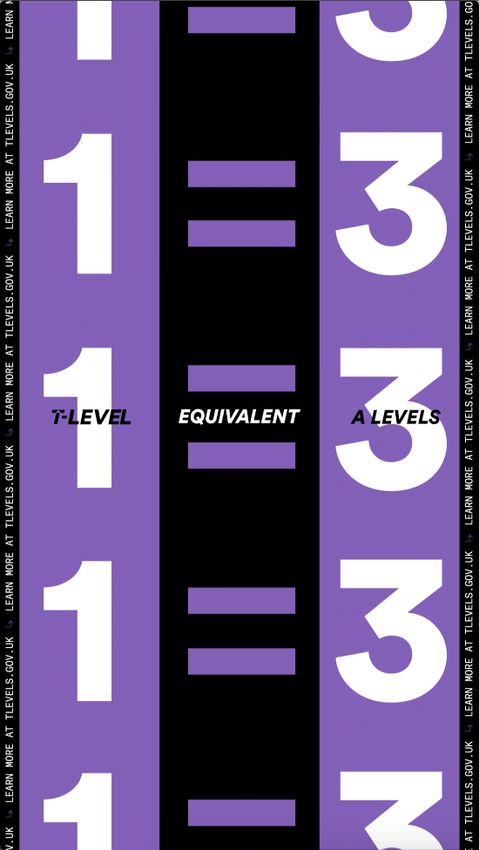
Page 9

STRUCTURE OF A T LEVEL
T Level certificates, awarded
on successful completion of
the course will be nationally
recognised and include:

    The overall grade for the
    T Level – Distinction* to Pass
    Separate grade for the core
    component – A* to E
    Separate grades for each
    occupational specialism –
    Distinction, Merit or Pass.

It will also confirm that the
student has:

    Achieved the minimum standards
    for English and maths
    Completed an industry
    placement
    Met any additional mandatory
    requirements, if applicable.

Students who do not pass all
elements will get a T Level
statement of achievement which
will show the elements they have
completed.
Page 10
INDUSTRY PLACEMENT
A unique part of a T Level is the WHAT TO EXPECT
time students spend on an industry Thousands of T Level-style
placement (minimum of 315 hours/ industry placements have taken
around 45 days) or around 20% of place in readiness for the rollout
their course. This gives students of T Levels and the feedback from
an invaluable opportunity to put both employers and students has
their new knowledge and skills been positive.
into practice and understand the
world of work. Students benefit by having the
opportunity to:
Placements differ from traditional
work experience as they are Put their studies into
significantly longer and students context and practice their
are expected to complete developing skills in a real
meaningful work for the employer. work environment
Understand the world of
Individual employers and training
work and start networking
providers agree how the placement
with potential future
will work – whether as a block of
employers
time, a series of day releases or
a combination of both. Gain real experience to put
on their CV and talk about
Students are not typically paid at interview
for their placement. However, the Check that this is career
provider may be able to support they want to pursue
some of the costs of placement.
Employers benefit by:
Spotting talented young
people that they might want
to recruit
Bringing in new skills and
extra resource for projects
Upskilling existing staff
through coaching and
mentoring
Creating a diverse workforce
and supporting their
communityPage 11 TESTIMONIALS TRAINING PROVIDERS AND COLLEGES “This really is going to be the new gold standard qualification for people entering employment... The T Level is perfectly designed to help you hit the ground running when you start work.” Matt Reynolds, Vice Principal, Cirencester College EMPLOYERS “There is a huge shortage of talented young people entering technical careers, and Fujitsu has felt the effects of this. The lack of fresh talent entering the sector makes it increasingly difficult to secure enthusiastic new employees to fill the necessary talent pipeline. The introduction of T Levels will help alleviate this problem by enabling more students to enter the industry with the skills needed to succeed.” Tim Chapman, Lead for the Cyber Security Architecture and Design, Fujitsu “With the ongoing skills shortages in both the construction trades and professions, industry placements give us a chance to see and work with young people as a shortcut in the recruitment process. Having spent nearly three months working with us, they are already part of the team and understand the company and how we work.” Bruce Boughton, Lovell Partnerships “T Levels place an emphasis on hands on experience, which is why I was so keen to get involved in their development and help raise awareness of all they have to offer. When I’m hiring staff, I look for people who can hit the ground running and T Levels will give young people the skills they need to do just that.” Lee Stafford, Celebrity Hair Stylist
Page 12

TESTIMONIALS

STUDENTS
“It has changed me as a
person, it really has. I was
really scared about leaving
college. I didn’t know how it
was going to work out or how
I was going to get a job. Now
I’m passionate and excited
about my future. This has been
massive for me.”
Kiran, Walsall College

“The theory is really good,
but being able to see things
in person makes it more real
and it’s helped when I’m back
in the classroom. It’s also
helped with my assignments as
I can use things I’ve done on
placement as examples.”
Tom, Bolton College

       You can watch video interviews with industry placement
       students here.
Page 13
HOW DO T LEVELS COMPARE
WITH OTHER POST 16 OPTIONS?
The Department for
Education has developed
a grid and animated film
comparing the different
options available to
young people after
GCSEs.
This can be accessed
on the Careers and
Enterprise Company
website. These resources
have been developed for
students and teachers.
You can watch the animated film comparing different
options here.Page 14
PHASING OF T LEVELS & POSSIBLE
DESTINATION ROLES & CAREERS
STARTING SEPT 2020
Digital production, design and development (software
development technician, junior games designer)
Design, surveying and planning for construction (civil
engineering technician, digital engineering technician,
construction site engineering technician)
Education & childcare (early years educator, teaching
assistant, learning mentor)
STARTING SEPT 2021
Building services engineering for construction (installation
electrician, maintenance electrician, plumbing & domestic
heating technician)
Digital business services (digital applications operator,
IT solutions technician, digital marketer)
Digital support and services (IT support, infrastructure
technician)
Health (dental nurse, senior healthcare support worker,
theatre support)
Healthcare science (dental laboratory assistant, healthcare
science assistant, pharmacy services assistant)
Onsite construction (advanced site carpenter, advanced site
joiner, construction assembly and installation operative)
Science (laboratory technician, food technologist)Page 15
PHASING OF T LEVELS & POSSIBLE
DESTINATION ROLES & CAREERS
STARTING SEPTEMBER 2022
Accounting (assistant accountant, payroll administrator)
Design and development for engineering and manufacturing
(engineering/project technician)
Finance (financial services administrator, mortgage adviser,
investment operations technician)
Maintenance, installation and repair for engineering and
manufacturing (engineering technician, motor vehicle
technician)
Management and administration (business administrator, bid
coordinator, business improvement technician)
Engineering, manufacturing, processing and control
(manufacturing technician, welder)
STARTING SEPTEMBER 2023
Agriculture, land management and production (crop/fishery
technician)
Animal care and management (veterinary nurse, animal care
assistant)
Catering (chef de partie, senior production chef)
Craft and design (design technician, graphic designer, model
maker)
Hair, beauty and aesthetics (senior hair/beauty professional)
Human resources (HR support, recruitment consultant)
Legal (paralegal)
Media, broadcast and production (junior journalist, editorial
assistant)Page 16 FREQUENTLY ASKED QUESTIONS 1) What does ‘technical’ training mean? ‘Technical’ education encompasses any training that focuses on progression into skilled employment and requires the acquisition of both a substantial body of knowledge and a set of practical skills valued by industry. Technical education does not need to be linked to technical studies, science or digital, as is commonly believed. It can include social sciences, arts, humanities or any other sector. 2) What are the entry requirements? These are set by the college, school or other learning provider and will vary across courses. 3) How do students apply? Students need to apply directly to the provider. The T Level website www.tlevels.gov.uk has links to all providers offering T Levels starting in September 2020 and 2021. The website will be updated as more T Levels are rolled out. 4) Can an A level be studied at the same time as a T Level? We would be supportive of high attaining students who want to take an A level alongside their T Level. However, since T Levels involve more teaching time than most existing technical courses, the T Level provider will need to consider the impact on the student’s timetable.
Page 17

FREQUENTLY ASKED
QUESTIONS
5) Do students get paid for the industry placement?
   T Level industry placements are about providing students with
   high quality, meaningful training, not work. Employers are under
   no obligation to pay students but may choose to do so if
   they wish.

6) What’s different between
   a T Level and an apprenticeship?
   Apprenticeships are paid work,
   suitable for students who know
   what occupation they want
   to pursue and wish to train
   ‘on the job’ (80% in the
   workplace, 20% off the job).

  T Levels are largely classroom
  based, with a substantive
  industry placement (80% in the
  classroom, 20% in the workplace)

  T Levels will offer a broader course content but students will
  also specialise in a particular occupation. Apprenticeships
  content is narrower and focussed on a specific occupation from the
  outset.

7) Can students choose the employer for the work placement?
   The T Level provider is responsible for sourcing the industry
   placement – however in some cases the provider may encourage
   students to research and self-source their preferred employers
   for their placements. Providers should help students to identify
   suitable employers that are relevant to their chosen specialism at
   the appropriate level

8) Will T Levels be suitable for students with special educational
   needs or disabilities?
   We want as many students as possible to benefit from T Levels and
   there are flexibilities around the English and maths requirement
   and the industry placement to help students with SEND take part.
   For example students with SEND may be able to use providers’
   onsite facilities for the placement if appropriate.
Page 18

USEFUL RESOURCES
AND LINKS
Please find a list of useful resources and links below.

     Powerpoint presentation
     This Powerpoint presentation is designed to be used by teachers
     and careers professionals to inspire students, colleagues and
     parents about the benefits of T Levels and contains slides and a
     basic script.
     Visit: www.amazingapprenticeships.com/TLevels

     T Level Explainer recordings
     Useful 30 minute recordings covering different course areas,
     including Early Years, Digital and Construction.
     Visit: www.amazingapprenticeships.com/TLevels

     T Level video case studies - DfE YouTube channel
     Helpful video case studies giving insight into placements from
     both the student’s and employer’s point of view.
     Visit: https://tinyurl.com/Y9BQEUQS

     T Level website
     Official information on T Levels, plus how to find your nearest
     T Level provider.
     Visit www.tlevels.gov.uk
You can also read


