A BRIEF INTRODUCTION OF AFRICA UNION'S HEADS OF STATE DECION ON ORGANIC AGRICULTURE AND UPDATES ON ITS IMPLEMENTATION - Agroecology Conference
←
→
Page content transcription
If your browser does not render page correctly, please read the page content below
A BRIEF INTRODUCTION OF AFRICA UNION’S
HEADS OF STATE DECION ON ORGANIC
AGRICULTURE AND UPDATES ON ITS
IMPLEMENTATION
Presented to the 1ST INTERNATIONAL CONFERENCE ON
AGROECOLOGY TRANSFORMING AGRICULTURE & FOOD
SYSTEMS IN AFRICA AT SAFARI PARK HOTEL, NAIROBI
(JUNE 18, 2019)
Presented by:    By Zachary Makanya,
                 Country Coordinator, PELUM- Kenya
NB: PELUM Kenya hosts the Regional (EA) Secretariat of the
AU-EOAI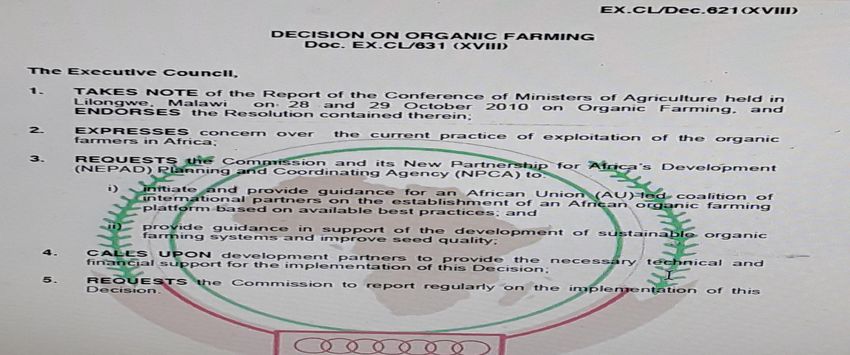
THE KEY ELEMENTS OF THIS PRESENTATION
    1. The Decision by the AU Heads of state on
         Organic Agriculture.
    2.   The efforts to implement the decision
    3.   The AU-EOAI Framework & Foot Prints
    4.   The Current Status of AU-EOAI
    5.   The Key Achievements of AU-EOAI
    6.   AU-EOAI in Action
    7.   Key Challenges in the implementation of AU-
         EOAI
    8.   AU-EOAI Contacts
    9.   Acknowledgement and special thanks

2
THE AU HEADS OF STATE DECISION ON ORGANIC
    AGRICULTURE
             ❖ AU-EOAI      is an initiative to
               implement the decision adopted
               in January 2011 ( EX. Cl / Dec.621
               (xvii) by the African Union Heads
               of States and Governments
               addressing challenges facing the
               farmers in agriculture.

3
THE AU HEADS OF STATE DECISION ON ORGANIC AGRICULTURE

4
IMPLEMENTATING THE AU HEADS OF STATE DECISION
The first meeting was held in May 2011 at SACDEP
Kenya Centre, in Thika
Organized by PELUM Kenya (Mr. Zachary
Makanya) in collaboration with other key
stakeholders.
Key stakeholders include: Africa Union
Representative (Dr Sarah Olembo), BvAT (Dr
Amudavi), ISD (Dr Sue Edwards), SACDEP
Kenya (Mr Ngugi Mutura), NOGAMU (Mr Musa
Muwanga). KOAN (Eustace Kiarie), TOAM
(Jordan Galma), UGO Cert (Prof. Charles
Ssekyewa) among others.
The meeting was supported by SSNC and
5
AUC
The Key Concepts of the Ecological Organic Agriculture
EOA is a production management system that considers the agro-
ecosystem in all its diversity, focusing on biological diversity, healthy
use of soils, air and water and relying on renewable resources in locally
organized agricultural systems.
EOA combines modern science, innovative practices and traditional
knowledge.
Examples of farming practices in EOA include Organic Farming,
Sustainable Ecological Agriculture, Bio-intensive agriculture,
Permaculture, Ecological farming, biodynamic agriculture, and
agroecology.
EOA is more accessible for resource-limited rural people and has
therefore a high potential for improving the livelihoods of a large group
of rural poor and particularly women.
6
3. EOAI’S FRAMEWORK AND FOOD PRINTS
                        3.2 MISSION
                       To scale up ecologically        3.3 GOAL
    3.1 VISION
                       and organically sound
Resilient and                                        To mainstream Ecological Organic
                       strategies and practices
vibrant Ecological                                   Agriculture into national agricultural
                       through institutional
Organic Agricultural                                 production systems by 2025 in
                       capacity development,
systems for                                          order to improve agricultural
                       scientific innovations,
enhanced food and                                    productivity, food security, access
                       market participation,
nutrient security,                                   to markets and sustainable
                       public policies and
and sustainable                                      development in Africa.
                       programs, outreach and
development in         communication, efficient
Africa.                coordination, networking
                       and partnerships in Africa.

7
3.4 EOAI’S CORE VALUES.
    The EOA initiative values are grounded in the reality of
    sustainable agricultural practices:

    1.   Biodiversity, respect for nature and sustainable
         development

    2.   Promote family farming cultures, indigenous
         knowledge, cultural practices and wisdom

    3.   Embrace fairness and justice to the ecosystem

    4.   Promote safe, nutritious and healthy food

8
3.5 EOAI STRATEGIC OBJECTIVES
1. To increase documentation of information and knowledge on organic agricultural
   products along the complete value chain and support relevant actors to translate
   it into practices and wide application.
2. To systematically inform producers about the EOA approaches and good
   practices and motivate their uptake through strengthening access to advisory
   and support services.
3. To substantially increase the share of quality organic products at the local,
   national and regional markets.
4. Strengthen inclusive stakeholder engagement in organic commodities value
   chain development by developing national, regional and continental multi-
   stakeholder platforms to advocate for changes in public policy, plans and
   practices

9
3.6 THE KEY PILLARS FOR
     IMPLEMENTING AU-EOAI

     1.   Research, Training and Extension
     2.   Information and Communication
     3.   Value Chain and Market Development
     4.   Networking and Partnerships
     5.   Policy and Programme Development
     6.   Institutional Capacity Development

10
3.7 INSTITUTIONAL FRAMEWORK FOR ROLLING OUT
AU-EOAI
3.7 (A) NATIONAL PLATFORMS
• Country-based platform with multi-stakeholder representations
from across the country (CSOs, Government, Private Institutions,
Academia, research etc.)
• Has a National Steering Committee, with a Chair from the
Relevant Ministry e.g. a senior officer from Ministry of
Agriculture
• May also start with the Chair from the Civil Society
Organizations.
113.7 (B). Regional Platforms • Multi-stakeholder representations from the region (CSOs, RECs, Private Institutions, Academia etc.). • Currently in Eastern and Western African clusters. Southern Africa cluster is on course • Currently has two Regional Steering Committees (RSC) with a chair from the REC (ECOWAS) and a Co-Chair from one of the CSO partners. • Has three Regional Secretariats with a coordinator hosted by one of the partners in the cluster. 1. Eastern Africa – hosted by PELUM Kenya 2. Western Africa – hosted by 3. Southern Africa – hosted by 3.7 (C). Continental Platform • Consists of multi-stakeholder representations. • Has a Continental Steering Committee (CSC) which is Chaired by Africa Union Commission • Has a continental Secretariat with a Continental Coordinator based at Biovision Africa Trust (BvAT) in Kenya 12
3.8 Why the Focus on Multi-stakeholders-layered Platforms.

1. Create coherence and synergy for sharing experiences, lessons and best
    practices
2. Improve communication, knowledge transfer and know-how among and
    between various stakeholders
3. Develop and spread new technologies and promote commercial
    collaborations
4. Popularize the initiative and reach varied and new stakeholders and
    organic markets
5. Find partners to optimize comparative advantages and undertake joint
    research and development activities
6. Facilitate identification of policy gaps, capacity gaps, emerging
    opportunities and contribute to appropriate programme design and
    development of policies that favor small holder farmers.
7. Amplify benefits from organic investments, the economic and
 13 environmental opportunities for small holders farmers.
Mainstreaming Ecological Organic Agriculture Initiative in Africa
AfroN et RECs
Civil Society Continental EOA Steering Committee – Farmers ’
Private Sector Chaired by the Africa Union Organis ations
Commission Res earch N etworks
Development
Partners Certification bodies
EOA Se cre tariat
Regional EOA SC
P ro je ct Imp l e me n ti n g
Organ i zati o n s
C LO i n o th e r
co u n tri e s
Centres of National EOA Platform
Excellence Public Sector Civil Society Private Enterpris es
(R e se arch , Train in g, Country Le ad
Exte n sio n , In fo rmatio n G overnment Farmer Organiz ations
& C o mmu n icatio n , Res earch & Training
Organisation
Valu e C h ain s & M arke t
Advis ory Services
Cons umers
14 De ve lo p me n t3.9 The EOAI Delivery Approaches 1. Needs assessment, baselines surveys, mid-term and end of programme evaluations 2. Organization capacity assessment (OCA) 3. Strengthening the capacity of the EOAI implementing partners. 4. Promoting partnership and networking 5. Designing of bottom-heavy programmes: where most resources target farmers and extension and marketing 6. Promoting learning via exchange & exposure visits 15
4. THE CURRENT STATUS ON THE AU-EOAI
4.1 Participating Countries :
1. Eastern Africa: Kenya, Uganda (SSNC)
2. Eastern Africa: Kenya, Uganda: Tanzania, Rwanda & Ethiopia (SDC)
3. West Africa: Nigeria, Senegal, Benin and Mali (SDC)
4.2 Financial Support:
• SDC’s Global Programme for Food Security (GPFS) committed up to 2019
    and a new face July 2019 – December 2022.
• SSNC-SIDA support (committed up to December 2020)
• AUC – support to trainings in Organic Standards and Certification Systems
    and marketing and the CSC operations.
4.3 Lead Coordinating Organizations:
• Biovision Africa Trust (SDC Contribution), also hosts the EOAI Continental
    Secretariat and Coordinator
• PELUM Kenya SSNC / SIDA Contribution) also hosts the EOAI Regional
 16 (Eastern Africa) Secretariat and Coordinator
4.4 Coverage in Africa & Strategic partners
COUNTRY LEAD ORGANIZATION (CLOS)
1. Kenya – Kenya Organic Agriculture Network (KOAN)
2. Senegal – National Federation For Organic Agriculture
(FENAB)
3. Mali - Association des Organisations Professionnelles
Paysannes (AOPP)
4. Benin - Béninoise pour la Promotion de l'Agriculture
Biologique (OBEPAB)
5. Nigeria – Association of Organic Agriculture Practitioners
of Nigeria (NOAN)
6. Ethiopia – Institute for Sustainable Development (ISD)
7. Uganda – National Organic Agriculture Movement of
Uganda (NOGAMU)
8. Tanzania – Tanzania Organic Agriculture Movement
(TOAM)
9. Rwanda (Rwanda Organic Agriculture Movement (ROAM)
17
Overall, over 32 partners are involved5. KEY ACHIEVEMENTS
5.1 Institutional Achievements
5.1.1. National Level
o All the participating countries have established National Platforms, National
Steering Committees and the National Secretariats
5.1.2 Regional Level
o 2 functional Regional Platforms ( West and Eastern Africa ), Has two
functional Regional Steering Committees served by active Regional
Secretariats
5.1.3 Continental Level
- Consists of a continental Platform with multi-stakeholders
- Has a Continental Steering Committee, Chaired by Africa Union Commission
18
(AUC)5.2 Some Achievements of Mainstreaming EOA in Standards and
Certification
Country PGS & ICS Processes
Benin • 10 facilitators undertaken through ICS & PGS
• 3 organic producers associations trained in ICS & PGS
Ethiopia • 78 producers sensitized on PGS and 50 vegetable farmers
undergoing PGS process.
Kenya • 15 PGS certification
Mali • No report yet
Nigeria • Fifty-six (56) trained in Participatory Guarantee System
procedure of Certification.
• Nigeria 47 local inspectors
Uganda • 11 Local Inspectors trained in PGS
• PGS Assessed for Organic Agriculture production
• 226 farmers trained in ICS
Senegal • No report yet
19
Tanzania • 42 PGS have been developed 12 bear active licenses under the5.3 Some Key Achievements of Mainstreaming EOA into National Policies All the 8 EOA-I participating countries s have achieved various levels of mainstreaming EOA into programmes, plans or policies. For example: o Kenya has the 5th draft (2017) undergoing review in the Ministry of Agriculture before submission to the Cabinet. o Nigeria is on its 3rd draft of Organic Agriculture Act of 2017 o Tanzania, organic agriculture is highlighted in the National Agriculture Policy of 2013. o Uganda, the Ministry of Finance has issued the Certificate of Financial Implication (CFI) for the draft National Organic Agriculture Policy (NOAP) on its role on supporting organic agriculture. o Benin, the Innovation for Sustainable Agricultural Growth (2017) plan promotes use of organic herbicides and fertilizers in the rice and soya value chains. o Senegal, National Agricultural Investment Program for Food Security and 20
KEY HIGHLIGHTS IN NUMBERS – Part 1
                                                              500+ policy
                                                                makers
                                         1700+ farmers         reached &
                                      facilitated to trade   facilitated to
                                        fairs, exchange      policy events
                                      visits, workshops,
                                       conferences etc.
                                                                                500 000+
                                                                              Stakeholder
                        140,000                                                s reached
                        + Social                                                  with
                                                                              information
                         media                                                 materials

             21 000+                                                            2,100 +
             farmers                                                           through
            linked to                                                          Curricula
             markets

                  100 000+ farmers                                                Organic
                      trained in
                  ecological/organi                                              champions
                    c agriculture
                      practices

21
KEY HIGHLIGHTS IN NUMBERS –
Part 11
Establishment of two fully
Establishment of functional continental secretariat
a fully functional (Two Regional Coordinators one
for eastern and the other for
continental western Region)
secretariat
Published a
directory of key
actors in organic
agriculture in Support for Agro-ecology
Eastern Africa research in Master and
PhD levels
Documentation Improved livelihoods security
of 20 success by 20 % of farmers being
cases in Agro- reached by the on-going
ecology programme
Increased organic Supported of Training of 40
market outlets in youth through ITCOA: a
supermarket, key programme organized by
strategic areas Makerere University
22Some of the Africans Organic Champions
Dr Mwatima
Juma
Mr Ngugi Mutura
23 Mr John Njoroge6. EOAI in Action 24
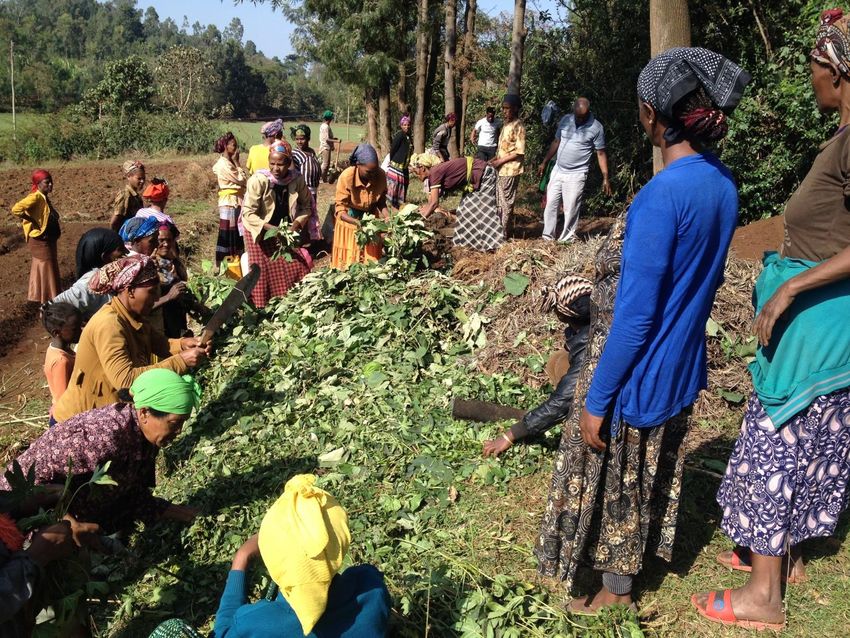
Making of composts in Ethiopia

25
26
27
28
29
EOAI Warriors engaging the stakeholders in the Media Launch of the this
Conference in Nairobi on Thursday, June 13, 2019

30
7. THE KEY CHALLENGES FACING AU-EOAI
1. EOA is implemented in many countries but there is poor
    coordination of efforts and reporting on its implementation.
2. Inadequate documentation of success cases of EOA in the
    continent.
3. Limited funds & resources to roll out / implement AU-EOAI in
    54 countries.

4. Inadequate awareness of the AU – EOAI at the REC and the
   member State Level hence low involvement

5. Limited research on the link between the Ecological Organic
   Agriculture with human health.
31
8. THE FUTURE PLANS 1. Map out all the actors implementing EOA in all countries and strengthen the coordination of the efforts by stakeholders. 2. All the RECs are integral part EOAI and implementing it 3. All the 55 state members implementing the EOAI. 4. EOA favoring policies in place and operating cascading from the County, National, REC and Continental level 5. Over 70 % small holder farmers and especially the women and the youth benefiting from organic food and products. 6. Over 70% of the Africa population are benefiting from safe, healthy and nutritious food. 7. There is a strong research in support of EOAI offering the solutions to support the small holder organic farming in Africa. 8. Strong institutions like AFRONET, NOAMs, NOARA and Agro-ecological Networks working in harmony with other key 32
9. AU - EOAI Contacts in Africa
Dr. Simplice Nouala Fonkou, The Chair, AU-EOAI
Email: Noualas@africa-union.org;

Alex Mutungi, the Continental Coordinator,
Email: amutungi@biovisionafrica.org;

Prof Charles Ssekyewa, Chair, Regional (EA) Steering Committee
Email: cssekyewa@gmail.com;

Ms. Manei Naanyu, Coordinator, Regional (EA) Secretariat
manei@pelum.net;

Mr. Ernest Aubee Chair, Regional (Western Africa) Steering Committee
Email: dsvodouhe@yahoo.com;
Mr. Nafiu Olore , Coordinator, Regional (Western) Secretariat
Email: oloorenafiu@gmail.com

Lead Executing Agencies:
Dr David Amudavi, Executive Director, Biovision Africa Trust
Email: damudavi@biovisionafricatrust.org;
Mr Zachary Makanya, Country Coordinator, PELUM Kenya
Email:
 33    makanya@pelum.net;
10. ACKNOWLEDGEMENT AND APPRECIATION
We need to applaud the following for their gallant efforts to support in the growth and
implementation of AU - EOA Initiative so far:

•   African Union Commission for offering institutional support for the implementation of EOAI

•   The African Union Member States and Governments for providing a conducive environment to operate and
    expand EOAI.

•   The RECS (EAC, ECOWAS) for their support.

•   The SSNC, SDC & Biovision Foundation for gallantly supporting the AU-EOAI from its nascent stages

•   The Lead Coordinating Organizations (LCOs) Biovision Africa Trust (BvAT) and PELUM Kenya for their
    coordination of SDC and SSNC support respectively.

•   AFRONET and National Organic Movements (NOAMs)

•   IFOAM International and UNCTD, for always accompanying and supporting.

•   The Chairs of the Regional EOAI Steering Committees

• 34 The Coordinators for the Continental Secretariat and the Coordinators for the Regional Secretariat (for the
THREE PARTING SHOTS
“Do not go where there is a well-trodden path or a road to follow; it is very
easy to do this! Instead, go to where there are no paths or roads and
leave a trail of footprints for others to follow.” By Harold R. McaAlindon
If you find yourself in a hole – stop digging and come out of the hole. We
have challenges / issues around pests and diseases, GMOs, climate
change etc. Let us stop digging and let us truly embrace Agro-ecology.
If you are here as an individual or organization or a funding partner, what
are you supporting? Why are you not supporting EOAI? In EOAI, we are
implementing the AU heads of decision to support organic agriculture.
Please join the bandwagon of EOAI, Support EOAI
,
3510 SPECIAL
APPRECITION FOR THE
SUPPORT OF THIS
CONFERENCE
36You can also read


