A Common Goal: Primary Care and Psychiatry Improve Depression Detection and Outcomes
←
→
Page content transcription
If your browser does not render page correctly, please read the page content below
University of San Diego
Digital USD
Doctor of Nursing Practice Final Manuscripts                                                                            Theses and Dissertations

Spring 5-26-2018

A Common Goal: Primary Care and Psychiatry
Improve Depression Detection and Outcomes
Katherine Kilkenny
University of San Diego, kkilkenny@sandiego.edu

Follow this and additional works at: https://digital.sandiego.edu/dnp
     Part of the Psychiatric and Mental Health Nursing Commons

Digital USD Citation
Kilkenny, Katherine, "A Common Goal: Primary Care and Psychiatry Improve Depression Detection and Outcomes" (2018). Doctor
of Nursing Practice Final Manuscripts. 62.
https://digital.sandiego.edu/dnp/62

This Doctor of Nursing Practice Final Manuscript is brought to you for free and open access by the Theses and Dissertations at Digital USD. It has been
accepted for inclusion in Doctor of Nursing Practice Final Manuscripts by an authorized administrator of Digital USD. For more information, please
contact digital@sandiego.edu.
1

                  UNIVERSITY OF SAN DIEGO
            Hahn School of Nursing and Health Science:
              Beyster Institute for Nursing Research

          DOCTOR OF NURSING PRACTICE PORTFOLIO

                                by

                      Katherine M. Kilkenny

                   A portfolio presented to the

FACULTY OF THE HAHN SCHOOL OF NURSING AND HEALTH SCIENCE:
          BEYSTER INSTITUTE FOR NURSING RESEARCH
                  UNIVERSITY OF SAN DIEGO

                    In partial fulfillment of the
                   requirements for the degree

               DOCTOR OF NURSING PRACTICE
                        May 2018
2

                         TABLE OF CONTENTS

Acknowledgements…………………………………………………………                         3
Documentation of Mastery of DNP Program Outcomes…………..……….     4
Appendix
   A. Letter of support from clinical site…….…………………...…….….   28
   B. Poster Abstract……..………………………………………………..                  29
   C. GNSA Letter of acceptance…….. ..…..……………………...……..       30
   D. DNP Project Poster…………………………………………………..                  32
   E. Stakeholder Presentation…...………………………………………...           33
   F. Final Clinical Exemplars………………………..…………………...            41
   G. Official Protocol…….………………………...……………………..               57
3

                              ACKNOWLEDGEMENTS

       I owe a great many thanks to a great many people who supported and helped me

throughout the duration of this program.

       My deepest thanks to Dr. Michal Terry and Dr. Dee Cannon for their constant

support, invaluable guidance, and contributions throughout this program. You both

helped me to focus on what ultimately has been a hugely rewarding an enriching process.

       I would also like to express a huge amount of gratitude to my astoundingly

supportive friends. Without your life-long encouragement I would not have been able to

achieve any of this.

       Most importantly I want to thank my family. Mom, Dad, Marc, Rory, Sara,

Conor, Gabi, Mac, and Hampton nobody has been more important to me in the pursuit of

this doctorate degree than all of you. Your love and support provided unending

inspiration to make it where I am today.
4

DOCUMENTATION OF MASTERY OF DNP PROGRAM OUTCOMES

                  A Common Goal: Primary Care and Psychiatry

                    Improve Depression Detection and Outcomes

Author: Katherine M. Kilkenny RN, BSN

Author affiliations: University of San Diego, Hahn School of Nursing and Health

Science: Beyster Institute for Nursing Research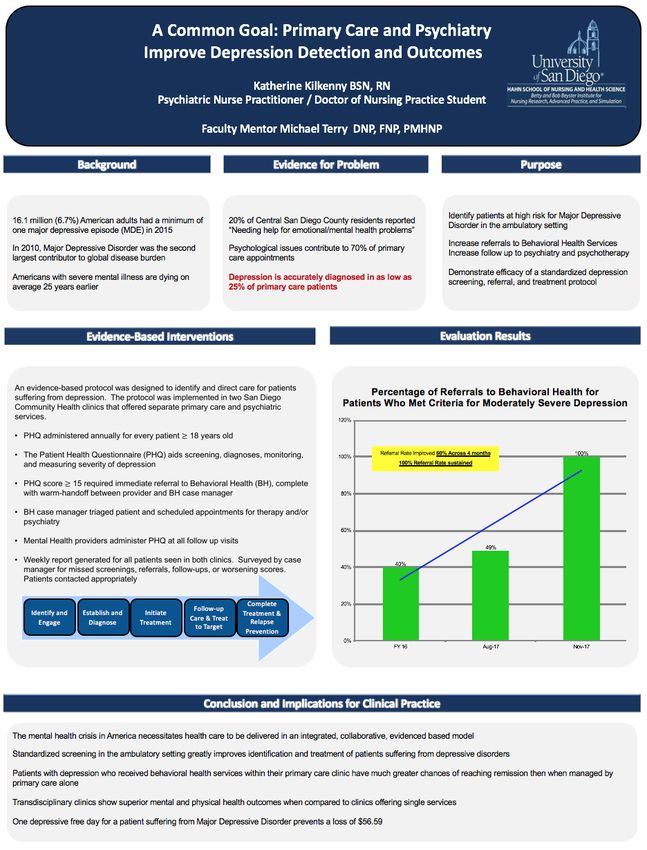
5

                                      ABSTRACT

Background: Major Depressive Disorder (MDD) affects over 15 million (6.7%) adult

Americans. While one in four primary care patients suffer from depressive symptoms,

MDD is accurately diagnosed as little as 25% of the time.

Purpose: Implementation of an evidence-based protocol outlining the process for

screening, behavioral health referral, and the role of a collaborative care team would

improve detection and treatment of adult MDD patients in the ambulatory setting.

Process: A systematic Patient Health Questionnaire (PHQ-9) based screening protocol

was implemented. Every new and existing patient completed the PHQ-9 during

scheduled primary care appointments. If a patient scored 15 or higher, indicating

moderate to severe risk, they were referred to behavioral health. The behavioral health

case manager then triaged the patient for their specific needs and scheduled appointments

to psychiatry and psychology as appropriate. If a patient was not progressing during

treatment the case was discussed during bi-weekly collaborative care team meetings and

the plan was adjusted.

Outcomes: The baseline PHQ-9 screening rate for all patients was 40% for Quarter 2 of

2017. After implementation of the protocol screening rates of new and existing patients

increased to 49% in one month’s time. After two months screening and referral rates

reached 100%. This rate was maintained for the five-month project duration.

Conclusion: Depression must be addressed in the primary care setting. Depression

screening is a safe and efficacious intervention to improve detection and guide treatment.

Addressing MDD in a collaborative care model is also a cost-effective and successful

approach to address one of the most detrimental diseases worldwide.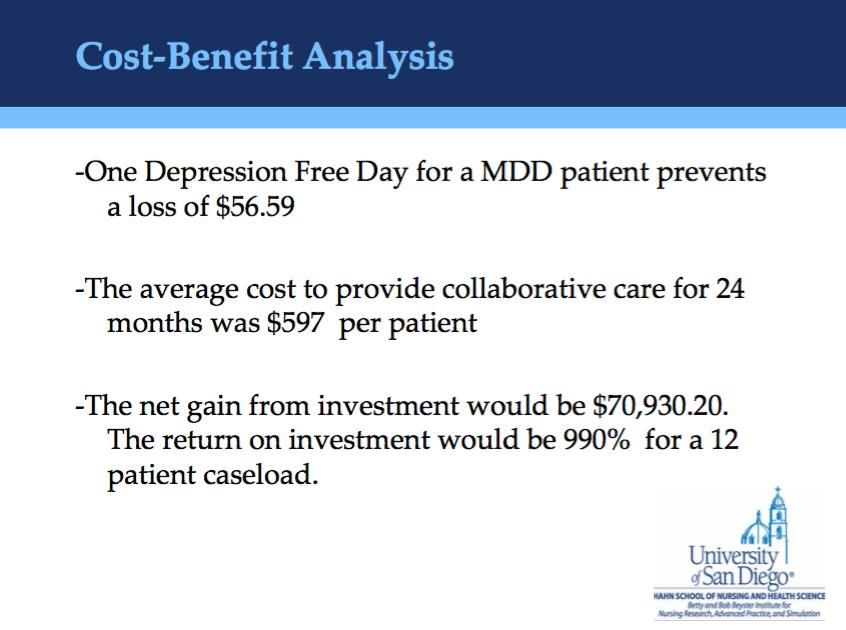
6

                                    INTRODUCTION

       Lack of access to mental health services is a worldwide health disparity. In 2010,

Major Depressive Disorder was the second largest contributor to global disease burden.

(Ferrari et al., 2013) In the United States mental health disorders are the leading cause of

disability and premature death. (Zaat, 2004) Americans with severe mental illness are

dying on average 25 years earlier. (Zaat, 2004)

       In regard to depression, 16.1 million (6.7%) American adults had a minimum of

one major depressive episode (MDE) in 2015. Over 10 million (4.3%) adults had severe

impairment because of it. (Ali, Dean, & Hedden, 2016) Major Depressive Disorder

(MDD) rates and impact increase in the low socioeconomic and minority populations.

(Jackson-Triche et al., 2000; Lee et al., 2016)

       Many patients are trying to seek help. Psychological problems drive up to 70% of

primary care appointments and depression is the third most common reason for

consultation. (Hunter, 2009; Gilbody, 2006) Despite the frequency in presentation

depression management is below evidence-based standards. A 20-year study revealed

that primary care providers detected and diagnosed depression correctly in as low as 25%

of patients, only half of which received minimally adequate pharmacologic care. (Simon,

2002) Some providers referred patients but due to the lack of in-house psychiatric

providers many are referred to a distance location. Research has shown that only 10% of

patients will follow up with psychiatric services that are not co-located. (Hunter, 2009)

       Despite the high rate of patients suffering from depression a gap exists between

need and services provided. Both patients and providers are contributing to the issue.

Primary care providers have identified multiple contributing factors to the subpar
7

diagnosis and treatment of depression at their ambulatory settings. Lack of funds,

incentives, training, and treatment resources were top of the list. (Unützer, Schoenbaum,

Druss, & Katon, 2006) Low levels of cultural competence, language barriers, and

qualities of care recipients are also listed amongst the reasons for the gap in care.

(Martinez, Galván, Saavedra, & Berenzon, 2016; Sanchez & Watt, 2012) Patients have

reported a lack of access, fear of stigma, fear of burden, provider compassion fatigue,

guilt, shame, denial, and social withdrawal amongst the reasons they do not seek care

when first experiencing psychological distress. (Dawson et al., 2017; Gronholm,

Thornicroft, Laurens, & Evans-Lacko, 2017)

       The clinic of concern was located in San Diego County. The community clinic is

a Federally Qualified Health Center that provides women’s, behavioral, pediatric, and

adult health services to low-income, uninsured and families experiencing homelessness.

San Diego County has high rates of psychological stress when compared to the state of

California. Approximately 9% of Californians report experiencing severe psychological

distress, compared to 10.2% in San Diego County and 13.3% of Central San Diego

County. Twenty percent of Central San Diego County residents reported “Needing help

for emotional/mental health problems” while 17.6% of all Californians reported this.

(UCLA Center for Health Policy Research, 2016)

       The behavioral health and physical health services offered at this clinic were

siloed. The behavioral health department had medical assistants, case managers,

psychiatrists, psychologists, and licensed social workers. The primary services offered

were standard ambulatory care. There was no formalized procedure or process in place

to structure collaborative care between these services. There was also no standard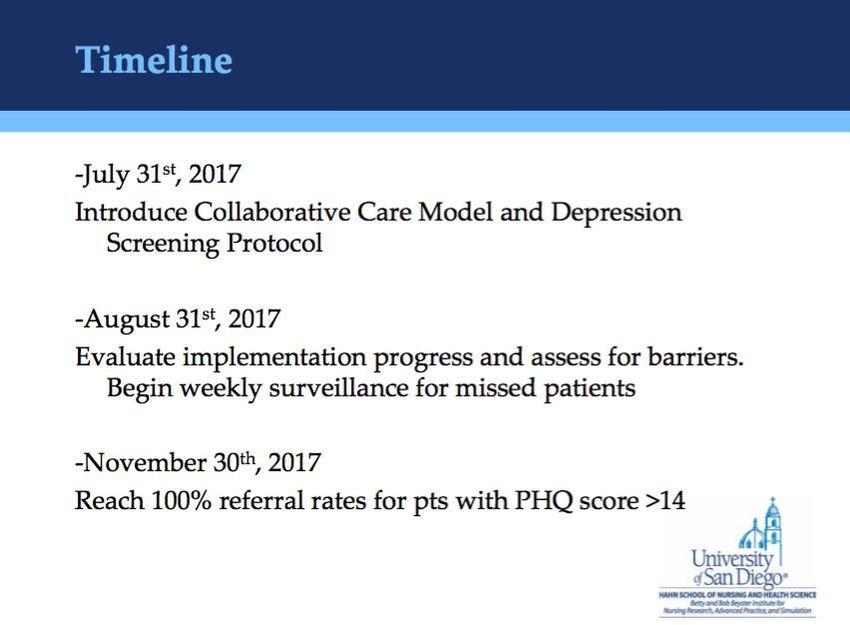
8

process to identify and engage primary care patients who were suffering from depressive

symptoms. Implementing a standard screening with immediate referral to a collaborative

care service between primary care and behavioral health has been shown to greatly

improve identification, treatment, and overall health outcomes of patients with depression

within the primary care setting.

Evidence Addressing the Problem

       A literature review was performed to collate evidence for best practice regarding

collaborative care and depression screening within the ambulatory setting. Databases

accessed included CINAHL, Cochrane Library of Systematic Reviews, PsycINFO, and

PubMed. Search terms used included "collaborative care,” “depression," “behavioral

health,” “case managers,” “screening,” “follow ups,” “electronic health record referral”

and “trans-disciplinary meetings.” A total of 314 articles were identified. The author

reviewed abstracts to identify 47 relevant articles. The final literature review included 27

studies. Studies were ranked according to Melnyk and Fineout-Overholt’s hierarchy of

evidence. These studies comprised of 9 systematic reviews and/or meta-analyses, 5

randomized control trials, 7 case-control studies, and 6 qualitative studies.

       Collaborative care was designed to improve detection and diagnosis of

depression, increase the amount of providers following evidence-based care guidelines,

and increase clinical and community knowledge and support of depression. (Community

Preventive Services Task Force, 2012) There is robust research to support collaborative

care in a multitude of settings and patient populations. A Cochrane review that included

79 randomized controlled trials and nearly 25,000 participants concluded that patients

with depression under a collaborative model had significant improvements in the short,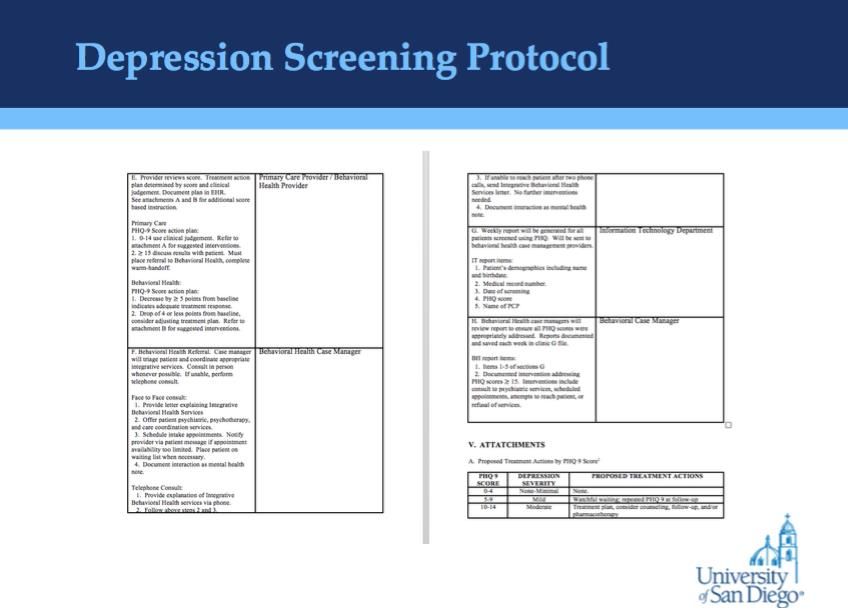
9

medium, and long-term outcomes. The review contributed the success to increased

adherence to care plans, guidance and support throughout treatment, and higher rates of

patient satisfaction. (Archer et al., 2012)

       The key foundation of care collaboration is that it involves a multi-disciplinary

team to create and deliver a patient centered care plan. This team includes the patient, a

case manager, behavioral health specialist (therapist or psychologist), the primary care

provider, and a psychiatric provider. Unützer and Park (2012) stated that patients

receiving care within a collaborative clinic have a 50% or greater improvement in

depressive symptoms at 12 months when compared to separate services. Collaborative

care will also increase psychotropic medication adherence, patient satisfaction, remission

of symptoms, and quality of life. These patients also have lower rates of cardiovascular

events, chronic pain, and medical costs. (Goodrich et al., 2013) Collaborative care

models are also translatable to both private practice and community clinics. (Coventry et

al., 2014) A diverse patient population has been shown to benefit from care

collaboration. Spanish speaking Hispanic patients had a 77% recovery rate and 51% of

English speaking Hispanics reported significant improvement. (Sanchez & Watt, 2012)

       Research has shown that family practice providers don’t identify up to 50% of

MDD patients when not using standardized screening. (Arroll et al., 2010) The Patient

Health Questionnaire (PHQ-9) has been validated for depression screening within

ambulatory care settings. (Arroll et al., 2010) The PHQ-9 utilizes a “categorical

algorithm” to detect the presence of DSM-V depression diagnosis criteria and a

“continuous score” that relates to depression severity. (Löwe, Schenkel, Carney-

Doebbeling, & Göbel, 2006) Scores are equated with the risk a patient is suffering from
10
MDD. A score of 0-4 indicates no risk, 5-9 mild, 10-14 moderate, 15-19 moderately
severe, and 20-27 indicate severe risk for MDD. A PHQ-9 score of 10 or above has an
88% sensitivity and 88% specificity for MDD. (Muñoz-Navarro et al., 2017) Use of the
PHQ-9 to aid diagnosing and tracking depression is recommended by the World Health
Organization, American Psychiatric Association Practice Guidelines for the treatment of
Patients with MDD, and the Cochrane Review for Collaborative Care of Depression.
(American Psychiatric Association, 2010; Archer et al., 2012; World Health
Organization, 2001)
METHODS
Framework
Implementation of this evidence-based practice (EBP) project required a clear and
well defined model. The Stetler Model is a proven and reliable model. Phase I entails
the preparation phase. Phase II requires that the Advanced Practice Registered Nurse
(APRN) must critique the gathered evidence to ensure its adequacy. Phase III requires
that the APRN consider the feasibility, sustainability, risks, resources, and readiness for
the EBP change before progressing to the implementation phase. Phase IV is the actual
evidence implementation stage. Phase V calls for evaluation. (Rycroft-Malone &
Bucknall, 2010)
The Stetler Model worked well with this practice change as it allowed for both
qualitative and quantitative research, was simple to follow, and was highly recommended
by the University of San Diego.
Project Approval11
The University of San Diego’s Institution Review Board granted this project
exemption as it did not qualify as a research or clinical investigation as defined by the
federal government. New verbal or written consent outside the clinic’s consent to receive
services was not obtained as no new additional services were offered.
Description of Project
The purpose of this EBP project was the implementation of an evidence-based
protocol outlining the process for primary care patient depression screening, referral to
in-house behavioral health (BH), and the role of the collaborative care team. This
protocol’s goals were to improve detection, treatment, and outcomes for adult MDD
patients. A major strength of this protocol was the utilization of trans-professional staff
engaged in care collaboration. Another strength was the use of evidence-based screening
tools to guide practice. The evidence-based tool was the PHQ-9. Lastly, a major strength
was the ease of provider notification regarding PHQ-9 scores and the need for referral.
Provider notification and referral order ensured patients were offered collaborative care
services. These services include meeting with the BH case manager, psychiatry
appointments for medications, and psychologist appointments for therapy.
The Doctor of Nursing Practicing (DNP) student wrote, implemented, and monitored the
evidence-based protocol “Clinical Depression Screening and Follow Up Using the Patient
Health Questionnaire” (Appendix H). The DNP student also obtained baseline screening
rates to evaluate project success. The EBP project was evaluated over a five-month
period.
Intervention Implementation12
For this EBP project all further described interventions were formally detailed in
the implemented practice protocol. All patients presenting to the clinic were to be
administered the PHQ-9 by the medical assistants. All new patients were to be screened
at their physical exam and intake appointment. For existing patients, the medical
assistant performed a chart review and administered the tool if they had not completed
one within the last calendar year. The medical assistant then documented each score in
the electronic medical record during the appointment. The Information Technology (IT)
department built an automatic “trigger” into the electronic medical record to alert all
providers to order a “Behavioral Health referral” for patients with documented score 15
or above. The primary care provider underwent training to assess for depression,
understand the PHQ-9 scores, and how to place the BH referral.
Patient screening rates, scores, follow-up appointments and clinical outcomes
needed to be monitored to gauge the success of the protocol. Monitoring adherence to
the protocol ensured patients suffering from depressive symptoms were identified,
contacted, monitored, and following a care plan. The DNP student was responsible for
this. The IT department provided the student each week with a list of every patient who
presented to the clinic and their corresponding scores. This list was reviewed by the DNP
student performed a corresponding chart audit. The purpose of the audit was to ensure
each patient who required a PHQ-9 screening as outlined above completed one, and those
who were appropriate received a BH referral. For patients that scored equal to or above a
15 and did not get the BH referral, the DNP student placed the referral and contacted the
patient to offer the BH services. The audit also indicated which patients were not
progressing per their PHQ-9 scores. These patients were discussed during the bi-weekly13
collaborative care meetings. After the DNP student completed the project, the case
manager absorbed the chart auditing process.
Care collaboration was vital to this process as it empowered the team and the
patient to be involved with creating a care plan and goal setting. Specific roles of each
team member were outlined in the depression screening protocol. These roles and
coinciding responsibilities in relation to the protocol were disseminated to providers by
the DNP student. A key role to highlight was that of the BH case manager. Case
managers were individuals with a minimum education of a bachelor’s degree in social
work or nursing. They were also specially trained in the standards of care for patients
suffering from MDD in order to accurately address patients’ mental health needs and
offer appropriate services. This knowledge and training was vital as the case managers
were directly responding to the BH referrals placed by the primary care providers. When
a referral was placed, a warm hand off between these two providers occurred directly
after completion of the primary care appointment. At this time the BH case manager
further screened the patient and educated them on BH collaborative care. If appropriate
and the patient was agreeable, the BH case manager then scheduled desired psychiatric
services. If a patient was not able to meet in the case manager during their primary care
appointment they received a follow-up phone call from the case manager. While warm
handoffs were preferred, phone calls have also been proven as effective. Follow up calls
have shown that up to 20% of patients who receive a call have significant improvements
when compared to those who don’t have contact at with a case manager at all. (Bao,
Druss, Jung, Chan, & Unutzer, 2016). This phone call reinforced the clinical alliance
between the patient and the care team by discussing symptom status, medication14
compliance, and barriers to care. The BH case manager charted an encounter note in the
EMR once the call or warm handoff were complete. The DNP student monitored the
occurrence of these interactions on a weekly basis during chart audits to ensure no
patients were missed. All case manager duties were outlined in the EBP protocol.
A requirement of successful care collaboration is also patient focused case
discussions during collaborative care meetings. These team meetings are associated with
symptom improvement and medication adherence (Conventry et al., 2014). This protocol
required bi-weekly meetings between the entire team. The DNP student also participated
in these meetings when possible to ensure a tailored plan was formulated in a timely
manner for the presented patient.
Stakeholder Identification
Process stakeholders were vital to the successful implementation of this EBP.
Outcome stakeholders are vital to the EBP change’s sustainability. Regarding this
project the patient and faculty advisor were solely process stakeholders. The psychiatrist
(clinical mentor), primary care provider, psychologist, IT department, and case managers
were both process and outcome stakeholders. The strict outcome stakeholders were
identified.
Process Stakeholders
The faculty advisor collaborated with the DNP student on implementation and
sustainability strategies. This was done through monthly emails and monthly informal
meetings. Discussion topics included patient data, implementation barriers, and project
gaps.15
The patient’s role was informal but important. The patient informally reported on
the effectiveness of the care plan and provide process feedback during follow up
behavioral health meetings. This occurred during scheduled clinic appointments and BH
case manager phone calls.
Process and Outcome Stakeholders
The clinical mentor required similar updates as the faculty chair and also received
monthly emails. The clinical mentor also required formal meetings to consult on project
process.
To assist the DNP student with success and sustainability of the project a close
working relationship with the case manager was required. The case manager provided
feedback regarding the student’s strengths and weaknesses, areas for improvement, and
brainstorm strategies to streamline and improve collaborative care. The case manager
and DNP student also collaborated on strategies to engage the patient during warm
handoffs and telephone calls. Weekly emails or phone calls and bi-weekly informal
meetings were held.
The IT department was vital as they provided weekly emails obtaining PHQ-9
data. This informed the DNP student of the project’s progression. These emails will
also need to be continued for the BH case managers post DNP student project completion
for project sustainability. Weekly emails occurred between the IT department, the case
managers, and the DNP student.
The primary care provider needed to be informed and provided feedback
regarding plan of care changes recommended by the collaborative team. Weekly emails,16
documentation in the medical record, and bi-weekly 15-minute caseload discussion took
place at the clinical site.
Desired Project Outcomes
Desired outcomes included 100% of new patients completed a PHQ-9 during their
physical exam and intake appointment. All existing patients completed a PHQ-9
assessment annually. All patients who scored 15 or higher were to be referred to
collaborative care immediately by the primary care provider placing an order for
“Behavioral Health Referral”. A behavioral health case manager was meet with every
referred patient same day or call them via telephone unless the patient refused. This was
to ensure that the clinic referred 100% of patients with a PHQ-9 score of 15 or above to
receive appropriate psychiatric services.
Outcome Indicators
The project was evaluated using two key components. Patient screening rates and
patient referral rates. Short-term goals included include writing the protocol, establishing
the collaborative care team and completing training within the first month of
implementation. Collaborative meetings were to occur bi-weekly after the first month of
the project start date. Ninety-eight percent of all patients seen were to be screened or
have a PHQ-9 on file in the same calendar year starting at the end of the second month.
Long term goals included 100% completion rate of PHQ-9 scales on all patients seen
between the second and fifth month. Lastly, 100% of patients who scored at least a 15
were referred to behavioral health.
Sustainability17
For sustainability the DNP student trained the BH case managers to absorb the
DNP student’s responsibility. Another option was training the medical assistant (MA)
the DNP student role. Additional chart training for the MA would be simple as the PHQ-
9 has already been built into the EMR and the IT department is now regularly sending
weekly updates. The Psychiatric MD supported both options. The psychiatric MD’s
support was key to sustainability as she was the project champion and committed to the
success of integrated collaborative care.
Dissemination
Dissemination of this EBP project’s success took place in a variety of settings.
These settings included a formal stakeholder presentation, a national conference poster
presentation, and an abstract planned to be submitted for a target journal.
Stakeholder dissemination included a 20-minute PowerPoint presentation during
the collaborative care meeting. The 20-minute time frame was a recommendation from
the DNP Student Handbook. A digital copy of the poster presentation was also emailed
to the appropriate stakeholders.
This project was accepted as a poster presentation at the Graduate Nursing
Student Academy national convention in Atlanta, Georgia in February of 2018. This
conference was appropriate because the conference objective is to highlight evidence-
based nursing practices that are being implemented by graduate students.
The target journal identified for abstract submission is the journal Nursing
Outlook. This journal focuses on current nurse student issues and trends throughout
education. The role of a mental health DNP student within a small organization primarily
offering primary care services operating without funds has generated little published18
discussion. As funding and quality initiatives continue to target collaborative services and
mental health needs in the primary care setting it is possible more students will have an
interesting in learning from the DNP student’s experiences.
DATA ANALYSIS AND RESULTS
The Quality Initiative (QI) Department requested that the DNP student evaluate
outcomes combining both existing and new patients into one group for both screening
and referral rates. All analysis done was with the aid of Dr. Dee Cannon.
To evaluate the PHQ-9 screening and referral rates a pre, mid, and post evaluation
approach was used. The QI department provided the baseline data regarding screening
rates. This was used as the prescreening rate data point. Subsequent screening and
referral rates were obtained bi-weekly for every scheduled appointment until project
conclusion. The post evaluation data point was obtained one month after the EBP project
concluded.
The baseline PHQ-9 screening rate for all patients was 40% for Quarter 2 of 2017.
Per QI department request the implementation of the DNP Depression Protocol occurred
August 1, 2017. At the end of this month screening rates increased from 40% to 49% for
both new and existing patients combined. Screening rates increased from 49% to 100%
by the end of September. From October to January the 100% screening rates were
maintained. January was the month the post evaluation data point was obtained.
The baseline referral rates were not able to be determined as there was no formal
behavioral health referral order in place. Providers would refer patients by in-person
introductions to behavioral health employees or by placing a variety of orders including
“refer to psychology,” “refer to case management,” “refer to psychiatry,” “refer to mental19
health.” Once the protocol was implemented a single order was established as the
“Behavioral Health referral.” Following referral rates were observed. August through
January had a 100% referral rate for patients who scored equal to or above a 15 on the
PHQ-9 tool. This success can be contributed to educating the providers, having a
standardized protocol, and the EMR automatic referral reminder for providers.
Further analysis could include investigating PHQ-9 score progressions to assess if
patients are improving. Analysis could also include medication adherence or follow up
adherence. Other valuable information would be length of time to reach remission and
overall score reductions for patients. Analysis could also include documenting the dates
of each collaborative meeting and each care-call. The specific timelines of each
intervention could be determined and compared to patient outcomes. This could identify
if quicker intervention implementation translates into more effective outcomes. For
example, this data could reveal if a three-week care-call window is more effective than a
four-week care-call window. Data analysis and presentation of this data would be further
discussed with Dr. Cannon.
Cost Benefit Analysis
This EBP did not require additional funds as all services utilized were already in
place at the clinic. To demonstrate the cost-benefit, costs determined by the Grochdreis
et al. (2012) systematic review will be used. The calculated intervention costs included
the cost of a case manager, primary care provider, psychiatric provider, psychiatric
medications, and outpatient mental heave services. The average cost to provide
collaborative care for 24 months was $597 per patient.20
To calculate the benefit, Depression Free Days (DFD) will be used. One DFD for
a MDD patient prevents a loss of $56.59 per day. (Grochtdreis et al., 2015) This is due to
the prevented direct and indirect medical costs as well as prevention of work-related lost
productivity. Patients with MDD who received collaborative care had an average of 115
more DFDs in 24 months than MDD patients who didn’t. (Grochtdreis et al., 2015) This
would be an average prevention of a loss of $6.507.85 per patient over 24 months.
The theoretical DNP student caseload would consist of 12 patients. Over 24
months this caseload would require a total cost of $7,164 (12 patients x $597 in costs).
The intervention would potentially result in 1,380 additional DFDs (12 patients x 115
DFDs). This would amount to $78,094.2 prevented losses over 24 months (1,380 DFDs
x $56.59). The net gain from investment would be $70,930.20 ($78,094.2 – $7164). The
return on investment would be 990% ([$70,930.20 / $7164] x 100).
IMPLICATIONS FOR RESEARCH AND PRACTICE
Project Impact
Implementing this protocol to improve early identification, quality of treatment,
and patient outcomes for medically underserved patients at moderate-high risk of
depression in the community health setting has the potential for great outcomes. Full
integration of the PHQ-9 to screen all adult patients presenting to a clinic can increase
identification and treatment of depressed patients. This project can also potentially
increase access to integrated behavioral health services for San Diego County residents
by increasing the level of behavior health integration at the clinic of concern. Mental
health outcomes of the vulnerable or underserved primary care patient can improve while21
operating under a cost-effective care model. Barriers to accessing behavioral health
services and implementing collaborative care will be identified for this clinic setting.
Barriers and Lessons Learned
Lessons learned included the strengths and weaknesses working in a small
community clinic. Strengths included the ease of EBP project implementation. Having
to work with only a small staff size made education and evaluation processes simpler
then when compared to larger organizations. Small staff size was also a weakness and
barrier for this project. Further data analysis including specific patient numbers was
unable to be obtained from the IT department. The IT department was only one
individual who ultimately and reluctantly stated clinic priorities did not allot much time
to mine data for the DNP student. Under these conditions the project outcomes would
have been better analyzed if there were two DNP students working on this project. One
student to write and implement the protocol and one student to evaluate outcomes and
produce clinic suggestions.
Conclusion
Depression is a prevalent and debilitating illness affecting individuals worldwide.
The psychological effects can exacerbate physical ailments, personal relationships, and
ability to contribute within society. It is the utmost importance that the healthcare system
addresses this public health threat.
Collaborative care is an evidenced based approach to identifying and treating
depression. It improved provider adherence to recommended treatment guidelines and
patient adherence to treatment plans. It also addresses the stigmatization and lack of care
of this population. Care collaboration has been shown to be effective in a vast number of22 patient populations, clinical environments, and countries. This model empowers patients and providers to face depression by actively engaging in treatment. Depression can no longer be ignored by the public or medical sectors and care collaboration is the strongest evidenced based intervention to address it.
23

                                     REFERENCES

Ali, M. M., Dean, D., Jr., & Hedden, S. L. (2016). Key Substance Use and Mental Health

    Indicators in the United States: Results from the 2015 National Survey on Drug Use

    and Health. Addictive Behaviors, 59, 35–41.

    http://doi.org/10.1016/j.addbeh.2016.03.019

American Psychiatric Association. (2010). American Psychiatric Association Practice

    Guidelines for the Treatment of Patients With Major Depressive Disorder (3rd ed.).

    Arlington, VA: American Psychiatric Publishing, Inc.

    http://doi.org/10.1176/appi.books.9780890423387.654001

Archer J, Bower P, Gilbody S, Lovell K, Richards D, Gask L, Dickens C, Coventry

       P. (2012) Collaborative care for depression and anxiety problems. Cochrane

       Database of Systematic Reviews DOI: 10.1002/14651858.CD006525.pub2.

Arroll, B., Goodyear-Smith, F., Crengle, S., Gunn, J., Kerse, N., Fishman, T., ... Hatcher,

       S. (2010, July 19). Validation of PHQ-2 and PHQ-9 to Screen for Major

       Depression in the Primary Care Population. The Annals of Family Medicine, 8(4),

       348-353. http://dx.doi.org/10.1370/afm.1139

Bao, Y., Druss, B. G., Jung, H., Chan, Y., & Unutzer, J. (2016,). Unpacking

       Collaborative Care for Depression: Examining Two Essential Tasks for

       Implementation. Psychiatric Services , 67(4), 418-424.

       http://dx.doi.org/10.1176/appi.ps.201400577

Community Preventive Services Task Force. (2012). Recommendation from the

    Community Preventive Services Task Force for Use of Collaborative Care for the

    Management of Depressive Disorders. American Journal of Preventive Medicine,
24
42(5), 521–524. http://doi.org/10.1016/j.amepre.2012.01.010
Conventry, P. A., Hudson, J. L., Kontopantelis, E., Archer, J., Richards, D., Gilbody, S.,
... Bower, P. (2014,). Characteristics of Effective Collaborative Care for
Treatment of Depression: A Systematic Review and Meta-Regression of 74
Randomised Controlled Trials. PLoS ONE, 9(9).
http://dx.doi.org/10.1371/journal.pone.0108114
Dawson, S., Gerace, A., Muir-Cochrane, E., O'Kane, D., Henderson, J., Lawn, S., &
Fuller, J. (2017). Carers' experiences of accessing and navigating mental health care
for older people in a rural area in Australia. Aging & Mental Health, 21(2), 216–223.
http://doi.org/10.1080/13607863.2015.1078283
Ferrari, A. J., Charlson, F. J., Norman, R. E., Patten, S. B., Freedman, G., Murray, C. J.
L., et al. (2013). Burden of Depressive Disorders by Country, Sex, Age, and Year:
Findings from the Global Burden of Disease Study 2010. PLoS Medicine, 10(11),
e1001547. http://doi.org/10.1371/journal.pmed.1001547
Gilbody, S. (2006). Collaborative Care for Depression. Archives of Internal Medicine,
166(21), 2314. http://doi.org/10.1001/archinte.166.21.2314
Grochtdreis, T., Brettschneider, C., Wegener, A., Watzke, B., Riedel-Heller, S., Harter,
M., & Konig, H. (2015,). Cost-Effectiveness of Collaborative Care for the
Treatment of Depressive Disorders in Primary Care: A Systematic Review. PLoS
ONE, 10(5). http://dx.doi.org/10.1371/journal.pone.0123078
Gronholm, P. C., Thornicroft, G., Laurens, K. R., & Evans-Lacko, S. (2017). Mental
health-related stigma and pathways to care for people at risk of psychotic disorders or
experiencing first-episode psychosis: a systematic review. Psychological Medicine,25
1–13. http://doi.org/10.1017/S0033291717000344
Goodrich, D. E., Kilbourne, A. M., Nord, K. M., & Bauer, M. S. (2013). Mental Health
Collaborative Care and Its Role in Primary Care Settings. Current Psychiatry
Reports, 15(8), 383. http://doi.org/10.1007/s11920-013-0383-2
Hunter, C. L. (2009). Integrated behavioral health in primary care: Step-by-step
guidance for assessment and intervention. (9781433804281). American
Psychological.
Jackson-Triche, M. E., Greer Sullivan, J., Wells, K. B., Rogers, W., Camp, P., & Mazel,
R. (2000). Depression and health-related quality of life in ethnic minorities seeking
care in general medical settings. Journal of Affective Disorders, 58(2), 89–97.
Lee, C.-T., Chiang, Y.-C., Huang, J.-Y., Tantoh, D. M., Nfor, O. N., Lee, J.-F., et al.
(2016). Incidence of Major Depressive Disorder: Variation by Age and Sex in Low-
Income Individuals: A Population-Based 10-Year Follow-Up Study. Medicine,
95(15), e3110. http://doi.org/10.1097/MD.0000000000003110
Löwe, B., Schenkel, I., Carney-Doebbeling, C., & Göbel, C. (2006). Responsiveness of
the PHQ-9 to Psychopharmacological Depression Treatment. Psychosomatics, 47(1),
62–67. http://doi.org/10.1176/appi.psy.47.1.62
Martinez, W., Galván, J., Saavedra, N., & Berenzon, S. (2016). Barriers to Integrating
Mental Health Services in Community-Based Primary Care Settings in Mexico City:
A Qualitative Analysis. Psychiatric Services (Washington, D.C.), appips201600141.
http://doi.org/10.1176/appi.ps.201600141
Muñoz-Navarro, R., Cano-Vindel, A., Medrano, L. A., Schmitz, F., Ruiz-Rodríguez, P.,
Abellán- Maeso, C., … Hermosilla-Pasamar, A. M. (2017). Utility of the PHQ-9 to26
identify major depressive disorder in adult patients in Spanish primary care
centers. BMC Psychiatry, 17, 291. http://doi.org/10.1186/s12888-017-1450-8
Rycroft-Malone, J., & Bucknall, T. (Eds.). (2010). Models and frameworks for
implementing evidence-based practice: linking evidence to action (1st ed).
Chichester, West Sussex: Wiley-Blackwell.
Sanchez, K., & Watt, T. T. (2012). Collaborative care for the treatment of depression in
primary care with a low-income, spanish-speaking population: outcomes from a
community-based program evaluation. The Primary Care Companion for CNS
Disorders, 14(6). http://doi.org/10.4088/PCC.12m01385
Simon, G. E. (2002). Evidence review: efficacy and effectiveness of antidepressant
treatment in primary care. General Hospital Psychiatry, 24(4), 213–224.
UCLA Center for Health Policy Research. (2016). 2015 California Health Interview
Survey. Los Angeles. Retrieved from
http://ask.chis.ucla.edu/AskCHIS/tools/_layouts/AskChisTool/home.aspx#/results
Unützer, J., & Park, M. (2012). Strategies to Improve the Management of Depression in
Primary Care. Primary Care, 39(2), 415–431
http://doi.org/10.1016/j.pop.2012.03.010
Unützer, J., Schoenbaum, M., Druss, B. G., & Katon, W. J. (2006). Transforming Mental
Health Care at the Interface With General Medicine: Report for the Presidents
Commission. Psychiatric Services, 57(1), 37–47.
http://doi.org/10.1176/appi.ps.57.1.37
World Health Organization. (2001). The World Health Report 2001. World Health
Organization.27
Zaat, J. (2004). World Health Report. Huisarts en Wetenschap, 47(11), 239–239.
http://doi.org/10.1007/BF0308373628
APPENDIX A
LETTER OF SUPPORT FROM CLINICAL SITE
To: Institutional Review Board, University of San Diego
From: Kelley De Leeuw, MD, MPH
Behavioral Health Director, Imperial Beach Community Clinic
I am serving as a mentor for the DNP Project being conducted by Katherine Kilkenny in
the Hahn School of Nursing and Health Science. I approve of this timely and important
project and will be advising this student throughout this process.
If you have any questions, please do not hesitate to contact me at (619) 429-3733 or
kdeleeuw@ibclinic.org
Sincerely,
Kelley De Leeuw, MD Behavioral Health Director Imperial Beach Community Clinic29
APPENDIX B
POSTER ABSTRACT
POSTER ABSTRACT SUBMITTED TO
GRADUATE NURSING STUDENT ACADAMY NATIONAL CONFERENCE
Title: A Common Goal: Primary Care and Psychiatry Improve Depression
Detection and Outcomes
Background: Major Depressive Disorder (MDD) affects over 15 million (6.7%) adult
Americans. While one in four primary care patients suffer from
depressive symptoms, MDD is accurately diagnosed accurately 25% of the
time.
Intervention: Implementation of an evidence-based protocol outlining the process for
depression screening, r behavioral health referral, and the role of the
collaborative care team will improve detection, treatment, and outcomes
for adult MDD patients.
Outcomes: The mission is to achieve a 100% screening rate using the patient health
questionnaire (PHQ-9) of all adult patients and a 100% behavioral health
referral rate for patients with a PHQ-9 score of 15 or above.
Word count: 10030
APPENDIX C
GRADUATE NURSING STUDENT ACADEMY CONFERENCE LETTER OF
ACCEPTANCE
Congratulations!
I am pleased to inform you that your abstract# 0973-000772, titled "A Common Goal:
Primary Care and Psychiatry Improve Depression Detection and Outcomes" has been
selected for a Poster Presentation at the 2018 Graduate Nursing Student Academy (GNSA)
Conference at the Marriott Marquis in Atlanta, GA.
*Please be sure see the following details regarding your presentation.*
General Information:
• The poster presentations will occur on Thursday, February 22, 2018 from 5:00 to
7:00 p.m. during the Networking Reception.
• We ask that posters remain displayed on Friday, February 23, 2018 so that
participants can view them during breaks. Presenters are only required to be by
their poster during the Networking Reception.
• Please visit the following link for instructions on effective poster
presentations: http://www.aacnnursing.org/Portals/42/Professional-
Development/Conferences/Poster-Recommendations.pdf
• Please note that you are required to register for the conference in order
to present.
Acceptance Confirmation Instructions:
In order to present, you must confirm your acceptance via the abstract
management website by January 22, 2018. If we do not receive your confirmation by
this date, you will no longer be eligible to present.
• On or before January 22, please log in to the abstract management website with your
original email username and password created during the submission process, via
the link below.
https://precis2.preciscentral.com/Link.aspx?ID=58BE2DD4C8D34683BA220F0F
CD84EAB7
• Once logged in, under My Submissions, proceed to the Graduate Nursing Student
Academy Conference Page. From here, select the abstract that has been accepted
and click the edit icon.
• Click the blue Edit Submission button at the top of the page, and then select
the Confirmation tab.
• From here, please indicate if you Accept or Decline the invitation to present.
• After you have indicated Accept or Decline, simply click Save and then be sure to
click on “Submit & Review Changes” and then “Finalize” to complete your
submission. If you do not click “Submit & Review Changes” and then “Finalize”,31
your submission will be marked as incomplete. After you have clicked “Finalize” to
mark your submission complete, you can simply log out or close out of the site.
Poster Presentations:
The following are specifications that should assist you in the preparation of your poster
presentation.
• AACN will provide double-sided bulletin board that will hold two (2) posters per
side. Poster presentations will need to be 48” H x 36” W; formatted as a
portrait layout. Please adhere to these dimensions to ensure that your poster
can be displayed properly.
• Historically successful posters presentations have included graphics, pictures and
text clearly describing the methods, programs or practices pertaining to the theme
of the event.
Shipping:
If you plan to ship your materials to the hotel, please address the package(s) to your attention
at the following address. Please do not ship materials to the hotel any earlier than Monday,
February 19, 2018.
Attn: YOUR NAME
Atlanta Marriott Marquis Hotel
265 Peachtree Center Avenue
Atlanta, GA 30303
Hold for: AACN GNSA Conference
Co-Presenters:
PLEASE NOTIFY YOUR CO-PRESENTERS OF ALL INFORMATION AND
DETAILS
AACN Website:
A week prior to the conference, an email will be sent to all registered attendees including a
web link to select online materials. These materials will include the abstract that you
originally submitted to the abstract website. You will NOT be able to make changes to the
posted abstract as the original version was the version approved by AACN.
Best Regards,
Marta Okoniewski, MPA
Director of Student Engagement
American Association of Colleges of Nursing
655 K Street, NW, Suite 750
Washington, DC 20001
202-463-6930 ext. 220
Website: www.aacnnursing.org
Email: mokoniewski@aacnnursing.org32
APPENDIX D
DNP PROJECT POSTER33
APPENDIX E
STAKEHOLDER PRESENTATION34
35
36
37
38
39
40
41

                                     APPENDIX F

                        FINAL CLINICAL EXEMPLARS

AACN DNP Essentials &              USD DNP Program                   Exemplars
 NONPF Competencies                   Objectives              Provide bulleted exemplars
                                                                  that demonstrates
                                                                 achievement of each
                                                                       objective
DNP Essential I:               2. Synthesize nursing and
Scientific Underpinnings       other scientific and ethical
for Practice                   theories and concepts to          •   (Fall 2015-
                               create a foundation for               Summer 2016)
NONPF: Scientific              advanced nursing practice.            Didactic
Foundation Competencies                                              coursework
                                                                     including:
The scientific foundation of                                         Primary Mental
nursing practice has                                                 Health series,
expanded and includes a                                              Methods of
focus on both the natural                                            Translational
and social sciences                                                  Science,
including human biology,                                             Pathophysiology,
genomics, science of                                                 Pathogenesis of
therapeutics, psychosocial                                           Complex
sciences, as well as the                                             Diseases, APRN
science of complex                                                   Physical
organizational structures.                                           Assessment and
In addition, philosophical,                                          Diagnosis,
ethical, and historical                                              Pharmacology,
issues inherent in the                                               Epidemiology,
development of science                                               Introduction to
create a context for the                                             Health Care
application of the natural                                           Information
and social sciences.                                                 Management,
                                                                     Philosophy of
                                                                     Reflective
                                                                     Practice, Health
                                                                     Policy Analysis,
                                                                     Perspectives in
                                                                     Program
                                                                     Planning and
                                                                     Evaluation,
                                                                     Strategic
                                                                     Planning and
                                                                     Quality
                                                                     Initiatives, and
                                                                     Financial
                                                                     Management in
                                                                     Health Systems
42
• (Fall 2015-
Spring 2018)
Completed over
1080 clinical
hours in
psychiatric
settings
including:
Neuro-
Behavioral
Health Inpatient
Unit, Inpatient
Psychiatric
Clinical Liaison,
outpatient
psychiatry,
Survivors of
Torture clinic,
San Diego Youth
Services,
behavioral health
student centers,
community
mental health
clinic, and
indigent
population based
care
DNP Essential II: 5. Design, implement, and
Organizational & System evaluate ethical health care • (Fall 2015)
Leadership for Quality delivery systems and Utilized research
Improvement & Systems information systems that to author a paper
Thinking meet societal needs and based on an
ensure accountability for epidemiological
NONPF: Leadership quality outcomes. factors of Major
Competencies/Health Depressive
Delivery System Disorder and
Competencies created a
screening plan
Advanced nursing practice for at risk
includes an organizational college students
and systems leadership in Epidemiology
component that emphasizes • (Spring 2016-
practice, ongoing Fall 2016)
improvement of health Didactic
outcomes, and ensuring coursework
patient safety. Nurses including:
should be prepared with Methods of
sophisticated expertise in Translational
assessing organizations,43
identifying system’s issues, Science, Health
and facilitating Policy Analysis,
organization-wide changes Introduction to
in practice delivery. This Health Care
also requires political Information
skills, systems thinking, and Management,
the business and financial Perspectives in
acumen needed for the Program
analysis of practice quality Planning and
and costs. Evaluation,
Financial
Decision Making
for Health Care
Settings,
Strategic
Planning and
Quality
Initiatives
• (Spring 2016-
Fall 2016)
Designed and
evaluated
theoretical health
care delivery
systems with an
electronic
medical record
implementation.
Evaluated for
population
service,
accountability
maintenance,
outcome quality
and financial
stability in
Health Care
Information
Management
course
• (Summer 2016)
Created and
presented business
proposal to address
vulnerabilities in
health care
worker’s uniforms
in Financial
Management in
Health Systems
course44
• (Fall 2017-Spring
2018) EBP project
A Common Goal:
Primary Care and
Psychiatry Improve
Depression
Detection and
Outcomes
successfully
bridged gap
between two
specialties to better
address mental
health needs in the
ambulatory setting.
Implemented EBP
interventions
including the
Stetler model,
telephone follow
ups, behavioral
health referrals,
PHQ screening
tool, and
collaborative care
meetings
DNP Essential III: 4. Incorporate research into • (Fall 2015)
Clinical Scholarship & practice through critical Reviewed evidence
Analytical Methods for appraisal of existing in research paper
Evidence-Based Practice evidence, evaluating practice “Screening for
outcomes, and developing Adverse Childhood
NONPF: Quality evidence-based practice Events in Primary
Competencies/Practice guidelines. Care” using
Inquiry Competencies PRISMA checklist
and the Delfini
Scholarship and research evidence grading
are the hallmarks of system
doctoral education. • (Fall 2015)
Although basic research is Designed and
viewed as the first and most evaluated an
essential form of scholarly evidence-based
activity, an enlarged practice change to
perspective of scholarship increase efficiency
has emerged through of ACE screening
alternative paradigms that tools in Methods of
involve more than Translational
discovery of new Science course
knowledge. These • (Spring 2016)
paradigms recognize: (1) Developed paper
the scholarship of investigating the
discovery and integration45
“reflects the investigative gap in San Diego
and synthesizing traditions availability of
of academic life”; (2) Acute Psychiatric
scholars give meaning to Beds and need.
isolated facts and make Based on evidence
connections across in literature and
disciplines through the evaluating
scholarship of integration; outcomes based on
and (3) the scholar applies data in Health Care
knowledge to solve a Information
problem via the Management
scholarship of application course
that involves the • (Spring 2016)
translation of research into Synthesized and
practice and dissemination disseminated
and integration of new evidence-based
knowledge. research in
Complementary
and Alternative
Medicine
Presentation: Green
Tea in
Pharmacology in
Health
Management
course
• (Summer 2017-
Spring 2017)
Completed
literature review to
create and
implement an
evidence based
protocol to
standardize
depression
screening and
referral in the
ambulatory care
setting for the DNP
Scholarly Practice
EBP project
• (Spring 2018)
Completed
literature review to
create and
implement a 10
week DBT group
therapy course in
the outpatient46
psychiatric setting
in the
Psychotherapy with
Group and Family
Systems course
DNP Essential IV: 7. Incorporate ethical, • (Fall 2015)
Information regulatory, and legal Obtained
Systems/Technology & guidelines in the delivery of Biomedical
Patient Care Technology health care and the selection, Research Human
for Improvement & use, and evaluation of Certification –
Transformation of Health information systems and Basic/Refresher
Care patient care technology. Course through
CITI in the
NONPF: Technology & Epidemiology
Information Literacy Foundations of
Competencies Evidence-Based
Practice course
DNP graduates are • (Spring 2016)
distinguished by their Researched current
abilities to use information APRN legislation
systems/technology to and analyzed
support and improve proposed
patient care and health legislation.
care systems, and provide Developed paper to
leadership within examine the impact
healthcare systems and/or on telehealth and
academic settings. healthcare
Knowledge and skills accessibility
related to information through the passage
systems/technology and of SB 323 in the
patient care technology Health Policy
prepare the DNP graduates Analysis Course
apply new knowledge, • (Fall 2016-Spring
manage individual and 2018) Didactic
aggregate level course work
information, and assess the including Health
efficacy of patient care Care Information
technology appropriate to Management and
a specialized area of Primary Mental
practice along with the Health series
design, selection, and use • (Summer 2017-
of information Spring 2018)
systems/technology to Researched
evaluate programs of care, efficacy of
outcomes of care, and care electronic check-in
systems. Information and screening tools
systems/technology provide via IPads in the
a mechanism to apply ambulatory care
budget and productivity setting and
tools, practice information47
systems and decision performed related
supports, and web-based data-analysis for
learning or intervention efficiency for the
tools to support and DNP EBP project
improve patient care. • (Fall 2016-Spring
2018) Experience
operating multiple
electronic medical
health records in
inpatient,
outpatient,
community, and
ambulatory care
settings
DNP Essential V: Health 3. Demonstrate leadership in • (Spring 2016)
Care Policy for Advocacy collaborative efforts to Didactic
in Health Care develop and implement coursework
policies to improve health including Health
NONPF: Policy care delivery and outcomes at Policy Analysis
Competencies all levels of professional • (Spring 2016)
practice (institutional, local, Developed a policy
Health care policy, whether state, regional, national, brief regarding the
created though and/or international). ACA and the
governmental actions, current prescription
institutional decision- drug policy in
making, or organizational Health Policy
standards, creates a Analysis course
framework that canYou can also read


