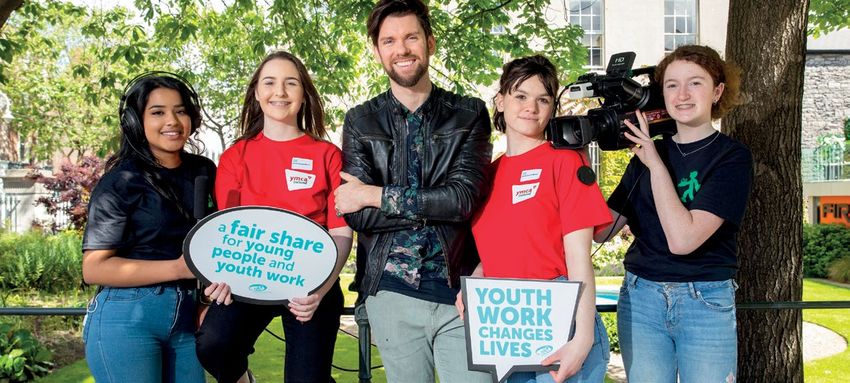
A FAIR SHARE FOR YOUNG PEOPLE AND YOUTH WORK - The best way of securing long-term social and economic sustainability is investment in our growing ...
←
→
Page content transcription
If your browser does not render page correctly, please read the page content below
NYCI PRE-BUDGET SUBMISSION 2020

A FAIR SHARE FOR YOUNG
PEOPLE AND YOUTH WORK
The best way of securing long-term social and
economic sustainability is investment in our
growing youth population

                                       JUNE 2019
Contents There are a million good reasons to invest in our youth population..................................................................... 1 Summary of costed recommendations............................................ 2 Background......................................................................................... 3 Recommendations.............................................................................. 5 1. Youth Work Services............................................................................... 5 2. Youth Unemployment.......................................................................... 10 3. Social Protection for Young Jobseekers............................................. 15 4. Youth Homelessness............................................................................ 19 Conclusion......................................................................................... 22 National Youth Council of Ireland The National Youth Council of Ireland is the representative body for voluntary youth organisations in Ireland. We use our collective experience to act on issues that impact on young people. www.youth.ie Author: James Doorley Edited by: Daniel Meister Designed by: FUSE First published in 2019 by: © National Youth Council of Ireland 2019. All rights reserved. ISBN no: 978-1-900210-56-0
NYCI 2020 PRE-BUDGET SUBMISSION

                                                                       The number of young people aged 10-24 will

      There are a million                                                    increase by 13.2%
                                                                                between 2015 and 2025
      good reasons to
      invest in our youth                                                          and will be just over

      population                                                              ONE MILLION
                                                                            young people by 2025 (1,005,938)1

          The Youth
                                                                            1,400           support
                                                                                                       40,000
          Work sector                                                          STAFF                       VOLUNTEERS

          has the scale                                                                 to reach over

          to support it...                                                383,000 YOUNG PEOPLE
                                                                             in almost every community in Ireland

                                                            According to NYCI Indecon study
          and it makes                                      EVERY €1 INVESTED in youth work
          economic sense                                    SAVES THE STATE €2.202
          to invest in                                      Indecon study estimated the annual

          youth work
                                                            economic value of youth work-related

                                                                              €47.7m
                                                            volunteering at               3

          Young People &                                DCYA funding has
                                                                                                                   2%
                                                        increased by €511m
          Youth Work has
                                                                                                                €10.6M
                                                                                                                YOUTH
                                                        between 2014-2019.                                      WORK
          not had its fair                              YOUTH WORK HAS                     €511m
                                                                                            SPENDING
          share of investment                           ONLY RECEIVED
                                                                                                                98%
                                                        AN ADDITIONAL
          since 2011                                    €10.6M OR JUST 2%                                       €500.4M
                                                                                                                OTHER

          The YSGS should be at               Investment in the

          €12.7m                              Youth Service Grant
                                              Scheme (YSGS)
                                                                             from
                                                                        €10.96m                       €10.65m
                                                                                                              to

          in 2019 just to                     in 2019 is still below
                                              the investment in             in 2005                         in 2019
          keep pace with                      the YSGS in 2005
          cost of living
          increases                           INFLATION BETWEEN 2005 AND 2019 HAS BEEN 15.7%4

1
    E3003, Population 2011-2016 by Single Year of Age, Sex, County and City, CSO https://www.cso.ie/px/pxeirestat/Statire/
    SelectVarVal/Define.asp?maintable=E3003&PLanguage=0
2
    Assessment of the Economic Value of Youth Work by Indecon Economic Consultants, November 2012
3
    Assessment of the Economic Value of Youth Work by Indecon Economic Consultants, November 2012
4
    CSO CPI Inflation Calculator https://www.cso.ie/en/interactivezone/visualisationtools/cpiinflationcalculator/
                                                                                                                             1
NYCI 2020 PRE-BUDGET SUBMISSION
Summary of costed
recommendations
In this submission, NYCI recommends to Government a number of
priorities for investment in Budget 2020.
INVEST IN VOLUNTARY YOUTH ORGANISATIONS
1 AND YOUTH WORK SERVICES INVESTMENT
Increase investment in voluntary youth work organisations
and youth work services by €16.6m to ensure the provision
€16.6m
of more supports and services for young people and to meet
the needs of a growing youth population. In particular, NYCI
recommends investment of €3m in the Youth Service Grant
Scheme in Budget 2020.
HALVE LONG-TERM YOUTH UNEMPLOYMENT
2 Increase investment in education, training and access to INVESTMENT
apprenticeships to halve long-term youth unemployment
by end 2020. €14.9m
EQUALITY FOR YOUNG JOBSEEKERS
3 Restore the full adult rate of €203 to young people INVESTMENT
on Jobseeker’s Allowance over next two budgets.
In Budget 2020 increase rate for young people age €29.9m
18-24 by €45.10 a week and those aged 25 by €22.60
per week.
TACKLING YOUTH HOMELESSNESS
4 Restore the full rate of Jobseeker’s Allowance to young INVESTMENT
people who are homeless or at risk of homelessness.
€2.1m
2NYCI 2020 PRE-BUDGET SUBMISSION
Background
The National Youth Council of Ireland (NYCI) is the representative body for 51 voluntary youth
organisations in Ireland. Our member organisations work with and for up to 383,000 young people
aged 10 to 24 years in every community in Ireland with the support of 40,000 volunteers and 1,400
paid staff.5 NYCI functions to represent the interests of young people and youth organisations.
NYCI's role is recognised in legislation (Youth Work Act) and is represented on the National
Economic and Social Council.
INTRODUCTION
The results of Census 20166 confirmed that Ireland has one of the youngest populations in Europe
with one-third aged less than 25 years. Another CSO study7 found that Ireland had the highest
number of young people in the 0-14 age cohort in the EU. The 2016 census results also indicate
that the number of young people aged 10-24 will increase by 13.2% between 2015 and 2025
and will be just over one million young people by 2025 (1,005,938)8. While it is true that Ireland,
in line with most countries in the Western World, has a growing older population, these figures
confirm that Ireland is also unique in that exhibits a large and growing youth population. Many
other countries are grappling with a declining youth population, whereas Ireland has a unique
opportunity to invest in a growing youth population. NYCI contends that wise investment in our
growing youth population now would be the best way to ensure long term social and economic
success and better secure us against potential future economic and financial difficulties. It is
unfortunately also clear, that successive Governments in the last 15 years have failed to invest
in young people and youth work. Therefore this submission is entitled Budget 2020 – A Fair Share
for Young People and Youth Work. NYCI is calling on Government to implement a number of
recommendations and policies in the Budget 2020, to meet the needs of young people and
support them to achieve their full potential and ensure Ireland’s long term prosperity.
NYCI welcomed the commitment in the 2016 Programme for Government concerning young
people; which states:
“There are over 800,000 people aged 10-24 in Ireland. As these young people
transition from adolescence to adulthood, primary school to secondary and
further education or work, they are faced with major changes,
pressures, expectations and, indeed, opportunities. We must ensure
that their voice is heard, that they are respected, safe and healthy
and that they meet their full potential in life and in education9.” OVER
ONE MILLION
young people
(10-24) by 2025
(1,005,938)
5
Assessment of the Economic Value of Youth Work, Indecon Economic Consultants, NYCI, 2012 http://www.youth.ie/sites/
youth.ie/files/Economic_Beneifit_Youthwork_2012.pdf
6
Census 2016, Central Statistics Office, http://www.cso.ie/px/pxeirestat/Statire/SelectVarVal/Define.asp?maintable=EY007&PLanguage=0
7
Measuring Ireland’s Progress http://www.cso.ie/en/releasesandpublications/ep/p-mip/mip2015/introduction/
8
E3003, Population 2011-2016 by Single Year of Age, Sex, County and City, CSO https://www.cso.ie/px/pxeirestat/Statire/
SelectVarVal/Define.asp?maintable=E3003&PLanguage=0
9
A Programme for Partnership Government, May 2016, pp78
3NYCI 2020 PRE-BUDGET SUBMISSION
We acknowledge the €7.5m increase in youth work funding in the first budget of this Government,
however the last two budgets have been disappointing with an increase of just 5% in youth work
funding (€3m) since 2017. In 2011, funding for youth work from the newly established Department of
Children and Youth Affairs (DCYA) was €60.2m. In subsequent years there were significant cuts, so even
with the recent increases in the youth work budget, funding is just back to the 2011 levels of funding
at €60.4m. While overall Government expenditure has increased by 12% between 2011 and 2019,
youth work funding has increased by a meagre 0.3%.
Likewise an analysis of funding allocations within the Department of Children and Youth Affairs,
indicate significant spending increases of €511m or 51% between 2014 and 2019. Of these additional
monies, only 2% or €10.6m was allocated to youth work.
The Youth Service Grant Scheme (YSGS) supports 30 national and major regional youth organisations.
It provides the core funding which enables youth organisations to deliver mainstream youth work in
every village, town and city in Ireland. In 2005, the investment in the YSGS was €10.96m. While there
have been increased allocations to the scheme in recent years, the current funding for the scheme
is still below the 2005 level at €10.65m. Between January 2005 and December 2018 the rate of inflation
has been 15.7%10 , therefore just to meet cost of living increases since then the scheme should be
€12.7m. The fact that the funds available to youth organisations from the YSGS is 19% below that of
15 years ago when inflation is taken into account and when regulation and compliance has increased
has created an unsustainable situation. That is why in Budget 2020 NYCI is calling on the Government
to invest €3m in the YSGS.
We welcome the decline in youth unemployment, but we still have 5,93911 young people who are
long term unemployed; much more needs to be done to support this cohort of young people to access
the labour market. Likewise, the discriminatory cuts to young jobseekers under 26 years have not
been reversed, which has created hardship and increased poverty. We are also concerned at the large
numbers of young people who are either those who are homeless or at risk of homelessness. We are
concerned at the rise of the far right across the globe, who tend to target young people, especially
those most impacted by austerity and social exclusion. We must avoid creating an environment where
young people see no future and are enticed into extremist and far right politics. This budget is an
opportunity for the Government to undo the damage of austerity and to meet the needs of a growing
youth population.
As outlined above, it is clear that youth work and young people have not benefited proportionately
from the recovery in our economy and have not received a fair share. In this submission, NYCI is calling
on Government to provide adequate funding to the youth work sector and to respond to the needs
of young people, particularly jobseekers and homeless. In Budget 2020 funding should be provided
to ensure the implementation of the 4 recommendations outlined on page 2 of this submission.
If implemented, our proposals will help to meet the needs of young people and support them
to achieve their full potential and ensure Ireland’s long term prosperity. In framing these
recommendations, NYCI is cognisant of the existing government commitment contained in the
Programme for Government12, the National Youth Strategy13 and Ireland’s obligations under the
Sustainable Development Goals.14 In implementing these proposals, the Government will not
only be supporting young people to seize opportunities and tackle challenges but will be meeting
its own existing commitments and obligations.
10
CSO CPI Inflation Calculator https://www.cso.ie/en/interactivezone/visualisationtools/cpiinflationcalculator/
11
Dáil Éireann, Parliamentary Questions 1482-1483, May 8th 2019 https://www.kildarestreet.com/wrans/?id=2019-05-08a.4027
12
Programme for Partnership Government, May 2016 http://www.merrionstreet.ie/MerrionStreet/en/ImageLibrary/
Programme_for_Partnership_Government.pdf
13
National Youth Strategy, 2015-2020 https://www.dcya.gov.ie/documents/publications/20151008NatYouthStrat2015to2020.pdf
14
UN Sustainable Development Goals http://www.un.org/sustainabledevelopment/sustainable-development-goals/
4NYCI 2020 PRE-BUDGET SUBMISSION
1
RECOMMENDATIONS
Youth Work Services
RECOMMENDATION:
Increased investment in Voluntary Youth Work Organisations
and Youth Work Services, in particular investment in the Youth
Service Grant Scheme
RATIONALE:
A decade on from the start of the great recession and as our society and economy
recovers, among one of the positive indicators in Ireland is our growing youth
population. Census 2016 shows that the number of young people aged 10-24 will
grow by 13.2% between 2015 and 2025.15 Although this a positive development,
it will also create challenges. With adequate resources, voluntary youth work
organisations are well placed to support young people to reach their potential
and make Ireland the best country in the world to be a young person.
Voluntary youth organisations are active in
almost every community reaching over 383,000
young people. They are particularly active in YOUTH
supporting young people from economically ORGANISATIONS
or socially disadvantaged communities, with are active in almost
53.3% of all participants coming from these every community
areas.16 Voluntary youth organisations work reaching over
in a broad range of areas such as promoting
active citizenship, social and political education,
383,000
and supporting the participation of young
YOUNG PEOPLE
people in education and training. They also
deliver programmes to promote positive mental
health, school completion and employability
and run projects in youth justice, equality and
alcohol and drug awareness. Voluntary youth
organisations also organise international
exchange programmes for young people,
allowing them to meet, engage and work with
young people from other countries and cultures.
The track record, credibility and reach of the
youth sector is also demonstrated by the fact that we have the highest level of involvement
in youth services in the EU, with 26% of young people active in a youth club/organisation.17
15
E3003, Population 2011-2016 by Single Year of Age, Sex, County and City, CSO https://www.cso.ie/px/pxeirestat/Statire/
SelectVarVal/Define.asp?maintable=E3003&PLanguage=0
16
Assessment of the Economic Value of Youth Work by Indecon Economic Consultants, pp 49 November 2012
17
European Commission 2011, Youth on the Move - Analytical Report of Flash Eurobarometer Number 319a
5NYCI 2020 PRE-BUDGET SUBMISSION
As detailed in the Indecon Report18 for every €1
invested in youth work the economic benefit/
costs saved by the State in the long run are €2.20.
Investment in youth
This study demonstrates that investment in youth
work services
from the Department of
work not only supports young people to reach
Children and Youth Affairs
their full potential and become active citizens,
it also reduces long-term costs for the State in
relation to the health, justice and welfare services
for young people. One of the unique features of
youth work services in Ireland, is the contribution STILL
of the over 40,000 adult volunteers who work with
and for young people. These volunteers bring
17%
their life experiences and expertise and provide a
critical resource to organisations in the sector and
considerable savings to the State. In 2012, Indecon
estimated that the annual economic value of youth
BELOW LEVELS IN 2008
work-related volunteering at €47.7m19. Too often
the State has viewed the work of recruiting, training
and maintaining volunteers as being cost neutral,
from to
when in fact voluntary youth organisations have
to invest staff time and resources in gaining new
€73.1m €60.4m
in 2008 in 2019
and supporting existing volunteers. The State must
urgently provide more financial assistance in
this regard.
Investment in youth work services from the Department of Children and Youth Affairs (DCYA)
decreased by 31.8% over an eight year period, from €73.1m in 2008 to €49.8m in 2014. While funding
for youth work from DCYA has increased in recent years and now stands at €60.4m in 2019, it is €12.7m
or over 17% below that of over a decade ago. We acknowledge that all public spending was cut during
the recession, however an analysis of Government spending since 2011 indicates that while
overall public expenditure has increased by 12%, youth work funding has increased by 0.3%.
As our economy and public finances recover, it is evident that young people and youth work services
are not getting their fair share from the exchequer and this needs to be addressed in Budget 2020.
Government
Spending INCREASED INCREASED
since 2011
12% 0.3%
It is evident that young
people and youth
work services are not
getting their fair share. OVERALL PUBLIC YOUTH WORK
EXPENDITURE FUNDING
18
Assessment of the Economic Value of Youth Work by Indecon Economic Consultants, pp 18 November 2012
19
Assessment of the Economic Value of Youth Work by Indecon Economic Consultants, November 2012
6NYCI 2020 PRE-BUDGET SUBMISSION
TABLE 1: CURRENT SPENDING 2011-2019
YEAR 2011 2019 % CHANGE +/-
TOTAL GOVERNMENT SPENDING20 €52.8bn €59.3bn +12%
TOTAL YOUTH WORK SPENDING21 €60.2m €60.4m +0.3%
Likewise an analysis of
funding allocations within
the Department of Children
and Youth Affairs, indicate
2%
significant spending increases
of €511m or 51% between €511m €10.6M
YOUTH WORK
2014 and 2019. Of these 98% SPENDING
additional monies, only 2%
€500.4M
or €10.6m was allocated to OTHER
youth work.
TABLE 2: CURRENT SPENDING 2014-2019
YEAR 2014 2019 € CHANGE +/- % CHANGE +/-
TOTAL DCYA SPENDING22 €999m €1510m €511m +51%
TOTAL YOUTH WORK SPENDING23 €49.8m €60.4m €10.6m +21%
The severe cutbacks between 2008 and 2015 left significant deficits and have put substantial strain
on volunteers, staff and organisations to deliver quality youth services and supports for the increasing
number of young people, against a background of increased governance and compliance requirements.
While there has been some increase in funding since 2015, the data outlined above illustrates that as
our economy and public finances recover, youth work services have not received their fair share.
TABLE 3: YOUTH SERVICE GRANT SCHEME FUNDING
YEAR 2005 2019
YOUTH SERVICE GRANT SCHEME FUNDING €10.96m €10.65m
INFLATION 2005-2019 — +15.7%
FUNDING +/- 2005-2019 — -3%
20
Dáil Éireann, Parliamentary Question 242, 8th May 2019 https://www.kildarestreet.com/wrans/?id=2019-05-08a.645
21
Dáil Éireann, Parliamentary Questions 1363-1366, 8th May 2019, https://www.oireachtas.ie/en/debates/question/2019-05-
08/1363/#pq_1363
22
Dáil Éireann, Parliamentary Question 1371, 8th May 2019 https://www.kildarestreet.com/wrans/?id=2019-05-08a.3711
23
Dáil Éireann, Parliamentary Questions 1363-1366, 8th May 2019 https://www.oireachtas.ie/en/debates/question/2019-05-
08/1363/#pq_1363
7NYCI 2020 PRE-BUDGET SUBMISSION
The Government urgently needs to address the
overall funding deficits in Budget 2020. Many
voluntary youth organisations are reaching a crisis
point as they stretch already diminished budgets Overall Youth
to meet ever growing governance and compliance Work Funding
requirements such as Children First, the National
€16.6m
Quality Standards Framework (NQSF) for the Youth
Work Sector, vetting, charities regulation, the
companies act, lobbying regulation, GDPR, etc. while
also responding to the changing and growing needs
of young people in their programmes and activities.
Furthermore, if we are to achieve the outcomes set 2020 INVESTMENT
out in the National Youth Strategy, to cater for the
increased youth population and to meet the new
regulatory demands it is vital and urgent that the
Government invests significantly in young people Youth Service
and youth work. We welcome the commitment in the Grant Scheme
Programme for Government24 to “fund an expansion
of Youth Services that support, in particular, Early
School Leavers into employment and in recognising the €3m
value of such services and groups”, however, these
commitments have not been fully realised. There
remains a lack of resources and investment in the
youth work sector, which needs to be urgently
addressed in Budget 2020.
In 2008, the investment in youth work services was €76 per young person. By 2014, this had collapsed
to €58 per young person. As outlined earlier, while there has been an increase in funding, the youth
population is also growing significantly; therefore the actual investment in 201925 comes to just €64
per young person. The results of Census 2016 indicate that there will be 961,786 young people aged
between 10-24 years in 2020. We propose that investment in youth work services should be increased
to €80 per young person by 2020, which amounts to €77m. In order to achieve this, Government
must invest an additional funding allocation of €16.6m per annum in current expenditure in the
upcoming budget.
ALLOCATION OF INVESTMENT
We welcomed the decision of the Department of Children and Youth Affairs to allocate a higher
proportion of the 2019 Budget allocation to schemes such as the Youth Service Grant Scheme and Local
Club Grant Scheme, in line with the proposals in our pre-budget submission last year. It is important
that key funding schemes which in previous years has received little or no uplift, were supported by
the additional funding. Therefore, NYCI proposes that the additional funding commitments required in
2020 are allocated as detailed in Table 4. NYCI would welcome the opportunity to engage further with
DCYA in advance of the Budget and indeed after the announcement of global funding envelopes
in October 2019.
24
"A Programme for Partnership Government”, May 2016, pp79
25
Census 2016, CSO http://www.cso.ie/px/pxeirestat/Statire/SelectVarVal/Define.asp?maintable=EY007&PLanguage=0
(925,582 young people and a budget of €58.9m)
8NYCI 2020 PRE-BUDGET SUBMISSION
TABLE 4: RECOMMENDED ALLOCATIONS OF 2020 FUNDING FOR
YOUTH WORK
NAME OF SCHEME 2019 FUNDING FUNDING INCREASE 2020 FUNDING
Youth Service Grant Scheme €11,126,380 €3,060,000 €14,186,380
Local Youth Club Grant Scheme €2,531,206 €696,000 €3,227,206
Targeted Youth Funding Scheme26 €35,183,847 €9,675,000 €44,858,847
Revised Youth Funding Scheme (VFM) €3,357,346 €920,000 €4,277,346
Youth Information Centres €1,377,060 €380,500 €1,757,560
Other National Youth Organisations
€1,721,960 €473,500 €2,195,460
and Youth Initiatives
Internal Policy/Youth Officers/
€5,097,201 €1,400,000 €6,497,201
Technical Support
TOTALS €60,395,000 €16,605,000 €77,000,000
In light of the increased youth population, we believe this additional support is necessary to provide
more and greater supports to young people and to honour the additional commitments and regulatory
requirements placed on the sector. This additional investment is also justified on the basis that youth
work has not received its fair share of funding despite the recovery in the economy and public finances.
This investment would meet Ireland’s commitment under Goal 4 of the Sustainable Development
Goals, to ensure inclusive and equitable quality education and promote lifelong learning opportunities
for all.
INVESTMENT
€16.6m additional investment in youth work services, to strengthen voluntary youth work
organisations to provide more supports and activities for young people and to meet the needs of
a growing youth population, including an investment of €3m in the Youth Service Grant Scheme
as detailed in Table 4.
RESPONSIBILITY
Department of Children and Youth Affairs.
26
The Targeted Youth Funding Scheme is the amalgamation of 4 previous schemes, i.e.; Special Projects for Youth, Young
People’s Facilities and Services Fund Round 1 & 2 and the Local Drugs Task Force Projects Scheme) into a single scheme
9NYCI 2020 PRE-BUDGET SUBMISSION
Youth
Unemployment
RECOMMENDATION:
2
Halve Long-Term Youth Unemployment by the end of 2020
RATIONALE:
We welcome job growth in the Irish economy and the consistent trend of reduced
youth unemployment, which in April 2019 stood at 10%.27 However the rate of youth
unemployment (15-24 years) is nearly three times that of those aged 25-74 years
which stands at 3.7%. This translates into 19,639 young people under 26 years
receiving Jobseeker's Benefit, Jobseeker's Allowance and/or signing for credits28.
We are particularly concerned about
the 5,93929 young people who are now
5,939
long-term unemployed (for 12 months
or more). As noted by a Eurofound
study,30 while Ireland has a lower than
average EU youth unemployment rate,
we have a higher than average long term
YOUNG PEOPLE
youth unemployment rate. In addition
to the young people on Jobseeker's are now
Allowance and Benefit, in 2018 we also LONG-TERM
have 21,907 young people on Disability UNEMPLOYED
Allowance,31 an increase of 45% since
2013. There is also 8,345 young people
on the One Parent Family Payment,
which represents a 34% decrease since
2013. Another area of concern is the
continued high number of young people
‘not in education, employment and
training’ (NEET). In 2017, Ireland’s NEET
rate among 15-29 year olds was 13.1%32.
27
CSO, Monthly Unemployment Report, May 2019 https://www.cso.ie/en/releasesandpublications/er/mue/
monthlyunemploymentapril2019/
28
Dáil Éireann, Parliamentary Questions 1482-1483, May 8th 2019 https://www.kildarestreet.com/wrans/?id=2019-05-08a.4027
29
Dáil Éireann, Parliamentary Questions 1482-1483, May 8th 2019 https://www.kildarestreet.com/wrans/?id=2019-05-08a.4027
30
Eurofound (2017), Long-term unemployed youth: Characteristics and policy responses, Publications Office of the European
Union, Luxembourg. https://www.eurofound.europa.eu/sites/default/files/ef_publication/field_ef_document/ef1729en.pdf
31
Dáil Éireann, Parliamentary Question 1485, May 8th 2019 https://www.kildarestreet.com/wrans/?id=2019-05-08a.4034
32
Dáil Éireann, Parliamentary Questions 591, 26th March 2019 https://www.kildarestreet.com/wrans/?id=2019-03-26a.1416
10NYCI 2020 PRE-BUDGET SUBMISSION
TABLE 5: UNEMPLOYMENT DATA MAY 2019
Overall Unemployment Rate 4.4%
Age 25-74 Unemployment Rate 3.7%
Age 15-24 Youth Unemployment Rate 10%
Young Long Term Unemployed (12 months) 5,939
Not in Education, Employment, Training (NEET) rate (15-29) 13.1%
The current levels of youth unemployment are disappointing in light of the commitments given
to implement the EU Youth Guarantee, which included measures to provide any young person an
education, training and/or work experience place if they were unemployed for four months or more.
NYCI broadly welcomed the Irish plan for the Youth Guarantee33 when it was published in January
2014. As we outlined to both the Oireachtas and the European Court of Auditors,34 NYCI is concerned
at the overall slow pace of implementation five years later. We concur with the report of the European
Court of Auditors35 on the implementation of the Youth Guarantee scheme in Ireland which found
that the results to date from the Youth Guarantee in Ireland have fallen short of expectations. We
are concerned that a cohort of young people who are on the live register or are “not in education,
employment or training” are being left behind and that Government efforts and commitment to prevent
youth unemployment and reduce long term youth unemployment are inadequate and faltering. With
the economy growing and more opportunities being available, now is the time to invest in and support
young jobseekers. NYCI believes that with concerted action and investment we can significantly reduce
the number of young people who are long term unemployed.
NYCI is calling on Government in Budget 2020 to commit to reducing the number of young
people under 26 who are long-term unemployed, from 5,939 now to less than 3,000 by the
end of 2020. It is vital we support young jobseekers into education, training, apprenticeships
and employment to prevent the drift into long-term joblessness. In order to achieve this we are
proposing the following package of measures to assist 3,000 young jobseekers who are long term
unemployed which would contribute towards Ireland's Youth Guarantee objectives:
• Investment in a National Access to Apprenticeship Scheme
• Increased investment in the Youth Employment Support Scheme
• Additional places on the Back to Education Allowance Scheme
• Greater promotion of Jobs Plus Youth to young jobseekers and employers
33
Implementation Plan of the EU Council Recommendation on the Youth Guarantee
http://www.welfare.ie/en/downloads/youth-guarantee-implementation-plan.pdf
34
NYCI Presentation to the European Court of Auditors, February 11th 2016
35
European Court of Auditors, Special Report, No 5/2017 http://www.eca.europa.eu/en/Pages/DocItem.aspx?did=41096
11NYCI 2020 PRE-BUDGET SUBMISSION
TABLE 6: NYCI BUDGET 2020 YOUTH EMPLOYMENT PROPOSALS
NAME OF SCHEME PARTICIPANTS INVESTMENT
National Access to Apprenticeship 500 €2.5m
Increased Investment in YESS 1,000 €5m
Additional Places on BTEA 1,000 €4.4m
Additional Place on JobsPlus Youth 500 €3m
TOTALS 3,000 €14.9m
NATIONAL ACCESS TO APPRENTICESHIP PROGRAMME
NYCI recommends that €2.5m is invested in
a national access to apprenticeship programme.
We welcome the expansion and growth in APPRENTICES
apprenticeships in the last number of years. IN IRELAND
The number of apprentices in training in 2019 was
16,00036 up from 10,445 in 201637 driven by a 110%
increase in the number of new entrants between
2013 and 2018.38 Funding has also increased by
131% from €52.7m in 2014 to €122m in 2018.
are young
2%
We support the overall Government commitment
women
to increase the number of new entrants to 9,000
per annum by next year with the introduction of
a range of new apprenticeships including in areas
such as animation, horticulture and healthcare39.
2.8%
At present only 2% of apprentices are young
women and 2.8% have a disability. There is
no data available on other categories such as
young people who are socially and economically have a disability
disadvantaged or those from a minority ethnic
background. As we expand the number and range
of apprenticeships, it is vital that these opportunities remain open to all young people, especially
disadvantaged and under-represented groups. In that context, the review of pathways to participation
in apprenticeships by SOLAS in 2018 was welcome.40 However, any policy or measures to increase
participation by under-represented groups, will require investment. In 2019, the funding for SOLAS
pre-apprentice programmes was €873,000 which is less than 1% of the overall apprenticeship
budget, with no direct State funding for access to apprenticeship programmes. NYCI endorses
36
Dáil Éireann, Parliamentary Questions 367-377, May 8th 2019 https://www.kildarestreet.com/wrans/?id=2019-05-08a.1001
37
Dáil Éireann, Parliamentary Questions 114, 117-119, 18th January 2018
https://www.kildarestreet.com/wrans/?id=2018-01-18a.295
38
Dáil Éireann, Parliamentary Questions 367-377, May 8th 2019 https://www.kildarestreet.com/wrans/?id=2019-05-08a.1001
39
https://www.education.ie/en/Press-Events/Press-Releases/2017-Press-Releases/PR17-12-08.html
40
http://www.solas.ie/SolasPdfLibrary/PathwaysApprenticeshipReviewNov18.pdf
41
https://www.dit.ie/colleges/collegeofengineeringbuiltenvironment/accesstoapprenticeship/
12NYCI 2020 PRE-BUDGET SUBMISSION
programmes such as the TU Dublin Access to Apprenticeship41 (ATA) programme funded by the private
sector that supports young people aged 16-24 from disadvantaged backgrounds, and with limited
educational qualifications in Dublin City. The TU Dublin ATA programme supports the participants over
a 12 week period to sample a range of apprenticeship opportunities, assists with CV and interview
preparation and also includes two weeks work experience. NYCI supports the proposal to implement
this model nationwide involving the key stakeholders, such as the local Education and Training Boards,
Institutes of Technology, SOLAS, local employers and the local youth and community sector. This
programme provides supports and tackles barriers, which may prevent disadvantaged young people
from opting for and being able to sustain an apprenticeship, with a particular focus on the long-term
unemployed. The anticipated costs of such a national ATA scheme in 2020 is €2.5m based on a cost
per participant of €5,000 and an additional 500 places.
YOUTH EMPLOYMENT SUPPORT SCHEME
NYCI recommends an investment of €5m in the Youth Employment Support Scheme in Budget 2020.
We welcomed the announcement in Budget 2018 of the new Youth Employment Support Scheme
(YESS)42 which is targeted at young people aged 18 to 24 who are long-term unemployed or who face
barriers to employment. We note that YESS is designed to provide the long-term unemployed with
the opportunity to learn basic work and social skills in a supportive environment while on a work
placement. YESS is designed to serve as a replacement for JobBridge, which was abolished in October
2016. We are disappointed with the slow rate of progress, as it took twelve months to set up the
scheme and to date only 225 young people have commenced on the YESS in the first 6 months
to end March 2019.43 We are calling on the Government to invest a further €5m in the scheme in 2020,
to meet the needs of at least 1,000 long term jobseekers.
BACK TO EDUCATION ALLOWANCE
NYCI recommends an investment of €4.4m in the Back to Education Allowance (BTEA) in Budget 2020.
The BTEA is an educational opportunities scheme which facilitates those in receipt of social welfare
payments to retain welfare supports while undertaking an educational programme at second or third
level. To qualify for the allowance while pursuing a second level course of education the applicant must
have been on a qualifying welfare payment, such as Jobseeker’s Allowance or Disability Allowance for
3 months. While for those pursuing a third level course the qualifying period is 9 months. In general,
participants have to be aged 21 years or over to qualify for BTEA and over 24 years if applying for a
post-graduate course. If a young person aged 18-20 years has been out of formal education for two
years, however, they may be approved for inclusion on the BTEA. Young people under 26 years on the
lower rate of Jobseeker’s Allowance will receive the full rate of €203 if approved for BTEA. Many young
people who end up as long-term unemployed have left school early, which is confirmed by data
demonstrating that the incidence of unemployment is closely associated with low levels of
educational qualifications. Therefore the BTEA is an excellent vehicle to support young people with
limited educational qualifications to upskill and improve their chances of decent employment.
42
Department of Employment Affairs and Social Protection, Budgetary Measures, October 2017
https://m.welfare.ie/en/Pages/Budget-2018.aspx
43
Dáil Éireann, Parliamentary Question 1469, May 8th 2019 https://www.kildarestreet.com/wrans/?id=2019-05-08a.4002
13NYCI 2020 PRE-BUDGET SUBMISSION
At present 2,209 young people44 under the age of 26 are on the BTEA scheme, we believe with
increased awareness and promotion this number could be increased. We propose that the
Department should aim to increase the number of long-term unemployed young people on BTEA
by 1,000 to 3,200 in 2020. On the basis that 86% of young people are on the €112.70 and 14% on the
€157.80 rate of Jobseeker's Allowance, the annual cost of an increase to €203 per person per week
would be approximately €4.4m.45
JOBSPLUS YOUTH
NYCI recommends an investment of €3m in JobsPlus Youth in Budget 2020. JobsPlus Youth is an
employer incentive which encourages and rewards employers who recruit young jobseekers under
the age of 25 on the live register. Employers who recruit a young persons under 25 years who is on
the live register for 4 months (104 days) or more will receive a €7,500 subsidy over 2 years. JobsPlus
Youth is available to all employers in the private, community, not for profit and voluntary sectors. The
job must be full time employment of at least 30 hours a week over 4 days. Since 2015, 3,494 young
people46 have participated on the scheme, with the numbers declining from 816 in 2016 to 414
in 2018. While the decline in youth unemployment and upturn in the economy has impacted on the
numbers participating on the scheme, there is still a need for the scheme given the level of long-term
youth unemployment. We believe greater promotion and awareness among young jobseekers and
employers should be undertaken with the aim of supporting 1,000 long-term unemployed young
people in 2020. This would assist many more young jobseekers, currently on the live register to access
the labour market. We estimate based on figures available from the Department of Employment
Affairs and Social Protection, that the additional investment required for 500 additional participants
in 2020 would be in the region of €3m.47
INVESTMENT
€14.9m to halve long-term youth unemployment
RESPONSIBILITY
Department of Employment Affairs and Social Protection/Department of Education and Skills.
44
Dáil Éireann, Parliamentary Question 1464, May 8th 2019 https://www.kildarestreet.com/wrans/?id=2019-05-08a.3993
45
860 x annual cost per person of €4,695 + 140 x €2350 annual cost per person
46
Dáil Éireann, Parliamentary Questions 1466-1468, May 8th 2019 https://www.kildarestreet.com/wrans/?id=2019-05-08a.3997
47
Average cost per participant in 205-2017 was €5,800 x 500 additional participants over 2018
14NYCI 2020 PRE-BUDGET SUBMISSION
Social Protection for
Young Jobseekers
RECOMMENDATION:
3
Equality for young people on Jobseeker's Allowance
RATIONALE:
NYCI supports full equality for young people.
We opposed the decision of previous
69%
Governments to reduce welfare payments
to young unemployed persons under 26
years of age and we want the full rates to
be restored. We acknowledge the decision
in receipt of
of Government in Budget 2017, in line with a
proposal made by NYCI since 2014 to restore JOBSEEKER’S
the full adult rate to young people engaged ALLOWANCE (JA)
in education, training and work experience. in April 2019 were on
We are disappointed that no progress was
made in the last three budgets to reinstate
the full payment to ensure all welfare
recipient regardless of age are on the same €112.70
level of Jobseeker’s Allowance. We believe A WEEK
the imposition of lower rates on young
jobseekers is contrary to the provisions of
Article 40.1 of the Irish Constitution,48 which
dictates that all citizens should be treated
equally and must be addressed.
The Irish Human Rights and Equality Commission50 has expressed concern at the
lower rates of Jobseeker’s Allowance for young people and the Council of Europe’s
Committee on Social Rights51 has found that Ireland is not in conformity with
Article 12§1 of the European Social Charter because the lower rate of Jobseeker’s
Allowance is inadequate.
The most recent data indicates that 69% or 11,944 of the 17,310 young people in receipt
of Jobseeker’s Allowance (JA) in April 2019 were on €112.70 a week, 10.5% or 1,841 were
on €157.80 with 17% or 2,917 on the full rate of €203 per week.49
48
Irish Constitution http://www.taoiseach.gov.ie/eng/Historical_Information/The_Constitution/February_2015_-_Constitution_
of_Ireland_.pdf
49
Dáil Éireann, Parliamentary Questions 1484, May 8th 2019 https://www.kildarestreet.com/wrans/?id=2019-05-08a.4031
50
IHREC Comments on Ireland’s 14th National Report on the Implementation of the European Social Charter https://www.ihrec.
ie/app/uploads/2017/04/F1-IHREC-Comments-on-Irelands-14th-Report-on-European-Social-Charter_April-2017-002.pdf
pp 14 April 2017
51
CoE Committee on Social Rights, Conclusions on Ireland http://hudoc.esc.coe.int/eng?i=2017/def/IRL/12/1/EN
15NYCI 2020 PRE-BUDGET SUBMISSION
TABLE 7: DATA ON JOBSEEKER’S ALLOWANCE PAYMENTS TO
YOUNG PEOPLE
Young persons under the age of 26 in receipt of Jobseeker’s Allowance at the end of April 2019 by rate.
RATE RECIPIENTS %
€112.70 11,944 69%
€157.80 1,841 10.5%
€203 2,917 17%
Other rates52 608 3.5%
TOTAL 17,310 100%
The impact of these reduced payments is confirmed by the statistics on the rate of consistent poverty
among young people aged 15-2453. The consistent poverty rate for young people aged 15-24 years in
2015 was 15.6%, which is almost double the overall rate of 8.7% and the highest of all age cohorts.
The percentage of young people aged 15-24 years in consistent poverty has increased by 73% between
2010 and 2015, compared to the overall increase of 40% over the same period. In addition to the data
there is compelling anecdotal evidence that the cuts are leading to youth homelessness.
NYCI commissioned the Vincentian Partnership for Social Justice (VPSJ) to do detailed analysis of the
Minimum Essential Standard of Living for young people on Jobseeker's Allowance aged 18-25 years.
The VPSJ’s Minimum Essential Standard of Living (MESL) budget standards details the minimum income
needed to live and take part in the social and economic life in Ireland. The research places an emphasis
on ‘needs, not wants’, and produces comprehensive, transparent, itemised lists (of over 2,000 items,
goods and services) detailing what is required to meet minimum needs and enable an acceptable
minimum standard of living. From this, budgets specifying the actual average weekly cost of a minimum
acceptable standard (the Minimum Essential Standard of Living) are compiled, producing MESL budgets
for 90% of households across urban and rural Ireland. This understanding of an acceptable minimum
standard of living, embodies the concepts which underpin the human right to an adequate standard
of living, and reflect the Irish Government definition of poverty which emphasises the ability to have
a “standard of living which is regarded as acceptable by Irish society generally” and to participate in normal
activities.
The results from the MESL of young people aged 18-25 years indicates that the current levels
of Jobseeker’s Allowance payments create economic poverty, hardship and social exclusion.
52
608 persons are in receipt of varying rates due to the imposition of penalty rates or where means have been assessed
against them.
53
Social Inclusion Monitor 2015, Department of Social Protection pp42 https://www.welfare.ie/en/downloads/
SocialInclusionMonitor2015.pdf
16NYCI 2020 PRE-BUDGET SUBMISSION
TABLE 8: LIVING ALONE-AVERAGE MARKET RENT
18-24 YEARS 25 YEARS 18-24 YEARS 25 YEARS
EXPENSES
URBAN URBAN RURAL RURAL
MESL Core €213.38 €213.38 €253.63 €253.63
Housing Costs €252.65 €252.65 €89.32 €89.32
Total MESL €466.03 €466.03 €342.95 €342.95
18-24 YEARS 25 YEARS 18-24 YEARS 25 YEARS
INCOME
URBAN URBAN RURAL RURAL
Jobseeker's Allowance €112.70 €157.80 €112.70 €157.80
Income adequacy -€353.33 -€308.23 -€230.25 -€185.15
JA as % of adequacy 24% 34% 33% 46%
Urban Rural
Young people aged Young people aged
18-24 have less than 24% 18-24 have less than 33%
a quarter of income of income a third of income for of income
for minimum essential minimum essential
standard of living standard of living
TABLE 9: LIVING ALONE-WITH HOUSING ASSISTANCE PAYMENT
18-24 YEARS 25 YEARS 18-24 YEARS 25 YEARS
EXPENSES
URBAN URBAN RURAL RURAL
MESL Core €213.38 €213.38 €253.63 €253.63
Housing Costs €93.28 €93.28 €17 €25
Total MESL €306.66 €306.66 €270.63 €278.63
18-24 YEARS 25 YEARS 18-24 YEARS 25 YEARS
INCOME
URBAN URBAN RURAL RURAL
Jobseeker's Allowance €112.70 €157.80 €112.70 €157.80
Income adequacy -€193.96 -€148.86 -€157.93 -€120.83
JA as % of adequacy 37% 51% 42% 57%
17NYCI 2020 PRE-BUDGET SUBMISSION
TABLE 10: LIVING IN PARENTAL HOME
18-24 YEARS 25 YEARS 18-24 YEARS 25 YEARS
EXPENSES
URBAN URBAN RURAL RURAL
MESL Core €149.05 €149.05 €137.24 €137.24
Housing Costs — — — —
Total MESL €149.05 €149.05 €137.24 €137.24
18-24 YEARS 25 YEARS 18-24 YEARS 25 YEARS
INCOME
URBAN URBAN RURAL RURAL
Jobseeker's Allowance €112.70 €157.80 €112.70 €157.80
Income adequacy -€36.35 €8.75 -€24.54 €20.56
JA as % of adequacy 76% 106% 82% 115%
The analysis from VPSJ demonstrates that for all those on the lower rates of Jobseeker’s Allowance
with the exception of young people aged 25 living in the family home, the current payments are wholly
inadequate. For the vast majority of recipients, the current payments are a fraction of what is required
to live with dignity.
NYCI is calling on the Government to reverse these cuts over the next two Budgets, beginning in Budget
2020. This proposal, if implemented, would contribute to Ireland’s commitment under Goal 8 of the
Sustainable Development Goals, to promote sustained, inclusive and sustainable economic growth,
full and productive employment and decent work for all.
In Budget 2020, NYCI calls on Government as the first of two steps in eliminating the age-related
difference in payment by increasing the Jobseeker’s Allowance rate for 18-24 year olds by €45.10
per week from €112.70 to €157.80 and increase the rate for 25 year olds by €22.60 from €157.80 to
€180.40 per week. According to data provided by the Department of Employment Affairs and Social
Protection, these two measures would cost €27.76m and €2.14m respectively in a full calendar year54.
INVESTMENT
€29.9m as the first of two steps to restore young people to full adult Jobseeker’s Allowance rate.
RESPONSIBILITY
Department of Employment Affairs and Social Protection.
54
Dáil Éireann, Parliamentary Questions 1479-1481, May 8th 2019 https://www.kildarestreet.com/wrans/?id=2019-05-08a.4022
18NYCI 2020 PRE-BUDGET SUBMISSION
Youth
Homelessness
RECOMMENDATION:
4
Tackling Youth Homelessness
RATIONALE:
In April 2019, 10,37855 people were recorded as homeless, which included 6,584
adults and 3,794 children under 18 years. The number of young people aged
18-24 who are homeless was 903 in April 2019 representing a rise of 42%
in the three years since February 2016.
The National Policy Framework for Children
and Young People 2014–2015, Better Outcomes The number of
Brighter Futures, identifies ‘economic security young people
and opportunity’ as a national outcome for aged 18-24
children and young people up to the age of 25. who were
Despite this national outcome homelessness HOMELESS
amongst young people in Ireland as outlined was 903 in April 2019
above is a significant and growing problem. representing a rise of
42%
While there are many reasons a young person
in the two years
can experience homelessness, issues such as
since March 2015
reduced social welfare supports, young people
being a lower priority on housing waiting lists,
unsuitable emergency accommodation and
inadequate support services, especially for those
leaving care are major contributory factors.
Many young people have difficulty accessing affordable and quality housing in the private
rental market and/or social housing sector. The current levels of youth unemployment and cuts
in social welfare for young people in successive budgets has made it increasingly difficult for
many to be able to afford to leave home and live independently. Furthermore, these cuts and
lack of supply have made it very challenging for young people leaving care to access housing.
55
The Department of Housing, Planning, Community & Local Government Homelessness Report April 2019, https://www.
housing.gov.ie/sites/default/files/publications/files/homeless_report_-_april_2019.pdf
19NYCI 2020 PRE-BUDGET SUBMISSION
As previously referenced, the cuts in welfare payments have particularly impacted on young people
at risk of homelessness. Between 2007 and 2015 the rate of severe deprivation amongst 18 to
24 year-olds increased by almost 157% (4.6% to 11.8%), twice that of the general population.56
The policy has yet to be reversed despite improvements in the national finances in recent years.
It is welcome that Government have previously protected young people leaving care aged
18-24 years from the reduced welfare rates, where they have been in care any time in the
previous 12 months before the age of 18.
We now also believe it is now time to protect young people experiencing homelessness and
restore the full rate of Jobseeker’s Allowance to this cohort in Budget 2020. While we are
proposing a phased restoration of the full adult rate for all young people, we believe we cannot
wait for future budgets to address the needs of young people who are homeless or at risk of
homelessness. We need to provide this cohort of young people with adequate income now.
The current policy of reduced Jobseeker’s Allowance payment means that young people who do
not come from a care background and have become homeless will not be able to support themselves
out of homelessness and into accommodation. In the vast majority of cases, the causes of their
homelessness mean that returning to the ‘family home’ is not a viable option. Given the priorities
in the allocation of social housing, the most likely route for a young person to secure accommodation
is through rent supplement.
While taking up an education/training course will result in a full payment being made, this cannot
be used as the basis of a move to independent living as it would be impossible to sustain the
accommodation after the training is completed. The result of this policy anomaly is that young people
will spend much longer periods in homeless services, increasing the likelihood that they become
entrenched in homelessness. This policy is not only detrimental for the young people involved;
it is also costly for the state. Supporting young people in homeless accommodation is very expensive.
A Mazars report57 estimated that the average cost of supporting a person experiencing homelessness
in 2014 was €19,179 per annum.
NYCI endorses Focus Ireland’s proposal that where a young person under 26 years has been assessed
as being homeless or at risk of becoming homeless, they would qualify for the full rate under the
discretions allowed as part of the supplementary welfare payments procedure. Once a young person
on the reduced rate has been assessed as in need of support to address homelessness, a case
conference would be triggered that would include, the case/support worker, a local authority housing
officer and Intreo office official, and any other appropriate services that the young person may be
accessing. Once a pathway out of homelessness and support plan is agreed with the young person
the local Intreo office could use the discretion available under article 38 of the supplementary welfare
regulation SI 412 of 2007 to provide an increased payment to the young person in accordance with
the support plan agreed with the young person. This proposal, if implemented, would contribute
towards Ireland’s commitment under Goal 1 of the Sustainable Development Goals to end poverty
in all its forms everywhere.
This proposal could be a last hope and resort for many young people who are homeless and
desperate to secure accommodation. The investment proposed would actually save the State
56
European Survey of Income and Living Condition 2016. Eurostat Indicator: ilc_mddd11
57
Independent Review of Homeless Services, Mazars for the Department of the Environment, Community & Local Government,
December 2015 https://www.housing.gov.ie/housing/homelessness/other/independent-review-homeless-services-mazars
20NYCI 2020 PRE-BUDGET SUBMISSION
significant resources as otherwise homelessness supports would have to be provided to the young
person. NYCI estimates that the cost of implementing this new policy would be €4,69558 per qualifying
young person. In the unlikely event that all 903 young people who are currently homeless would
move from the reduced rate to the full rate, such a proposal would cost €4.2m. This maximum cost
is extremely unlikely, as 69% of young people are on the lowest Jobseeker’s Allowance rate of €112.70
and it is possible that some young people will not meet all the criteria for the increased payment.
NYCI estimates that up to 50% of the current cohort could qualify for the increased rate at
a cost of €2.1m in 2020.
INVESTMENT
€2.1m to tackle Youth Homelessness
RESPONSIBILITY
Department of Employment Affairs and Social Protection/Department of Housing, Planning,
Community and Local Government.
58
€90.30 per week x 52 weeks =€4,695.60
21NYCI 2020 PRE-BUDGET SUBMISSION Conclusion Budget 2020 presents an opportunity for Government to invest in our growing youth population, which will increase by 13.2% between 2015 and 2025. The investment in youth work services and voluntary youth organisations, employment, education and social protection supports, and measures to tackle and prevent youth homelessness in 2020 will not just make a difference now but will generate a social and economic dividend over the coming decades. As the title of this Pre-Budget 2020 Submission Budget 2020 – A Fair Share for Young People and Youth Work illustrates, while young people and youth work services endured some of the deepest cuts during the recession, they have in large part not benefitted from the recovery in our economy and public finances. As well as investing in young people and youth services to secure long-term social and economic sustainability, this Budget should also be fair to young people and youth work. WE CALL ON GOVERNMENT TO MAKE THAT CHOICE IN BUDGET 2020. 22
National Youth Council of Ireland
3 Montague Street
Dublin 2
Ireland
D02 V327

info@nyci.ie
+353 (0) 1 478 4122
www.youth.ie
You can also read


