A Journey on the Jayavarman - Carnet de Voyage - Heritage Line
←
→
Page content transcription
If your browser does not render page correctly, please read the page content below
Text by Anna Tuyen Tran
                                                                                                                                                      Illustrations by Buth Sonrin, Prak Ke, Roeun Sokhom, Hiek Vila, Chin Borey

                                                                                                                                                                      Carnet de Voyage
                                                                                                                                                   A Journey on the Jayavarman

                                                                                                                     A Journey on the Jayavarman
                                                This “Carnet de Voyage” is a book of images.
                                               A montage of pictures, experiences, and sights.
                                    From the word go, this languid voyage - from Siem Reap to Saigon -
                                           was a delightful meandering along the mighty Mekong.
                                         As you embark on your excursions, you will be mesmerized
                            by the cherubic smiles and natural friendliness of the peoples of these two countries,
                                               as seen through the eyes of Anna Tuyen Tran.
                                     The five artists of Sonleuk Thmey managed to capture in art form
                                      when pictures and words fail to adequately describe the journey.

                                                          Collectors Artisans Hosts

cover_classic_01.indd 2-3                                                                                                                                                                                                          20/10/10 14:00
Text by Anna Tuyen Tran
    Illustrations by Buth Sonrin, Prak Ke, Roeun Sokhom, Hiek Vila, Chin Borey

                     Carnet de Voyage
A Journey on the Jayavarman

                             Collectors Artisans Hosts
Preface
    This travel diary is a snapshot of Anna Tuyen Tran’s experience on the Jayavarman. Filled with pictures,
    this diary paints a vividly accurate and oft humorous account of her journey on the Jayavarman between
    Cambodia and Vietnam.
    Aptly named after the King Jayavarman the 7th, the god-king of the Khmer Empire, this cruise sails along
    one of the most fascinating rivers on planet Earth. The world’s 12th longest river, the Mekong meanders
    through a total length of 4,350 km and gives life to millions in China, Myanmar, Laos, Thailand, Cambodia
    and Vietnam. The Jayavarman is the first ship of Heritage Line and is more than just a luxury boutique cruise
    ship. It is the birth of a vision conceived years ago. A dream to establish to touch the hearts of Indochina.
    From Vietnam to Cambodia and beyond, the mystic allure of cruising through former Indochina is all consuming.
    An explosion of dazzling temples, monks in flaming orange robes, endless rice paddies that disappear into
    the horizon in puffs of gold and green, colorful floating markets and smiling faces seduce the mind and soul.
    But the Mekong today is at risk. Dams are built with blatant disregard to their damning consequences.
    Damage to the environment is widespread and villagers’ livelihoods are invariably affected. Poverty-stricken
    Cambodia is particularly affected as its fledgling economy is dependent on the much needed water for its crops.
    Equally damaging is indiscriminate clearing of rocks and sandbars, causing floods in some areas and forcing
    indigenous peoples to flee.
    The Jayavarman represents our deep connection to the Mekong river – the life giver of millions. As you visit
    these two countries, you will be mesmerized by the cherubic smiles and natural friendliness of the peoples
    of Cambodia and Vietnam. They represent a glimmering hope for the future. A future which refuses to be drown
    by the greed and avarice of some quarters. And we are happy to contribute to the future of these lands by our
    involvement in the Cambodia Illiteracy project. (You can view details at www.cambodiailliteracyproject.com)
    It is but a small part that we can play in building these societies. Thank you for being a part of it too.
    Thank you for touching the hearts and souls of the people of Vietnam and Cambodia. This diary is a snapshot
    of Anna’s experience on the Jayavarman. And the deep connection it created between her and these two countries.
    We are assured that the Jayavarman will touch you in the same way as it did Anna. Enjoy!

                                                                                                       Thomas Peter
                                                                            Founder and Managing Director, Heritage Line

2                                                                                                                          3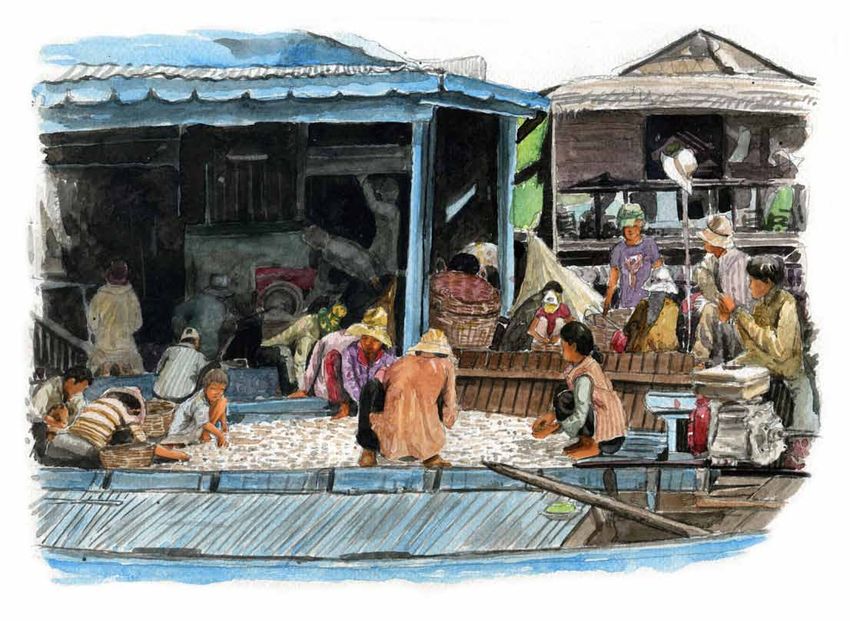
1. Saigon                                                4. Phnom Penh                                        7. Wat Nokor                                           11. Kampong Chhnang
    Saigon - today called                                    The capital of the Kingdom                           This modern Theravada Buddhist pagoda is squeezed      Kampong Chhnang is at the fertile
    Ho Chi Minh city - is located                            of Cambodia is located                               into the walls of an 11th century Mahayana Buddhist    and almost ever-wet heart of
    near the Mekong Delta                                    at the confluence of three                           shrine of sandstone and laterite. Many of the older    Cambodia. Due to its location next
    and is Vietnam’s largest                                 rivers - the Mekong,                                 building’s archways have been incorporated into        to the Tonle Sap Lake, the population
    metropolis. If every town                                the Bassac and Tonle Sap                             the new building as shrines for worship.               is predominantly involved in fishery
    had a symbol, Saigon’s would                             Despite its development,                             There is also                                          and rice plantation. This river port
    be the motorbike. More than                              Phnom Penh has retained its                          a large                                                town features a big fishery port.
    four million of them fly                                 charm and character: cyclos                          reclining
    along streets once swarming                              that weave through traffic with                      Buddha.
    with bicycles. Teeming                                   ease, broad boulevards, old
    markets, sidewalk cafés,                                 colonial buildings, parks
    massage studios                                          and green spaces, and above
    and centuries-old pagodas                                all its people who always have
    are just a part of what this                             a smile for you.
    charming city has to offer.
                                                             5. Chong Koh                                         8. Wat Hanchey
    2. Cai Be                                                Chong Koh Village is situated on an island                                                                  12. Kampong Thom
    Cai Be is very well-known for its colorful and                                                                Wat Hanchey is a beautifully situated hilltop pagoda
                                                             of the Mekong River. The whole village specializes                                                          Kampong Thom is a picturesque town
    luscious floating market. Onboard small sampans,                                                              that overlooks the Mekong River. The brick
                                                             in silk weaving and visitors are welcome to watch                                                           between Phnom Penh and Siem Reap.
    visitors can watch the locals trading fruit and                                                               structures of Wat Hanchey date back to the 8th
                                                             the silk weaving procedures. The beautiful                                                                  The Sambor temple and Prei Kuk
    vegetables on board their vessels. This small town                                                            century. It was an important religious center during
                                                             and colorful Khmer headscarfs are also for sale.                                                            temple are the two main temples here.
    offers its visitors also insights in producing coconut                                                        the pre-Angkor Chenla
                                                                                                                  Empire period.
    candies, pop-rice and rice paper. Nearby lush fruit      6. Kampong Cham                                      There are many                                         13. Siem Reap
    orchards invite for relaxation and fruit tasting.        Kampong Cham is the third largest city in            religious monuments                                    Siem Reap
                                                             Cambodia and has always been an important trade      and small buildings that                               is located on
                                                             and transportation hub. The town itself is quaint    remain spread out                                      the shores of the
                                                             and charming with its bustling morning river         over the large hilltop.                                Tonle Sap Lake,
                                                             scene and wide boulevard streets beside the river.                                                          the greatest sweet
                                                             With a few modern buildings only, it is rich                                                                water reserve in
                                                             in French architecture from the colonial period.     9. Prek K’Dam                                          whole South-East
    3. Chau Doc                                                                                                   Between December and June, when the water is too       Asia. The proximity
    Chau Doc is a pleasant town near the Cambodian                                                                low for crossing the Tonle Sap Lake, we disembark      of the world famous
    border with sizable Chinese, Cham and Khmer                                                                   the Jayavarman early morning in Prek K’Dam.            temples of Angkor north of the city
    communities. Its cultural diversity - apparent                                                                                                                       turned Siem Reap into a boomtown in
    in the mosques, temples, churches and nearby                                                                  10. Kampong Louang                                     less than half a decade. “Siem Reap”
    pilgrimage sites - makes it a fascinating place                                                               Kampong Louang is one of the last silversmith          literally means “Siamese defeated”,
    to explore. A special highlight is an excursion                                                               villages of the region and everyone seems to be        referring to the victory of the Khmer
    to the attractive floating villages with its catfish                                                          a silversmith, handcrafting delicate items that        Empire over the army of the Thai
    farms and bustling markets.                                                                                   are being sold in the markets and jeweller’s shops.    kingdom in the 17th century.
4                                                                                                                                                                                                                5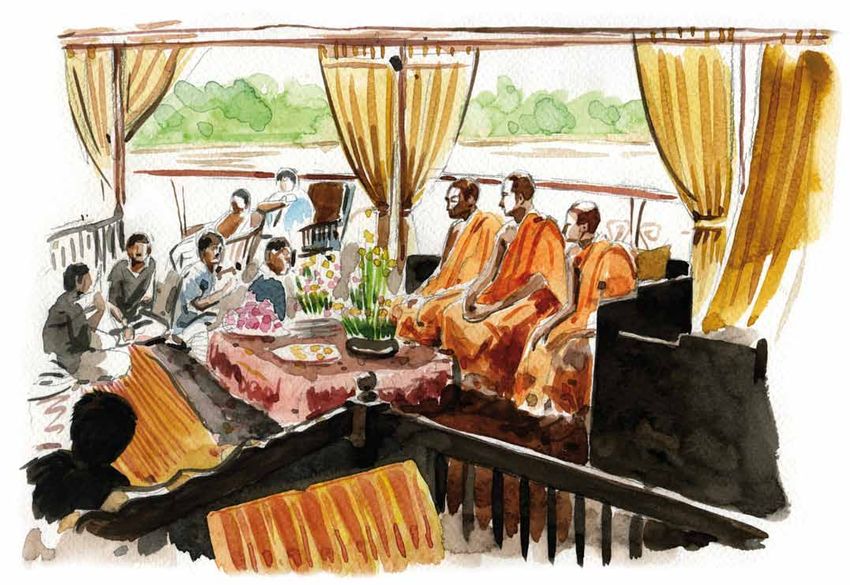
My father is Vietnamese, my mother is French. My visage is a mélange of both East and West. I was born
    and raised in France but for many years, I was enveloped by an irresistible quest to embrace my Vietnamese
    heritage. In 2000, I first traveled to Vietnam with little or no expectation. Like a dry sponge, I wanted
    to absorb everything that the country of my father’s birth had to offer. Thus, four years ago, I settled in Saigon.
    Since then, I have traveled for work many times from Vietnam to Cambodia, from Saigon to Phnom Penh
    and Battambang. It was on one of these journeys that I had the pleasure of the Jayavarman experience.
    Penning this travel diary is rather serendipitous. I ran into a long-time friend, Vinh, who was assisting
    his friend Aline write a “Carnet de Voyage” (travel diary) on the Jayavarman cruise experience. Both Vinh and
    Aline share a common heritage with me. They are Viet Kieu – descendants of Vietnamese nationals who fled
    the country, adopt a new homeland and have returned to the land they never knew or had once forgotten.
    Aline was commissioned to decorate the luxury cruise – Jayavarman – and was in search of an author and
    illustrator for the “Carnet de Voyage”. Later, I was introduced to Thomas. My experience as a graphic designer
    and the pivotal role I played in the creation of Sonleuk Thmey, a graphic design and illustration studio as well
    as my work in Phare Ponleu Selpak, a NGO in Battambang in Cambodia, probably convinced Thomas that
    I was the right person for the job. So, a few months later, I found myself, with bags packed, on this unforgettable
    voyage on the Jayavarman. My partner in crime was Borin, one of the illustrators and graphic designers
    of Sonleuk Thmey. It was his first time out of the country and he was understandably excited.
    For this assignment, I thought I’d throw in photographer and writer into my varied resume. After the weeklong
    cruise, I lugged billions of photos to Sonleuk Thmey, and it was here that the studio team – Borin, Ke, Sokhom,
    Vila, Borey and myself – built the “Carnet de Voyage”. Back home to Saigon, I started to write the text, while
    Sonleuk Thmey team turned the photos into sensitive watercolors.
    This is a book of images, a souvenir of my unforgettable experience. With photographs to capture – whenever
    possible – enduring snapshots of our experience. From the word go, this voyage – from Siem Reap to Saigon –
    was a delightful adventure. And so was the making of this diary.
    I dedicate it to my father, Tran Minh Tri.
                                                                                                    Anna Tuyen Tran

6                                                                                                                         7
Siem Reap

         My story begins in this historical city.

                                                    ‘‘Thnôt’’ or sugar palm, is everywhere in this     At 11 am, we gather at the Foreign Correspondents Club, a white edifice that once was the official
                                                    country. Locals proudly proclaim that everything   residence of the Ambassador of France. A sumptuous breakfast greets us. The other passengers
                                                    from the sugar palm tree can be used, except       begin to trickle in. Some alone, some in groups. Couples, families, singles. Small talk is made
                                                    the sound of the wind in its palms!                and bonds begin to develop. All are eager to get going.
8                                                                                                                                                                                                           9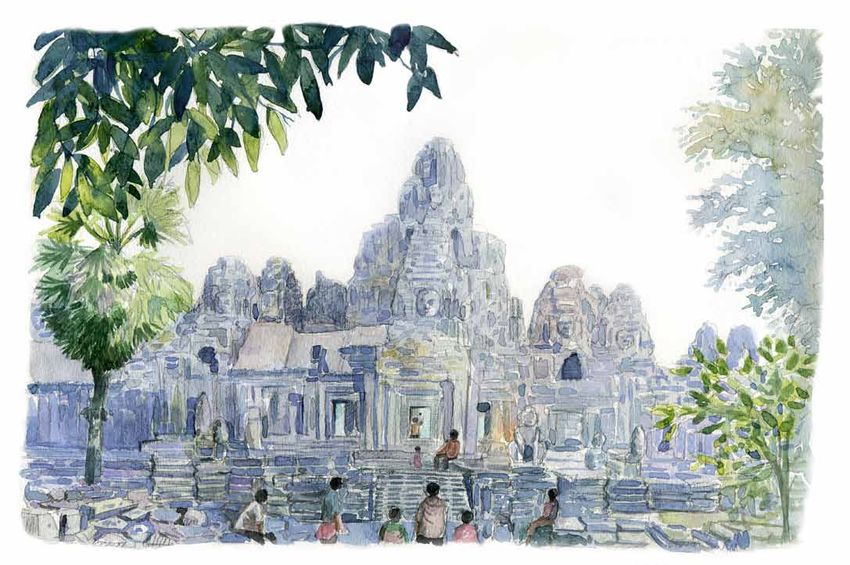
Tonle Sap Lake

                                                                                                             And the boat putters to life. The incessant rev of the engine seems to bother no one, not even nature.

     We leave Siem Reap for a 15-kilometer bus ride
     to Tonle Sap Lake. A small boat awaits us. The lake is enormous. It looks more like a sea.
     Vast and almost forbidding. Since it is December, the temperature was just right and not too hot,
     as I had expected. The smells of the sea waft through the air. They tickle your nostrils and quickly                                                              Suddenly, a young, agile Khmer jumps onto
     become almost familiar. The light afternoon sun shines on the lake. It looks like a painting.                     A merchant boat appears.                        our boat, armed with knick-knacks for sale.
10                                                                                                                                                                                                                    11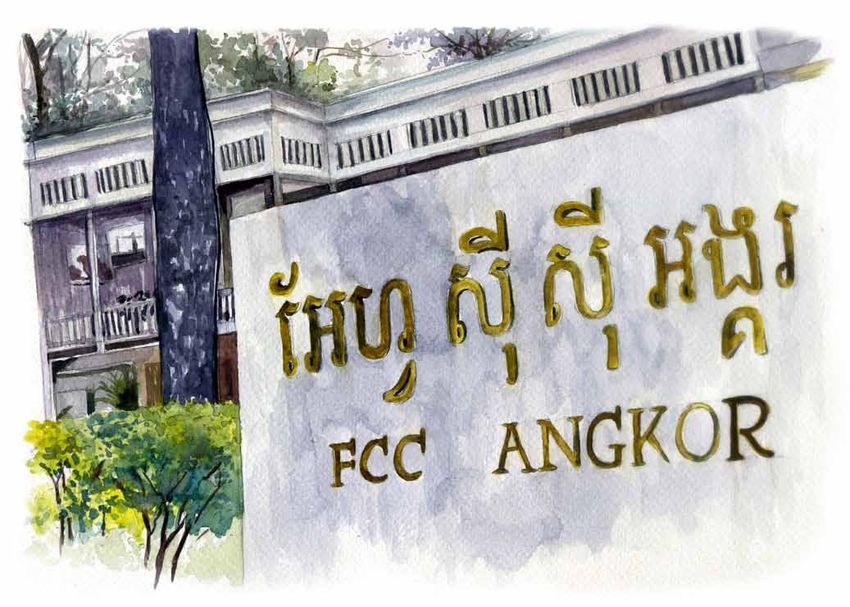
Angkor,
     Khmer city
                                     Prasat                          Bantey Prei
                                      Prei            Prah Khan

                                              Bayon
                                                                          Neak Pean

                                                           Ta Prom
                                      Angkor Thom
                                                                     Banteay        Sra
              Phnom                                                                Srang
                                                                       Kdei
              Bakheng

                                                           Prasat
                                                           Kravanh

                        Angkor Wat

                                                                                           The magic of the Angkor temple complex fills our souls. Magnificent. Imposing. Grandiose.
                                                                                           These words are simply inadequate to describe the temple complex that lies deep in the jungles
                                                                                           of Cambodia. The temples come in different shapes sizes and hues, piles of brick rubble
                                                                                           scattered through beautiful rice paddies. I remember Bayon...
12                                                                                                                                                                                          13
and the many Apsara,

                                                                    ... and of course, Angkor Wat, majestic, regal,
                       or a face hidden     I remember a statue     intimidating. Meanwhile, lulled by the buzz
                         in branches            of a noble lion     of the engine on the Tonle Sap Lake,
     ... or Ta Prom,     of Ta Prom,         in front of Bayon...   we finally approach our destination...
14                                                                                                                    15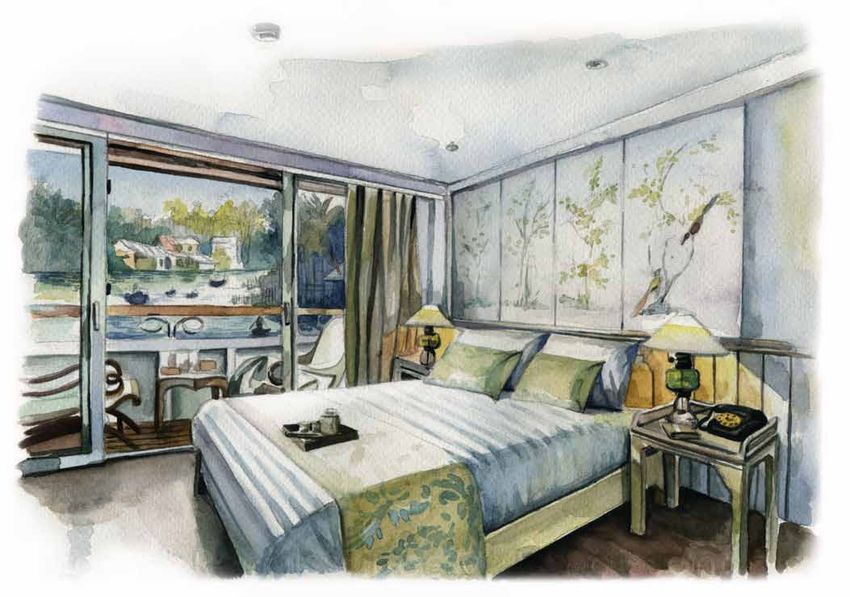
Welcome on board!

             And here is the Jayavarman. Like an imperial maiden awaiting her suitor.   The crew sharply dressed and with ready smiles, awaits us.
16                                                                                                                                                   17
A little tour of my cabin...
We explore our cabins. We take time to discover the little, delicate touches that make the Jayavarman
so unique. I am at once impressed by its beautiful decor. Obviously, a lot of thought had gone
into even the minutest detail. Everything is subtle, carefully planned to recreate the Indochinese style
of yore. I feel like I am caught in a marvelous time warp
18 19On the upper deck,
the Henry Mouhot lounge,
the observatory
and the library
At 2 pm, on the terrace deck, the doors of Jayavarman’s Indochine Dining Hall swing open
and a buffet spread beckons: braised fish fillet in lotus leaves, grilled lamb accompanied by fried
potatoes colored with saffron, rice of course, lots of salads and cheese bought in Saigon.
The air-conditioning in the restaurant gives much relief against the rising afternoon heat. L’Extrême Orient, the boutique shop
20 21After lunch, some trundle to their rooms for a nap, others play cards on the terrace deck
or bathe in the rays of sun on the rooftop.
The journey is so intoxicating - the languid waves, the seamless transition
from one border to another, the hypnotic sensation of the waves lapping against the ship. The sun sets at 6 pm every day throughout the year. The sunset that evening is simply splendid!
Like an inebriated lover, I lose my senses. I quickly forget which country I am in. A cloud cuts the sun into two and the hour turns magical. On the deck, the ship’s engines seem
I could be in anywhere in the world. softer and more cautious. A little evening breeze rises. The trip grows increasingly enchanting.
22 23Breakfast is divine: a delightful blend of East and West to suit any palate. Other passengers
are still in somnambulistic mode, carried to celestial heights with music by Edith Piaf...
This breakfast is so mouth-watering!
All kinds of croissants and bread
Many cereals and exotic fruit jams
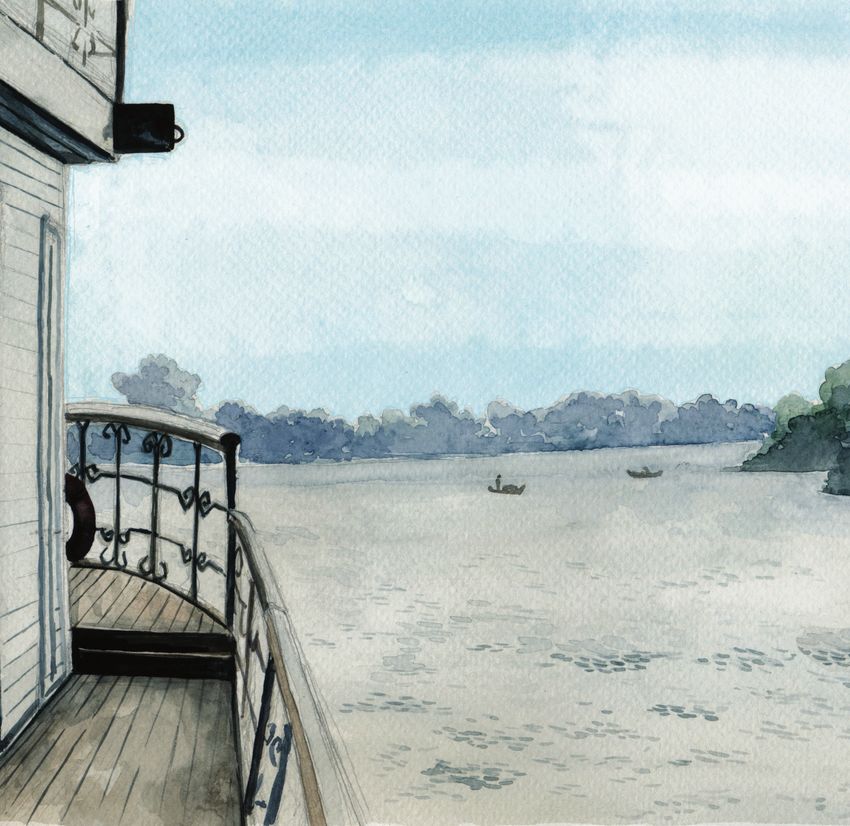
In the early morning, the Jayavarman sets sail to cross the Tonle Sap Lake. What beautiful light
at daybreak! I love the purring engines of the ship, which gently nudges me awake every morning.
From our deck, the view over the Mekong is sublime, and for a moment I wonder what crosses Cheese, ham, banana, mango, apple,
the minds of local people when the Jayavarman glides past the banks. Delicious and really juicy mangoes persimmon, dragon fruit, tangerine, and yoghurt
24 25... And another caffeine hit on the sun deck. Kompong Chhang
The natural elegance of the Khmer,
with soft colors of tan and blue, captures
my fascination.
On an excursion
boat, we discover
the Mekong,
and the tumultuous
life that accompanies it.
The scenery
is spectacular
along the border
of Kampong
Chhnang
province.
26 27Houses on stilts, many merchants and traders, and schools as well. It is an amazing life on the water. 28 29
At the market in Kampong Chhang, beneath the scorching sun,
     we visit the market with its diverse colors and hues.

                                              A hairdresser
                                              working
                                              on the street

                                                                   Big rice bags,
                                                                   which are later
                                                                   turned into
                                                                   recycled
                                                                   wallets,
                                                                   sold in
                                                                   Phnom Penh

     A seller
     of baskets                                                                      The statue of Kompong Chhang
30                                                                                                                  31
Kompong Louang
After lunch, as the Jayavarman continues its journey downstream, we stop at Kompong Luong.
We sit on two wooden carts attached to large oxen, and we cross the village. On the way,
smiling children on bicycles follow us with lotus flowers for sale. We then visit the temples
of Kompong Trolaeh, which are found in the middle of rice fields.
32 33Wat Hanchey
The following day, in the small hours
of the morning, with the weather still
Back on the Jayavarman, some monks gather to seek divine protection for the ship. The cruise welcoming, we visit the pre-Angkorian temple
in the afternoon wanders through the maze of the Tonle Sap River, which narrows down to a long of Wat Hanchey, located atop a hill
slender corridor before finally touching Phnom Penh. overlooking the Mekong.
34 35Some ride up
on the backs
of bikes,
called
“moto dop”
in Khmer, Special thanks
to the policeman
others trudge who paused
to the top for a proud
by foot. photo op!
36 37Monkeys
watching us!
Life here seems to have slowed to the pace of the monks.
A small snack at the end This very old structure does justice to the architecture
of the morning is very well of Chenla Empire, which predates the glories of the mighty Angkor.
appreciated. The view from above is really spectacular.
38 39Wat Nokor
To say ‘‘Hello’’
in Khmer, clasp
your hands in
prayer and say,
‘‘Chum riep
suer’’.
After another delectable lunch on the boat, we anchor on the shores of Kampong Cham and visit
Wat Nokor. Built within the ruins of an ancient temple, it holds a story from an undated past.
For the Khmers, it is time for the all-important afternoon nap!
40 41Phnom Penh
Legend has it that Phnom Penh was born at the hill called Madam Penh after the discovery
of Buddhist statues in the Mekong. The city has kept its colonial charm
And we were quite relieved to return to the ship after the tour with its wide tree-lined avenues and yellowed buildings, relics from the days of the past.
with a refreshing glass of iced tea awaiting us, like every day. Today, Phnom Penh is a city, bursting with colors, sounds and economic activity.
42 43The
Independence
Monument,
decorated
with one
hundred
snake
heads
To discover
this city, formerly
known as the
‘‘Pearl of Asia’’,
we ride in cyclos.
It was
so much fun! First, we visit the National Museum.
44 45Then, we visit the grand Royal Palace lest we forget that Cambodia still has a monarchy. The exit doors of the Royal Palace 46 47
Everyday life of Phnom Penh… filled with layers of exoticism.

                                                                     Tofu and vegetable fritters

                                                                                                   The central market,
                                                                                                         a must-see,
                                                                                                        has been only
                                                                                                               slightly
                                                                                                             renovated
                                                                                                           in order to
                                                                                                             retain its
                                                                                                               original
                                                                                                              heritage.

48                                                                                                                        49
That evening, on our boat, there is a traditional
Khmer dance show. Accompanying the soothing
traditional Khmer music is a delicious buffet.
After a tour
of the historic
and vibrant capital,
we pause for lunch
at Khmer Surin,
a well-appointed
Cambodian restaurant.
50 51From the port, we see the Cambodian-Japanese friendship bridge. Memories of this nation’s violent
past trickles back. My thoughts race to S21 – the notorious torture museum. A tragic chapter
With the sun peaking over the Mekong, one wakes up for tai chi on the sun deck. in Cambodian history. Etched indelibly in the minds and hearts of older Cambodians.
52 53The passengers now
forgo footwear
as they wander about
the boat: one relaxes,
one reads a book or
quaffs a light cocktail,
one remakes the world,
another takes pictures,
This morning, nobody is sure of our time of departure but it doesn’t matter anyway. lying down on the bridge,
I simply love this ship! I wish this journey would never end. I will cross the world others chat.
on the Jayavarman to meet everyone on the planet. Time reaches a standstill.
54 55The essential fish sauce
is called “nuoc mam.”
Preparation for the traditional
Cucumber, For spring rolls, we must place the ingredients, one by one, Khmer amok with coconut milk
carrot, into the rice paper before rolling them like cigars. is usually served in a banana leaf.
peeled prawns,
soya bean
sprouts,
lettuce, basil
to prepare
spring rolls
Lazy day. The crew apparently made arrangements for us to enter into Vietnam Spring rolls, ready Dragon fruit Persimmons Papaya, delicious Tiny
but we didn’t notice anything! This is a perfect time for a cooking class on Asian cuisine. to be savoured with a lime zest quail eggs
56 57At the border in Vietnam
We pass a fishing boat and some small crafts. The border is marked clearly and near the horizon,
a Vietnamese flag flutters in the wind. Drifting down the middle of the Mekong River, we cross
the border.
58 59Chau Doc
Chau Doc
market
Vietnam is a land of water, fans and motorcycles...
In a worn-out cyclo, we discover the ragged streets of Chau Doc and with its explosive mix The Vietnamese love flowers for offerings
of smells, moods and dampness. The working class and squatting merchants fascinate me. to the gods or to decorate their houses. Rice from all countries around
60 61The temple
of Lady Chua Xu
Of course we’re in Vietnam.
The Latin alphabets
and conical hat prove it!
Local residents lug onto
their motorcycles bundles balanced precariously
The famous Honda Cub, a small motorcycle from the 60’s of stuff yet unknown. Scenes of daily life in Vietnam. And offerings
62 63Later we return to the quay and begin a boating excursion to the floating villages
including a shore excursion to the village of the local Cham Muslim community.
64 65Cai Be
The next day begins with a visit to the colorful floating market of Cai Be. We cruise aboard
Cai Be Princess among the local sampans that are filled with fruits and vegetables from all provinces
of the delta. The scenery is so beautiful along the river. We glide along discovering the typical
rural life of the Mekong Delta. The scenery is breathtaking. The cathedral of Cai Be which is almost on the water
66 67Young Vietnamese women wrap themselves up
completely; their arms disappear under long gloves
to shield them from the sun. I hear loud voices
We see several interesting houses and other things that catch my attention... and laughter, like music escaping from houses.
68 69We pause to visit a coconut candy and rice cake
manufacturing shop.
My love for the Mekong delta is quite possibly biological – my family is originally from here.
My grandfather was from Ben Tre and my grandmother was from Sa Dec. They lived here when
Marguerite Duras was also growing up on the Mekong. Names like Annam, Tonkin, and Indochina
resonate like roots anchored in the minds and hearts of French people. Then back to the lovely Cai Be Princess.
70 71The Longanier
We eat at the Longanier, a magnificent Indochina era villa, located in a lush tropical garden
on the banks of the river. Here we taste the famous giant catfish of the Mekong.
There are small paradises like this, hidden in nature along the Mekong.
72 73And the Mekong continues to unfold its many arms like myriad tentacles
that earned it the nickname ‘‘Nine Dragons ’’.
Finally, it is time for the farewell dinner. This will be
our last night on the Jayavarman. At My Tho, the sky is heavy; the storm descends onto the town,
like a stampede of factory workers at the break of lunch. This is the end of our cruise. I rest on
the terrace deck with Louis Armstrong’s ‘‘It’s a wonderful world ’’ wafting softly in the background.
74 75Saigon
Iced coffee is the favorite
drink of the Vietnamese,
perhaps after beer.
Saigon is booming. The city is trying to strike a precarious balance between modernity and tradition. It
borrows hungrily from the West whilst trying to ensure its Eastern face remains unsullied. It changes;
it changes quickly. It wants to make up for lost time, halted by the wars and conflicts of the past.
As it sheds its past, does it lose its beauty? I think not. If the future of this country, my country,
emerges as it sheds its past, it also welcomes those who wish to enjoy its treasures. I love Saigon!
76 77Some say Saigon is crazy, the town is crazy, and its life is crazy, everything moves at breakneck speed.
It is not only the thousands of motorcycles which fill the intersections from the small hours of
the morning, but gargantuan buildings which mushroom at every corner… they grow fast, too fast,
along with private residences, tall and narrow, and a swarming blanket of sounds and noises.
Blaring television sets and karaokes, along with the babble of Vietnamese voices and the thousands
of horns, fill the streets. The Vietnamese like the noise, it reassures them! When the Vietnamese
shout ‘‘Hey, you!’’ or ‘What do you want to buy?’’ this is not an invasion of your space. These are words
they have learned by rote. They wish to draw your attention to them. These little things grow on you
when you live here for a while like I have.
I try to adapt, but for the Vietnamese, my eyes are not slanted enough, my nose is not a nice little
button in the middle of my face and my hair is not long, straight or black enough. And with my
toddler’s feet, I will always be a foreigner, a foreigner who lives here, yet still a stranger.
But who cares, I feel at home in Saigon!
78 79Buth Sonrin Prak Ke Roeun Sokhom Hiek Vila Chin Borey
This “Carnet de Voyage” has been illustrated by Sonleuk Thmey, graphic design and illustration studio
of Phare Ponleu Selpak in Battambang, Cambodia.
It all starts in 1986 in the refugee camps on Site 2. Cambodian children meet up at a drawing workshop.
Seven years later, they return to their country. They decide to stay together; they establish Phare Ponleu Selpak
with the vision that in order to create peace, it is necessary to allow everyone, particularly the most vulnerable,
to rebuild a dynamic cultural ethos… The years go by. Phare Ponleu Selpak’s school of plastic arts is renowned
throughout the country. It is the same for the music and circus schools, which take part in numerous international tours.
Then, in a more and more acute way the question of professionalism is raised. Sonleuk Thmey is an obvious response.
The young practitioners of the school of visual arts are poised to take advantage of the Cambodian, and by extension,
the Asian work market. Sonleuk Thmey is a professional milieu. The young graphic artists work on commissions
and earn their living this way. They are nevertheless supervised by specialist members of Phare Ponleu Selpak,
thus offering a guarantee of quality to their clients.
But Sonleuk Thmey also needs support from everyone! (Please, visit www.phareps.org)
This “Carnet de Voyage” was inspired by Aline Ho, interior designer.
The editorial conception and art direction was spearheaded by Anna Tuyen Tran.
Special thanks to Mehran Chinniah for editing the English of this text.
Acknowledgments:
Vinh Than Trong
Nam Bui The Trung
Justin Barrera
Lucien Do
and all passengers and all crew members
Collectors Artisans Hosts
Text © 2010 by Anna Tuyen Tran
Illustrations © 2010 by Sonleuk Thmey
Printed in Ho Chi Minh city by Truong Tin Printing House, October 2010
80You can also read


