A Russian Military Framework for Understanding Influence in the Competition Period - Army ...
←
→
Page content transcription
If your browser does not render page correctly, please read the page content below
A Russian Military
Framework for
Understanding Influence in
the Competition Period
Tom Wilhelm
Information has become a destructive weapon just like a    to gain freedom of action in any domain. This is done
bayonet, bullet or projectile.                             through the integration of political and economic
                                 —Vladimir Slipchenko      actions, unconventional and information warfare,
                                                           and the actual or threatened employment of conven-
                                                           tional forces.1 “Russia exploits the conditions of the

T        o the U.S. Army, a competition period is
         described as actions over time that exploit the
         operational environment conditions in order
to gain a position of advantage below the threshold
of armed conflict. At the crux of competition is the
                                                           operational environment to achieve its objectives by
                                                           fracturing alliances, partnerships, and resolve, par-
                                                           ticularly through the effective use of information in
                                                           undermining friendly will.”2 In various forms, this
                                                           description of Russian influence is prolific throughout
ability to create a strategic and operational standoff     Western security analysis. The prevailing views often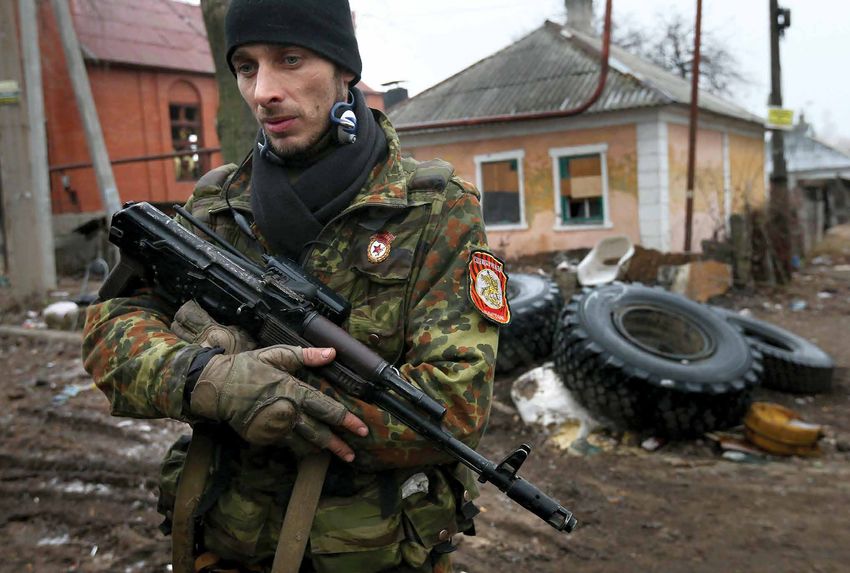
UNDERSTANDING INFLUENCE

 include the notion that much of Russian influence                         to modern hybrid wars.”5 For the Russian military
 over events is planned and orchestrated. This is cer-                     establishment—a keeper of Russian strategic culture
 tainly true in many instances; however, identifying                       and its premier planning institution, the General
 the wiring of Russian influence can be difficult as it                     Staff—this has been alarming, and members have
 can not only come from planned operations but                                    been working to come to grips with it.
 also from standard geopolitical practice,                                                   There are a variety of frameworks that
 spontaneous civic activities, and                                                            provide a way to understand how
 many other actions and events                                                                    Russian influence plays out in the
 that contribute to achieving                                                                         current operational environ-
 Russian objectives.3 The ac-                                                                            ment. These frameworks are
 tors can come from across                                                                                often focused on partic-
 the entire government and                                                                                 ular military events or
 yet not be whole-of-gov-                                                                                   explained at sociocultural
 ernment. Russian influ-                                                                                    and political-strategic
 ence can involve many                                                                                      levels. These models range
 aspects of Russian society                                                                                from case study analyses to
 and other governments                                                                                      a summing-up of Russian
 and their societies, and                                                                                   mentality and tradition,
 it can include extralegal                                                                                 to Kremlinology, and to
 networks too. Adding                                                                                      mirror reflections of what
 to this are other insoluble                                                                            the military claims the West
 factors such as the opaque                                                                            is doing to Russia.6 All offer
 institutional dynamics in                                                                                invaluable insight; howev-
 Kremlin decision-making                     Emblem of the General Staff of the Russian Armed Forces      er, in terms of a distinctive
 and the secret activities                         (Graphic courtesy of Wikimedia Commons)                framework built from
 of the Russian security                                                                                  Russian military insight,
 services including its armed                                                                             developments of the
 forces and General Staff. Confounding outsiders even                      General Staff reveal a useful model for examining all
 more is that any event and activity can be denied                         levels of influence in the competition period.
 or can be the result of bardak (a particular Russian                          The Russian military does not directly or fully
 understanding of fiasco). But events that occur while
                                4
                                                                           illuminate what it does in conceiving, developing,
 competitively vying to shape and control the security                     implementing, and coordinating actions to affect
 environment can also be confusing for the Russians                        what it describes as the “amalgam of calculation and
 themselves and for the military in particular. As                         risk” of its adversaries.7 To a significant degree, its
 leading Russian military theorists I. A. Chicharev, D.                    process is dogmatic, secretive, and opportunistic at
 S. Polulyah, and V. Yu. Brovko observe, the operation-                    the same time. Moreover, sometimes Russian influ-
 al environment is characterized by “the confusion of                      ence events obviously involve the armed forces, and
 military and non-military array of tools [that] belong                    at other times, the armed forces seem to grapple and
                                                                           play catch-up with actions that defy their deep cul-
                                                                           ture of planning.8 Nevertheless, surveying some of the
                                                                           General Staff ’s doctrinal developments resulted in a
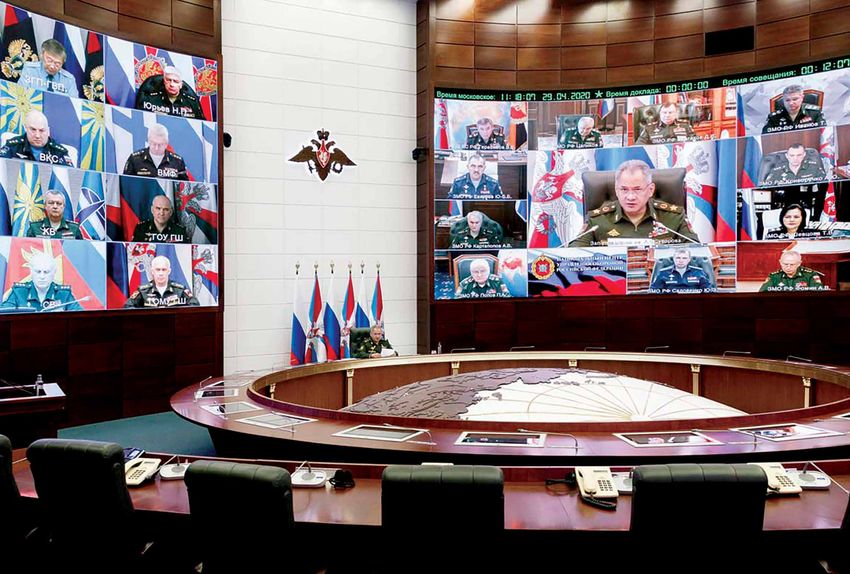
Russia’s Defence Minister Sergei Shoigu holds a virtual meeting of the     structured exposure to how the Russian military may
Russian Defence Ministry Board in Moscow on 29 April 2020 that             look at influence, particularly in the competition peri-
includes Chief of the General Staff Valery Gerasimov, other key Gen-       od. There is also the potential to see how they can be
eral Staff members, and other Russian military leaders. The meeting
                                                                           expected to deal with it going forward, even emerging
was held to discuss a variety of issues including measures to mitigate
adverse impacts of the COVID-19 pandemic. (Photo courtesy of the           with a more consolidated and central role among the
Russian Ministry of Defence)                                               state’s security institutions.

MILITARY REVIEW        July-August 2020                                                                                             33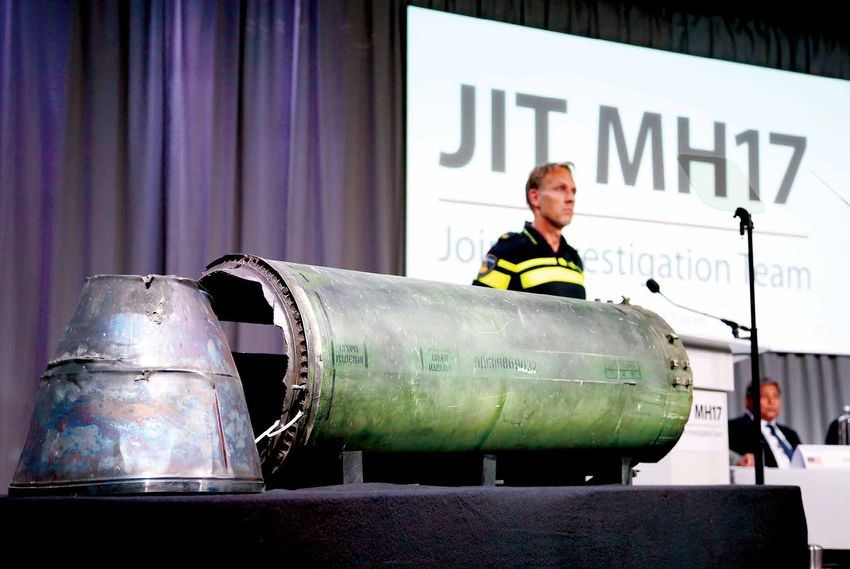
Influencing the Defense of the                                Through its media outlets, Russian combat-system developers assert
Russian World and the Goal of                                 that Russian military robots (as shown in the photo) using sophisticated
Information Warfare                                           artificial information will soon have “nearly human capabilities” that
                                                              will enable them to independently evaluate the changing conditions
    As described in the official military policy, Russia      they face, plot new courses of action, communicate and coordinate
will take military measures to provide for “the safety of     with other machines, and make battlefield decisions without human
the vital interests” of individual Russians, the society,     involvement. Such assertions are at least in part intended to intimidate
                                                              prospective adversaries. (Photo from RT)
and the state.9 Military risks and threats include a
“rivalry of proclaimed values and models of develop-
ment.”10 The policy, however, instructs the military
establishment to apply measures “only after political,        academics, such as Nobel laureates.”13 According to
diplomatic, legal, economic, informational, and other         the military, the goal of influence domination, in this
non-violent instruments have been exhausted” but              context, is described as protecting national interest
does not preclude the military’s participation, support,      by “countering” and “suppressing” attacks against the
or the development of its capacities in any of these          promotion of Russia and its defense of a Russkiy mir
domains.11 In fact, as the doctrine further notes, “There     (Russian world).14 In the information domain, Russian
is a tendency towards shifting military risks and mili-       military science divides information warfare into infor-
tary threats to the information space.”12 This is a telling   mational-technical, which can incorporate cyberattacks
statement because information warfare is something            and electronic warfare, and informational-psycholog-
Russians have developed significantly in their military       ical, which includes a wide range of activities aimed
science over decades. Empowered by this doctrine,             at creating unpredictability. In the latter, legitimate
which equates to national policy in Russian statecraft,       appearances are maintained but content is changed and
the General Staff ’s contemporary list of information         the context of information is transformed to fit objec-
warfare components indicates an imaginatively broad           tives.15 According to the military, the ultimate effect of
vision. It includes international media centers, military     influencing operations would be to have an adversary
bases abroad, human rights organizations, movie and           “self-disorganize” and “self-disorient.”16
computer gaming industries, private military com-                 Words matter. The significance of this in Russian
panies, and even “the need to use world-renowned              military thought is also evidenced in the evolution of

34                                                                                        July-August 2020     MILITARY REVIEW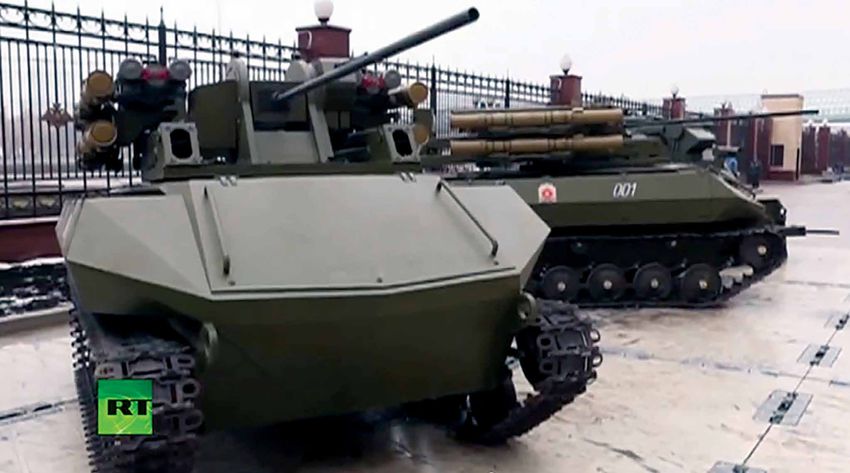
UNDERSTANDING INFLUENCE

its military terminology. Russian terms of operational        launched to accomplish this are “information strikes.”23
art have doctrinal weight. The military, often through        The purpose of “specially created channels” to insert
the Military Academy of the General Staff and related         erroneous information may include organizations such
higher military educational institutions, chooses and         as the General Staff ’s Main Intelligence Directorate
uses words carefully after deliberate consideration           but expressly includes the public media.24
over time. The lexicon of Russian military science is             This evolution of terms signals that the General
used to ensure that planning proceeds toward calcula-         Staff is building a very particular foundation. It is an
ble ends and that force-wide developments are an-             understanding of not just how information warfare
chored to a common ground. In the realm of influence          is contextualized in forecasting and describing the
and influence operations, some key terms associated           nature of conflict but how influence actions can be
with Russian information warfare have been deliber-           operationalized or at least dealt with in a more calcu-
ately evolved in this way, revealing motivations and          lable way. For instance, taken together, these concepts
directions of the General Staff. Some terms are in a          are much more than planning and mounting an oper-
state of consideration, indicating that there is still on-    ation to divert, mask, or deceive an enemy in a tactical
going General Staff doctrinal developments; still, other      moment; the aim is to ultimately shape or change the
terms have appeared to guide the General Staff work           nature of the conflict itself.
in the current operational environment. For example,              Influence and Russian operational art. In
the term “propaganda,” holding onto its Red Army              2015, then chief of the Russian General Staff ’s
roots, still exists officially to mean the government’s       Main Operational Directorate, Gen.-Lt. Andrei V.
“purposeful” wisdom.17 However, the military hardly           Kartapolov, published an article in the Journal of the
uses it in that positive sense in its current writings, and   Academy of Military Science that described “new-type
instead, the nondoctrinal, negative sense of the term         war.” His article, a work of trend analysis, solidified
pops up more often as something practiced against it.         the General Staff ’s previous forecasting and historical
“Counter-propaganda,” once a common feature of the            surveys. The most famous of these was done by S. G.
Russian military lexicon and used to explain negative         Chikinov and S. A. Bagdonov that was understood by
information contrived by adversaries, is in a kind of         Western analysts as “Russian new-generation warfare’,”
doctrinal term limbo, and Russians seem to be search-         and was also used by Chief
ing for other ways of expressing this.18 Some old terms       of the Russian General            Tom Wilhelm has served
are receiving a face-lift: “sabotage,” for instance, has      Staff Valery Gerasimov’s          as the director of the
been expanded to embrace the context of information           own publication on                Foreign Military Studies
operations; the doctrinal terms for “deception,” “misdi-      foresight, the erstwhile          Office (FMSO) since 2007.
rection,” and “disorientation” are becoming synonyms          “Gerasimov doctrine.”             FMSO conducts open-
in describing influence effects.19 The standard defi-         Critically, Chikinov and          source research, focusing
nition of “defense” now includes the “use of precision        Bagdonov believed that            on the foreign perspec-
weapons and highly effective means of information             strategic goals would not         tives of understudied and
warfare.”20 Other terms like “controlled chaos technol-       be accomplished unless            unconsidered aspects of
ogy” in the “cultural-philosophical sphere” of “hybrid        information superiority           the operational environ-
war” are newer concepts and in a state of discussion          was assured; Gerasimov’s          ment. Over his career as
and development, along with “information packet”              work indicated that the           a U.S. Army foreign area
and “simulacra” related to “reflexive control,” which         ratio of nonmilitary to           officer, he has worked
is inclining an adversary to make decisions on his            military measures in fu-          and served with Russians
or her own accord that are predetermined to favor             ture war was four to one.25       and the Russian military in
the protagonist.21 “Disorganization” aims at creating         In terms of military art in       diplomatic assignments,
“mismanagement”; “fragmentation,” similarly, refers           what the West recognizes          operational missions, field
to actions that disrupt the enemy’s decision-making           as the competition period,        training exercises, arms
at crucial times but particularly highlights isolation of     Kartapolov noted a “set           control implementation,
key players from making those decisions.22 Operations         of indirect actions” that         and academic programs.

MILITARY REVIEW     July-August 2020                                                                                    35
characterize “new-type war” including “hybrid war.” This      A damaged Buk missile is displayed 24 May 2018 during a news con-
list of the forms and methods—a specific nomenclature         ference by members of the joint investigation team, comprising author-
                                                              ities from Australia, Belgium, Malaysia, the Netherlands, and Ukraine, in
of Russian military science—was based on the General          Bunnik, Netherlands. Moscow continued to deny involvement in the
Staff ’s historical analysis of what it believed the West     destruction of Malaysia Airlines Flight 17, even as an international team
had been doing to attack Russia since before the end of       of investigators said that detailed analysis of video images and photos
the Cold War.26 Given his position at that time and now       had unequivocally established that the Buk missile that brought down
                                                              the plane over eastern Ukraine nearly four years ago came from a Rus-
as the deputy minister of defence and chief of the Main       sian-based military unit. (Photo by Francois Lenoir, Reuters)
Military-Political Administration, Kartapolov’s descrip-
tion of the methods can be seen as serving a couple of
critical purposes. First, it has been a beacon over key de-
velopmental years to orient the General Staff ’s doctrinal    (2) disorientation of the political and military
work and planning focus. Second, it has also illuminated          leadership;
Russian intentions with regard to the nature of contem-       (3) spreading dissatisfaction among the population;
porary conflict with great consistency.27 In this context,    (4) support of internal opposition in other countries;
Kartapolov’s description can be understood as a road-         (5) preparing and deploying armed opposition;
map of Russian development and practice.                      (6) deployment of special forces;
                                                              (7) conduct of subversive acts; and
An Applied Look at                                            (8) employment of new weapon systems.28
Kartapolov’s Framework                                        Some exemplars can help demonstrate how the
   The framework has eight parts and involves more            General Staff may consider influencing actions
than just the military institution:                           through the competition phase and initial phase of
(1) political, economic, informational, and psychological     warfare. (This is not meant to be a definitive list or
    pressure;                                                 analysis of events.)

36                                                                                         July-August 2020     MILITARY REVIEW
UNDERSTANDING INFLUENCE

    Political, economic, informational, and psycho-                         dubious weapons transfer documentation, and simula-
logical pressure. As an influence method, political,                        tions of a fabricated Ukrainian surface-to-air missile or
economic, informational, and psychological pressure                         military aircraft attack. Today, a majority of Russians
can include commonly practiced military engagements                         believe that their country was blameless as do some
and multilateral exercises that Russia uses to devel-                       Ukrainians and even the Malaysian prime minister at
op and to shape political and military relations and                        the time, Mahathir Mohamad, who stated his support
partnerships. For instance, military advancements in                        of Russia’s “no-proof ” position.29 Overall, this effort
robotics and increased presence in the Arctic encour-                       could be seen as an array of decoy actions that frag-
age a sense of competitive advantage to outsiders. This                     mented unifying condemnation of Russia.
is classic, effective military propaganda in accordance                         Support of internal opposition in other countries.
with the Russian definition.                                                One way Russia supports internal opposition abroad is
    Disorientation of the adversary’s political and                         with state-sponsored paramilitary organizations. The
military leadership. Most major Russian media                               use of these quasi-state forces develops pro-Russian
remain quasi-controlled by the Kremlin and thus                             constituency, discredits other narratives, and acts as an
serve to disseminate                                                                                                instigating force or
Kremlin-approved                                                                                                    alternative police.
messages at home                                                                                                    This could be con-
and abroad. Each                                                                                                    sidered a disorga-
of the major tele-                                                                                                  nizing activity. The
vision and radio                                                                                                    Cossacks who were
stations also offer                                                                                                 deployed as alter-
military-themed                                                                                                     native, pro-Rus-
programs, many of                                                                                                   sian police forces
which are support-                                                                                                  in the immediate
ed by the Ministry                                                                                                  aftermath of the
of Defence and                                                                                                      Crimean seizure
not only highlight                                                                                                  are an example of
the latest military                                                                                                 these citizen militias
developments and                                                                                                    coordinating and in-
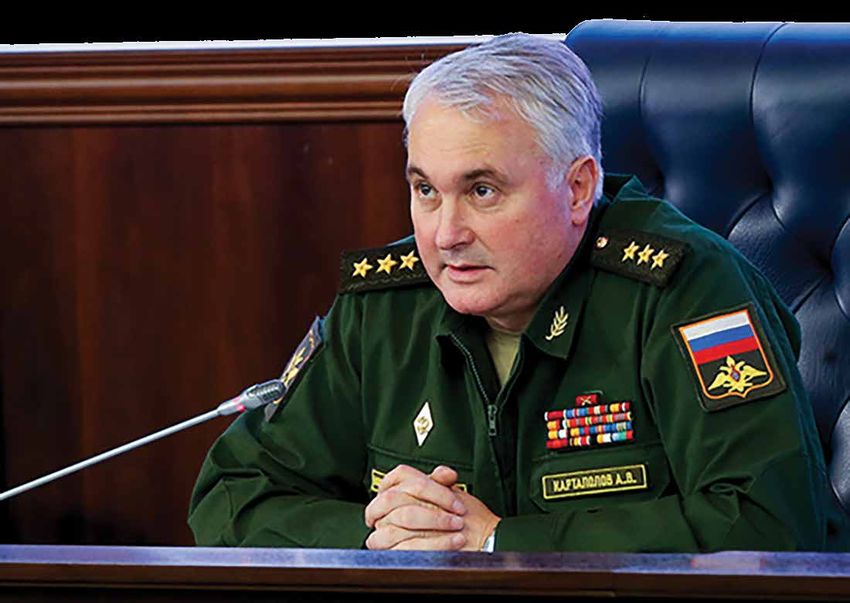
promote the image           Col.-Gen. Andrei Kartapolov, chief of the Main Operational Directorate of the           tegrating in Russian
of the military but         Russian General   Staff, conducts   a press  conference  19 November    2015  detailing military operations.
                            the results of Russian air strikes in Syria. (Photo courtesy of Ministry of Defence of
also inculcate the          the Russian Federation)
                                                                                                                    In the current
Kremlin’s threat                                                                                                    Russian military
portrayal. President                                                                                                encyclopedia, the
Vladimir Putin’s descriptions of new “invincible” weap- Union of Cossacks is specifically noted as a legitimate
on systems promote a sense of Russian strength and                          organization of the “defensive work of the masses.”30
an alternative strategic security environment in which                          Preparing and deploying armed opposition.
Russia has advantage. These activities have propaganda                      Within the targeted state, the support of separat-
value in promotion of Russian objectives but can also                       ist militias in Eastern Ukraine has many examples.
disorient outside observers and decision-makers.                            In late May 2014, for instance, a group of outside
    Spreading dissatisfaction among the target pop-                         fighters who supported Ukrainian separatists—the
ulation. Many Russian influence activities have made                        Vostok Battalion—led a series of attacks in and around
headlines. One such event is the Malaysian airliner                         Donetsk. The fighters, many of whom said they were
(MH-17) that was shot down over a separatist-con-                           Chechen, appeared in Ukraine less than one month
trolled territory in Ukraine. In this case, the Russian                     after Chechen head of state Ramzan Kadyrov threat-
military establishment supported its government’s                           ened to send troops to fight in Ukraine. (Chechnya is a
response with the use of outdated satellite imagery,                        federal territory of Russia.)

MILITARY REVIEW        July-August 2020                                                                                                37
Deployment of special forces. The deployment of the competition period. Unit 26165, the military’s cyber
special forces may include a range of military forces, hacking unit, is one well-known example. It was widely
so “special” in this case means more than just special noted that during the Ukrainian conflict, other cyber/
operations forces. The iconic “Polite People” who software spying and attacks anonymously contacted
facilitated the takeover of Crimea are one example. adversary soldiers on their cell phones to intimidate or
Another example includes regular armed forces sol- persuade them into quitting their posts.32 Russia also
diers deployed in deception, such as those members in jammed GPS signals during NATO military exercises
support of Ukrainian separatists groups. More recently, and conducted provocative proximity and laser opera-
special forces can be seen in its broadest, interagency tions against various commercial and military satellites.33
sense in November 2018 when three Ukrainian navy Although obviously offensive, the tests of hypersonic
ships were seized en route to a Ukrainian port in the munitions fit the new-type war paradigm by informa-
Sea of Azov.31 The coordinated operation included tionally “defending” Russia in the competition period.
forces from several agencies and services including the Taken together as prescribed by the Russian General
Russian military. In Syria, the Russian Military Police, Staff and viewed as methods of Russian military science,
as the principal force in securing and delivering hu- the framework that Kartapolov anointed may be richer
manitarian aid, support the strategic Russian image in than other sociocultural and strategic models and pro-
this conflict. This demonstrates the whole-of-govern- vide a holistic understanding of how the Russian military
ment part of new-type war and might be considered may observe and deal with influence activities.
“specially packaged information” aimed to reflexively
influence the opinions of other states. “Вперед!” (Forward!)
Conduct subversive acts. Russia will conduct sub- The General Staff is gaining a central role among
versive acts such as its role with General Staff ’s Main Russian security organizations for the development,
integration, and
coordination of the
The RAND report Russia’s Hostile Measures: Combating Russian Gray Zone national concepts
Aggression Against NATO in the Contact, Blunt, and Surge Layers of Compe- and the doctrine for
tition provides analysis stemming from research focused on examining the the defense of the
diverse means and methods Russia is using to threaten the security and un-
state. Specifically,
dermine the stability of members of NATO. It is part of the larger research
in a draft of an up-
project, “Russia, European Security, and ‘Measures Short of War,’” sponsored
coming presidential
by the U.S. Army Deputy Chief of Staff, G-3/5/7. The purpose of the overall
project was to provide recommendations to inform the options that the Army
decree, the General
presents to the National Command Authorities to leverage, improve upon,
Staff is designated
and develop new capabilities and address the threat of Russian aggression as the supervising
in the form of measures short of war. To view Russia’s Hostile Measures, visit organization for
https://www.rand.org/pubs/research_reports/RR2539.html. the armed forces,
the National Guard
troops, the other
military forma-
tions and agencies
Intelligence Directorate officers in a spate of assassi- such as the Federal Security Service, Federal Protective
nation, sabotage, and other mokroye delo (wet work) Service, Ministry of Emergencies, and the country’s
abroad. Besides achieving objectives of the attack, the defense industrial complex, as well as other law enforce-
informational and influencing aspects of these opera- ment agencies and local authorities regarding issues of
tions also serve to disorient, fragment, and disorganize defense. Putin himself declared this to be “the military
in accordance with Russian operational art. organization,” creating a legal bridge over any gaps
Employing new weapons systems. Russia has been between the military and nonmilitary space in terms
employing new weapons systems to achieve influence in of coordinating state efforts and evolving that security
38 July-August 2020 MILITARY REVIEWUNDERSTANDING INFLUENCE
collective from what was previously described in the Not far from the Donetsk International Airport in Donetsk, Ukraine, a
national military policy.34 It also makes good use of the man from the Vostok battalion of the Donetsk’s People’s Republic pa-
trols the city’s Oktyabrsky residential area 16 December 2014. (Photo
General Staff ’s deep culture and institutional design for by Valery Sharifulin/TASS/Alamy Live News)
detailed planning. The General Staff has downplayed
this, indicating that the decree mostly provides clearer
legal authorities for functions already undertaken such
as mobilization and arms exports. However, concom- According to the Russian General Staff, this period
itant initiatives that are enhancing centralized, secure is persistent and pervasive. It is seen and experienced
command and control (e.g., the National Defence by many but can also be elusive to investigation and
Management Center, the consolidated National Guard, analytic frameworks. Not everything is an informa-
and sovereign and military communication networks) tion operation. To get better clarity, Russian military
make it easy to imagine more integrated, whole-of-gov- science provides a useful porthole. From doctrinal
ernment defense and security activities networked discussions over time, the General Staff has revealed a
through the General Staff. It is also not hard to see how structured perspective aimed at justifying a broad use
the Russian military, in such a supervisory position, will of information warfare and other supportive activities,
be able to better argue for desired funding and other especially for the competition period. That framework
state resources. At the very least, such development will and consensus on the key forms and methods—derived
help the General Staff develop doctrine that overcomes from their military science—gives an outside observer
the inherent confusion it loathes while waging more a Russian-based opportunity to consider influencing ac-
effective influence in the competition period. tions that can simultaneously range from sociocultural
In the period of conflict that precedes actual com- to strategic to tactical. It gives the Russians their best
bat, competition for influence is the most prevalent. institution to bring that together.
MILITARY REVIEW July-August 2020 39Notes
Epigraph. Makhmut Akhmetovich Gareev and Vladimir Heather A. Conley et al., The Kremlin Playbook: Understand-
Slipchenko, Future War (Fort Leavenworth, KS: Foreign Military ing Russian Influence in Central and Eastern Europe (Washing-
Studies Office [FMSO], 2007), 33. ton, DC: Center for Strategic and International Studies, Octo-
ber 2016), accessed 14 February 2020, https://www.csis.org/
analysis/kremlin-playbook. The authors describe a “unvirtuous
1. U.S. Army Training and Doctrine Command (TRADOC) cycle” of corrupt political and economic influence resulting in
Pamphlet 525-3-1, The U.S. Army in Multi-Domain Operations “state capture.”
2028 (Fort Eustis, VA: TRADOC, 6 December 2018), vi, 6–7. See also a comparison of several models in James P. Farwell,
2. Ibid., vi. “Adversarial Tactics to Undercut US Interests in New Generation
3. For highlights of implementation of Russian influence Warfare 2019” (Boston: NSI, 3 May 2019), 6–9.
actions and information operations in the Ukrainian conflict, See also Timothy L. Thomas, Russian Military Thought: Concepts
see Michael Kofman et al., Lessons from Russian Operations in and Elements, MITRE MP190451V1 (McLean, VA: Mitre Corporation,
Crimea and Eastern Ukraine (Santa Monica, CA: RAND Corpo- August 2019), 1-1. Thomas describes a deliberate process of “disor-
ration, 2017). ganizing an opposing force, reflexively controlling them, examining
4. Sarah A. Topol, “What Does Putin Really Want?,” New numerous forms and methods of applying force by branch of service,
York Times (website), 25 June 2019, accessed 11 February 2020, and finding innovative ways to employ military art,” particularly with a
https://www.nytimes.com/2019/06/25/magazine/russia-unit- focus on the initial phase of war. Thomas additionally lists the military
ed-states-world-politics.html. Quoting Ruslan Pukhov, director of process as a “mixture of vision, deception, deterrence, outright
the Centre for Analysis of Strategies and Technologies, a Russian power, innovative thought, preparation, and the development of
military think tank: “Every time some Western observer says alternate realities” (ibid., 12-7).
‘Russians did this, Russia did that,’ I say: ‘You describe Russians 7. I. N. Vorobyev and V. A. Kiselev, “From Modern Tactics to
like they are Germans and Americans. We are not … if you don’t’ the Tactics of Network-Centric Actions,” Military Thought 17, no.
know the word bardak, you are an idiot and not an analyst of 3 (2008): 84–91, quoted in Timothy L. Thomas, Kremlin Kontrol
Russia. Because bardak is disorder, it’s fiasco.” (Fort Leavenworth, KS: FMSO, 2017), 186.
5. I. A. Chicharev, D. S. Polulyah, and V. Yu. Brovko, “Hybrid 8. For example, the Russian General Staff discusses the need
War: Reconstructionism vs. Deconstructionism,” The Journal of the for new procedures to overcome shortcomings between national
Academy of Military Science 65, no. 4 (2018): 58. level and armed forces level security assessments in S. P. Belokon
6. Dmitry (Dima) Adamsky, “Moscow’s Syria Campaign,” and O. V. Kolomoez, “Scientific-Methodological Problems of Esti-
Russie.Nei.Visions, no. 109 (Paris: Institut français des relations mating National and Military Security of the Russian Federation,”
internationales [Ifri], July 2018), 7–8. Using the Syrian campaign, The Journal of the Academy of Military Science 61, no. 4 (2017):
Adamsky outlines strategic principles of preservation of con- 4–17. Compare that with Ruslan Pukhov’s bardak quote in Sarah
trolled tensions, reasonable sufficiency in military involvement, A. Topol, “What Does Putin Really Want?”; and Mark Galeotti’s
and flexibility. coined condition “adhocracy,” in Mark Galeotti, “What Exactly
Also see, for example, Katri Pynnoniemi, “Information-Psy- are Kremlin Ties,” The Atlantic (website), 12 July 2019, accessed
chological Warfare in Russian Security Strategy,” in Routledge 14 February 2020, https://www.theatlantic.com/international/
Handbook of Russian Security, ed. Roger E. Kanet (Abingdon, archive/2017/07/russia-trump-putin-clinton/533370/.
UK: Routledge, 2019), 222, which notes a Russian model based 9. “Military Doctrine of the Russian Federation,” Presidential
on the Russian mentality and national traditions as having four Decree No. Pr-2976 (Moscow: The Kremlin, 2014), sec. 1, para.
aspects: “formation of positive image of Russia as a country that 8a, accessed 14 February 2020, https://www.offiziere.ch/wp-con-
is effectively solving international conflicts; conduct of psycho- tent/uploads-001/2015/08/Russia-s-2014-Military-Doctrine.pdf.
logical operations at the individual and mass consciousness level 10. Ibid., sec. 2, para. 9.
both in the conflict zone and beyond; the role of Russian special 11. Ibid., sec. 1, para. 5.
services in conducting psychological operations; [and] protec- 12. Ibid., sec. 2, para. 11.
tion of the domestic audience and state decision-making bodies 13. V. K. Novikov and S. V. Golubhikiv, “Analysis of Informa-
from the foreign information-psychological influence.” tion War in the Last Quarter of a Century,” trans. Harry Oren-
See also Graeme P. Herd, “Putin’s Operational Code and Stra- stein, The Journal of the Academy of Military Science, no. 3 (2017):
tegic Decision-Making in Russia,” in Kanet, Routledge Handbook of 1–14, referenced in Thomas, Russian Military Thought, 8-20.
Russian Security, 17. Herd explains that “Putin’s ‘operational code’ is 14. “Doctrine on Information Security of the Russian Federa-
driven by the personality of Putin (a function of his eduction, train- tion,” Presidential Decree No. 646 (Moscow: The Kremlin, 5 De-
ing, life experiences and psychological-emotional state).” cember 2016), sec. 23(a) and 23(b), accessed 14 February 2020,
Also see Janis Berzins, Russian New Generation Warfare in http://www.mid.ru/en/foreign_policy/official_documents/-as-
Ukraine: Implications for Latvian Defence Policy, Policy Paper #2 set_publisher/CptlCkB6BZ29/content/id2563163. Section 21
(Riga, Latvia: Center for Security and Strategic Research, National notes the military’s policies and obligations, particularly pro-
Academy of Defence of Latvia, April 2014), 6. The eight-phase tecting Russia’s “historical foundations and patriotic traditions”;
model is derived from Russian General Staff Academy work in S. “Putin’s Russian World,” The Moscow Times (website), 6 May
G. Chekinov and S. A. Bagdonov, “The Nature and Content of a 2014, accessed 14 February 2020, https://www.themoscowtimes.
New-Generation War,” Military Thought, no. 10 (2013): 13–15. com/2014/05/06/putins-russian-world-a35150.
40 July-August 2020 MILITARY REVIEWUNDERSTANDING INFLUENCE
15. Michael Connell and Sarah Vogler, “Russian’s Approach to and Methods of Carrying out Combat Operations,” trans. Robert
Cyber Warfare” (Arlington, VA: CNA, March 2017), 3, accessed Coalson, Military-Industrial Kurier, 27 February 2013. Charles
14 February 2020, https://www.cna.org/CNA_files/PDF/DOP- Bartles, “Getting Gerasimov Right,” Military Review 96, no. 1
2016-U-014231-1Rev.pdf; Timothy Thomas, “Russian Informa- ( January-February 2016): 34. In his analysis of this work, FMSO
tion Warfare Strategy: Can the Nation Cope in Future Conflicts?,” analyst Bartles writes, “The important point is that while the West
The Journal of Slavic Military Studies 27, no. 1 (2014): 101–2; considers these nonmilitary measures as ways of avoiding war,
Pynnoniemi, “Information-Psychological Warfare in Russian Russia considers these measures as war.”
Security Strategy,” 220; Condensed Encyclopedic Dictionary, s.v. 26. A. V. Kartapolov, “Lessons of Military Conflict, Perspec-
“Operations of Informational-Psychological Warfare,” comp. V. B. tives on the Development of the Related Forms and Methods,”
Venprintsev (Moscow: Goryachaya Liniya–Telekom, 2011). The Journal of the Academy of Military Science 51, no. 2 (2015):
16. Pynnoniemi, “Information-Psychological Warfare in Rus- 26–36.
sian Security Strategy,” 218–19. 27. See verbatim use of Kartapolov without reference in
17. There are numerous examples spread over official Russian Chiharev, Poluyak, and Brovko, “Hybrid War: Reconstructivism
military literature. See, for example, A. A. Bartosh, “A Model of vs. Deconstructivism”; Brychkov, Dorokhov, and Nikonorov, “The
Hybrid Warfare,” Military Thought 28, no. 2 (2019): 9. Hybrid Nature of Future Wars and Armed Conflicts,” 20–32.
18. See, for instance, “Doctrine on Information Security of 28. Kartapolov, “Lessons of Military Conflict,” 36. Also see a
the Russian Federation,” sec. 21(e), which outlines the military discussion of this at Timothy L. Thomas, “Thinking Like A Russian
policy using the expression “countervailing information and Officer: Basic Factors and Contemporary Thinking on the Nature
psychological information.” See a comparison of “purposeful of War” (Fort Leavenworth, KS: FMSO, April 2016), accessed
propaganda” and avoidance of the term in Bartosh, “A Model of 14 February 2020, https://community.apan.org/wg/tradoc-g2/
Hybrid Warfare,” 9, 14–17. Also see the sort of term avoidance fmso/m/fmso-monographs/194971.
in description of “protection against adversary information and 29. Marnie O’Neill, “Malaysian PM Declares ‘No Evidence’
psychological impact” in L. A. Kolosova et al., “Moral and Psy- Russia Shot Down MH17,” news.com.au, 31 May 2019, accessed
chological Support System for Combat Troops,” Military Thought 22 June 2020, https://www.news.com.au/travel/travel-updates/
28, no. 2 (2019): 167. incidents/malaysian-pm-declares-no-evidence-russia-shot-down-
19. The selected terms (propaganda, counterpropoganda, mh17/news-story/7cb88ca51f21007b625d1603a4d183bf.
sabotage, deception, misdirection, defense, controlled chaos 30. Russian Ministry of Defence online encyclopedia.
technology, information packet, simulacra, reflexive control, 31. Roland Oliphant and Rob Crilly, “Russian Special Forces
disorganization, fragmentation, information strikes, and specially Storm Three Ukrainian Navy Ships Sailing through Disputed
created channels) were compared among the official Russian Waters Off Crimea,” The Telegraph (website), 26 November
Ministry of Defence online encyclopedia, accessed 1 July 2019, 2018, accessed 25 March 2020, https://www.telegraph.co.uk/
http://encyclopedia.mil.ru/encyclopedia/dictionary/list.htm; N. N. news/2018/11/26/russia-fsb-special-forces-seize-ukraine-navy-
Tyutyunnikov, “Military Thought in Terms and Definitions,” Mil- ships-crimea/, accessed 14 February 2020.
itary Thought 27, nos. 1-3 (2018); Condensed Encyclopedic Dic- 32. Victoria Vlasenko, “Spam Weapons: In Avdeevka,
tionary, s.v. “Operations of Informational-Psychological Warfare”; the Russian Army Used SMS Scare to Deter,” RBC-Ukraine, 3
Military Encyclopedic Dictionary, ed. A. P. Gorkin et al., vol. 2 February 2017, accessed 25 March 2020, https://daily.rbc.ua/
(Moscow: Institute of Military History of the Ministry of Defence rus/show/avdeevke-rossiyskaya-armiya-ispolzovala-ustrasheni-
of the Russian Federation, 2001); Soviet Military Encyclopedia, ed. ya-1486123672.html.
A. M. Prokhorov (Moscow: Military Press, 1986). 33. Ryan Browne, “Russia Jammed GPS during Major NATO
20. Tyutyunnikov, “Military Thought in Terms and Defini- Military Exercise with US Troops,” CNN, 14 November 2018,
tions,” 242. accessed 25 March 2020, https://www.cnn.com/2018/11/14/pol-
21. Bartosh, “A Model of Hybrid Warfare,” 15; A. S. Brych- itics/russia-nato-jamming/index.html; W. J. Hennigan, “Exclusive:
kov, V. L. Dorokhov, and G. A. Nikonorov, “The Hybrid Nature Strange Russian Spacecraft Shadowing U.S. Spy Satellite, General
of Future Wars and Armed Conflicts,” Military Thought 28, no. 2 Says,” Time (website), 10 February 2020, accessed 25 March
(2019): 30; for enhanced explanations and references regarding 2020, https://time.com/5779315/russian-spacecraft-spy-satellite-
reflexive control, see Thomas, Kremlin Kontrol, 175–98. space-force/, accessed 10 February 2020.
22. Tyutyunnikov, “Military Thought in Terms and Defini- 34. Alexei Ramm, Alexei Kozachenko, and Roman Kretsul,
tions,” 1:319–20. “The Army at Centre of Defence: General Staff Appointed
23. Ibid., 3:137. Senior among Security Agencies. It Is Planned to Make Gen-
24. Russian Ministry of Defence online encyclopedia. eral Staff Responsible for Military Organisation in Russia,”
25. Chekinov and Bagdonov, “The Nature and Content of a Iz.ru, 26 November 2019, accessed 18 February 2020, https://
New-Generation War,” 13–15. The authors continued their ar- iz.ru/930009/aleksei-ramm-aleksei-kozachenko-roman-kret-
gument with the observation about the necessity of information cul/v-tcentre-oborony-genshtab-naznachaiut-starshim-sredi-si-
superiority in S. G. Chekinov and S. A. Bagdonov, “A Forecast fo loviko. Putin’s expanded “military organization,” described in
Future Wars: Meditation on What They Will Look Like,” Military Ramm, Kozachenko, and Kretsul, lists the nonmilitary actors
Thought, no. 10 (2015): 45, in Thomas, Kremlin Kontrol, 98. The much more specifically those in “a complex of state adminis-
4:1 ratio is available at Valery Gerasimov, “The Value of Science is tration” found in the military policy “Military Doctrine of the
in the Foresight: New Challenges Demand Rethinking the Forms Russian Federation,” sec. 1, para. 8( j).
MILITARY REVIEW July-August 2020 41You can also read


