RUSSIAN AERIAL OPERATIONS - ANTON LAVROV - RUSSIA'S WAR IN SYRIA - Foreign Policy Research Institute
←
→
Page content transcription
If your browser does not render page correctly, please read the page content below
RUSSIA’S WAR IN SYRIA

RUSSIAN
AERIAL
OPERATIONS
ANTON LAVROV
All rights reserved. Printed in the United States of America. No part of this publication may be reproduced or
transmitted in any form or by any means, electronic or mechanical, including photocopy, recording, or any
information storage and retrieval system, without permission in writing from the publisher.

Author: Anton Lavrov

This report is part of FPRI’s edited volume Russia’s War in Syria: Assessing Russian Military Capabilities
and Lessons Learned, ISBN: 978-0-910191-00-5, available at:
https://www.fpri.org/article/2020/09/about-the-book-russia-war-syria/

The views expressed in this report are those of the author alone and do not necessarily reflect the position of
the Foreign Policy Research Institute, a non-partisan organization that seeks to publish well-argued, policy-
oriented articles on American foreign policy and national security priorities.

Editing: Thomas J. Shattuck
Design: Natalia Kopytnik

© 2020 by the Foreign Policy Research Institute

September 2020
OUR MISSION

The Foreign Policy Research Institute is dedicated to producing the highest quality scholarship
and nonpartisan policy analysis focused on crucial foreign policy and national security challenges
facing the United States. We educate those who make and influence policy, as well as the public at
large, through the lens of history, geography, and culture.

Offering Ideas

In an increasingly polarized world, we pride ourselves on our tradition of nonpartisan scholarship.
We count among our ranks over 100 affiliated scholars located throughout the nation and the world
who appear regularly in national and international media, testify on Capitol Hill, and are consulted
by U.S. government agencies.

Educating the American Public

FPRI was founded on the premise that an informed and educated citizenry is paramount for
the U.S. to conduct a coherent foreign policy. Through in-depth research and extensive public
programming, FPRI offers insights to help the public understand our volatile world.

Championing Civic Literacy

We believe that a robust civic education is a national imperative. FPRI aims to provide teachers with
the tools they need in developing civic literacy, and works to enrich young people’s understanding
of the institutions and ideas that shape American political life and our role in the world.
RUSSIA’S WAR IN SYRIA

RUSSIAN AERIAL OPERATIONS

About the Author

Anton Lavrov is a graduate of Tver State Technical University. Currently, he is a military
observer for the Izvestia newspaper covering Russian military developments and modern
local conflicts. Since 2009 he was an independent military analyst, closely associated with
Moscow-based Centre for Analysis of Strategies and Technologies (CAST). His primary
fields of expertise are Russian military reform, the Russian defense industry, the 2008
Russian-Georgian War, the conflict in Eastern Ukraine, and the recent Russian operation in
Syria. He is a co-author of 12 books (on Russian and English language), author of several
papers and major publications on those topics. In 2018 Mr. Lavrov was a visiting fellow in
the Washington-based Center for Strategic and International Studies.
RUSSIAN AERIAL OPERATIONS • RUSSIA’S WAR IN SYRIA

INTRODUCTION                                                     Subsequently, the composition of the Russian
                                                                 air group changed depending on the situation
                                                                 on the ground and the intensity of the fighting.
Before the start of the military intervention                    After the shoot-down of a Russian Su-24 by
in Syria in 2015, even top Russian generals                      Turkey in November 2015, Russian command
were uncertain what the result would be.                         increased the number of fighters. Since then,
Shortly before the start of the intervention, the                it has kept 8-10 modern jets at Khmeimim
Russian Aerospace Forces (RuAF) received                         at any given time and used them for typical
hundreds of new airplanes and helicopters                        fighter missions, like combat air patrol. They
and new “smart” precision weapons. Almost                        are also often involved in strike missions.
all of them had never been tested in real
combat. The pilots and commanders also                           During the most intense periods of fighting
did not have combat experience and were                          in March 2016 and November 2017, the
trained by textbooks filled with outdated                        number of Russian jets at Khmeimim reached
concepts and tactics.                                            40-44. Despite several attempts to claim
                                                                 “mission accomplished” in Syria1 and reduce
The five years of war in Syria have been the                     numbers, on average, there were 25-30
most intense period of transformation for                        combat airplanes in the country and up to a
the RuAF since the war in Afghanistan in the                     dozen auxiliary ones. To support the military
1980s. The Russian military not only gained                      operations, the RuAf deployed to Khmeimim
an unprecedented amount of experience,                           a few light and medium transport planes,
but also made substantial improvements in                        such as the An-32 and Il-76, and Il-20 and Tu-
tactics and strategy.                                            214 reconnaissance planes. One or two A-50
                                                                 early warning and control aircraft were also
                                                                 present at times.
EVOLUTION OF                                                     Over time, the composition of the group has
THE RUSSIAN AIR                                                  changed to include more modern aircraft
                                                                 types. Su-24M bombers, used during the
GROUP IN SYRIA                                                   Cold War, were gradually replaced with newer
                                                                 Su-34s, about one hundred of which were
                                                                 acquired since 2009. Initially, the ratio of Su-
The Russian Federation began its Syria                           24M to Su-34 was 12:4. By the end of 2017, it
intervention on September 30, 2015, with 32                      changed to 8:14.2 In 2016, numerous old Su-
combat jets at the Khmeimim Airbase. The                         25 attack planes were retired. A group of four
RuAF deployed 12 Su-24M bombers, 12 Su-                          simple and rugged Su-25 “Frogfoot” returned
25SM attack aircraft, four advanced Su-34                        for several months in 2017 to operate from the
bombers, and four Su-30SM fighters to the                        forward T4 airbase, located in Syrian desert
remodeled civilian airfield near the capital of                  60 kilometers west of Palmyra.3 No other
Latakia province. The fighters and bombers                       types of Russian aircraft, except helicopters,
were accompanied by four transport and 12                        were permanently stationed outside of
attack helicopters as well as a few transport                    Khmeimim.
and reconnaissance aircraft.

1 Partial aircraft withdrawal was officially ordered on 14 March 2016, 29 December 2016, and 11 December 2017.
2 According to satellite photos of Khmeimim.
3 “Russia deploys Su-25 attack aircraft at T-4 Airbase in Homs,” Al-Masdar Al-‘Arabi, 21 July 2017, https://www.almas-
darnews.com/article/russia-deploys-su-25-attack-aircraft-t-4-airbase-homs.

                                            FOREIGN POLICY RESEARCH INSTITUTE                                            1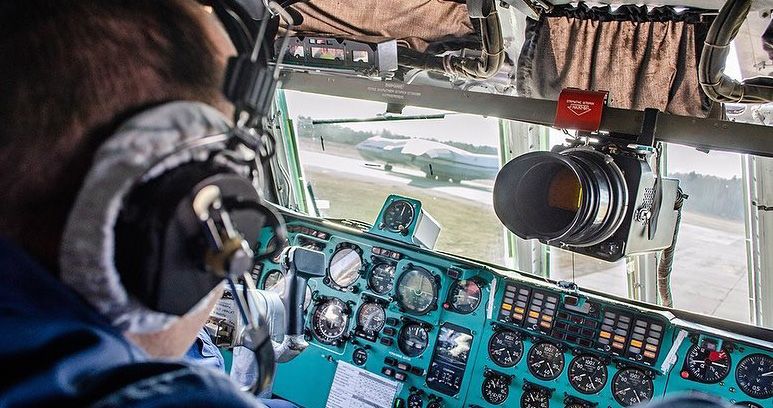
RUSSIAN AERIAL OPERATIONS • RUSSIA’S WAR IN SYRIA

                                                                                                                              (kremlin.ru)

By the end of major hostilities at the end of                     this would exceed the shelter space built to
2018, the number of jets was reduced to just                      protect the jets.
18—the lowest point of the entire campaign.4
By then, Russia had built concrete shelters                       Several flight crews and technicians were
for military aircraft and helicopters to protect                  stationed at the base for each aircraft. As
them from crude and improvised drones that                        a result, a single Su-24 could fly up to 6
the opposition had built and used to target                       sorties per day. This is more than typical for
Russian aircraft.5 This development made                          modern conflicts. Such a high tempo allowed
it challenging to use open source satellite                       a relatively small number of aircraft to make
imagery to monitor the composition of the                         up to 88 attacks7 and strike more than 200
air group accurately. Even the second visit                       targets per day. This helps Russia to have a
of Russia’s most modern jet, the Su-57, for                       significant impact on the ground situation in
combat tests in 2019 went unnoticed by                            Syria with limited resources.
observers and became known after Russian
Defense Minister Sergey Shoygu made a
statement acknowledging their presence.6
But it’s unlikely that more than 30 jets were
there in 2019-2020 at any given time because

4 “Russian air group in Syria as of November 8,” Diana Mikhailova, 25 November 2018, https://diana-mihailova.livejour-
nal.com/3026747.html/
5 “Khmeimim 2.0: Large-scale renovation at Russia’s airbase in Syria protects jets & allows deployment of even more,”
RT, 27 September 2019, https://www.rt.com/news/469715-khmeimim-russia-airbase-syria-renovations/.
6 “Su-57 tested new types of missiles and bombs in Syria,” TASS, 24 December 2019, https://tass.ru/armiya-i-
opk/7413645.
7 “Russian air force makes 88 sorties, hits 86 IS targets in Syria,” Reuters, 13 October 2015, https://www.reuters.com/ar-
ticle/us-mideast-crisis-syria-russia-sorties/russian-air-force-makes-88-sorties-hits-86-is-targets-in-syria-ifax-idUSKCN0S-
71DY20151013.

                                             FOREIGN POLICY RESEARCH INSTITUTE                                                          2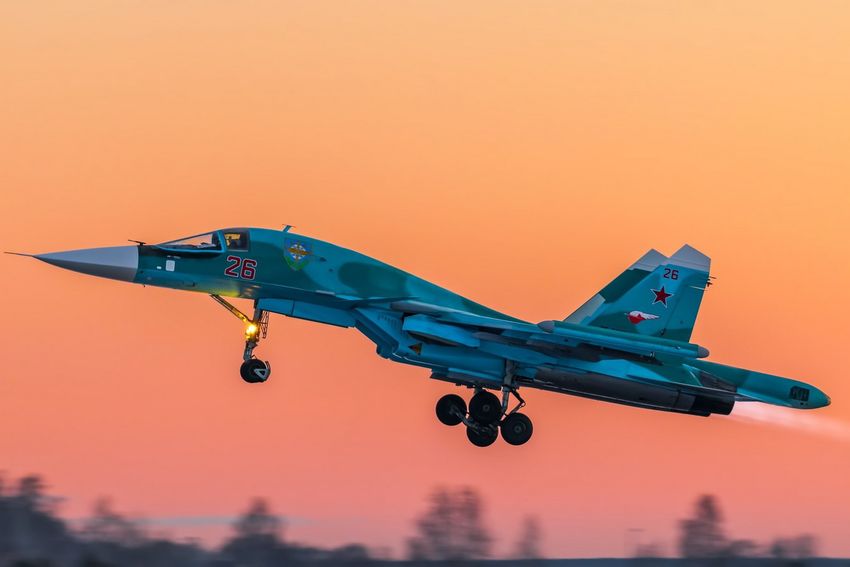
RUSSIAN AERIAL OPERATIONS • RUSSIA’S WAR IN SYRIA

FROM LATAKIA TO                                               The Russian command’s fear of losses at least
                                                              partially explains the early ineffectiveness of
DAMASCUS: RUAF                                                Russian air operations in Syria. Russian aircraft
                                                              operated exclusively from the heights of five
IMPACT ON THE                                                 km or more, inaccessible to Man-Portable Air
                                                              Defense Systems (MANPADs) and rebels and
GROUND SITUATION                                              terrorist groups’ air defense assets. Before
                                                              Syria, such scenarios on exercises were not
                                                              common. Equipped with mostly unguided
The effectiveness of the Russian air group                    bombs, strikes from such heights proved not
was not constant. It increased with experience                especially useful for close air support and
gained in the first months and during the                     tricky for striking small and sturdy targets.
assault on Aleppo. In later operations around
Damascus, in the Syrian desert, and in the
province of Idlib, the effect was noticeably
improved.                                                                              THE RUSSIAN
In the first months of the operation, the effect                            COMMAND’S FEAR
of Russian airstrikes on the course of combat
operations was surprisingly low. The start                                            OF LOSSES AT
of the bombing campaign did not radically
change the situation on the ground. The                                        LEAST PARTIALLY
October 2015 government offensive in the
mountainous part of Latakia province had little                       EXPLAINS THE EARLY
success, even though ground forces there
were supported by the full power of Russian                                 INEFFECTIVENESS
aviation and helicopters, which conducted
70-80 strike sorties per day from an airbase                                         OF RUSSIAN AIR
just a hundred kilometers away.
                                                                   OPERATIONS IN SYRIA.
At first, Russian airstrikes were distributed
over a vast territory in several Syrian
provinces against many opposition groups at
the same time. This lack of concentration of
efforts impeded progress. Even a strike with                  The first visible successes came in November
26 ship-based cruise missiles on October 7,                   2015. In response to the Russian Metrojet
2015 did not produce any noticeable military                  Flight 9268 terror act by the Islamic State
effect. As a political message, it was quite                  (ISIS), Russian command conducted a massive
effective.8 For the first time ever, Russia                   retaliation operation against ISIS targets in
demonstrated the possibility of delivering                    Syria. For the first time, strategic bombers
sudden and precise strikes by its Navy. The                   flying from Russia took part. The heavy and
range of missiles used in the strike allowed                  powerful Tu-160 jets and Tu-95MS turboprops
Russia to project power onto a significant part               used long-range cruise missiles X-102 and
of Europe and the Middle East from the Black                  X-555. The smaller and shorter-range Tu-
and Caspian Seas.                                             22M3 attacked targets with unguided bombs.

8 “Putin’s Navy Sends a Shot Across Obama’s Bow,” Bloomberg, 16 October 2015, https://www.bloomberg.com/opin-
ion/articles/2015-10-16/russian-cruise-missiles-in-caspian-send-a-message-to-u-s-.

                                        FOREIGN POLICY RESEARCH INSTITUTE                                         3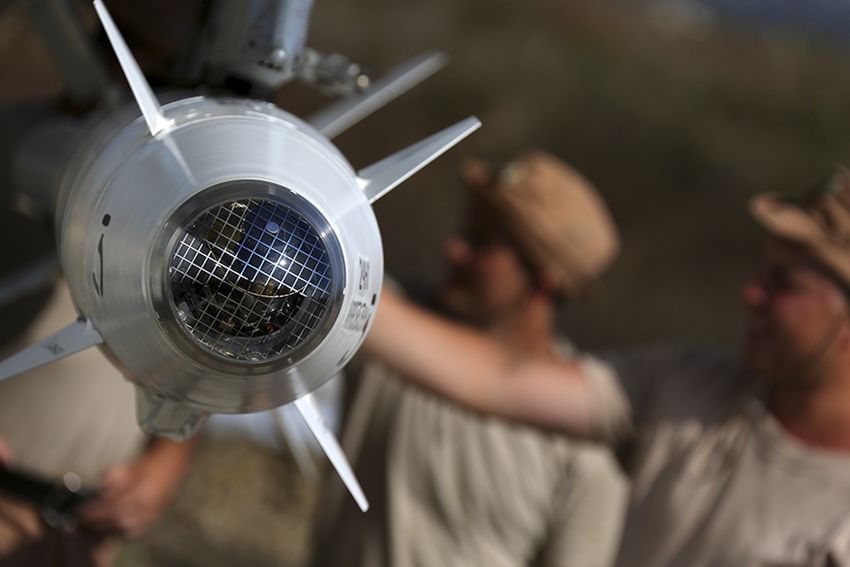
RUSSIAN AERIAL OPERATIONS • RUSSIA’S WAR IN SYRIA

                                                                                      Su-25s at Latakia (Wikimedia Commons/mil.ru)

For several days, Russia concentrated all                      escorted bombers operating near the
efforts on ISIS. The RuAF carried out a series                 Turkish border. But in general, the incident
of attacks on large, soft, and stationary targets:             did not have any meaningful impact on the
oil production and refining facilities, as well as             subsequent Russian bombing campaign.
columns of thousands of oil carriers engaged
in oil smuggling for terrorists. Such objectives               The list of targets attacked during the first
were much more similar to standard training                    month of the Russian campaign is indicative.
tasks. The total damage to oil infrastructure                  According to the Russian Ministry of Defense
was significant even with high-altitude                        (MoD), the air group performed 1,391 combat
airstrikes. In parallel, the United States was                 sorties engaging 1,623 targets, including
also engaged in attacks on the same targets.9                  249 command and communication centers,
It is difficult to determine whose contribution                51 training camps, 35 car-bomb workshops,
was more substantial, but the economic base                    131 ammunition depots, 371 strong points and
of ISIS in Syria was irrevocably destroyed.                    fortified positions, and 786 field camps and
                                                               bases from September 30, 2015 to October
This effort also coincided with Turkey’s                       30, 2015.10 These are exclusively stationary
shootdown of the Su-24, which allegedly                        targets, and most of them are non-frontline.
violated Turkey’s sovereign airspace on                        Vehicles are noticeably absent from the
November 24, 2015. Russian command                             target list.
reacted by bringing an S-400 long-range air
defense system to Khmeimim and deploying                       After a brief period of concentration against
several of its newest and most capable Su-                     ISIS, Russia returned to fighting against other
35 fighter planes there. For a while, fighters                 Islamist and moderate opposition groups. The

9 “U.S. Warplanes Strike ISIS Oil Trucks in Syria,” New York Times, 16 November 2015, https://www.nytimes.
com/2015/11/17/world/middleeast/us-strikes-syria-oil.html.
10 Briefing by Russian MOD, 30 October 2015, http://eng.mil.ru/en/news_page/country/more.htm?id=12062281.

                                         FOREIGN POLICY RESEARCH INSTITUTE                                                           4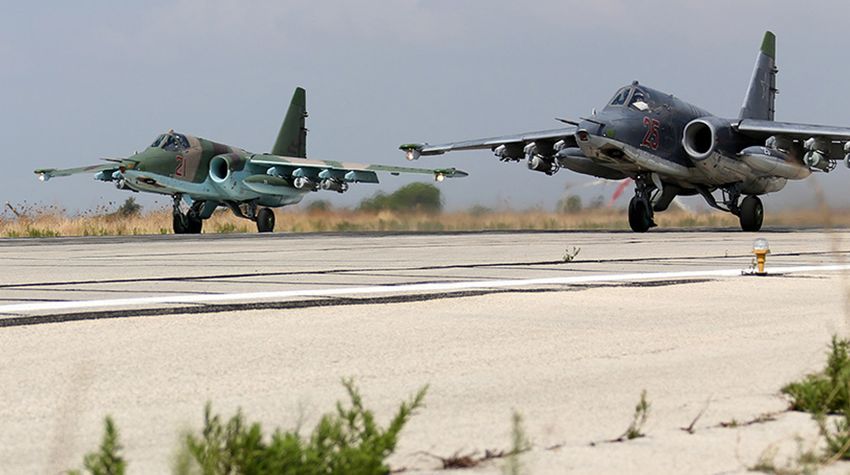
RUSSIAN AERIAL OPERATIONS • RUSSIA’S WAR IN SYRIA

culmination and turning point of the entire                to established “kill zones” during day and
war was the months-long battle for Aleppo.                 night. The Ministry of Defense provided most
Success in this urban battle in summer-                    of the rare video footage of the destruction of
autumn 2016 was achieved not by high                       moving tanks and vehicles from these battles.
technology, but by the massing of aviation                 The role of Russian aviation in the victory over
and a relentless bombing campaign largely                  ISIS south of the Euphrates was decisive.
directed at Western-backed opposition
groups in the city. After the fall of Aleppo, a            In 2018, the battles for the suburbs of
change in Russian strategy became evident                  Damascus were supported by a much more
in 2017 when the RuAF focused on the fight                 experienced Russian Aerospace Forces.
against ISIS in the Syrian desert and around               Using fewer planes and sorties than during
the Euphrates River.                                       the Aleppo battle, the RuAf significantly
                                                           improved its effectiveness, lethality, and
                                                           coordination with ground forces. The fight
IMPROVEMENT IN                                             for these heavily fortified and well-defended
                                                           cities went much faster than the fight for
RECONNAISSANCE                                             Aleppo.
CAPABILITIES AND                                           Russia easily defeated the rare attempts by
                                                           militants to mount counterattacks in 2018. An
ACCUMULATED OVERALL                                        example is the Hayat Tahrir al-Sham (HTS)
EXPERIENCE SINCE THE                                       counterattack in Northern Hama on March
                                                           14 when the RuAF decimated entire armored
START OF OPERATIONS                                        battle teams. To do this, a force must have
                                                           capability to quickly locate and destroy hostile
HAS ALLOWED RUSSIA                                         mobile targets on a dynamically changing
                                                           front line. This is a different and no less difficult
TO ESTABLISH A MORE                                        task compared to urban warfare. Success
                                                           against opposition strikes demonstrated that
EFFECTIVE “KILL CHAIN”                                     the close air support capabilities of the RuAF
                                                           also had grown significantly compared to
AND TO IMPROVE                                             2015-2016.

REACTION TIME FROM                                         Even Turkey’s provision of MANPADS to
                                                           militants in Idlib Province in 2020 did not
DETECTION TO TARGET                                        change the overall picture. Turkish-backed
                                                           fighters managed to stop the operations of
DESTRUCTION.                                               Syria’s helicopters completely. They also fired
                                                           missiles at Russian planes. But MANPADS
                                                           were ineffective against aircraft flying at high
                                                           altitudes. Russian aviation did not suffer any
                                                           losses and was able to deliver a sufficient
Improvement in reconnaissance capabilities                 level of attrition to the militants, thwarting
and accumulated overall experience since                   their counterattacks.
the start of operations has allowed Russia to
establish a more effective “kill chain” and to
improve reaction time from detection to target
destruction. Also, desert conditions made it
possible to send helicopters for free hunting

                                     FOREIGN POLICY RESEARCH INSTITUTE                                             5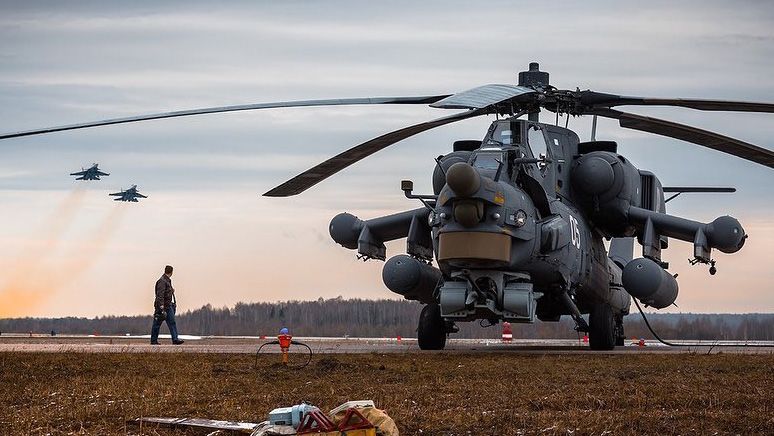
RUSSIAN AERIAL OPERATIONS • RUSSIA’S WAR IN SYRIA

During the battle for Idlib, the Turkish Air                    never been tested in combat before and took
Force’s F-16s shot down three Syrian Su-24                      months to master.
bombers, but they did not attack Russian
jets. Without direct intervention of a peer                     The typical attack scenario with the new sight
opponent, the RuAF became the most                              mirrored the following pattern. The Russian
crucial factor that impeded the attempt of                      forward air controller with the Strelets
the opposition’s revenge on the ground and                      reconnaissance, command, control, and
saved regime forces from the defeat.                            communications complex determined the
                                                                exact satellite coordinates of the stationary
                                                                target at the front line. Target information was
PRECISION                                                       sent through an automated communication
                                                                system to the attack aircraft patrolling in the
PROBLEM                                                         air.14 The coordinates of the target could also
                                                                be obtained from reconnaissance drones
                                                                or loaded before the flight from the target
By the beginning of the Syrian operation,
                                                                database on Khmeimim. Once the aircraft
the RuAF had a limited inventory of guided
                                                                received the coordinates, the process was
weapons, especially modern high-precision
                                                                highly automated and took only a few minutes.
weapons. There are no official numbers from
                                                                The navigation and sight systems calculated
the MoD, but judging by photos, videos,
                                                                the approach to the target and, at the
and reports from the initial period, the most
                                                                precisely determined moment, dropped one
common weapons were dumb high-explosive
                                                                bomb. The result of the hit was studied by a
bombs weighing 500 and 250 kilograms.
                                                                drone or visually by the forward air controller.
                                                                If necessary, the aircraft turned around and
To compensate for the insufficient accuracy
                                                                attacked again. Another approach to the
of dumb bombs, the use of cluster and
                                                                target took 5-10 minutes. Sometimes, up to
incendiary munitions, such as AO-2.5RTM,
                                                                four approaches on one target were made.
ShOAB-0.5M, PTAB-1M, and SPBE, was
                                                                According to MoD statistics, in most sorties,
common.11 The precision weapon of choice
                                                                more than one target was attacked (or, per
in the first few months became KAB-500S
                                                                MoD, “destroyed”), three on average.15 These
satellite-guided bombs.12
                                                                numbers allow us to estimate that one, less
                                                                often two, bomb(s) was spent on most objects.
Even old Su-24M and Su-25SM aircraft were
                                                                Such a sequence was typical for simple Su-
modernized variants with advanced digital
                                                                25SM3 attack aircraft and advanced Su-35
sights developed by the Gefest company and
                                                                fighters.
equipped with accurate satellite navigation
systems. In theory, this technology allows
the use of unguided bombs with near smart-
weapons precision.13 But this system had

11 Marks Czuperski, Faysal Itani, Ben Nimmo, Eliot Higgins, Emma Beals, “Breaking Aleppo,” Atlantic Council, 2017,
https://www.publications.atlanticcouncil.org/breakingaleppo/cluster-munitions/.
12 Michael Kofman. “Russia’s Arsenal in Syria: What Do We Know?,” War On The Rocks, 18 October 2015, https://waron-
therocks.com/2015/10/russias-arsenal-in-syria-what-do-we-know/.
13 “Russia’s advanced technology helps use unguided munitions as precision bombs,” TASS, 25 August 2017, https://
tass.com/defense/962079.
14 Roger McDermott. “Russia’s Network-Centric Warfare Capability: Tried and Tested in Syria,” Eurasia Daily Mon-
itor, vol. 15, issue 154, 30 October 2018, https://jamestown.org/program/russias-network-centric-warfare-capabili-
ty-tried-and-tested-in-syria/.
15 “Russian Aerospace Forces during the operation in Syria destroyed 122 thousand objects of terrorists,” Russian Min-
istry of Defense, 22 October 2018, .https://function.mil.ru/news_page/country/more.htm?id=12200595@egNews

                                           FOREIGN POLICY RESEARCH INSTITUTE                                             6
RUSSIAN AERIAL OPERATIONS • RUSSIA’S WAR IN SYRIA
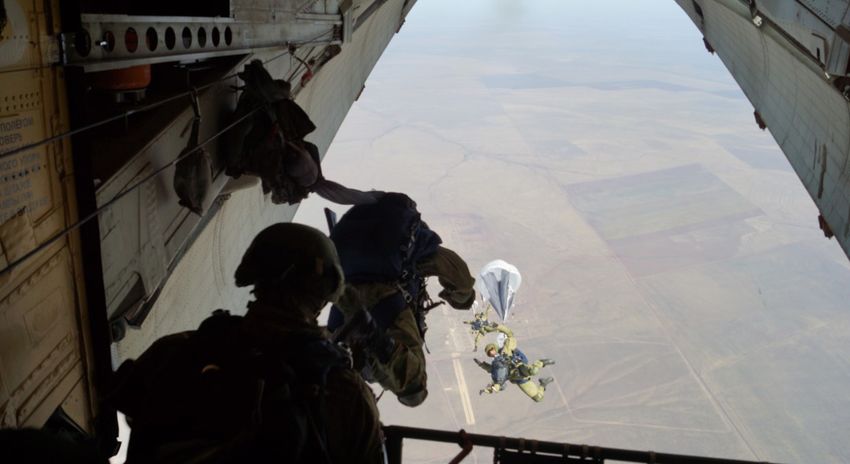
Russian paratroopers (mil.ru)/Facebook)
In 2019-2020, the Russian Aerospace Forces At the same time, to hit high-priority targets,
were still using a lot of unguided bombs. Russian command often uses guided
Even on videos published by the Ministry bombs. This is especially true for attacks
of Defense and loyal media, misses of 15- on underground bunkers and similar hard
30 meters from a stationary object are not targets. Use of short- and medium-range
uncommon. With 500 kg high-explosive missiles was limited and not promoted as
bombs, this is still enough to destroy most much as the long-range sea- and air-based
soft targets.16 cruise missiles.
Accuracy with dumb bombs nonetheless In the late stages of the operation, a pattern in
noticeably increased. Countless videos show the distribution of weapons developed. The
that in recent operations the RuAF were old Su-24 and Su-25 use almost exclusively
able to reliably hit with unguided bombs a unguided bombs. Newer Su-34 bombers
single house in an urban environment or a specialized in the use of precision weapons.
weaponized pick-up truck hiding in a shelter. Modern Su-35 fighters also often use guided
The Russian Ministry of Defense’s newspaper bombs and missiles.
claimed even examples of direct hits by the
Su-35 fighters from a height of five kilometers One noticeable sign that the accuracy
on standing tanks.17 increased was the decline in the use of cluster
and incendiary munitions by Russian aviation
in 2019-2020. For the Idlib campaign, non-
16 For example video “Airstrike against building at Alteh village,” Russian Ministry of Defense, 24 August 2019, http://
syria.mil.ru/war-on-terror/video/view.htm?id=9964.
17 “Impossible piloting over the Euphrates,” Red Star, 12 January 2018, http://redstar.ru/nevozmozhnyj-pilotazh-nad-ev-
fratom/.
FOREIGN POLICY RESEARCH INSTITUTE 7RUSSIAN AERIAL OPERATIONS • RUSSIA’S WAR IN SYRIA
governmental organizations did not report a
single case of their use.18 By the standards SYRIA AS A TESTING
of the Russian Air Forces during the wars in
Chechnya (1994-2001) or Georgia (2008), GROUND
such a performance is a great achievement.
But this is clearly not enough to put Russian The list of weapons tested in Syria is vast.
among the world’s elite modern air forces. According to official figures, 359 types were
used in real combat for the first time.19 This
The Russian Aerospace Force’s biggest number includes not only the latest models,
problem is its inability to hit moving targets. but also fairly old Soviet equipment, such as
Even after more than four years of experience, the strategic bombers Tu-160 and Tu-95MS.
the level of success here is very modest. This Most of these weapons have been developed
limitation dramatically reduces its capability more recently.
to prevent the movement of small enemy
groups. While it is able to decimate large Russian command sent to Syria not only
groups of enemy forces as it did against systems already in service, but also those
the HTS counterattack in March 2018, the undergoing test and evaluation. Performance
RuAF still had problems stopping smaller results from Syria have become an important
counterattacks by militant armored groups in criterion for making procurement decisions,
2020. so defense industry enterprises were
interested in such trials. They sent their
prototypes to the battleground with teams of
This problem comes mostly from a lack
engineers and technicians. These personnel
of effective ammunition. According to
actively interacted with the military and made
traditional Russian doctrine, the elimination
changes and corrections on the spot.
of armored and combat vehicles is the task
of helicopters and Su-25 attack aircraft. But
Even the newest and secret Su-57, still under
given the widespread presence of MANPADS
state trials, was sent to Syria. In February
in Idlib, the daytime use of helicopters is too
2018, the arrival of two Su-57 at Khmeimim
dangerous. The Su-25 also operated mainly
was spotted and filmed. Dissatisfied with the
as a level bomber from a higher altitude,
violation of secrecy, the Russian Ministry of
instead of the low-altitude attacks for which
Defense quickly withdrew these fighters from
it was designed. Missile threats for aircraft in
the country. Nevertheless, they managed to
future conflicts will only increase, so we can
complete about ten flights and use weapons,
expect that the task to defeat moving targets
specially developed for this aircraft, against
will be ultimately delegated to the new
real targets. In 2019, Su-57s went to Syria for
generation of Russian strike drones—one of
the second time.
many new weapons tried in Syria.
The Navy tested Kalibr missiles as well as
several types of new warships, including
cruise missile-armed diesel submarines,
corvettes, and frigate. But most valuable was
the first-ever trial of Admiral Kuznetsov aircraft
carrier with new MiG-29K and the maritime
18 “The Syrian Regime Repeatedly Uses Cluster Munitions Against Residential Neighborhoods in and Around Idlib
Governorate, Constituting War Crimes,” Syrian Network for Human Rights, 27 February 2020, http://sn4hr.org/
blog/2020/02/27/54699/.
19 “Russia tested 43 more new weapons in Syria,” RIA Novosti, 24 December 2019, https://ria.ru/20191224/1562776515.
html.
FOREIGN POLICY RESEARCH INSTITUTE 8RUSSIAN AERIAL OPERATIONS • RUSSIA’S WAR IN SYRIA
(mil.ru)/Instagram)
version of the Ka-52K helicopters as well Predator, weighing 1.2 tons.21 But the absence
as modernized Su-33s with improved digital of unmanned combat aerial vehicles en
sights. After losing one of the MiG-29KUB masse is the most apparent capabilities gap
and Su-33 fighters in landing incidents, all for Russian Aerospace Forces. The contrast
other planes were transferred from the carrier was especially evident in comparison to the
to Khmeimim and made most of the sorties successful operations of numerous Turkish
from the ground.20 For carrier-based aviation, attack drones in February-March 2020.
this obviously was a complete failure. The
Kuznetsov was recalled home faster than The situation with reconnaissance drones
anticipated and put on lengthy repairs. is better. The RuAf and Navy employed
several MALE-class Forpost drones (licensed
A significant innovation for helicopters was IAI Searcher II) and dozens of light ones.
the use of modernized Vikhr-M (AT-16 Scallion) Up to 70 UAV were used daily, and they
missiles by the Ka-52 attack helicopter. For the accumulated more than 25,000 flight hours
first time, Russian Army Aviation developed in first three years of operation.22 In Syria,
the ability to reliably hit targets day and night through extensive experience, very tight
from a distance of up to 8 kilometers. This is a interaction was established between planes
significant improvement over the old missiles and drones. UAVs find targets, determine
with a range of 5-6 km at the very best. their coordinates, and monitor the results of
airstrikes.
In 2019, Russia tested in Syria its first MALE-
class strike drone Orion-analog of the MQ-1
20 “Kuznetsov transits through English channel,” Armada International, 31 January 2017, https://armadainternational.
com/2017/01/kuznetsov-transits-through-english-channel/.
21 “New types of missiles and bombs tested on the Su-57 in Syria,” TASS, 24 December 2019, https://tass.ru/armiya-i-
opk/7413645.
22 “Military operation of the Russian Armed Forces in the Syrian Arab Republic – in numbers,” Russian Ministry of De-
fense, 22 August 2018, https://www.youtube.com/watch?v=viCiwbJG5Pk.
FOREIGN POLICY RESEARCH INSTITUTE 9RUSSIAN AERIAL OPERATIONS • RUSSIA’S WAR IN SYRIA
The use of drones also became a staple strengthen its air defense. By order of Vladimir
for the Ground Forces. The Russian Army Putin, a partial battalion of the newest long-
has extensively used drones for artillery range S-400 complex was swiftly deployed to
fire adjustment and reconnaissance. Since Khmeimim Airbase in November 2015. Later,
2017, it has tested light drones with laser an S-300 battalion was added to protect the
designators. They illuminate targets for the naval base in Tartus, eventually replaced by
laser-guided artillery shell Krasnopol.23 All a second S-400 battalion. Long-range air
modern modifications of larger UAVs, such defense systems have yet to fire a missile;
as Forpost-R, will have similar and more shorter-range systems have done all the
powerful lasers, which will allow drones to work.
direct heavy laser-guided munitions, such as
the KAB-1500L aviation bombs, from great In early 2018, Russian bases faced an entirely
distances. new threat. Ten light homemade drones
with bomblets attacked the Khmeimim base.
Russian media reported that in 2019 elements Three more tried to strike the Tartus base. A
of the future S-500 air defense complex combination of electronic warfare systems
were transferred to Khmeimim. Launchers and Pantsir air defense systems successfully
or missiles were not tested, but radars and repelled the attack.25 In subsequent years,
control equipment did get tested.24 drone raids became a regular and constant
threat, as did long-range bombardments with
unguided missiles.
AIR DEFENSE The Ministry of Defense had to create a
EXPERIENCE multilayered air defense system to ensure
the complete security of the bases. The
short-range SAM Tor-M2 (SA-15 Gauntlet) was
Surprisingly, the amount of experience gained
added to the air defense systems. According
in Syria for Russian air defense is second only
to some Russian reports, they were more
to aviation. Initially, Russian command did not
successful in the fight against small drones
expect serious air threats to its bases. Early in
than the Pantsir.26
the campaign, Russia deployed to Khmeimim
only short-to-medium range air defense
The Ministry of Defense claimed that more
systems with a reach of 20-40 kilometers.
than a hundred small enemy drones were
The military believed that several Pantsir
shot down in two years. Initially, air defense
missile systems (SA-22 Greyhound) would be
systems had problems detecting targets with
enough to shoot down the small drones and
such a low radar signature and slow speed.
unguided missiles used by militants.
According to the developer of air defense
systems, they managed to cope with these
The conflict with Turkey over the downed
challenges.27
Su-24M bomber in 2015 forced Russia to
23 “Innovative UAV Technology Helps Syrian Army Offensive in Idlib,” Aviation International News, 27 February 2020,
https://www.ainonline.com/aviation-news/defense/2020-02-27/innovative-uav-technology-helps-syrian-army-offen-
sive-idlib.
24 “Prometheus ask for fire: S-500 systems tested in Syria,” Izvestia, 02 October 2020, https://iz.ru/927353/alek-
sei-ramm-aleksei-kozachenko-bogdan-stepovoi/prometei-prosiat-ognia-sistemy-s-500-ispytali-v-sirii.
25 Briefing by the Head of the Russian General Staff’s Office for UAV Development, Russian Ministry of Defense, 11
January 2018, https://syria.mil.ru/en/index/syria/news/more.htm?id=12157872.
26 “Tor-M2 “or Pantsir-C1?,” Gosnovosti, 28 June 2018, https://www.gosnews.ru/article/oboronka/tor_m2_ili_zrpk_pan-
tsir_s1_.
27 “Interview with the chief designer of the Pantsir,” TASS, 29 January 2020, https://tass.ru/interviews/7623815.
FOREIGN POLICY RESEARCH INSTITUTE 10RUSSIAN AERIAL OPERATIONS • RUSSIA’S WAR IN SYRIA
Date Type Killed Aircraft Notes
24 October 2015 Su-24M 1 plane shot down by Turkish F-16
24 October 2015 Mi-8 0 helicopter Hit by TOW-2 while on the ground
12 April 2016 Mi-28N 2 helicopter piloting error in night flight
08 June 2016 MI-35M 2 helicopter shot down by ATGM while in-flight
01 August 2016 Mi-8 5 helicopter shot down
03 November 2016 Mi-35M 0 helicopter hit by ATGM while on the ground
MiG-
13 November 2016 29K 0 plane accident on landing
03 December 2016 Su-33 0 plane piloting error during landing
06 October 2017 Mi-28N 0 helicopter technical problem
10 October 2017 Su-24M 2 plane accident during take-off
31 December 2017 Mi-24 2 helicopter technical problem
Su-
03 February 2018 25SM 1 plane shoot down by MANPAD
06 March 2018 An-32 39 plane accident during landing
Su-
03 May 2018 30SM 2 plane accident during take-off
07 May 2018 Ka-52 2 helicopter piloting error
17 September 2018 IL-20 15 plane shoot down by Syrian air defense
The Turkish operation, dubbed Spring Shield,
in 2020 provided a significantly greater LOSSES
challenge. For ten days, Russian air defense
observed the highly successful actions of In almost five years of combat operations,
medium Turkish strike drones and their Russia has lost eight aircraft and eight
duels with the Syrian Buk-M2 and Pantsir helicopters. Seventy-three people on board
systems, which were largely ineffective lost their lives in those incidents. Only one
against them at the outset, but scored airplane was shot down by enemy fire.
kills towards the end of the brief flare up. Others were lost due incidents and technical
problems. By contrast, most helicopters were
Russia collected a substantial amount of hit by the enemy.
information from observing numerous Israeli,
American, and Turkish air strikes. These
lessons will make it possible to modernize Most casualties occurred from two incidents.
Russian air defense equipment and adapt its In March 2018, an An-32 plane transporting
tactics to modern realities. Russian military personnel from Aleppo
crashed while landing on Khmeimim, killing
all 39 men on board. The reason for the
second-largest incident was “friendly fire”
by an S-200 as Syrian air defenses were
FOREIGN POLICY RESEARCH INSTITUTE 11RUSSIAN AERIAL OPERATIONS • RUSSIA’S WAR IN SYRIA
responding to an Israeli air raid on September FOR RUSSIA, ITS SYRIA
17, 2018. Syrian air defenders misidentified a
Russian reconnaissance aircraft and shot it OPERATION IS ITS
down. The only combat loss of a combat jet
occurred when an Su-25 used old tactics and MOST PROLONGED AND
attacked a ground target from low altitude
with unguided rockets.28 The most substantial INTENSE AIR CAMPAIGN
losses were suffered by helicopters. Russia
learned that their use during daytime is SINCE THE WAR IN
excessively risky. The RuAf adjusted tactics
and reduced their use until modernized AFGHANISTAN (1979-
models arrive.
1989).
LESSONS LEARNED
For Russia, its Syria operation is its most
To maximize gains in experience, rotation of
prolonged and intense air campaign since
the staff at Khmeimim Airbase was significant.
the war in Afghanistan (1979-1989). In their
Pilots and staff officers serve in Syria in short
first four years in Syria, Russian combat
shifts for two to three months. Some of them
jets conducted more than 45,000 sorties29
have made several rotations. At the beginning
(most of them on strike missions), and
of 2019, the Russian Ministry of Defense
reconnaissance drones completed over
reported that more than 68,000 military
25,000 sorties. The experience gain for the
personnel had gained combat experience in
RuAf has been unprecedented.
Syria. By 2020, 90% of all RuAf aviation crews
and 56% of air defense personnel were in
RuAf command, military scientific institutes,
Syria at least once. Some pilots made more
and combat training centers immediately
than 200 combat sorties.31 Strategic aviation
began to study lessons from the operation.
was less involved, but more than half of the
Based on their analysis, recommendations
crews nonetheless conducted at least one
were developed, and tactical changes were
airstrike.
introduced into combat training. The RuAf,
then, tested the new tactics in battle. Russia
The prolonged air operation made it possible
has demonstrated the ability to flexibly change
to test all types of aircraft and aviation
its approach depending on the situation. This
munitions. The Russian Ministry of Defense
involved both the general strategy of the
does not like to acknowledge problems
operation as well as the weapons and military
publicly, but its actions speak for themselves.
equipment used in the field.30
Modernization programs were announced for
28 “Lost vigilance. All about the death of the Russian Su-25 in Syria,” Radio Svoboda, 05 February 2018, https://www.
svoboda.org/a/29019535.html.
29 “Hmeimim airbase: stability factor,” Army Standard, 02 October 2019, https://armystandard.ru/news/t/2019930173-
buq0l.html.
30 Michael Kofman and Matt Rojansky, “What Kind of Victory for Russia in Syria?,” Military Review, 24 January 2018,
https://www.armyupress.army.mil/Journals/Military-Review/Online-Exclusive/2018-OLE/Russia-in-Syria/fbclid/IwAR1C-
c627O8fGTeq7SI0so6RpY405CeYQGURdxJJw4JcJZZ5wMPfeuhE585Y/.
31 Sergey Shoigu address to the Parliament, 25 March 2020, https://function.mil.ru/news_page/country/more.ht-
m?id=12283769.
FOREIGN POLICY RESEARCH INSTITUTE 12RUSSIAN AERIAL OPERATIONS • RUSSIA’S WAR IN SYRIA
(mil.ru/Instagram)
11 planes and helicopters.32 The most common radar, and longer-range weapons. Moreover,
point was an increase in combat capabilities Ataka (AT-9 Spiral-2) basic missiles with a
and lethality: the integration of new precision range of 5 km, Khrizantema-VM missiles (AT-
weapons, better sights, and navigation 15 Springer), with a range of 10 km, and the
systems. The Ministry of Defense ordered newest «Izdelie 305»34 with the range of 15-
improvements even for new equipment, just 20 km were also integrated.
recently adopted to service, such as Su-34
bombers or Mi-28N helicopters. Especially In 2019, an upgraded prototype of the new
pressing was the combat helicopter problem. Mi-28NM was sent for battle testing in Syria.
The effectiveness of the newest Mi-28N and Immediately after trials, the MoD signed a
Ka-52 in live-fire battles was not satisfactory, contract to purchase 98 units.35 A similar
especially in night conditions.33 These models modernization program is underway for
were supposed to be the best helicopters the Ka-52. A deal for about one hundred
available. modernized Ka-52M is expected in 2020.
The Russian Ministry of Defense initiated After waves of raids by small drones, training
a program to modernize the Mi-28N. The to repel such attacks on air and naval bases
aircraft received new engines, sight, optics, has become a regular exercise all over
32 “Russian aerospace forces evaluate the experience of the Syrian military campaign,” Interfax, 28 October 2018,
https://www.interfax.ru/russia/635353.
33 “Bondarev spoke about the “failed” Mi-28 electronics,” RIA Novosti, 30 November 2017, https://ria.
ru/20171130/1509918854.html.
34 Code name for the “Light multipurpose guided missile” currently in development.
35 “The Ministry of Defense signed a contract for 98 Mi-28NM helicopters,” TASS, 27 June 2019, https://tass.ru/armiya-
i-opk/6601643.
FOREIGN POLICY RESEARCH INSTITUTE 13RUSSIAN AERIAL OPERATIONS • RUSSIA’S WAR IN SYRIA
Russia.36 On the modern battlefield, this States and Israel and the latest drones.
problem is becoming more and more relevant Today’s RuAF are much more effective and
for all the militaries of the world. Intercepting deadlier than in 2015, but even with all the
cheap primitive drones and unguided rockets recent improvements, the RuAF are still
with anti-aircraft missiles proved not to be technologically behind in several key military
cost-effective. Therefore, after the first years technologies.
of combat duty in Syria, research and design
of a completely new specialized version of
the Pantsir-S began. It will be much lighter,
cheaper, and have a shorter range, but will
have more ammunition and a better fire rate
against such targets.
In the competition between the Navy and
RuAF as instruments of projection of force,
the Aerospace Forces gained a definite
advantage. The result was the initiation
of a large-scale modernization of all three
types of strategic bombers: Tu-22M3M, Tu-
95MSM, and Tu-160M. Serial production
of the upgraded Tu-160 has resumed. The
development of the future strategic bomber
PAK DA gained new momentum. For all
strategic aircraft, new precision medium- and
long-range missiles, including hypersonic
ones, are being developed and integrated.
By sending several dozen aircraft and a few
thousand military personnel to Syria, Russia
managed to turn the tide of the civil war.
The financial and material price (as well as
the price in life) of this experience for Russia
was bearable, and the experience gained
has been substantial. The benefits of the
operation clearly outweighed the cost.
Nevertheless, this experience is somewhat
limited. The campaign was more of a
counterinsurgency operation than a modern
conventional war with a peer or near-peer
opponent. The RuAF gained no knowledge
in air-to-air combat or fighting against
sophisticated air defenses. This can be only
partially offset by observations of the actions
of the air forces of other countries, including
the fifth-generation aircraft of the United
36 “About 20 ‘attacks’ of drones of various modifications were repelled by military service personnel as part
of the combat readiness check,” Interfax, 13 February 2020, http://www.interfax-russia.ru/FarEast/print.as-
p?id=1104471&sec=1671&type=news.
FOREIGN POLICY RESEARCH INSTITUTE 14Foreign Policy Research Institute
The Foreign Policy Research
Institute is dedicated to producing
the highest quality scholarship
and nonpartisan policy analysis
focused on crucial foreign policy
and national security challenges facing the
United States. We educate those who make
and influence policy, as well as the public at
large, through the lens of history, geography,
and culture.
Foreign Policy Research Institute
1528 Walnut Street, Suite 610
Philadelphia, PA 19102
215-732-3774 www.fpri.orgYou can also read


