Incoming Student Guide - Academic year 2019/2020 - Universität Konstanz
←
→
Page content transcription
If your browser does not render page correctly, please read the page content below

Incoming
                              Student
                                Guide
Academic year 2019/2020
(latest update: May 2019)
Table of contents   3

1. Welcome to Konstanz!                                                                           4
    1.1 The city of Konstanz                                                                      6
    1.2 The University of Konstanz                                                                8

2. Academic Structures and Terminology at the University of Konstanz                            10

3. The Faculties and their Departments                                                          16

3.1. Faculty of Science – Faculty I
    3.1.1. Department of Mathematics and Statistics                                             18
    3.1.2. Department of Computer and Information Science                                       20
    3.1.3. Department of Physics                                                                22
    3.1.4. Department of Chemistry                                                              24
    3.1.5. Department of Psychology                                                             26
    3.1.6. Department of Biology                                                                29

3.2. Faculty of Humanities – Faculty II
     3.2.1. The Department of Literature, Art and Media Studies                                 34
     3.2.2. Department of Linguistics                                                           40
     3.2.3. Department of Philosophy                                                            47
    3.2.4 Department of History, Sociology, Empirical Educational Research and Sport Science
    3.2.4.1 History                                                                             49
    3.2.4.2 Sociology                                                                           51
    3.2.4.3 Sport Science                                                                       54

3.3. Faculty of Politics, Law and Economics – Faculty III
     3.3.1. Department of Politics and Public Administration                                    57
     3.3.2. Department of Law                                                                   60
     3.3.3. Department of Economics                                                             63

4. The Language Institute (Sprachlehrinstitut, SLI)                                             66

5. The Centre for Transferable Skills (SQ-Zentrum, SQ)                                          74

6. Communication, Information, Media Center (KIM)                                               78

7. How to apply                                                                                 80
    7.1. Procedure for Erasmus+/ exchange students                                              81
    7.2. Procedure for free mover students                                                      82
    7.3. Language requirements                                                                  83
    7.4. Pre-semester programmes: Orientation programmes and language courses                   83
    7.5. Information for accepted students                                                      83
    Checklist for getting started                                                               84

8. Putting together your study plan                                                             86

9. Accommodation                                                                               100

10. Before you leave us (Checklist)                                                            106
4      1. Welcome to Konstanz                                                                                                                                 1. Welcome to Konstanz   5

    Welcome
    to Konstanz
                                                                                                                         Have you ever heard of the Swabian Sea?
                                                                                                                         Also known as Lake Constance? Lake Constance borders
                                                                                                                         Austria, Germany, and Switzerland, three countries,
                                                                                                                         also sharing one language.

       Lake Constance almost surrounds the medieval            With this brochure we would like to address all
       part of the city of Konstanz (the German spelling       students interested in spending a semester or year
       of Constance), and its shape is outlined in the         at the University of Konstanz, and give them useful
       picture above in blue.                                  information on the topics most relevant for this group.
                                                               Whether or not you have already applied to study
       The city of Konstanz is situated in the very South of   with us, we hope this guide will serve as a useful
       Germany, sharing a border with Switzerland (with        source of information for you. Topics covered range
       Zurich about one hour away by train). Konstanz is       from the study opportunities in the various depart-
       home to two universities, the University of Konstanz    ments and teaching bodies to the application
       and the University of Applied Sciences.                 procedures and deadlines.
6   1.1 The city of Konstanz                                                                                                                             1.1 The city of Konstanz                     7

                                                              1.1 The city of Konstanz

    The city of Konstanz, with its unique location on the     Within the city distances are small, places and loca-    Those looking for more information on academic life
                                                              tions can be discovered by bicycle, on foot or by bus.   in Germany in general will find the pages of the
    banks of Lake Constance and the river Rhine, the partly   Konstanz is a lively and active city offering numerous   German Academic Exchange Service (Deutscher
    medieval town, the green surroundings, the water and      cultural activities and sports, particularly mountain    Akademischer Austauschdienst, DAAD) very helpful.
                                                              and water sports. Studying in Konstanz, a student        – DAAD: 10 steps in Germany
    the mountains enables a study experience in a             town (about 15.000 out of 81.000 inhabitants are
    beautiful natural environment.                            students at one of the two universities) will be a       Those after more specific information on the study
                                                              wonderful experience in a location guaranteeing for      opportunities in the federal state of Baden-Württem-
                                                              a high living quality as well as safety.                 berg should have a look at the Baden-Württemberg
                                                                                                                       STUDYGUIDE.
                                                              More information on the city can be found in the
                                                              guidebook This is Konstanz – a city guide (Das ist
                                                              Konstanz) and on the website Grenzenlos Studieren
                                                              (Study without borders), with a lot of useful informa-
                                                              tion on life in Konstanz and the bordering Swiss
                                                              town of Kreuzlingen.

                                                                                                                                                                  Konstanz:

                                                                                                                                                                  – 55.65 km2
                                                                                                                                                                  – 85.478 inhabitants
                                                                                                                                                                  – University: 11.700 students
                                                                                                                                                                  – University of Applied Sciences:
                                                                                                                                                                    4.500 students
8   1.2 The University of Konstanz                                                                                                                           1.2 The University of Konstanz      9

    The University of Konstanz – A campus university
    accommodating three faculties and 13 scientific departments

                                      1.2 The University of Konstanz

                                      Top-level research, excellence in teaching and stu-
                                      dies, internationality and interdisciplinary collaboration
                                      have stood for the University of Konstanz since its
                                      foundation as a Reformuniversität (reform university)
                                      in 1966. This clear orientation soon led to a unique
                                      profile that is defined not only through high quality
                                      but also through innovation, creativity and a distinct
                                      zest for research. The strategy of modernisation and
                                      reform from within is being consistently advanced,
                                      and the University of Konstanz‘s “success story”
                                      (Lord Dahrendorf, 2006) is something that all mem-
                                      bers experience.

                                      The consistent expansion of its strengths, inno-
                                      vative concepts and ideas within the university’s
                                      Institutional Strategy “Modell Konstanz – Towards a
                                      Culture of Creativity” has contributed significantly         Many of the more than 100 study programmes have               – 11.700 students originating
                                      to the success of the University of Konstanz since           an interdisciplinary approach including a range of              from 95 countries
                                      October 2007 in both phases of the Excellence                international components such as courses in foreign           – 350 partner universities
                                      Initiative of the German Federal and State Govern-           languages, a stay abroad or double degree options.              worldwide
                                      ments to promote top-level research at German
                                      universities. Konstanz is therefore one of the eleven        The independent Language Institute (Sprachlehrinsti-
                                      universities whose institutional strategies are being        tut, SLI) offers a broad range of language courses at
                                      funded by the federal and state governments to               different levels, and the prize-winning library is open
                                      expand university top-level research.                        24 hours a day, letting everyone choose when to
                                                                                                   browse the catalogue or simply use one of the work
                                      The University of Konstanz is a campus university            spaces for study. Over 11.700 students originating
                                      and accommodates three faculties: The Faculty of             from 95 countries are enrolled at the university, and
                                      Science, the Faculty of Humanities and the Faculty of        with 350 partner universities worldwide, the universi-
                                      Politics, Law and Economics. These in turn host 13           ty is part of an expansive global network of learning
                                      departments on one campus.                                   opportunities.
10      2. Academic Structures and Terminology                                                                                   2. Academic Structures and Terminology                         11

                                                                       Studying at another university is a valuable experience
                                                                    and is often described as the most enjoyable part of ones’
                                                                    degree. It generally means getting to know a new country,
                                                                                             a new language and new people.

                                                 We hope we can help you avoid confusion when             teaching period of the summer semester starts in mid
                                                 starting your stay in Konstanz by introducing you to     April and runs until mid July. The lecture-free period
                                                 the most common/most important set of terminologies      following the summer semester starts in mid July,
                                                 you will come across during your stay with us. For any   and finishes mid October (with the beginning of a new
                                                 (subject-specific) questions left unanswered in this     winter semester).
                                                 section we recommend you consult the chapters on
                                                 the individual departments. You should by all means      Exam periods
                                                 attend one of the two information sessions for new
                                                 international students offered by the Coordinators/      Though differing slightly across departments, the               You should attend one of
                                                                                                                                                                          the Information sessions
                                                 Study Advisors within the welcome and orientation        exam period (written exams) usually covers the last
                                                                                                                                                                          offered by the Erasmus+/
                                                 programme before the beginning of lectures (either       two weeks of the teaching period of each semester               International Student
                                                 in September or in October / in March or in April).      and the first two weeks of the following lecture-free           Advisors in

     Academic
                                                                                                                                                                          – September/October
                                                 The exact dates for these sessions will be forwarded     period. In some departments there are only written
                                                                                                                                                                            (winter intake)
                                                 to you by our International Office.                      exams at the end of a semester, in some you will also           – March/April
                                                                                                          find take home papers or research papers.                         (summer intake)

     Structures and
                                                 The academic year and semester dates
                                                                                                          Papers are usually to be researched and written in
                                                 The University of Konstanz operates on a                 the lecture-free period and have to be handed in at
                                                 semester basis, and the academic year consists           the deadline announced by the examiner. All formal-

     Terminology
                                                 of a winter semester (Wintersemester, WiSe) and          ities regarding a course (detailed syllabus, assess-
                                                 a summer semester (Sommersemester, SoSe).                ments, mode of completion, deadlines, attendance
                                                 A semester is divided into approximately 13 weeks        policy etc.) are communicated in the first session of a
                                                 of teaching (Vorlesungszeit) followed by a lecture-      course. You should always be present in the first meet-
                                                 free/non-teaching period (vorlesungsfreie Zeit)          ing of class to make sure you are well-informed about
                                                 of 8 to 12 weeks.                                        the course contents and expectations of participants.

                                                 Roughly, the teaching period of the winter semes-        Exams and papers are usually corrected in the lec-
                                                 ter runs from mid October until mid February, the        ture-free period, results published at the beginning of
                                                 subsequent lecture-free period until mid April. The      the following semester. Students who need their results
12                         2. Academic Structures and Terminology                                                                                                                                           2. Academic Structures and Terminology           13

                           The academic year at the University of Konstanz

Please bear in mind that
the examination periods
differ from department
to department. Please
consult the chapters by    Jan.            Feb.           March       April         May             June          July           Aug.          Sept.         Oct.         Nov.            Dec.
the individual depart-
ments regarding exami-
nation periods.                   Winter semester – teaching period       Winter semester – lecture-free period          Summer semester – teaching period          Summer semester – lecture-free period

                           earlier can of course ask for an early correction of                                    The departments compose their teaching programme
                           their work. If an early correction is necessary students                                anew every semester, thereby making sure that all
                           are asked to discuss the deadline and options for fast                                  courses taught are closely connected to the current
                           track corrections with the lecturers during their office                                research compiled by their staff members.
                           hours.
                                                                                                                   When browsing through the course catalogue
                           Courses vs. modules, course catalogue                                                   ZEuS you will, however, still come across the term
                                                                                                                   “module” – which is a “false friend” in this case.
Our course catalogue is    What is called a “unit”, “subject” or a “module” in                                     Confusingly, in Germany “module” usually refers to
titled –ZEuS, and is put
                           some university systems is simply called a “course”                                     an entity bigger than a single course unit, pooling
together on a semester
basis.                     in Konstanz. There are specific terms for certain types                                 courses on a common topic or theme. Bachelor
                           of courses, which are rooted in the subject-specific                                    and Master degrees are therefore made up of several
Available:
                           terminology of the older degrees Magister and Diplom.                                   modules; those of the Bachelor degrees are often
– late Feb for SoSe
– late July for WiSe       Terms you will come across (and will find defined for                                   divided into Basismodule (base or basic modules, for
                           the different departments in the department chap-                                       the early stage of the programme) and Aufbaumodule
                           ters in section 3) could be Proseminar, Hauptseminar,                                   (advanced modules, for the advanced phase of the
                           Oberseminar, Projektseminar, Kurs, Vorlesung etc.                                       programme) in Konstanz.
                           (to name but a few).
                                                                                                                   When selecting any of the Bachelor or Master pro-
                           “Course” is therefore the generic term for teaching                                     grammes in ZEuS, the list of modules is not the list
                           units in Konstanz. When putting together your study                                     of courses offered within these degrees but merely
                           plan for a given semester, you will hence consult our                                   the structure of the degree itself at the University
                           course catalogue, which is put together on a semes-                                     of Konstanz. Clicking on the module titles you
                           ter basis. This means that individual courses are not                                   will then find the list of courses offered within the
                           usually repeated every semester or every year.                                          respective module. Sometimes modules even have a
                                                                                                                                                                                                                         The Academic year:
                                                                                                                   more complex internal structure. When you can see a
                           In Summer 2017 the University has launched a new                                        table of data (including the type of course, the course
                                                                                                                                                                                                                         – winter (first) semester (WiSe):
                           course catalogue as part of the central enrolment                                       number, the number of hours per week the course
                                                                                                                                                                                                                           mid October – mid February
                           and student portal. This portal, functioning also as                                    is taught, the amount of ECTS points awarded upon
                                                                                                                                                                                                                         – summer (second) semester
                           study planner for enrolled students, is called ZEuS.                                    successful completion etc.), you can be sure that you
                                                                                                                                                                                                                           (SoSe): mid April – mid July
                           If you are looking for the offer of courses of the                                      are looking at a description of a particular course.
                           winter semester 2019/20 (or later semesters), you                                       Some course descriptions are more detailed than
                                                                                                                                                                                                                         Exam periods differ from
                           will have to consult ZEuS in July 2019.                                                 others but the basic information is always included
                                                                                                                                                                                                                         department to department.
                                                                                                                   for all courses, which are listed in the catalogue.
14 2. Academic Structures and Terminology 2. Academic Structures and Terminology 15
them. Every department has its own registration Attendance
period, usually some weeks into the teaching period.
When and how students register for assessments In most departments students are expected to be
is part of the introductory meetings of the orienta- present in all sessions of a course during the teaching
tion program- me and the welcome sessions in the period. The only exception usually are lectures
departments. (Vorlesungen) for which attendance is not compulsory.
Missing more than two sessions in any other Registration for partici-
pation vs. registration for
The system used in Konstanz is more or less a course format (seminar, course) unexcused may
assessments the former
compromise between the “old” and the “new” result in the fact that you will not be allowed to does not entail the latter!
system: Students get to choose courses they find finish the course or hand in an assessment (e.g.,
interesting, probably more than they could com- to take the final exam). Therefore, missing more than
plete in one semester, and attend all of them for two sessions of a course unexcused may mean that
a few weeks. Several weeks into the semester they you will not receive any ECTS points for this course
will be asked to “commit” themselves to the ECTS (because you are considered to have dropped out).
coursework of the set of courses they want to com- In case you have to miss a session due to illness you
plete and receive ECTS points for. They might want to can of course hand in a doctor‘s certificate (Attest), in
stay in some courses without handing in an exam or case there are other good reasons for you to miss a
paper, but unless they register for the exams of these class, please speak to the lecturers in advance.
courses, they will not show up on their transcript as
“not completed” or “failed”. That is why the registration ECTS points
for exams takes place during the semester so that
students get to choose the courses that suit their The university operates with ECTS points (European ECTS points
25-30 hrs = 1ECTS point
degree/interests best. credit transfer system points), in which 1 ECTS
point reflects 25 – 30 hours of work. As mentioned points awarded per course is
Language of instruction earlier, there are a variety of course types or course subject (department-specific)
To register or not to register for courses Whether or not you have to register or sign up in formats, and ECTS points vary by teaching format
advance for a course is mentioned in the section While there are some departments that offer courses and department. In some departments students can
In many university systems students need to register „remarks“ in ZEuS. If you cannot register in the in English and a few degrees taught entirely in receive 3, 6 or 9 ECTS points for courses, in other
or “sign up” for courses in advance. Traditionally this requested way (e.g. because you need an activat- English, the language of instruction in Konstanz is departments it is 2, 4, 7 and 8, depending on the
was not the case in the German system, though this is ed uni-konstanz.de-email account to do so) send generally German. amount of course work, self-study and the type of
slowly changing. In some departments it has become an email to the lecturer explaining that you are an assessment expected of the students. The amount
common for students to have to register for all exchange student and kindly ask to be added to Detailed information on how many or which courses of ECTS points awarded in the departments is also
courses, especially if there is a limit to the number the list of participants/interested students by them. are offered in English per department can be found a topic in the departmental chapters of
of participants. There are several methods of In cases of doubt you can of course always contact in the chapters on the individual departments (sec- section 3.
registration. Sometimes lecturers simply ask students your exchange/Erasmus+ Coordinator and ask for tion 3). Please be aware that even though a course
to send an email to a specific email address and assistance. has an English title in ZEuS this does not mean the
announce their interest, sometimes students are asked course is taught in English – all courses have an En-
to register using the online platform ILIAS, sometimes IMPORTANT: glish and (usually) a German title, to make sure tran-
(especially with courses offered by the Language Registering vs. registering for assessments scripts can be printed bilingually. You will only know
Issues covered in this chapter
Institute) students are asked to register via ZEuS. for sure whether a course is taught in English
will all be part of the orienta-
Please note that even though students might not be if the field “language” in ZEuS clearly states
tion programmes offered by
In short, there is no single rule across departments or asked to register for a certain course before the “English”.
the International Office as well
faculties in Konstanz, and it is more or less up to the beginning of the semester, all students have to regis-
as the departmental welcome
lecturers themselves whether they want students to re- ter for the exams and assessments of their courses
sessions.
gister and in which way they would like them to do so. in order to receive the ECTS points and grades for
16      3. The Faculties and their Departments   3. The Faculties and their Departments   17

     The Faculties
     and their
     Departments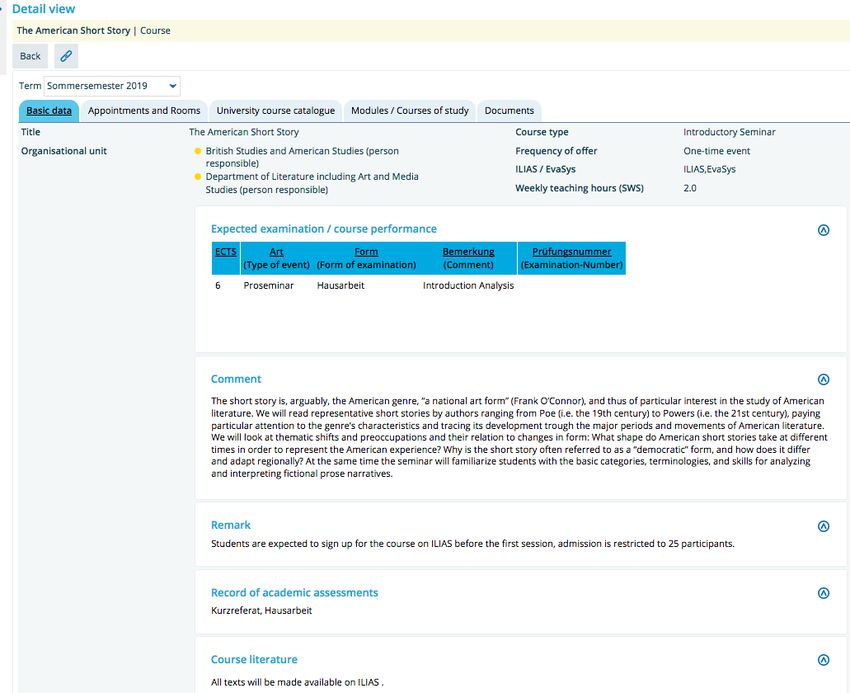
18   3.1.1. Department of Mathematics and Statistics                                                                                                                                    3.1.1. Department of Mathematics and Statistics   19

                                                                                                               2. Course categories and course offerings                The language of instruction on the undergraduate
                                                                                                                                                                        level is generally German. On postgraduate level,
                                                                                                               Most lectures are accompanied by homework assign-        courses are taught in English if requested by the
       3.1. Faculty I                                                                                          ments and tutorials, which are an integral part of the   participants. Do feel free to ask in case you are
                                                                                                               course. In seminars students study a specific topic      interested in a course but not yet able to follow a
                                                                                                               assigned to them and present their results in class.     course in German!
                                                                                                               There are different types of seminars, depending on

       Faculty of                                                                                              the degree phase students are in. Proseminar are
                                                                                                               seminars for undergraduate students at an introduc-      3. Contact information
       Science                                                                                                 tory level, e.g. for second year BA students.
                                                                                                                                                                        If you need advice and if you have questions on
                                                                                                               The outline of a course (lecture or seminar), the pre-   your study programme please contact the Erasmus+
                                                                                                               requisites for attendance and the ECTS points to be      Coordinator.
                                                                                                               received upon successful completion are announced
                                                                                                               in the respective descriptions of the online course      Dr. Volker Bürkel
                                                                                                               catalogue ZEuS.                                          Department of Mathematics and Statistics
                                                                                                                                                                        Room: F 406
                                                                                                                                                                        Ph.: +49 (0) 7531 88-2883
                                                                                                                                                                        – volker.buerkel@uni-konstanz.de

                                                                                                                                                                        Office hours upon request

     3.1.1. Department of Mathematics and Statistics

     1. About us                                             The degrees offered by the department are:         For more information see
                                                                                                                our website:
     The Department of Mathematics and Statistics has        Undergraduate/Bachelor programmes
                                                                                                                – math.uni-konstanz.de
     three research foci that students may specialise in:    Bachelor of Science
     – Analysis and Numerics                                 – Mathematics
     – Real Geometry and Algebra                             – Mathematical Finance (in cooperation with the
     – Statistics and Stochastics                              Department of Economics)
                                                             Bachelor of Education
     Most of the courses in the Department of Mathe-         – Mathematics
     matics and Statistics are taught in small groups,
     facilitating the dialogue between students, their       Graduate/Master programmes
     professors and tutorial instructors. Students benefit   Master of Science
     from this personal atmosphere that promotes inten-      – Mathematics
     sive discussions and allows every student to ask        – Mathematical Finance (in cooperation with the
     their questions.                                          Department of Economics)
                                                             Master of Education
     For more information about the department, the          – Mathematics
     teaching staff and the research foci please consult
     our website.                                            PhD programme
                                                             – Mathematics
20 3.1.2. Department of Computer and Information Science 3.1.2. Department of Computer and Information Science 21
3. Coursework 4. Research internship
Our Department offers no fixed courses in the ad- You are welcome to join us for a research internship.
vanced study period. The main reason for our flexible Students who are interested in applying for a rese-
course structure is that advanced level courses are arch internship usually contact the head of one of our
based on our Professor’s current research topics. Due research groups directly and ask for open projects.
to this course content, structure, number of ECTS Duration and conditions are discussed within the
credits and title can vary and/or be substituted. research group.
However, students usually have to face only minor
changes. As we cannot guarantee you a fixed set of – More information on research internship
courses for each winter term we would like to assist 5. Contact information
you in finding alternatives according to your chosen
programme if it becomes necessary. Department of Computer and Information Science
– erasmus.inf@uni-konstanz.de
Departmental advanced courses taught in English: – Skype Name: Informatik.UniKonstanz
– Winter term 2017/18
– Winter term 2015/16
3.1.2. Department of Computer – Summer term 2015
– Winter term 2014/15
and Information Science – Other courses taught in English
1. About us
are available in Data Science/Visual Computing/
Interactive Systems or even the Free Specialization
Our department is medium sized. Currently more than
(free course selection from the course book).
500 students are enrolled in the bachelor, master and
teaching study programmes. 14 professors and more
Teaching language:
than 90 scientific researchers teach and conduct
– Basic study period (1st – 4th semester) in German
research in our department.
– Advanced courses in English
(> 30 ECTS-Credits/semester)
Amongst other research areas our research groups
have a joint research interest in the areas of Explo-
The master’s programme in Computer and Infor-
rative Analysis and Visualization of Large Informa-
mation Science focuses on methods and systems to
tion Spaces. For more information see
visualise, analyse, explore and process large volumes
our website:
of data. Our students are requested to choose a study
– Incoming students
specialization (study profile) and an academic mentor – informatik.uni-konstanz.de
– Research at our Department
within their first semester.
– Labs
Teaching language: English
(> 30 ECTS-Credits/semester)
2. Study programmes
The bachelor’s programme in Computer Science
(three years) focuses on mathematical and theoretical
fundamentals. As a specialized area of study, options22 3.1.3. Department of Physics 3.1.3. Department of Physics 23
3.1.3. Department of Physics
1. About us This is why you should make sure to attend the first
meeting of a course you are interested in, even if you
At the department of Physics about 560 Bachelor are unsure about your participation in it. Where reg-
and Master students, 120 PhD students as well as istration is explicitly requested, you should follow the
41 researchers are working on numerous different instructions in the course commentary.
facets of Physics. With the tradition of open doors all
these different groups work closely together to gain
deeper insight and widen their knowledge. 3. Language requirements
Our recent study courses and research ranges from It is strongly recommended that incoming students have
different aspects of atomic electric contacts and at least German B2 (according to the Common Europe-
photonics to nanostructured materials, foundations of an Framework of Reference for Languages) language
renewable energy generation, laser development, and skills in order to successfully take courses from the B.Sc.
the foundations of quantum information processing. or M.Sc. programme. All B.Sc. courses are being taught
We offer a three-year Bachelor’s programme, with a in German language, while M.Sc. courses are given in
wide choice of minor subjects and a two-year Mas- English on student request. The language skills will of
ter’s programme, where students are deeply involved course influence the range of courses a student can
in research activities. choose from. Language requirement for degree-seek-
ing students in the B.Sc. or M.Sc. programme is proof
Together, we offer you a most attractive research en- of German proficiency DSH 2 or comparable. DSH1 or
vironment with excellent training in virtually all fields comparable is sufficient, if English B2 language skills
of Physics from the fundamentals up to the most are proven.
modern applications.
4. Contact Information
2. Registering for courses and assessments
Theda Brokamp | Erasmus+ Coordinator
Students do not have to register in order to take a lec- Room: M 1003
ture in Physics, they join a lecture by simply showing Ph.: +49 (0) 7531 88-3819
up at the first meeting of class. However, they do have – erasmus.physik@uni-konstanz.de
to register for tutorials and for assessments within the
lecture at a later stage of the semester. Assessment
registration is completed using the electronic student
information system StudIS or contact the Exchange
Coordinator.
To attend any kind of course with a practical part you
should contact the Exchange Coordinator as early as For more information see
possible. Details on the coursework and assessments our website:
of each course are either mentioned in ZEuS or
– physik.uni-konstanz.de/en
announced by the lecturer in the first meeting of class.24 3.1.4. Department of Chemistry 3.1.4. Department of Chemistry 25
3.1.4. Department of Chemistry
to take courses from the M.Sc. programmes.
Your language skills will of course influence the
course range you can choose from.
3. Contact Information
For more information see
Erasmus+ Coordinator
our website:
Room: L 803
Ph.: +49 (0) 7531 88-2283 – chemie.uni-konstanz.de/en
– erasmus.chemie@uni-konstanz.de
1. About us To apply for a PhD position, please contact the
individual research groups.
The department of Chemistry at the University of
Konstanz offers education covering many different
facets of modern Chemistry, Life Sciences and 2. Language requirements
Material Sciences. All study programmes consist of a
three years Bachelors and a two years Masters degree. International exchange students and Erasmus+
Detailed curricula including information on workload students are not formally required to take a German
and ECTS are provided on the homepages of the indi- language exam before coming to Konstanz.
vidual study programmes (links see below).
Nevertheless, it is strongly recommended that incom-
At the graduate level the department offers its struc- ing students have at least German B2 (according to
tured PhD programmes (Graduiertenschule) where re- the Common European Framework of Reference for
search is in the center of what you do. The department Languages) language skills in order to successful-
consists of 18 research groups covering a broad range ly take courses from the B.Sc. programmes (being
of different topics. taught in German language), or English B2 in order26 3.1.5. Department of Psychology 3.1.5. Department of Psychology 27
Exemplary Term Schedule for the 4-Year Bachelor in Psychology
1. Sem. 2. Sem. 3. Sem. 4. Sem. 5. Sem. 6. Sem. 7. Sem. 8. Sem.
(WiSe) (Sose) (Sose) (SoSe) (Wise) (Sose) (Wise) (Sose)
30 I 18* 30 I 16* 30 I 18* 30 I 16* 30 I X* 30 I ?* 30 I ?* 30 I 2*
NOTE: The Bachelor‘s
L: What is applied L: Developmental L: Developmental L: Learning and S: Advanced S: Advanced
Psychology Psychology I Psychology II Memory Studies in Studies in programme in Psychology
Psychology Psychology follows the definitions
2 I 2* 4 I 2* 4 I 2* 4 I 2* 4 I 2* 4 I 2* and guidlines as can be
L: Biopsychology L: Social- S: Seminar on L: Motivation and S: Advanced found in the “Prüfungs-
psychology Developmental Emotion Studies in und Studienorientierung”.
Psychology Psychology Descriptions of the various
6I 2* 4 I 2* 3 I 2* 4 I 2* 4 I 2*
modules and courses can
S: Seminar in L: Social- L: Cognition Seminar on LEMG Seminar on Seminar on
be found in the “Modul-
Biopsychology psychology II Academic Writing Academic Writing
handbuch”. This schedule
3 I 2* 4 I 2* 4 I 2* 3 I 2* 3 I 2* 3 I 2* is meant to be used as a
guideline and does not
S: Social- L: Perception S: Perception Practical Training
psychology and Cognition in Empirical necessarily have to be
Psychology
3.1.5. Department of Psychology 3I 2* 4 I 2* 3 I 2*
Research II
3 I 2*
adhered strictly to.
* ECTS I SWS
L/T: L/T: Metho- L/T: Statistics II L: Work & Organi- Module: Neuro Module: Health
Methodology I dology II sational Psycholo- Psychology Promotion
gy (Introduction)
5 I 3* 5 I 4* 5 I 4* 4 I 2* 8 I 4* 8 I 4*
1. About us Furthermore, it introduces in-depth studies in the vari- Practical Training L: Test theory and S: Psychological L: Introduction Module: Methodo- Module: Psycho-
ous fields of application (e.g. Health Psychology, Work- in Empirical test construction Assessment to Health logy of W&H social Factors
Research Psychology
Psychology as a science is concerned with behaviour Psychology, Clinical Psychology, Clinical Neuropsy- 3 I 2* 4 I 2* 3 I 2* 4 I 2* 8 I 4* 8 I 4*
and experience, as well as with cause and effect. chology). Key qualifications for working as a psycholo- L/T: Staistics I VL: Psychological L 1 on Clinical Module: Module: Clinical
Assessment Psychology I Life-Span Psychology 3
Its task is to analyse and explain behaviour and ex- gist are learned during the programme. Psychological Introduction
perience – meaning analysis of the conditions of the techniques of consultation and chairmanship, experi- 3 I 2* 4 I 2* 4 I 2* 8 I 4* 8 I 4*
L 2 on Clinical Module: Clinical Module: Clinical
environment and of the organism on which behaviour mental work and systematic observation and execu-
Psychology I Psychology Neuro-Psychology
and experience depend. At the same time the field tion of surveys, competences in IT and the presentation
4 I 2* 8 I 4* 8 I 4*
has to develop suggestions and propositions of be- of scientific results using modern presentation tech-
haviour as to how psychologically ideal conditions niques are essential parts of the curriculum.
Key Qualification Non-psychological Non-psychological Bachelor Thesis
may be created. Finally, it has to participate in the course course
realisation of these aforementioned conditions. Since The Department of Psychology at the University of
interdisciplinary
2 I 1* 5 I 2* 4 I 2* 12 I X*
psychology is an empirical science, all of its results Konstanz has close ties to research facilities and Internship Kolloqium
and suggestions have to be challenged empirically. psychological institutions, such as clinics and
Therefore education in psychology at the University psychotherapy ambulances, in the Lake Constance 30 I X* 4 I 2*
of Konstanz puts strong emphasis on methodology area. We are also engaged in various interdisciplin- 20 proband hours Guided theoretical
and empirical
of empirical/experimental as well as practical ary research groups in cooperation with different research
psychological work. departments of the University. 2 I X* 14 I X*
„Zwischenprüfung“: has to be completed until end of the sixth In total, 9 ECTS have to be earnd from non-psychological cour-
The curriculum provides students with the empirical
semester ses. These can be distributed freely among the first 6 semester.
tools that are required in modern scientific studies. 2. Course categories and course offerings
„Orientierungsprüfung“: has to be completed until end of the The 20 proband hours can be distributed freely a among the
The programme also includes a wide array of fun-
third semester. duration of study.
damental studies of different aspects of psychology The diversity of the field leads to a huge variety of
During semester 6 to 8 the students must complete 5 modules
(e.g. biopsychology, social psychology, developmental courses which are divided into three different cate-
from the areas of application (8 ECTS each) and the following
psychology, perception, cognition, assessment, learn- gories. Lectures (Vorlesungen) are your typical classes seminars: 2 seminars on Academic Writing, 3 Seminars on
ing and memory, motivation and emotion). and are tested by means of a final examination at the Advanced Studies in Psychology28 3.1.5. Department of Psychology 3.1.6. Department of Biology 29
3.1.6. Department of Biology
For more information see
our website: 1. About us – Ecology, with research groups in ornithology,
– psychologie.uni-konstanz.de movement ecology, limnology, fish ecology,
Studying with us means to be immersed into the environmental physics, ecology, microbial ecology,
active research environment of the Faculty of ecotoxicology, physiology and biochemistry
Natural Sciences at the University of Konstanz. of plants, and ecophysiology of plants.
The Department of Biology has grown into one of the
most active and successful biology departments in Our collaborative cross-disciplinary research builds
Germany. Topics in our research groups focusing on the fundament for a broad and modern education in
the future challenges to basic science and the grow- a three-year German-taught Bachelor programme, a
ing importance of the biological sciences in society. two-year English-taught Master programme, where
The research profile of the Department of Biology is students are deeply involved in research activities
focused on defined areas: and may choose to specialize in a specific profile, a
five-year Teacher Programme and various graduate
– Molecular cell biology, with research groups in schools which students join to obtain a PhD degree
biophysics, molecular bioinformatics, molecular within three years.
microbiology, molecular genetics, cell biology,
evolution, neurophysiology, and developmental
end of the semester. Seminars (Seminare) take place You will always find an updated list of courses in neurobiology.
in smaller classrooms and gain from in-group dis- the University’s centralised course catalogue:
cussions. You might be asked to hold presentations – ZEuS – Biomedical research, with research groups in
on a given topic and/or to hand in homework and biochemistry, immunology, biochemical pharma-
seminar theses. Tutorials (Übungen) are based around cology, molecular toxicology and alternative
the discussion of exercises and case studies. Stud- 3. Contact information in-vitro methods.
ies in Psychology are usually divided up into various
modules (Module) which consist of different lectures, Filipa Gonçalves | Erasmus+ Coordinator
seminars and tutorials belonging to the same field of Room: D 525
application. Not all courses can be taken at all times. Ph.: +49 (0) 7531 88-48 25
Each course is available either during the summer Fax: +49 (0) 7531 88-28 99
semester or during the winter semester. The following – erasmus.psychologie@uni-konstanz.de
exemplary schedule for the 4-year Bachelor’s pro-
gramme provides you with a first insight as to which Office hours: Wed 9:30–11:30 am in D 525
courses are available at what time of the year, how
many weekly hours are required and how many ECTS
credits are awarded upon completion.
Most of the classes are taught in German but we
also offer a wide range of seminars in English. Have
a look at our homepage to get more information:
– www.psychologie.uni-konstanz.de/en/study/
international/incomings30 3.1.6. Department of Biology 3.1.6. Department of Biology 31
Courses in Biological Sciences along either as biology related cookbook lab work Mandatory courses in the B.Sc. programme
International students will find theoretical and practi- and report writing, or solving math or physics assign-
cal courses they can chose from to receive the ne- ments at home (homework). Seminars (Seminar) 1. Semester 2. Semester
cessary study credits. Exchange students studying are smaller classes, in which you present papers and
Module Course Type SPW ECTS Module Course Type SPW ECTS
in a more specialized Bachelor programme, or in the discuss recent publications. In the preference module
last year of a four-year Bachelor programme at their (Präferenzmodul) you will find more advanced 1 Basic Chemistry L 4 5 1 Organic Chemistry L 4 5
home university, are welcome to ask for admittance lectures on specific topics. Elective modules (Wahl-
2 Experimental Physics I L+E 4+2 5 2 Experimental Physics II L+E 4+2 5
to advanced courses of our Master programme. In pflichtmodule) are a collection of all course types.
case you have problems choosing your courses or While the mandatory part of the programme has a 3 Mathematics for Biologist L+E 2+2 5 2 Physics Practical Course L+E 2+2 5
are unsure whether the selected courses will suit you, more or less fixed schedule, topics and schedules
5 Genetics I L 2 3 4 Biophysics & Physical Chemistry I L 2 3
please contact the Erasmus+ Coordinator by email. of elective courses may vary from year to year, and
you will most probably not be able to collect a full 5 Cell Biology I L 2 3 6 Structure and Function of Plants L 2 3
Bachelor programme Biological Sciences (B.Sc.) semester load of ECTS points by only choosing from Cellbiology Histology-
5 P 2 2 6 Botanic Course P 2 2
The vast majority of the courses in the B.Sc. pro- this section of courses. Microscopy Course
gramme are taught in German with only one fixed ex- 7 Zooological Systematics L 3 4 6 Identification of Plants L 3 4
ception, which is the course “Evolution and Behaviour”. The three compact courses in the 5th semester com- Elective Modules
SoSe 2012, WiSe 2012/2013
Some of the courses in the preference module bine lectures, seminars and experimental work. They
(module 10) and a bunch of elective courses (3300 come in a special format taking almost all of your time
Wahlpflichtmodule) may also be taught in English. In during four consecutive weeks of the semester. If you 3. Semester 4. Semester
most cases, English examinations (in terms of presen- plan to take one or several of these courses please
Module Course Type SPW ECTS Module Course Type SPW ECTS
tations, seminar papers, and final exams) are possible, contact the Erasmus+ Coordinator as early as possible.
Biochem./Molecular Biol.
regardless of the original course language. You are 1 Chemical Practical Course P 6 6 4
Practical Course
P 8 8
encouraged to get in touch with the lecturers of your The following curriculum includes the mandatory
3 Biostatistics L+E 2+1 3 9 Genetics II L 2 3
selected courses and discuss a means of examination. courses in the three-year B.Sc. programme and pro-
The lecturers will also be glad to provide you with vides you with a first insight as to which courses are 4 Biochemistry I L 4 5 9 Microbiology L 2 3
additional or alternative English studying material. available at what time of the year, how many weekly
7 Zoological Course P 3 3 9 Cell Biology L 2 3
hours are required and how many ECTS credits are
You are likely to meet one of our many internatio- awarded upon completion. Courses in the 1st, 3rd, 7 Identification of Animals E 3 2 10 2 Preference Modules L 4 2
nal English speaking PhD students as a teaching and 5th semester of the programme are available Elective Modules
8 Ecology L 3 3
assistant in the practical or lab courses (Praktika) every winter semester, courses in the 2nd, 4th and SoSe 2012, WiSe 2012/2013
or in a tutorial (Tutorium). 6th semester are available every summer semester. 8 Evolution and Behaviour L 3 3
Please follow the link to the course descriptions of Elective Modules
You will find that in the Bachelor programme in the course titles. SoSe 2012, WiSe 2012/2013
Biological Sciences there are seven different course
types. Lectures (Vorlesung) are presented in large Master programme Biological Sciences
5.–6. Semester
classes and assessment is with final written examina- The Master programme in Biological Sciences at the
tions at the end of the semester. They are often ac- University of Konstanz is completely taught in English. Module Course Type SPW ECTS
companied by a facultative tutorial (Tutorium), in which Students enter the Master programme after success- L/
11 Compact Course Microbiology 3+7 10
students can ask questions and discuss the topics in ful completion of a three year Bachelor degree in S+P
Compact Course Plant L/
more detail with a teaching assistant. Biological Sciences. The backbones of the Master 12
Physiology S+P
3+7 10
programme are advanced courses in which students Compact Course Animal L/
13 3+7 10
Practical courses (Praktikum) come as partly self- will be deeply immersed into ongoing research in the Physiology S+P
Specific Interest Course
directed lab work. They either accompany a related department. (6 weeks, full day)
P 8 8
lecture in the same semester, or build on a lecture in Bachelor Thesis
L 10
the semester thereafter. Exercises (Übung) come (6. semester, 6 weeks)
Elective Modules
SoSe 2012, WiSe 2012/201332 3.1.6. Department of Biology 3.1.6. Department of Biology 33
The classes are small, with about 12 students. Each your own research project. As you can see, taking research work. The research carried out can either 3. Language requirements
advanced course is offered once a year in a block other courses in parallel to an advanced course might relate to a single research group or to different
of six weeks with 5 days of course work per week, be difficult, but not impossible. Students are expected research groups. However, places are limited and It is deeply recommended that incoming exchange
either in the first or second half of the winter or the to have basic skills and knowledge in the respective depending on availability. If you consider taking an students have at least German B2 (according to the
summer semester. Each advanced course has two research field. Please find detailed information in applied research course, please notify the Erasmus+ Common European Framework of Reference for Lan-
parts, a lecture with colloquium, and a supervised English on dates, contents, and possible research and Exchange Coordinator as early as possible and guages) language skills in order to successfully take
research project. The two parts of each course are projects in the advanced courses offered in upcoming preferentially well in advance of the planned exchange courses from the B.Sc. programme, or English B2 in
listed separately in the course catalogue and both semesters in the booklet, which you can download study period. Applicants should submit a short sum- order to take courses from the M.Sc. programme. The
parts have the same title but different course codes. from the Master programme online description. mary of their previous studies and acquired qualifi- language skills will of course influence the course
It is possible to take the lecture with colloquium only, cations and they are asked to suggest three research range a student can choose from.
or to take both parts together. If you cannot find a suitable advanced course offered groups in the Department of Biology as possible hosts.
during the period of your stay, you are welcome to Language requirement for degree-seeking stu-
For the lecture and colloquium, you will attend 90 apply for an applied research course for exchange You are also welcome to choose from a number of dents in the German taught Bachelor programme
minutes of lecture each day in the morning, you will students, which is a flexible individual course that can smaller elective courses, which are offered as eve- is proof of German proficiency DSH 2 or TestDaF 4,
have to present a paper and you will earn 5 ECTS. For be arranged in any research group at the Depart- ning lectures, seminars of fieldwork courses. without exceptions.
the research project, you are expected to spend full ment of Biology or affiliated institutions any time of
days in the lab after lectures, each day of the 6 weeks the year. By taking the 5 ECTS, the 10 ECTS and The language requirements for degree-seeking
except weekends, and you will earn 10 ECTS. You will the 15 ECTS course offered each semester, you can 2. Registering for courses and assessments students in the M.Sc. programme Biological Sciences
be supervised by a postdoc and create and conduct even gain a full semester workload of 30 ECTS with is English B2 (TOEFL70 internet based of IELTS
Unless specified in the course commentary in the Band 6). Native speakers of English do not have to
online course catalogue, students do not have to re- hand in a proof of language skills.
gister in order to take a lecture in Biological Science.
Students join a lecture by simply showing up at the
first meeting of class. However, they do have to re- 4. Contact Information
gister for the assessments within the lecture at a
later stage of the semester. Assessment registration Dr. Sabine Kreissl | Academic Advisor, Erasmus+
is completed using the electronic student information and Exchange Coordinator for Biological Sciences
system StudIS or contact the Exchange Coordinator. – s.kreissl@uni-konstanz.de
To attend any kind of course with a practical part you
should contact the Exchange Coordinator as early as Office hours: Wed and Thu 3 –5 pm in M 1109
possible. or by appointment
Details on the coursework and assessments of each
course are either mentioned in ZEuS or announced
by the lecturer in the first meeting of class. This is
why you should make sure to attend the first meeting
For more information see
of a course you are interested in, even if you are un-
our website:
sure about your participation in it. Where registration
– biologie.uni-konstanz.de is explicitly requested, you should follow the instruc-
tions in the course commentary.34 3.2.1. The Department of Literature, Art and Media Studies 3.2.1. The Department of Literature, Art and Media Studies 35
Bachelor of Education Except for the B.A. programme British and
3.2. Faculty II
– English American Studies and the M.A. courses in English
– German Literatures and Cultures, the language of instruc-
– French tion in the department is mostly German.
– Italian In French/Italian/Spanish Literatures a small
Faculty of – Latin percentage of courses is also offered in the
Humanities – Russian respective language (1–3 courses per semester).
– Spanish
(all in collaboration with the Department of
Linguistics and the Language Institute) 2. Course categories and ECTS points
Graduate/Master programmes There are basically five different course categories in
Master of Arts the Department of Literature, Art and Media Studies
– Eastern European Studies: History – Media (see the list below, the information in brackets indi-
– Literature (Konstanz Master School of Literary Studies) cates at what stage the course types should/can be
areas of specialisation: selected):
– German Literature – Einführung/Undergraduate introduction
– English Literatures and Cultures (BA 1st semester/1st year)
– French Literature – Proseminar/Undergraduate beginner level courses
– Italian Literature (BA 1st and 2nd year)
– Spanish and Ibero-American Literature – Hauptseminar/Advanced level courses
– Latin Literature (BA 3rd year, MA level. This seminar type is only
– Slavic Literatures open to advanced students of literary studies)
– Literature – Art – Media – Kolloquium/Colloquium
– Studies in European Culture (Kulturelle (final BA or MA semester)
Grundlagen Europas)
Master of Education There are two more terms for course categories one
– German can come across in the Department of Literature, Art
3.2.1. The Department of Literature, Art and Media Studies – English and Media Studies, these are Kurs (course) and Vor-
– French lesung (lecture). A course can be taken by both BA
– Italian as well as MA students. The amount of ECTS points
– Latin awarded will depend on the type of assessment
1. About us show a national-philological conception, they have
– Russian required in the respective degree programme.
a strong interdisciplinary focus. The degrees
– Spanish
The Department of Literature, Art and Media Studies offered by the department are:
A lecture is also open to students of both levels, it
has an uncommon structure compared to other
PhD programmes differs from the seminar types with respect to the
German universities offering philological degrees: Undergraduate/Bachelor programmes
Exist for all philologies as well as for Art History teaching method employed. Lectures are usually big-
Instead of separate philological institutes, the various Bachelor of Arts
and for Media Studies. ger in student numbers and hence do not allow for
national literatures are located in one single depart- – German Literature
active participation by each individual participant.
ment. We combine the strengths of English, American, – British and American Studies
Programme duration, Language of instruction
German, Greek, Latin, Romance and Slavic Studies in – French Literature
All BA programmes are three-year programmes, Courses in the Department of Literature, Art and Media A course can be awarded
a comparative perspective and in a shared interest – Italian Literature with 3 or 6 ECTS points
all MA programmes run for two years. Studies are awarded 3 or 6 ECTS points, depending on
in literary and cultural theory. Another distinguishing – Spanish and Ibero-American Studies depending on the
the assessment completed for them. In order to receive assessment completed
characteris- tic of the department is that it also incor- – Classics and the Ancient Near East
3 ECTS points for a course, apart from regular and for it.
porates the fields of Art History and Media Studies. – Slavic Literatures
active participation, students typically have to give an
Although the department’s various degree options – Literature – Art – Media36 3.2.1. The Department of Literature, Art and Media Studies 3.2.1. The Department of Literature, Art and Media Studies 37
oral presentation during the semester or hand in a small Research and teaching of the faculty for British Stud-
piece of written work. Courses worth 6 ECTS points usu- ies focuses on British and New English Literatures,
ally require both, an oral presentation on a topic relevant Cultural Identity Studies, Drama, Film, and TV Studies,
to the course and a more extensive written assignment Postcolonial Studies, Memory Studies, and Gender
handed in for assessment (either a final exam or a Studies, while research and teaching of the faculty for
paper, varying in length according to the study level American Studies focuses on American Literature and
BA vs. MA). Culture, Canadian Literature and Culture, Comparative
North American Studies, Literature and the Media,
Since students from different degree programmes Gender Studies, and Native North American Literature.
with different requirements often attend the same
courses, these courses may be listed several times 3.1. Course offerings in English
in our course catalogue. In some cases a course ap-
pears several times as it can be completed with 3 or With only a few exceptions the courses in the B.A.
6 ECTS. Which assessment has to be completed for British and American Studies and the M.A. courses
how many ECTS is defined in the course catalogue in English Literatures and Cultures are taught in the
(see “ECTS requirements”) and will be explained in the English language. Courses/course categories offered
first meeting of class. International students should on a regular basis include: British Literature and Culture I – A survey lecture offering a more pronouncedly theoretical/cultur-
select the workload suiting their study level and and accompanying tutorial introducing students to al studies perspective on American literature and
degree at home and have to make sure to register for BA Introductory Level the basic periods and concepts of British literature culture and focusing on the intensive discussion of
the correct amount during the registration phase for Summer semester Winter semester and culture from the 16th up to the 21st century, as individual texts and subject areas within a smaller
assessments. well as to canonical texts from various genres. group of students.
British Literature American Literature
and Culture I and Culture I
American Literature and Culture I – A survey lecture
Introduction to the Analysis of Literary Texts
and accompanying tutorial introducing students to 4. M.A. programme: Literature
We offer eight B.A. programmes, one the basic periods and concepts of American literature (Konstanz Master School of Literary Studies)
is almost completely taught in English: BA Advanced Level and culture from its beginnings up to the 21st century,
as well as to canonical texts from various genres. In the academic year 2014/15 the department
British and American Studies Summer semester Winter semester
launched its M.A. programme “Literature”. In this four
American Literature British Literature Author/Genre/Period/Theme of British or Ameri- semester degree (120 ECTS points) students take
and Culture II and Culture II
can or New English Literatures – This course cat- courses in two major areas of studies: Modules in the
3. B.A. British and American Studies Author/Genre/Period/Theme of British or egory describes advanced seminars on a wide array Konstanz Master School of Literary Studies, focussing
American or New English Literatures
of subjects in which students will study particular on general literary theory, and modules with courses
The B.A. degree programme British and American authors, genres, periods, or themes from the national on specific literatures. Students choose to study in
Studies situates literatures of the English-speaking In the online course catalogue ZEuS, courses of this literatures of Britain, the United States, but also, for one of the following areas of specialisation:
world in their historical and cultural contexts. In its programme may easily be found following the path to instance, from Canada, New Zealand, or South Africa.
concentration on Great Britain, the United States, as BA-courses offered by the Department of Literature, – German Literature
well as Canada and other anglophone countries Art and Media Studies. British Literature and Culture II – This advanced – English Literatures and Cultures
(the “New English Literatures”), the programme intro- seminar complements the survey lecture BLC I by of- – French Literature
duces students to important literatures and cultures 3.2. Short course descriptions fering a more pronouncedly theoretical/cultural studies – Italian Literature
that have a worldwide sphere of influence. The B.A. perspective on British literature and culture and focus- – Spanish and Ibero-American Literature
programme British and American Studies was estab- Introduction to the Analysis of Literary Texts – This ing on the intensive discussion of individual texts and – Latin Literature
lished in 2003/04 and is offered as a major and a course category describes introductory seminars on subject areas within a smaller group of students. – Slavic Literatures
minor subject. After completion of the B.A. programme, varying subjects which familiarise students with the
qualified students may pursue graduate studies within basic modes and methodologies of textual analysis American Literature and Culture II – This advanced
the Konstanz Master School of Literature (see 4.) and interpretation. seminar complements the survey lecture ALC I byYou can also read


