Adult-onset porokeratotic eccrine ostial and dermal duct nevus: dermatoscopic findings and treatment with tazarotene
←
→
Page content transcription
If your browser does not render page correctly, please read the page content below
Volume 26 Number 2| February 2020|
Dermatology Online Journal || Photo Vignette                                                                                26(2):12

Adult-onset porokeratotic eccrine ostial and dermal duct
nevus: dermatoscopic findings and treatment with
tazarotene
Husain Alomran, Jean Kanitakis
Affiliations: Department of Dermatology, Ed. Herriot Hospital Group, Lyon, France and Department of Pathology, Centre
Hospitalier Lyon Sud, Pierre Bénite, France
Corresponding Author: Jean Kanitakis Department of Dermatology, Ed. Herriot Hospital Group, 69437 Lyon Cedex 03, France, Tel: 33-
472110301, Email: jean.kanitakis@univ-lyon1.fr

                                                                      left upper limb. Physical examination showed an
  Abstract                                                            erythematous-pink, slightly hyperkeratotic, rather
  Porokeratotic eccrine ostial and dermal duct nevus                  well-limited elongated plaque on the radial side of
  (PEODDN) is a rare dermatosis initially described as                her left thumb, extending to the wrist (Figure 1A).
  ‘comedo nevus’ and renamed ‘PEODDN’; it has also                    Dermatoscopic       examination      showed       an
  been referred to as linear eccrine nevus with
                                                                      erythematous plaque studded with several distinct
  comedones, porokeratotic eccrine ostial and hair
  follicle nevus, and porokeratotic adnexal ostial nevus.
                                                                      whitish pinhead-sized globules (Figure 1B). The
  PEODDN is usually present at birth or develops early                patient reported mild occasional pruritus, which was
  in life. Rarely, PEODDN can develop in adults. The                  unrelated to her work and showed no clear seasonal
  treatment of this puzzling condition is not                         variations. She mentioned that similar lesions had
  standardized. We report herein a new case of adult-                 appeared previously on the same extremity (forearm
  onset PEODDN with dermatoscopic images. Our                         and arm) but had regressed spontaneously. The
  patient responded favorably to topical tazarotene.                  patient was otherwise in good condition, had no
                                                                      other mucocutaneous lesions, and was not taking
                                                                      systemic treatments. She had two healthy children
                                                                      (aged 8 and 10 years) and her family history was
Keywords: porokeratotic eccrine ostial and dermal-duct                unremarkable. Her lesions had been treated by her
nevus, porokeratosis, tazarotene                                      family physician with topical corticosteroids, which

Introduction
Porokeratotic eccrine ostial and dermal duct nevus
(PEODDN) is a rare dermatosis initially described in
1979 as 'comedo nevus' [1] and it was renamed
'PEODDN' in 1980 [2]. It has also been referred to as                   A
linear eccrine nevus with comedones [3],
porokeratotic eccrine ostial and hair follicle nevus [4],
and porokeratotic adnexal ostial nevus [5]. Most
cases of PEODDN are present at birth or develop
during childhood [6]. Rarely, PEODDN can develop in                     C                              B
adults.
                                                                      Figure 1. A) Clinical appearance of the lesion: erythematous-
                                                                      pink, slightly hyperkeratotic, well-limited elongated plaque on the
                                                                      radial side of the thumb, extending to the wrist. B) Dermatoscopic
Case Synopsis                                                         examination shows an erythematous plaque studded with
A 38-year-old woman was referred to us for skin                       several whitish pinhead-sized globules. C) Clinical improvement
lesions that had appeared three years prior on her                    after a one-month treatment with 0.1% tazarotene gel.

                                                                -1-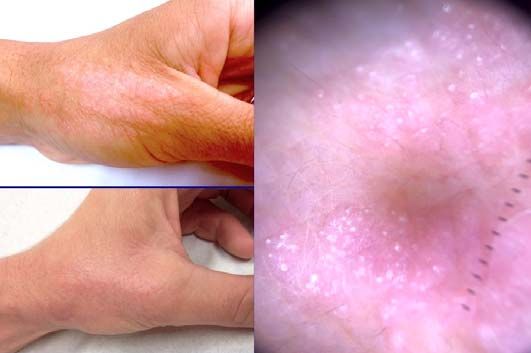
Volume 26 Number 2| February 2020|
Dermatology Online Journal || Photo Vignette                                                                                26(2):12

alleviated pruritus, but had no obvious effect on the                     PEODDN affects almost equally both genders, but
appearance of the plaque. Microscopic examination                         the adult onset cases show a slight male
of a punch skin biopsy showed epidermal                                   predominance (5:3). It presents clinically with
hyperplasia        (hyperkeratosis,       acanthosis,                     unilateral, verrucous or keratotic, pink, brown, or
papillomatosis) and parakeratotic plugs within                            whitish pits with comedo-like plugs or papules,
dilated, hyperplastic eccrine sweat-gland ostia                           located primarily on the extremities, particularly the
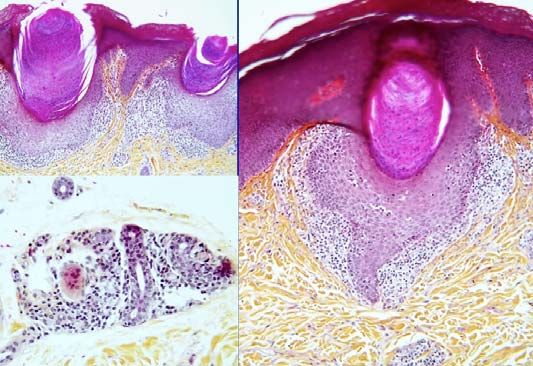
(Figure 2A, B). A lymphocytic infiltrate was present                      palms and soles [7-11, 13-15]. The lesions are more
in the dermis, surrounding the superficial part of the                    rarely bilateral. They may coalesce into linear plaques
excretory eccrine sweat gland ducts and the eccrine                       [8], sometimes following Blaschko lines [5, 7, 16], and
sweat gland coil (Figure 2C). These findings were                         have thereby been considered as a variant of linear
diagnostic of PEODDN. The patient was prescribed                          porokeratosis by virtue of a similar pathological
treatment with daily applications of tazoretene 0.1%                      appearance. The lesions are usually asymptomatic
gel. After one month, the lesions had improved,                           [10, 13, 14] but may be mildly pruritic as in our
showing less erythema and surface hyperkeratosis                          patient [8, 9]. The clinical differential diagnosis of
(Figure 1C). The treatment was well-tolerated and                         PEODDN includes dermatoses with linear
the patient was advised to continue the treatment                         distribution, such as epidermal nevi, linear psoriasis,
for another month.                                                        linear Darier disease, linear lichen planus, and
                                                                          ichthyotic disorders with a Blaschkoid distribution,
                                                                          such as Conradi-Hünermann-Happle and CHILD
Case Discussion                                                           syndrome [8, 13]. Dermatoscopic examination may
PEODDN, first described as 'comedo nevus of the                           assist the diagnosis by showing whitish pinhead-
palm' [1], is a rare condition of which about 70 cases                    sized dots (corresponding to the surface of the
have been reported in the literature. Most cases are                      cornoid lamellae embedded in eccrine ostia) over a
present at birth or develop within the first two                          slightly erythematous background. The definite
decades of life [6]. Seven cases [7-13] had their onset                   diagnosis requires microscopic examination, which
in adulthood, at a mean age of 31 years (range, 18-                       shows a variable degree of epidermal hyperplasia
65). Our patient is therefore the 8th case of adult-                      (hyperkeratosis, acanthosis, papillomatosis) and the
onset PEODDN reported in the literature (Table 1).                        presence of cornoid lamellae (narrow vertical stacks
                                                                          of parakeratotic corneocytes) within eccrine sweat
                                                                          gland ostia. A lymphocytic infiltrate may surround
                                                                          the eccrine gland, as in our case, and highlights the
                                                                          involvement of the eccrine gland in the
                                                                          development of this condition. The presence of
  A                                                                       cornoid lamellae confined to adnexal ostia
                                                                          differentiates PEODDN from other porokeratosis
                                                                          forms, in which the cornoid lamella is not confined to
                                                                          adnexal ostia [17].
                                                                          The etiopathogenesis of PEODNN remains poorly
                                                                          known. It has been proposed that the lesions of
  C                           B                                           porokeratosis result from the peripheral expansion
                                                                          of a clone of mutant epidermal keratinocytes located
Figure 2. A, B) Microscopic examination of a skin biopsy shows            at the base of the cornoid lamella [17]. It can be
two keratin parakeratotic plugs (cornoid lamellae) within dilated
eccrine gland ostia. The upper dermis contains a lymphocytic
                                                                          speculated that the same mechanism could underlie
infiltrate surrounding the superficial part of excretory eccrine          PEODDN if the mutant keratinocytes reside within
sweat gland ducts. C) The infiltrate also surrounds the deep              eccrine glands. Our finding of lymphocytic
dermal eccrine sweat-gland coil. H&E, A) 100×, B) 200×, C) 400×.          infiltration around eccrine glands is consistent with

                                                                    -2-
Volume 26 Number 2| February 2020|
Dermatology Online Journal || Photo Vignette 26(2):12
Table 1. Cases of adult-onset porokeratotic eccrine ostial and dermal duct nevus published in the literature.
Gender/
Age at Treatment/
Case Ref onset Location Aspect of lesions Associated conditions Outcome
linearly-arranged yellow- Hyperthyroidism,
1 [7] M/65 R palm nm/nm
grey keratotic papules sensory polyneuropathy
linearly-arranged
brownish verrucous
L forearm, arm, ablative laser
2 [8] M/18 papules, nodules and none
upper chest therapy/nm
plaques, punctate palmar
pits
pruritic keratotic papules
3 [9] M/21 R lateral ankle linearly distributed to nm nm/nm
form plaques
L upper limb
multiple hyperpigmented
(index finger, pits and groove of the
4 [10] F/27 keratotic papules discrete nm/nm
hand dorsum, nail of the index finger
or coalescing to plaques
forearm)
Keratotic papules and pits,
5 [11] F/29 L foot none nm/nm
some with keratotic plugs
well-demarcated 2-cm urea 40% cream: little
poorly-controlled type II
M/ plaque with multiple 3- to improvement, shave
6 [12] R buttock diabetes mellitus, heavy
mid 30’s 4-mm-thick yellow-brown removal: no recurrence
tobacco smoking
hornlike projections 12 months later
punctate pits, keratotic
topical keratolytics,
7 [13] M/30 L hand papules and verrucous none
emollients/ nm
plaques
Pink, well-demarcated
This tazarotene 0.1% gel/
8 F/35 L wrist plaque with a keratotic none
case improvement
surface
this hypothesis. Heredity may play a role since one mutations of the GBJ2 gene. It has been suggested
familial case has been reported [18]. The distribution that patients carrying GBJ2 somatic mosaicism are at
of PEODDN lesions along the lines of Blaschko risk for transmitting systemic disease to their
suggests that genetic mosaicism may play a role [19]. offspring and that all individuals with PEODDN
More recently, it was found that PEODDN is caused should therefore be counseled regarding the risk of
by somatic mutations in the gene GJB2 encoding for having a child with KID syndrome [20].
connexin 26 [20], a gap junction protein, which
The course of PEODDN is chronic. The lesions may
permits intercellular ion and macromolecule flux.
remain stable over years [8, 10] or be slightly
Porokeratotic eccrine ostial and dermal duct nevus,
progressive [12]. Our patient experienced
especially when systematized or bilateral, can be
spontaneous regression of part of her lesions on the
associated with various conditions, including
arm and forearm. The prognosis is as a rule benign;
hyperthyroidism and sensory polyneuropathy [7],
however, transformation of PEODDN into Bowen
breast hypoplasia [21], deafness, developmental
disease [28] and squamous cell carcinoma [29, 30]
delay [22], alopecia, onychodysplasia [23], psoriasis
has been reported. This fact is consistent with the
[24], palmoplantar keratoderma [25], hemiparesis,
contention that PEODDN may be a form of linear
and scoliosis [26]. Whether or not these associations
porokeratosis, known to be at risk for malignant
are fortuitous remains speculative. The association of
transformation [17].
PEODDN with KID (keratosis, ichthyosis, deafness)
syndrome [27] is interesting and seems significant The treatment of PEODDN is challenging as no
since this complex genetic disease is also related to standardized option exists. Various treatments have
-3-Volume 26 Number 2| February 2020|
Dermatology Online Journal || Photo Vignette 26(2):12
Table 2. Cases of porokeratotic eccrine ostial and dermal duct nevus treated with topical tazarotene (TZT).
Age/ Location of Previous
Case Ref Gender lesions treatments Treatment with TZT Result
TZT 0.1% cream, 5-FU
chest, legs,
1 [5] Newborn/F – 5% cream and Somewhat helpful
neck, perineum
emollients
Minocycline
trunk &
100mg twice/d
extremities
2 [5] 37/F × 2 months: slight TZT 0.05% cream Minimal response
along Blaschko
reduction in the
lines
blistering eruption
Urea keratolytics: TZT 0.1% gel Significant
3 [28] 6/M R palm & sole
no response 3 weeks improvement
Local
this TZT 0.1% gel Significant
4 F/35 L hand corticosteroids:
case One month improvement
improved pruritus
been used, but none seems to be regularly effective local application to small skin areas seems to be
[6]. Topical corticosteroids (methylprednisolone and limited, nevertheless a pregnancy test is
clobetasol propionate) can achieve temporary relief recommended prior to the onset of treatment in
[31, 32]. Local tretinoin 1% cream, calcipotriene women of childbearing potential. The drug is
ointment [32], 5-fluorouracil [5], and various contraindicated in women who are pregnant or
keratolytics have been used, including urea desire a pregnancy.
ointment or cream [12] and salicylic acid in
petrolatum [15], without significant results. Systemic
acitretin (50mg/d for two months) was ineffective in Conclusion
one case, although it improved the pruritus [15]. Porokeratotic eccrine ostial and dermal duct nevus
Partial results have been obtained with can rarely appear in adults but should be considered
photodynamic therapy [33]. Carbon dioxide laser [6, in the differential diagnosis of acral keratotic lesions
8, 16] alone or combined with erbium [34] have appearing in adulthood. The diagnosis is usually
provided good results, especially for large lesions. made by histological examination. Although no
Topical tazarotene has been tried in three patients, regularly effective standard treatment exists our
as 0.1% gel or 0.05% or 0.1% cream (Table 2). Two observation suggests that tazarotene 0.1% gel may
patients showed minimal response [5], but another be a satisfactory treatment option. More cases need
patient achieved almost complete response within to be studied in order to confirm the efficacy of this
three weeks [28]. We decided to try this treatment in treatment.
our patient since it can provide good results in
various (genetic or acquired) diseases of
keratinization and our patient obtained encouraging Potential conflicts of interest
results. The systemic absorption of tazarotene after The authors declare no conflicts of interests
References
1. Marsden RA, Fleming K, Dawber RPR. Comedo naevus of the 4. Coskey RJ, Mehregan AH, Hashimoto K. Porokeratotic eccrine duct
palm—a sweat duct naevus? Br J Dermatol. 1979;101:717. [PMID: and hair follicle nevus. J Am Acad Dermatol. 1982;6:940. [PMID:
93967]. 709665].
2. Abell E, Read SI. Porokeratotic eccrine ostial and dermal duct 5. Goddard D, Rogers M, Frieden I, Krol A, White Jr CR, Jayaraman AG,
naevus. Br J Dermatol 1980;103:435. [PMID: 7437310]. Bostom LR, Bruckner AL, Ruben BS. Widespread porokeratotic
3. Blanchard L, Hodge SJ, Owen LG. Linear eccrine nevus with adnexal ostial nevus: Clinical features and proposal of a new name
comedones. Arch Dermatol. 1981;117:357. [PMID: 7247428]. unifying porokeratotic eccrine ostial and dermal duct nevus and
-4-Volume 26 Number 2| February 2020|
Dermatology Online Journal || Photo Vignette 26(2):12
porokeratotic eccrine and hair follicle nevus. J Am Acad Dermatol. Systematized Porokeratotic Eccrine Ostial and Dermal Duct Nevus
2009;61:1060.e1. [PMID: 19664847]. with Unilateral Breast Hypoplasia [abstr.]. J Cutan Pathol.
6. Llamas-Velasco M, Hilty N, Kempf W. Porokeratotic adnexal ostial 2005;32:95.
naevus: review on the entity and therapeutic approach. J Eur Acad 22. Jamora MJJ, Celis MA. Generalized porokeratotic eccrine ostial
Dermatol Venereol. 2015;29:2032. [PMID: 25255914]. and dermal duct nevus associated with deafness. J Am Acad
7. Rasi A, Tajziechi L. Late-onset porokeratotic eccrine ostial and Dermatol. 2008;59[2, suppl. 1]:S43. [PMID: 18625383].
dermal duct nevus associated with sensory polyneuropathy and 23. Hartman R, Rizzo C, Patel R, Kamino H, Shupack JL. Porokeratosis
hyperthyroidism. Arch Iran Med. 2008;11:218. palmaris et plantaris disseminata or a disseminated late-onset
8. Bandyopadhyay D, Saha A, Das A, Das A. Porokeratotic eccrine variant of porokeratotic eccrine ostial and dermal ductal nevus
ostial and dermal duct nevus. Indian Dermatol Online J. 2015; 6: [PEODDN] with follicular involvement. Dermatol Online J. 2009;
117. [PMID: 25821735]. 15:15:8. [PMID: 19891916].
9. Naraghi M, Nikoo A, A. Goodarzi A. Porokeratotic Eccrine Ostial 24. Yu HJ, Ko JY, Kwon HM, Kim JS. Linear psoriasis with porokeratotic
and Dermal Duct Nevus. Case Rep Dermatol Med. eccrine ostial and dermal duct nevus. J Am Acad Dermatol.
2013;2013:953840. [PMID: 24307955]. 2004;50[5 Suppl]:S81. [PMID: 15097935].
10. Mondal A, Kumar P, Das A, Debbarman P, Kumar Mandal R. 25. Cobb MW, Vidmar DA, Dilaimy MS. Porokeratotic eccrine ostial
Porokeratotic eccrine ostial and dermal duct nevus: A noteworthy and dermal duct nevus: a case of systematized involvement. Cutis.
presentation. Indian Dermatol Online J. 2015;6:130. [PMID: 1990;46:495. [PMID: 2269022].
25821740]. 26. Solis J, Sau P, James WD. Puzzling palmar and plantar papules.
11. Stoof TJ, Starink TM, Nieboer C. Porokeratotic eccrine ostial and Porokeratotic eccrine ostial and dermal duct nevus. Arch
dermal duct nevus. Report of a case of adult onset. J Am Acad Dermatol. 1991;127:1220. [PMID: 1863085].
Dermatol. 1989;20[5, part 2]:924. [PMID: 2715447]. 27. Criscione V, Lachiewicz A, Robinson-Bostom L, Grenier N, Dill SW.
12. Arbogast M, Bax D, Paragh G, Bogner P. Late-onset solitary Porokeratotic eccrine duct and hair follicle nevus [PEHFN]
porokeratotic eccrine ostial and dermal duct nevus. JAAD Case associated with keratitis-ichthyosis-deafness [KID] syndrome.
Rep. 2018;4:434. [PMID: 29984273]. Pediatr Dermatol. 2010;27:514. [PMID: 21182641].
13. Bhushan P, Thatte S, Singh A, Jayant S. Porokeratotic eccrine ostial 28. Coras B, Vogt T, Roesch A, Landthaler M, Hohenleutner U. Bowen’s
and dermal duct nevus: A report of three cases. Indian J Dermatol disease on porokeratotic eccrine ostial and dermal duct nevus.
Venereol Leprol. 2016;82:553. [PMID: 27297273]. Dermatol Surg. 2007;33:496. [PMID: 17430387].
14. Ghiasi M, Jamshidi S, Ghasemi H, Kamyab K, Nikoo A. 29. Xiangang F, Huixian L, Lankai Y, Jiayou X, Xinbo W, Yunxiang Z,
Porokeratotic eccrine ostial and dermal duct nevus [PEODDN]: A Zhenhua W. Metastatic squamous cell carcinoma arising from a
case report. Iran J Dermatol. 2011;14:106. serious widespread porokeratotic eccrine ostial and dermal duct
15. Birol A, Erkek E, Bozdoethan O, Koçak M, Atasoy P. A case of nevus: Case report and literature review. Dermatol Sinica
porokeratotic eccrine ostial and dermal duct naevus of late onset. 2017;35:92. [DOI: 10.1016/j.dsi.2016.09.004].
J Eur Acad Dermatol Venereol. 2004;18:619-621. [PMID: 15324411]. 30. Nassiri N, Hansen J. Diffuse squamous cell carcinoma in
16. Pathak D, Kubba R, Kubba A. Porokeratotic eccrine ostial and porokeratotic eccrine ostial and dermal duct nevus. Plast Reconstr
dermal duct nevus. Indian J Dermatol Venereol Leprol. 2011;77:174. Surg. 2009;123:87e. [PMID: 19182594].
[PMID: 21393947]. 31. Agulló-Pérez AD, Resano-Abarzuza MA, Córdoba-Iturriagagoitia
17. Kanitakis J. Porokeratoses: an update of clinical, aetiopathogenic A, Yanguas-Bayona J. Porokeratotic eccrine and hair follicle nevus:
and therapeutic features. Eur J Dermatol. 2014;24:533. [PMID: a report of two cases and review of the literature. An Bras
25115203]. Dermatol. 2017;92[5 Suppl 1]:121. [PMID: 29267468].
18. Masferrer E, Vicente M, Bassas-Vila G, Rovira C, Gonzalez-Ensenat 32. Zade J, Jfri A, Nabatian A, Alajaji A, Geller L, Khorasani J.
M. Porokeratotic eccrine ostial dermal duct nevus. Report of 10 Porokeratotic eccrine ostial and dermal duct nevus: a unique case
cases. J Eur Acad Dermatol Venereol. 2010;24:847. [PMID: treated with CO2 laser. Clin Case Rep. 2017;5:675. [PMID:
19925595]. 28469874].
19. Wong J, Summers E, Taylor, Harris RM. Porokeratotic eccrine ostial 33. Kim WJ, Choi SR, Lee HJ, Kim DH, Yoon MS. Porokeratotic eccrine
and dermal duct nevus treated with a combination erbium/CO2 ostial and dermal duct nevus showing partial remission by topical
laser: A case and brief review. Dermatol Online J. 2011;17:10. photodynamic therapy. Ann Dermatol. 2011;23[Suppl 3]:S322.
[PMID: 21971275]. [PMID: 22346268].
20. Levinsohn J, McNiff J, Antaya R, Choate K. A somatic p.G45E GJB2 34. Del Pozo J, Martinez W, Verea M, Yebra‐Pimentel MT, Garcia‐Silva
mutation causing porokeratotic eccrine ostial and dermal duct J, Fonseca E. Porokeratotic eccrine ostial and dermal duct naevus:
nevus. JAMA Dermatol. 2015;151:638. [PMID: 25692760]. treatment with carbon dioxide laser. Br J Dermatol. 1999;141:1144.
21. Jyaramn A, Robinson-Bostom L, McDonald C. Bilateral [PMID: 10722274].
-5-You can also read


