(AEMP) Africa Energy Market Place - Zambian Government Presentation
←
→
Page content transcription
If your browser does not render page correctly, please read the page content below
Africa
      Energy
    Market Place
      (AEMP)

    Zambian Government Presentation

1
Section 1

    Country Energy
    Sector Overview

2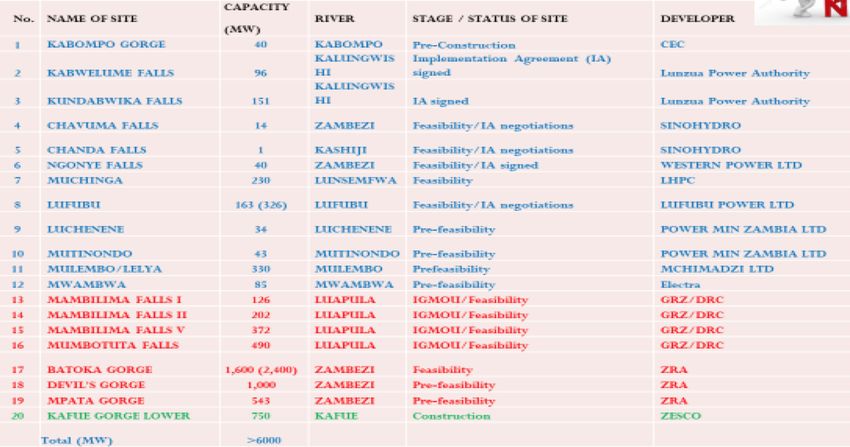
I.         Sector Snapshot
                   Potential                        Generation                       Consumption
 • Solar Resource map has been
   completed with indication of                    2,878 MW                    34%
                                                                                          National
   massive solar potential for power            Total Installed Capacity               Electrification
   generation

• 6000 MW of Hydro potential, of which
                                                         17%                              Urban
  only 2400 MW (40 %) is exploited
                                             Of capacity developed by IPPs     56%        Access
• Current     small    hydropower   (SHP)
  between 1 MW to 20 M W with the
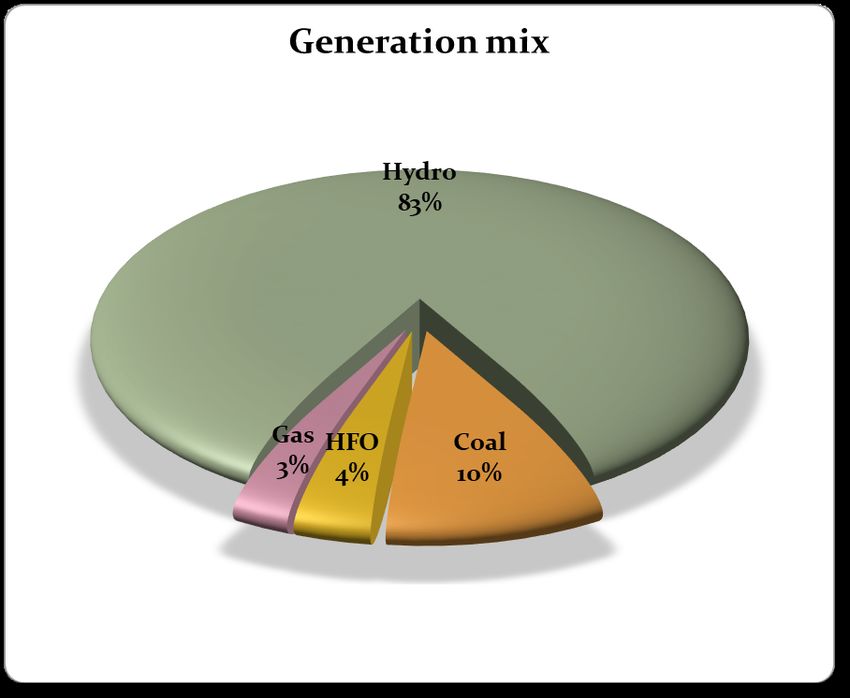
  installed capacity of around 44 MW, (0.7      Installed Capacity by source
  % of national hydro potential)
                                                                               4.5         Rural
                                                                                %         Access
 • Coal Fired power plants by IPPs is
   contributing 300 MW which is
   10% of the installed Capacity
                                                                               2.1        Peak
                                                                               GW        Demand
 • Currently doing the Wind resource
   potential. The results are expected
                                                                                        Demand Growth
   by November 2018
                                                                               5%        Per annum

 3
I.   Installed Generation Capacity
                  Name of Power Plant
                                                        Technology Type   Capacity (MW)
         (including off-grid renewable energy)
                 ZESCO - Kafue Gorge                         Hydro             990

                 ZESCO - Kariba North                        Hydro             720

             ZESCO - Kariba North extension                  Hydro             360
                  ZESCO - Victoria Falls                     Hydro             108
                  ZESCO - Lunzua River                       Hydro            14.8
                    ZESCO – Lusiwasi                         Hydro             12
                ZESCO - Chishimba Falls                      Hydro              6
                 ZESCO - Musonda Falls                       Hydro              5
                 ZESCO - Shiwang'andu                        Hydro              1
             Itezhi-tezhi Power Corporation                  Hydro             120
               Zengamina Power Limited                       Hydro            0.75
          Lunsemfwa Hydro Power - Mulunguishi                Hydro             31
          Lunsemfwa Hydro Power - Lunsemfwa                  Hydro             25
          Maamba Collieries Limited - Maamba                 Coal              300
                   CEC Plc – Bancroft                        Diesel            20
                    CEC Plc – Luano                          Diesel            40
                   CEC Plc – Luanshya                        Diesel            10
                   CEC Plc – Mufulira                        Diesel            10
             Ndola Energy Company Limited                Heavy Fuel Oil        105
              Rural Electrification Authority                Solar            0.06

                                                Total                      2,878.6
4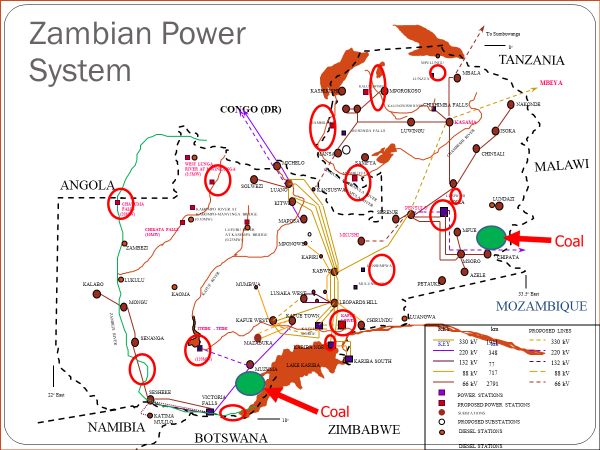
I.   Planned Generation Projects

5
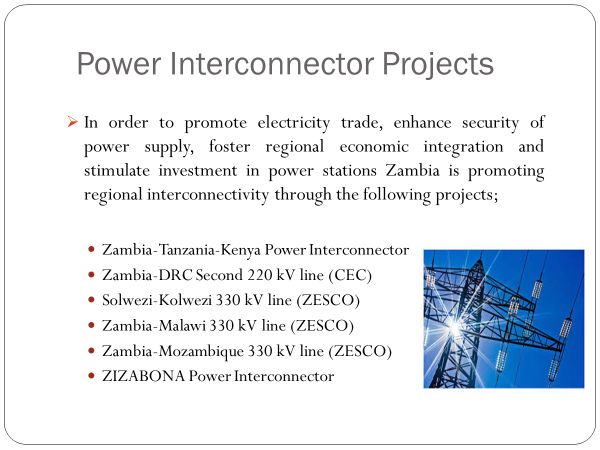
Transmission Projects The Ministry through ZESCO Limited is implementing a number of transmission projects. The projects range from reinforcement, rehabilitation and upgrading of the power transmission and distribution infrastructure.
I.       Resources Required

         Govt. Key Reforms/Actions   Resources Required                  Breakdown

                                                          • Batoka Gorge US$ 5 billion – AfDB lead
                                                            arranger for this project
               Generation               USD 9 Billion
                                                          • Kafue Gorge Lower US$ 2 billion

                                                          • IPPs US$ 2 billion

               Distribution            USD 1.5 Billion                           TBD

               Transmission             USD 1 Billion                            TBD

           Rural Electrification        USD 2 Billion                Required up to 2030

7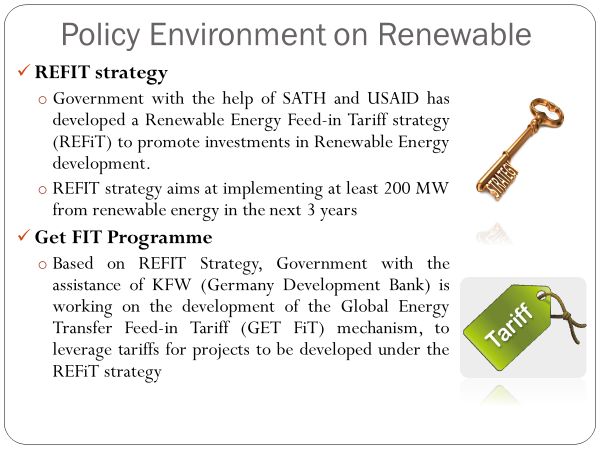
Section 2

    Regulatory & Investment
          Framework

8
Policy Environment
ü The government has put in place enabling polices and regulations meant to attract
investments in energy sector.
ü Energy Policy of 2008
Ø Electricity Act (under review)
Ø (Liberalized Power Sector - Private Players in Generation,Transmission and Distribution)
Ø Open Access Regime - Grid Code sets framework for equitable access to transmission network by all IPPS. This is
yet to be operational
Ø Energy Regulation Act (under review)
Ø Rural Electrification Act (under review)
ü Vision 2030
Ø To increase rural electricity access to 51% by 2030
Ø To increase urban areas access to 90% by 2030
Ø To expand the deployment and development of renewable and alternative energy sources in the
country’s energy mix from < 2% to 15% by 203010
Policy Initiatives/Programmes
                                        Accelerate the implementation of access to electricity by the rural population;
 Electricity Service Access             • On grid Electricity Access Expansion
       Project (ESAP)                   • Off grid Electricity Access Expansion
                                        • Capacity building and Project Implementation Support
                                        • GRZ working on the UN Sustainable Energy for All Initiative with support from AfDB Hub to
                                          support three interlinked objectives of;
      SE4ALL Initiative                   • providing universal access to modern energy services,
                                          • Doubling the global rate of improvement in energy efficiency,
                                          • Doubling the share of renewable energy in the global energy mix.
                                         • GRZ with support from World Bank is developing a resource map
 Renewable Energy Resource Map             indicating the country’s solar and wind resource potential to guide
                                           investments on suitable locations

                                         • Increase access to clean, reliable and more equitable and affordable energy and
  Increased Access to Electricity and      Promote renewable energy production and energy efficiency across Zambia;
Renewable Energy Production (IAEREP)     • Two Components; 1) enhancement of policy, legal, regulatory environment, 2)
                                           Capacity building for renewable energy and energy efficiency

                                         • Programme aims to help low income countries use new economic opportunities to increase
                                           energy access through renewable energy use
Scaling Up Renewable Energy Program      • Total amount of up to $40 million made available for Zambia to assist private sector power project
  for Low Income Countries (SREP)          financing, of which $18 million is a grant and $22 million is a concessional loan
                                         • Currently the government is in the process of preparing an investment plan for the programme
Section 3
Sector
Mobilization Strategy
1213
14
Section 4

     Proposed Government
          Action Plan
       Addressing investment risks and bottlenecks

15
IV. Power Sector Reforms
The government is committed to providing a conducive Investor destination in
the power sector. As such it has embarked on a rigorous reform programme. A
road map has been developed which will look at:
1. Policy/Legislative and Regulatory Framework;
2. Planning
3. Procurement
4. Licensing
5. Tariff setting
6. Zesco Restructuring and recapitalization
7. Energy Efficiency and Demand side management
8. Rural Electrification
16IV. Action Plan - Reforms
Act Review Zesco Reforms
§ Government has initiated a process of reviewing Acts § Government constituted a Task Force to critically
in order to analyze the financial, organizational and
Create a supportive enabling environment to mobilize operational structure of Zesco Limited given its
private participation, transition to a competitive business current challenges and recommend the best
model for the power sector; reformation.
1. Electricity the electricity 2003 § The report has been finalized for tabling to
2. Energy Regulation Act No. 20 of 2007 tabling before Cabinet
3. Rural Electrification Act no. 20 of 2003
Cost of Service Study
§ The Government has engaged a consultant to do
the Cost of Service Study to determine the real
cost of production, transmission and distribution
of electricity.
§ Study to be completed by August 2018
17IV. Action Plan
Energy Access Untapped Renewable energy potential
§ Increase National Electricity Access from the § Within three years, facilitate the development of
current 34% to 61% by 2030 about 200MW by 2021from the private sector at
§ Increase Electricity generation from 2,878MW in small scale. This will be in first phase
2018 to 6,378MW by 2030. § Facilitate the development of 600 MW of solar by
§ Develop transmission and distribution capacity to the IPPs at large scale
match the power generation trajectory. § Conclude the resource mapping for Wind
electricity generation mix by November 2018.
Human Capacity building & Technology
Energy efficiency and conservation
development
§ Promote use of energy efficient buildings and § Build capacity in locals at small scale for micro
appliances. solar project development of about 5 MW with
§ Promote Energy efficiency Technologies e.g solar water three years up to 2021
heating in public institutions, hotels and lodges.
§ Promote energy efficiency technologies for industries
and Agricultural processes.
§ Promote initiatives for Demand Side Management.
18IV. Conclusion
ü Government is committed to implementing the actives
highlighted in the road map;
ü Government is committed in transforming Zesco Ltd into a
commercially viable entity;
ü Government is committed to migrating to Cost Reflective
tariff as demonstrated on the 75% tariff increase effected last
year; and
ü Government is committed to working with the private
sector in developing the energy sector for economic growth
19Thank you
For
Your Attention
20You can also read


