ALLCHURCHES TRUST LIMITED - 2019 STRATEGIC REPORT WITH SUPPLEMENTARY MATERIAL
←
→
Page content transcription
If your browser does not render page correctly, please read the page content below
ALLCHURCHES TRUST
     LIMITED

      2019 STRATEGIC REPORT
  WITH SUPPLEMENTARY MATERIAL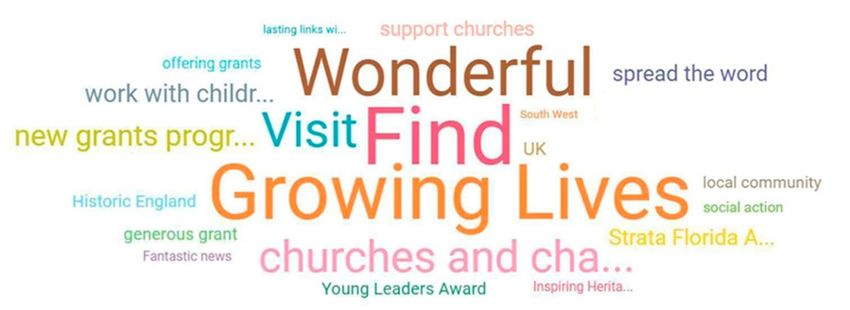
As the owner of an ethical and successful
 financial services group, our vision is to
    deliver steadily growing support to
   churches and other charities, for the
             greater good of all.
Allchurches Trust Limited
Table of Contents
Page Contents
4 About us
5 Explanation of terms
6 Reference and administrative details
7 Chairman’s Report
10 Strategic Report
49 Trustees’ Report
58 Charity statement of financial activities
(including an income and expenditure account)
59 Charity balance sheet
60 Charity statement of cash flows
61 Consolidated statement of financial activities
(including an income and expenditure account)
63 Consolidated balance sheet
64 Charitable giving (unaudited)
This strategic report with supplementary material is only part of the Allchurches Trust Limited
2019 Annual Report, which is the charity’s full annual report and accounts. It does not contain
sufficient information to allow for as full an understanding of the results of Allchurches Trust
Limited and its trading subsidiaries and the state of affairs of the charity as would be provided
by the full annual report and accounts.
Notes to the charity and consolidated financial statements are not included in this statement
but, where referred, are presented in the full annual report and accounts.
The auditor’s report on the full annual report and accounts was unqualified and did not include
a reference to any matters to which the auditor drew attention by way of emphasis without
qualifying their report. The auditor’s statement relating to the consistency of the trustees’
annual report and strategic report with the accounts was unqualified.
For further information, copies of the full annual accounts can be obtained, free of charge, from
the company secretary at the registered office on page 6 of this statement.
3Allchurches Trust Limited
About us
Allchurches Trust Limited (the Trust or the charity) was established in 1972. It is a registered charity
that seeks to promote the Christian religion, providing grants to Anglican churches, churches of
other denominations and charitable organisations with an emphasis on heritage, supporting those in
need and strengthening communities.
The Trust is managed by the Board of trustees, who are also the directors of the charitable company
for Companies Act purposes. The Trust is completely independent of the Church of England
although, because of its Christian aims, some of its trustees and members are leading figures in the
Church of England.
The Trust receives the majority of its income from the companies it owns and it does not fundraise.
It is the owner of the Ecclesiastical Insurance Group plc (EIG plc) which in turn owns Ecclesiastical
Insurance Office plc (EIO plc), an independent financial services company, regulated by the Financial
Conduct Authority and Prudential Regulation Authority. EIO plc insures heritage buildings, charities,
schools, churches and other faith buildings and its subsidiaries provide a range of specialist
investment management, broking and advisory services.
A full list of the Trust’s related undertakings is presented in note 46 to the financial statements.
4Allchurches Trust Limited
Explanation of terms
Throughout the annual report, the following terms are used as defined below:
Ecclesiastical The abbreviation for the legal entities which together comprise the
Ecclesiastical Insurance group
Ecclesiastical Insurance group The overall term for the Ecclesiastical business which includes
Ecclesiastical Insurance Group plc and its direct and indirectly‐
owned subsidiaries
EIG plc Ecclesiastical Insurance Group plc, the direct subsidiary of
Allchurches Trust Limited
EIO plc Ecclesiastical Insurance Office plc, a direct subsidiary of EIG plc. It is
the principal operating subsidiary.
The Trust or the charity Allchurches Trust Limited
5Allchurches Trust Limited
Reference and administrative details
Board of trustees Timothy Carroll, BA, MBA, FCII Chairman
Michael Arlington BSc (Hon), FRAgS
Caroline Banszky, BA, FCA
Revd Paul Davis, BA
The Very Revd Jane Hedges, BA
Stephen C. Hudson BA (Hons), FCA
Sir Stephen Lamport, GCVO DL
The Venerable Karen Lund BA (Hons)
Sir Laurie Magnus Bt
Chris Moulder MA, FCA
Company Secretary Mrs Rachael J. Hall FCIS
Registered and Beaufort House,
Head Office Brunswick Road,
Gloucester GL1 1JZ
Company Registration 1043742
Number
Charity Registration 263960
Number
Auditor Deloitte LLP,
Statutory Auditor,
1 New Street Square,
London EC4A 3HQ
United Kingdom
Bankers National Westminster Bank plc,
21 Eastgate Street,
Gloucester GL1 1NH
Solicitors Farrer & Co,
66 Lincoln's Inn Fields,
London WC2A 3LH
Investment Managers EdenTree Investment Management Limited,
24 Monument Street,
London EC3R 8AJ
Rathbones Investment Management Limited,
8 Finsbury Circus,
London EC2M 7AZ
6Allchurches Trust Limited
Chairman’s Report (taken from the full annual report and accounts)
This Annual Report and Accounts of Allchurches Trust is presented against a period of significant
social and economic uncertainty as a result of the Covid‐19 outbreak. We recognise, along with
many other Christian funders, that this exceptional event will have a significant impact on our
beneficiaries and the people and places they support. We stand with them during these challenging
times and thank them for continuing to provide such vital support to communities as they adapt and
innovate to meet changing needs.
Overview
2019 proved to be an excellent year for our wholly owned subsidiary, Ecclesiastical Insurance Group,
with a record profit before tax of £71.1m1 (2018: £13.4m1) driven by robust underwriting profits and
a strong investment return. This solid performance strengthened the company’s capital position
thereby providing additional security ‐ including the ability to withstand temporary economic
disruption ‐ as well as flexibility for the future. Ecclesiastical has made over £96m of charitable
donations since 2016 and has made great progress towards reaching its target of donating £100m to
charity by the end of 2020. I congratulate the trustees and staff on their many achievements in the
past year and thank them warmly on behalf of the Trust’s many beneficiaries.
These strong financial results enabled Ecclesiastical to make a £30.0m (2018: £17.0m) grant to
Allchurches Trust which, together with a donation of £5.0m (2018: £1.5m) from Methodist Insurance
PLC, allowed the Trust, in turn, to donate £17.9m to more than 1200 beneficiaries worldwide (2018:
£16.9m). We also invested an additional £13.5m (2018: £5.0m) in our Expendable Endowment Fund
which, on 31 December 2019, stood at £109.4m (2018: £85.7m), providing a substantial buffer for
years when our subsidiary’s financial results are challenged and its grant, in consequence, is
reduced. The fund generated additional income of £3.5m (2018: £3.5m) which was used to support
our grant‐making.
Grant‐making
2019 saw the implementation of the recommendations arising from the Trust’s Strategic Review of
its grant‐making completed during 2018 with the intention of maximising effectiveness while being
more intentional, proactive and strategic in our approach. We also recognised that we need to be
better able to evidence and demonstrate the impact of our grants, particularly the larger ones.
Our vision, to be a Trust that, through its grants to churches and other charitable organisations,
makes a positive difference to people’s lives remains unchanged. We were pleased to celebrate the
1
This is the Ecclesiastical result under UK Generally Accepted Accounting Practice (UKGAAP) which is the accounting basis under which
the charity and consolidated accounts of the Trust are prepared. Ecclesiastical prepares its accounts under International Financial
Reporting Standards (IFRS). A reconciliation of the IFRS result and shareholders’ funds to UKGAAP is shown in notes 22(f) and 22(g) to the
consolidated financial statements.
7Allchurches Trust Limited
diverse work and impact of our beneficiaries in our first Giving Report in 2019, as well as to share
their stories through a new e‐newsletter.
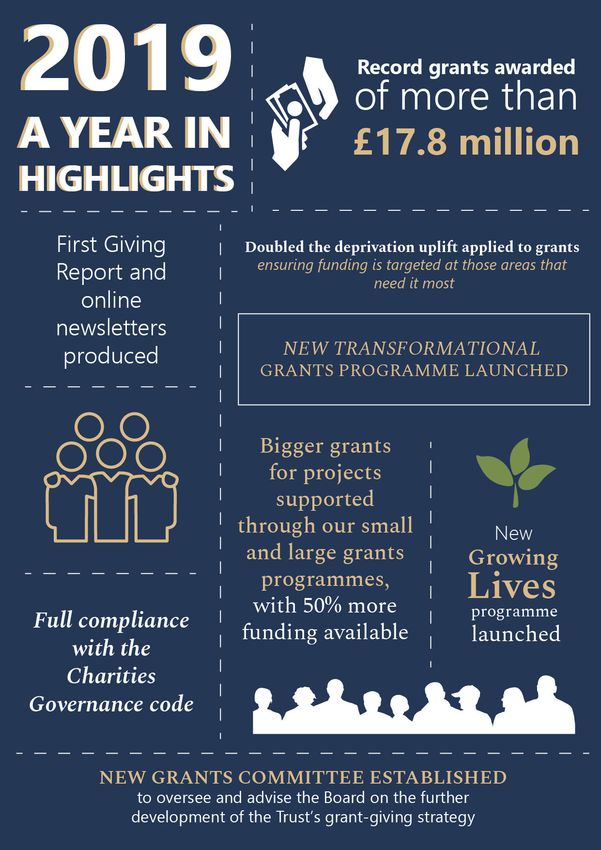
We launched “Growing Lives” the first of what we hope will be a series of Thematic Grants
programmes. Through the Growing Lives programme, we hope that churches and Christian charities
will feel more confident, inspired and better equipped to help young people reach their potential,
both spiritually and in other ways, through active participation in church and community life.
More than a million pounds has already been given to more than 100 churches and Christian
organisations all over the UK. This new programme is enhancing our support for projects focused on
improving the lives of those up to age 18, helping to build local partnerships by engaging more
young people more regularly, and forging lasting relationships that provide an opportunity for
individual, family, church and community flourishing.
In West Yorkshire for example, Hemsworth Methodist Church will use its £25,000 Growing Lives
grant to help convert the nave of the chapel into a soft play area to give children a safe place to play,
and to provide a café that will enable the church to serve healthy meals to young families in an area
that has suffered since the closure of the coal mines. The play area will also be run as a social
enterprise.
You can watch the latest video showing some of the projects we have supported and find links to
Growing Lives case studies and advice and resources on our website at
www.allchurches.co.uk/growinglives.
We also launched a “Transformational Grants” programme, through which we envisage more
churches and charitable organisations will connect with more people, communities and
organisations, who will benefit from their innovative and impactful work, and which will inspire and
increase confidence in others to do likewise. This programme aims to assist the development of
larger, more ambitious projects that are intended to have wide‐ranging reach and impact (often
national and sometimes inter‐denominational in scope) and that will deliver a step‐change – for the
applicant organisation and/or the communities and other organisations its work supports.
We awarded a grant of £177,857 to Transforming Lives for Good (TLG) in October 2019 under this
programme to help fund a major expansion of its ‘Make Lunch’ project. Every school holiday, TLG’s
network of church partners open lunch clubs across the UK to provide free, healthy, cooked food
and activities for children who are in receipt of free school meals.
Grant‐making under existing programmes continues. In our Small Grants category, we receive on
average some 70 applications per month and respond positively to more than 85% of them for
amounts between £200 and £25,000. 47 Large Grants were made for amounts between £1,000 and
£130,000.
Through its Methodist Grants‐Giving Committee, the Trust awarded grants totalling £2.0m (2018:
£2.2m) to support the mission and ministry of the Methodist Church in Britain and Ireland.
8Allchurches Trust Limited
Allchurches Trust continues to devolve grant‐making arrangements in Canada and Australia. I was
privileged to visit Melbourne in the first week of September and met a number of local beneficiaries
in addition to presenting to the staff of the Group’s Australian subsidiary, Ansvar Insurance, about
the work of Allchurches Trust more broadly.
We pride ourselves on our ability and willingness to respond quickly to emergencies. One such was
the devastating impact of the bushfires for many communities around Australia. While the bushfire
season began with several serious uncontrolled fires in June, hundreds of fires burnt throughout the
summer, peaking in December to January. We donated AUS$50,000 to the Salvation Army Bushfire
Appeal enabling emergency services and support to be delivered in over 165 locations across the
country.
Our People
As I write this Report from my home office during the Coronavirus lockdown, I can only hope and
pray for the better days that surely lie ahead. The daily flow of information and pace of activity
across the small Allchurches Trust team as we work to help communities across the UK has been
dynamic and humbling to say the least. Dioceses and cathedrals have already had confirmation of
full payment of their 2020 grants, the first tranche being advanced by three months to June 2020.
The first, Covid‐19 specific, hardship relief grants have already been made. Work continues apace
and I am so proud of our people and so grateful for all they are doing to continue to serve our
beneficiaries despite the disruption to normal patterns of working. We will get through this test and
emerge the stronger for it!
Mr Chris Moulder and Mr David Walton were appointed as trustees during 2019, Mr Walton
resigning as a trustee in November for personal reasons. In addition, Sir Stephen Lamport and the
Revd Paul Davis were appointed as trustees in March 2020.
I cannot close my first Chairman’s report without paying tribute to our previous Chairman, Sir Philip
Mawer, who retired on 31 December 2019. Sir Philip continues to be a member of the Trust and we
look forward to welcoming him to many future AGMs. On any measure, he made an enormous
contribution and leaves the Trust in robust good health. His are big shoes to fill and I am deeply
honoured to have been considered a worthy successor.
Tim Carroll
Chairman
11 May 2020
9Allchurches Trust Limited
Strategic Report
Our purposes and activities
The purposes of the charity are:
to promote the Christian religion; and
to contribute to the funds of any charitable institutions, associations, funds or objects and to
carry out any charitable purpose.
The vision that shapes our annual activities remains the promotion of the Christian faith and
Christian service to others through supporting the mission and work of dioceses and cathedrals and
allocating our charitable giving in response to requests from Anglican churches, churches of other
denominations, Christian communities and other charitable organisations.
The charity also has the general aim of assisting in areas of greatest need and encouraging the
training and development of lay and ordained people as well as helping projects supporting
communities and enabling evangelism and church growth.
In shaping our objectives for the year and planning our activities, the trustees have considered the
Charity Commission’s guidance on public benefit, including the guidance Public Benefit: Running a
Charity (PB2). The charity’s income is derived from the gift aid it receives from its subsidiary
company, EIO plc, donations from Methodist Insurance PLC and the investment income generated
from the charity’s expendable endowment fund.
The objectives we have identified to help achieve the charity’s aims in 2020 are as follows:
Continue to implement and monitor the success of the new grants programmes launched in
2019; identify a partner in Ireland for the Heritage Grants programme; and identify potential
new funding streams under the Thematic Grants programme.
Continue to develop impact evaluation for the Trust, primarily focusing on the
Transformational, Thematic and Large Grant Programmes, with the aim of having
mechanisms in place by the end of 2020 to assess the impact of these schemes.
Further develop internal and external communications plans, working with key stakeholders
to increase transparency and recognition, to continue to raise the Trust’s profile in a
targeted manner and to explore how the Charity can add value to its existing beneficiaries
through means additional to grant funding.
Ensure the successful induction of the new auditors.
10Allchurches Trust Limited
Appoint a new investment advisor to the Trust following the resignation of
PricewaterhouseCoopers (‘PwC’) (who can no longer undertake the role, as they will be
appointed as the Trust’s Statutory Auditor for the financial year ending 31 December 2020,
following a tender process).
Successfully induct the new chairman and Grants Committee chairman and the new trustees
into their respective roles.
Ensure that effective succession is in place for the roles of deputy chairman of the Board and
the chairman of the Finance and Investment Committee, and implement any consequential
changes in the Board’s organisational arrangements.
Continue to develop relationships with other funders, potential partners and delivery bodies
and explore opportunities for major Christian grant‐makers and other trusts to act
collectively for the benefit of beneficiary groups.
Covid‐19
The charity is very conscious of the fast‐changing Covid‐19 situation and, along with many other
Christian funders, recognises that the pandemic is an exceptional event that will have a significant
impact on our beneficiaries and the people and places they support.
As a funder, we recognise the need for flexibility in these challenging times, and want to support our
beneficiaries to meet changing needs. We are doing this by offering our beneficiaries the flexibility
to put forward proposals that might involve re‐directing our grant monies to meet urgent
community need in response to the pandemic.
The charity’s own small team has, of course, also been impacted by the pandemic in terms of
resource and administration of grants. However, we have been able to keep our existing grant‐giving
programmes up and running, and we have provided £250,000 funding to four charities tackling food
poverty in response to the Coronavirus crisis. The Trust has also given reassurance to dioceses and
cathedrals throughout the UK and Ireland that they will receive their 2020 recurrent grant in full,
and that the first tranche of the payment will be brought forward by three months, recognising the
financial difficulties they may be experiencing at this time, primarily due to church closures, and the
impact on the communities they support.
We will continue to keep our own response to the crisis under review as the situation evolves, but
the Trust remains well placed and looks forward to continuing to make a positive difference in
partnership with our beneficiaries.
11Allchurches Trust Limited
Achievements and Performance
We had another successful year during 2019, making significant progress in meeting the objectives
we had set to further the charity’s aims.
The objectives we set during 2019 were to:
Implement the outcome of the Strategic Grants Review in a new Grants Strategy, including:
Implementing new scale awards and deprivation uplifts on regular grants
(the new Small and Large Grants programmes)
Launching the new Transformational Grants programme
Launching the new Heritage Grants programme
Launching the new Thematic Grants programme
Implementing the new planning and reporting process to demonstrate the
impact of recurrent grants.
Convene a new Grants Policy Committee to advise the Board on the further development
of the Trust’s grant‐making policies, the Committee’s remit to include the work of the
current Small Grants Fund Committee and pre‐assessing Thematic and Transformational
grant applications for recommendation to the Board, normally twice a year.
Analyse existing data on the pattern and effect of the Trust’s grants and establish an
agreed process for measuring and reporting on the impact of those grants, building on the
improved reporting mechanisms developed in 2018, thereby helping to ensure that the
work undertaken by the Trust makes a real difference to internal and external
stakeholders.
Continue to ensure that effective succession planning is in place for the Board, in particular
for succession to the role of chairman, and implement any consequential changes in the
Board’s organisational arrangements.
Consider and implement as appropriate the recommendations arising from the Report of
the Independent Evaluation of the Board conducted in the fourth quarter of 2018.
Further develop internal and external communications plans, working with key
stakeholders to improve transparency and recognition, to continue to raise the Trust’s
profile in a targeted manner and to add value to existing beneficiaries.
Further develop relationships with other funders, potential partners and delivery bodies.
12Allchurches Trust Limited
Our performance against each objective is set out below. More details of our grant giving in the year
are included on pages 17‐25.
Implement the outcome of the Strategic Grants Review in a new Grants Strategy
During 2017, the Board established a Strategic Grants Review Group to lead a review of the Trust’s
Grants strategy, chaired by Michael Arlington. The development of a new grants strategy for the
Trust was successfully completed during 2018 after extensive consultation with dioceses (Bishops,
Archdeacons and Diocesan Secretaries) and cathedrals and also key beneficiaries in Scotland, Wales
and Ireland.
A revised methodology for the recurrent grants the Trust makes to Church of England dioceses
(based on population and modified income (as a measure of relative deprivation)) was implemented
during 2018 and the recurrent grants to Church of England cathedrals were marginally uplifted and
fixed until the end of 2022. During 2019, processes were implemented to enable the Trust to better
understand the impact made by these grants. Recurrent grant recipients were requested to provide
information as to how they used their grant awarded in the prior year and their intentions for the
use of the grant to be allocated in the following year. The analysis of the information obtained from
dioceses and cathedrals has enabled the Trust to begin to identify trends and areas of need with the
aim of being more directional in asking recurrent grant recipients to apply their grants to value‐add
activities. It has also enabled the Trust to begin to share case studies of the positive impact of these
grants on parishes and the wider community, which are published on the website and signposted to
the Trust’s social media channels and beneficiary communications.
The Trust also reviewed the arrangements for the diocesan and cathedral grants in Ireland, Scotland
and Wales to ensure that the principles underlying them were consistent with the approach being
taken in England from 2020 onwards. Discussions continued throughout 2019 with the relevant
Provincial offices and new arrangements have been implemented for Ireland and Scotland. Further
work is being undertaken in respect of diocesan and cathedral grants in Wales.
In addition to the changes made to the recurrent grants, existing grant programmes were
restructured during 2018. The following programmes were available from 1 January 2019:
Small Grants Programme – this programme is available for projects with a total cost of up
to £1.0m, awarding grants of up to £15,000 plus a potential deprivation uplift of up to 50%.
During the year 856 grant awards were made totalling £2.7m.
Large Grants Programme – this programme will be available for projects with a total cost of
over £1.0m, awarding grants of up to £100,000 plus a potential deprivation uplift of up to
50%. During the year, 47 grant awards were made totalling £2.3m.
Transformational Grants Programme – this programme is aimed at supporting projects of
regional or national significance, awarding grants usually of over £100,000. During the year,
ten grant awards were made totalling £1.2m. These helped to fund work including the
church’s mission in deprived communities, faith development, educational projects for
young people, resilience and wellbeing projects for young people and adults, and enhancing
the church’s mission through cathedrals and larger churches.
13Allchurches Trust Limited
Thematic Grants Programme – this will be a series of funding streams, to be launched over
a 3‐5 year period, targeted at particular issues or problems. The first theme ‘Growing Lives’
launched in May 2019 and aims to support churches and Christian organisations to connect
with children and young people in their communities through funding the adaptation of
buildings and provision of equipment. This new theme has been a huge success and by the
end of year, 86 grant awards were made totalling £0.9m. The trustees have agreed to
extend the duration of ‘Growing Lives’ and have allocated an additional budget of £2m for
the Thematic Grants Programme in 2020, £1m of which is earmarked for ‘Growing Lives’.
Heritage Grants Programme – this programme has been undertaken in conjunction with
partners with the aim of protecting the UK and Ireland’s heritage, for the benefit of all. The
first grants under this programme have focused on the promotion and protection of
traditional craft and heritage skills. The Trust has agreed to partner with Historic England to
fund an apprenticeship programme for three years; with the Prince’s Foundation and Strata
Florida Trust to fund an archaeology field school in Wales; and with the Queen Elizabeth
Scholarship Trust (QEST) to fund craft apprentices and scholars. In addition, grants have
been made under this programme to The Heritage Crafts Association (to fund craftspeople
engaged in at risk crafts) and Gloucester Cathedral (to fund a trainee stonemason). These
latter grants were made in recognition of the particular contribution to the development of
traditional craft skills that both the Cathedral and The Heritage Crafts Association are able
to offer through their work in this area.
Methodist Grants Programme – the overarching aim of this programme is to enhance the
mission and ministry of the Methodist Church in Great Britain and the Methodist Church in
Ireland, through grant support to the Methodist Connexion, Methodist Districts and Circuits,
and individual Methodist churches and charities. The programme does not support routine
building maintenance but instead, awards grants for projects which are specifically
concerned with building development, mission, outreach and community benefit, with
applicants also encouraged to demonstrate a focus on energy efficiency. During the course
of 2019, 54 grants totalling £2.0m were awarded through this programme.
Roof Alarms Programme ‐ in response to the ongoing issue of theft of metal from church
roofs, through this programme the Trust now offers grants of up to 50% of the cost of a roof
alarm, capped at £2,500, to churches at risk from metal theft. Grants can be applied for
either direct to the Trust, or to a growing number of Dioceses and local Historic Churches
Trusts with which the Trust has provided funding to establish grant schemes around the
country. Churches must install insurer‐approved alarm systems, and commit to maintaining
the system for a minimum of 5 years. During the year, 53 grant awards were made totalling
£0.3m.
In line with our aim of helping those in greater need, grants made to churches and other
organisations in relatively disadvantaged areas can be increased by up to 50%, depending on levels
of relative deprivation. Deprivation is also taken account of in determining awards made through the
‘Growing Lives’ thematic grants programme.
14Allchurches Trust Limited
Convene a new Grants Committee
The Trust established a Grants Committee in January 2019. The Committee comprises four trustees
and meets quarterly. It is responsible for overseeing and advising the Board on the further
development of the Trust’s grant‐giving strategy, processes and other arrangements. It has
successfully assessed the first Thematic and Transformational grant applications for
recommendation to the Board. It plans to consider the development of a further theme during 2020.
Measuring and Reporting on Impact
As outlined above, the Trust has implemented processes to enable the Trust to measure the impact
made by its recurrent grants to dioceses and cathedrals. In addition, the trustees, with the benefit of
an external consultant, considered the evaluation of impact more broadly within its grants
programmes and agreed a more in‐depth evaluation of impact would be extended to the Thematic
and Transformational grant programmes. The external consultant has continued to assist the Trust
with the evaluation of impact for the Thematic and Transformational programmes; this work was
concluded in Quarter 1, 2020.
The Trust has also worked in partnership with Church Urban Fund (CUF), developing an impact
assessment and project‐reporting toolkit and advice to aid, inter alia, its beneficiaries in assessing
the impact of their projects. These tools are available on the Trust’s ‘Advice and Resources Hub’ on
its website, along with a related advice blog.
Continue to ensure that effective succession planning is in place for the Board
The Trust has developed a formal succession plan to identify emergency successors, short‐term
successors and long‐term successors to the roles of Board Chairman, Committee Chairmen, and
other trustees. The plan is considered by the Nominations Committee annually and recommended
to the Board.
On 31 December 2019, Sir Philip Mawer resigned as Chairman and trustee after nine years’ service
to the Trust, six of them as Chairman. The Nominations Committee led the process to recruit a
successor and in June 2019, Mr Tim Carroll, an existing trustee, was appointed as Chairman elect.
Mr Carroll became Chairman on 1 January 2020.
Following the resignation of Sir Philip, a number of changes were made to the membership of a
number of Committees. In particular, Mr Arlington has succeeded Sir Philip, as Chairman of the
Grants Committee and Mr Hudson has been appointed as a member of the Methodist Grants‐Giving
Committee with Revd Barriball, a Methodist representative, appointed as Chair for a period of one
year.
As part of the succession planning process, two trustees were appointed to the Trust during the year
– Chris Moulder was appointed to act as a ‘common director’ with the Trust’s subsidiary, and David
Walton (who later resigned for personal reasons). In addition, two further trustees have been
appointed during 2020: Sir Stephen Lamport was appointed as a trustee on 5 March 2020 and has
subsequently been appointed to the Board of the Trust’s subsidiary, EIG plc and will serve as a
15Allchurches Trust Limited
‘common director’. Revd Paul Davis was appointed as a trustee on 29 March 2020 to succeed David
Walton. Details of the trustees who have stepped down during the year and the new trustees
appointed during the year can be found on page 51.
Implement the recommendations arising from the Report of the Independent Evaluation of the
Board
The Board undertook an external Board Evaluation by an independent evaluator in the fourth
quarter of 2018. The results of the evaluation were considered by the Board at its meeting in
December 2018 and all recommendations were accepted. The recommendations largely related to
improving the quality of the papers circulated to the Finance and Investment Committee, uploading
approved minutes to the Board portal accessed by the trustees, extending the length of Board and
Committee meetings to ensure that adequate time is given to the consideration of matters and
reminding trustees that training and development courses were available for them to attend at the
Trust’s expense. The implementation of the recommendations was monitored by the Nominations
Committee. All were achieved during the year.
Further develop internal and external communications plans, working with key stakeholders to
improve transparency and recognition, to continue to raise the Trust’s profile in a targeted
manner
In 2019, Allchurches Trust continued to significantly increase its communications and marketing
activity; enabling the Trust to more effectively tell the story of the impact of its grants to internal
and external audiences. During the year, the Trust introduced a quarterly digital newsletter,
launched a new advice blog platform and produced its first Giving Report, as well as developing and
enhancing toolkits and resources for beneficiaries. The launch of the Growing Lives grants
programme in May 2019 resulted in record website traffic and record‐breaking reach and
engagement across social media channels (overall 2019 increases reflected in reach and awareness
summary on page 22). It was supported by a detailed stakeholder mapping exercise, which enabled
the Trust to raise awareness among and encourage applications from new audiences, particularly a
wider range of Christian denominations.
Further develop relationships with other funders, potential partners and delivery bodies
The Trust has continued to meet regularly with representatives from other charitable bodies and
funders during the year. As outlined above, the Heritage Grants Programme has been launched in
collaboration with five external organisations in the UK and it is intended to identify a further
partner in the Republic of Ireland. In addition, the Chairman of the Trust meets regularly with the
Chairs of major Christian Funders. The trustees and staff team also meet occasionally with other
charitable trusts that have similar organisational structures to our own to share learning and best
practice.
16Allchurches Trust Limited
Grant Giving and Impact Assessment
The Trust’s principal source of income is the grants it receives as the owner of the Ecclesiastical
Insurance group. As insurance is a risk business, these may fluctuate markedly. Thanks to the efforts
of Ecclesiastical staff and the loyalty of its customers, we were again able to increase our financial
support to churches and other charitable institutions significantly in 2019, with total charitable
giving of £17.9m (2018: £16.9m).
The charitable giving of the Trust is shown in its statement of financial activities on page 58. An
analysis of charitable giving is shown on pages 23‐25 and in note 6 to the charity financial
statements.
The Trust has agreed a number of key performance indicators (KPIs) and measurable targets to
assess the efficiency and effectiveness of its grant making:
2019 2018 2017
Total charitable giving by the Trust £17,850,255 £16,943,744 £15,592,834
Total number of applications received 1,250 1,140 1,214
Percentage of applications received in the year falling
within the grant policies of the Trust that were 92% 89% 94%
considered and were successful
Total number of grants uplifted by a deprivation scale
439 417 389
factor
Total number of grants uplifted by a deprivation scale
factor as a percentage of total number of grants 35.5% 40.9% 30.3%
awarded
Operating costs of the Trust (staff, administration and
overheads including donated services) as a percentage 4.3% 4.5% 4.6%
of total charitable giving
17Allchurches Trust Limited
The Trust has steadily increased its charitable giving since its formation in 1972, distributing £121.3m
over the past 10 years. Total expenditure on grants is inevitably influenced by the fluctuating
number of applications received by the Trust, the size of the projects for which assistance is sought
and the Trust’s income.
The Trust aims to award a grant in respect of at least 85% of those applications received which
conform to its objects and its grant‐making policies. This was achieved during the period highlighted
in the table above.
During 2019, only six applicants did not complete their project and returned their grant to the Trust
(2018: seven).
The Trust aims, in particular, to help those in areas of greater need. Grants awarded in response to
applications from such areas are increased above the normal level. The Trust expects grants to such
areas to constitute at least 20% of total grants made. In 2019, 35.5% of grants made by the Trust
were uplifted by a deprivation scale factor (2018: 40.9%). The trustees have not set a target for the
percentage of grants uplifted in this way as applications to the Trust are externally driven.
The Trust aims to ensure that the total of its operating costs remains below 7.5% of its total
charitable giving. From the data shown in the above table, the Trust has achieved this target in each
of the three years assessed.
The Trust recognises that it needs to improve its assessment of the impact of its grant making and to
ensure that its grant giving is having the desired effect and making a real difference to beneficiaries.
Steps have continued to be taken to strengthen this area during 2019 and reporting mechanisms will
be adapted and improved to reflect the learnings from this work during 2020. As noted earlier, work
continues with an external consultant to improve the Trust’s impact evaluation processes focusing
on the Thematic and Transformational grants programmes initially, with the intention that learning
from this work will then be applied to other grants programmes in appropriate ways. Improvements
to the impact evaluation of the Trust’s recurrent grants to Anglican dioceses and cathedrals is also in
progress, with this work expected to conclude in Quarter 2 2020.
18Allchurches Trust Limited
Beneficiary Relations
The satisfaction of beneficiaries in their dealings with the Trust is of great importance to the
trustees. As part of the Strategic Grants Review, extensive consultation was undertaken with
beneficiary groups to ensure that the trustees took into account a wide range of views in reaching
decisions.
In addition, the Trust keeps abreast of issues affecting its various stakeholders and, in particular, has
continued to monitor closely during the year the impact of the Church of England’s Renewal and
Reform programme on Dioceses; the decision of the Heritage Lottery Fund (now known as the
National Lottery Heritage Fund) to withdraw its Grants for Places of Worship scheme; the outcome
of the Taylor Review into the Sustainability of English Churches and Cathedrals (final report due in
summer 2020); and also the work of the Cathedrals Working Group, established by the Archbishops
of Canterbury and York, the report of which was received during 2018 and the follow‐up to which is
now underway. The Trust maintains active dialogue with key stakeholders ‐ including other funders
in the sector ‐ in these areas, and will continue to consider how best it might respond to
developments as they unfold, both through grant funding and in other ways.
The Trust requests feedback from all its beneficiaries on their experience of dealing with the Trust.
While the Trust has always received a lot of positive feedback from its beneficiaries on the value and
impact of the money we give and its relatively simple and speedy grant‐making process,
beneficiaries and partners are also now increasingly feeding back on the quality and usefulness of
the advice and resources the Trust provides and the support provided with storytelling/awareness‐
raising around projects. Below are a representative selection of beneficiary comments:
“The grant you provided shows the importance of trusts such as Allchurches, in that relatively small
amounts of funding can have a major impact in communities and be the catalyst to sustainable
activities. I believe that sharing information and experiences is a vital aspect of all such work, and a
ripple effect helps far more people than our small project could do in isolation.”
David Bowser, St Francis Church, Bramley
On behalf of St Bartholomew's Church, I would like to thank the trustees for this wonderful grant. It
has already proved helpful in driving our project forward as more volunteers stepped forward when
they heard about it. Many thanks for all the publicity advice, which we shall certainly be
taking advantage of.”
Jennifer Watson, Church Warden, St Bartholomew's Church, Sealand
“I cannot thank @AllchurchesT enough for the support they’ve given to our Mission Apprentice
team in Birmingham. Such an honour to be featured in their annual Giving Report #Mission
#Poverty”
Lizzie Gawen, Mission Apprentice Scheme, Birmingham
19Allchurches Trust Limited
“Just to let you know, our press release has received fantastic attention. The Lancaster Guardian has
popped it in as a full page spread in this week's paper. They have also called me to say what an
amazing achievement this project is, and they want to come and interview our family life centre
manager in the New Year to do a follow up piece. We have also heard that the Diocesan magazine
wants to monitor the project from here‐on, and that they have sent the press release onto the
Church Times. They are also going to nudge BBC Radio Lancashire on our behalf, about featuring the
project. So we have really achieved a lot with one press release. I know I keep thanking you, but we
wouldn't have been able to get this amount of media attention, without your help. So thank you
once again... and for the donation itself, of course!”
Karen Shackleton, Heart of the City project, Lancaster
“Thanks for the Allchurches newsletter this morning. It’s always such a great read and I love the
projects you are funding. The website is also interesting and there is such a variety of projects that
you fund. I especially liked the growing crops and church together in Darlington. I have been talking
to our pastor about a plot of land at the back of our church which hopefully we will get permission to
turn into an urban edible garden to supply our community cafe. Keep up the good work! :)”
Antony Oliver
The ‘word cloud’ below also gives a visual representation of some words and terms that
beneficiaries and partners use when talking about Allchurches Trust on Twitter. The size of the word
reflects the number of times it was mentioned.
20Allchurches Trust Limited
The Trust has agreed a number of KPIs and measurable targets to assess the satisfaction of
beneficiaries in their dealings with the Trust:
2019 2018 2017
Total number of messages of appreciation received 627 519 736
Total number of complaints received None None None
Percentage of applications dealt with in the time period % % %
specified below:
< 3 months 86.1 91.8 91.7
3 – 6 months 7.6 7.1 5.0
6 – 12 months 0.5 0.5 2.5
>12 months 0.2 ‐ ‐
Pending a decision 5.6 0.6 0.8
The Trust aims to achieve a 95% satisfaction rate in its dealings with beneficiaries, as measured by
the number of complaints received as a percentage of the total number of applications handled.
From the data shown in the table above, the Trust has achieved this target in each of the years
assessed.
The speed with which applications are decided depends on the scale and complexity of the project
involved. The Trust aims to deal with 75% of grant applications within six months of their receipt and
90% within 12 months. From the table shown above, 93.7% of grant applications were dealt with
within six months and 94.2% within 12 months during 2019. The Trust met its target for each of the
periods assessed.
21Allchurches Trust Limited
Reach and Awareness
As previously mentioned, the trustees have continued to improve the reach and promote awareness
of the Trust during the year, with major increases in website traffic and social media reach and
followers. The Trust has raised its profile in the media, enhanced its social engagement and
developed new advice and resources for beneficiaries, including the launch of a new advice blog
platform, bringing together in‐house and external expertise for the benefit of beneficiary groups.
Website performance1
2019 2018 2017
Users 39,938 24,094 21,183
New users 39,412 23,341 20,674
Sessions 67,797 38,874 33,197*
*Note: the figure quoted for sessions (hits) in the 2017 annual report differs from the figure quoted for 2017 in the table
above. A false traffic source was being tracked in 2017 and the figures from this source have now been removed to give
more accurate 2017 figures. The source was removed from our analytics in January 2018.
Social media performance
End of 2019 End of 2018 End of 2017
Twitter followers 1,148 663 359
Twitter impressions 484,900 268,622 71,734
Facebook followers 698 234 76
Facebook reach 62,764 42,903 14,584
*Note: the Allchurches Trust Twitter channel launched in January 2017. The Trust’s Facebook page launched in May 2017.
‘Impressions’ represents the number of people reached.
1
A user is an individual visiting the website, and the number of sessions represents the times those users interacted with our site, hence
the number of sessions being significantly higher than the numbers of individual users each year as most users will access the website
more than once in any given year (note also that if a user visited the website using two different internet browsers, this would count as
two users/new users). The total of new users in relation to overall users is high for Allchurches Trust due to the fact that most users will
visit the site on behalf of their organisation to access information on what we fund and how to apply, before completing an online
application form on the Benefactor grant‐giving software that is external to the Allchurches Trust website. They are then unlikely to return
to the website the following year as there is a two‐year rule for the majority of the Trust’s grants programmes, i.e. you cannot apply for a
grant from Allchurches Trust if your organisation has received funding from the Trust in the last two years. The analytics platform sets a
two‐year expiration date on new visitors, so if they visited the website for the first time in 2017, and then did so again after that date in
2019, they would appear as a new user both times. The fact that the Trust introduced a new website in May 2018, with old and new
websites linked to two different analytics accounts, will also have resulted in occasions where website users prior to May 2018 are
counted as new users when they visit the ‘new’ website (post May 2018) for the first time.
22Allchurches Trust Limited
‘Growing Lives’
The Trust’s new thematic programme, ‘Growing Lives’, has also provided a platform to reach out and
engage with new audiences. The Trust has agreed the following KPIs to measure the success of this
grant programme:
2019
% of applications from denominations outside the Church of England 59.3%
% of ‘Growing Lives’ budget spent 92.1%
In launching ‘Growing Lives’, the Trust aimed to encourage applications from a range of Christian
denominations, with at least 30% of applications coming from churches from denominations outside
of Church of England, and Christian charities. In addition, the Trust aimed to generate sufficient
number and quality of applications to fulfil at least 50% of budget spend for thematic programme by
the end of 2019. The Trust achieved both of these targets. Additional ‘Growing Lives’ KPIs are in
development for 2020.
The geographical, denominational and charitable spread of grants made, which are shown in the
following tables, are largely determined by the Trust’s objects and the pattern of applications
received by the Trust.
The Trust has agreed a number of KPIs which measure the reach of and the extent of awareness of
its charitable grant making:
2019 2018
Based on Based on Based on Based on
number of value of number of value of
grants grants grants grants
awarded awarded awarded awarded
Geographical spread of grants: % % % %
National projects 1.0 5.8 0.1 1.7
England
North East 3.4 3.0 3.4 3.6
North West 9.0 9.4 8.4 7.9
Yorkshire and The Humber 10.7 8.8 9.7 11.1
East Midlands 8.2 7.6 9.1 7.1
West Midlands 9.2 7.3 10.3 7.1
East of England 13.8 10.6 10.9 8.7
London 6.5 15.4 6.5 22.8
South East 12.7 11.5 15.0 11.8
South West 11.7 10.2 12.5 7.8
Scotland 5.0 2.3 4.4 3.1
Wales 4.8 4.3 4.9 3.7
Northern Ireland 1.5 0.8 2.1 1.0
Republic of Ireland 1.9 2.5 2.2 1.6
Other 0.6 0.5 0.5 1.0
23Allchurches Trust Limited
2019 2018
Based on Based on Based on Based on
number of value of number of value of
grants grants grants grants
awarded awarded awarded awarded
Denominational spread of grants:* % % % %
Church of England 63.5 69.7 65.9 66.0
Church of Scotland 1.3 0.4 1.0 0.4
Baptist 4.3 1.3 2.8 0.5
Methodist 11.0 14.9 11.9 16.5
Roman Catholic 4.1 1.2 1.1 0.1
URC 1.7 0.7 1.4 0.3
Church of Ireland 2.5 2.7 3.1 1.9
Scottish Episcopal Church 1.9 1.2 2.8 1.5
Church in Wales 3.8 4.0 4.2 3.7
Other Anglican ‐ ‐ 0.7 6.5**
Other Churches 5.9 3.9 5.1 2.6
* These percentages relate only to grants given to churches and church bodies.
** includes grants totalling £0.9m awarded to the Lambeth Conference.
2019 2018
Based on Based on Based on Based on
number of value of number of value of
grants grants grants grants
awarded awarded awarded awarded
Charitable spread of grants: % % % %
Cathedrals 7.0 11.2 7.8 11.4
Churches 72.7 26.5 72.2 19.1
Dioceses 5.4 40.6 5.8 42.1
Registered charities 14.9 21.7 14.2 27.4
With the exception of those grants given to dioceses and cathedrals on a recurrent basis, the grants
made by the Trust reflect the number of applications received and the size of the project each
application involves as well as the decisions made by trustees about those applications. Assessing
trends in grant‐making data can therefore be difficult when so much of that data is externally driven.
However, the tables above indicate that the Trust’s giving is geographically and denominationally
spread (it is not, in particular, confined by any means either to the Church of England or to
churches), and is used to support a range of projects in line with its objects. Examples of some
individual grants made can be found on pages 26‐32 of this report.
The Church of England receives the highest percentage of grants made by the Trust to churches for a
number of reasons, including the fact that it is the Established Church in England with a much higher
number of parishes and church buildings to support than any other denomination. Many of its parish
churches are listed buildings and preservation of these buildings features heavily in the applications
24Allchurches Trust Limited
received by the Trust. With a church in every parish (over 16,000 throughout England), Church of
England churches are at the heart of local community life.
Indeed, many applications received by the Trust are not just about maintaining church buildings but
about adapting them for community use, thus helping those communities to develop and thrive.
Many applications involve the provision by churches and other local groups of services to the
community, such as helping people experiencing homelessness, supporting asylum seekers,
providing groups to tackle loneliness among older people or activities for young people and families.
Again, some examples are given later in this report.
The charitable spread of grants based on value given is strongly affected by the recurrent grants
made to dioceses and cathedrals. These recurrent grants have a long history and, as explained
previously, have recently been reviewed as part of the Trust’s Strategic Review of its grant‐making
policies and procedures.
A growing proportion of the number of the Trust’s grants is now given to charities other than
churches, demonstrating the Trust’s increasingly wide range and profile. Encouraging applications
from a range of Christian denominations was a focus in launching the Trust’s ‘Growing Lives’
programme in May 2019, and with 59.3% of applications coming from Christian charities and
churches outside the Church of England, exceeded targets set.
At the heart of the Trust’s grant‐making is the Christian belief that individuals reach their full
potential in community and that the opportunity to flourish should be available to all. Increasingly,
our grants target people in need but they also strengthen the churches, schools and charities who
deliver that help.
The trustees will further analyse the data produced in relation to the KPIs during the course of 2020
and will consider any implications for the development of the Trust’s grant‐giving programmes in
future years. These implications are only likely fully to emerge, however, when the Trust has
gathered further comparative data covering an additional number of years. Moreover, the ability of
the trustees to fine‐tune the pattern of grant‐making will always remain limited in light of the
responsive nature of much of the Trust’s work. Accordingly, no specific targets have been set for the
Trust’s geographical, denominational or charitable spread of grants for 2020.
25Allchurches Trust Limited
Examples of 2019 charitable giving
ALLCHURCHES TRUST IN ACTION
Our Transformational Grants
Building financial resilience in young people
A £250,000 grant from the Trust will enable The Just Finance Foundation’s LifeSavers programme to
provide financial education to thousands more primary school children, helping them to develop
healthy money skills and habits at a key point in their lives.
Lifesavers is an educational programme that teaches children the key skills and knowledge required
to manage money effectively. Research has highlighted that habits around money are being formed
by the age of seven, yet just 5% of parents think that their child or children leave school with the
adequate skills needed to manage their money well.
The Trust’s investment over three years will not only allow LifeSavers to continue assisting the 120
schools the programme is already embedded in, it will enable an expansion into Wiltshire and
Nottinghamshire. The Trust and The Just Finance Foundation hope this expansion will reach 40
schools, delivering crucial financial education to 8,000 new children.
Developing estate leaders to become community catalysts
Up to 50 people will be trained to work as leaders on estates and neighbouring communities over
the next three years thanks to a grant of more than £155,903 to The Archbishops’ Council to enable
work being delivered through the National Estate Churches Network. The funding will provide
support for leaders ministering in estate churches with a focus on encouraging work with children
and young people.
The funding will help estate church leaders work in partnership with organisations to increase the
number of children and youth groups working in areas such as education, wellbeing, crime reduction
and improvements in the environment, as well as courses with Christian content.
The grant is aimed at resourcing the growing network of estate church groups across the country, and
developing leaders who will act as catalysts for building impactful community partnerships on estates
in Birmingham and London, with the learnings from these pilots then providing a blueprint for a
national network.
Tackling loneliness and boosting wellbeing
Kintsugi Hope has received a grant of £83,514 from the Trust to grow its Wellbeing Groups project
over the next three years, enabling more churches to access resources and support to tackle
loneliness and mental health issues in their communities.
26Allchurches Trust Limited
Feedback from the 10 pilot groups across England – including one in a homeless hostel ‐ has been
extremely positive, with the majority of participant evaluations showing a step improvement in
mental, emotional and social wellbeing. The sessions take a facilitated peer‐mentoring approach
with session materials covering areas such as honesty, anxiety, anger, self‐acceptance and resilience.
The Trust’s grant will enable Kintsugi Hope to appoint a new National Wellbeing Groups Coordinator.
The project will also see 10 Volunteer Ambassadors trained and recruited to support Group Leaders
and fund the development of an interactive website for Group Leaders to access material, manage
groups and network. It is also planned to research and pilot new material aimed at young people.
Although the Groups have only 12 weeks of content, the project is designed to encourage churches
and group leaders to engage participants to become part of a sustainable community. The aim is to
have up to 100 Wellbeing Groups running annually across the country by April 2022.
Our Large grants
Helping Abbey project go green
A £50,000 grant to Bath Abbey in 2019 will help provide a new Song School and install an eco‐
heating system that will use the energy from Bath’s famous hot springs.
Underpinning Bath Abbey and the new spaces created by Footprint is the innovative heating, hot
water and renewable energy equipment, which will ensure the Abbey is supported by efficient and
environmentally sustainable systems. Using cutting‐edge technology to harness sustainable energy
from Bath’s hot springs, the new heat extraction system will contribute approximately 480,000kWhs
of energy, which represents a carbon saving of nearly 60%.
The former Abbey offices in Kingston Buildings will be fully renovated and will now also include a
new Song School for the Abbey Choirs, local music groups and other musicians, and a dedicated
room for volunteers, all of which will now be fully accessible thanks to new lifts and disabled toilets
being installed as part of the funding from Allchurches Trust.
Going digital to target church community support in Wales
Parish boundary maps across Wales are going digital for the first time in a major project aimed at
improving the way churches serve their communities. With the help of £14,500 funding from the
Trust, The Church in Wales is creating a complete digital map of the country, including the
boundaries of its 466 parishes and ministry areas. The maps will then be used to model demographic
trends specific to each area.
The project will provide church leaders with key data about people in their areas ‐ such as the age
profile, education level and employment status – enabling them to tailor their services to their
communities. That could mean setting up more foodbanks or debt centres in areas where there is
greatest poverty, or extending initiatives such as Messy Church and after school clubs in places
27You can also read


