An Institutional Perspective on Genres: Generic Subtitles in German Literature from 1500-2020
←
→
Page content transcription
If your browser does not render page correctly, please read the page content below
Journal of
                                                                                                     April 5, 2021
                 Cultural Analytics

An Institutional Perspective on Genres:
Generic Subtitles in German Literature
from 1500-2020
Benjamin Gittel
Benjamin Gittel, University of Göttingen
Peer-Reviewer: Gerhard Lauer, Matthew Wilkens
Dataverse DOI: 10.7910/DVN/XZAXTE

                                                      ABSTRACT
                Using a custom-designed database of 388,000 first editions of German Literature this paper
                investigates the long-term development of genre-indicating subtitles over more than 500 years
                of literary history. This approach adds a social-institutional perspective to recent work in the
                field of genre theory, and is a first step towards combining historical testimony, i.e. historical
                actors’ classifications, and textual features in a single model. Starting from the fundamental
                question of how many books have generic subtitles, the paper analyses the use of the most
                common genre labels, the relation between generic subtitles and genre production, periods of the
                permanent presence of generic terms (institutional cycles) and periods of generic differentiation.
                It identifies recurrent patterns in the development of generic subtitles using K-Means-Clustering
                and Dynamic Time Warping (DTW) and sheds light on literature’s changing relation to history
                and truth, thereby underpinning recent theoretical work on the practices of poetic invention.

It would be worthwhile to distinguish two aspects of research on literary genres. 1
First there is research on text types as generalizations over textual features, and
second, genres as generalizations over individuals’ attitudes to texts.2 Although the
latter aspect seems crucial for a perspective that does justice to the social dimensions
of literature and its history, recent research in the Digital Humanities has most
frequently focused on literary texts as text types.3 Descriptive models aim at
determining the most distinctive features of one group of texts versus another, while
predictive models have tried to reproduce or even predict human classifications of
literary texts,4 usually working with the classifications of librarians or contemporary
researchers. Although predictive modeling does not aim at generalizations over the
textual features that literary scholars have in mind when they define text types (e.g.
“All texts that start with ‘once upon a time’”) — arguably, it does not aim at
definitions at all —5 it clearly relies on textual features or, more precisely,
probabilistic combinations of textual features.

                   Journal of Cultural Analytics 4 (2021): 1-38. doi: 10.22148/001c.22086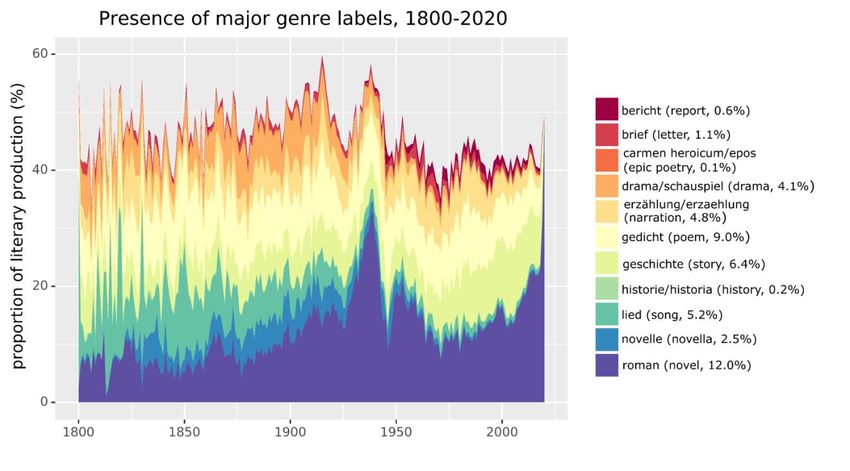
GENERIC SUBTITLES IN GERMAN LITERATURE FROM 1500 -2020

As impressive as the successes of this approach have been, however, it represents
just one perspective on genre that ought to be supplemented by a social-institutional
perspective. Genre concepts are and have been used by historical actors to orient and
position themselves in the literary field and are accordingly linked to certain
expectations (e.g. “All texts from which the reader expects a moral”). Such
expectations, which are often linked to certain terms (e.g. “fable”), can become
established in certain periods of time and disappear in later periods of time. In other
words, a genre can become institutionalized or deinstitutionalized.6 Yet this sort of
social-institutional perspective on genres has rarely been pursued in the digital
humanities,7 in part because computational approaches are generally conceived as
complementary to classical genre research: “Text analysis,” argues Ted Underwood
and the NovelTM Research Group, “may not provide a complete picture of the
history of genre, but it does give us a second reference point - a touchstone that we
can use to unpack historical assertions about genre, or compare them to each other.”8
Complementing this point of view, I would argue here for the use of statistical
computational methods with regards to the problem of institutionalization, which
lies at the heart of historically oriented genre theories in literary studies. The
following analysis of the occurrence of genre-indicating concepts in literary works’
titles or subtitles over roughly 500 years of literary history is a first step on this path.
Before presenting my dataset (section 1), methods (section 2), and results (section
3), I want to point out more in detail what I mean by the term “institutionalization”
and how this article will tackle the problem of genre institutionalization. Obviously,
an account of the institutionalization of a genre can take various forms. Against the
backdrop of the distinction that has been introduced in the first paragraph, one can
think of the institutionalization process as the process by which — in addition to the
instantiation of a text type T in a certain period of time — additional conditions are
met that include a certain attitude of people towards texts of the type T. There are at
least three candidates for these additional conditions that must be met for a genre to
be institutionalized or, in more simpler words, to exist in a certain period (in a certain
community): (1) feature expectations, (2) genre awareness, and (3) rules for dealing
with texts of type T.9 Fairy tales, for example, arguably fulfil all three conditions in
our days. When we read a text in which dragons, elves and fairies appear, we expect
the appearance of the wizard with a long white beard (feature expectations).
Furthermore, we are aware that the genre “fairy tale” exists (genre awareness). Third,

                                             2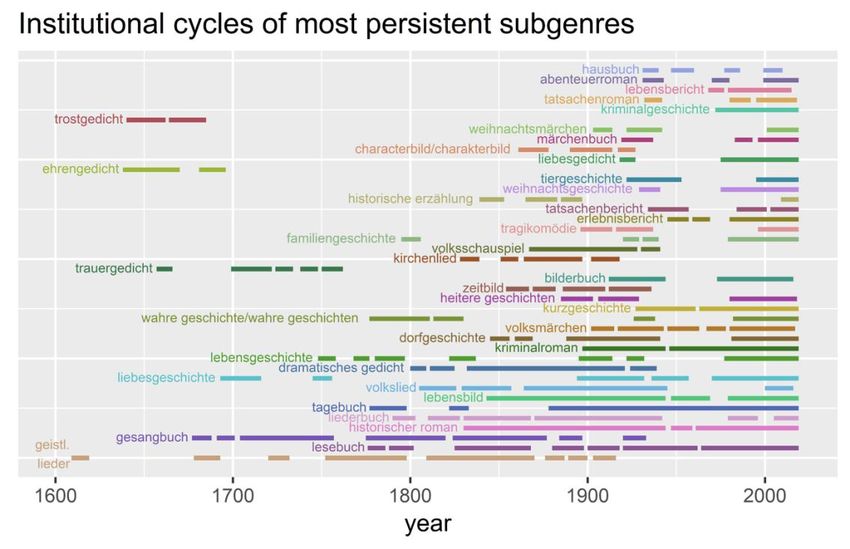
J OURNAL OF CU LTURAL A NALYTICS

when reading fairy tales, we accept that dragons are able to spit fire (it may not even
have to be said) and we are usually not interested in the spatio-temporal location of
the story (rules for dealing with a particular text type). Depending on which of these
three combinable criteria a genre concept includes, differently sophisticated
concepts of genre institutionalization result.
The relevance of generic concepts’ occurrence in the titles or subtitles of literary
works for an institutional approach results directly from the account of genre
institutionalization just introduced, which has been elaborated elsewhere.10 For the
approach chosen in this article, feature expectations and genre awareness are the
important conditions:11 Only if the authors, publishers, or editors of literary works
believe that readers will associate certain expectations with a particular genre
concept, will they use it with any frequency as a title or subtitle.12 Therefore, generic
concepts’ occurrence in the titles or subtitles of literary works can be regarded as
indicators for the institutionalization or deinstitutionalization of a literary genre.
Please note that this consideration applies irrespective of the emergence of a literary
market in the modern sense and irrespective of a possible connection between a
genre’s production on the one hand and the occurrence of the respective genre term
in subtitles on the other hand (a connection argued for in section 3.3).
One final note before getting started: Since there is very few quantitative research
on the subject of this paper, at least for German literature,13 it may be sometimes
difficult to classify the results. I have tried to point out links to existing qualitative
research wherever it seemed useful and where my limited knowledge on the broad
investigation period allowed it. My expectation was not to prove or disprove any
particular theory or view, but the conviction that the approach chosen here will prove
fruitful and offer a variety of different connecting points to past and future research.

1. Dataset
The database of German Literature needed for this article’s analysis had to fulfil four
criteria:
   ▪ be as comprehensive as possible;
   ▪ contain only literature in German without translations into German;
   ▪ comprise only first editions; and

                                            3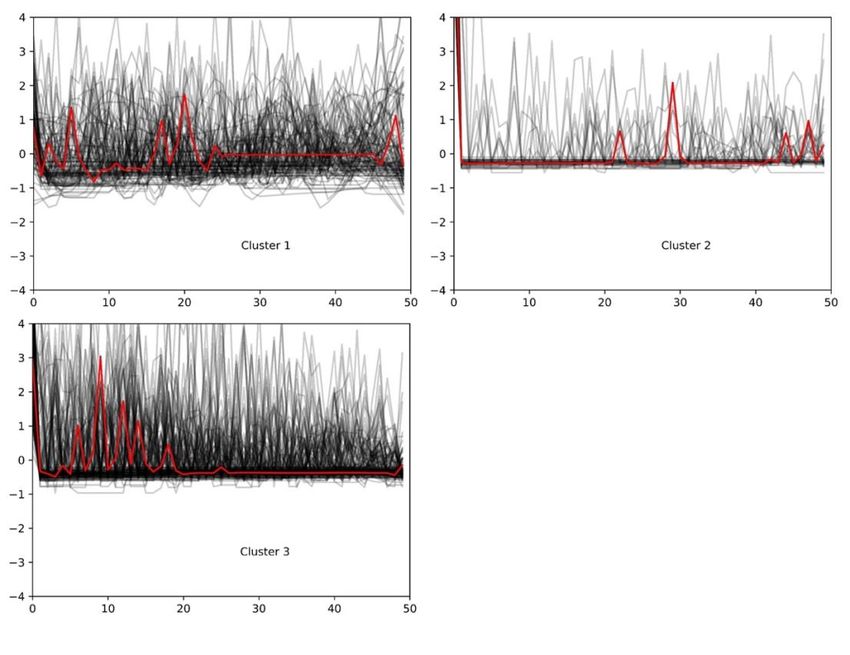
GENERIC SUBTITLES IN GERMAN LITERATURE FROM 1500 -2020

    ▪ contain no duplicates.

These criteria resulted directly from the intention to analyse the frequency of generic
terms in titles and subtitles. Literature in other languages would distort the analysis,
as would translations from other languages, because foreign genre-related subtitles
are often not easily translatable into German and are therefore frequently changed
or omitted. Later editions would also distort the analysis, insofar as they often
preserve subtitles from original publications and might thus virtually prolong the
existence of old-fashioned genre terms.
Since there was no existing database of German literature that would even
marginally comply with these criteria, it had to be developed for this article.14 In
order to do so, I worked with one the of the biggest library networks in Germany,
the GBV (Gemeinsamer Bibliotheksverbund), which encompasses more than 430
libraries, including the national library in Berlin (The Staatsbibliothek zu Berlin) and
the German National Library DNB (Deutsche Nationalbibliothek in
Leipzig/Frankfurt). GBV's data, as provided in MARC21 format, comprised
approximately 68 million records (around 120 GB), which could only be filtered
according to this article’s criteria with invaluable information provided by various
GBV and DNB employees.15 The filtering proved relatively complex: the data
originated from different libraries and was created during different time periods and
regions, meaning that different classification systems and codes were used for so-
called subject groups (Sachgruppen). The following filtering was carried out in
Python (see table 1).16

 Step                                      Records          Description
 1. Starting point                         68,366,626       Total GBV records
 2. Filtering of books                     45,194,326       Books (no e-books, no periodicals)
 3. Filtering of German Literature           740,053        German Literature (Schöne Literatur) without
                                                            translations
 4. Filtering of first editions              472,502        First edition German Literature without
                                                            translations
 5. Deleting of duplicates                   388,127        First edition German Literature without
                                                            translations and without duplicates

Table 1: Filtering of GBV-library-data

                                                        4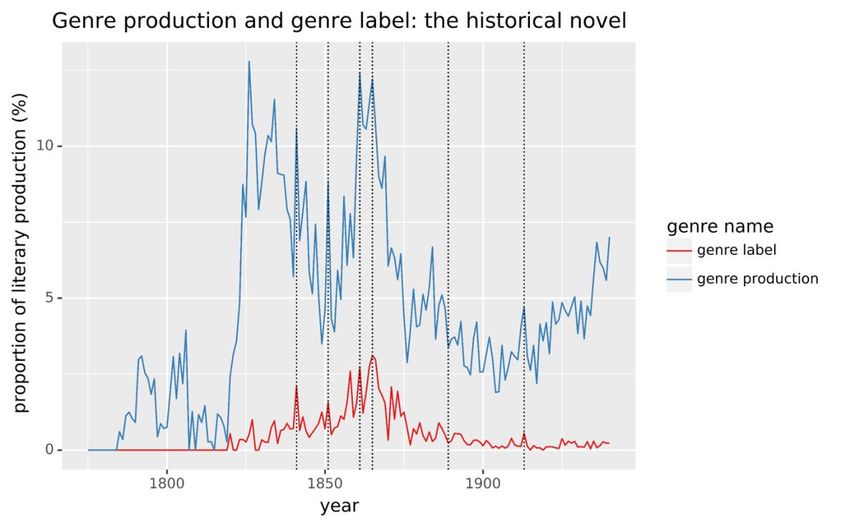
J OURNAL OF CU LTURAL A NALYTICS

Since only around 60% of all of the records in the GBV library data had a language
code, automatic language detection based on titles and subtitles was performed for
the records without a language code, using “detectlanguage” from Google.17 The
filtering out of later editions took into account numerated editions, as well as
standardized references to “supplemented edition” (erg. Aufl.), “extended edition”
(erw. Aufl.), or “folk edition” (Volksausgabe). The duplicate search was based on
author name and title (without subtitles, which may have changed in later editions),
with the earliest published work retained.
In this way, a database of first edition German-language literature was created,
covering 520 years of literary history (see figure 1). The database is made available
to the scientific community for further research.18

Figure 1: Books per year

Apart from a slump in production during to the Second World War, the year 1800
stands out as an outlier. This is probably due to the practice of dating books
published in the years around 1800 either back or forward to align with the

                                          5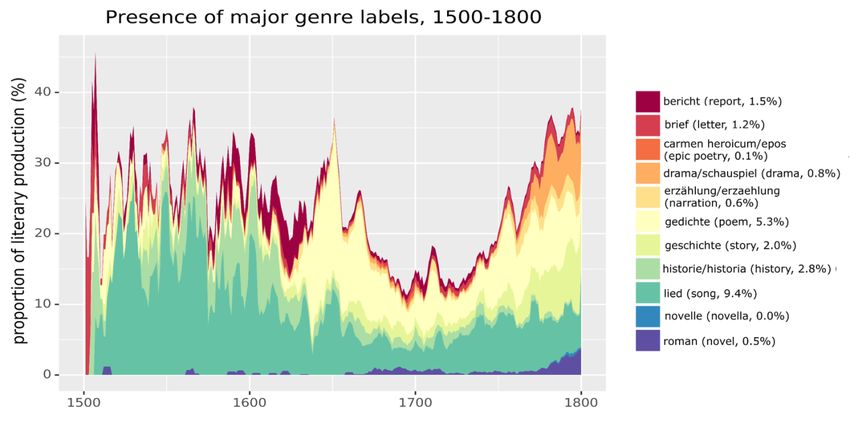
GENERIC SUBTITLES IN GERMAN LITERATURE FROM 1500 -2020

centennial mark. The drop at the end of the graph is due to the incompleteness of
available data, especially for 2019 and 2020.19

2. Methods
Analyzing the data was essentially a matter of determining the frequencies of genre
terms in titles or subtitles per year and relating these frequencies to literary
production.20 It proceeded in two steps: recognition of genre terms and basic
descriptive statistics.

2.1 Recognition of genre terms
A distinction was made between three different types of genre terms’ occurrences:
   (a) total genre appearances (e.g. the word “novel” (roman) in “romance novel”
       (Liebesroman), “historical novel (historischer Roman), or just “novel”
       (Roman), but excluding “romantic” (romantisch));
   (b) compound genre terms (e.g. ““romance novel” (Liebesroman));
   (c) phrasal genre references in the form adjective + genre (e.g. “historical novel
       (historischer Roman));
These search patterns were elaborated through a list of 73 basic non-compound genre
terms like novel (Roman), story (Geschichte), and poem (Gedicht) (see Annex 1).21
In order to effect the categorization, regular expressions in Python and the CNN-
based Part-of-Speech-Tagger ("de_core_news_sm", version 2.3.0) from the package
“spaCy” were used.22

2.2 Basic descriptive statistics
Each occurrence of a genre term in titles or subtitles was counted per year. In
addition, the number of titles in which at least one basic genre term occurred was
counted (search pattern “total genre appearances”). Statistics on clearly identical
genre terms, which had been created by different spellings or abbreviations (for
example, “hist. Roman”), were merged, i.e. the counts were summated. These
absolute values were then converted into relative values by relating the counts to
literary production in the year in question. This was an important step towards
obtaining meaningful and comparable values, since literary production – due to

                                         6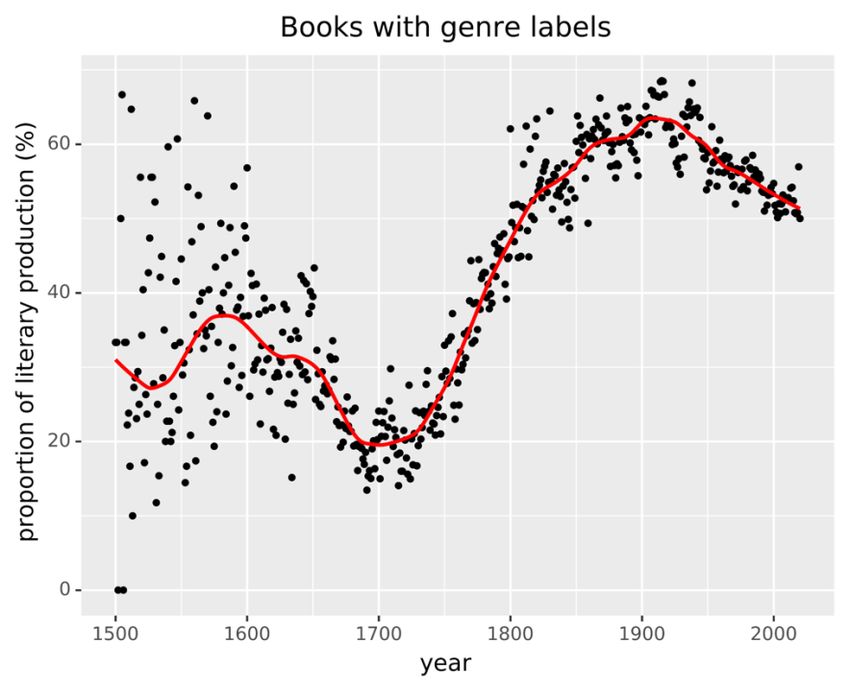
J OURNAL OF CU LTURAL A NALYTICS

technical, historical and book market developments – has varied greatly over 500
years (see figure 1, p. 5).

2.3 Determining the most persistent genres
The full list of compound genre terms comprised 25,064 items (10,876 compound
terms + 14,188 phrasal references), many of them appearing only once. In order to
filter this list for later analysis, I determined the most persistent genres within the
list. In a first step, I calculated a two-year rolling average in pandas (Version 1.0.5)
in order to compensate for minor fluctuations in the data.23 Second, I determined all
of the cycles (time periods) in which a genre term was present for at least 10
consecutive years (hereafter: “institutional cycles”). Third, I created a list of genres
that had at least one institutional cycle. The resulting list of 371 genres has been
sorted out semi-automatically to exclude non-genre terms (e.g. “selected poems,”
“German poems,” “most beautiful stories”), non-intended matches (e.g. czernowitz,
a falsely recognized composition with the genre term witz (joke), or obviously non-
literary genres (e.g. “studbook” (Stammbuch)). This resulted in a list of 279 genres
(see appendix A2).
This list served as the basis for (a) the visualization of the institutional cycles of the
most persistent subgenres (see section 3.4) and (b) the K-Means Clusters using
Dynamic Time Warping (see section 2.4). To visualize the institutional cycles of the
most persistent subgenres, I used the information gathered during step two of the
process outlined above. Figure 8 (p. 16) shows the institutional cycles of the 40 most
persistent genre labels.
I also determined the time periods in which the largest number of genres “fought”
for institutionalization, that is, in the periods when many new genre labels are
repeatedly employed. To do so, I used the same multi-step procedure outlined above,
with one major difference. In this case, a three-year rolling average was calculated
(minimum number of observations = 1), which yielded a list of 581 genres (see
section 3.5). For each of the most persistent genres the starting point of its first
institutional cycle was determined. Figure 9 (p. 18) visualizes the counts of starting
points per year.

                                            7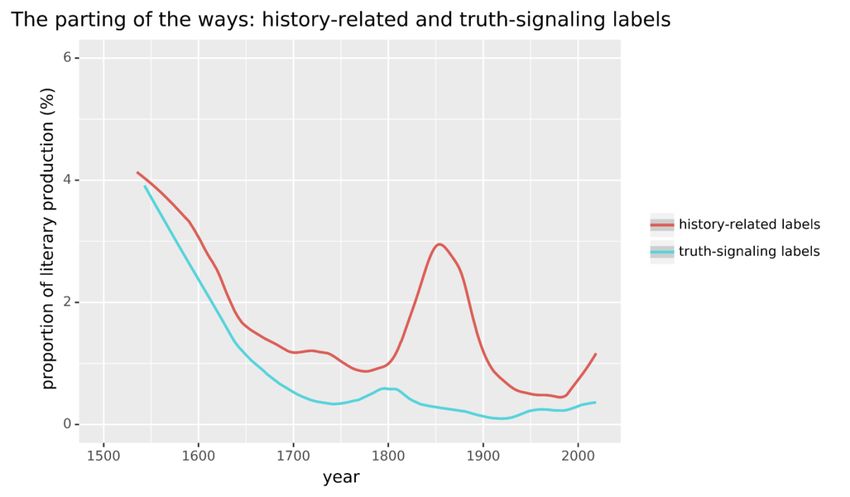
GENERIC SUBTITLES IN GERMAN LITERATURE FROM 1500 -2020

2.4 K-Means Clustering using Dynamic Time Warping (DTW)
In order to identify patterns in 279 time series, each corresponding to a persistent
genre term, I used K-Means-Clustering on the basis of Dynamic Time Warping
(DTW) as implemented in Python’s “tslearn” (Version 0.4.1).24 DTW is used to
collect time series of similar shapes. It is especially suitable for the data in this
article, insofar as it does not presuppose synchronized time series, meaning that it
can find similar shapes even if they are offset to each other.25 In practice, DTW
outperforms its classical rival Euclidean Distancing on most data sets.26
To prepare the data for the clustering, leading zeros and NA’s were removed, and
then TimeSeriesScalerMeanVariance and TimeSeriesResampler (both from the
tslearn-package) were applied. The time series were scaled so that each output time
series had zero mean and unit variance. They were resampled to a target size of 50
to limit computation time. The K-Means-Clustering was achieved with the
“TimeSeriesKMeans” function, which allows soft-DTW.27 The number of times the
k-means algorithm would be run with different centroid seeds was set to “3” and the
number of iterations for the barycenter computation process was set to “10.” The
clustering was carried out repeatedly, with a preset of between 2 and 10 clusters.
The optimal number of clusters was determined by the so-called elbow-method. This
method visualizes the sum of squared distances of samples to their closest cluster
center (inertia). To determine the optimal number of clusters, one selects the value
of k at the “elbow”, the point after which the inertia start decreasing in a linear
fashion.28

3. Results

3.1 Proportion of books with genre labels
An initial important question may be to ask how many books have genre terms in
their titles at all. The first graph (see figure 2, below) shows that there have been
considerable changes regarding this question:

                                          8
J OURNAL OF CU LTURAL A NALYTICS
Figure 2: Books with genre labels, 1500-2020
While it was not uncommon in the 16th and the first half of the 17th century for
German Literature to have genre-indicating subtitles (around 30 % of all titles), this
choice became unpopular around 1700, when the percentiles dropped below 20 %.
Afterwards, there was a steady rise until 1850. By the 1920s, more than 60 % of
literary publication added a genre-indicating subtitle. One possible explanation for
the drop around 1700 may be the contemporaneous and intense debates about the
entire system of genres that had been established at this time.29 These controversial
debates, which were in part related to the reception of Nicolas Boileau’s strict L’Art
poétique (1674), may have caused uncertainty among authors regarding existing
genre labels. The resulting reluctance to use genre labels subsides during the 18th
century with the gradual establishment of a new system of genres and corresponding
labels.
9GENERIC SUBTITLES IN GERMAN LITERATURE FROM 1500 -2020
3.2 The most common genre labels
The next natural question is: which are the most common genre terms (a) for the
early modern period and (b) for the late modern period, including contemporary
history? Graphs 3 and 4 (see below) show the genre appearances of the 10 most
common non-compound terms, again as a proportion of the total literary
production.30 These terms are Roman (“novel”), Erzählung (“narration”), Novelle
(“novella”), Lied (“song”), Gedicht (“poem”), Historie or Historia (“history”), Epos
(“epic poem”), Gebet (“prayer”) and Brief (“letter”). Although not in the top ten, I
also manually added the terms Drama / Schauspiel (“drama / play”) as a further
major non-compound genre.
Figure 3: Presence of major genre labels, 1500-1800
As regards the early modern period (see figure 3, above), two genre labels are
dominant: the Lied (“song”) label from around 1500 until 1650, and the Gedicht
(“poem”) label from approximately 1625 until 1800. The second finding in
particular, however, must be treated with caution: the term Gedicht could originally
designate all kinds of texts in verse, and only in the last third of the 18 th century did
the term start to be used for shorter lyric texts as continues through to today.31
10J OURNAL OF CU LTURAL A NALYTICS
Figure 4: Presence of major genre labels, 1800-2020
Regarding the period from 1800 until today (see figure 4, above), the distribution of
generic terms is far more balanced. Seen over the full timespan, there are four
significant genre terms: the Roman (“novel”), the Geschichte (“story”), the
Erzählung (“narration”) and the Gedicht (“poem”). The Lied (“song”), which is still
important throughout the 19th century, vanishes after 1945. A special case is the
genre label Novelle (“novella”), which establishes itself only during the first half of
the 19th century, but becomes insignificant just one century later during the
beginning of the 20th century. The modern period also witnesses the multi-step “rise
of the novel” (Ian Watt) as a genre label. The first notable rise is situated in the last
third of the 18th century (see figure 3, p. 10), culminating at 1800, when 8% of all
literary works have Roman in their subtitles. Since the history of the German novel
starts earlier than the last third of the 18th century,32 moreover, the rise of the text
type clearly predates the rise of the genre term’s usage. A second rise of the genre
term’s use takes place during the second half of the 19th and the beginning of the 20th
centuries, with a peak in 1939, where 33% of all literary works have the subtitle
“Roman”.33
11GENERIC SUBTITLES IN GERMAN LITERATURE FROM 1500 -2020
3.3 Genre terms and genre production
Since there is no reliable data available about the production of German novels,34
the relationship between the use of genre terms and genre production cannot yet be
studied for the German novel as a whole. However, there is detailed data concerning
the historical novel. A collaborative research project at the University of Innsbruck
in the early 2000s manually compiled a list of all historical novels based on the
following definition: a historical novel is a fictional work of at least 150 pages,
whose plot mainly takes place before the author's birth.35 By applying data from this
project, it is possible to relate genre production to labeling (see figure 5, below).
Figure 5: Genre production and genre label, e.g. the historical novel
One can observe at least two things in figure 5. First, this graph shows that the boom
of historical novels in the German language, which starts with the translations and
pseudo-translations of Walter Scott’s novels, is soon followed by a rise in the use of
the genre term “historical novel.” Second, while the historical novel’s first two boom
periods, lasting roughly from 1825 until 1850 and 1860 until 1875, are reflected in
growing use of the genre label, the further development of the genre is not.
12J OURNAL OF CU LTURAL A NALYTICS
Nevertheless, the continuous use of the genre term fits with the continuous
production of historical novels over this period (in contrast to many other
discontinuous genre terms). Overall, there is clear correlation between the two data
sets, as illustrated by the vertical lines in figure 5 that mark characteristic peaks and
valleys. This visual impression is also confirmed by statistical tests. If Spearman's
Rho is determined as a suitable correlation measure, a positive correlation is
obtained (r = 0.76).
This analysis on the example of “historical novels” suggests that the frequency of
genre labels is not only, as argued at the beginning of this article, a good indicator
for the institutionalization of a genre, but that it also correlates to a certain degree
with genre production. Future research will be needed to further illuminate this
correlation. In the following sections, I will focus primarily on genre concepts as
indicators for the institutionalization or deinstitutionalization of a genre.
3.4 Institutional cycles of genres
It has been argued that generic subtitles are a good indicator of genres’
institutionalization, because the usefulness of generic subtitles depends on readers’
generic expectations. For major genre terms like “novel,” “history,” or “poem”
interpretations are straightforward, with the corresponding genre terms having been
clearly established over long periods of time (see figures 3 and 4). However, there
are many more genres that never achieve this level of “market share” in the genre
label market; they are only institutionalized for short periods. This section considers
examples of such “minor” genre labels, working with compound genre terms and
phrasal genre terms (adj. + genre).
It’s instructive to start with subgenres of the novel, because they are an especially
complex and much researched case. The novel’s success as the most productive
genre in the 19th and 20th century, together with a growing market for literature,
created a need for orientation and organization. Authors and publishers sought to
fulfil this need through the production of virtually countless genre labels. My
analysis shows that for the period between 1800 and today there are approximately
1080 compound genre terms (x + roman) and 400 genre terms of the pattern
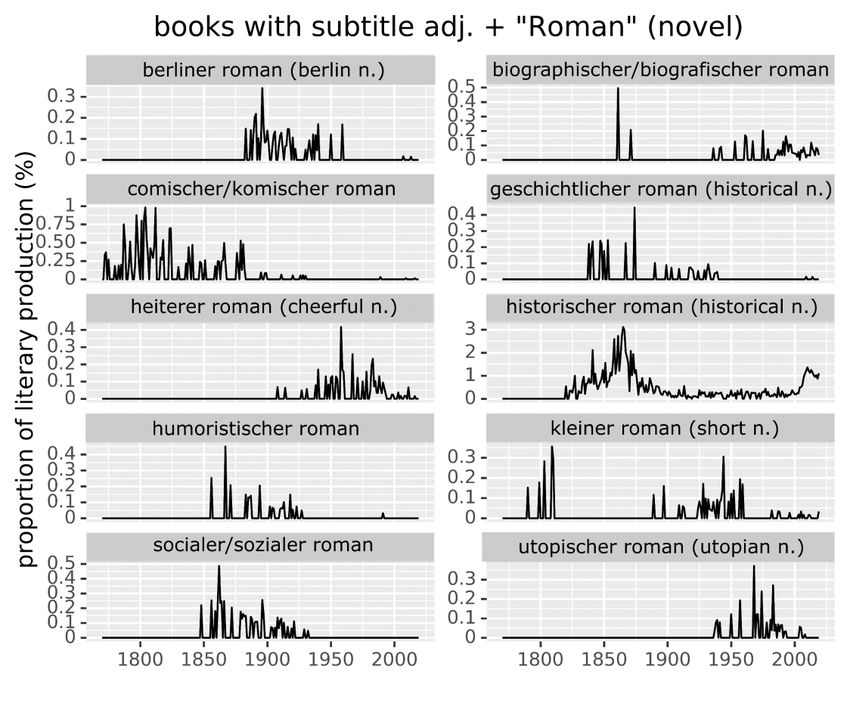
“adjective plus Roman” (“novel”).36 The two following figures visualize the 10 most
successful of these labels, according to their accumulated proportions of total literary
production (see figures 5 and 6, below).37
13GENERIC SUBTITLES IN GERMAN LITERATURE FROM 1500 -2020
Figure 6: Books with subtitle noun + roman (“novel”)
14J OURNAL OF CU LTURAL A NALYTICS
Figure 7: Books with subtitle adjective + Roman (“novel”)
There are several distinct distribution patterns. Some graphs indicate a genre’s quick
rise, like in the case of the war novel (Kriegsroman) after World War I or the
women’s novel (Frauenroman). In other cases, however, this process takes several
decades (see, e.g., socialer/sozialer Roman or Berliner Roman). Almost all of the
genre terms show considerable variance over time, with only the romantic novel
(Liebesroman) existing continuously for more than 150 years without ever becoming
particularly popular. In many cases, there is a single clear boom period, exceptions
being the small novel (kleiner Roman), the biographical novel
(biografischer/biographischer Roman), and the Zeitroman (a special kind of social
novel), the distributions of which are discontinuous.
As noted above, figures 6 and 7 represent only the most successful sub-genres of the
“novel.” This does not include hundreds of less successful novel sub-genres, or the
15GENERIC SUBTITLES IN GERMAN LITERATURE FROM 1500 -2020
sub-genres of other major genres (e.g., narrative, novella, story, song, etc.). In order
to be able to compare these many labels and visualize some of them, I have
introduced the concept of a genre’s “institutional cycle.” An institutional cycle is
the time period in which a genre label is continuously present for at least 10 years.38
Determining institutional cycles does not require reference to the proportion of
literary production a genre label constitutes; what counts is the continuous presence
of a genre label over time.
Calculating the institutional cycles contained within the approximately 25,000
compound and phrasal genre terms analyzed in this article allows for the comparison
of these terms in terms of the aggregated length of their institutional cycles.39 The
following illustration (figure 8, below) shows the 40 sub-genres (compound genre
terms and phrasal genre terms), which have been present for the longest periods of
time over 520 years of literary history. The 16th century was excluded, because none
of these genre labels were present before 1600. The bars show the time periods where
the corresponding genre labels reached at least 10 years of continuous appearances.
Figure 8: Institutional cycles of most persistent subgenres, 1600-2020
16J OURNAL OF CU LTURAL A NALYTICS
Even a superficial glance at figure 8 reveals that the vast majority of the most
persistent genres are children of the modern age: they are present from the 19th
century into the 20th or, frequently enough, the 21st century. Almost all of the genre
terms show essentially discontinuous institutional cycles, although an important
exception is the historical novel (historischer Roman). While shorter interruptions
are of little significance, longer interruptions or terminations in genre labels fit
surprisingly well with some literary-historical theses about genre developments: the
century-long presence of clerical songs (geistliche Lieder), the boom of "true stories"
in the second half of the 18th century, the institutionalization of the adventure novel
(Abenteuerroman) during the first third of the 20th century, the establishment of the
non-fiction novel (Tatsachenroman) and the factual report (Tatsachenbericht) in the
period of New Objectivity (Neue Sachlichkeit), etc. On the other hand, the presence
of village stories (Dorfgeschichten) in the 20th and 21st centuries is somewhat
surprising, as this genre is often seen as a 19th century phenomenon associated with
names such as Berthold Auerbach, Gottfried Keller, or Adalbert Stifter.
Only 4 sub-genres of the novel (historical novel, crime novel, adventurous novel,
and non-fiction novel) are amongst the 40 most institutionally established genres
when selection is made according to the length of their periods of presence. In
addition to the novel’s classic prose-rivals – narrative (Erzählung) and story
(Geschichte) (cf. figure 4, p. 11) – much less studied genres, such as the “picture”
(Charakterbild, Lebensbild, or Zeitbild), or the “report” (Erlebnisbericht,
Tatsachenbericht) also provide rivalry for the novel in this regard.
3.5 Periods of genre differentiation
The moment when authors or publishers start to use a genre term with regularity is
of particular interest, because this indicates the moment of the corresponding genre’s
institutionalization. To determine when the greatest number of genres are at the edge
of being institutionalized, I calculated institutional cycles using a slightly looser
criterion,40 which yielded 581 genres with at least one institutional cycle. The
following graph (figure 9, below) represents counts of the beginnings of the first
institutional cycle per genre. For example, the local maximum right before 1900 with
a y-value of “6” corresponds to six genres that began their first institutional cycle in
1895. In the style of the previous graph (figure 8), one would have six bars that begin
17GENERIC SUBTITLES IN GERMAN LITERATURE FROM 1500 -2020
in 1895 and there would be no bars before 1895, because these bars represent the
first institutional cycle of the six genres.
Figure 9: Beginnings of the first institutional cycle per genre, 1500-2020
Three periods of genre differentiation can be clearly identified. These are: a first
phase from roughly 1750 to 1800, a second from 1875 to 1925, and a third starting
in the 1960s. This data is in line with observations made by literary historians. The
second half of the 18th century is known as a period in which normative poetics
slowly lost control and, according to some theoreticians, the modern system of
literature emerged.41 It would be natural to assume that this change affected authors,
too, insofar as they became less interested in complying with “pure genres” (a
contemporaneous term) and more willing to experiment with and invent new
(sub-)genres.
The second local maximum right after 1900, immediately fits with the observations
made by literary historians. Helmuth Kiesel, for example, a renowned specialist on
German Literature in the classical modern period, speaks of this period as having a
“tendency to dissolve boundaries and overlap or cross literary genres.”42 The data in
18J OURNAL OF CU LTURAL A NALYTICS
figure 9 confirm this claim and allow for precision in determining the time periods
in which generic differentiation occurs. The particularly sharp increase after the
Second World War may be due to a tendency to use genre labels to signal innovation
(where such may or may not exist): e.g. the “wine crime novel” (Weinkrimi). In
general, there is also a tendency in this period to localize established genres,
especially with reference to the crime novel, with terms like Schwarzwaldkrimi,
Nordseekrimi, or Stuttgartkrimi.
3.6 Patterns of generic subtitles over time
In order to identify patterns across the many time series, I used Dynamic Time
Warping (DTW). DTW is a technique to dynamically compare time series data, even
if the different time series are offset to each other. The rationale behind using DTW
is to stretch or compress time series locally in order to make them resemble one
another as much as possible. Using the distance metric of DTW, it is then possible
to apply various kinds of clustering techniques to time series data, which identifies
groups of time series that resemble each other. The objective is to find similar shapes
within a set of time series.
In the present case, the popular KMeans-Clustering algorithm was used on 279
genres (compound genre terms and phrasal terms), which had been previously
filtered according to the criterion introduced in section 3.4: genres had to be
continuously present for at least 10 years (for details, see section 2.3). Using the so-
called elbow-method as heuristics, 3 clusters of time series emerged from the
KMeans-clustering (see figure 10, below).
19GENERIC SUBTITLES IN GERMAN LITERATURE FROM 1500 -2020
Figure 10: k-Means Clusters using Dynamic Time Warping (279 genres)
The red line presents the centroid of each cluster. The lines in grey present the 279
time series, each corresponding to one genre label. It is worth noting that due to the
transformation and normalization of the data (see section 2.4 for detail), there is no
intuitive interpretation for figure 10’s axis scales. The x-axis represents time and the
y-axis proportion of literary production, but it is not possible to tell from the graph
in which concrete year, for example, a rise starts.
Using information about the genres that fall into each cluster (see Appendix A2), it
is possible to interpret the clusters as follows. The first cluster is comprised largely
of genres that are important over a longer period of time and that experience repeated
rises. These include the historical novel, the science fiction novel, the travelogue,
and the folk song.43 The second cluster contains discontinuous genres, such as the
romance novel, where no clear phase of institutionalization is discernible (see figure
6, p. 14 for comparison). This cluster also includes the biographical novel, erotic
poems, satirical poems, the Spukgeschichte (“ghost story”), and the travel diary. The
20J OURNAL OF CU LTURAL A NALYTICS
third cluster includes genres that show a clear boom phase, but which have not been
permanently institutionalized. These include the edification book, the family novel,
the Sinngedicht (“epigram”), the social novel, and the Zeitroman (special kind of
social novel). Remarkably, many genres that emerged in the 19th century can be
found in this cluster. More generally, and in a very simplified way, one could refer
to the three clusters as single-period-boomers or annuals, evergreens, and
permanently institutionalized genres or perennials.
3.7 History-related genres and true stories
Working with the genre data employed in this article, it quickly becomes clear that
there are many genre terms containing historical reference. Besides the historical
novel, these are genre terms like "historical-romantic play" (historisch-romantisches
Schauspiel), "historical novella" (Geschichtsnovelle) or simply Historie. (Although
it is well established that in the early modern period the terms historie and historia
are also used for purely invented stories, it remains legitimate to include them here
because they may still have signaled a relation to history, even if only in the sense
of historia magistra vitae.44) Figure 11, below, depicts the distribution of these terms
over the entire period under review.
Figure 11: History-related labels, 1500-2020
21GENERIC SUBTITLES IN GERMAN LITERATURE FROM 1500 -2020
Figure 11 appears to show a bifurcation in the investigation period. The slow loss of
importance of Historie and Historia (green), which begins in the 18th century, is
accompanied by the rise of the adjective historisch ("historical", in purple), which
plays a dominant role in the 19th century. Only of marginal importance are genre
terms with the German equivalent of the Latin loanword “historisch” (geschichtlich
in German), and of even lesser importance are compositions such as
Geschichtsroman (aggregated together in the figure in one category, shown in red).
The division between the labels “history” and “historical” may mirror two different
modes of dealing with history: The early modern period would be the period of
(putative) “true histories” (this happened) and the 19th century the time of historical
perspective (things used to be thus), which portrays historical periods rather than
specific events or persons.45
A last observation regarding figure 11: Overall, it is striking that the 18th century,
and especially the second half, is characterized by a marginalization of history-
related labels. In research, the 18th century has also been known as a period of
pseudo-factuality, i.e. a period in which invented stories present themselves as true
stories through titles, forewords, or other paratextual framing.46 Such framings
should also be reflected, at least partially, in works’ titles and subtitles (see figure
12, below).
Figure 12: Truth-signaling labels, 1500-2020
22J OURNAL OF CU LTURAL A NALYTICS
Figure 12 shows a roughly three-way division in truth-signaling labels. While the
adjective "truthful” (wahrhaftig) is continuously present (with different spellings)
from 1600 onwards and dominates in the 17th century, two other categories are
present in clearly defined periods. The adjective "true" (wahre) occurs from the
middle of the 18th century; in the 20th century, a group of new compound labels
arrive that also signal truth.47 The transition from "truthful" to "true" is especially
notable, since "truthful" primarily describes a person’s characteristics, describing
him or her as sincere.48 In contrast to “true,” a property primarily of propositions or
claims, the use of “truthful” in compositions like “truthful story” is metaphoric and
leaves room for interpretation. A “true” story thus ought to be considered as the
clearest choice for a pseudofactual publication.
Against the background of early modern debates about the relationship between
poetry and history (which in turn go back to Aristotle’s “Poetics”), it would be
natural to ask whether there was a relationship between the development of history-
related and truth-signaling genre labels. For the purposes of comparison between the
two sets of labels, the categories from figure 11 were combined into one category –
"history-related labels" – and the categories from figure 12 into one category –
"truth-signaling labels" (see figure 13, below).
Figure 13: The parting of the ways: history-related and truth-signaling labels, 1500-2020
23GENERIC SUBTITLES IN GERMAN LITERATURE FROM 1500 -2020
According to the data here, there is a lengthy parallel development of historically
related genre concepts, on the one hand, and truth-claiming genres, on the other. This
period of shared development stretches from about 1550 to 1800. At this point,
however, a dissociation between the two genre categories occurs: the number of
history-related genre labels rapidly increases, while truth-signaling labels decrease.
This indicates that increased interest in literary representations of history, which is
characteristic for the 19th century (also see figure 5, p. 12 on the historical novel), is
not accompanied by an increase in truth claims.
At least prima facie, these findings seem to fit well with the macro-narrative that
Nicholas Paige has developed on the example of French literature. According to
Paige, there are three “regimes” of poetic invention. The early-modern Aristotelian
regime is characterized by the poet adding “his inventions to the renowned heroes
and events of history so as to make a good plot.”49 This would correspond to the
period of dominance of the term “truthful” (see figure 12, p. 22), since one may
sincerely (to the best of one's knowledge and belief) fill up and decorate a known
(factual) plot.50 The intermediate regime is the “pseudofactual” of the 18 th century,
probably here represented somewhat distorted by the rise of the term “true” (wahr,
see figure 12), which may seem too late even in the German context. It is worth
remembering, however, that a) pseudo-factuality is often signaled in other paratexts,
especially prefaces, too and b) that the ‘truth language’ in titles may succeed the rise
of production of pseudofactual novels in a similar way the graph on the historical
novel (see figure 5, p. 12) illustrates.51 Finally, the third modern regime in Paige’s
structure is characterized by a newly implicit agreement to “accept the writer’s
inventions as a kind of model of reality.”52 Under this agreement, renewed interest
in history and literary representations can be dissociated from truth-signaling labels
(as per figure 13, p. 23).
Conclusion
As this article demonstrates, the long-term development of generic subtitles is a
complex and important subject of investigation. Genre terms provide more than just
an important orientation function for readers, making them an important indicator of
a genre’s institutionalization. As the comparison of the production of the historical
24J OURNAL OF CU LTURAL A NALYTICS
novel and the use of the genre label “historical novel” suggests, moreover, there is a
strong correlation between genre productivity and the relative frequency of genre
subtitles.
The proportion of works with genre-indicating subtitles varies considerably over the
period under study, from under 20% of all literary production around 1700 to over
60% shortly after 1900. The most common non-compound genre terms are Roman
(“novel”), Erzählung (“narration”), Novelle (“novella”), Lied (“song”), Gedicht
(“poem”), Historie or Historia (“history”), epos (“epic poem”), Gebet (“prayer”),
and Brief (“letter”). If to summarize, the song may be said to dominate the 16 th
century, the poem the 17th, and the novel the 20th century. The 18th and the 19th
century have no clearly dominant genre label. Institutional cycles for the 20 most
important novel genres and the 40 most important genres in general have also been
determined (see figures 6, 7, and 8). Analysis of the institutionalization phases of
581 sub-genres, moreover, shows that there are two major phases of genre
differentiation: first, around 1780, and second, around 1900.
Furthermore, comparative analysis of history-related genre terms, on the one hand,
and truth-signaling labels, on the other, supports existing theses in the field of
literary history. According to these arguments, the relationship between literature
and truth fundamentally changed during the 18th century. Whereas in the early
modern period interest in history was accompanied by authors’ signaling of literary
claims to truth, the linked development of these two types of genre labels fell apart
after 1800.
Finally, the clustering procedures detailed in this article were able to show that the
development of generic subtitles follows characteristic patterns. Three such patterns
– “one-period-boomers,” “evergreens,” and “perennials” – have been identified
through the use of K-Means Clustering. Against the backdrop of the underlying
relation between a genre’s productivity and the use of corresponding genre terms,
the existence of patterns seems logical. Especially in the modern period, market
mechanisms are involved in the production of certain text types, and are likely to be
hidden behind the patterns seen in genre labels’ development.
Some limitations of the paper should also be pointed out. First, the database of
German Literature created is based on a modern (librarians՚) concept of literature
that did not exist (as explicit concept) before the 18th century. This problem which
25GENERIC SUBTITLES IN GERMAN LITERATURE FROM 1500 -2020
has been intensely debated in the research literature,53 could mean, in the worst case,
that the analyses above miss certain dynamics of the genre system which manifest
in the titles of books that have been excluded as “non-literature” by the librarians.
Future research (which, however, must also presuppose a certain concept of
literature) will show how big this problem is. A second limitation concerns the
accuracy of the filtering process to create the data set. Since very few of the filtered
books were available digitally and the percentage of false positives is likely to vary
widely by time period (for example due to books about literature falsely tagged as
literature), a quantitative evaluation of the filtering process is a quite challenging
task that could not be solved within the framework of a one-man project. Third, due
to the exclusion of translations from the dataset the presented analyses cannot do
justice to the importance of translation of generic terms from Latin, French and
English for the historical dynamics of the system of genre. These influences would
need to be scrutinized in a separate analysis.
I am confident that my results, despite these limitations, illustrate that a social-
institutional perspective on literary history is not only possible with the help of
quantitative methods, but that it can benefit greatly from quantitative methods.
Concepts such as genre awareness, genre expectations, interpretive conventions, and
reading practices, which have long been established in literary theory, cry out to be
operationalized and applied to historical periods and particular communities of
historical actors because they all focus on regularities, although of various kinds.
Complementing the DH-based research on text types as generalizations over textual
features by research on genre understood as generalization over individuals’
attitudes will not only have the desirable effect of fostering further exchange
between the digital humanities and the literary studies community. Ultimately, on
the horizon becomes apparent the possibility of examining how genres as social-
institutional entities relate to feature-based text types.
26J OURNAL OF CU LTURAL A NALYTICS
Appendices
A1: Basic genre terms
# term # term
1 Aphorismus 41 Hymne/Hymnus
2 Aufzeichnung 42 Interview
3 Ballade 43 Komödie
4 Bericht 44 Krimi
5 Bild 45 Legende
6 Biografie 46 Lied
7 Brief 47 Lyricum
8 Buch 48 Lyrik
9 Carmen heroicum 49 Märchen
10 Chronik 50 Monolog
11 Darstellung 51 Mythos
12 Dialog 52 Novelle
13 Dichtung 53 Ode
14 Dokumentation 54 Parabel
15 Drama 55 Parodie
16 Drama 56 Poesie
17 Einakter 57 Prosa
18 Ekloge 58 Reportage
19 Elegie 59 Robinsonade
20 Epigramm 60 Roman
21 Episode 61 Romanze
22 Epistel 62 Saga
23 Epos 63 Satire
24 Erzählung 64 Schauspiel
25 Essay 65 Schrift
26 Fabel 66 Skizze
27 Farce 67 Sonett
28 Feature 68 Sylva
29 Feuilleton 69 Szene
30 Fiktion 70 Tragödie
31 Fragment 71 Trauerspiel
32 Gebet 72 Utopie
33 Gedicht 73 Witz
34 Gemälde
35 Geschichte
36 Gleichnis
37 Groteske
38 Historia
39 Historie
27GENERIC SUBTITLES IN GERMAN LITERATURE FROM 1500 -2020
40 Hörspiel
A2: Most persistent genre terms and cluster assignment (DTW)
# genre label cluster
1 5-minutengeschichte 1
2 abenteuergeschichte 1
3 adventsgeschichte 1
4 alpenkrimi 1
5 autobiografie/autobiographie 1
6 baden-württembergkrimi 1
7 bildergeschichte 1
8 bildermausgeschichte 1
9 biographie 1
10 bodenseekrimi 1
11 bremenkrimi 1
12 bürgerliches trauerspiel 1
13 detektivroman 1
14 dorfgeschichte 1
15 drehbuch 1
16 eifelkrimi 1
17 erlebnisbericht 1
18 erotische geschichten 1
19 erotischer roman 1
20 erzählprosa 1
21 familiensaga 1
22 fantasyroman 1
23 fußballgeschichte 1
24 fußballwitz 1
25 geistergeschichte 1
26 geschichtenbuch 1
27 gruselgeschichte 1
28 gute-nachtgeschichte 1
29 gutenachtgeschichte 1
30 hamburgkrimi 1
31 heimatroman 1
32 historische novelle 1
33 historischer roman 1
34 historisches schauspiel 1
35 hohenlohekrimi 1
36 inselgeschichte 1
37 inselkrimi 1
28J OURNAL OF CU LTURAL A NALYTICS
38 jagdgeschichte 1
39 kaffeehauskrimi 1
40 katzengeschichte 1
41 kinderbuch 1
42 kleine geschichte 1
43 kleine prosa 1
44 kleine romane 1
45 kleinstadtgeschichte 1
46 krimigeschichte 1
47 kriminalgeschichte 1
48 kriminalroman 1
49 kurzgeschichte 1
50 kurzprosa 1
51 kurzroman 1
52 küstenkrimi 1
53 lebensbericht 1
54 lebensbild 1
55 lesebuch 1
56 meistererzählung 1
57 minutengeschichte 1
58 mundartdichtung 1
59 mundartgedicht 1
60 mutmachgeschichte 1
61 mysteryroman 1
62 münsterlandkrimi 1
63 nordseekrimi 1
64 originalroman (aggreg.) 1
65 persönlicher bericht 1
66 phantastische erzählungen 1
67 phantastische geschichten 1
68 provinzkrimi 1
69 reisebericht 1
70 reiseerzählung 1
71 reiseroman 1
72 romanbiografie 1
73 romantische erzählung 1
74 rügenkrimi 1
75 satirische geschichten 1
76 schwabenkrimi 1
77 schwarzwaldkrimi 1
78 schwäbische geschichten 1
79 schülerwitz 1
80 science-fictionroman 1
81 sportgeschichte 1
29GENERIC SUBTITLES IN GERMAN LITERATURE FROM 1500 -2020
82 stuttgartkrimi 1
83 syltkrimi 1
84 tagebuch 1
85 tagebuchaufzeichnung 1
86 taschenbuch 1
87 tatsachenbericht 1
88 tatsachenroman 1
89 thüringenkrimi 1
90 tiergeschichte 1
91 utopischer roman 1
92 vaterländisches schauspiel 1
93 volkslied 1
94 volksmärchen 1
95 vorlesebuch 1
96 vorlesegeschichte 1
97 vortragsbuch 1
98 wahren geschichte 1
99 weihnachtsgeschichte 1
100 weihnachtskrimi 1
101 weinkrimi 1
102 weisheitsgeschichte 1
103 westernroman 1
104 wissenschaftlich-phantastischer roman 1
105 zeitbild 1
106 zeitzeugenbericht 1
107 abentheuerliche geschichte 2
108 bilderbuch 2
109 biographischer/biografischer roman 2
110 denckwürdige historien 2
111 erotische gedichte 2
112 gelegenheitsgedicht 2
113 gesangbuch 2
114 glückwunschgedicht 2
115 hamburgische geschichte 2
116 heldengeschichte 2
117 kinderlied 2
118 klaggedicht 2
119 kriminalgroteske 2
120 kriminalkomödie 2
121 kurze geschichte 2
122 kurze geschichten 2
123 kurzgedicht 2
124 künstlerroman 2
125 liebesbrief 2
30J OURNAL OF CU LTURAL A NALYTICS
126 liebeslied 2
127 liebesroman 2
128 lobgedicht 2
129 lustige geschichten 2
130 mercklichen geschichten 2
131 phantastischer roman 2
132 reisegeschichte 2
133 reisetagebuch 2
134 satirische gedichte 2
135 schattenbild 2
136 schwäbische gedichte 2
137 schäfergedicht 2
138 spukgeschichte 2
139 tafellied 2
140 vorbericht 2
141 wanderlied 2
142 weihnachtsgedicht 2
143 zeitgeschichte 2
144 abenteuerroman 3
145 abschiedsgedicht 3
146 alltagsgeschichte 3
147 autobiographischer/autobiografischer roman 3
148 bauernkomödie 3
149 bauernroman 3
150 bergroman 3
151 berliner roman 3
152 bibelgeschichte 3
153 bilderbuchgeschichte 3
154 bildungsroman 3
155 bärengeschichte 3
156 characterbild/charakterbild 3
157 comischer/komischer roman 3
158 criminalgeschichte 3
159 culturbild 3
160 detektivgeschichte 3
161 dichterbuch 3
162 dramatische dichtung 3
163 dramatisches gedicht 3
164 ehrengedicht 3
165 epische dichtung 3
166 episches gedicht 3
167 erbauungsbuch 3
168 erfahrungsbericht 3
31GENERIC SUBTITLES IN GERMAN LITERATURE FROM 1500 -2020
169 erlebte geschichten 3
170 familiengemählde 3
171 familiengemälde 3
172 familiengeschichte 3
173 familienroman 3
174 freundschaftsgeschichte 3
175 gebetbuch 3
176 geistesgeschichte 3
177 geistliche(r) lieder 3
178 genrebild 3
179 hausbuch 3
180 heimatgeschichte 3
181 heitere gedichte 3
182 heitere geschichten 3
183 heiterer roman 3
184 heldengedicht 3
185 historisch-romantisches gemälde 3
186 historische erzählung 3
187 historischer erzählung 3
188 historischer schauspiel 3
189 historisches trauerspiel 3
190 hochzeitgedicht 3
191 hochzeitsgedicht 3
192 horrorgeschichte 3
193 hundegeschichte 3
194 jugendbuch 3
195 jugendgedicht 3
196 jugendroman 3
197 kalendergeschichte 3
198 kindergebet 3
199 kindergedicht 3
200 kindergeschichte 3
201 kinderwitz 3
202 kirchenlied 3
203 kleine schriften 3
204 kleiner roman 3
205 klostergeschichte 3
206 kriegstagebuch 3
207 kriminalerzählung 3
208 kriminalnovelle 3
209 kurze prosa 3
210 lebensgeschichte 3
211 lebensroman 3
32J OURNAL OF CU LTURAL A NALYTICS
212 liebesgedicht 3
213 liebesgeschichte 3
214 liederbuch 3
215 litteraturgeschichte 3
216 logbuch 3
217 lyrische gedichte 3
218 lyrische prosa 3
219 lügengeschichte 3
220 mordgeschichte 3
221 märchen 3
222 märchenbuch 3
223 märchendrama 3
224 nachdichtung 3
225 naturlyrik 3
226 novellenbuch 3
227 ostergeschichte 3
228 pferdegeschichte 3
229 piratengeschichte 3
230 politische lyrik 3
231 prosagedicht 3
232 reisebild 3
233 rittergeschichte 3
234 romanbiographie 3
235 romantisches gemälde 3
236 romantisches schauspiel 3
237 sachbuch 3
238 sagenbuch 3
239 schulgeschichte 3
240 sensationsroman 3
241 singgedicht 3
242 sinnbild 3
243 sinngedicht 3
244 sittenbild 3
245 sittengemälde 3
246 sittenroman 3
247 skizzenbuch 3
248 socialer/sozialer roman 3
249 sommergeschichte 3
250 soufflierbuch 3
251 soziales drama 3
252 spannende geschichten 3
253 spiegelbild 3
254 stadtgeschichte 3
33GENERIC SUBTITLES IN GERMAN LITERATURE FROM 1500 -2020
255 stimmungsbild 3
256 theatergeschichte 3
257 tiergedicht 3
258 tragikomödie 3
259 trauergedicht 3
260 trauerlied 3
261 trostgedicht 3
262 trostlied 3
263 unglaubliche geschichte 3
264 volksbuch 3
265 volkserzählung 3
266 volksschauspiel 3
267 wahre geschichte/wahre geschichten 3
268 weihnachtsbuch 3
269 weihnachtserzählung 3
270 weihnachtslied 3
271 weihnachtsmärchen 3
272 weltliche lieder 3
273 wild-west-roman (aggreg.) 3
274 wintergeschichte 3
275 zaubermärchen 3
276 zeitgedicht 3
277 zeitroman 3
278 zeitschrift 3
279 zukunftsroman 3
References
1
I sincerely thank Nicholas Paige (Berkeley), Andrew Piper (Montreal), Caroline Sporleder (Göttingen), Thomas
Wescott (Göttingen), Dirk Werle (Heidelberg), and my anonymous reviewers for helpful comments and advice on
previous drafts of this paper. I also sincerely thank the D-Lab community at the University of California, Berkeley,
especially Christopher Hench, for their support in the initial phase of the project from which this paper emerged.
The project was funded by the German Academic Exchange Service (DAAD) and the German Research Foundation
(DFG) - project number 392946741. Finally, my sincere thanks go to various employees of the Library Network
GBV and the German National Library (DNB), who provided invaluable information to carry out this project,
especially to Andrea Hemmer (DNB), Reinhold Heuvelmann (DNB), Bettina Kunz (GBV), Michael Rzehak (GBV),
and Gerald Steilen (GBV).
2
For this distinction see Harald Fricke, Norm und Abweichung. Eine Philosophie der Literatur (München: Beck,
1981), 130–33, as well as more recently Benjamin Gittel, Fiktion und Genre. Theorie und Geschichte
referenzialisierender Lektürepraktiken 1870–1910 (Berlin, Boston: De Gruyter 2021) [forthcoming], ch. I.6. Also
see the related distinction between “genre” and “genre membership” in Gregory Currie, Arts and Minds (Oxford,
New York: Oxford University Press, 2004), ch. 3.
34You can also read


