Antonio Ligabue - The Swiss Van Gogh - 2 April - 8 September 2019 Media preview: Monday, 1 April 2019, 11am Preview: Monday, 1 April 2019, 6.30pm ...
←
→
Page content transcription
If your browser does not render page correctly, please read the page content below
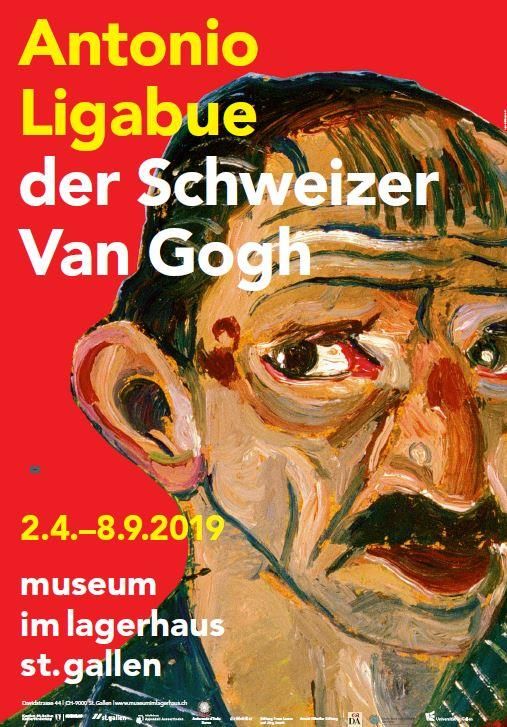
Antonio Ligabue –
The Swiss Van Gogh
2 April – 8 September 2019

Media preview:
Monday, 1 April 2019, 11am

Preview:
Monday, 1 April 2019, 6.30pm

Press Release
One hundred years ago, in May 1919, Antonio Ligabue (1899–1965, originally named Anton
Costa, and after his adoption Antonio Laccabue), who grew up in Eastern Switzerland, was
deported from his native country. After various relocations in the city of St. Gallen and the canton
of St. Gallen, the nineteen-year-old was sent “home” from his last residence in Romanshorn in the
canton of Thurgau to Gualtieri, Reggio Emilia, a home that had never been his own. Gualtieri was
the hometown of his adoptive father Bonfiglio Laccabue, whom he never met, since he was taken
away from his birth mother at nine months and put in the care of foster parents. However, Ligabue
did not have Swiss citizenship, and although Switzerland was the country of his birth, Gualtieri
remained his official hometown. Antonio Ligabue had nothing and no one in Italy. He grew up
with Swiss German and did not speak Italian. As a foreigner in Switzerland, he came to Italy, a
foreign country to him. Between all these borders, he was always the “other.” Homeless, without
connections, and without a sense of direction, he lived in the woods in a hut or a barn—wherever
he could find shelter. At the time, no one suspected that he would become a famous artist,
despite all the challenges he faced. Today he attracts large audiences in Italy as the “Italian Van
Gogh.” In his native Switzerland, however, he is almost unknown. Here he has forever remained a
foreigner. For the first time, Antonio Ligabue will now be presented in his lost homeland, and his
work will be shown in St. Gallen, where he spent the formative years of his life. One hundred years
after his deportation from Switzerland, Ligabue is now being reinterpreted as the “Swiss Van
Gogh.”
Antonio Ligabue is usually discussed as a solitary figure, with an emphasis on the uniqueness of
his work. The exhibition at the Museum im Lagerhaus will now present Ligabue within the culture
of his homeland. This includes the tradition of “untrained masters” in peasant painting and a
contextualization of Ligabue’s artistic oeuvre within the region’s culture. Eastern Switzerland in
particular has produced a number of famous practitioners of Naive Art and Art Brut, including
Adolf Dietrich (1877–1957), Hans Krüsi (1920–1995), and Hedi Zuber (1916–1996), whose
biographies and artistic careers show a variety of parallels to Ligabue.

The participation of Sandro Parmiggiani from Reggio Emilia as co-curator of the exhibition and co-
editor of this publication made it possible to assemble Ligabue’s works in Italy and realize the
exhibition. Sandro Parmiggiani knows Antonio Ligabue’s work like no other and has curated
various exhibitions and published books on the artist.

Renato Martinoni, emeritus professor of Italian modern and contemporary literary and cultural
history at the University of St. Gallen, has long researched Ligabue’s Swiss biography. For the first
time, his contribution to the exhibition and as co-editor of this catalog reveals Antonio Ligabue’s
life in eastern Switzerland, which was previously hidden away in archives.

The exhibition Antonio Ligabue: The Swiss Van Gogh is the beginning of an international
exhibition trilogy at the museum which will focus on to the “other” in art, illuminating the cultural,
sexual and gender-related, and religious facets of this theme. The wide-ranging exhibition project
will mark the thirtieth anniversary of the foundation and the Museum im Lagerhaus.

A German-English catalogue, with Italian translations, is published by Skira to accompany the
exhibition.

Programm
Press Preview
Monday 1 April 2019, 11am
With speeches by Monika Jagfeld, museum’s director, co-curator Sandro Parmiggiani, and Renato
Martinoni, University of St. Gallen.

Opening
Monday 1 April 2019, 6.30pm
With speeches by:
Peter Schorer, Foundation’s President
Thomas Scheitlin, Mayor
Fredy Fässler, Senior Civil Servant
Silvio Mignano, Italian Ambassador
Monika Jagfeld, Director Museum im Lagerhaus
Sandro Parmiggiani, Co-Curator
Renato Martinoni, University St. Gallen

Vortrag: Dall’esilio alla patria perduta, da Gualtieri a San Gallo
Tuesday 2 April 2019, 6.30pm
A lecture by Sandro Parmiggiani, Reggio Emilia, Ligabue specialist and co-curator of this
exhibition. This event will take place in Italian.

“A kiss – Antonio Ligabue” (play)
Friday 5 April 2019, 8pm
Saturday 6 April 2019, 7pm
The new play by award-winning Italian playmaker Mario Perrotta.

                                                                                                         2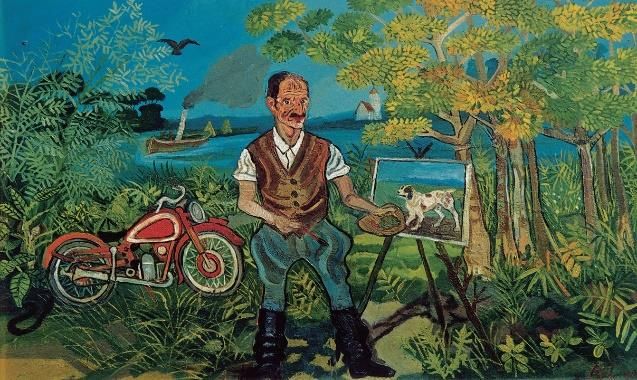
Film Screening: Antonio Ligabue – fiction a realtà
Wednesday 24 April 2019, 6pm
A film by Salvatore Nocita (2009), 68 min, shown at the University St. Gallen, Room 09-112 (library
building).

Antonio Ligabue’s years in Switzerland (1899-1919)
Tuesday 7 May 2019, 6.30pm
A lecture by Renato Martinoni, professor emeritus at the University of St. Gallen and Ligabue’s
biographer.

In St. Gallen: on Antonio Ligabue’s trail
Tuesday 21 May 2019, 6pm
Tuesday 2 July 2019, 6pm
A walk through “Little Venice” and the history of Italians in St. Gallen with historian and archivist
Marcel Mayer (with consecutive Italian translation). Meeting point: Bahnhof St. Fiden.

KKK – Kunst Kaffee Kuchen (cake coffee art): Repatriation Then, Deporation Today
Sunday 30 June 2019, 3pm
An explosive topic discussed and illuminated by Police Commander Bruno Zanga, former Head of
the Cantonal Migration Office, and Prorector Lukas Gschwend, Professor of Law, University of St.
Gallen, specialising in minority law.

Öffnungszeiten
Di-Fr 14-18 Uhr
Sa/So/Feiertage 12-17 Uhr
open during Summer holidays
1. August closed

Press Information
Press images as well as a press kit can be found on our website:
www.museumimlagerhaus.ch/service/presse

Anna-Maria Pfab
Kommunikation
Museum im Lagerhaus
anna-maria.pfab@museumimlagerhaus.ch

mit Unterstützung von

                                                                                                        3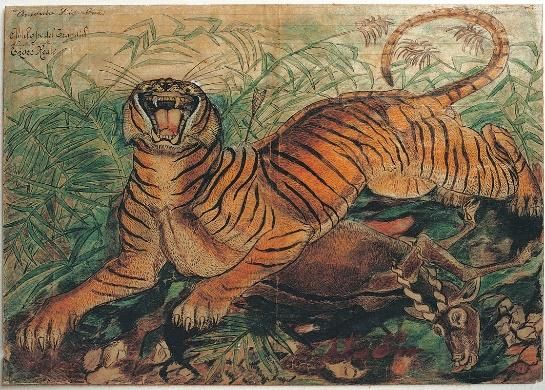
Antonio Ligabue –
der Schweizer Van
Gogh
2 April – 8 September 2019

 Press Images

Download the press images here: http://www.museumimlagerhaus.ch/service/presse/
Please e-mail info@museumimlagerhaus.ch for login details.

                                          Antonio Ligabue
                                          Autoritratto con mosche (Self-portrait with flies)
                                          Undated (1956–57)
                                          Oil on fibreboard
                                          32,5 x 25,7cm
                                          Private collection ©

                                          Antonio Ligabue
                                          Autoritratto con moto, cavalletto e paesaggio (Self-
                                          portrait with motorbike, easel and landscape)
                                          Undated (1953–1954)
                                          Oil on fibreboard
                                          63,9 x 104cm
                                          Gustalla (Reggio Emilia), private collection ©

                                                                                                 4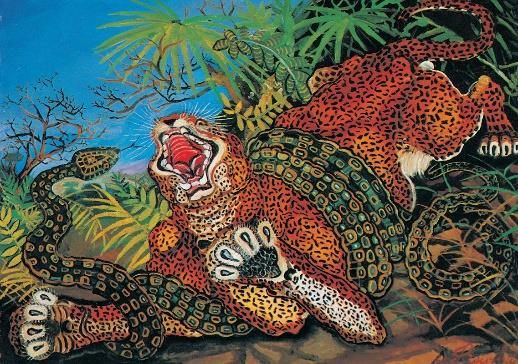
Antonio Ligabue
Caccia grossa (The big hunt)
1929
Oil on plywood
66 x 64cm
Private collection ©

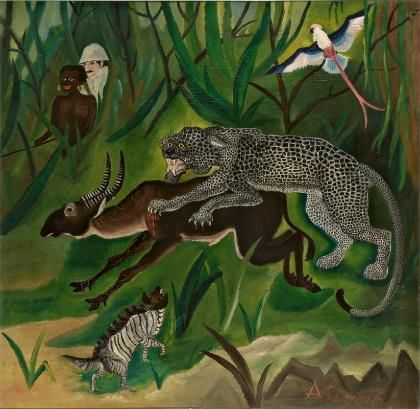
Antonio Ligabue
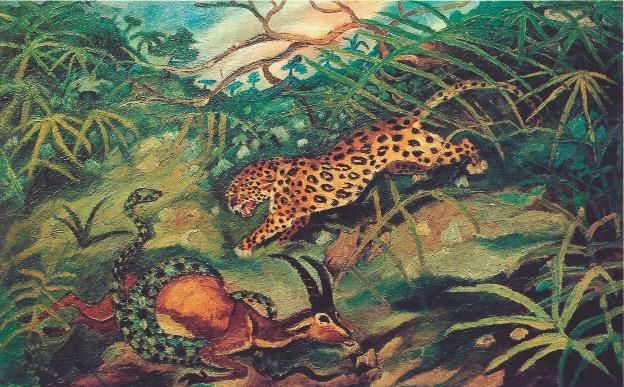
Giaguaro con gazzella e serpente (Jaguar with gazelle
and snake)
Undated (1948)
Oil on plywood
45 x 71cm
Private collection ©

Antonio Ligabue
Volpa in fuga (Fleeing fox)
Undated (1948)
Oil on fibreboard
60 x 74cm
Private collection ©

Antonio Ligabue
Leone (Lion)
Undated (1952–1962)
Pencil on paper
45 x 48cm
Santa Vittoria di Gualtieri (Reggio Emilia), Private
collection ©

Antonio Ligabue
Tigre reale (Bengal tiger)
Undated (1941)
China and wax crayons on paper with a header by the
San Lazzaro Psychiatric Hospital of Reggio Emilia
36 x 50cm
Private collection ©

                                                        5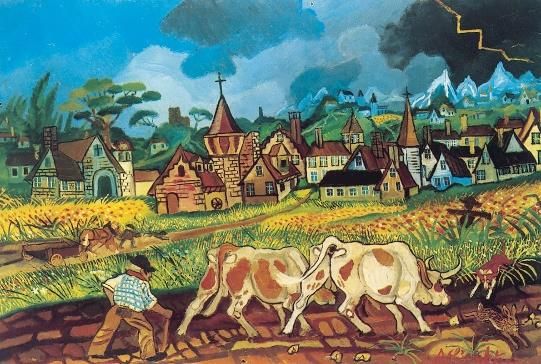
Antonio Ligabue
Gufo con preda (Owl with prey)
Undated (1957–1958)
Bronze
23 x 17 x 24cm
Private collection ©

Antonio Ligabue
Diligenza con cavalli (Horse stagecoach)
Undated (1959–1960)
Oil on fibreboard
75 x 83cm
Courtesy Galleria Centro Steccata, Parma ©

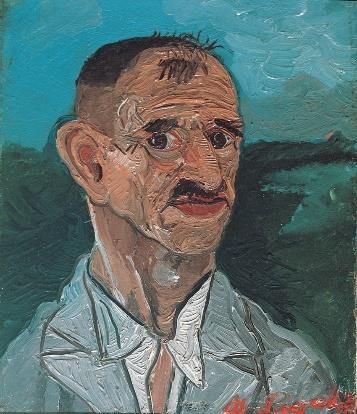
Antonio Ligabue (1899-1965)
Autoritratto (Self-portrait)
Undated (1940-42)
Oil on wood
25,5x10,5cm
Private collection ©

Antonio Ligabue (1899-1965)
Ritorno dal lavoro con buoi (Return from Field with Oxen)
Undated (1955-56)
Oil on fibreboard
58x87cm
Private collection
Courtesy Galleria Centro Steccata, Parma ©

Antonio Ligabue
Leopardo con serpente (Leopard with snake)
Undated (1955-1956)
Oil on fibreboard
69,5x98cm
Collezioni d’Arte Fondazione Cariparma ©

                                                        6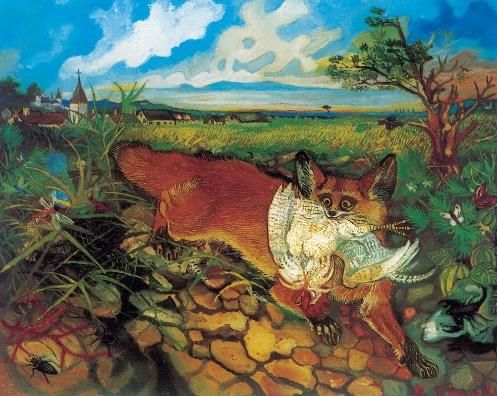
Ligabue
 Ligabueatanthe
              der
                easel
                  Staffelei
                      in theimcourtyard
                               Hof des Hauses
                                        of Andrea
                                               vonMozzali’s
                                                   Andrea
house,
 Mozzali,
       Guastalla
          Guastalla
1950
 1950
Photo
 Fotografie
      by William
             von William
                   Valli Valli

                                                              7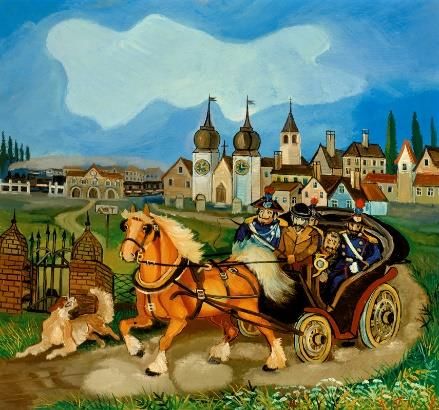
You can also read


