ARCELORMITTAL INVESTMENT PROGRAM NON-TECHNICAL SUMMARY
←
→
Page content transcription
If your browser does not render page correctly, please read the page content below
ArcelorMittal Investment Program
     Non-Technical Summary

                     Prepared by Ramboll Environ Poland
                     September 2017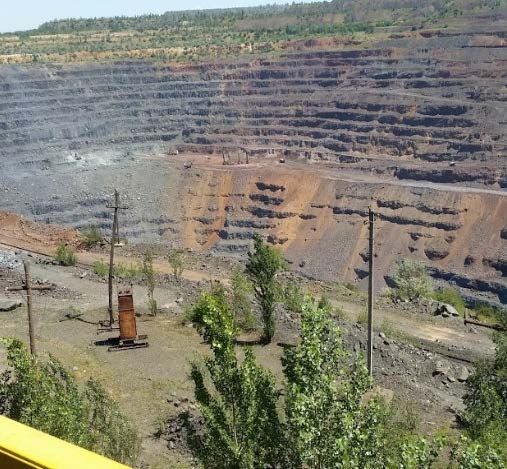
1.   INTRODUCTION
     Public Joint Stock Company ArcelorMittal Krivyi Rih (AMKR, the Company) owns an integrated steel
     plant with associated underground and open pit iron ore mines located in Krivyi Rih, Central
     Ukraine. AMKR is part of the ArcleorMittal Group, the world's leading steel company. ArcelorMittal
     Group is the leader in major global steel markets, including automotive, construction, household
     appliances and packaging. The Group also owns large raw material stocks and effective system of
     sales. ArcelorMittal Group with the workforce of more than two hundred thousand employees has
     representations in more than 60 countries all over the world.

     AMKR is one of the leaders among the largest enterprises of Mining and Steel Complex of Ukraine.
     AMKR specializes in long products – rebar and wire rod from ordinary and light alloyed steels, as
     well as sinter, concentrate, coke, pig iron, steel, section and shape rolled products. Activity of
     AMKR covers production chain from iron ore mining up to finished metal products. In 2015 the
     Company produced 5.5 million tons of pig iron, 6.3 million tons of steel and 5.3 million tons of
     rolled products.

     The history of the steel plant and the mines originate back to 1930’s, as a Government owned
     facility, when production of cast iron was commenced. The Company was one of the largest
     integrated steel plants in the former Soviet Union and at its peak producing17million tons of steel
     per annum. Through the years the facility has gradually developed to current state of integrated
     plant, where all metallurgical and other processes necessary to manufacture steel and steel
     products are conducted. Currently the production capacity amounts to almost 6.4 million tons of
     steel per annum and ore extraction exceeding 23 million tons per annum.

     The Company has embarked on a modernization program as part of the commitment to meet
     obligations from the Sale and Purchase Agreement (SPA) and amendments to it and production
     needs, but most importantly to meet its corporate sustainability goals and reduce its overall
     environmental footprint.

     This non-technical summary presents the part of the investment program financed by EBRD along
     with the environmental and social benefits which are expected to be achieved.

2.   WHAT DOES “INTEGRATED STEEL PLANT” MEAN?
     Production of steel is a complicated process which utilizes a lot of energy and raw materials, of
     which the most important are iron ore and coke. Steel is known since the “steel age” but its
     production nowadays is significantly different than in ancient times and the quality of steel is
     incomparably better now than even in the late 20th century.

     Nowadays there are 4 different methods of steel production as shown on Figure 1, of which the
     most commonly used is the method based on blast furnace and basic oxygen furnace method,
     which is also used at AMKR facility.

     It is not necessary for all the consecutive steps of steel production in this method to be conducted
     at one site, e.g. production of cast iron or coke can be done separately from the steel production,
     however, gathering all technological steps, from coke production to final steel making at one site
     allows for effective use of by-products of different processes and optimize energy consumption.
     Such plants at which all technological processes, from ore preparation and coke production to
     manufacturing of final products of steel are called “integrated steel plants”.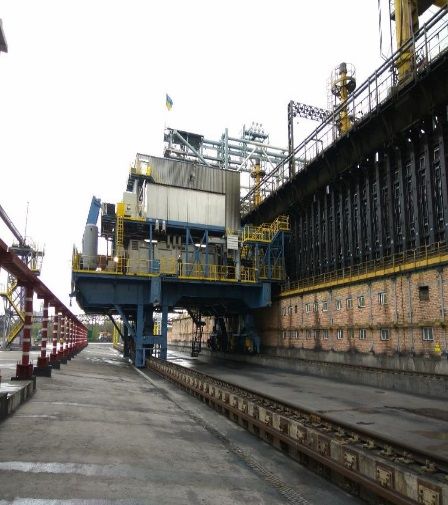
Figure 1. Crude steel production methods (source: BREF for Iron and Steel Production, 2010)

3.    WHAT ARE THE STEPS OF STEEL MAKING IN AMKR?
      The AMKR facility uses the classic blast furnace/basic oxygen furnace route of steel production.
      The most obvious difference between this and most of the others integrated steel plants is that at
      the AMKR facility iron ore excavated at own mines is used. Below, a short description of the
      production process is provided.

3.1   Iron ore excavation and primary preparation
      AMKR facility exploits their own iron ore deposits located in
      Krivyi Rih. Ore is excavated in open pit and deep mines with
      use of explosives (in open pit mines) and drilling methods.
      Ore deposits include both oxidized and non-oxidized ores, only
      non-oxidized is used for steel production, the oxidized ore is
      stored in temporary storage sites/facilities.

      Non-oxidized ore is transported to beneficiation plants, where
      it is crushed, diluted in water and then iron parts are
      separated from tailings with use of electromagnetic method.
      Such operation allows to increase the iron content in ore to
      approximately 60-70% which makes the further production
      more effective. The residuals of the beneficiation as well as of   Figure 2. Iron ore open pit mine
      mining process are stored in tailing ponds.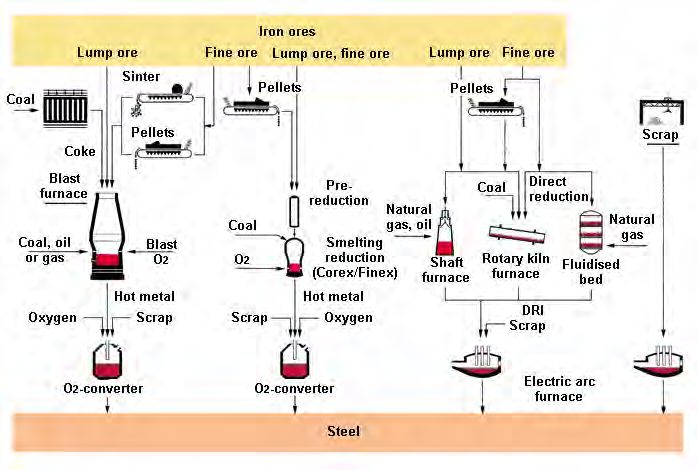
3.2   Coke production
      Coke is necessary for iron production as a chemical reagent
      (reducing agent) and partly as a fuel. Coke is produced from
      coking coal in so-called coking batteries. The coking battery
      is a set of ovens which are charged with coal and then
      heated without access to ambient air (i.e. oxygen) until all
      gases and water present in coal are fully evaporated. These
      high-calorific gases, called “coke oven gas” or COG, are
      captured and after treatment used for coke battery heating
      and for use in other installations. Treatment of COG includes
      among others removal of tar, sulphur compounds and other
      substances which are by-products of a commercial value.

      After completion of coal degasification the ready coke is
      pushed out of the ovens and quenched – at the AMKR facility
      with use of water.                                               Figure 3. Coke oven battery at AMKR site

3.3   Sinter production
      The modern blast furnaces (BF) need the charge to be
      provided in special form, usually as a sinter or pellets made
      of coke, iron ore, iron-bearing residues and other additives
      if needed. At the AMKR facility the BFs are charged with
      sinter.

      The raw materials are blended and then directed to the
      moving grate, where the coke present in the mixture is
      ignited by gas burners. Natural gas is used. As the grate
      continues to move, the burning coke reaches the
      temperature sufficient to create porous material referred to
      as a sinter. Further, the sinter is cooled by a strong blow of
      air and crushed and screened to separate small particles
      which are then returned to the process.                          Figure 4. Sinter strand

3.4   Blast Furnace
      A blast furnace is a closed system in which sinter or other
      iron-bearing material, additives, such as e.g. limestone and
      reducing agent, i.e. coke are continuously fed from the top
      through a charging system that prevents escape of blast
      furnace gas (BF gas). A hot air blast enriched with oxygen
      and auxiliary reducing agents is injected to the furnace,
      where reacts with the reducing agents and creates carbon
      monoxide which further reduces iron oxides to metal iron.
      Hot metal, so called pig iron, of a high content of iron is
      discharged from the furnace on regular basis in a cast
      house, and then directed for further metallurgical
      processes. The slag generated during the process is
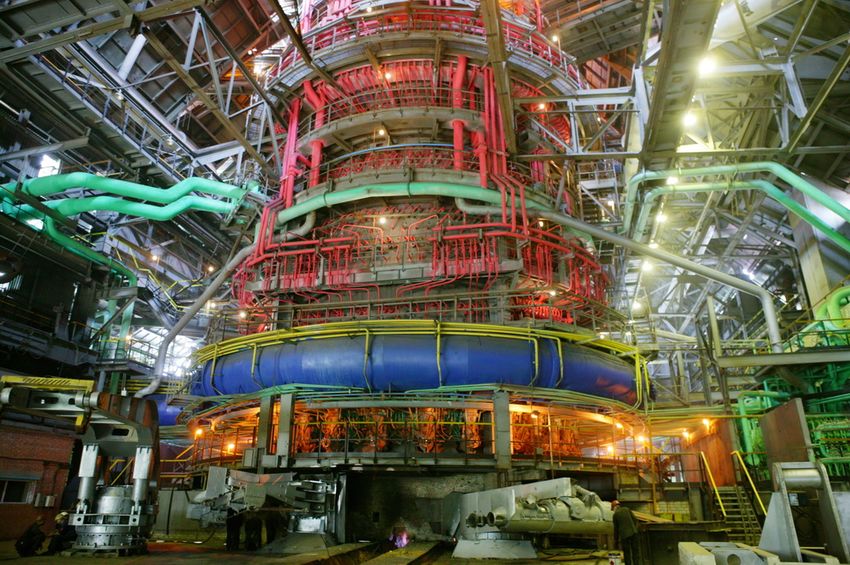
      collected and stored out of the main site. BF gas after          Figure 5. Blast furnace #9 at
      treatment, having high content of CO is used as energy           AMKR site
      source in various locations, such as hot blast stoves of blast
      furnaces, rolling mills, power plants etc.
3.5   Steel production and casting
      Pig iron produced in BFs contains more than 2% of carbon and requires further treatment in order
      to produce steel (which is defined as alloy of carbon and iron with carbon below 2%). Therefore,
      the next technological process is further reduction of carbon content.

      The modern techniques applied are basic oxygen furnaces (BOF), in which the pig iron is mixed
      with metal scraps and other additives and then oxygen is blown into the converter through water-
      cooled lance. Introduction of oxygen causes oxidation of carbon as well as other metal impurities
      which gather in a slag or are exhausted with the off-gases. The process is semi-continuous. After
      achieving the required quality, produced steel is tapped for casting, which can be either continuous
      ( i.e. the casting is conducted continuously in a casting machine which enables the casting of one
      or a sequence of ladles of liquid steel into a continuous strand of billet, bloom, slab, beam blank or
      strip), or ingot. At the site continuous casting is conducted for steel made in BOFs.

      AMKR facility also uses old technology for production of steel in a Twin Hearth Furnace (THF). This
      process is a batch process, in which the reactor is filled with light scraps, then heated with use of
      gas until the charge is melted, then heavy scraps and pig iron as well as other additives are added.
      The oxygen in iron oxide and other impurities decarburize the pig iron by burning excess carbon
      away, forming steel. To increase the oxygen contents of the heat, iron ore can be added to the
      reactor. While the quality parameters are achieved, the steel is tapped for ingot casting.

4.    WHAT IS THE CURRENT ENVIRONMENTAL SITUATION?
      As any other integrated steel plant around the world the AMKR facility impacts the environment, in
      particular by air emissions. Numerous processes conducted at the site involve transport and
      processing of dusty materials and incineration of fuels.

      The processes that generate high emission of dust include:
      • Coal transport, charging of COBs;
      • Coke pushing from COBs, quenching, screening and transport;
      • Preparation of charge for sintering and sintering - in particular during sinter cooling and
         crushing;
      • Preparation of charge for BFs, pig iron casting;
      • Charging of BOFs and casting.

      Such processes are to some extent controlled by application of gas capture systems (GCS)
      equipped with emission controls, such as bag filters or electrostatic precipitations, but their
      efficiency depends on the age of installations and technical status of the devices.

      The site emissions are related to coking and incineration of COG, BFG and BOF gas. Gaseous
      emissions from coking occur from leaky doors and valves of the COBs and the major measure for
      reduction is proper maintenance of the devices. Gases generated in COBs and BFs are collected
      and purified from impurities: COG at the gas treatment shop which substantially reduces content
      of tar and sulphur compounds, the BFG is dedusted. Incineration of gases is a source of emission
      of NOx and SO2 as well as CO2. Emission of CO2 is one of major concerns in ArcelorMittal Group,
      however, no effective technical measures to reduce such emission in the classical steel plants are
      currently known. Optimization at the AMKR site of CO2 emission is achieved by use of COG and
      BFG as fuel at the site, i.e. CO2 is generated during energy recovery. So far the BOF gas is not
      used that way and is incinerated in the stack flares in order to avoid CO emission.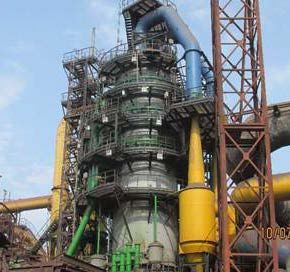
The investment program of AMKR that involved UAH 4.5 billion was commenced in 2007 and has
      resulted in significant reduction of overall environmental footprint of the plant, as shown at Figure
      6.

      Figure 6. Environmental results of the AMKR investment program since 2007

      It must be noted that AMKR’s current operations do not cause breaches of any permitted
      environmental impacts. Further, the Company conducts monitoring of air quality at 3 control
      points situated in a sanitary zone around the plant. The results of air quality measurements are
      updated on daily basis and are presented on the information board (once a day); city
      administration and SSFSCP (State Service for Food Safety and Consumer Protection) (on monthly
      basis), DRSA (Dnipropetrovsk regional state administration) (each 10 days) and State
      Environmental Inspection(quarterly). The results are also presented on the AMKR website
      (https://ukraine.arcelormittal.com/index.php?id=334).

5.    WHAT WILL BE FINANCED IN SHORT TERM?
      Although AMKR’s investment program for the following years is very extensive, a priority program
      has been developed and agreed to address key EHS issues. The program includes 4 investments
      as presented below.

5.1   New sinter plant
      Currently, there are three sinter plants (SP) in operation: SP 1, SP 2 and Metallurgical SP
      (historical name) with 17 sinter strands . These SPs are old and AMKR is challenged to meet the
      existing environmental standards and are unlikely to meet the new proposed standards which will
      be implemented in Ukraine from 01/01/2021. In order to secure sufficient sinter production for the
      years to come, the Company considered modernization of the SPs but due to the safety risks and
      the expected costs and the technical constraints this option has been reconsidered. Instead, the
      plan is to install a completely new sinter plant with a total capacity of 10 million tons per annum.
      The new sinter plant is proposed to have modern technological solutions and be equipped with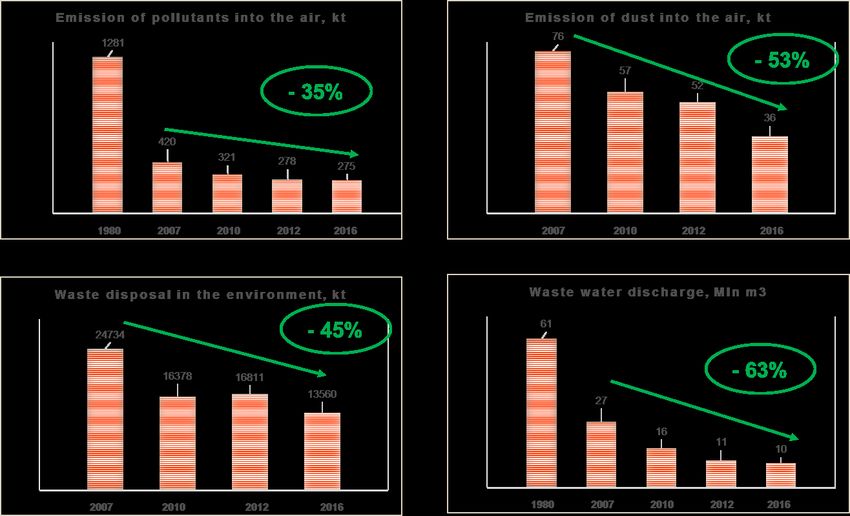
proportioning system, mixing/nodulizing circuit, 2 sinter machines with ignition furnaces, sinter
      crushing and screening circuit, process gas system, dedusting system, electrics/automation, sinter
      storage (16 Hrs), sinter dispatch system to BF-9, sinter dispatch system to BF Shop-1, coke and
      flux crushing and screening circuit as well as conveyors. The project is currently at the stage of
      designing and its implementation is planned for the years 2018-2022, subject to certain
      conditions. After full implementation of the project, SP 1 and MSP will be shut down. Capacity of
      the SP 2 will be reduced by at least 50%, this SP is planned to cover the difference between
      capacity of the new SP and the facility demand, which is expected to reach 10.5 million tons per
      annum in 2020.

5.2   Full reline of BF 9
      Pig iron at the site is produced by 4 BFs, of which BF 9 has the largest production capacity which
      amounts 50% of the total facility demand. The last major repair of this BF was completed in 2003
      and no major modernizations nor improvements has been done at this BF since then. A detailed
      health study of the furnace was conducted in November 2016, which showed that the shell steel
      structures are in a limited operational condition. Also, the auxiliary structures in the BF9 complex
      also needs to be reconstructed in order to properly support BF9 in the next camping life.

      The scope of this project includes among others implementation of a new cooling system,
      improvement of refractories and re-construction of the shell, significant and most up-to-date
      equipment of the cast house, replacement of the bustle pipes and furnace top, improvements in
      gas cleaning system (more effective dedusting for cast house and bunker stock house).

      The construction phase of the project is planned for the years 2018 (second half) – 2020.

5.3   Replacement of the blowers for BF 9
      The blast for the BF 9 is produced by steam driven blowers at heat and power plant No. 3. The
      blowers were constructed in 1970’s and, by today’s standards are highly ineffective from an
      energy use perspective. The company intends to replace the old blowers with the new, electric
      ones, which will allow for reduction of gas consumption and more effective energy use.

      The blowers will be replaced in two phases: the 1st one will be replaced before the relined BF 9 is
      fully operational, the second one will be replaced in 2021-2022.

5.4   Ladle furnace and continuous casting
      Apart of considerable air emissions, since most of AMKR’s products are still produced via old
      fashioned Ingot casting route, quality of the steel produced there is insufficient to meet the clients’
      expectations. As a measure for improvement, the company intends to improve converters No. 1, 2
      and 3 to achieve future environmental standards and resign from ingot casting for the favour of
      continuous casting.

6.    WILL THE PROJECT MEET THE NATIONAL AND
      INTERNATIONAL STANDARDS?
      All projects to be financed directly by EBRD are structured to meet the current and perspective
      national environmental legislation. After project implementation, the environmental performance
      of the subject investments will be improved as compared to the current status, since the new
      national standards introduce more strict environmental constraints with respect to air emissions.
      The projects will be prepared and executed in line with the Ukrainian regulations with respect to
      assessment of environmental impacts, i.e. in line with currently binding rules by December 18,
      2017, and in line with newly adopted Ukrainian EIA Law.
In line with corporate standards the investment program is also structured to meet the EU
environmental standards as far as practicable and economically justified. In particular, the
individual projects are planned to adopt the best industry practice as codified under the Best
Available Techniques (BAT) Conclusions 2012 for Iron and Steel, adopted by the European
Commission. Some investments to attain BAT compliance will be undertaken between 2020-23 and
2023-26. As part of the investment the Company will install CEMS (Continues Emission Morning
System) to allow for the optimization of processes and ensure more detailed environmental
monitoring. Given below are some of the key invests planned
• For augmentation of the sinter plant:
• Dust emission according to BAT shall not exceed 15 or 40 mg/Nm3 (depending on emission
control installed).
• For BF 9:
• Emission of dust from cast house should not exceed 15 mg/Nm3 (daily average) or 15
mg/t of hot metal according to BAT, but the design assumes emission of 50 mg/Nm3
(during dust generation).
According to EBRD Environmental and Social Policy (2014), the projects which fall under the EU
IED directive - and this is the case – shall meet, regardless geographical location, the provisions
of the directive, i.e. also meet the BAT requirements. Given the large investment needs of the
company and limited time for project implementation, the EBRD has applied for a derogation from
its usual policy position in relation to meeting of BAT, which means that the individual projects
shall meet the BAT requirements in the future, after 2023, i.e. shall be designed in the way
allowing full adaptation to BAT requirements at the later stage. Further, EBRD’s also requests the
Company to undertake an independent BAT assessment of the projects and the EIA procedure
following EU standards as per EIA directive. Moreover, the actions necessary to achieve full
compliance with EBRD’s requirements as per its Environmental and Social Policy (2014) are
summarized in the Environmental and Social Action Plan (ESAP).
7. WHAT ARE THE BENEFITS OF THE PROJECT FINANCED
BY EBRD?
The investments financed by EBRD at AMKR facility will first of all improve operational performance
of the plant and secure undisturbed and safe production of high-quality products. But thanks to
these investments also natural environment and society of Krivyi Rih and surrounding villages will
benefit.
Although the facility invested 4.5 billion UAH in the period 2007-2016 which resulted with overall
decrease environmental footprint (see Figure 6), thanks to the implementation of the investment
program further reduction of emissions is expected, as presented on Figure 7. The planned
investments will implement modern technologies used in well developed countries, although some
room for improvement will still exist, as indicated in section 5. One way or the other, the planned
investments will significantly contribute to the Company’s plans for further reduction of air
emission by 2021, when the total emission of air pollutants should not exceed 209 thousand tons
per annum, which corresponds to 32.7 kg/t of steel versus current 43.9 kg/t of steel.Figure 7. Forecast of expected overall emission from AMKR facility
Particular investments will create the following environmental benefits:
• Sinter plant:
• reduction of emissions' volume via shutdown of worn out SPM & SP1 & partly SP2, and
also reduction of average value of emissions per 1 ton of sinter via implementation of:
- automatic control system of environmental monitoring;
- intensive mixture with control of charge moisture;
- plant dedusting;
- modern GCP (electric filters & bag filters);
• recovering of exhaust sinter gases
• BF 9:
• reduction of dust emission from charge preparation and casting by application of gas
capture systems and installation of effective dedusters
• reduction of sulphur containing compounds emission by approximately 30%
• Replacement of blowers:
• Reduction of air emissions from heat and power plant due to reduced need for steam.
• New ladle furnace and continuous casting:
• reduction of emissions volume via shut-down of old THF
The project will be executed entirely on the premises of AMKR and will not affect in any way
protected areas. Further, due to overall reduction of air emission from the facility the quality of
ambient air in Krivyi Rih is expected to improve, which will be monitored by AMKR with use of the
existing air monitoring stations.
8. HOW WILL THE PROJECT BE MONITORED?
The investment program of the Company will be monitored on regular basis, both in terms of its
implementation and of the environmental benefits achieved.
The Company is obliged by the loan contract to develop a set of key performance indicators (KPI)
in a way sufficient to control performance of the implemented investment program, in particular
the part of it which is financed by EBRD. The KPIs will cover such aspects as energy use, air
emissions,– all relative to production volumes. KPIs will be developed also for basic H&S statistics
such as number of accidents and near misses, number of days off due to accidents at work etc.
The Company will also monitor relations with the stakeholders, among others by monitoring of
submitted grievances.
CEMSs installed at the modernized installations will allow for better control of actual emissions and
for improved control of the operational performance. The results of reduced emissions (due to
implementation of the investments) will be observed by continuation of the ambient air monitoring
program.The progress of the investment program implementation, KPIs and overall facility environmental
and social performance will be reported to the lenders and will be disclosed to the public in the
Sustainable development reports on annual basis. Further, the progress of the investment project
will be discussed by AMKR with ArcelorMittal corporate executives and EBRD representatives at the
meetings which will be held at least once a year during the lifetime of the program.
9. IS MORE DETAILED INFORMATION AVAILABLE?
AMKR, following the corporate standards has well developed system of communication with the
stakeholders, including administration, societies, scientific institutions and others. For the purpose
of this investment program and in order to fulfil requirements of EBRD a project-specific
Stakeholders Engagement Plan (“SEP”) has been developed. In line with the SEP information about
the investment program will be available among others:
• On the company web-site: the Company will provide up-to-date Projects’ information on its
web-site https://ukraine.arcelormittal.com. It will also be possible for users to provide
feedback or ask questions about the Projects via the web-site.
• The announcements on the forthcoming public meetings will be made one month in advance
via local media and by use of bulletin boards located in Kryvyi Rih and the neighboring
settlements.
• The general public and the workforce will be informed via media (incl. a corporate newspaper
“Metallurg”) of all relevant and important Projects’ milestones and current activities with press
releases with direct distribution and placement on the AMKR’s website.
For more information please contact the Company:
• By calling one of the five 24/7 operating hot-lines:
- Internal Communications (056) 499 28 88
- Environment (056) 499 58 58
- Health and Safety (056) 499 42 41
- Fraud (056) 440 00 41
- Security (056) 499 58 68
Any grievances can be submitted to the Company via its website or using the following email
addresses:
Ukraine@arcelormittal.com;
AMKR.SECURITY.HOT.LINE@mitallo.com;
AMKR.Internal.Communications@arcelormittal.com.You can also read


