ASSESSMENT GUIDELINES - CT.gov
←
→
Page content transcription
If your browser does not render page correctly, please read the page content below
ASSESSMENT GUIDELINES
fo r Ad min istering
Next Generation Science Stand ards Assessme n ts
S marter Balan ced Assess men ts
Performance Office 2020-21
Connecticut SAT School Day
Conn ecticu t Altern ate Assessmen ts
Students Who Receive
Special Education Services
Students Identified as
Disabled Under Section 504
of the Rehabilitation Act of
1973
Students Identified as
English Learners
Students Receiving
Designated Supports
Updated 2/4/21
STATE OF CONNECTICUT

    Ned Lamont, Governor

                                    STATE BOARD OF EDUCATION

    Allan B. Taylor, Chairperson
    Estela López, Vice Chairperson
    Erin D. Benham
    Bonnie E. Burr
    Erik M. Clemons
    Karen DuBois-Walton
    Elwood Exley, Jr.
    Donald F. Harris, Jr.
    Martha Paluch Prou
    Awilda Reasco
    Malia K. Sieve

    Mark E. Ojakian (ex officio)
    Robert J. Trefry (ex officio)

    Dr. Miguel A. Cardona
    Commissioner of Education

2/4/21 CSDE Assessment Guidelines                              ii | P a g e
CONTENTS
    INTRODUCTION                                                                                          1

    I. HISTORICAL PERSPECTIVE: Expect Students with Disabilities to Achieve Grade-Level
         Academic Content Standards                                                                       2

   II. DESCRIPTION OF THE CONNECTICUT ASSESSMENT SYSTEM                                                   3
         A. Smarter Balanced Assessment System                                                            3
         B. Connecticut SAT School Day                                                                    3
         C. Next Generation Science Standards Assessment                                                  4
         D. Connecticut Alternate Assessment System                                                       4
         E. English Proficiency Assessment                                                                6
         F. National Assessment of Educational Progress                                                   6

  III. WHO SHOULD BE TESTED?                                                                              8
         A. Underlying Intent of the Legislative Mandates and Policy Directives                           8
  IV. GRADE-LEVEL CONSIDERATIONS FOR PARTICIPATION IN STATEWIDE
      ASSESSMENTS                                                                                    11

   V.    GUIDELINES FOR PARTICIPATION IN AN ALTERNATE ASSESSMENT                                     12
         A. Historical Perspective                                                                   12
         B. National Center and State Collaborative                                                  13
         C. Connecticut Alternate Assessment System Participation Criteria and the Connecticut
             Alternate Assessment Eligibility Form                                                   13
         D. Required Training for Teachers Administering the Connecticut Alternate Assessment and
             Alternate Science                                                                       15
  VI. GUIDELINES FOR MAKING DECISIONS ABOUT DESIGNATED SUPPORTS
      FOR THE SMARTER BALANCED ASSESSMENTS AND THE NGSS                                              16
         A. Description of Smarter Balanced and Next Generation Science Standards Assessments:
             Universal Tools, Designated Supports, and Accommodation Categories                      16
         B. Universal Tools                                                                          17
             1. Embedded Universal Tools                                                             17
                  a. Breaks                                                                          17
                  b. Desmos Calculator (For Calculator-Allowed Math Items Only Grades 6-8; and
                      Science Grades 5, 8, and 11)                                                   17

2/4/21 CSDE Assessment Guidelines                                                         iii | P a g e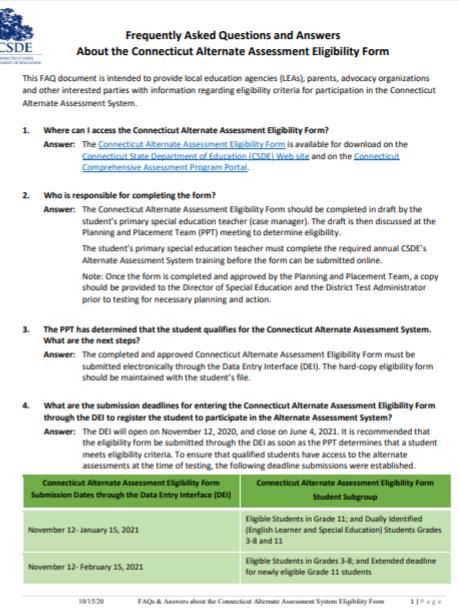
c. Digital Notepad                                                              18
                  d. English Glossary (Default) (Not Available for Science)                       18
                  e. Expanded Passages/Stimuli/Items                                              18
                  f. Highlighter                                                                  18
                  g. Keyboard Navigation                                                          18
                  h. Line Reader                                                                  18
                  i. Mark for Review                                                              18
                  j. Math Tools                                                                   19
                  k. NGSS Periodic Table (Grades 8 & 11) English                                  19
                  l. Strikethrough                                                                19
                  m. Writing Tools (Interim ELA Performance Task Only)                            19
                  n. Zoom                                                                         19
             2. Non-Embedded Universal Tools                                                      19
                  a. Breaks                                                                       19
                  b. Calculator (Science Grades 5, 8, and 11)                                     20
                  c. NGSS Periodic Tables (Grades 8 & 11) English & Spanish
                  d. Scratch Paper/White Board with Marker                                        20
         C. Designated Supports                                                                   21
             1. Embedded Designated Supports                                                      21
                  a. Color Contrast                                                               21
                  b. Illustration Glossary (Math)                                                 22
                  c. Masking                                                                      22
                  d. Mouse Pointer (Size & Color)                                                 22
                  e. Print Size Online                                                            22
                  f. Streamline                                                                   23
                  g. Text-to-Speech (Math and Science, Stimuli & Items), (ELA Items, NOT Reading
                      Passages)                                                                   23
                  h. Turn off Any Universal Accessibility Tool                                    23
             2. Non-Embedded Designated Supports                                                  23
                  a. Amplification                                                                23
                  b. Color Contrast                                                               23
                  c. Color Overlay                                                                23
                  d. Magnification                                                                24
                  e. Noise Buffer                                                                 24

2/4/21 CSDE Assessment Guidelines                                                       iv | P a g e
f. Read Aloud (Math and Science, Stimuli & Items), (ELA Items, Not Reading
                      Passages)                                                                   24
                  g. Separate Setting                                                             24
                  h. Simplified Test Directions (Not Available for Science)                       25
         D. Additional Designated Supports for Students Identified as English Learners            25
             1. Embedded Designated Supports for English Learners                                 25
                  a. Spanish Presentation (Math, Stacked)                                         25
                  b. Spanish Presentation (Science, Toggle)                                       26
                  c. Text-to-Speech (Science, English (Default) and Spanish)                      26
                  d. Translations-Math (Glossary)                                                 26
             2. Non-Embedded Designated Supports for English Learners                             27
                  a. Bilingual Dictionary (Science ONLY)                                          27
                  b. Native Language Reader Directions Only (Science ONLY)                        27
                  c. Read Aloud in Spanish (Math, Science)                                        27
                  d. Translation Glossary (Math) (Provided by test vendor ONLY for Large Print
                      Paper/Pencil Assessment. Classroom materials MAY NOT be used.)              27
                  e. Translated Test Directions (ELA and Math; Not Available for Science)         28
 VII. GUIDELINES FOR MAKING DECISIONS ABOUT ACCOMMODATIONS FOR
      STATEWIDE TESTING                                                                           29
         A. General Information about Accommodations                                              29
         B. Who May Receive Accommodations?                                                       30
             1. Students Who Receive Special Education Services                                   30
             2. Students Identified as Disabled under Section 504 of the Rehabilitation
                  Act of 1973                                                                     30
             3. Students Identified as English Learners with Disabilities                         31
             4. Students with Temporary Disabling Conditions - Broken Fingers, Arms, Shoulders,
                  or Concussions, etc.                                                            31
         C. Allowable Accommodations for Special Education and 504 Students                       31
             1. Embedded Accommodations for Students with Disabilities or a 504 Plan              32
                  a. American Sign Language Video (ELA-Listening, Math) (Grades 3-8) (Not
                      Available for Science)                                                      32
                  b. Braille (e.g., Refreshable Braille, Braille Embosser) (Grades 3-8)           32
                  c. Braille Transcript (ELA Listening Passages) (Grades 3-8)                     33
                  d. Closed Captioning for ELA Listening (Grades 3-8)                             33

2/4/21 CSDE Assessment Guidelines                                                           v|Page
e. Speech-to-Text (for Math and ELA open-ended items) New!                         33
                  f. Text-to-Speech for ELA Reading Passages (Grades 3-8)                            33
             2. Non-Embedded Accommodations for Students with Disabilities or a 504 Plan             34
                  a. 100s Number Table (Math Grades 3-8)                                             34
                  b. Abacus (Math)                                                                   34
                  c. Alternate Response Options (Smarter Balanced and NGSS)                          34
                  d. Braille Booklet (ELA, Math, and Science)                                        34
                  e. Large Print Booklet                                                             35
                 f. Multiplication Table (Math Grades 3-8)                                           35
                  g. Specialized Calculator (Math Grades 6-8 for Calculator-Allowed Items Only;
                      Science Grades 5, 8, & 11)                                                     35
                  h. Speech-to-Text Voice Recognition Software (e.g., Dragon Naturally Speaking) 35
         D. Accommodations Requiring a Special Documented Accommodations Petition                    36
                 a. Calculator (Non-Embedded) (Math Grades 6-8 for Calculator-Allowed Items
                      Only)                                                                          36
                 b. Customized Accommodations                                                        36
                 c. Human Signer for ELA, Math, and/or Science Items                                 37
                 d. Human Signer for ELA Reading Passages (Grades 3-8)                               37
                 e. Manipulatives (Math Grades 4-8)                                                  37
                  f. Print on Demand                                                                 37
                  g. Read Aloud (ELA Reading Passages Grades 3-8)                                    38
                  h. Scribe                                                                          38
         E. Entering Test Related Supports and Accommodations                                        38
         F. Selecting Appropriate Test Designated Supports or Accommodations                         39
         G. Evidence of the Need for Supports and Accommodations for Statewide Assessments           39
         H. Special Considerations for Assessments                                                   40
             1. Students Who Are Present, but Do Not Take the Test                                   40
             2. Reluctant Students                                                                   40
             3. Students Who Become Agitated or Disruptive                                           40
             4. Accommodation Provision Error                                                        41
         I. Additional Considerations Related to Providing Designated Supports and
             Accommodations during Assessment                                                        41
             1. Planning for Test Day                                                                41
             2. Administering Assessments with Accommodations                                        42

2/4/21 CSDE Assessment Guidelines                                                          vi | P a g e
3. Ethical Testing Practices                                               42
             4. Standardization                                                         42
             5. Test Security                                                           42
             6. Connecticut’s Test Security Policy                                      43

    VIII.    DESCRIPTION OF THE CONNECTICUT SAT SCHOOL DAY
             ACCOMMODATIONS AND SUPPORTS                                                44
             A. General Information About the Connecticut SAT School Day                44
             B. Eligibility for Connecticut SAT School Day Accommodations               44
             C. Applying for Connecticut SAT School Day Accommodations                  45
             D. Types of Accommodations                                                 46
             E. Supports for English Learners                                           47

    APPENDIX A Next Generation Science Standards (NGSS) Assessment Non-Embedded
               Calculators                                                              49
    APPENDIX B Medical Exemption                                                        51
    APPENDIX C Special Documented Accommodations                                        53
    APPENDIX D General Resources                                                        56
    APPENDIX E Change Log                                                               69

2/4/21 CSDE Assessment Guidelines                                            vii | P a g e
INTRODUCTION

This document includes revisions through September 2020 and is intended to provide guidance for
Connecticut school district personnel who must make decisions about testing special student
populations on the Smarter Balanced Assessments, the Next Generation Science Standards
(NGSS) Assessments, the Connecticut Alternate Assessments (CTAA) for English language arts
(ELA) and mathematics, and the Connecticut Alternate Science (CTAS) Assessments. These
special student populations include students identified as eligible for special education services
under the Individuals with Disabilities Education Act (IDEA), students identified as disabled under
Section 504 of the Rehabilitation Act of 1973, and students who are identified as English learners
(EL). This document also provides information regarding general education students who may
require additional supports when taking standardized assessments.

If after reviewing this document you have questions about the special student populations, the
criteria for participation in various assessment options, or allowable supports or accommodations,
please contact Deirdre Ducharme at deirdre.ducharme@ct.gov or Janet Stuck at
janet.stuck@ct.gov.

In addition to this document, the Connecticut State Department of Education (CSDE) continues to
prepare teachers to administer the Smarter Balanced Assessments for ELA and mathematics to all
students in Grades 3-8 in addition to the Connecticut Alternate Assessment System for those
students who qualify. One component of the Connecticut’s Assessment System includes
understanding, selecting, and providing access to each unique subtest. Resources related to student
supports and accessibility needs are available on the Connecticut Comprehensive Assessment
Program Portal.

2/4/21 CSDE Assessment Guidelines                                                         1|Page
I. HISTORICAL PERSPECTIVE: EXPECT
      STUDENTS WITH DISABILITIES TO ACHIEVE
         GRADE-LEVEL ACADEMIC CONTENT
                    STANDARDS
    Federal legislation, the Every Student Succeeds Act signed in 2015 reauthorized the Elementary
    and Secondary Education Act (ESEA). This act reaffirms and requires that each state institute
    challenging content and performance standards for its public school students. These performance
    standards establish the level at which students are expected to master the material included in the
    state’s content standards. The ESEA requires that all states have quality assessments established
    in reading, mathematics, and science to determine the extent to which students have mastered the
    material outlined in the state’s content standards. This requirement addresses a key element of the
    Title I program, i.e., a high-quality assessment system that is aligned with a state’s content and
    performance standards to ensure that all students are held to the same high academic standards.

    Connecticut has long advocated that, to the extent possible, students with disabilities should
    participate in both the general education curriculum and the standard administration of the state
    assessments; this has often not been the case nationally. It was only with the Public Law 105-17,
    1997 reauthorization of the Individuals with Disabilities Education Act (IDEA) that having high
    expectations for students with disabilities became a national priority. The 1997 IDEA amendments
    required that these students be included in appropriately challenging curriculums and in
    districtwide and statewide assessments, and that states and school districts publicly account for the
    progress of these students. Clearly, two goals of IDEA are: 1) the participation of a high percentage
    of students with disabilities in standard districtwide and statewide testing and related
    accountability efforts; and 2) the availability of an alternate assessment for those few students who
    cannot appropriately participate in the standard assessment program.

    Federal legislation, in the form of both ESEA and the IDEA, and state legislation in the
    Connecticut General Statutes (C.G.S.) Section 10-14, and the implementation of the Connecticut
    Core Standards (CCS) is consistent in the vision that is being promoted, i.e., high expectations,
    uniform standards, and public accountability for the performance of all students, including those
    with disabilities and limited English proficiency. Connecticut’s statewide assessment program is
    just one component of an overall accountability system that is intended to assess the effectiveness
    of Connecticut schools and lead to greater success for all students.

    To understand this educational accountability system, one must consider the progress of all
    students on a number of key indicators. For more information, the publication The Condition of
    Education in Connecticut is available for download.

2/4/21 CSDE Assessment Guidelines                                                               2|Page
II. DESCRIPTION OF THE CONNECTICUT
ASSESSMENT SYSTEM
A. SMARTER BALANCED ASSESSMENT SYSTEM
In the 2014-15 school year, Connecticut, as a member of the Smarter Balanced Assessment
Consortium, administered assessments for English language arts and mathematics to students in
Grades 3-8 and 11, with the exception of special education students with significant cognitive
disabilities participating in Connecticut’s Alternate Assessments. The Smarter Balanced
Assessment System was developed by the member states of the Consortium, including
Connecticut, to align to the Connecticut Core Standards. In the 2020-21 school year, the Smarter
Balanced Assessments will again be administered to students in Grades 3-8, while students in
Grade 11 will participate in the Connecticut SAT School Day (which became Connecticut’s
accountability assessment in lieu of Smarter Balanced during the 2015-16 school year).
When focusing on the Smarter Balanced summative assessments, it is important to understand its
test design and the activities associated with the test-taking situation. The Smarter Balanced
summative assessment for English language arts and mathematics requires students to:
Participate in an online assessment comprised of two components: a computer adaptive
test (CAT) for both ELA and math; and a performance task (PT) for math. The tests are
not timed, however, recommended test session lengths of 40 to 120 minutes, depending
on content area and grade level, are provided in the Test Administration Manual;
Demonstrate critical-thinking and problem-solving skills; and
Accurately respond to various item response types using a keyboard and mouse or
touchpad.
B. CONNECTICUT SAT SCHOOL DAY
On October 7, 2015, the Connecticut State Board of Education adopted the SAT (created by the
College Board) as the annual state assessment for eleventh graders in Connecticut. All students in
Connecticut must be tested once in high school for English language arts and mathematics using
the same assessment for all students. This is a requirement of federal and state law. By adopting
the SAT, Connecticut eliminates duplicate testing and eleventh grade students in Connecticut will
have an opportunity to take the SAT free of charge during the school day. The SAT assesses the
critical thinking skills students need for academic success. Students are able to use their SAT
scores for both the state school accountability system and for college admission.
Accommodations on the Connecticut SAT School Day are ONLY available for students with
special needs, as documented by an active Individualized Education Program (IEP) or a Section
504 Plan. These accommodations should be consistent with those accommodations provided
2/4/21 CSDE Assessment Guidelines 3|Pageduring instruction and on class, district, and statewide assessments per the 504 Plan or per Page 8
of the IEP. Certain supports, such as time and one-half (50% extended time), is available to
students with an English Learner Plan. See Section VIII in this document for more information.
The Connecticut SAT School Day is composed of the following subtests:
Evidence-Based Reading and Writing, consisting of two subtests: a Reading Test; and a
Writing and Language Test. Each test is composed of multi-paragraph passages and
multiple-choice questions.
Time allotted:
65 minutes for Reading
35 minutes for Writing and Language
Math: Includes one portion that permits calculator use and one that does not. Each portion
is composed of multiple-choice and student-produced response questions.
Time allotted:
25 minutes for Math Test-No Calculator
55 minutes for Math Test-Calculator
Most students will test in one or two days, and the test schedules are specified by the
Connecticut SAT School Day Coordinator Manual. However, there may be some students
who will require more time (refer to the Coordinator’s Manual for more detail).
C. NEXT GENERATION SCIENCE STANDARDS ASSESSMENT
Connecticut’s legacy science assessments, known as the Connecticut Mastery Test (CMT) Science
(administered to students in Grades 5 and 8) and the Connecticut Academic Performance Test
(CAPT) Science (administered to students in Grade 10), were replaced with the Next Generation
Science Standards (NGSS) Assessment in Grades 5, 8, and 11 during the 2017-18 school year. The
new science assessments, aligned to the Next Generation Science Standards (NGSS) adopted by the
Connecticut State Board of Education in November 2015, identify core scientific ideas, practices, and
concepts that all students should master. A variety of embedded tools and designated supports are
available to students, while accommodations are available for students with special needs, as
determined by an IEP or a Section 504 Plan. Supports are also available to students who are English
Learners (ELs).
For more information on the test design and content, visit the Connecticut Comprehensive
Assessment Program Portal.
D. CONNECTICUT ALTERNATE ASSESSMENT SYSTEM
The CSDE is committed to promoting student success for all students. The Connecticut Alternate
Assessment System is designed exclusively for a small percentage of special education students
2/4/21 CSDE Assessment Guidelines 4|Pagewith a disability or multiple disabilities that significantly impact intellectual functioning and
adaptive behavior, requiring intensive instruction and substantial supports. Generally, one percent
or less of the tested student population is expected to participate in alternate assessments and
eligibility is determined by the student’s Planning and Placement Team (PPT). Members of the
PPT ensure appropriateness using evidence explicitly documented throughout the student’s IEP in
conjunction with the Connecticut Alternate Assessment Eligibility Form, which documents
required data capturing the student’s intellectual impairment, adaptive behavior, and the
confirmation that the student receives extensive, repeated, individualized instruction and academic
support across all academic and non-academic areas. Refer to the Frequently Asked Questions and
Answers about the Connecticut Alternate Assessment Eligibility Form for additional information.
Frequently Asked Questions and Answers about the Connecticut Alternate Assessment System is
intended to provide Local Education Agencies (LEAs), parents, advocacy organizations, and other
interested parties with information regarding the requirements for serving Connecticut’s children
with significant cognitive disabilities participating in alternate assessments. This document
represents the current understanding of the CSDE on this topic. This guidance does not impose
any additional requirements beyond those required under applicable law and regulations.
The Connecticut Alternate Assessment System Participation Guidance for Planning and Placement
Teams flowchart provides the PPT with guidance on eligibility for student participation in the
Connecticut Alternate Assessment System. More information is available on the Alternate
Assessment webpage located on the Connecticut Comprehensive Assessment Program Portal.
Connecticut Alternate Assessment (CTAA) for English Language Arts and Mathematics
The CTAA for ELA and math is available for eligible students in Grades 3-8 and 11. This
assessment is presented to each student individually by a CSDE trained teacher via an online Test
Delivery System. The CTAA, including the supporting resources, was developed with Connecticut
teachers and administrators working closely with other national state members and experts in the
National Center and State Collaborative (NCSC). More information and resources about NCSC
can be found at http://www.ncscpartners.org/. More information about the CTAA can be found on
the Connecticut Alternate Assessment webpage. Teachers and parents with students who may be
eligible for the CTAA are encouraged to access the CTAA Practice and Training Site to become
familiar with the online environment, test format, and the accessibility features available.
Connecticut Alternate Science (CTAS) Assessment
If a student is determined eligible for the CTAA by the PPT, the student will also participate in the
CTAS when enrolled in Grades 5, 8, and 11. Unlike the CTAA, the CTAS is a non-secure test
intended to be administered throughout the year as teachers work with students to rate their
performance on the NGSS standards. The CTAS is organized into six Storylines for each assessed
grade that are linked to NGSS Standard Performance Expectations through the derived
Connecticut Alternate Science Essence Statements and the corresponding Core Extensions. Each
Storyline includes a Performance Task with a series of assessment activities in the following
content areas: Earth Science, Life Science, and Physical Science. These activities ask students to
make sense of real-world phenomena and/or engage with engineering design problems. Similar to
the CTAA, the CTAS is specifically designed for this specialized population by expert teachers
from across Connecticut who work with these students. For more information on the test design
2/4/21 CSDE Assessment Guidelines 5|Pageand content, visit the Connecticut Comprehensive Assessment Program Portal to access related
alternate assessment resources.
E. ENGLISH PROFICIENCY ASSESSMENT
LAS Links Assessment
Historically, Connecticut’s students identified as English learners have participated in statewide
assessments with designated supports if needed. These students acquiring English as a second
language are required to meet the same academic performance standards expected of students
whose first language is English. In addition to statewide academic assessment participation in
Grades 3-8 and 11 (and science in Grades 5, 8, and 11), all ELs must participate annually in the
standardized English Language Proficiency Assessment. In Connecticut, students who are
identified as ELs are assessed using the LAS Links Assessment to demonstrate their level of
English language proficiency. Students who are English learners must meet mandated exit
requirements on the LAS Links Assessment to exit bilingual and/or English for speakers of other
languages (ESOL) programs.
F. NATIONAL ASSESSMENT OF EDUCATIONAL PROGRESS
The National Assessment of Educational Progress (NAEP), is often called the "Nation's Report
Card." It is the only measure of student achievement in the United States that allows for the
comparison of Connecticut students to their peers in all other states. This national assessment,
sponsored by the U.S. Department of Education, has been conducted since 1969 and produces
results that are widely reported by the national and local media.
Every year, some Connecticut schools are selected to participate in the NAEP. For each NAEP
administration, representative samples of fourth, eighth, and twelfth-graders in states and
territories of the United States are tested in selected content areas. In odd-numbered years (e.g.,
2021), the number of participating schools increases and the results are used to assess achievement
for the state as a whole. Since it is critical that participants accurately represent Connecticut’s
public school population, students with disabilities and those designated as English learners must
be included in the testing.
School personnel are expected to make every effort to include all selected students with disabilities
and English learners in the assessments. Many of the universal tools and embedded and non-
embedded accommodations available for the Smarter Balanced and NGSS are also available for
the NAEP. As school personnel make specific decisions regarding how to include students in
NAEP, there are several important factors to consider:
Scores are not produced for individual students and participation in NAEP is anonymous;
The NAEP Assessments do not impose any consequences for students, teachers, schools,
or districts, and are intended solely to provide an overall measure of educational
achievement for the nation and individual states;
2/4/21 CSDE Assessment Guidelines 6|Page Participating students are not required to complete the entire test and may skip any test
question. Even when a student does not complete the entire test, valuable information is
obtained from the responses provided; and
Schools send a notification letter home to families of selected students. The letter explains
the importance of NAEP, and lets parents know that they may decide that their child will
not participate.
Annually, Connecticut’s NAEP State Coordinator provides the schools selected to participate in
the NAEP with detailed information about available accommodations specific to the assessments
that will be administered. Specific questions concerning NAEP accommodations should be
directed to Renée Savoie, NAEP State Coordinator, at 860-713-6858.
2/4/21 CSDE Assessment Guidelines 7|PageIII. WHO SHOULD BE TESTED?
A. UNDERLYING INTENT OF THE LEGISLATIVE MANDATES
AND POLICY DIRECTIVES
All Connecticut public school students should be assessed in accordance with federal and state
regulations. Students must be tested by the district when students are included in the Public School
Information System (PSIS) collection, and the district assumes fiscal responsibility for that student
by documenting at least some local costs, including eligible in-kind services for the student’s
education, and the student is enrolled to the extent the district is responsible for educational
placement and record keeping. These rules apply to students taking the Smarter Balanced
Assessments, the Connecticut Alternate Assessments, the NGSS, the Connecticut SAT School
Day, and the LAS Links.
Students who are eligible for special education services under the IDEA, students who are
identified as Section 504, and English learners must be recorded PSIS system to allow for accurate
reporting in the Test Information Distribution Engine (TIDE) system.
The following chart describes testing policies based on the student’s educational program.
Student Circumstance Testing Policy
Students entered into PSIS who Connecticut public school students who are enrolled in an
are enrolled in State Approved APSEP are tested by the APSEP. The reporting district is
Private Special Education accountable to test these students for the LAS Links with
Programs (APSEP) APSEP support.
Students entered into PSIS who The reporting district is accountable to test these students.
are enrolled in Non-Approved Procedural information is provided to District
Private Schools in Connecticut or Administrators for testing, English Learner Assessment
out-of-state schools Coordinators (ELACs) and SAT School Coordinators.
Students who move to another Students who move to another Connecticut public school
Connecticut public school in the in the same district or move to another Connecticut district
same district or move to another will have their tests follow them in TIDE upon the PSIS
Connecticut district during being updated. For the Connecticut SAT School Day,
testing students who do not take their test in the previous school
on the primary test dates of March 24 or April 13, 2021,
must take the test in their new school on the designated
make-up day of April 27, April 28, or May 18, 2021. For
the LAS Links testing, districts will access the Data
Recognition Corporation (DRC) Insight Portal to manage
student transfers for testing.
Students who move to a private Students who move to a private school or to an out-of-state
school or to an out-of-state school should be noted in PSIS as transferring from the
school during testing and are Connecticut public school system. These students are not
exited from PSIS tested.
2/4/21 CSDE Assessment Guidelines 8|PageStudent Circumstance Testing Policy
Students hospitalized or Students who are hospitalized or homebound due to illness
homebound due to illness should be tested unless there are medical constraints that
prevent them from testing (the student has received an
approved medical exemption). Students taking the
Connecticut SAT School Day must be tested on the
designated dates of March 24 or April 13, 2021 (depending
on the date selected by the district), or make-up testing
dates April 27, April 28, or May 18, 2021, at the school
district’s central administration offices by a certified
school staff member who is fully trained in the proper test
administration and security procedures.
Students on homebound Students who are receiving homebound instruction due to
instruction due to suspension or a suspension or expulsion must be tested either at home or
expulsion preferably at the school district’s central administrative
offices during the assessment specific testing window by a
certified school staff member who is fully trained in the
proper test administration and security procedures.
Connecticut SAT School Day must be tested on the
designated dates of March 24 or April 13, 2021 (depending
on the date selected by the district), or make-up testing
dates April 27, April 28, or May 18, 2021, at the school
district’s central administration offices by a certified
school staff member who is fully trained in the proper test
administration and security procedures.
Students who may qualify for a Requests for consideration of an Emergency Medical
medical exemption Exemption should be initiated by the District
Administrator (DA in TIDE) for the Smarter Balanced and
NGSS Assessments; by the Services for Students with
Disabilities (SSD) Coordinator for the Connecticut SAT
School day; or by the English Learner Assessment
Coordinator (ELAC) for the LAS Links as needed during
the appropriate test administration window. See Appendix
B.
Home-schooled students Home-schooled students are not public school students
and are not eligible to be administered state assessments.
Students who are newly enrolled Students who are newly enrolled in a Connecticut public
in a Connecticut public school school after the first day of testing are required to be
after the district testing window administered the state assessments. Students who are
has commenced taking the Connecticut SAT School Day who arrive after
either primary test dates (March 24 or April 13, 2021)
must take the test on April 27, April 28, or May 18, 2021.
Students registered in PSIS who The reporting district is responsible to test students
are enrolled in Non-Approved registered in PSIS who attend non-approved private
Private Schools in Connecticut schools in Connecticut. This includes both general and
special education students educated in non-approved
private schools using public school funds.
2/4/21 CSDE Assessment Guidelines 9|PageStudent Circumstance Testing Policy
Students registered in PSIS who The reporting district is responsible to test students
are enrolled in out-of-state registered in PSIS and attending out-of-state schools.
schools
If you have a student who is shared with another school district or program (i.e., reported in
TIDE as generic in state) and cannot access an assessment through the online Test Delivery
System, contact the Performance Office at 860-713-6860 for guidance.
For more information, refer to the Testing Students in PSIS Who Attend Out-of-State and Non-
Approved Facilities brochure.
2/4/21 CSDE Assessment Guidelines 10 | P a g eIV. GRADE-LEVEL CONSIDERATIONS FOR
PARTICIPATION IN STATEWIDE
ASSESSMENTS
For purposes of Connecticut’s statewide testing program, there are no ungraded school programs.
Each student must be enrolled in a specific grade, or assigned to a specific grade, based on his or
her age. This grade assignment must be specified in PSIS. Students in Grades 3-8 must participate
in the Smarter Balanced Summative Assessments for ELA and math and in the NGSS Assessment
when enrolled in Grades 5, 8, and 11. Additionally, students in Grade 11 participate in the
Connecticut SAT School Day. Students who qualify for the Connecticut Alternate Assessment
System participate in the CTAA for ELA and math in Grades 3-8 and 11, and also take the CTAS
Assessment when enrolled in Grades 5, 8, and 11. If there is any question as to the grade level for
a particular student, district administrators are advised to verify how the student was reported in
the PSIS and in the Special Education Data Application and Collection (SEDAC). Districts and
private approved special education programs are advised to work closely with districts on the
identification of students’ testing grades to avoid testing students in the wrong grade or not testing
students in a required grade.
Students enrolled in high school present additional issues for consideration beyond age and years
in school. Each local school district establishes its own policy for the determination of grade levels.
Many high schools establish grade levels based on the accumulation of earned credits. However,
this system and/or its timing must not result in a student not being tested. Therefore, it is critical
that the PSIS system accurately reflects the student’s current grade at the time of testing.
2/4/21 CSDE Assessment Guidelines 11 | P a g eV. G U I D E L I N E S F O R PA RT I C I PAT I O N
I N A N A LT E R N AT E A S S E S S M E N T
A. HISTORICAL PERSPECTIVE
In a commentary to the proposed Federal Regulations (Federal Register, October 1997, p. 55055),
the United States Department of Education estimated that approximately 1 to 2 percent of the total
school population would require an alternate assessment, whereas the vast majority of special
education students would participate in the standard grade-level version of statewide tests with
accommodations as identified by their IEP.
In response to meeting the needs of this specific student population, Section 602 (3) of IDEA ’97
required states to create an alternate assessment aligned with their academic content standards,
promote access to the general curriculum, and reflect professional judgment of the highest
achievement standards possible. To meet this requirement, the CSDE created the CMT and CAPT
Skills Checklist for students with significant cognitive disabilities and for whom a standard
statewide assessment was not appropriate. The CMT/CAPT Skills Checklist was used to assist in
the planning of instruction, monitoring student growth and progress, and documenting
achievement. Using this Checklist, teachers rated students on grade-level academic skills and
submitted results for state/federal reporting purposes during the CMT/CAPT testing window. In
2007, the CMT Skills Checklist Science for students in Grades 5 and 8, and the CAPT Skills
Checklist Science for students in Grade 10 was implemented.
Since that time, Connecticut’s academic standards and measurement tools have changed.
Beginning in 2015, Connecticut, as a member of the National Center and State Collaborative
(NCSC) consortium, worked to develop the Connecticut Alternate Assessment as a replacement
for the CMT/CAPT Skills Checklist. The CTAA is a system of valid, reliable, and fair next-
generation assessments aligned to the CCS in English language arts (ELA) and mathematics for
eligible students in Grades 3-8 and 11. The CTAS Assessment, aligned to the Next Generation
Science Standards, replaces the CMT and CAPT Skills Checklist Science for eligible students in
Grades 5, 8, and 11.
Currently, Connecticut’s Alternate Assessment System for students with significant cognitive
disabilities is comprised of the following:
Connecticut Alternate Assessment (CTAA) for ELA and mathematics for eligible students
in Grades 3-8 and 11; and
Connecticut Alternate Science (CTAS) Assessment for eligible students in Grades 5, 8,
and 11.
While the CSDE strives to provide alternate assessments that support student independence to the
greatest extent possible by making academic content accessible and the expected achievement
levels appropriate, it is critical to safeguard against an overreliance on this option, and reserve
these assessments for a very small percentage of students with the most significant cognitive
disabilities for whom the assessments were designed.
2/4/21 CSDE Assessment Guidelines 12 | P a g eWith this said, under the Every Student Succeeds Act (ESSA), a state-level cap of one percent
of the total number of tested students in the state should be assessed with an alternate assessment
in a particular subject. Under this law, there is an expectation that states will monitor district use
of the alternate assessments and provide the Connecticut Alternate Assessment System
Participation Guidance for Planning and Placement Teams to determine when a student should be
assessed using the alternate assessment.
B. NATIONAL CENTER AND STATE COLLABORATIVE
The National Center and State Collaborative (NCSC) applied the lessons learned from the past
decade of research on alternate assessments based on alternate achievement standards, to develop
a multi-state comprehensive assessment system for students with significant cognitive disabilities.
The long-term goal of the NCSC project was to ensure that students with significant cognitive
disabilities achieve increasingly higher academic outcomes and leave high school ready for post-
secondary options. A well-designed summative assessment alone is insufficient to achieve that
goal. All partners shared the commitment to the research-to-practice focus of the project and the
development of a comprehensive model of curriculum, instruction, assessment, and supportive
professional development. These supports are intended to improve the alignment of the entire
system and strengthen the validity of inferences of the system of assessments. More information
and resources are available at the NCSC Wiki.
C. CONNECTICUT ALTERNATE ASSESSMENT SYSTEM
PARTICIPATION CRITERIA AND THE CONNECTICUT ALTERNATE
ASSESSMENT ELIGIBILTY FORM
Regulations for Part B of the Individuals with Disabilities Education Act (IDEA) require states to
make available to eligible students with the most significant cognitive disabilities an alternate
assessment designed to measure their knowledge and skills (34 CFR §§ 200.1(d) and 300.160 (c)).
Alternate assessments are designed to measure the knowledge and skills of students with the most
significant cognitive disabilities as required by the IDEA and Every Student Succeeds Acts
(ESSA). Alternate assessments are designed to support student independence to the greatest extent
possible by making academic content accessible and the expected achievement levels appropriate.
The CTAA is aligned to the same Connecticut Core Standards (CCS) used to instruct and assess
all of Connecticut’s public school students in English language arts and mathematics. The CTAS
is aligned to the Next Generation Science Standards (NGSS).
The criteria for participation on the CTAA for students in Grades 3-8 and 11 and the CTAS for
eligible students in Grades 5, 8, and 11 reflect the pervasive nature of a significant cognitive
disability. Students with a significant cognitive disability eligible for partition in the Alternate
Assessment System are identified as individuals who:
Have an intellectual impairment, as documented through an assessment of cognitive
2/4/21 CSDE Assessment Guidelines 13 | P a g efunctioning that places the individual significantly below age/grade level expectations;
Demonstrate adaptive behavior (i.e., those conceptual, social and practical skills necessary
to meet the common demands of everyday life) that is well below age/grade level
expectations; and
Require intensive, repeated individualized instruction and use substantially adapted
materials, assistive technology, and individualized methods of accessing information to
acquire, maintain, demonstrate, and transfer skills across multiple settings.
The Connecticut Alternate Assessment Eligibility Form (which replaced the former Learner
Characteristics Inventory in 2019) is used to determine eligibility and participation in the
Connecticut Alternate Assessment System. This eligibility form documents required evidence of
the student’s intellectual impairment, adaptive behavior, and the confirmation that the student
receives extensive, repeated, individualized instruction and academic support across all academic
and non-academic areas. The Connecticut Alternate Assessment Eligibility Form can be
downloaded from the Connecticut Comprehensive Assessment Program Portal and completed in
draft by the student’s primary special education teacher (case manager). The draft is then discussed
at the PPT meeting to determine eligibility. Evidence in the IEP, such as the student’s present levels
of performance, eligibility for special education and related services should be reviewed. The
student must meet all criteria outlined above to participate in the Connecticut Alternate
Assessments. Refer to the Annotated Connecticut Alternate Assessment Eligibility Form for
clarifying information for each section if additional guidance is needed.
Students who do not meet the eligibility criteria for the alternate assessments will be expected to
participate in the standard statewide assessments with designated supports, accommodations, and
assistive technology (if applicable) as indicated on Page 8 of their IEP. Refer to the Frequently
Asked Questions and Answers about the Connecticut Alternate Assessment Eligibility Form and
the Connecticut Alternate Assessment System Participation Guidance for Planning and
Placement Teams for more information.
Given that the timely submission of eligibility forms ensures that students will have access to the
alternate assessment at the time of testing, please follow the submission deadlines below:
Connecticut Alternate Assessment Eligibility Form
Submission Dates Through the Student Subgroup
Data Entry Interface (DEI)
November 12, 2020 - Eligible students in Grade 11;
January 15, 2021
Dually identified (special education and English
learner) Grades 3-8 and 11
November 12, 2020 - Eligible students in Grades 3-8; Extended
February 15, 2021 deadline for newly eligible Grade 11 students
June 4, 2021 DEI closes for the spring 2021 assessment
window.
2/4/21 Assessment Guidelines 14 | P a g eFollowing the specified deadlines, data from the timely submitted eligibility form is retrieved from
the Data Entry Interface (DEI) and an ALT Flag indicator is activated in TIDE. This provides the
student access to the CTAA at the time of testing, while providing the Trained Teacher
Administering the Alternate (TEA) access to the Test Administration Interface and other critical
functions. If the eligibility form is submitted after the deadlines, contact the Connecticut Help
Desk at 1-844-202-7583 or the CSDE at 860-713-6860 immediately so that the ALT Flag indicator
can be activated prior to testing. If the ALT Flag indicator is not activated, students will only have
access to the standard assessments.
Given that PPTs occur throughout the school year, the DEI will remain open during the testing
window through June 4, 2021. However, it is highly recommended that eligibility forms be entered
into the DEI when it opens on November 12, 2020, and in advance of the testing window if
possible.
D. REQUIRED TRAINING FOR TEACHERS ADMINISTERING THE
CONNECTICUT ALTERNATE ASSESSMENT AND ALTERNATE
SCIENCE
The Performance Office uses an online training process to ensure Teachers Administering the
Alternate Assessment (TEAs) have up-to-date information related to testing policies and system
enhancements to administer the alternate assessments with fidelity. This training is completed
annually and is designed to be self-led and self-paced. The TEA must complete and pass the
associated quiz with a score of at least 80% accuracy prior to administering any alternate
assessments. For more information, refer to the Connecticut Alternate Assessment System
Training Required for Teachers Administering the Alternate Overview for TEAs and Overview
for District Administrators.
The responsibilities and suggested steps for the Trained TEA are provided in the following
checklists available on the Connecticut Comprehensive Assessment Program Portal:
The Connecticut Alternate Assessments (CTAA) for English Language Arts and
Mathematics TEA Responsibility Checklist; and
The Connecticut Alternate Science (CTAS) Assessment TEA Responsibility
Checklist.
2/4/21 Assessment Guidelines 15 | P a g eVI. GUIDELINES FOR MAKING
D E C I S I O N S A B O U T D E S I G N AT E D
S U P P O RT S F O R T H E S M A RT E R
BALANCED ASSESSMENTS AND THE
NGSS
The Smarter Balanced Assessments and the NGSS Assessments are provided to students via an
online testing environment using the Test Delivery System provided by Cambium Assessment,
Inc. (CAI) (formerly AIR). Students are able to access embedded and non-embedded universal
tools, designated supports, and accommodations depending on their learning needs and eligibility.
A. DESCRIPTION OF SMARTER BALANCED AND NEXT
GENERATION SCIENCE STANDARDS ASSESSMENTS:
UNIVERSAL TOOLS, DESIGNATED SUPPORTS, AND
ACCOMMODATION CATEGORIES
Smarter Balanced Governing States approved the Smarter Balanced Assessment Consortium:
Usability, Accessibility, and Accommodations Guidelines for the assessment system. These
guidelines were developed in collaboration with member states and nationally recognized experts
on English language learners and students with disabilities. The research-based policy outlines
three categories of resources to ensure that the assessments provide the greatest opportunity to
meet the needs of all students on the Smarter Balanced English language arts and mathematics,
and include: universal tools, designated supports, and accommodations. The guidelines are
intended for school-level personnel and decision-making teams, particularly IEP teams, as they
prepare for and implement the Smarter Balanced Assessments. The guidelines provide information
for classroom teachers, English development educators, special education teachers, and related
services personnel to use in selecting and administering universal tools, designated supports, and
accommodations for those students who need them. The guidelines are also intended for
assessment staff and administrators who oversee the decisions that are made in instruction and
assessment.
The Smarter Balanced Assessment Consortium: Usability, Accessibility, and Accommodations
Guidelines is the foundation for the Connecticut Assessment Guidelines. There are, however, some
differences in implementation for some of the designated supports and accommodations as they
are applied in Connecticut, based on historical policy and the addition of the NGSS Assessment.
The following sections embed information from the Smarter Balanced Usability, Accessibility,
and Accommodations Guidelines, but are Connecticut-specific as they provide guidelines that
apply to students in Connecticut who participate in statewide assessments.
Universal tools, designated supports, and accommodations are grouped into two broader categories
based on how they are provided to the student. They are:
Embedded: Available through the online computer platform; and
2/4/21 CSDE Assessment Guidelines 16 | P a g e Non-Embedded: Provided to the student by the school.
Accommodations differ from universal tools and designated supports. Accommodations are
changes in procedures or materials that increase equitable access during assessment. Unlike
universal tools or designated supports, accommodations are available only for students for
whom there is documentation of the need in an IEP or Section 504 Plan. Assessment
accommodations generate valid assessment results for students who need them; they allow
these students to show what they know and can do. Refer to the 2020-21 Accessibility Chart
for a listing of Universal Tools, Designated Supports and Accommodations available to
students participating in Smarter Balanced and NGSS.
B. UNIVERSAL TOOLS
What Are Universal Tools?
Universal tools are accessibility features of the assessment that are either provided as digitally
delivered components of the Test Delivery System, or provided separately from the digital
platform as a non-embedded tool. Universal tools are available to all students based on student
preference and selection. Use of the universal tools (listed below) yield valid scores that meet the
requirements for participation and assessment identified in the ESSA when used in a manner
consistent with the guidelines. To learn more, refer to the Smarter Balanced Blog Post: Five Built-
In Test Tools Students Should Know (and Use!).
1) EMBEDDED UNIVERSAL TOOLS
The Smarter Balanced and NGSS digitally-delivered assessments include a wide array of
embedded universal tools. These are available to all students as part of the technology platform.
Listed below are the embedded universal tools available to all students for computer administered
Smarter Balanced and NGSS Assessments. This list includes a description of each tool. Although
these tools are generally available to all students, educators may determine that one or more might
be distracting for a particular student, and thus might indicate that the tool should be turned off for
the administration of the assessment to the individual student.
a. Breaks
The number of items per session can be flexibly defined based on the student’s need.
Breaks of more than 20 minutes will prevent the student from returning to items already
attempted unless an appeal for a test-reopen is requested by the District Administrator.
There is no limit on the number of breaks that a student might be given. The use of this
universal tool may result in the student needing additional overall time to complete the
assessment.
b. Desmos Calculator (For calculator-allowed math items only, Grades 6-8; NGSS
Grades 5, 8, and 11) (See Non-embedded accommodations for students who
cannot use this embedded calculator)
The Smarter Balanced Assessments for mathematics in Grades 6-8 offers an
embedded on-screen Desmos digital calculator that can be accessed for calculator-
allowed items when students click on the calculator icon. This tool is available only
with the specific items for which the Smarter Balanced Item Specifications indicated
that it would be appropriate.
2/4/21 Assessment Guidelines 17 | P a g eThe Desmos functions vary by grade:
a basic calculator (Grade 6 math)
a scientific calculator (Grades 7 and 8 math)
a scientific/graphing calculator (Grade 11 math)
For more information on using the Desmos Calculators, visit the Smarter Balanced
Sample Items Website.
Additionally, the Desmos Calculator is available for all students taking the NGSS
Assessment in Grades 5, 8, and 11. Students who are unable to access the online
calculator on the NGSS may use a hand-held calculator (per the calculator descriptions
stated above) as a non-embedded universal tool.
c. Digital Notepad
Available in all subjects, this tool is used for making notes about an item. The digital
notepad is item specific and is available through the end of the test segment. Notes are
not saved when the student moves on to the next segment or after a break of more than
20 minutes.
d. English Glossary (Default) (Not available for Science)
Grade-and context-appropriate definitions of specific construct-irrelevant terms are
shown in English on the screen via a pop-up window. The student can access the
embedded glossary by clicking on any of the pre-selected terms. The use of this
universal tool may result in the student needing additional overall time to complete the
assessment.
e. Expanded Passages/Stimuli/Items
Each passage or stimulus and test items can be expanded so that it takes up a larger
portion of the screen.
f. Highlighter
This is a digital tool for marking desired text, item questions, item answers, or parts of
these with a color. Highlighted text remains available throughout each test segment.
g. Keyboard Navigation
Navigation throughout text can be accomplished by using a keyboard. Students are
provided with a document called Keyboard Commands for Students that explains the
various keystrokes.
h. Line Reader
A new Line Reader mode is available, which adds a dark gray background to test
content, except for the line that being highlighted. This tool provides the
straightforward functionality of the Line Reader, with the distraction-removing benefits
of the Masking tool.
i. Mark for Review
Allows students to flag items for future review during the assessment. Markings are
not saved when the student moves on to the next segment or after a break of more than
20 minutes.
2/4/21 Assessment Guidelines 18 | P a g ej. Math Tools
These digital tools (i.e., embedded ruler, embedded protractor) are used for
measurements related to math items. They are available only with the specific items for
which the Smarter Balanced Item Specifications indicate that one or more of these tools
would be appropriate.
k. NGSS Periodic Table (Grades 8 & 11) English
The Periodic Table (presented in English) is available on the Grade 8 and 11 NGSS.
l. Strikethrough
Allows users to cross out answer options. If an answer option is an image, a
strikethrough line will not appear, but the image will be grayed out.
m. Writing Tools (Interim ELA Performance Task Only)
Selected writing tools (i.e., bold, italic, bullets, undo/redo) are available for all student-
generated responses.
n. Zoom
A universal tool for making text or other graphics in a window or frame appear larger
on the screen. The default font size for all tests is 14 pt. The student can make text and
graphics larger by clicking the Zoom-In button. The student can click the Zoom-Out
button to return to the default or smaller print size. As a universal tool, the student’s
use of the Zoom-In and Zoom-Out buttons will only change the size of the text and
the graphics on the current screen. When the student clicks any navigational button
(Back, Next) or utilizes the question drop-down list to navigate to another item, the
print size will return to the default value.
To increase the default print size of the entire test (from Level 2 to Level 3 print size),
the print size must be set as an Embedded Designated Support for the student in TIDE,
or set by the Test Administrator (TA) prior to the start of the test. The use of this
Embedded Designated Support may result in the student needing additional overall
time to complete the assessment. Please note that the Streamline Mode Embedded
Designated Support, Streamline Mode, must be set to “ON” for a student to access the
following print-size levels – this allows the test content to be displayed vertically.
Level 5
Level 6
Level 7
Level 8
2) NON-EMBEDDED UNIVERSAL TOOLS
Some universal tools may need to be provided outside of the computer test administration system.
These tools, described below, are provided locally by the school and can be made available to any
student.
a. Breaks
Breaks may be given at predetermined intervals or after completion of sections of the
assessment for student. Sometimes individual students are allowed to take breaks when
needed to reduce cognitive fatigue as they experience heavy assessment demands. The
2/4/21 Assessment Guidelines 19 | P a g euse of this universal tool may result in the student needing additional overall time to
complete the assessment.
b. Calculator (Science Grades 5, 8, & 11)
When the embedded Desmos Calculator is not suitable for a student participating in the
NGSS, the provision of a battery-operated hand-held calculator may be appropriate. If
a calculator is provided, proctors must ensure that the device is functional, has working
batteries, and that the student is familiar and comfortable with how to use it. Students
may not use calculators available on their phones, iPads, or other electronic devices.
Students may not share calculators. Depending on the student’s grade, the following
calculator types are permissible:
Grade 5- basic calculator
Grade 8 and 11- scientific or graphing calculators
Appendix A includes a list of approved calculators for the Connecticut SAT School
Day that should be used as guidance for the Grade 11 NGSS Assessment.
Security Requirements:
Calculators with keyboards and/or communication functionality are NOT allowed
unless requested through a special documented accommodation per a student’s IEP
or 504 Plan.
Calculators cannot be shared between students during testing. Each student will
need to use either their own calculator or the online calculator available through the
student interface.
Calculators used during testing should be those used during instruction so they are
familiar to the students.
Talking calculators may be used by students who require them per their IEP or 504
Plan; however, the TA must prevent distractions for other students using procedures
such as using the calculator with ear phones or testing the student in a separate test
environment.
Test examiners must actively proctor to ensure that students are not accessing
stored information on the calculator.
c. NGSS Periodic Tables (Grades 8 & 11) English & Spanish
An English and Spanish version of the Periodic Table is available on the Connecticut
Comprehensive Assessment Program Portal for printing and distribution for testers on
the Grade 8 and 11 NGSS.
d. Scratch Paper/White board with Marker
Students may use blank scratch paper to make notes, write computations, record
responses, or create graphic organizers. Plain paper, lined paper, or graph paper may
be used for ELA, math, or science. Graph paper is required beginning in sixth grade for
math and may be used on all sections of the math assessments. A whiteboard with a
marker may be used as scratch paper. As long as the construct being measured is not
impacted, assistive technology devices, including low-tech assistive technology (Math
Window), are permitted to make notes. The assistive technology device needs to be
consistent with the child's IEP or 504 Plan. Internet access must be disabled on assistive
2/4/21 Assessment Guidelines 20 | P a g eYou can also read


