AUGUST fromHermanus 2021 - SKY CHARTS
←
→
Page content transcription
If your browser does not render page correctly, please read the page content below
AUGUST
from Hermanus      2021
                 1. SKY CHARTS

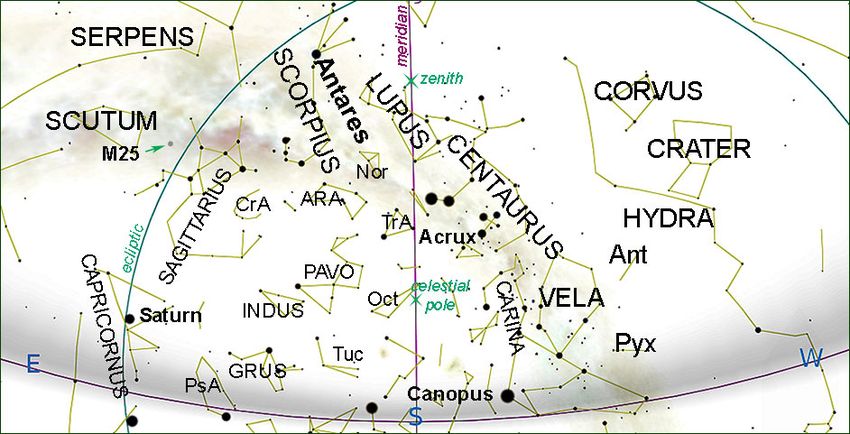
 EVENING SKY 6th AUGUST at 21h00 (NORTH DOWN)

 EVENING SKY 6th AUGUST at 21h00 (SOUTH DOWN)

                       1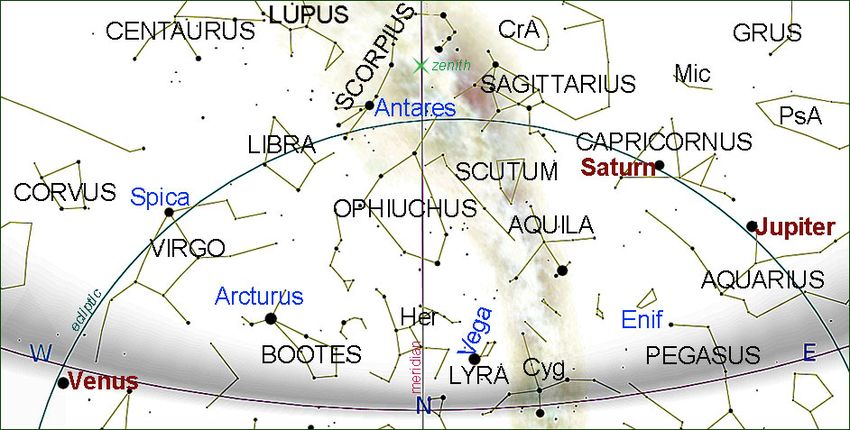
2. THE SOLAR SYSTEM

   PLEASE NOTE: All events predicted are as observed from Hermanus, Western Cape, South
   Africa.
   Times are South African Standard Time (UTC +2). Also please note: with the exception of Pluto
   (magnitude +14.4), all events predicted are visible to the naked eye.

  HIGHLIGHTS FROM THE SKY GUIDE
Date       Time                Item
   1            16h00          Mercury at superior conjunction
   2            09h36          Moon at apogee (404 410 Km)
                07h24          Saturn at opposition
   3            06h28          Moon passes 6.1º north of Aldebaran
                04h51          Moon at ascending node 1
   5            18h46          Moon northernmost
   8            15h50          New Moon
  11         After sunset      A fine crescent Moon (11%) paired with Venus
  13                           Moon (29%) about 6º north of Spica (α Vir)
  15            17h20          First quarter Moon
  16            18h04          Moon at descending node 2
                23h20          Moon passes 4.6º north of Antares
  17            11h25          Moon at perigee (369 126 Km)
  19            00h24          Moon southernmost (-25.8º)
  20            01H05          Jupiter at opposition
                               Uranus stationary
  21            03h19          Moon passes 3.2º south-east of Saturn
  22            14h02          Full Moon
            Before sunrise     Moon near Jupiter
  25                           Winter solstice on Mars (southern hemisphere)
  30            09h13          Last quarter Moon
                04h23          Moon at apogee (404 098 Km)
                07h13          Moon at ascending node 1

      1 the glossary of the Sky Guide Africa South]
  [from
       1
         ASCENDING NODE – in the orbit of a solar system body, the point where the body crosses the ecliptic
       from south to north.
       2
         DESCENDING NODE - in the orbit of a solar system body, the point where the body crosses the ecliptic
       from north to south.

Astronomers push for global debate on giant satellite swarms:
https://www.nature.com/articles/d41586-021-01954-4 ... time is tight. SpaceX is launching fresh batches of
Starlinks — around 60 satellites per batch, sometimes several times a month. “People are spending years
establishing relationships, but in the meantime the satellites are launching continuously,” says Venkatesan.
“It’s almost like we are arriving at solutions for a problem three years ago.”

                                                       2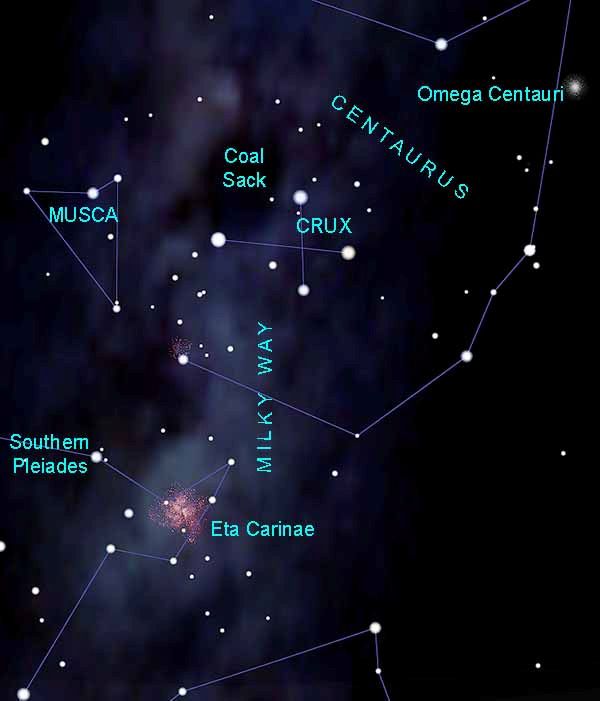
1st        1st
                  AUGUST 2021                                                         Visibility
                                                         August   September
                                          Rises:         07h36     07h02        Never look at the
Sun          Cancer to Leo                                                        sun without
Length of                                 Transit:       12h49     12h43
             10:56 to 11:23                                                      SUITABLE EYE
day                                       Sets:          18h03     18h25         PROTECTION!
Mercury      Cancer to Virgo              Rises:         07h43     08h02
Magnitude    +2.0 to -0.0                                                        Low in the west
                                          Transit:       12h51     14h10
Phase        100% to 73%                                                          after sunset
Diameter     5” to 6”                     Sets:          17h59     20h19
Venus        Leo to Virgo                 Rises:         09h19     08h46
Magnitude    -4.0
                                          Transit:       14h59     115h10            Evening
Phase        82% 73%
Diameter     13” to 15”                   Sets:          20h40     21h35
Mars         Leo                          Rises:         08h49     07h39
Magnitude    +1.8                                                                Low in the west
                                          Transit:       14h18     13h29
Phase        99% to 100%                                                          after sunset
Diameter     4”                           Sets:          19h48     19h20
Jupiter      Aquarius to Capricornus      Rises:         19h31     17h10
Magnitude    -2.8 to -2.9                                                        Throughout the
                                          Transit:       02h12     23h51             night
Diameter     48” to 49”
                                          Sets:          08h48     06h37
Saturn    Capricornus                     Rises:         17h57     15h45
Magnitude +0.2 to +0.3                    Transit:       00h56     22h41         Throughout the
Diameter 19” to 18”                                                                  night
                                          Sets:          07h50     05h42
Uranus    Aries                           Rises:         01h35     23h30
Magnitude +5.8 to +5.7
                                          Transit:       06h52     04h51             Morning
Diameter 4”
                                          Sets:          12h09     10h08
Neptune Aquarius                          Rises:         21h23     19h17
Magnitude 7.8                                                                    Throughout the
                                          Transit:       03h39     01h35
Diameter 2”                                                                          night
                                          Sets:          09h52     07h48
Pluto     Sagittarius                     Rises:         16h42     14h37
Magnitude +14.3                                                                  Throughout the
                                          Transit:       23h50     21h46
                                                                                     night
                                          Sets:          07h02     04h58

Phase: In a telescope, the inner planets (Mercury, Venus and Mars) appear to us in phases,
depending on the angle of the Sun’s illumination, as does the Moon. The angular diameter is given
in arc seconds (“). This is the apparent size of the object as we see it from Earth.
Magnitude: we are accustomed to hearing stars described in terms of ‘magnitude’. For example the
planet Jupiter at magnitude -1.8 is considerably brighter than the star Antares (in Scorpius) at +1.05.
The scale is ‘inverse’; the brighter the object, the lower the number. A ‘good’ human eye on a clear
night can see down to a magnitude of about +6.
Transit: When an object crosses the local meridian it is said to ‘transit’. The local meridian is an
imaginary line from the horizon directly north passing overhead (through zenith, see charts on page
1) to the horizon directly south.

                                                     3
THE MOON                                       .

Lunar Libration
In lunar astronomy, libration is the wagging or wavering of the Moon perceived by Earth-bound
observers and caused by changes in their perspective. It permits an observer to see slightly
different hemispheres of the surface at different times. It is similar in both cause and effect to the
changes in the Moon's apparent size due to changes in distance. It is caused by the three
mechanisms detailed below, two of which
cause a relatively tiny physical libration via
tidal forces exerted by the Earth. Such true
librations are also known for other moons
with locked rotation.
    The images to right show an example of libration.
    Note the different positions of the features Tycho
    and Imbrium. The black line represents a common
    axis which, itself, librates.

The Moon keeps one hemisphere of itself
facing the Earth (tidal locking). The first view
of the far side of the Moon was not possible until the Soviet probe Luna 3 reached the Moon on
7th October 1959 followed by further lunar exploration by the United States and the Soviet Union.
Over time, thanks to libration, about 59% of the Moon's surface can be seen from Earth.
Causes: Lunar libration arises from three changes in perspective due to: 1. optical libration - its
non-circular and inclined orbit. 2. parallax - the finite size of the Earth. 3. physical libration - the
orientation of the Moon in space.
Effects: The following are the four types of lunar libration:
•   Libration in longitude results from the eccentricity of the Moon's orbit around Earth; the
    Moon's rotation sometimes leads and sometimes lags its orbital position. The lunar libration in
    longitude was discovered by Johannes Hevelius in 1648. It can reach 7°54′ in amplitude.
•    Libration in latitude results from a slight inclination (about 6.7°) between the Moon's axis of
    rotation and the normal to the plane of its orbit around Earth. Its origin is analogous to how the
    seasons arise from Earth's revolution about the Sun. Galileo Galilei is sometimes credited with
    the discovery of the lunar libration in latitude in 1632, although Thomas Harriot or William
    Gilbert might have done so before. It can reach 6°50′ in amplitude. The 6.7º depends on the
    orbit inclination of 5.15º and the negative equatorial tilt of 1.54º.
•   Diurnal libration is a small daily oscillation due to Earth's rotation which carries an observer
    first to one side and then to the other side of the straight line joining the Earth's and the Moon's
    centres, allowing the observer to look first around one side of the Moon and then around the
    other - the observer is on Earth's surface, not at its centre. It reaches less than 1° in amplitude.
    Diurnal libration is one effect of parallax, which depends on both the longitude and latitude of
    the observer. [therefore is this true libration? - ed]
       • Physical libration is the oscillation of orientation in space about uniform rotation and
    precession. There are physical librations about all 3 axes. The sizes are roughly 100 seconds of
       arc. As seen from the Earth, this amounts to less than 1 second of arc. Forced physical
        librations can be predicted given the orbit and shape of the Moon. The periods of free
          physical librations can also be predicted but their amplitudes and phases cannot.
                         Lunar and Solar eclipses: none predicted for this month
                              Meteor showers: none predicted for this month
           For details regarding meteor watching, please see the SGAS 2021, pages 86- 87.

                                                         4
3. LOOKING UP
SUGGESTED EVENING OBSERVATION WINDOW for AUGUST 2021
(Lunar observations notwithstanding)
Date dusk end Moon
30th July 19h28 rises 23h57 (60%)
12th August 19h36 sets 20h09 (5%)
CLUB STARGAZING – unfortunately, owing to the pandemic, we
can still not enjoy physical club gatherings. Of course that should
not prevent our members digging out a good coat and indulging in
observation from your home or favourite darkest, rural, cloudless
spots.
And don’t forget the Moon, our closest celestial neighbour.
Please consult our website for updates: http://www.hermanusastronomy.co.za
DEEP SKY HIGHLIGHTS
This month we revisit the “Big Five” of the southern African skies. These five targets are all visible
to the naked eye while also richly rewarding the binocular or telescope user.
What are the Big 5?
The Big 5 are five celestial objects that represent the best specimens of each type of deep-sky
class:
• an open star cluster – the Southern Pleiades
• a globular cluster - omega Centauri
• a bright nebula - eta Carinae Nebula
• a dark nebula - the Coal Sack
• a galaxy - the Milky Way
THE BIG FIVE
of the southern African skies
6 Aug 2021 Omega Centauri Coalsack Southern eta Carinae
NGC5139 Nebula C99 Pleiades IC2602 Nebula
NGC3372
Constellation Centaurus Crux Carina Carina
Distance 17 kly, 5.2 kpc 490 ly, 150 pc 479 ly, 147 pc 10 kly, 3.1 kpc
Magnitude +3.7 +1.6 +1.0
Absolute mag -9.9 -4.43 -11.43
Apparent size 36 arcmin 375 x 250 arcmin 100 arcmin 120 arcmin
Actual size 271 ly, 83.2 pc 53.4 ly, 16.4 pc 15.3 ly, 4.7 pc 349 ly, 107 pc
Alt/Az 50º20’/ 125º10’ 51º45’ / 150º 40’ 59º21’ / 171º54’ 63º39’ / 168º54’
Declination − 47° 28.6′ − 63° 44.6′ − 64° 24.0′ − 59° 53.4′
J2000 RA
13h 26.8m 12h 31.3m, 10h 43.2m, 10h 44.3m,
5Where can I see the big 5?
The Big 5 are visible from anywhere within the
southern hemisphere. The positions of four of the
objects are described in the table above with more
detail for each object below.
The fifth, the Milky Way, encircles the entire sky
so a single position cannot represent it. The
galactic centre is in Sagittarius which is not
depicted on the chart.
Omega Centauri - NGC 5139
Omega Centauri is the brightest globular cluster in
the sky, and the largest and most luminous
globular orbiting the Milky Way.
History and Observation
Omega Centauri has been known since antiquity. The Greek astronomer Ptolemy listed it in the
star catalogue that he compiled in the mid-2nd century CE. When Johannes Bayer assigned
Greek letters to the brighter stars, he also mistook this cluster for a star, and designated it Omega
Centauri.
Edmond Halley was the first to document Omega Centauri's non-stellar nature, listing it in 1677 as
a "luminous spot or patch in Centaurus". Lacaille included it in his catalog as number I.5. John
Herschel was the first to correctly identify it as a globular cluster, in the 1830s.
Omega Centauri is visible to the naked eye, impressive in binoculars and simply stunning when
viewed through a telescope of any size. With a visual magnitude of +3.7 and a diameter of about
36 arcmin, it appears larger than the full Moon. Compared with most globulars, it has a distinctly
flattened shape.
Physical Properties
At a distance of 15,600 light years, Omega Centauri is one of the nearest globular clusters to the
Solar System. Its visual size of about 36' corresponds to a true diameter of 175 light years. Its
photographic size is 65', implying a diameter over 300 light years. As in all globular clusters, the
stellar density increases rapidly toward the interior. The average distance between stars at its
centre is only about 0.1 light years.
Containing several million stars and roughly 5 million solar masses, Omega Centauri is about 10
times as massive as a typical big globular, and about as massive as the smallest of whole
galaxies. It is the brightest and most massive globular orbiting the Milky Way and of all the
globular clusters in the Local Group, only Mayall II (G1) in the Andromeda Galaxy (M 31) is more
massive and luminous.
Origin and Evolution
Omega Centauri is so different from the Milky Way's other globulars that it is thought to have a
different origin. It is about 12 billion years old but, as suggested in a 1999 study, the stars of
6Omega Centauri formed over a 2-billion-year period rather than all at once. The team that carried
out this work speculated that Omega Centauri is the remaining core of a small galaxy that merged
with the Milky Way.
This suspicion was confirmed in 2008 when a team of astronomers working with the Hubble Space
Telescope and Gemini Observatory reported that Omega Centauri harbours an intermediate-sized
black hole at its centre. The motions of the stars at the centre of Omega Centauri are much faster
than expected from their mass alone. From this, the mass of this black hole was deduced to be
about 40,000 Suns.
In 2009, astronomers announced that Kapteyn's Star, the 25th nearest star system at only 13 light
years away, may have originated from Omega Centauri. Along with 16 other stars in the same
moving group, all of which orbit the galaxy backwards and are very old, it shares the same
elemental abundances as Omega Centauri's stars. If Omega Centauri is the left-over nucleus of a
dwarf galaxy that merged with the Milky Way, some stars were flung towards us during the
merger, including Kapteyn's.
Coalsack – Caldwell 99
The Coalsack Dark Nebula is the most prominent dark nebula in the sky. Appearing between
Alpha Crucis and Beta Crucis in the constellation of Crux, it is easily visible to the naked eye as
a dark patch, seemingly a 'hole in the Milky Way'.
The Coalsack Dark Nebula overlaps somewhat into the neighbouring constellations Centaurus
and Musca. Although this nebula was known to the people of the Southern Hemisphere in
prehistoric times, its first observation was reported by Vincente Yanez Pinzon in 1499. The
Coalsack is not listed in the New General Catalogue and does not have an NGC number.
Southern Pleiades, theta Carinae Cluster - IC 2602
The prominent open cluster IC 2602 was discovered by Abbe Lacaille in March of 1752, observing
from South Africa. This cluster in Carina is often compared with the Pleiades and is commonly
known as the "Southern Pleiades". It is also known as the theta Carinae cluster.
IC 2602 has an overall magnitude of +1.9 and contains about 60 stars. Theta Carinae, a third-
magnitude star, is the brightest star within the cluster. The other stars in the cluster are of fifth
magnitude and much fainter.
Like its northern counterpart in Taurus, the Southern Pleiades spans a sizeable area of sky,
approximately 50 arc minutes; it is best viewed with large binoculars or a telescope with a wide-
angle eyepiece.
The distance of IC 2602 has recently been adjusted using data from the Hipparcos star catalog.
The cluster is at a distance of 479 light years (the older value was 489 light years). The cluster is
thought to have an age of 50 million years.
Eta Carinae Nebula - NGC 3372
Also known as the Great Nebula in Carina, this is a large bright nebula that surrounds several
open clusters. The nebula can be seen with the naked eye. The star eta Carinae, a giant variable,
is among the most massive and luminous stars in the Milky Way. Now only a 6th magnitude star,
after a serious outburst back in 1840, it rivalled Sirius in brightness.
7The central part of NGC 3372 is known as the Keyhole Nebula, a famous dark zone seen near
eta Carinae. With binoculars one can see the nebula, which appear as three fan shaped areas
with dark lanes in between. The nebula was discovered by Nicolas Louis de Lacaille in 1751-52
from the Cape of Good Hope.
This first magnitude nebula is one of the largest H2 regions in the Milky Way and is one of the
largest diffuse nebulae in the sky. Although it is some four times as large and much brighter than
the famous Orion Nebula, the Carina Nebula is less well known due to its location far in the
Southern Hemisphere. The nebula lies at an estimated distance of between 6,500 and 10,000 light
years from Earth.
Within the large bright nebula is a much smaller feature immediately surrounding eta Carinae
itself. This small nebula is known as the Homunculus Nebula (from the Latin meaning Little Man)
and is believed to have been ejected in an enormous outburst in 1840, briefly making eta Carinae
the second-brightest star in the sky.
Please keep in touch...
Have a look at our excellent website, edited by Derek Duckitt.
http://www.hermanusastronomy.co.za/
Contact ASSA
Get in touch with officers of the Society - we're real people with a passion for astronomy, so contact us and
let's talk!
You can find us on Facebook, Twitter, the ASSAInfo mailing list and the ASSADiscussion mailing list.
ASSA website http://assa.saao.ac.za
ASSA Deep-Sky Section
Whatsappchat group: [ 074 100 7237 ]
MNASSAhttp://assa.saao.ac.za/about/publications/mnassa/
Nightfall https://assa.saao.ac.za/?s=Nightfall
Official Big 5 of the African Sky web page
Official Big 5 Facebook group
ASSA Deep-Sky Section mailing list
Grateful thanks to the following:
Andrew Bell
ASSA
Johan Retief
Sky Guide Africa South 2020
Sky Safari
Stellarium
Edited by Peter Harvey - e-mail: petermh@hermanus.co.za -Tel: +27 (0) 81 212 9481
8You can also read


