B.C.'s Back to School Plan - CUPE 523
←
→
Page content transcription
If your browser does not render page correctly, please read the page content below
8/18/2020                                                  B.C.'s Back to School Plan - Province of British Columbia

   B.C.'s Back to School Plan
   Students in B.C. will return to in-class learning September 2020. B.C.’s plan includes new health and safety
   measures, increased funding for protective equipment like masks and new learning groups to help keep everyone
   safe.

   Last updated: August 18, 2020

       What
       Parents Need to
       Know

                 Our plan
                 Health and safety
                 measures
                 Increased funding
                 Learning groups
                 Orientation week
                 COVID-19
                 science and
                 children
                 COVID-19
                 protocols
                 Attendance
                 requirements
                 Supporting
                 additional needs
                 In the classroom
                 Outside the
                 classroom

                                          B.C.'s Back to School Plan is built on three core principles to keep everyone
       Our Plan
                                          safe.

                                          1. New health and safety measures

https://www2.gov.bc.ca/gov/content/education-training/k-12/covid-19-return-to-school                                      1/14
8/18/2020                                                  B.C.'s Back to School Plan - Province of British Columbia

                                          2. Increased funding to keep schools safe and clean

                                          3. Learning groups to help reduce transmission

       Health & Safety
       Measures

                                          Special safety measures help create safe schools and reduce the spread of
                                          COVID-19. These extra layers of protection measures work well in schools
                                          because they're controlled environments that have:

                                                     Consistent groups of people
                                                     Robust illness policies for students and staff
                                                     The ability to have most people follow effective personal practices like
                                                     hand washing

                                          Health Guidelines

                                            Wearing a mask

                                            Practicing physical distancing

                                            Riding a school bus

                                            Using shared items

                                            Practicing hand hygiene

                                            Cleaning the school

                                            Installing physical barriers

                                            Controlling traffic flow
https://www2.gov.bc.ca/gov/content/education-training/k-12/covid-19-return-to-school                                            2/14
8/18/2020                                                  B.C.'s Back to School Plan - Province of British Columbia

       Increased
       Funding

                                          An additional $45.6 million will help schools implement new health and safety
                                          measures.

                                          The investment includes:

                                                     $23 million for more staff and staff time for cleaning schools
                                                     $9.2 million for hand hygiene
                                                     $5.1 million for cleaning supplies
                                                     $2.2 million for reusable face masks for students and staff
                                                     $3 million to support remote learning, including:
                                                              Technology loans
                                                                Software to support students with disabilities or complex needs
                                                     $3.1 million to independent schools

       Learning Groups

                                          A learning group is a group of students and staff who remain together throughout
                                          the school quarter, semester or year and who primarily interact with each
                                          other. Learning groups were recommended by the Provincial Health Officer to
                                          help reduce the transmission of COVID-19.

                                          For example, a learning group could be made up of:

                                                     A single class of students (20-30)

https://www2.gov.bc.ca/gov/content/education-training/k-12/covid-19-return-to-school                                              3/14
8/18/2020                                                  B.C.'s Back to School Plan - Province of British Columbia

                                                     Multiple classes that sometimes join together for activities like physical
                                                     education (PE) or music
                                                     A group of secondary school students with the same courses in the
                                                     same quarter or semester

                                          Learning groups can also include staff, like:

                                                     Teachers
                                                     Specialist support staff
                                                     Education Assistants (EAs)

                                          Learning groups provide a range of benefits for students including more in-class
                                          learning time, increased peer interaction and support, and decreased feelings of
                                          isolation.

                                          Why Use Learning Groups?

                                          Compared to other public settings, schools have a relatively consistent set of
                                          people accessing the building. Learning groups further reduce the number of
                                          interactions between students and staff.

                                                     This helps with contact tracing and limits interruptions to learning if a
                                                     case of COVID-19 is confirmed in a learning group

                                          Learning group sizes

                                          Learning groups are smallest in elementary and middle schools because it is
                                          more challenging for younger students to maintain physical distance.

                                          Students in secondary school are better able to minimize physical contact,
                                          practice hand hygiene and recognize if they are experiencing symptoms of
                                          COVID-19.

                                                     Elementary: 60
                                                     Middle: 60
                                                     Secondary: 120

                                          The PHO order on mass gatherings does not apply to schools, as events are
                                          defined in the order as an irregular gathering, like a party or celebration.

                                          Learning group examples

                                          The following examples are for illustrative purposes only. Actual configurations of
                                          learning groups will be designed by school districts and independent schools to
                                          meet local needs and other considerations in alignment with health and safety
                                          measures to protect students and school staff.

                                            Elementary schools

https://www2.gov.bc.ca/gov/content/education-training/k-12/covid-19-return-to-school                                              4/14
8/18/2020                                                  B.C.'s Back to School Plan - Province of British Columbia

                                            Middle schools

                                            Secondary schools

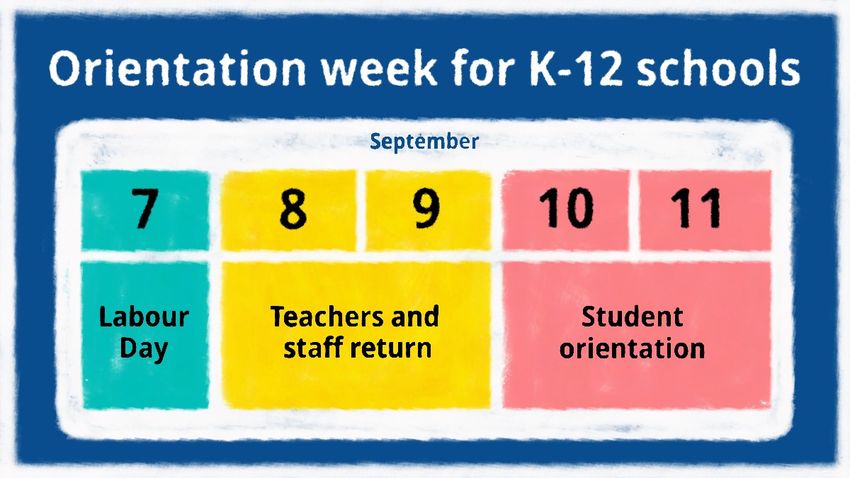
       Orientation Week Schools will be in touch with parents with further details about the return to
                                          school. To ensure all schools are ready to welcome students into classrooms for
                                          the week of September 8-11, 2020, there will be a gradual restart. This gives
                                          students and staff extra time to learn about the new health and safety measures
                                          in their school and classroom.

                                          September 7

                                          Labour Day, schools are closed.

                                          September 8 and 9

                                          Starting September 8, all staff will meet with their school’s joint health and safety
                                          committee to receive instruction on how the updated BCCDC guidelines will work
                                          in their school. This time allows teachers and staff to:

                                                     Adjust to their new routines
                                                     Finalize plans for learning groups
                                                     Review health and safety protocols
                                                     Confirm lesson plans that align with the new normal in schools

                                          September 10 and 11

https://www2.gov.bc.ca/gov/content/education-training/k-12/covid-19-return-to-school                                              5/14
8/18/2020                                                  B.C.'s Back to School Plan - Province of British Columbia

                                          Students will return to school by September 10 for orientation. Check with your
                                          school district to confirm details.

                                          Students can get familiar with classrooms that will look different than they did
                                          before the pandemic. During orientation, students will:

                                                     Get assigned to their class or classes
                                                     Find out who is in their learning group
                                                     Practice their new routines
                                                     Familiarize themselves with how to safely move from the class to outdoor
                                                     and common areas of the school

                                          According to current worldwide data, COVID-19 has a very low infection rate in
       COVID-19
                                          people 19 years old and under, and especially low in children under the age
       Science &                          of 10.
       Children
                                          Serological tests have confirmed that in B.C., less than 1% of all children tested
                                          have been COVID-19 positive.

                                          Studies show that most COVID-19 cases in children originate from symptomatic
                                          adult family members, not from peers. Even in family bubbles, adults appear to
                                          be the primary spreaders of the virus.

                                          Children who do test positive for COVID-19 usually have milder symptoms, such
                                          as a low-grade fever, dry cough, and gastrointestinal issues.

                                          What has B.C. learned from the reopening of schools in other
                                          places?

                                          Due to widespread, worldwide school closures, there are few studies on the
                                          effects of COVID-19 transmission in school settings.

                                          In places that have resumed in-class instruction, children do not appear to be the
                                          primary spreaders of COVID-19.

                                          In schools where there were confirmed cases, there was typically minimal
                                          spreading beyond the initial case.

                                          Studies have shown that closing schools and child care facilities has significant
                                          negative mental health and socioeconomic impacts on vulnerable children.

https://www2.gov.bc.ca/gov/content/education-training/k-12/covid-19-return-to-school                                            6/14
8/18/2020 B.C.'s Back to School Plan - Province of British Columbia
COVID-19 Stay Home When Sick
Protocols
The BCCDC guidelines for schools are firm. If a student, staff member or any
other adult has any symptoms of a cold, influenza, COVID-19, or any other
infectious respiratory disease, they must not enter the school.
Students, staff members and any other adult must stay home and self-isolate if
they have:
Symptoms of COVID-19
Travelled outside Canada in the last 14 days
Identified as a close contact of a confirmed case or outbreak
This includes the children of essential service workers.
Daily Health Screening
Parent & caregiver responsibilities
Daily screenings start at home. Ask these questions:
Does your child have the symptoms of a common cold, influenza,
COVID-19, or other infectious respiratory disease?
Has your child been outside Canada in the last 14 days?
Has your child been identified as a close contact of a confirmed case or
outbreak?
If the answer is yes to any of these questions, you must keep your child at home,
self-isolate, and seek care from a health-care provider.
School administration responsibilities
Ensure staff and other adults know they are responsible for assessing
themselves daily for symptoms prior to entering the school.
Clearly communicate with parents and caregivers that they are responsible for
assessing their children daily before sending them to school.
Testing Students Before a Return to School
At this time, it is recommended that only people with symptoms or people
otherwise identified by a health professional should be tested for COVID-19. This
includes children.
Testing can also result in false positive and false negatives for the following
groups:
Asymptomatic people
https://www2.gov.bc.ca/gov/content/education-training/k-12/covid-19-return-to-school 7/148/18/2020 B.C.'s Back to School Plan - Province of British Columbia
Those who are very early on in the illness
Those who may be incubating the disease
What if someone in my household or bubble has COVID-19
symptoms?
Students or staff may still attend school if a member of their household
has cold, influenza, or COVID- 19-like symptoms, provided the
student/staff is not sick
It is expected the symptomatic household member is seeking
assessment by a health-care provider
What if my child has allergies?
Students and staff who experience seasonal allergies, or other COVID-
19-like symptom that are related to an existing condition, can continue to
attend school when they are experiencing these symptoms as normal
If you notice a sudden change in the severity or type of symptoms your
child normally experiences, you may want to keep your child at home
and seek advice from a health-care provider
Confirmed Case of COVID-19 in a Learning Group or at
School
If a student or staff member develops symptoms at school, protocols are in place.
If a student or staff member develops symptoms at school, they may be
given a non-medical mask and will be separated from their classmates or
colleagues
The individual’s parent or guardian will be contacted to discuss next
steps
Custodial staff will clean and disinfect the areas the person used
Schools will immediately inform public health of a potential case
Public health will then:
Reach out and identify any potential cases
Get in touch with close contacts
Recommend 14-day isolation if necessary
Provide follow-up recommendations if necessary
Schools will provide learning support to students required to self-isolate
Together, schools and public health officials will determine if suspending
in-class learning is necessary
You will be notified if your child has been in contact with a COVID-positive
person. If that happens, your child is required to self-isolate.
https://www2.gov.bc.ca/gov/content/education-training/k-12/covid-19-return-to-school 8/148/18/2020 B.C.'s Back to School Plan - Province of British Columbia
Attendance In-Class Instruction
Requirements In-class instruction provides students with peer engagement, supports social and
emotional development and decreases feelings of isolation.
School also provides many students access to programs and services they can't
get at home and is integral to their overall health.
Like every year, students who are registered in "bricks and mortar" schools
are expected to attend school in-person, unless they are sick.
Schools and teachers at the elementary and middle school grades will
not be providing daily online options for students
Students in secondary school courses may be required to complete
some learning online, only if in-person instruction is not possible given
learning group sizes
Alternative Options
Like every September, parents have options for their child's education.
Before selecting an alternative to in-class instruction, parents should talk to their
school district about their options if they later want to return and enrol at their
desired school.
We recommend making a decision as soon as possible.
Online and distributed learning
Both public and independent distributed learning schools offer classes. Students
in Kindergarten to Grade 7 must take a full course load at one school, while
students in Grades 8 to 12 may enrol in courses from a number of different
distributed learning schools at one time.
There are 48 school districts with 56 public schools offering distributed learning
courses. Sixteen independent schools are currently offering distributed learning
courses.
Register for distributed learning
Homeschooling
Homeschooling is an alternative method of teaching offered outside the B.C.
educational system. Typically, a family member delivers the entire educational
program to children at home.
https://www2.gov.bc.ca/gov/content/education-training/k-12/covid-19-return-to-school 9/148/18/2020 B.C.'s Back to School Plan - Province of British Columbia
Note: Homeschoolers are not eligible to receive a British Columbia Dogwood
Graduation Certificate.
Register for homeschooling
Supporting Students with Complex Medical Conditions
Additional Needs Parents of children with complex medical conditions that place them at
heightened risk for COVID-19 should consult their primary health-care provider to
consider the health risks and make a decision about returning to school.
Contact your child’s school to discuss alternative education options and
support
Students with Disabilities
Students with disabilities have faced many challenges during the pandemic,
including physical vulnerability to the virus, social isolation and accessing the
basics of daily life.
The Ministry of Education is committed to treating students with disabilities and
their families ethically, fairly, and respectfully.
International Students
We continue to support international students coming to B.C. to study.
All students who have travelled outside of Canada are required to self-isolate for
14 days under both provincial and federal orders. This includes students who are
attending school from abroad.
Students will return to the classroom by September 10, 2020. International
students should arrive in B.C. no later than August 26, 2020 to complete their 14-
day self-isolation. This can be done with a host family or with the help of federal
government officials.
Indigenous Students
https://www2.gov.bc.ca/gov/content/education-training/k-12/covid-19-return-to-school 10/148/18/2020 B.C.'s Back to School Plan - Province of British Columbia
The Ministry fully respects the jurisdiction of First Nations and their right to make
their own decisions on re-opening First Nations schools. Visit the First Nations
Schools Association website for the latest updates.
For those Indigenous students that attend public schools, school districts will
engage with First Nations and Indigenous peoples as a part of their planning
process.
In the Classroom Instruction & Supports
A focus on mental health and well-being supports for students returning
to school
Full-time instruction for students with disabilities/diverse abilities and
students requiring additional support
Options for students with underlying complex medical needs
Alternative methods of delivery, jointly determined by boards of
education and First Nations, for students from First Nations that remain
closed and will not be sending students back in September
Curriculum, Assessment & Report Cards
The return to full in-class instruction in September will include the following:
Provincial curriculum for all students at all grade levels
Regular report cards
Regular assessments at the classroom and provincial level
Outside the Recess, Lunch & Break Times
Classroom Students will remain in their learning group during recess, lunch and break
times.
Students can socialize with a friend in a different learning group if they follow
these rules.
Elementary schools
Outdoors, minimizing physical contact
Indoors, maintain physical distance
https://www2.gov.bc.ca/gov/content/education-training/k-12/covid-19-return-to-school 11/148/18/2020 B.C.'s Back to School Plan - Province of British Columbia
Middle and secondary schools
Consistently maintain physical distance in all environments
Sports, Clubs & Extracurricular Activities
Extracurricular activities including sports, arts and special interest clubs can only
occur if:
Physical distance can be maintained between members of different
learning groups
Reduced physical contact is practiced by those within the same learning
group
Assemblies, Concerts & Gatherings
Small gatherings can only occur within a learning group.
A gathering can include the full learning group (60 or 120) and the
minimum number of people needed to meet the gathering's purpose
For example, a parent-teacher conference would require one parent per
student and a teacher
Assemblies, concerts and other large gatherings like a guest speaker should
happen virtually.
Tournaments, competitions & festivals
All inter-school events including competitions, tournaments and festivals should
not occur at this time.
Work Placements & Apprenticeships
School districts and independent school authorities will assess and determine if it
is safe for students to remain on work placements and apprenticeships.
For work placements that cannot continue in person, districts and
schools will determine if alternate methods to continue learning or
accumulate volunteer hours for work placements are possible
Students are encouraged to talk to their teachers about work placements
and apprenticeships
School Meal Programs
https://www2.gov.bc.ca/gov/content/education-training/k-12/covid-19-return-to-school 12/148/18/2020 B.C.'s Back to School Plan - Province of British Columbia
School districts with existing meal programs will continue to work with community
partners to provide meal support to families in need, in alignment with current
public health guidelines.
Five Stages Framework Info for School Districts Contact Your School
The Five Stage Framework outlines School districts and independent Have questions? Your school or
expectations for B.C. elementary, school associations are required to district is the best place to get help
middle and secondary schools for submit a Restart Plan before the
learning during COVID-19 2020/21 school year begins
Translated Information Help in Other Languages
ਆਮ ਤੌਰ ‘ਤੇ ਪੁੱਛੇ ਜਾਣ ਵਾਲੇ ਪਸ਼ਨ (ਢਅਥਸ): ਸਕੂਲ ਵਾਪਸੀ, Translation services are available in more than
ਸਤੰਬਰ 2020, PDF, 237KB (Punjabi) 110+ languages, including:
2020年九月重返学校常见问题, PDF, 518KB 翻譯服務
(Simplified Chinese) 翻译服务
ਅਨੁ ਵਾਦਸਰਿਵਿਸਜ਼
2020年九月重返學校常見問題, PDF, 607KB
(Traditional Chinese) ﺧدﻣﺎت ﺗرﺟﻣﮫ؟
Services de traduction
Retour à l’école en septembre 2020, PDF, 270KB
Servicios de traducción
(French)
Service is available 7:30 am to 8 pm Pacific Time
자주묻는질문(FAQ): 2020 년도9 월학교로복귀하기,
PDF, 809KB (Korean)
Call 1-888-268-4319
Preguntas frecuentes: Regreso a la escuela,
septiembre de 2020, PDF, 248KB (Spanish)
FAQ: Return to School September 2020, PDF, 826KB
(Urdu)
Mga Tanong na Madalas Itanong (FAQs): Pagbabalik
sa Paaralan, Setyembre 2020, PDF, 266KB (Tagalog)
https://www2.gov.bc.ca/gov/content/education-training/k-12/covid-19-return-to-school 13/148/18/2020 B.C.'s Back to School Plan - Province of British Columbia
PDF,) 2020 أﯾﻠول/ ﺳﺑﺗﻣﺑر، اﻟﻌودة إﻟﻰ اﻟﻣدرﺳﺔ:اﻷﺳﺋﻠﺔ اﻟﺷﺎﺋﻌﺔ
(331KB Arabic
PDF,) 2020 ﺳﭘﺗﺎﻣﺑر، ﺑﺎزﮔﺷت ﺑﮫ ﻣدرﺳﮫ:(FAQ) ﺳواﻻت ﻣﺗداول
(338KB Farsi
https://www2.gov.bc.ca/gov/content/education-training/k-12/covid-19-return-to-school 14/14You can also read


