Background paper for the AQF Council on generic skills - Dr Kaye Bowman 24 March 2010
←
→
Page content transcription
If your browser does not render page correctly, please read the page content below
Background paper for the AQF Council on
             generic skills

               Dr Kaye Bowman

               24 March 2010
Acknowledgements This research was undertaken in 2010 for the Australian Qualifications Framework Council with funding provided by the Ministerial Council for Tertiary Education and Employment and the Australian Government Department of Education, Employment and Workplace Relations. The research paper is copyright to the South Australian Department of Further Education Employment Science and Technology on behalf of the Australian Qualifications Framework Council. Dr Kaye Bowman of Kaye Bowman Consulting undertook the research and preparation of the paper. The author is solely responsible for the content of this paper. Background paper for the AQF Council on generic skills page 2
Contents
Introduction                                                                 3
Background research overview                                                 5
Recommendations based on the research                                       10
Background research details                                                 12
    Generic skills in Australian education and training                     12
         Schools                                                            12
         VET sector                                                         16
         Australian Core Skills Framework (ACSF)                            17
         Higher education sector                                            18
    Generic skills in the international context                             21
        OECD: Assessment of Higher Education Learning Outcomes project      21
        (AHELO)
        OECD: Definition and Selection of Competencies framework (DeSeCo)   22
        21st-century skills (ACTS project)                                  23
    Generic skills in three other countries                                 26
         Scotland                                                           26
         New Zealand                                                        27
         Ireland                                                            28
References                                                                  29
Attachment 1: Graduate attributes in Australian universities                33

Background paper for the AQF Council on generic skills                      page 3
Introduction The issue During development of the strengthened Australian Qualifications Framework (AQF) consideration was given to a range of ‘generic’ learning outcomes that are not specific to a particular qualification type or education program. Among the examples given were problem- solving and interpersonal skills. They were referred to as ‘generic skills, the key transferable skills a graduate may achieve through learning that may have application in study, work and life contexts’. It was agreed during the consultation process that generic skills were important outcomes to be acquired through an education process, but views differed on how they should be included in the new AQF taxonomy: as a separate dimension of learning outcomes or embedded in the other three dimensions. In the end it was decided to embed generic skills in the taxonomy of learning outcomes, with its three interrelated dimensions of knowledge, skills and application (of knowledge and skills), since generic skills are best taught and learnt in the context of particular qualifications. In this embedded approach, however, only those generic skills pertinent to distinguishing between levels in the AQF are specified, such as the degree of personal autonomy and accountability that would be expected in a particular context. These specified skills are only a subset of a wider set of generic skills. A fuller range of generic skills should result from every education experience. The brief The brief from the AQF Council requested research to identify and describe different conceptualisations of generic skills across the education landscape in Australia and in three other countries. Information on three prominent international frameworks was also sought. Consideration was also to be given to identifying a term for use in referring to these skills in AQF documents. This report This report presents the background research. It includes an overview section and a recommendations section, which is followed by a detailed account of the understandings of generic skills across Australia’s education and training system and internationally and the level of attention they are receiving. Background paper for the AQF Council on generic skills page 4
Background research overview
The research undertaken
Examples of conceptualisations of generic skills identified in this research have been identified
in:
each of the three education sectors of Australia
three international frameworks (the OECD AHELO project; the OECD DeSeCo framework;
and the 21st-century skills framework of a consortium based at the University of Melbourne 1 )
the education and training sectors in Scotland, Ireland and New Zealand.
Each researched conceptualisation of generic skills is described in terms of its:
origin
rationale
definitions
the ‘learning outcomes/skills’ included
the teaching, learning assessment and reporting processes in place
links to other conceptualisations
The National Centre for Vocational Education and Research’s publication, Defining generic
skills: At a glance (NCVER 2003), was also consulted.
A synthesis of the research, in which all key issues relating to generic skills are comprehensively
covered, follows.
Key findings
Origins
Conceptions of generic skills have been central to education for many years and have been
reflected in education goal statements. They have been inherent to good educational practice.
Rationale for their increased prominence
It is only relatively recently that generic skills have received explicit attention in all forms of
education and on an international scale. This greater prominence is in response to economic,
social and technological change and high demand for these skills by industry.
New demands are being placed on education. The world is changing in ways that require
education to ensure that students achieve a range of generic learning outcomes as well as
discipline-specific learning outcomes. For example:
1
The Organisation for Economic Co-operation and Development’s Assessment of Higher Education Learning
Outcomes; DeSeCo = Definition and Selection of Competencies; the consortium comprises the University of
Melbourne and technology companies Microsoft, Cisco and Intel.
Background paper for the AQF Council on generic skills page 5 Globalisation and increased competition are intensifying the need for workers able to:
engage with the organisation’s goals; share information; work in teams; make appropriate
decisions; and be enterprising – all with the ultimate goal of improving productivity.
The shift to advanced knowledge economies has meant that the requirements for the
information and knowledge management and communication skills integral to information
and communication technology are changing.
The complexity of economic, social and technical issues is heightening the need for critical
thinking and problem-solving skills.
The pace of change is intensifying the need for greater individual adaptive capacity and
lifelong learning.
Globalisation and international mobility are highlighting the need to nurture appreciation and
respect for social, cultural and religious diversity.
Definitions
Terminology becomes an issue when discussing generic skills. Generic skills are referred to by a
variety of different terms.
The different terms in current use include:
key competencies and general capabilities in Australian schools
employability skills and associated attributes in the Australian vocational education and
training (VET) sector
graduate attributes or capabilities in the Australian higher education sector
several other terms in other countries and international frameworks, including core skills,
essential skills, generic skills, transferable skills, key competencies, graduate skills, graduate
qualities, graduate capabilities, and 21st-century skills (see also NCVER 2003).
Whatever the terminology, the central notions are that:
All students need a solid grounding in generic skills, in addition to discipline-specific skills,
which will equip them for their various roles in the 21st century, both in the world of work and
in society generally.
These skills enable an individual’s potential to be realised in all aspects of life.
The skills are required to perform all kinds of tasks.
The skills are applied and performed in different combinations and at various levels,
depending on the task.
The skills are transferable from context to context.
The skills are developed over a lifetime.
Generic skills development is the collective responsibility of schools, vocational education
and training providers and universities, as well as businesses and the broader community
and governments.
Conceptualisations
There is no one definitive set of generic skills. There are many sets. Some sets are more limited
than others. For example:
Key, core, basic or fundamental skills can refer to literacy and numeracy skills only.
Background paper for the AQF Council on generic skills page 6 The employability skills defined in the VET sector do not include literacy and numeracy skills.
They include: communication skills; teamwork skills; problem-solving skills; self-
management; planning and organising; technology skills; lifelong learning skills; and initiative
and enterprise skills.
The employability skills of the VET sector, with their focus on work, have been viewed as a
subset of the generic attributes of the university sector, which also focus on citizenship,
values and ethics and having a world view. This claim could also be made about the general
capabilities of the schools sector, which also focus on the skills and knowledge associated
with citizenship, in addition to versions of the employability skills.
The employability skills also include a number of associated personal attributes, such as
honesty and integrity, which have not been a focus to date. When personal attributes are
taken into account, the employability skills of the VET sector become similar to those of the
other two education sectors.
Due to industry influence, employability skills have received attention in every education sub-
sector.
In the Australian schools sector, there are two sets of general capabilities (one as described
in the education goals and the other in the new curriculum for schools).
In the higher education sector each university has its own set of generic attributes.
Some conceptualisations of generic skills are in a list format (for example, the VET employability
skills and the graduate attributes of most universities). Others are grouped under a small number
of overarching categories. Examples of these categories include:
The education goals for Australian schools outline generic capabilities within a three-
category framework as illustrated below.
Successful learners Confident and creative Active and informed citizens
individuals (with an appreciation of
diversity and equity)
The new national schools curriculum will focus on nine categories or sets of general
capabilities as follows:
1. Literacy/numeracy
2. ICT
3. Thinking skills
4. Creativity
5. Self-management
6. Teamwork
7. Intercultural understanding
8. Ethical behaviour
9. Social competence
Background paper for the AQF Council on generic skills page 7 A few universities map their graduate attributes into overarching categories such as:
Citizenship World view Personal practical knowledge
The two international projects conceptualise generic skills into the following categories:
o The DeSeCo framework classifies key competencies into three broad categories as
follows.
Ability to use tools Ability to act in socially Ability to act autonomously
interactively heterogeneous groups
o The 21st-century skills project uses four categories after consideration of a number of
other conceptualizations as follows.
Ways of thinking Ways of working Tools for working Living in the world
together
Assessment and reporting processes of generic skills
In all education sectors assessment and reporting of generic skills has lagged behind discipline-
specific systems and is an area currently receiving research and development attention in
Australia and internationally. It is argued that, unless there is explicit assessment of generic
skills, the teaching of these skills is unlikely to be given the required attention. A discipline-
embedded approach to developing generic skills is favoured, but with explicit assessment and
reporting of the outcomes.
The trend has moved from implicit to explicit identification of generic skills (1990s) and
subsequently to their explicit inclusion in curriculum and assessment and graduate outcomes
reporting (under current development).
The VET sector in Australia is the most advanced in terms of having a systemic approach to the
assessment and reporting systems of generic skills. There are employability skills summaries for
every VET qualification.
As of 2009 the schools sector has an explicit set of general capabilities to be built into the new
curriculum and it is assumed that these capabilities will be reported on in future.
Australian universities have begun to integrate their various versions of graduate attributes into
the curriculum. The new Australian Higher Education Graduation Statement includes a section
for reporting of graduate attributes by universities. The Graduate Skills Assessment (GSA)
developed by the former Department of Education, Science and Training (DEST) and the
Australian Council for Educational Research (ACER) and first piloted in 2000 to assess
university students’ generic skills has not proved popular.
Overall, the development of common conceptual structures and performance levels standards
that show progression in generic skills across the entire education landscape remains an
Background paper for the AQF Council on generic skills page 8outstanding issue. Currently, international-level research on assessment and teaching of ‘21 century skills’ is underway. In the three other countries in which generic skills were explored as part of the background research, the different conceptions of generic skills in the various sub-sectors of education are similar to those in Australia and they appear to be embedded in the various national qualifications frameworks. Background paper for the AQF Council on generic skills page 9
Recommendations based on the background research
What term to use in AQF policy
Two options are offered for consideration: ‘generic skills’ and ‘generic learning outcomes’.

Rationale for using the term ‘generic skills’
1. There is no one ‘correct’ term to use.
2. ‘Generic skills’ is the term that was used in the initial stages of the strengthening the AQF
   project. Continuity would be maintained if ‘generic skills’ became the accepted term.
3. The term ‘generic’ conveys the inherent nature of the skills: they are not specific to either the
   education sector or to a particular discipline. The alternative term ‘transferable skills’ is more
   a characteristic of generic skills, once attained.
4. The term implies comprehensiveness: other terms used in some conceptualisations, such as
   key skills, core skills, basic skills or fundamental skills, are specific subsets of a broader set
   of generic learning outcomes. These terms can refer to literacy and numeracy skills only. The
   Australian Core Skills Framework covers learning, reading, writing, oral communication and
   numeracy skills.
5. The term provides a contrast to current sector usage, while implying an overarching capacity:
   a term is needed that is not in current use by any specific education sector in Australia (i.e.
   ‘general capabilities’ in the school sector, ‘employability skills and attributes’ in the VET
   sector, and ‘graduate attributes or capabilities’ in the higher education sector).

Rationale for using the term ‘Generic learning outcomes’
Reasons 1, 3, 4 and 5 above are also applicable here.
The term ‘generic learning outcomes’ covers all of the ways in which they might be and have
been articulated; that is, in terms of any and all of knowledge, skills and attributes. Using ‘values’
as an example: they can be expressed in terms of knowledge (of codes of conduct and
manners), skills (behaving in acceptable ways) and attributes (showing respect for others,
having a disposition to overcome stereotypes and prejudices).

Another option is to use the terms ‘generic learning outcomes’ and ‘generic skills’
interchangeably, according to the context in which the term is used.

What conceptualisation of generic skills to use in AQF policy
There are many conceptualisations of generic skills. Some conceptualisations of generic skills
are in list format, while others are grouped into a few overarching categories

The AQF requires a conceptualisation with the capacity to incorporate the various sets from
each Australian education sector.

In 2002 the National Centre for Vocational Education Research (NCVER) identified six broad
categories into which several sets of generic skills of various countries (including Australian
VET) could be mapped.

Background paper for the AQF Council on generic skills                                page 10
NCVER identified common ‘elements’ in listings of generic skills across several countries, which
were:

1. basic fundamental skills                         e.g. literacy etc.
2. people-related skills                            e.g. teamwork etc.
3. conceptual thinking skills                       e.g. problem-solving etc.
4. personal skills                                  e.g. acts with integrity etc.
5. skills related to the business world             e.g. enterprising etc.
6. skills related to the community                  e.g. citizenship etc.

It is certainly possible to map the sets of generic skills from each of the three Australian
education sectors onto the six categories above. However, given that generic skills are
multipurpose skills relevant to all aspects of life, the appropriateness of singling out skills related
to business and citizenship needs to be considered. These skills can be understood to be
incorporated in the other uncontextualised four categories.

The suggested broad-category conceptualisation of generic skills for AQF policy is:

1. basic fundamental skills
2. people skills
3. thinking skills
4. personal world view skills
When providing examples of generic learning outcomes in AQF policy, all of the employability
skills and the attributes of integrity/ethical and moral behaviour should be included, since these
learning outcomes have received attention in every education subsector.

Background paper for the AQF Council on generic skills                                  page 11
Background research details
Generic skills in Australian education and training
Schools sector
Origins
For a number of years ‘generic capabilities’ have been contained in statements of the
educational goals of schooling. The most recent are outlined below and are also to be covered in
the new national curriculum.
The schools sector has been influenced by the Finn Review (Australian Education Council 1991)
and the Mayer Committee, with the former recommending the ‘key competencies’ required by
young people for effective preparation and participation in work, while the latter further refined
the concept (Australian Education Council 1992).
During the mid-1990s considerable effort was expended on implementing the key competencies
in schools and in the VET sector. However, attention was diverted by and to other reforms. A
refocus has occurred more recently as a result of industry influence and the introduction of VET
in Schools programs under the banner of ‘employability’ skills and attributes.
Generic capabilities as expressed in the Melbourne Declaration
The 2008 Melbourne Declaration on Education Goals for Young People (Ministerial Council on
Education, Employment, Training and Youth Affairs) has two goals relating to generic skills:
Goal 1: Australian schooling promotes equity and excellence.
Goal 2: All young Australians become: successful learners, confident and creative individuals,
and active and informed citizens.
Rationale
The Melbourne Declaration acknowledges major changes in the world that are placing new
demands on Australian education:
Global integration and international mobility: this heightens the need to nurture an
appreciation of and respect for social, cultural and religious diversity, and a sense of global
citizenship.
Globalisation and technological change: the nature of jobs available to young Australians is
changing faster than ever, requiring continuous learning and higher achievement levels than
in the past.
Complex environmental, social and economic pressures: to meet these challenges,
Australians must be able to engage with scientific concepts and principles, and approach
problem-solving in new and creative ways.
Rapid and continuing advances in information and communication technologies (ICT): these
are changing the ways people share, use, develop and process information and technology.
Young people need to be highly skilled in the use of ICT.
Background paper for the AQF Council on generic skills page 12The Melbourne Declaration states that, while literacy and numeracy and knowledge of key
disciplines remain the cornerstone of schooling for young Australians, schooling should also:
support the development of skills in areas such as social interaction, cross-disciplinary
thinking and the use of digital media, which are essential in all 21st-century occupations
include as a legacy to young people national values of democracy, equity and justice, and
personal values and attributes such as honesty, resilience and respect for others.
Generic capabilities included
Goal 2 of the Melbourne Declaration aims for all young Australians to become successful
learners, confident and creative individuals and active and informed citizens. The goal includes a
number of generic capabilities for each of these three categories as follows.
Successful learners
develop their capacity to learn and play an active role in their own learning
have the essential skills in literacy and numeracy and are creative and productive users of
technology, especially ICT, as a foundation for success in all learning areas
are able to think deeply and logically, and obtain and evaluate evidence in a disciplined way
as the result of studying fundamental disciplines
are creative, innovative and resourceful, and are able to solve problems in ways that draw
upon a range of learning areas and disciplines
are able to plan activities independently, collaborate, work in teams and communicate ideas
are able to make sense of their world and think about how things have become the way they
are
are on a pathway towards continued success in further education, training or employment,
and acquire the skills to make informed learning and employment decisions throughout their
lives
are motivated to reach their full potential
Confident and creative individuals
have a sense of self-worth, self-awareness and personal identity that enables them to
manage their emotional, mental, spiritual and physical wellbeing
have a sense of optimism about their lives and the future
are enterprising, show initiative and use their creative abilities
develop personal values and attributes such as honesty, resilience, empathy and respect for
others
have the confidence and capability to pursue university or post-secondary vocational
qualifications leading to rewarding and productive employment
relate well to others and form and maintain healthy relationships
are well prepared for their potential life roles as family, community and workforce members
embrace opportunities, make rational and informed decisions about their own lives and
accept responsibility for their own actions.
have the knowledge, skills, understanding and values to establish and maintain healthy,
satisfying lives
Background paper for the AQF Council on generic skills page 13Active and informed citizens
act with moral and ethical integrity
appreciate Australia’s social, cultural, linguistic and religious diversity, and have an
understanding of Australia’s system of government, history and culture
understand and acknowledge the value of Indigenous cultures and contribute to and benefit
from reconciliation between Indigenous and non-Indigenous Australia
are responsible global and local citizens.
are committed to national values of democracy, equity and justice, and participate in
Australia’s civic life
are able to relate to and communicate across cultures, especially the cultures and countries
of Asia
work for the common good, in particular sustaining and improving natural and social
environments
Teaching, learning and assessment and reporting of general capabilities
The new national school curriculum will cover the following general capabilities as outlined in
The Shape of the Australian Curriculum (National Curriculum Board 2009).
Literacy/numeracy - knowledge, skills and understanding need to be used and developed in all
learning areas. Initial and major continuing development will be in English but the national
curriculum will ensure that this competency is used and developed in all learning areas
ICT - knowledge, skills and understanding and competence in information management through
the use of technology, including the ability to evaluate the source, reliability, accuracy and
validity of information that abounds in cyberspace.
Thinking skills - a range of kinds of applied intellectual activities that are involved in using
information to achieve outcomes such as solving problems, making decisions, thinking critically,
developing an argument and using evidence to support it.
Creativity - generating an idea which is new to the individual, seeing existing situations in a
new way, identifying alternative explanations, seeing links, and finding new ways to apply ideas
to generate a positive outcome. Creativity is closely linked to innovation and enterprise, and
requires characteristics such as intellectual flexibility, open-mindedness, adaptability and
readiness to try new ways of doing.
Self-management - taking responsibility for their own work and learning: managing one’s
learning; monitoring, reflecting on and evaluating one’s learning; identifying personal
characteristics which contribute to or limit effectiveness; planning and undertaking work
independently; taking responsibility for one’s behaviour and performance; and learning from
successes and failures.
Teamwork - working effectively and productively with others: working in harmony with others,
contributing towards common purposes, defining and accepting individual and group roles and
responsibilities, respecting individual and group differences, identifying the strengths of team
members, and building social relationships.
Background paper for the AQF Council on generic skills page 14Intercultural understanding - respect and appreciate their own and others’ cultures, and to work and communicate with those from different cultures and backgrounds. It includes appreciation of the special place of Aboriginal and Torres Strait Islander cultures; respect for Australia’s multicultural composition; communicating and working in harmony with others within and across cultures and appreciation of difference and diversity. Ethical behaviour - understanding and acting in accordance with moral and ethical principles, including: willingness, determination and capacity to think, make judgments and behave independently; identifying right and wrong and having the willingness, determination and capacity to argue the case for change; understanding the place of ethics and values in human life; acting with moral and ethical integrity; acting with regard for others; and having a desire and capacity to work for the common good. Social competence - interacting effectively with others by: assessing and successfully operating within a range of changing, often ambiguous human situations; initiating and managing personal relationships; being self-aware and able to interpret one’s own and others’ emotional states, needs and perspectives; having the ability to manage or resolve conflicts and to foster inclusive and respectful interactions; and participating successfully in a range of social and communal activities. Links to other frameworks The Melbourne Declaration goals are highlighted in the statement as the collective responsibility of governments, school sectors and individual schools as well as of parents and carers, young Australians, families, other education and training providers, business and the broader community. Influence of the VET sector The schools sector has been influenced by the VET sector: in 2004 Australian and state government education ministers agreed that the eight skills identified in the VET Employability Skills Framework covered the skills required by young people for successful transition from school to other areas, including work, and were important. At least half of Australian secondary students in Years 11 and 12 are now enrolled in VET in Schools qualifications, which require the teaching, assessment and reporting of employability skills. The concept of a ‘job ready certificate’ has recently been canvassed; the certificate involves the teaching, assessment and reporting of the VET sector employability skills and also the associated job-readiness attributes. The rationale was to give at least senior secondary VET in Schools students a further reference to assist in their search for employment. As many as one- third of all school leavers move directly to the labour market without undertaking any further study (Sweet 2008). Influences of the higher education sector Schools focus on developing young people as productive citizens as well as workers. Universities also focus on citizenship in their graduate attributes. Background paper for the AQF Council on generic skills page 15
VET sector

Origins
In 2004 the Mayer Key Competencies mentioned above were replaced by employability skills
and attributes.

Scope
The current focus is on the employability skills and not the attributes.

Rationale
Australian industry requires new graduates who are responsive to economic, social, cultural,
technical and environmental change and who can work flexibly and intelligently across business
contexts. They also require graduates to hold the practical skills that enable them to work
effectively in their roles, while understanding the part they play in building their organisations.

This means more than having the necessary technical skills. It means engaging with the
organisation and its goals, understanding the dynamics of the workplace, and taking up a job
role with an informed knowledge of all of its requirements. It also means applying a broad range
of employability skills learned in many contexts and through a range of experiences. Industry
representatives are satisfied with the technical or discipline-specific skills of graduates, but there
is a perception that, for some, their employability skills are under-developed. Consultations with
industry in 2007 reinforced the view that these skills are still seen as highly relevant to their
needs (Precision Consulting 2007).

Definition
‘Employability skills are defined as skills required not only to gain employment, but also to
progress within an enterprise so as to achieve one’s potential and contribute successfully to
enterprise strategic directions’ (Australian Chamber of Industry and Commerce & Business
Council of Australia 2002)..

Generic skills included
The Employability Skills Framework has eight employability skills and 13 personal attributes.

Employability skills               Personal attributes that contribute to employability
Communication skills               Loyalty                     Honesty and integrity

Teamwork skills                    Personal presentation           Positive self-esteem

Problem-solving skills             Balanced attitude to work       Motivation
                                   and home life
Self-management skills                                             Enthusiasm
                                   Commitment
Planning and organising skills                                     A sense of humour
                                   Common sense
Technology skills                                                  Adaptability
                                   Ability to deal with pressure
Lifelong learning skills                                           Reliability
Initiative and enterprise skills

Background paper for the AQF Council on generic skills                                    page 16
Teaching, learning, assessment and reporting of employability skills For several years the VET sector has been working to integrate the employability skills into national qualifications. From July 2008 the policy on the employability skills was strengthened: an explicit approach to the development of the employability skills was to be adopted (National Quality Council 2008). The sector has subsequently taken a system-wide approach and applied the eight employability skills to all nationally recognised qualifications. Employability Skills Summaries record how the employability skills are covered in every nationally endorsed qualification. The VET sector is exploring effective approaches to the teaching, learning and assessment and reporting of the employability skills. The adoption of four adult learning principles has been recommended: responsible learning; experiential learning; cooperative learning; and reflective learning (Cleary, Flynn & Thomasson 2006). However, it is up the individual teacher as to the approach taken. Links to other frameworks Higher education graduate attributes The Employability Skills Framework has many overlaps with the university-defined graduate attributes. Recent work done on integrating and developing employability skills in university undergraduates as part of the trend towards a stronger link between universities and businesses has suggested that the employability skills can reasonably be seen as a subset of the university sector’s graduate attributes (Precision Consulting 2007). Generic skills The employability skills and attributes are a significant subset of the broad set of generic skills. Overseas connections The NCVER Defining generic skills publication of 2003 included comparisons of generic skills in Australia, and particularly the VET sector employability skills, with those of several overseas countries. Both the terms used and the skills included were found to vary, but the lists collectively were identified to have six ‘common elements’ as outlined below. Common ‘elements’ in listings of generic skills across several countries Basic fundamental skills e.g. literacy etc People-related skills e.g. teamwork etc Conceptual thinking skills e.g. problem-solving etc Personal skills and attributes e.g. responsible, ethical etc Skills related to the business world e.g. enterprising etc Skills related to the community e.g. citizenship knowledge, respect for diversity The Australian Core Skills Framework (ACSF) Of note also is that the employability skills do not explicitly include the basic fundamental skills of literacy and numeracy skills, as in some other conceptions. These are the focus of the Australian Core Skills Framework (ACSF). Background paper for the AQF Council on generic skills page 17
The ACSF is based on the National Reporting System (NRS), a mechanism for reporting
outcomes of adult English language, literacy and numeracy provision used by Australian English
language, literacy and numeracy (LLN) specialists since 1995.

The ACSF describes five levels of performance in the five core skills that are defined as
essential for people to participate in our society: learning; reading; writing; oral communication;
and numeracy.

The ACSF provides detailed insights into some aspects of each employability skills cluster. For
example, a broad range of aspects of the core skills are grouped within the communication
employability skill, while others are reflected in the employability skills of self-management,
learning, and planning and organising and are also reflected in initiative and enterprise skills and
team work skills (Department of Education, Employment and Workplace Relations 2008, pp.13–
15).

While there are areas of overlap between the employability skills and the five core skills of the
Australian Core Skills Framework, the ASCF cannot be used to rate an individual’s level of
performance in any of the actual employability skills.
                                  2
Higher education sector

Origins
To develop educated graduates with a broad knowledge base and a sense of social
responsibility is a core value of universities. This value is encapsulated in statements on
graduate attributes or capabilities.

Graduate attributes, as they are conceptualised in Australian universities, have their origins in
the West Review. This review provided a framework of generic attributes that ideally every
university graduate should hold (Department of Employment, Education, Training and Youth
Affairs 1998, p.47). Universities have since developed their own sets of graduate attributes.

Framework of generic attributes: West Review 1988
The capacity for critical, conceptual and reflective thinking in all aspects of intellectual and
practical activity
Technical competence and an understanding of the broad conceptual and theoretical elements of
his or her fields of specialisation
Intellectual openness and curiosity, and an appreciation of the interconnectedness, and areas of
uncertainty, in current human knowledge
Effective communication skills in all domains (reading, writing, speaking and listening)
Research, discovery, and information retrieval skills and a general capacity to use information
Multifaceted problem-solving skills and the capacity for team work
High ethical standards in personal and professional life, underpinned by a capacity for self-
directed activity.

2
 While this section refers to the higher education sector as a whole, the examples used are from
Australian universities.

Background paper for the AQF Council on generic skills                                             page 18
Definition
Graduate attributes may be defined as ‘… the qualities, skills and understandings a university
community agrees its students should develop during their time with the university’ (Bowden et
al. 2002).
Each university has its own definition. Two university specific examples are:
University of Sydney University of Adelaide
Generic attributes go beyond the disciplinary Graduate attributes: encapsulate for a student,
expertise or technical knowledge that has and the wider community, the defining
traditionally formed the core of most university characteristics of their university degree
courses and describe the qualities that also programs rather than a list of skills to be
equip graduates for their role in society and the mastered; describe a set of characteristics that
world of work. are designed to be transferable beyond the
particular disciplinary context in which they
have been developed.
Rationale
Three major factors are seen to have an influence on the value placed on graduate attributes:
the popular perspective that education is a lifelong process; a greater focus on the relationship
between education and the employment outcomes of graduates; and the development of
outcomes measures as part of the quality movement (Cummings 1998).
Attributes covered
Graduate attributes are determined at a university level. There is no one set of graduate
attributes in the higher education sector of Australia.
A listing of graduate attributes from 29 Australian universities was included in the Precision
Consulting report of 2007. This list is reproduced in Attachment 1: Graduate attributes in
Australian universities.
A few universities use a cascading approach to defining graduate attributes, beginning with a
small number of overarching categories, with more detailed elements in each category. Other
universities have a single (long) list of graduate attributes.
Teaching, learning, assessment and reporting of graduate attributes
Universities favour a discipline-embedded approach to developing graduate attributes, rather
than using broad national frameworks.
Curriculum mapping is one means to ensure that graduate attributes are given an appropriate
focus, are discipline-nuanced and aligned with course content. A number of universities have
established institution-wide initiatives to undertake curriculum mapping, with a range of support
systems. In some universities where no institution-wide initiatives exist, individual faculties have
undertaken curriculum mapping in their own right (Business–Higher Education Roundtable in
Australia 2003).
Research is currently being conducted in Australian universities on the attributes of graduates,
while another study is being undertaken by the Australian Learning and Teaching Council
Background paper for the AQF Council on generic skills page 19(ALTC) on the integration and assessment of graduate attributes in curriculum – the National Graduate Attributes Project, directed by Dr Simon Barrie. The Graduate Skills Assessment (GSA), developed by the Department of Education, Science and Training and the Australian Council for Educational Research to assess university students’ generic skills, and first piloted in 2000, has not proved to be particularly successful. The test is voluntary for students, and universities are under no obligation to use it. The uptake of the GSA in universities appears to be limited and employers are still largely unaware of it. It is a paper- based formal testing program designed to be conducted on university entry and exit and considers four specific areas – problem-solving, critical thinking, interpersonal understanding and written communication (Precision Consulting 2007). The Australian Higher Education Graduation Statement includes a section on the graduate’s academic achievement. One of the sub-sections, ‘Additional course details’, is elaborated as: ‘Specific details of particular course related achievements of the graduate, which may include: workplace learning; institutional organised study abroad or independent overseas study credited to the award; major practicum or professional training placements; and assessed competencies or graduate employability skills’ (University of Melbourne & University of New England 2008, p.12). The inclusion of assessed competencies or graduate employability skills is a consequence of industry continuing to reinforce the idea, during the consultations on the graduation statement, that the skills defined in the 2001 Employability Skills Framework (Australian Chamber of Commerce and Industry & Business Council of Australia) are still seen by employers as being highly relevant to their needs (University of Melbourne & University of New England 2008, p.ix). Links to other frameworks The links to other Australian education sector frameworks have already been noted. Also of note is that the full range of the graduate attributes listed can be fitted into the common ‘elements’ of various lists of generic skills identified by the NCVER. International developments of note specifically in relation to Australian universities include work by the Organisation for Economic Co-operation and Development (OECD 2009) on assessment of higher education learning outcomes, which includes a stream on generic skills and which will have flow-on effects in Europe and Australia. Background paper for the AQF Council on generic skills page 20
Generic skills in the international context
OECD: Assessment of Higher Education Learning Outcomes (AHELO)
The OECD is overseeing an AHELO feasibility project that includes four strands: a generic skills
strand; two disciplinary strands (engineering and economics); and a research-based value-
added strand. The intention of AHELO is to measure learning outcomes across the OECD’s 31
member countries. Australia is among the participating countries. The feasibility project will be
completed in 2011.

Rationale
The extraordinary pace of change in technological advancement is placing pressure on
universities around the world to keep abreast in their learning outcomes standards.
More students than ever before enter higher education and a growing number study abroad,
while the job market demands new skills and adaptability. As a consequence universities,
polytechnic schools and colleges struggle to maintain currency and sustain their
competitiveness.

Ministers at the 2006 Athens Conference agreed that OECD countries needed to ensure that
higher education was not only more freely available but of better quality, recognising also that
current assessment methods were not adequate for meeting the challenges of posed by the
technological changes of the 21st century . The aim of AHELO is to search for alternative
approaches to assessment (OECD Feasibility Study for International Assessment of Higher
Education Learning Outcomes website).

The generic skills strand
Current participants in the generic skills strand are: Finland, Korea, Mexico and Norway.

The feasibility study is adapting the Collegiate Learning Assessment (CLA), developed by the
Council for Aid to Education (CAE) in the United States, to an international context, with a view
to providing a proof of concept.

Generic skills included
The CLA measures students’ critical thinking, analytic reasoning, problem-solving, and written
communication skills with meaningful, holistic, complex tasks (Klein et al. 2007).

Nature of the assessment of generic skills
Students will complete an online assessment, using their critical skills along with data provided
on each task. The questions are not specialised, which means that they can be answered by
most undergraduates, whatever their field of study.

The tasks are derived from a domain of real-world jobs suggested by activities found in
education, work, policy, and everyday practice. To perform the tasks, test-takers need to think
critically and analytically about the information they are given, and communicate their decisions,
judgments, or recommendations clearly and with appropriate justification.

Background paper for the AQF Council on generic skills                              page 21
OECD: Definition and Selection of Competencies framework (DeSeCo)
Origins
The DeSeCo framework of key competencies developed by the OECD (1999a) was assembled
by distilling theoretical and conceptual insights derived from papers commissioned from a range
of disciplines and across the broader life context.
Rationale
In 1998 the OECD inaugurated a four-year program to advance the theoretical underpinning of
the ‘definition and selection of competencies’.
The OECD sought to address the theory supporting the identification of key skills/key
competencies, an issue which had largely been neglected in their development in countries at
that time, except in Britain and Australia and to a lesser extent in the United States, though the
approach had been mainly an empirical/functional one. In the initial phases of the project the
methodology for DeSeCo included procuring a range of theoretical and conceptual papers from
a number of disciplines (Kearns 2001).
Key competencies included
The DeSeCo conceptual framework classifies key competencies into three broad categories with
nine identified key competencies, mapped as follows:
The ability to use tools The ability to act in socially The ability to act
interactively heterogeneous groups autonomously
Ability to use language, Ability to cooperate Ability to defend and assist
symbols and text interactively own rights, interests, needs
Ability to manage and resolve
Ability to use knowledge and conflict Ability to form and construct
information interactively life plans and personal
projects
Ability to relate to others
Ability to use technology
interactively. Ability to act within the big
picture
Additional points of note
DeSeCo identified four major conceptual elements in key competencies; namely, they:
are multifunctional, as they meet a range of different and important demands of daily life.
They are needed to achieve various goals in different contexts
are relevant across many fields, for participation in school, the labour market, political
processes, social networks, and interpersonal relationships, including family life and for
developing a sense of social wellbeing
are multidimensional, as they are composed of know-how, analytical, cultural and
communication skills, and common sense
they assume a mental autonomy which involves an active and reflective approach to life.
Background paper for the AQF Council on generic skills page 22‘21 century skills’ (ATCS) project Scope In 2009 the ’21 century skills’ project was established by a consortium of the University of Melbourne and technology companies CISCO, INTEL and Microsoft (The Partnership for 21st Century Skills), with a remit to examine the assessment and teaching of ‘21 century skills’ (hence, ATCS project).This initiative, which also involves international working groups, is focused on defining those skills and developing ways to measure them using information technology (ATCS website). Definition Twenty-first century skills are those high-priority skills, competencies and types of understanding that individuals need to be productive and creative workers and citizens of the 21st century. They are skills required by all individuals. Rationale Conceptions of these skills have been central to education for many years and have become more prominent with the shift to advanced knowledge economies and globalisation. Knowledge itself is growing ever more specialised and expanding exponentially. Information and communication technology is transforming the nature of how work is conducted and the meaning of social relationships. Decentralised decision-making, information-sharing, teamwork and innovation are key in today’s enterprises. Success for the individual now lies in being able to communicate, share, and use information to solve complex problems, in being able to adapt and innovate in response to new demands and changing circumstances, and in being able to marshal and expand the power of technology to create new knowledge and expand human capacity and productivity. These skills are often identified in the aims and goals of education and are generally specified as being taught through, within and across subjects rather than explicitly recognised as having the capacity to be generalised and transferable across domains and without the detail of how this is to be achieved or what the responsibilities of each subject might be in achieving them. The ATCS project rationale is that, without this depth of detail, national statements of 21st- century aims and goals are unlikely to be reflected in the actual learning experiences of students or in the concomitant assessments. Without highly valued assessments of these 21st-century aims or goals – which therefore necessitate their teaching – it is difficult to see when or how education systems will change significantly for the majority of students. Background paper for the AQF Council on generic skills page 23
21st-century skills included
The ATCS project’s conceptual framework of 21st-century skills defines ten skills grouped into
four categories, developed from consideration of a number of other conceptualisations:
Ways of thinking Ways of working Tools for working Living in the world
Creativity and Communication Information literacy Citizenship – local and
innovation (includes research on global
sources, evidence,
Collaboration
biases etc.)
Critical thinking, (teamwork) Life and career
problem-solving,
decision-making ICT literacy
Personal and social
responsibility – including
Learning to learn, cultural awareness and
metacognition competence
In the development of this framework a number of conceptualisations of these skills from around
the world were considered, including:
The European Union: Key Competencies for Lifelong Learning – A European Reference
Framework, November 2004
OECD: New Millennium Learners Project: Challenging our Views on ICT and Learning USA
(Partnership for 21st Century Skills)
Japan: Center for Research on Educational Testing (CRET)
Australia: Melbourne Declaration on Educational Goals for Young Australians
Scotland: A Curriculum for Excellence – the Four Capabilities
England: The Learning Journey
England: Personal learning & thinking skills – The national curriculum for England
Northern Ireland: Assessing the cross-curricular skills
USA: National Academies, science for the 21st century
USA: Department of Labor Competency models: A review of the literature
USA: The role of the Employment and Training Administration (ETA).
The ACTS project also looked at statements of educational goals and found references to 21st
century skills in them. Detailed curriculum documentation was also searched but little detail on or
elaboration of these skills and their assessment was found.
Twenty-first century skills can be conceptualised in terms of knowledge, skills or attributes (K, S,
A).
Of significance is the ATCS project’s observation of the way in which the project’s ten 21st-
century skills are articulated can vary. These skills, which have also been described in other
frameworks, can be considered in terms of the:
knowledge and understandings requirements for each skill (K)
skills they are designed to develop in students (S)
Background paper for the AQF Council on generic skills page 24 attitudes, values and ethics or behaviours and aptitudes the students will exhibit in relation to
each skill (A).
The ACTS project’s Defining 21 century skills: Draft white paper includes grid tables of the KSAs
that have been articulated for each of the ten skills in their four-category conceptual framework.
The table below provides a number of examples.
Selected examples of how several of the 21st-century skills can be described:
The 21st-century Described in terms Described in terms Described in terms
skill of Knowledge (K) of Skills (S) of Attitudes (A)
Creativity Knowledge of a wide Ability to develop Openness and
range of idea creation innovative and responsiveness to
techniques creative ideas new ideas
Critical thinking, Knowledge of a wide Analyze how parts of Trustful of reason.
problem-solving, range of idea creation a whole interact with Inquisitive and
decision making techniques each other to produce concerned to be well
overall outcomes in informed.
complex systems
Open and fair minded
Communication Sound knowledge of Ability to Disposition to
basic vocabulary, communicate, in approach the opinions
functional grammar written or oral form, and arguments of
and style, functions of and understand, or others with an open
language make others mind and engage in
understand, various constructive and
messages in a variety critical dialogue
of situations and for
different purposes
Living in the world – Know the codes of Ability to: Showing interest in
personal and social conduct and manners communicate and respect for others
responsibility generally accepted or constructively in Willingness to
promoted in different different social overcome stereotypes
societies situations (tolerating and prejudices
the views and
Disposition to
behaviour of others;
compromise
awareness of
individual and
collective
responsibility)
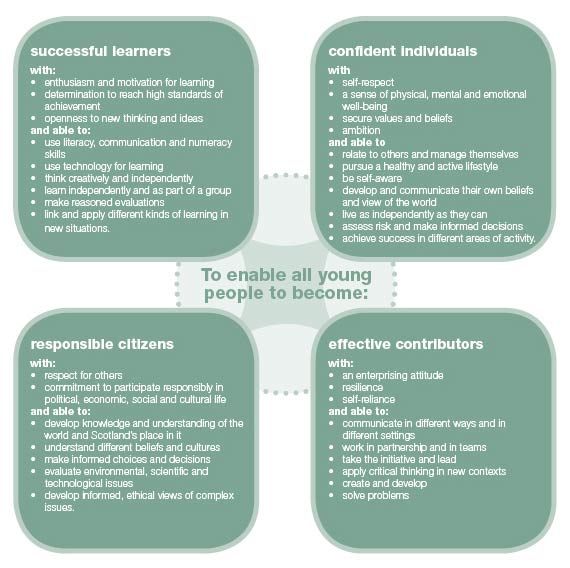
Background paper for the AQF Council on generic skills page 25Generic skills in three other countries Scotland Schools The Curriculum for Excellence defines four capacities for children and young people – to be a successful student, a confident individual, a responsible citizen and an effective contributor. Each of the four capacities has an expanded statement, written in behaviour /attitudes and skills terms and which, taken as a whole, embodies the full expectations of capabilities. Source: http://www.ltscotland.org.uk/curriculumforexcellence/curriculumoverview/aims/fourcapacities.asp The research undertaken for Scotland also identified references to core skills and generic skills (HM Inspectorate of Education 2001). Core skills are the broad, transferable skills that help to Background paper for the AQF Council on generic skills page 26
develop the main capabilities people need to be fully active and responsible members of society. The core skills are: communication; personal and interpersonal; problem solving; numeracy; and information technology. The five core skills support the acquisition of generic skills such as thinking skills, analysis and synthesis, and creativity. These latter higher-order skills underpin knowledge and understanding and are related to employability and lifelong learning. Generic skills are broader than core skills, but both are transferable. Since the late 1980s, the British Government and employers have articulated the need for generic, transferable skills as part of education and training, and as a key aspect of employability. Generic skills in the qualifications framework Levels are defined by the complexity of the following five generic skills, which may be developed during a learning experience, irrespective of the subject content. Level descriptors indicate the expected outcomes of learning, which are mapped against these five generic skills, and it is these which can be used to check how detailed and complex the learning experience should be: 1. knowledge and understanding 2. practice – applied knowledge and understanding (linking theory to practice) 3. communication, ICT and numeracy skills 4. generic cognitive skills – problem-solving, analysis, evaluation 5. autonomy, accountability and working with others. Complexity increases as the levels increase. New Zealand New Zealand refers to essential skills, which include skills similar to Australia’s employability skills (New Zealand Qualifications Authority 1993). Essential skills are fundamental to students achieving their full potential and participation in society. Skills that are included The essential skills in the New Zealand curriculum for schools include: Communication Information Self-management Physical Numeracy Problem-solving Social and cooperative Work and study New Zealand also refers to generic skills as those skills common to many occupations but which may not necessarily be regarded as required by all New Zealanders. They are skills generic to Background paper for the AQF Council on generic skills page 27
You can also read


