BEYOND THE HOMELAND Protecting America from Extremism in Fragile States - INTERIM REPORT OF THE TASK FORCE ON EXTREMISM IN FRAGILE STATES - United ...
←
→
Page content transcription
If your browser does not render page correctly, please read the page content below
BEYOND THE
HOMELAND
Protecting America from
Extremism in Fragile States

INTERIM REPORT OF THE TASK FORCE
ON EXTREMISM IN FRAGILE STATES
September 2018
Members of the Task Force on Extremism in Fragile States

Cochairs                                          Mr. Farooq Kathwari
                                                  CEO and President, Ethan Allen Interiors Inc.
Governor Thomas Kean
Former Governor of New Jersey; former 9/11        The Honorable Nancy Lindborg
Commission Chair                                  President, United States Institute of Peace

Representative Lee Hamilton                       The Honorable Dina Powell
Former Congressman of Indiana; former 9/11        Nonresident Senior Fellow, The Future
Commission Chair                                  of Diplomacy Project, Harvard University;
                                                  former U.S. Deputy National Security Advisor
                                                  for Strategy
Task Force Members
                                                  The Honorable Rajiv Shah
Secretary Madeleine Albright
                                                  President, The Rockefeller Foundation;
Chair, Albright Stonebridge Group; former
                                                  former Administrator, U.S. Agency for
U.S. Secretary of State
                                                  International Development
Senator Kelly Ayotte
                                                  Mr. Michael Singh
Board of Directors, BAE Systems, Inc.;
                                                  Senior Fellow and Managing Director, The
former U.S. Senator from New Hampshire
                                                  Washington Institute; former Senior Director for
Ambassador William Burns                          Middle East Affairs, National Security Council
President, Carnegie Endowment for International
Peace; former Deputy Secretary of State
                                                  Senior Advisors
Ambassador Johnnie Carson                         Ambassador Reuben E. Brigety II
Senior Advisor to the President, United States
                                                  Adjunct Senior Fellow, Council on
Institute of Peace; former U.S. Assistant
                                                  Foreign Relations
Secretary of State for African Affairs
                                                  Mr. Eric Brown
Ambassador Paula Dobriansky                       Senior Fellow, Hudson Institute
Senior Fellow, The Future of Diplomacy Project,
Harvard University; former Under Secretary        Dr. Susanna Campbell
of State for Global Affairs                       Assistant Professor, School of International
                                                  Service, American University
Ambassador Karl Eikenberry
Director of the U.S.-Asia Security Initiative,    Ms. Leanne Erdberg
Stanford University; former U. S. Ambassador      Director of Countering Violent Extremism,
to Afghanistan                                    United States Institute of Peace

Dr. John Gannon                                   Mr. Steven Feldstein
Adjunct Professor at the Center for Security      Nonresident Fellow, Carnegie Endowment for
Studies, Georgetown University; former            International Peace; Frank and Bethine Church
Chairman, National Intelligence Council           Chair, Boise State University

The Honorable Stephen Hadley                      Dr. Hillel Fradkin
Chair of the Board of Directors, United States    Senior Fellow, Hudson Institute
Institute of Peace; former U.S. National
                                                  Ms. Alice Friend
Security Advisor
                                                  Senior Fellow, International Security Program,
                                                  Center for Strategic and International Studies
Dr. George Ingram Dr. Lawrence Rubin
Senior Fellow, Global Economy and Associate Professor, Sam Nunn School
Development, Brookings Institution of International Affairs, Georgia Institute
of Technology
Dr. Seth G. Jones
Director of the Transnational Threats Mr. Andrew Snow
Project and Senior Advisor to the International Senior Fellow, United States Institute of Peace
Security Program, Center for Strategic and
Dr. Paul Stares
International Studies
Senior Fellow for Conflict Prevention and
Dr. Mara Karlin Director of the Center for Preventive Action,
Associate Professor of the Practice of Strategic Council on Foreign Relations
Studies, Johns Hopkins School of Advanced
Ms. Susan Stigant
International Studies
Director of Africa Programs, United States
Dr. Homi Kharas Institute of Peace
Interim Vice President and Director of the
Ms. Anne Witkowsky
Global Economy and Development Program,
Former Deputy Assistant Secretary of
Brookings Institute
Defense for Stability and Humanitarian Affairs,
Mr. Adnan Kifayat U.S. Department of Defense
Senior Fellow, German Marshall Fund and
Ms. Mona Yacoubian
Head of Global Security Ventures, Gen
Senior Advisor for Syria, Middle East, and
Next Foundation
North Africa, United States Institute of Peace
Dr. Rachel Kleinfeld
Senior Fellow, Carnegie Endowment
Project Staff
for International Peace
Mr. Blaise Misztal
Mr. Christopher A. Kojm Executive Director
Visiting Professor of the Practice of International
Affairs, George Washington University Mr. Michael Hurley
Advisor to the Cochairs
Mr. Michael Lumpkin
Vice President of Human Performance Dr. Corinne Graff
and Behavioral Health, Leidos Health Senior Policy Scholar
Mr. Robert Malley Dr. Daniel Calingaert
CEO, International Crisis Group Lead Writer
Dr. Bridget Moix Dr. Michael Marcusa
Senior U.S. Representative and Head Policy Advisor
of Advocacy, Peace Direct
Dr. Nathaniel Allen
Mr. Jonathan Papoulidis Policy Advisor
Executive Advisor on Fragile States,
Ms. Alyssa Jackson
World Vision
Program Manager
Ms. Susan Reichle
President and COO, International
Youth FoundationLegislative Language H.R. 244 - CONSOLIDATED APPROPRIATIONS ACT, 2017 Public Law 115-31, May 5, 2017 SEC. 7080. (b) COMPREHENSIVE PLAN.—Funds made available pursuant to subsection (a) shall be transferred to, and merged with, funds appropriated by this Act under the heading “United States Institute of Peace” for the purposes of developing a comprehensive plan (the Plan) to prevent the underlying causes of extremism in fragile states in the Sahel, Horn of Africa, and the Near East. Acknowledgments The Task Force is grateful to the U.S. Congress, particularly Senator Lindsey Graham, for entrusting it with this important task. It is deeply appreciative of the support it has received from the United States Institute of Peace and the Bipartisan Policy Center, on whose earlier work this effort builds. The work of the Task Force would not have been possible without the time and guidance that the Senior Advisors have generously given. Finally, the Task Force wishes to acknowledge and thank all those from the U.S. Government, policy community, academia, and civil society who have provided input and feedback on its deliberations. Disclaimer This report represents the consensus of a bipartisan Task Force with diverse expertise and affiliations. No member may be satisfied with every formulation and argument in isolation. The findings of this report are solely those of the Task Force. They do not necessarily represent the views of the United States Institute of Peace or the Senior Advisors.
Contents

I.    Executive Summary                                                            1

II.   Introduction                                                                 3
      From the 9/11 Commission to the Task Force on Extremism in Fragile States    4
      Roadmap of the Task Force’s Work                                             4

III. The New Strategic Environment: Fragility, Extremism, and Competition         5
      An Increasingly Fragile Landscape                                            5
      From Safe Havens to Statebuilding: Extremist Strategy in Fragile States      7
      Strategic Competition in Fragile States                                      9

IV. The Threat to U.S. Interests from Extremism in Fragile States                 12
      The Threat to Americans                                                     12
      The Costs of Counterterrorism                                               13
      Chaos, Conflict, and Competition                                            13
      The Political and Ideological Struggle                                      14

V.    Conditions for Extremism                                                    15
      The Local Conditions for Extremism                                          15
      Actors Reinforcing and Exploiting the Conditions for Extremism              17

VI. Elements of a Preventive Strategy                                             19
      Strategic Objectives: Addressing the Political Conditions for Extremism     19
      Challenges to Prevention                                                    21
      What Can Work                                                               22
      Why Now?                                                                    26

VII. Conclusion                                                                   26
Appendix                                                                          27
Notes                                                                             28
I. Executive Summary
Since the tragic attacks of September 11, 2001, law enforcement has stopped many terrorists
from entering the United States, and U.S. armed forces have eliminated large numbers of
terrorists overseas.
Seventeen years later, the threat has evolved. Violent extremism has spread across a
wide arc of instability stretching through fragile states in the Middle East, the Horn of
Africa, and the Sahel. These groups are present in 19 out of 45 countries in these regions
and have held and governed territory in 10 of them. The United States has responded by
conducting combat operations in 5 of the 45 countries and providing security assistance to
39 of them. But to stop extremists from spreading further and roll back their gains, we need
a new strategy, one that focuses on the incubators of extremism: fragile states. Congress has
charged this Task Force to devise such a strategy.
We confront a different strategic environment than on 9/11. The Middle East, the Horn
of Africa, and the Sahel have become increasingly fragile. Extremists’ strategies have
evolved, and their focus is now on establishing a new political order. Meanwhile,
America’s rivals have seized on this disorder to grow their power and influence, preying
on the weakness of state fragility.
As a result, the threat that extremism in fragile states poses to the United States has also
changed. The dangers of extremism now extend beyond our homeland. Violent extremism
dulls America’s ability to compete on the world stage. It undermines U.S. regional influence
and the open, rules-based international order by fueling chaos that destabilizes neighboring
countries, weakens U.S. allies, and triggers further crises, such as the unprecedented wave
of refugees.
As long as extremism fuels instability, the United States cannot compete effectively
against strategic rivals such as China, Russia, and Iran. Nor can the United States confront
extremism without addressing the ways our rivals exploit and contribute to this threat.
The time has come for a new U.S. strategy. We need not
only to defeat individual terrorists but also to mitigate the
conditions that enable extremist ideologies to take root,
As the 9/11 Commission
spread, and thrive. Going forward, the priority for U.S.
recommended in 2004, we need
policy should be to strengthen fragile states—to help them
not only to attack terrorists and build resilience against the alarming growth of violent
protect against their attacks but extremism within their own societies.
also to prevent the continued
growth of violent extremism. This interim report assesses the threat posed by extremism
A preventive strategy is a cost- in fragile states, analyzes the conditions that fuel extremism,
effective and sustainable way to proposes a new set of strategic objectives for U.S. policy,
and examines what we know about how to achieve these
keep America safe.
objectives. The Task Force will issue a final report in early
2019 to propose a comprehensive strategy for reducing
extremism in fragile states.
1 | Task Force on Extremism in Fragile StatesAs the 9/11 Commission recommended in 2004, we need not only to attack terrorists and
protect against their attacks but also to prevent the continued growth of violent extremism.
A preventive strategy is a cost-effective and sustainable way to keep America safe.
We have, thus far, lacked a common understanding of how to stop the spread of extremism.
But a consensus is growing on what conditions fuel extremism; political will is building
in the international community to act; and recent success stories give hope that we can
make a difference.
Extremism emerges through the confluence of poor and undemocratic governance in
fragile states and extremist ideology and organization. These conditions arise from the
actions of regimes in fragile states, violent extremist groups, and international actors. In
fragile states, governments lack legitimacy, and institutions struggle or fail to provide basic
public goods—security, justice, and services. An effective strategy to combat extremism
needs to tackle both the conditions that gave extremism a chance to take root in a society
and the behavior of actors that spawned these conditions in the first place.
Such a strategy cannot succeed without strong U.S.
As President Donald Trump said leadership and sustained commitment. The United States
at the 2017 Riyadh summit, we needs to build productive national and local partnerships
should build “a coalition of nations in fragile states for strengthening the resilience of their
who share the aim of stamping societies, including through humanitarian assistance;
secure the political cooperation and financial support of
out extremism and providing our
international partners; dissuade countries from abetting
children a hopeful future.”
extremism, corruption, and repression in fragile states; and
unite disparate American and international efforts behind
a common goal. As President Donald Trump said at the
2017 Riyadh summit, we should build “a coalition of nations who share the aim of stamping out
extremism and providing our children a hopeful future.”1
This approach does not call for the United States to undertake expensive attempts to remake
far-off societies with very different cultures and histories than our own. We cannot. But we
can work with partners to identify and target the discrete local conditions that fuel extremism.
Cooperation to prevent extremism is an effective and
sustainable strategy that will lower the costs that the We want to foster resilient
United States bears. Already, among the United Nations, societies in the Middle East, the
the World Bank, the European Union, and the Arab Horn of Africa, and the Sahel
Gulf states, opinions are converging on the importance
that are capable of resisting the
of tackling extremism in fragile states. If we lead that
growth of violent extremism, so
effort, our partners’ resources can leverage our own.
that we not only defeat today’s
Moreover, preventive measures cost far less than military
terrorists but also alleviate the
interventions—saving $16 for every $1 invested2—and put
fewer American lives at risk. conditions that spawn tomorrow’s.
A preventive strategy is neither passive nor naive.
The United States always reserves the right to use force and should do so to confront
imminent threats posed by terrorism. The bigger challenge before us is to prevent future
threats from emerging. We want to foster resilient societies in the Middle East, the Horn of
Africa, and the Sahel that are capable of resisting the growth of violent extremism, so that we
not only defeat today’s terrorists but also alleviate the conditions that spawn tomorrow’s.
Interim Report | 2II. Introduction
In the upheaval of the Arab Spring in 2011, as the Yemeni government was falling apart in the
face of popular protests, dozens of masked men from al-Qaeda drove into the town of Jaar
in southern Yemen. They introduced themselves as “supporters of Islamic law,” and told the
townspeople they had come to restore order.
In taking control of Jaar, the goal of al-Qaeda in the Arabian Peninsula (AQAP) was to
“run people’s lives in accordance with Shariah law,” explained Adil al-Abab, AQAP’s chief
cleric. But instead of focusing on dress codes and mosque attendance, al-Qaeda made its
first priority to provide public services such as sewage and water systems. Jaar was one
of the many areas of Yemen neglected by the government, and al-Qaeda played on the
resentments of Jaar’s residents. “We hope that when the people see us meet their demands,
they will accept the methodology of the mujahidin and accept the implementation of
Shariah.”3 Soon, AQAP’s propaganda featured glowing testimonials from locals who claimed
their lives had improved under al-Qaeda’s rule.
AQAP’s experiment in governing did not last. But it was replicated across the Middle East
and in parts of Africa where governments fail to provide for their citizens, enabling terrorist
groups to step in to fill the void.
In 2015, amid another Yemeni government collapse and civil war, AQAP seized the port city of
al-Mukalla, with more than 500,000 inhabitants. AQAP’s efforts to provide services were well
received. “I prefer that al-Qaeda stay here, not for al-Mukalla to be liberated,” one resident
told Reuters in early 2016. “The situation is stable, more than any ‘free’ part of Yemen.”4
In Iraq, ISIS similarly attempted to govern. It prosecuted even small debts and minor
infractions, which the Iraqi government had generally ignored, as a way of gaining support
among the population it ruled. “As far as justice was concerned,” according to one Iraqi
citizen, “ISIS was better than the government.”5
The gap between government failures and citizens’
The gap between government aspirations, above all else, is what facilitates the spread
failures and citizens’ aspirations, of violent extremism. As this gap grows wider in the arc
above all else, is what facilitates of fragile states from the Sahel, through the Horn of Africa,
and into the Middle East, extremists will find fertile ground
the spread of violent extremism.
to reemerge and establish their own political order. As New
York Times correspondent, Rukmini Callamachi, has said:
“We should be more afraid of ISIS’ capacity to govern than
we are of their fighters.”6
3 | Task Force on Extremism in Fragile StatesFrom the 9/11 Commission to the Task Force on Extremism
in Fragile States
In 2004, the 9/11 Commission foresaw the possibility for extremism to spread, mutate, and
reemerge in new places. Thus, the Commission recommended a comprehensive strategy that
would not only “attack terrorists and their organizations” and “protect against and prepare for
terrorist attacks,” but just as critically “prevent the continued growth of Islamist terrorism.”7 The
Commission proposed a range of preventive measures, including promoting the rule of law and
tolerance for opposing views, offering an agenda of opportunity, and building a comprehensive
coalition of international partners.8 The United States has effectively adopted two elements of
this strategy—attacking terrorists and protecting the homeland—but made limited progress on
prevention. The time is ripe to adopt what the 9/11 Commission called “a preventive strategy
that is as much, or more, political as it is military.”9
At the time that the 9/11 Commission issued its recommendations, U.S. officials were rightly
focused on imminent threats to the homeland, and there was little common or concrete
understanding of how to go about preventing violent extremism. Since then, the strategic
environment has changed, requiring a new strategy for dealing with extremism, not only
mitigating its damage but also addressing its underlying causes.
That is precisely the task with which the U.S. Congress charged the United States Institute of
Peace and this Task Force. Section 7080 of the Consolidated Appropriations Act of 2017 (H.R.
244), signed into law on May 5, 2017, calls for a “comprehensive plan to prevent the underlying
causes of extremism in fragile states in the Sahel, Horn of Africa, and the Near East.”
Roadmap of the Task Force’s Work
This interim report of the Task Force on Extremism in Fragile States explains why such
a preventive strategy is needed and what it might entail. In 2019, the Task Force will
propose a comprehensive preventive strategy to mitigate the conditions that give rise
to violent extremism.
This report begins by reviewing the new strategic environment that has emerged since 9/11—
the increased fragility, the evolution in extremist strategy, and the rise of strategic competition
that plays out in fragile states—and argues for a new understanding of the threat posed by
extremism in fragile states to U.S. interests. The threat is based not only on the possibility of
attacks against the homeland but also on the ability of the United States to compete against
its adversaries globally. The report then examines the conditions and actors that contribute to
the emergence of extremism in fragile states. Finally, it considers what a preventive strategy
might look like by identifying the strategy’s key objectives, highlighting the challenges for
implementation, and reviewing evidence of what sorts of approaches can make a difference
in fragile states. Ultimately, this report argues that the United States urgently needs a new
strategy to strengthen fragile states and help them build resilience against extremism. Such
a strategy would be difficult, but not impossible, to put in place. The current political winds
are favorable to its adoption and successful implementation.
Interim Report | 4III. The New Strategic Environment:
Fragility, Extremism, and Competition
Extremism continues to plague the international community, just as it did on 9/11. But in the
meantime, the strategic environment has changed dramatically. As a result, the threat of
extremism today is different than it was seventeen years ago. The Middle East, the Horn
of Africa, and the Sahel have become increasingly fragile. Extremists have spread across
the region and their strategy has evolved to focus on establishing a new political order,
which undermines existing states and weakens the international system. And America’s
rivals have seized on this disorder to grow their power and influence, often at the expense
of fragile states. At the same time, U.S. dependence on energy from these regions has
lessened, and as our economic interests there have declined, so has our influence relative
to other powers, especially China.
An Increasingly Fragile Landscape
Each fragile state is fragile in its own way, but they all face significant governance and
economic challenges. In fragile states, governments lack legitimacy in the eyes of citizens,
and institutions struggle or fail to provide basic public goods—security, justice, and services—
and to manage political conflicts peacefully.10 Citizens have few if any means of redress. As a
result, the risk of instability and conflict is heightened. Throughout the Middle East, the Horn
of Africa, and the Sahel, fragility is further exacerbated by growing youth populations.11
In some states, governments lack the capacity to meet their citizens’ needs. In many others,
fragility is perpetuated by poor, undemocratic, or even predatory governance. In such
countries, ruling elites exploit the state and enrich themselves rather than serve citizens. They
are willing to hold on to power by any means necessary: buying support through patronage,
violently repressing opponents, and neglecting the rest. The resulting deep sense of political
exclusion among citizens is aggravated by insecurity and shortages of economic opportunity.
Repeated shocks—including the global financial downturn, the Arab Spring, and recurring
cycles of crippling droughts—have roiled the Middle East, the Horn of Africa, and the Sahel
in the last decade. Few states have weathered these shocks well.
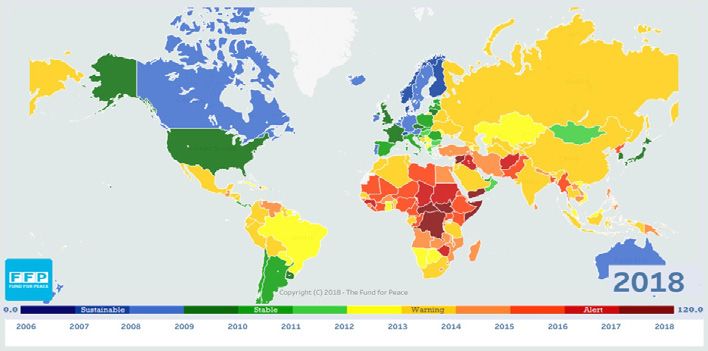
Almost every country in these regions falls outside the “stable” range of the Fund for
Peace’s Fragile States Index, occupying a spot somewhere between a “warning” and an
“alert” level of state fragility (see figure 1, “State Fragility in the Middle East, the Horn of Africa,
and the Sahel, 2018”).12 And fragility in all three regions has deepened over the past decade.
Since 2006, 30 countries across these regions have become more fragile, while only 19 have
seen their fragility reduced.13 And the extent of these increases in fragility, on average, was
greater than the decreases (see figure 2, “Changes in State Fragility, 2006–18”). Today, both
the scale and the complexity of fragility are unprecedented.
5 | Task Force on Extremism in Fragile StatesFigure 1. State Fragility in the Middle East,
Figure 1. Statethe Horn
Fragility of Middle
in the Africa, and
East, the the
Horn Sahel,
of Africa,2018
and the Sahel, 2018
Sustainable Stable Warning Alert
Source: Fragile
Source: FragileStates
StatesIndex at the
Index Fund
at the for Peace
Fund website,
for Peace http://fundforpeace.org/fsi/
website, (accessed
http://fundforpeace.org/fsi/ August 20,
(accessed 2018).20, 2018).
August
Figure 2. Changes in State Fragility, 2006–18
Figure 2. Changes in State Fragility, 2006–18
0 20 40 60 80 100 120 0 20 40 60 80 100 120
Cameroon Mauritania
Libya Guinea
Syria Chad
Mali Uganda
Yemen Iran
Central African Republic Jordan
Senegal Egypt
Eritrea Israel and Palestinian Territories
Gambia Algeria
Guinea-Bissau Morocco
Niger Togo
Kenya Burkina Faso
Oman Sudan
Ethiopia Kuwait
Ghana Qatar
Bahrain Liberia
Somalia Iraq
Djibouti Saudi Arabia
Tunisia Sierra Leone
Lebanon United Arab Emirates
Nigeria Cape Verde
South Sudan (from 2012) Côte d’Ivoire
Benin
2018 2006
Scores range from 0, least fragile, to 120, most fragile. Countries are arranged in descending order of increased fragility.
Scores range from 0,Source:
least fragile, to 120, most fragile. Countries are arranged in descending order of increased fragility.
Calculated from time series data in the Fragile States Index at the Fund for Peace website, http://fundforpeace.org/fsi/
Source: Calculated from time series
(accessed Augustdata20,
in 2018).
the Fragile States Index at the Fund for Peace website, http://fundforpeace.org/fsi/ (accessed August 20, 2018).
Interim Report | 6From Safe Havens to Statebuilding: Extremist Strategy
in Fragile States
Amid this ferment, extremists have launched their most daring onslaughts and made their
greatest gains. Fragile states are no longer mere safe havens but instead are the battlefields
on which violent extremists hope to secure their political and ideological objectives.
Extremism and Violence
This Task Force is charged with addressing the underlying causes of extremism. Within
the contemporary political environment, “extremism” generally refers to a wide range
of absolutist and totalitarian ideologies that share the following three characteristics:
• Blaming injustices on existing social, moral, economic, or political institutions
• Denying the possibility of justice as long as these institutions remain in place
• Seeking to replace these institutions with a new political order governed by a doctrine
that denies individual liberty and equal rights to citizens of different religious, ethnic,
cultural, or economic backgrounds
“Extremists” believe in and advocate for such radical outcomes and seek to achieve them
through political means. “Violent extremists” espouse, encourage, and perpetrate violence
as they seek to create their extremist political order.
Many forms of violent extremism exist, but the most common form in the Middle East, the
Horn of Africa, and the Sahel, and the one posing the most immediate threat to the United
States today, espouses the creation of a radical Islamist state based on rigid, twisted, and
false interpretations of sharia law.
The Evolution of Extremist Strategies Post-9/11
Extremist have attempted to achieve their ideological objectives in different ways. Islamist
militants in Algeria and Egypt waged bloody but unsuccessful insurgencies during the 1990s
to overthrow those countries’ regimes. Osama bin Laden blamed their failure on Western
support for secular Middle Eastern states. He created al-Qaeda to attack the United States
and force it to withdraw from the region.14
After al-Qaeda was driven out of Afghanistan in 2001, a new strategic vision emerged. The
influential 2004 strategic treatise, The Management of Savagery, called on al-Qaeda to
exploit “the weakness of the ruling regime”15 rather than try to overthrow entire states or
attack the West. The treatise argued that extremists should concentrate on providing “food
and medical treatment” in the areas they control, while preserving “security and justice,
securing the borders,” and “setting up defensive fortifications.”16
Fragile states, extremists realized, afforded a conducive environment for establishing
experiments in governance and thereby demonstrating the validity of the extremist
ideological agenda.
During the following decade, extremists began to execute this strategy. Al-Qaeda imposed
harsh versions of Islamic law in Fallujah in 2004.17 Extremists in Somalia, Yemen, Libya, and Mali
captured towns, established rudimentary governance structures, provided social services, and
established makeshift Islamic courts, curtailing freedoms and imposing strict punishments.18
7 | Task Force on Extremism in Fragile StatesThe most dramatic project of extremist statebuilding was the self-proclaimed Islamic State of
Iraq and Syria (ISIS). The ISIS caliphate provided courts, religious schools, and social welfare
services;19 maintained public order;20 and even collected hundreds of millions of dollars in taxes.21
The Spread of Extremism
Although the United States and its partners have crushed ISIS’s proto-state, a declaration
of victory is premature. Rather than accept defeat, ISIS extremists have warned that they
are still in the fight.22 Indeed, extremism is more widespread today than at any time before
(see figure 3, “Extremist Attacks and Governance in the Middle East, the Horn of Africa, and
the Sahel, 1996–2001” and figure 4, “Extremist Attacks and Governance in the Middle East,
the Horn of Figure 3. the
Africa, and Extremist Attacks and Governance in the
Sahel, 2013–18”).
Middle East, the Horn of Africa, and the Sahel, 1996–2001
Figure 3. Extremist Attacks and Governance in the M
iddle East, the Horn of Africa,
and the Sahel, 1996–2001
Attacks
Governance
Source: Global Terrorism Database at the website of the National Consortium for the Study of Terrorism and Responses to
Source: Global
Terrorism, Terrorism Database at the website
https://www.start.umd.edu/gtd/ of the National
(accessed August Consortium
20, 2018).for the Study
Data of Terrorismcompiled
on governance and Responses
fromtosecondary
Terrorism, sources.
Figure 4. Extremist Attacks and Governance in the
https://www.start.umd.edu/gtd/ (accessed August 20, 2018). Data on governance compiled from secondary sources.
Middle
Figure East,Attacks
4. Extremist the Horn of Africa,in and
and Governance the M the East,
iddle Sahel, 2013–18
the Horn of Africa,
and the Sahel, 2013–18
Attacks
Governance
Source: Global Terrorism Database at the website of the National Consortium for the Study of Terrorism and Responses to
Source: Global
Terrorism, Terrorism Database at the website
https://www.start.umd.edu/gtd/ of the National
(accessed Consortium
August 20, for the
2018). Data onStudy of Terrorism
governance and Responses
compiled to Terrorism,
from secondary sources.
https://www.start.umd.edu/gtd/ (accessed August 20, 2018). Data on governance compiled from secondary sources.
Interim Report | 8ISIS is still present in Iraq and Syria23 and has established affiliates in twelve countries.24
And al-Qaeda has grown in strength in recent years, with a presence in Syria, Yemen, and
now the Sahel.25
Moreover, the extremist focus on winning territory and establishing governance has blurred
the line between terrorism, insurgency, civil war, and international conflict. Today, 77 percent
of conflicts in the Middle East, the Horn of Africa, and the Sahel have a violent extremist
element, compared with 22 percent in 2001.26 Extremists instigated violent insurgencies in
the Sinai and Nigeria. In countries with a preexisting conflict—in Iraq, Libya, Somalia, Syria,
and Yemen—violent extremist groups have exerted significant influence and sometimes
gained territorial control.
Extremists are primed to attempt governing again. They only need another political crisis,
breakdown of social order, or nascent civil conflict to make their comeback. Due to the
persistence of state fragility across the Middle East, the Horn of Africa, and the Sahel,
the risk of another extremist attempt to seize and govern territory remains high.
Strategic Competition in Fragile States
Global and regional powers are expanding their influence in the Middle East, the Horn
of Africa, and the Sahel, making the strategic environment in those regions more
challenging. China, Russia, Iran, Turkey, Saudi Arabia, and other Gulf states often compete
with each other and the United States in ways that make these regions more fragile and
more susceptible to extremism.
Great Power Competition
“China and Russia,” the president’s 2017 National Security Strategy asserts, “challenge
American power, influence, and interests, attempting to erode American security and
prosperity.” This great power competition extends to Africa and the Middle East.
China has built a large economic and diplomatic presence
Global and regional powers in Africa.27 It is Africa’s largest single-country trade partner
are expanding their influence and its biggest creditor,28 having lent more than $100 billion
to African governments and state enterprises since 2000.29
in the Middle East, the Horn of
This debt diplomacy is enhancing China’s political leverage.
Africa, and the Sahel, making the
In Djibouti, for example, China owns the lion’s share of
strategic environment in those
the country’s national debt and recently constructed a
regions more challenging. military base just miles away from the only permanent U.S.
military base in Africa.30 There is a serious risk that failure
to repay loans will allow China to take control of significant
infrastructure, as it did in Sri Lanka31 (see figure 5, “U.S., EU, and Chinese Foreign Direct
Investment in Sub-Saharan Africa, 2009–16”).
In addition to boosting Beijing’s influence, rising Chinese investments, when made
irresponsibly, can also weaken already fragile states. With few of the stipulations that are
attached to Western investment and aid, such as transparency, Chinese assistance allows
predatory governments to avoid reforms32 and has been shown to have increased corruption.33
9 | Task Force on Extremism in Fragile StatesFigure 5. U.S., EU and Chinese Foreign Direct Investment
Figure 5. U.S., EU, andIn Sub-Saharan
Chinese Foreign DirectAfrica, 2009–16
Investment in Sub-Saharan Africa, 2009–16
100
90 China
80
70
European Union
60
Billions of $
50
40
30
20
United States
10
0
2009 2010 2011 2012 2013 2014 2015 2016
Source: Calculatedfrom
Source: Calculated from publicly
publicly available
available datadata in Coordinated
in the the Coordinated
DirectDirect Investment
Investment SurveySurvey at the International
at the International MonetaryMonetary
Fund
Fund website,
website, http://data.imf.org/?sk=40313609-F037-48C1-84B1-E1F1CE54D6D5.
http://data.imf.org/?sk=40313609-F037-48C1-84B1-E1F1CE54D6D5.
Russia has relied principally on military assistance to expand its influence. In 2015,
Moscow intervened in the Syrian conflict to prop up Bashar al-Assad’s brutal regime.
Shortly thereafter, regional U.S. partners, perhaps sensing a shift in the center of gravity,
expanded their relations with Moscow.34 Egypt and Saudi Arabia have both signed large
arms deals with Russia; Israel’s prime minister has traveled three times to Moscow, and only
once to Washington, in the last two years; and Turkey has purchased a controversial Russian
air defense system.
Although the United States leads in military assistance to the Middle East, in Africa, Moscow
is by far the largest weapons supplier.35 Russian arms are relatively affordable36 and come
with no human rights requirements. When the United States denied Nigeria’s request for
Cobra attack helicopters because of human rights concerns, Russia stepped in and also
agreed to train Nigerian security forces.37
Regional Spillover
Fragile states are also an arena for regional rivalries, particularly the long-simmering feud
between Iranian-backed Shi’a and the Middle East’s looser Sunni bloc, led by Saudi Arabia.
Iran has for almost forty years used political subversion and terrorism to export its
revolutionary ideology and expand its influence. Since 2011, it has taken a more aggressive
approach: intervening directly in the Syrian civil war; arming the Houthis in Yemen; and
increasing its support for various Iraqi Shi’a militias and for Hezbollah.
Iran has extended its ambitions into Africa as well. It has recently shipped weapons through
Djibouti and Sudan, provided arms to insurgents in Nigeria, and plotted terrorist attacks
against Western targets in Kenya. In addition, Iran is now operating more than a hundred
religious institutions in Africa.38
Interim Report | 10Saudi Arabia, which is feeling increasingly surrounded, is responding in kind. From 1982 to
2005, it spent $75 billion to fund mosques, madrassas, and religious television channels.39
Other countries have also contributed to the spread of extremist ideology. Qatar and Turkey
have supported the Muslim Brotherhood, which other Sunni states view as on par with al-
Qaeda, and Pakistan is complicit in funding radical madrassas.40
Saudi Arabia under Crown Prince Muhammad bin Salman has taken a more muscular
approach to its regional rivalries—for instance, intervening militarily in Yemen. The United
Arab Emirates (UAE) is similarly assertive. The Sunni bloc is fracturing, with the Saudis and
Emiratis splitting from Qatar and, increasingly, Turkey.
These regional rivalries are exacerbating local conflicts and feeding tensions in fragile
states. In Libya, Qatar supported Islamist militias, while the UAE backed competing
factions.41 Foreign interventions in Syria by a wide array of actors deepened the country’s
bloody civil war (see figure 6, “Foreign Involvement in the Syria Conflict”). Meanwhile,
Saudi, Kuwaiti, Qatari, and Emirati purchases of large
tracts of agricultural land in Ethiopia, Sudan, and Tanzania
Competition among great and have incentivized those governments to expropriate
regional powers is exacerbating small landholders, creating a new group of aggrieved
fragility and extremism in the and marginalized citizens.42
Middle East, the Horn of Africa,
and the Sahel. Competition among great and regional powers is
exacerbating fragility and extremism in the Middle East,
the Horn of Africa, and the Sahel.
Figure 6.Figure
Foreign Involvement
6. Foreign Involvement inin
thethe
SyriaSyria Conflict
Conflict
Islamic State foreign fighter source
Pro-regime proxy fighter source
Nation-state combatant
Source of extremist financial support
Source: Data
Source: Dataonon
foreign fighters
foreign is drawn
fighters from from
is drawn Soufan Group,Group,
Soufan “Foreign“Foreign
Fighters: Fighters:
An UpdatedAnAssessment of the Flow ofofForeign
Updated Assessment the Fighters
into Syria
Flow and Iraq”Fighters
of Foreign (2015), http://soufangroup.com/wp-content/uploads/2015/12/TSG_ForeignFightersUpdate3.pdf
into Syria and Iraq” (2015), http://soufangroup.com/wp-content/uploads/2015/12/TSG_ (accessed August 20,
2018); and Soufan Group, “Beyond
ForeignFightersUpdate3.pdf the Caliphate:
(accessed Foreign
August Fightersand
20, 2018); andSoufan
the Threat of Returnees”
Group, “Beyond(2017) http://thesoufancenter.org/wp-con-
the Caliphate: Foreign Fighters and the
tent/uploads/2017/11/Beyond-the-Caliphate-Foreign-Fighters-and-the-Threat-of-Returnees-TSC-Report-October-2017-v3.pdf
Threat of Returnees” (2017), http://thesoufancenter.org/wp-content/uploads/2017/11/Beyond-the-Caliphate-Foreign-Fighters- (accessed
August 20, 2018). The source for data on pro-regime proxy fighters is Ali
and-the-Threat-of-Returnees-TSC-Report-October-2017-v3.pdf Alfoneh, “Tehran’s
(accessed Shia2018).
August 20, Foreign Legions”
The source (Carnegie
for dataEndowment for
on pro-regime
International
proxy fightersPeace,
is AliWashington, DC, January
Alfoneh, “Tehran’s 30,Foreign
Shia 2018), http://carnegieendowment.org/2018/01/30/tehran-s-shia-for-
Legions” (Carnegie Endowment for International Peace, Washington, DC,
eign-legions-pub-75387.
January Data on extremist financial support is drawn from Yaya J. Fanusie and Alex Entz, “Al-Qaeda’s
30, 2018), http://carnegieendowment.org/2018/01/30/tehran-s-shia-foreign-legions-pub-75387. Branch
Data in Syria:
on extremist
Financial Assessment” (Foundation for Defense of Democracies, Washington, DC, June 2017), http://www.defenddemocracy.org/con-
financial support is drawn from Yaya J. Fanusie and Alex Entz, “Al-Qaeda’s Branch in Syria: Financial Assessment” (Foundation
tent/uploads/documents/CSIF_TFBB_AQIS.pdf.
for Defense of Democracies, Washington, DC, June 2017), http://www.defenddemocracy.org/content/uploads/documents/
CSIF_TFBB_AQIS.pdf.
11 | Task Force on Extremism in Fragile StatesIV. The Threat to U.S. Interests from
Extremism in Fragile States
Extremism continues to fester in the world’s fragile states and, just as the strategic landscape
has shifted, so too has the threat posed by extremism to U.S. national security. Terrorists still
aspire to strike the United States, but the dangers of extremism to the United States now
extend beyond the homeland.
The United States confronts, as the Trump administration’s National Security Strategy puts
it, “rivals [that] compete across political, economic, and military arenas . . . to shift regional
balances of power in their favor.” U.S. global power rests in large measure on the stability
of the open, rules-based international order, which facilitates trade, access to resources, and
alliances and international partnerships that help protect our interests. The erosion of stability
and order weakens the United States.
We cannot compete effectively against China, Russia, or Iran as long as extremism
fuels an arc of instability from the Sahel to the Middle East. Nor can we end the era of
extremism inaugurated on 9/11 without confronting the ways that global and regional
powers exploit and contribute to this threat.
The Threat to Americans
While a spectacular set of attacks like those conducted on 9/11 remains possible, extremists
have shifted the emphasis of their strategy of violence to smaller, locally perpetrated attacks.
Extremist enclaves in foreign cities provide launching pads for terrorist attacks, such as
the ISIS attack on Paris in November 2015, which have killed Americans abroad. Attacks in
Europe, Africa, and the Middle East have claimed fifty American lives overseas from 2014 to
2016.43 Worldwide, the number of people killed in terrorist attacks has increased substantially
since 2001 (see figure 7, “Worldwide Terrorist Attack Fatalities, 2001–16”).
Figure 7. Worldwide Terrorist Attack Fatalities, 2001–16
Figure 7. Worldwide Terrorist Attack Fatalities, 2001–16
50000
43,566
38,464
40000 34,676
30000
22,234
20000 15,436
12,858
9,362 9,135 9,271
7,743 7,727 8,228
10000 4,799 5,718 6,313
3,278
0
2001 2002 2003 2004 2005 2006 2007 2008 2009 2010 2011 2012 2013 2014 2015 2016
Source: Global Terrorism Database at the website of the National Consortium for the Study of Terrorism and Responses to
Source: Global Terrorism Database at the website of the National Consortium for the Study of Terrorism and Responses to Terrorism,
Terrorism, https://www.start.umd.edu/gtd/ (accessed August 20, 2018).
https://www.start.umd.edu/gtd/ (accessed August 20, 2018).
Interim Report | 12As ISIS demonstrated, the creation of extremist rule can help facilitate terrorism in
ways that hiding in a remote safe haven never could. The self-proclaimed caliphate
attracted sympathizers to join ISIS in Syria. It also inspired a “virtual caliphate” of radicalized
followers around the world. Through social media and encrypted communications, ISIS has
encouraged attackers worldwide to harness lethal, low-tech weapons, such as trucks,
cars, and knives. As long as extremist ideology and calls to violence continue to resonate
with new recruits, we must expect them to devise and attempt new ways to harm us.
The Costs of Counterterrorism
By 2004, Osama bin Laden realized that it might be possible to draw the United States into
a war of attrition on al-Qaeda’s turf. “All that we have to do,” he explained, “is to send two
mujahedeen to the furthest point east to raise a piece of cloth on which is written al Qaeda
in order to make generals race there and cause America to suffer human, economic, and
political losses without achieving anything of note.”44 Since then, extremists have tried
to drive the United States to military, financial, and political exhaustion through the
relentless grind of asymmetric warfare.
And, indeed, the United States has paid a high price for wars in Afghanistan, Iraq, and
elsewhere; the cost of post-9/11 wars is projected to total $5.6 trillion by the end of fiscal year
2018.45 Even as the U.S. military has pivoted to lighter-footprint and therefore lower-cost
counterterrorism operations, the political and strategic costs of seventeen years of ever-
expanding war remain high.
Nearly every country in the Middle East, the Horn of
The length and growing Africa, and the Sahel receives some form of U.S. security
scope of the fight are driving assistance.46 The United States has launched air or drone
Americans and their leaders to strikes in five of these forty-five countries47 and deployed
question the value of foreign Special Operations forces to more than half of them since
January 2017.48 The United States spent $175 billion on
military engagement.
counterterrorism in 2017 (eleven times what it spent in 2001),49
and the cost in terms of the lives of U.S. soldiers continues
to rise, with losses sustained recently in Yemen, Niger, and Somalia. The length and growing
scope of the fight are driving Americans and their leaders to question the value of foreign
military engagement. President Trump in April 2018 voiced support for pulling U.S. troops out
of Syria, and the Pentagon is considering a sharp cut in Special Operations forces in Africa.50
Chaos, Conflict, and Competition
“We are facing,” according to the U.S. Department of Defense’s 2018 National Defense
Strategy, “increased global disorder, characterized by decline in the long-standing rules-
based international order—creating a security environment more complex and volatile
than any we have experienced in recent memory.” Military planners argue that “inter-state
strategic competition, not terrorism, is now the primary concern in U.S. national security.”51
But extremism, and its persistence in fragile states, is not separate or distinct from the
strategic competition the United States now confronts. While the threats to our national
security from Russia, China, Iran, and North Korea might be graver than from the likes
of ISIS and al-Qaeda, extremism must be understood within the same strategic context.
13 | Task Force on Extremism in Fragile StatesAs extremism mutates and spreads, the resulting chaos and conflict drain U.S. power,
weaken our allies, and provide openings for our adversaries. We cannot effectively
compete with strategic rivals unless we reduce extremism.
Conflicts in fragile states that pit authoritarian governments against extremist groups present
the United States with difficult strategic choices: stay out of the fray and appear powerless;
side with the rulers and compromise our democratic principles; or intervene to oust the
extremists and be held responsible if stability does not quickly return. The United States has
tried all three options and found that each one can be ineffective and erode its standing in
the region and the wider world.
Furthermore, the damage that extremists wreak in fragile states rarely stays there. As more
states suffer violent outbreaks of extremism, chaos radiates outward and international
order unravels further. Conflicts reverse hard-won gains in economic development,52 displace
populations on a massive scale,53 spread pandemics, encourage criminality, and precipitate
humanitarian crises. The political consequences are also significant. Unprecedented refugee
flows, and the strains of responding to them,54 for example, have provoked significant splits
within the European Union, weakening and dividing our allies.
Our adversaries at times have taken advantage of this instability, as Russia has done to
extend its influence in the Middle East at the United States’ expense. More often, they leave
the fight against violent extremism to the United States and its allies as they pursue their
economic interests, expand their diplomatic reach, and enhance their political leverage.
While extremism and the chaos and conflict it creates may not present an existential
threat to the United States, it is a serious national security challenge in its own right and
undermines our ability to compete against our adversaries.
The Political and Ideological Struggle
The competitions in which the United States is engaged are not only military in nature; they
are political and ideological as well. As the 2017 National Security Strategy explains, we now
confront “contests between those who favor repressive systems and those who favor free
societies.” The Russian and Chinese models are formidable competitors, but they are not
our only ones; the totalitarian, intolerant ideology of extremism is just as dangerous.
For citizens fed up with autocratic, kleptocratic, or incompetent government, the extremist
ideal of an infallible state imbued with religious morals often offers one of the few options
available. This sets up a cruelly self-sustaining struggle between autocracy and extremism.
The more support extremists garner for their critique of the state, the more inclined the state
is to repress them harshly. The harsher the state’s repression, the more alienated citizens
look to radical alternatives. And as extremists resort to violence, the vicious cycle of repression
begins anew. The spread of extremist beliefs crowds out values of liberty, pluralism, and
tolerance; degrades the social fabric; and foments support for totalitarianism.
Societies trapped between fragility and extremism—with no viable alternatives for
just, inclusive, and competent governance—will remain unstable, impoverished, and
susceptible to conflict and foreign interference.
As long as extremism persists and extremist beliefs persuade and inspire more people
than does the hope for tolerant and inclusive governance, the United States cannot
expect to win the competition for peace and prosperity in the twenty-first century.
Interim Report | 14V. Conditions for Extremism
The new strategic environment demands a new U.S. strategy to reduce the ability of
extremism to take root and spread in fragile states. This strategy requires a common
understanding of why and how extremism emerges. Disagreements over the root causes of
extremism have bedeviled U.S. and international policy; the time has come to move past them.
The Task Force has focused on the conditions that give rise to violent extremism in fragile
states and the actors that reinforce and exploit these conditions. This focus conveys the
importance of environmental factors in addition to individual motivations, looks beyond any
single cause of extremism, and highlights the complex and dynamic interactions that make a
society vulnerable to extremism.
The Local Conditions for Extremism
Extremism is most likely to emerge in fragile states when the following conditions
prevail: (1) citizens experience or see injustices perpetrated by the state; (2) significant
segments of society are excluded from political processes; (3) extremist ideology gains
support; and (4) extremist organizations establish a presence (see figure 8, “Conditions
for Extremism”). These conditions are shaped by the local context and thus vary
significantly from one context to another.
FigureFigure
8. Conditions forExtremism
8. Conditions for Extremism
INTERNATIONAL
ES ACTORS EXTREM
E REGIM ISTS
FR AGIL
POLITICAL IDEOLOGICAL
EXCLUSION SUPPORT
SENSE OF ORGANIZATIONAL
INJUSTICE PRESENCE
EXTREMISM
Sense of Injustice
In fragile states, reasons for frustration abound: poverty, unemployment, economic inequality
and exclusion, violence, and conflict can be rampant. But these conditions alone do not push
15 | Task Force on Extremism in Fragile Statesindividuals to join extremist movements.55 Instead, extremism is enabled by the belief that
existing indignities and suffering are the direct result of poor, undemocratic, or predatory
governance. This sense of injustice aligns with a core tenet of extremist political ideology:
rejection of the state in favor of a new political order.
In Iraq, ISIS gained prominence by presenting itself as the defender of Sunnis marginalized
by Prime Minister Nouri al-Maliki’s Shi’a-dominated government.56 Abusive security forces are
a major factor contributing to extremism among youth in Africa.57
Political Exclusion
Even when trust in government is low, as it is throughout the Middle East and much of
Africa, support for extremists remains limited.58 Extremism appeals less to citizens who can
advocate for their interests and believe their appeals might be heeded than to citizens
who believe they have no future opportunities. Where governments extend basic services
and economic opportunities (even if they are limited) to the entirety of their societies, and
where citizens are free to engage in civic and political organizations, extremists struggle to
attract followers.59 In Tunisia’s mining basin, labor unions helped build community resilience
against extremism.60 In Syria, ISIS struggled to penetrate regions such as Aleppo and Deraa
that have traditions of vibrant civil society and political activism.61
When extremists provide the only viable option for change, they gain traction. Tunisian
foreign fighters were more likely to come from parts of the country where labor unions were
less embedded in the community. And Libya, a completely closed society under Muammar
Gadhafi’s rule, easily fell prey to violent extremism.
Ideological Support
The move to extremist violence can be facilitated, or justified, by exposure to extremist
ideology. Extremist ideology, even when peaceful, can support the same objectives as
violent extremist groups: rejection of the secular nation-state, hostility to Western values,
and strict public morality. Individuals in societies where (even nonviolent) extremism is
prevalent are more likely to favor these objectives, particularly if people have been exposed
to extremist ideology from a young age. They may also be relatively easily persuaded to
pursue these objectives violently.
Egyptian foreign fighters, for example, tend to come from religious fundamentalist families.62
Analysts have attributed Algeria’s paroxysms of extremist violence in the 1990s to the influx,
three decades earlier, of foreign teachers, many of whom held extreme religious views.63
Organizational Presence
The presence of an organizational infrastructure can make it easier for extremists to
recruit, inspire, and direct followers. Oftentimes, such organizational capacity comes from
outside a country’s borders. Iraqi extremists penetrated eastern Syria after the outbreak of
the civil war in 2011, laying the foundations for ISIS’s later emergence.64 In Yemen, the arrival
of Saudi fighters in 2009 led to the formation of AQAP.65
In other contexts, violent extremist groups such as Boko Haram in Nigeria and al-Shabaab in
Somalia emerge organically, in response to local conditions, but their leadership might draw
heavily on the brand, tactics, connections, or structures of a larger international organization.66
Interim Report | 16Actors Reinforcing and Exploiting the Conditions
for Extremism
These conditions that fuel extremism in fragile states are reinforced and exploited
by key actors: extremist groups, fragile regimes, and international actors.
Extremist Groups
Once extremists establish a presence, they reinforce the dynamics that led to their
initial emergence. Their presence highlights the state’s inability to provide security, their
propaganda exposes citizens to extremist ideology, and their activity provokes harsh security
responses, all of which stoke perceptions of injustice.67 Additionally, extremists resort to
intimidation and violence to carve out power and influence; for instance, they may target civil
society activists.68 And once extremists have established a foothold in one community, they
can more easily spread to neighboring communities, regions, and countries.
Fragile Regimes
Predatory regimes in fragile states put their own survival and enrichment ahead of their
people’s needs. They cling to power through a combination of patronage, corruption,
repression, and neglect.
Patronage and corruption buy off the local elites and security forces. Repression helps
keep a restive population in check temporarily, but it also fuels the sense of injustice that
extremists exploit, particularly among prison inmates.69 Moreover, when states criminalize
dissent, their first targets are often the moderate religious voices and opposition movements
that would otherwise serve as alternatives to extremism.
Fragile regimes may choose to neglect peripheral regions of the country, creating a void that
extremism can fill. Where states fail to provide education, religious institutions, or a sense of
shared national identity, extremists have room to spread their ideology.70 Where the central
government neglects security, extremists easily enter from abroad or emerge organically
from within the neglected areas. And sometimes fragile states deliberately tolerate an
extremist presence, either to counterbalance some other domestic or foreign threat or to
attract international security assistance.71 Peripheral, historically marginalized regions, such
as northern Mali and western Yemen, are particularly vulnerable to extremists seeking to
exploit grievances and broaden conflict.
International Actors
Whether intentionally or inadvertently, both great and regional powers can contribute to
the fertile environment for extremism and facilitate those that would exploit the environment.
Engaged in strategic competitions, international actors may seek to secure fragile states’
support, resources, or territory by offering them aid, investment, or weapons. Even when
done for legitimate reasons, such as defeating terrorist networks, unconditional assistance
can perpetuate if not bolster predatory regimes. Too often, international actors pursue their
own interests with little regard for the negative impact they have on societies vulnerable
to extremism (see figure 9, “How Actors Contribute to Extremism”).
17 | Task Force on Extremism in Fragile StatesYou can also read


