Business Plan 2018-19 - Bioregional
←
→
Page content transcription
If your browser does not render page correctly, please read the page content below

Business Plan 2018-19
Contents

About Bioregional............................................................................................... 3
  Vision .............................................................................................................. 3
  Governance ...................................................................................................... 3
  Executive Summary ........................................................................................... 4
  Our Values ....................................................................................................... 5
  The way we work .............................................................................................. 5
  Our USP - what differentiates Bioregional from others? ........................................... 6
Our Strategic Aims for 2015-2020 ...................................................................... 7
Strategic review - Bioregional’s five focus areas for 2018/19 ............................ 8
  Service area changes ......................................................................................... 8
  Energy Strategy summary .................................................................................. 9
  Policy Strategy summary .................................................................................. 10
  New project or service approach and process ...................................................... 11
2018/19 Work plan .......................................................................................... 13
  One Planet Living (1) ....................................................................................... 14
  OnePlanet.Net ................................................................................................ 18
  Bioregional Homes Ltd (2) ................................................................................ 21
  Sustainable Business (3) .................................................................................. 26
  Sustainable Places (4)...................................................................................... 29
  Oxfordshire (5) ............................................................................................... 33
  BEPIT (6) ....................................................................................................... 39
  UKSSD (7) ..................................................................................................... 42
  Finance and Resources ..................................................................................... 45
  Communications, Marketing and Policy ............................................................... 47
  Marketing Priorities 2018/19 ............................................................................. 50
  Fundraising .................................................................................................... 51
  Staff team ...................................................................................................... 54
  2018-19 Budget Summary ............................................................................... 57

                                                           2
About Bioregional

Bioregional champions a better, more sustainable way to live. We work with partners to
create places which enable people to live, work and do business within the natural limits
of the planet. We call this One Planet Living.

Vision
Bioregional’s vision is of thriving regional economies where we meet more of our needs
from local, renewable and waste resources, enabling people to live happy, healthy lives
within the natural limits of the planet, leaving space for wildlife and wilderness. We call
this One Planet Living.

Governance
Bioregional is a registered charity and award winning social enterprise based in the UK,
with offices in London, Oxford and Brighton.

As we are a registered charity, the board of trustees are ultimately responsible for
ensuring that the charity operates effectively in line with our charitable objects.

The trustees delegate day to day authority to the chief executive, who works with the
management team to lead the work of the charity strategically and on an operational
level.

Bioregional has sister organisations or representative offices in South Africa, Mexico,
France and Australia.

Bioregional takes a strong market-focused approach. We always intend for our projects
to be replicable models to be taken into the mainstream economy. It may be appropriate
to establish an enterprise as a way to start or exit a project. These enterprises may be
associated with and wholly or partly owned by the charity, as in the case of Bioregional
Homes Ltd, or separate such as Sutton Community Farm or Mayfield Lavender. The
charity has, since it was founded in 1994, established a number of associated enterprises
to develop or continue the charitable mission and in which the charity sometimes retains
an interest.

                                             3
Executive Summary
Bioregional is now in our fourth year of working towards our 2015-2020 external
strategic aims. Namely that: 1) One Planet Living is the major globally used and
recognised framework for creating better places to live and work. 2) A global network of
One Planet Living enterprises and projects provide a compelling experience of
sustainable living and working and to 3) Research and propose innovative solutions that
will enable One Planet Living and 4) Influence policy at critical levels to reflect One
Planet Living by leveraging our evidence base.
The need for Bioregional’s unique, expert and very practical role - to demonstrate one
planet living in practice, help others to achieve one planet living and leverage these
practical examples to change policy and practice - remains strong. In the UK this has
been very necessary and difficult due to the backdrop of austerity and rolling back of
sustainability requirements. But the counter weight is the global trend of the multilateral
mandate of the 2015 Paris Agreement and the Sustainable Development Goals.
The management team acknowledged this in our focus areas for 2018-19 which guided
the development of this year’s business plan. That we need to scale our work with
impact and urgency. But also that, having invested in new business areas in recent years
leading to a reduction in our reserves, the organisation needs to generate surpluses in
the coming year, understand risk and reward, and focus on work that we can win.
Our Sustainable Business advisory work (Service area 3) has gone from strength to
strength and has provided the backbone of our income and activity in recent years as we
have also worked to establish two new business approaches for Bioregional: Service area
1) One Planet Living, where we will launch a digital platform in 2018 which, combined
with a refreshed training offer and a cities pilot, will take us towards our first strategic
aim; and Service area 2) Bioregional-led communities to enable us to both demonstrate
leading edge one planet communities incorporating new approaches to affordable
housing, and secure bread and butter income. As part of this, a new wholly owned
company, Bioregional Homes has been established with a pipeline of three or more
developments planned for 2018/19. The Sustainable Business team have big ambitions
too; to be recognised as leaders in SCP in the retail sector, to work with six large
companies, and develop new offers for the High Street, for circular value chains and a
new mainstream product, all by 2020.
Our Sustainable Places advisory service area (SA4) is clearly articulating specific
expertise and services which the communications team and Business Development
Manager can promote as part of our marketing strategy. For example, planning support
to local authorities and sustainable fit out for retailers. The Oxford team (SA5) have
developed a new strategy which is less reliant on the Bicester eco-town; with a new
partnership with the county to develop a one planet plan for Oxfordshire, establishing
Greentech to facilitate sustainable business in Oxon, creating BDG-led one planet
communities in Oxon, and advisory services, all working out of a new office at the eco-
town which will help to showcase what we do. With our new Fundraising Manager now in
post, we are working to secure grant funding of £500K during 2018 to support Oxon,
one planet living, for our SDGs implementation work and for core costs.
In 2018/19 two projects have become service areas in their own right; BEPIT (SA6), our
new service where for £350 per home you can avoid the building energy performance
gap, and UK Stakeholders for Sustainable Development (SA7) a cross sector network of
organisations working together to drive action on the SDGs in the UK. With a national
plan for the SDGs being a focus of activity in 2018.
We also have internal aims to ensure the team can develop their expertise and careers
in a satisfying way at Bioregional and will be working on our training and staff
development offer more intensively in 2018. We now have 29 staff and plans to grow in
2018/19 with an income target of £2.1M if we are to achieve all we have set out to do.
4Our Values
We focus on solutions We are dedicated to creating better, more sustainable places
for people to do live, work and do business. These places and projects provide powerful
exemplars which can be replicated. Crucially, we lead by example, demonstrating that
sustainable living can be affordable and attractive.
We aim to inspire Once we have demonstrated the effectiveness of our approach, we
champion its wider take up by policy makers and practitioners for maximum impact. We
want our powerful exemplars to inspire people to live happy, healthy lives within the
natural limits of the planet.
We are entrepreneurial We like to apply creativity to challenges that need a fresh
perspective, or where an entirely new approach is required. Indeed, many of our
projects become self-financing and independent social enterprises.
We work with the mainstream We know that working with a business, local
community or public body is often the best place to start. We work here - with the
mainstream - to encourage the widest possible adoption of One Planet Living and
transform the world for the better.
We are absolutely environmental We hold ourselves and our partners to the highest
standards of environmental performance. We benchmark against the scientific evidence,
and adopt leading approaches to performance measurement. The goal of all that we do
is One Planet Living.
The way we work
We help businesses and public bodies create better places and improve the way they
work. We apply our expertise in a highly practical way because we want our work to
inspire people to live happy, healthy lives within the natural limits of the planet.
Creative/strategic thinking We start by applying strategic thinking to what it will take
to make our own ideas, and those we co-create with our partners, happen. Critically, this
process starts by applying what science tells us about environmental limits with a view
to achieving One Planet Living. Examples: B&Q’s One Planet Action Plan, Sutton’s
Strategic Plan, Singita’s OPAP
Practical implementation We are interested in delivery, so we bring our creativity to
life with practical and effective projects, products and services. Examples: BedZED eco-
village, WestWyck, Australia, Eco Bicester/ NW Bicester, Sutton Community Farm
Research and evaluation We are always seeking to improve, so we then measure, test
and, if necessary, adapt or amend our approach. Examples: Eco Bicester Living Lab
initiative, project Annual Reviews, BedZED 7 years on
Scaling up by influencing policy and practice: And once we demonstrate the
effectiveness of our approach, we champion its wider use by policy makers and
practitioners for maximum impact. Examples: Influencing the UK’s Eco-towns Planning
Policy Statement, the campaign to embed sustainable consumption and production in the
post-2015 development goals
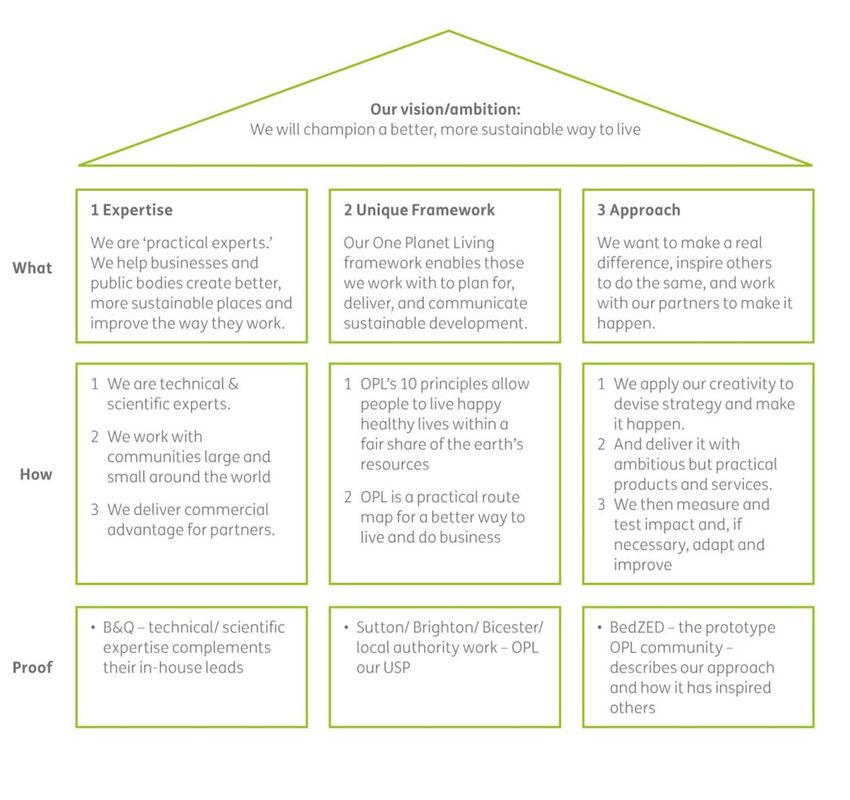
5Our USP - what differentiates Bioregional from others?
The Message House (below) sets out the points of differentiation which help us to work
effectively and stand out from our competitors.
6Our Strategic Aims for 2015-2020
Our Strategic Aims for 2015-2020 are set out in summary below, with more detail on our
objectives and our business plan to achieve them in following sections.
External aims:
1. One Planet Living is the major globally used and recognised framework for
creating better places to live and work.
2. A global network of One Planet Living enterprises and projects provide a
compelling experience of sustainable living and working
3. Research and propose innovative solutions that will enable One Planet Living.
4. Influence policy at critical levels to reflect One Planet Living by leveraging our
evidence base.
Internal aims:
1. Develop and deepen our expertise in One Planet Living by exchanging knowledge
and skills with experts of a complementary vision and ethos.
2. Be the “go- to” organisation for the next generation of people who are going to fix
the environment. We are comfortable, happy and effective at working in this
world while creating the next.
7Strategic review - Bioregional’s five focus areas for 2018/19
Management Team undertook a strategic review in October 2017 with input from
trustees.
Bioregional’s five focus areas for 2018-19
MT considered successes and challenges and drew out five key focus areas to inform the
development of our Business Plan for 2018-19.
Cross organisational
1. Profitability, ensure that we understand risk and return
2. Focusing on winning work that we can win and that is worth winning
3. How to scale our work and our impact with urgency
Strategic initiatives
4. Scaling One Planet Living to make more impact
5. Bioregional-led property development, particularly make a success of Chobham
and replicate it
Service area changes
Service areas group types of income-generating work and associated income streams
more clearly. MT reviewed and updated the service areas.
Our service areas in 2018-19 are:
1. One Planet Living, comprising of One Planet Living initiative and OnePlanet.net
2. Bioregional-led communities (Bioregional Homes)
3. Corporate Advisory
4. Placemaking Advisory
5. Oxon
6. BEPIT – Building Energy Performance Improvement Toolkit
7. UKSSD – UK Stakeholders for Sustainable Development
The table on page 11 shows this in graphic form, together with who is responsible for
each programme and service area.
Energy, policy and innovation strategies
It was decided that energy, policy and innovation are cross cutting, and may occur in
any service area. Therefore, rather than these being service areas we would instead
develop strategies and guidance for our work on energy, policy and innovation, these are
summarised below.
8Energy Strategy summary
Bioregional’s energy aims are to help the transition to a zero-carbon world, using our
unique role in the built environment, demonstrating viable approaches and business
models with corporate partners, new residential construction, local neighbourhood
energy projects, primarily in the UK, leveraging the stories to change policy and practice.
Bioregional delivers energy related work across all service areas but we can summarise
our focus in 3 areas:
1. Corporate
These services are best as part of a wider partnership, allowing us to tailor work to
exactly what the client needs, based on a deeper understanding of their business. Scope
includes:
• Strategic energy advice
• Overall carbon targets, Scope 1-3
• Renewable energy purchasing
• Market research, modelling
• Specifications for new property energy performance
Actions for 2018-19:
• Refine corporate energy offer based on current work programmes and key
strengths
• Develop comms/BD strategy including:
a. Insights paper
b. Introduce to existing clients
c. 1 Energy event
d. Target new corporate clients
• Secure and deliver projects
For details see Sustainable Business and Placemaking service area workplans
2. Built Environment
We have a range of advisory service offers through which we aim to inspire by
demonstrating an effective approach to delivering zero carbon in buildings.
• Zero carbon strategies for our own developments (e.g. BedZED, One Brighton)
and for other One Planet Communities (e.g. NW Bicester)
• The Building Energy Performance Improvement Toolkit (BEPIT) service closes the
performance gap in new homes
• Energy related planning support (e.g. Lambeth)
• Heat network feasibility studies (e.g. Newhaven, Bicester, Rosehill)
Actions for 2018-19:
1. Secure new Bioregional-led community sites, deliver zero carbon strategies,
employ BEPIT during construction
2. Build BEPIT into a nationally recognised service amongst housebuilders and
secure a new BEPIT customer every quarter
3. Advise on zero carbon strategies for other new communities
4. Deliver heat network feasibility studies for partners who have secured RCEF,
HNDU or HNIP funding
For details see BEPIT, Placemaking and Bioregional Homes service area workplans
3. Local Energy Demonstrators
Bioregional has a history of facilitating flagship neighbourhood level energy projects with
strong community involvement. The aims of local energy demonstrators are to:
• Overcome barriers to communities becoming zero carbon
9• Developing viable scale up solutions
• Use learnings to support and advise partners in their projects
Actions for 2018-19:
We have existing funding through Oxfutures to:
• deliver an urban demonstrator in Rose Hill, Oxford
• develop the Energy Local model for different applications
• Complete a LEMUR mapping of Oxfordshire’s entire housing stock condition
• Assist community action groups with their thermal imaging campaigns and
provide technical advice on neighbourhood scale retrofit
• Work with Low Carbon Hub and Parity Projects to develop a business model for
RetrofitWorks in Oxfordshire
• Work with the 5 Oxfordshire local authorities to interpret the LEMUR analysis and
develop retrofit programmes (e.g. Warm Homes with Oxford City)
• Progress the HNDU-funded heat network feasibility study for Rose Hill with
Oxford City
• Work with Carbon Alternatives to explore potential RCEF applications in
Oxfordshire
We have 3 funding applications already submitted which if successful will match fund
Oxfutures and will progress Energy Local and LEMUR work. These will go through the
innovation filter process before funding is accepted.
Focussing on these existing specialisms, any new funding applications will first go
through the innovation filter process. No unfunded Business Development time will be
spent without first going through the filter process.
For details, see Oxon Workplan Objective 5
Policy Strategy summary
Bioregional’s policy strategy sets out how to employ policy advocacy to best play our
unique role in achieving One Planet Living and helping implement the Paris Agreement
and the SDGs with urgency and scale – while ensuring that as a charity we maintain an
annual surplus across the organisation.
Bioregional’s strategy includes a specific aim to: “influence policy at critical levels to
reflect One Planet Living by leveraging our evidence base’.
Our strategic objectives, as set out in our 2015-20 strategy plan are:
1. Achieve SCP in the SDGs – achieved.
2. Implement the SDGs - Work with partners to advocate for and support the
implementation of the Post 2015 Sustainable Development Goals by joining or
leading and responding to appropriate initiatives.
3. UK policy - Working with partners, campaign for change in the UK during the
2015-2020 Parliamentary term; we will advocate well-considered and feasible
national and local level policies which implement OPL, with a specific focus on
sustainable energy, communities, homes and implementation of the SDGs in the
UK.
The complete policy strategy can be found here.
10New project or service approach and process
In line with our values and cross organisational objectives we have created a new
‘Project Development Approval Process’. This sets out a robust process for how we
ensure that when developing new project ideas that we are minimising risks to the
organisation. This process will now apply to any decision to spend business development
time i.e. staff resource (including using existing grant funding) on all new projects, and
any new stages of ongoing projects. We have identified three risk categories:
- Category A (Low risk): Paying customer (at commercial rates) has been
identified and the project fits with our core skills and experience, target market
segments / SA work plan objective(s). Decisions on whether these opportunities
are taken forward will be managed by the relevant Programme Sponsor.
- Category B (Medium Risk): Grant funding or investment body identified and
the project fits with our core skills and experience, target market segments / SA
work plan objective(s). Providing the relevant service area is making a surplus
(YTD) or it has CEO sponsorship, decisions on whether the project is pursued are
agreed by the Head of Finance and relevant programme sponsor based on a
completed Project Proposal form.
- Category C (High Risk): No client or grant funding identified but the project fits
with our core skills and experience, target market segments / SA work plan
objective(s). Providing the relevant service area is making a surplus (YTD) or it
has CEO sponsorship, decisions on whether the project is pursued are agreed by
the full Management Team based on a completed Project Proposal form. Where
an agreement is not reached, input from the most relevant trustee member(s)
will be sought.
The below projects for 2018-19 are under review and will go through the above process;
Category C
1. KUISHI
2. BDG-led affordable, sustainable communities concept with Chobham as a case
study example
3. OP.net
4. Ecology Park
5. Greentech
Category B
6. Transform Together
7. Energy Local
8. Community energy manager concept and linked projects (e.g. Cleaner, warm
homes)
Category A
9. Bioregional Homes Tishman Speyer and Grainger advisory and profit share type
arrangements
11Bioregional Programmes and service areas
In order to deliver on our 2015-20 strategic objectives, we have set out projects and
activities under seven service areas against these objectives in each of our four ways of
working as seen in the table below.
Service areas ONE PLANET SUSTAINABLE SUSTAINABLE
OXON & BEPIT UKSSD
LIVING BUSINESS PLACES
MT Sponsors POORAN HAYLEY RONAN NICOLE JULIA
ONE PLANET 1A. One Planet
LIVING Living
Ben
1B.Oneplanet.net
Pooran
BDG-LED 2. Bioregional 5A. Oxon
COMMUNITIES Homes (New Build
Communities)
Anthony Lewis
ADVISORY 3. Corporate 4. 5B. Oxon
SERVICES Partnerships Placemaking
Majonne Lewis
6. BEPIT
Anthony
Doug
UKSSD 7. UKSSD
Emily
High income Medium income Low income
potential potential potential
(£250k+) (£100k - £250k (2018/19 Work plan
In the following 2018/19 work plan we have set out how we will achieve our 2015-20
Strategic Aims and our five key focus areas.
Our Plan is organised into two sections as follows:
1. Programme and project delivery –We organise our work into seven service
areas.
2. Central support - Central team support the delivery of our strategy through
Leadership and Governance, Development, Communications, Finance, Operations
and HR.
13One Planet Living (1)
Pooran Desai (until oneplanet.net investment comes through) with
MT Sponsor
Sue, Julia and Ronan leading on various aspects through OP Steering
Group (OPSG)
Team/Service Ben Gill
area lead(s)
Strategic aim One Planet Living is the major globally used and recognised
framework for creating better places to live and work.
A global network of One Planet Living enterprises and projects
provide a compelling experience of sustainable living and working
Strategic 1. Secure more paying customers by understanding their
Objectives needs and how OPL can help. We believe this will enable us
to
• Win more OPL-related advisory work from
Bioregional’s existing and new customers (PD/BG)
• Sell peer reviews and training
• Develop new licensing model with partners
(PD/All)
2. Spin off oneplanet.net in a way that scales OPL as
successfully as possible and that considers the interests of
Bioregional (SR, TS)
3. Strengthen the OPL brand through developing a new brand
management strategy which includes
• Secure the TM from WWF which will enable us to scale
OPL (PD/SR)
• Capitalise on the proliferation of new ‘One Planet’
initiatives by placing OPL as the gold standard mark of
commitment (SR)
• Ensure the integrity of the brand when oneplanet.net
becomes a separate company (JH)
• Leverage OP.Net global founders (Integral, Sherwood,
Urban Equation and FCBS)
4. Finalise Bioregional’s new ‘One Planet programme’
including finalising all tools, manuals and fees and sharing
with all existing partners and staff
(BG with JH/EB)
5. KR One Planet Cities and Wates One Planet Schools:
Successfully implement projects (MF, MG, HBB, LK)
6. Develop Integrator Training to a professional standard
and promote (BG with RL/SR)
7. Support international sister organisations and
representatives including Bioregional South Africa,
Bioregional Australia and Marika where possible through
combined income generation. (BG/PD)
14Costs and Costs: (based on 3.7 FTE incl. Pension, NI and OH): £417K
Income
target FTE: 3.7
(Complete this
once the rest Income Target: £540K incl. 17% margin
of template is
Secured Income 18/19: £99,000 and £181,000 from KR
finished)
foundation. Total £280k
CL1 Income 18/19: £0
Grant Fundraising Target: £150K
Market Who needs this?
(customers - Initial targets are a) Cities and their associated organisations
and (companies and schools) and b) developers
competitors) - The approach is available to anyone
Who will pay for it? Revenue streams.
- Existing partners
- Cities and Projects using the new system
- Consultants getting Integrator training (target 60 paying
integrators at average of £300) and assessments (target 30
at average of £300)
What is the Value Proposition?
- Cross sector engaging ‘hearts and minds’ approach you can
use for sustainability strategy and engaging staff and
customers
- Proven track record
- Increases competitiveness/resiliency and reduces risk
- It is an approach that you can use yourself and integrate into
your existing ways of working
Across the potential field available to us, where will we choose to
play?
- Existing markets: actively pursue cities and developers
- Tourism and companies as and when opportunities arise
and not play?
- Not partner with existing programmes unless on terms which
work clearly from a financial perspective for both parties
- Not focus on companies initially
How will we choose to win against the competitors there?
Stick to core OPL philosophy of flexibility not standards with
credibility through disclosure, transparency and sharing Minimise
obstacles to starting to use OPL– allowing customers to choose
how to engage with the programme by having very low barriers
to entry but clear opportunities to ‘upsell’
- Ensure oneplanet.net embodies core philosophy of OPL.
Maximise functionality – effective project management and
engagement tool
- Build virality into OPL
- harness customer recommendations
Partners – UN 10 YFP One Planet Network, C40, Global Covenant of
Mayors, WWF, ICLEI
15Actions and SMART milestones to achieve objectives including targets (include
milestones and note if outcomes are a commitment to funders or clients.)
(2018/19)
Q1 - Finalise Bioregional’s new ‘One Planet Living
programme’ incl. tools, manuals & fees (BG with OPSG, TS)
- Benefits of OPL clarified for use in marketing & bids (AP)
- Market research findings shared to inform sales and
marketing strategy (PD/JH/RL)
- Cost of running programme & fees Identify what is
needed to run core OPL programme and establish costs and
income for new services and fees. (TS with OPSG)
- Bioregional’s Marketing strategy implemented including
selling OPL advisory services & training, building on our USP
as source of OPL, track record and authenticity (JH)
- PR - Organise press trip to Villages Nature in April (JH)
- Training improved by mid-May & CPD certified (BG, RL, SR)
- KR OP cities - first Integrator training & city-wide
workshops with cities (PD, BG, RL, HBB, MF, MG)
- Wates OP schools - start working with 4 schools on their
OPAPs (PD/LK)
- OPL and various One Planet initiatives & new WWF
position – negotiate with parties to arrive at a good outcome
for all. (SR, PD)
- OPL Brand & IP strategy developed to take advantage of
proliferation of One Planet initiatives and new WWF position.
(JH, SR, PD)
- Agree working arrangements between OPL at Bioregional
and One Planet Digital should a new company be established,
building on Heads of Terms of February 2018. (SR, PD)
- Spin out OP.net if agreed with trustees/investors (SR,TS)
- OP partnership programme – develop offer (BG,PD,JH,EB)
- OP Partners Share new OPL programme with existing
partners (incl. Global Founders) and staff (BG with JH/EB)
- Bioregional Australia – develop a way forward which
addresses communications and financial issues (BG, PD, JH)
- Sister organisations & representatives – determine
resourcing requirements and objectives and agree approach
with MT (BG, PD)
Q2 - KR OP cities - run stakeholder OPAP workshops (PD, BG, RL,
HBB, MF, MG)
- Wates OP schools – complete 4 school OPAPs (LK)
- Run one OP Integrator training course
- Complete first OP Integrator assessments
- Complete 2 peer reviews
Q3 - KR OP Cities – support stakeholders and delivery partners
(PD, HBB, MF, MG)
- Run 3 Integrator training course
- Complete 5 OPI assessments
- Complete 5 peer reviews
-
Q4 - KR OP Cities – support stakeholders and delivery partners
(PD, HBB, MF, MG)
- Run 3 Integrator training course
- Complete 10 OPI assessments
- Complete 5 peer reviews
16Resources What capabilities are necessary to build and maintain to win in our
required chosen manner?
People – Who are the team, what skills, what % time on the project,
new staff needed/grades.
Staff
- PD 40%
- BG 3 days per week
- SR 20%
- JH 20%
- EB 20%
- Kat 40%
- MF 1 day per week
- New project officer 33%
- Identify and train staff in new OPL system, benefits and costs
Partners
- Global Founders
- OP partners
- New customers
Cost - Capital (set-up) and ongoing operational costs.
- Trip to VN (£4K)
A couple of brochures
What specific support is needed from any of the following central
support areas?
- Comms on manual, brochure
- Comms to help organise and promote Integrator training
- Steering group time (1 day per month SR, JH, EM, BG, RL
Grant fundraising:
- For the platform
- For expanding cities pilot?
Business development:
- Mainly digital promotion and referrals from existing customers
CEO:
- IP and trademark negotiations
- Negotiations and relationship with OP.net
Communications and marketing:
- Completing brand strategy
- Comms on manual, brochure
- Comms to help organise and promote Integrator training
Policy:
- Not significant
Finance:
- OP platform negotiations and agreement
17OnePlanet.Net
Pooran Desai
MT Sponsor
Team/Service Pooran
area lead(s)
Stop gates 1) After the funding from the KR foundation for development of
the platform has been utilised, if there is no other external
funding secured then spending on the platform will stop.
Strategic aim
Planet Living is the major globally used and recognised frameworks
for creating better places to live and work.
Research and propose innovative solutions that will enable One
Planet Living.
Strategic 1. Secure more customers
Objectives
2. Spin off oneplanet.net
3. Continually improve oneplanet.net functionality
Costs and Costs: (based on X FTE incl. Pension, NI and OH): TBD
Income
target FTE: TBD
(Complete this
once the rest Income Target: Customers £150K, and grants £250K plus capital
of template is investment into OP Digital (£250K)
finished)
Secured Income 18/19: £0
CL1 Income 18/19: £0
Grant Fundraising Target: £250K
Market Who needs this?
(customers
and - Cities and their associated organisations (Companies and
competitors) schools) and b) developers
Who will pay for it? Revenue streams.
- Existing partners
- Cities and Projects using the new system
- Consultants for listing after getting Integrator training
What is the Value Proposition?
- Cross sector engaging ‘hearts and minds’ approach you can
use for sustainability strategy and engaging staff and
customers
- Proven track record
- Increases competitiveness/resiliency and reduces risk
- It is an approach that you can use yourself and integrate into
your existing ways of working
18Across the potential field available to us, where will we choose to
play?
Existing markets: Cities, developers and companies mainly via
network of One Planet Integrators
and not play?
- Not partner with existing programmes unless on our terms
which work clearly from a financial perspective for both
parties
- Not focus on companies initially
How will we choose to win against the competitors there?
- Stick to core OPL philosophy of flexibility not standards with
credibility through disclosure, transparency and sharing
- Have very low barriers to entry but clear opportunities to
‘upsell’
- Ensure oneplanet.net embodies core philosophy of OPL
- Maximise functionality – effective citizen engagement tool
- Build virality into OP.Net
- Ensuring customers are happy every step of the way by doing
constant on-line feedback/daily deployment
- Timely to market by launching in April come what may
Actions and SMART milestones including targets (include and note if outcomes
milestones are a commitment to funders or clients.)
(2018/19)
Q1 - First working tool for cities for KR pilot
- Finalise and validate business plan for OP.net
- Agree division of responsibilities between OP Digital and
Bioregional
- Define IP/Brand protection strategy, inc. reputational risk
(Bior)
- Secure first customer for OP Digital
- Establish OP Digital as new company
- Secure first round investors
- Continue submitting grant applications and secure at least
£50K in grant funding
Q2 - Support KR pilot
- Have full working system to capture KPIs to capture impact
- Secure more customers
- Continue submitting grant applications and secure at least
£50K in grant funding
Q3 - Secure second round investors
- Fully functional working platform for cities
- Secure more customers
- Continue submitting grant applications and secure at least
£50K in grant funding
Q4 - Secure more customers
- Continue submitting grant applications and secure at least
£50K in grant funding
Resources What capabilities are necessary to build and maintain to win in our
required chosen manner?
People – Who are the team, what skills, what % time on the project,
new staff needed/grades.
19- Pooran/Ben/Jan – subject area experts
- Barrie - CTO
- Digital designers/coders (2 x full time, 1 x 50% time)
- Customer development (TBC)
- Paul M - Investment
Partners and customers
- Paul Tudor Jones
- Cities (e.g. in California)
- Global Founders
- OP partners
- New customers
Cost - Capital (set-up) and ongoing operational costs.
- Pooran 40%;
- Ben 1 day per week
- 2.5 x coders @ Euros 4k/m
- Software licences £20K pa
- Kat 40%
- Jan Gerhards (?)
- Barrie (?)
What specific support is needed from any of the following central
support areas?
- Comms to help organise and promote Integrator training and
drive business to OP.Net
Grant fundraising:
- For the platform e.g. Innovate UK
Business development:
- Mainly digital promotion
CEO:
- IP and trademark licensing negotiations
- Negotiations and relationship with OP.net
Communications and marketing:
- Completing brand strategy
- Comms on manual, brochure
- Comms to help organise and promote Integrator training
Policy:
- Not significant
Finance:
- OP platform negotiations and agreement
20Bioregional Homes Ltd (2)
Bioregional Homes Ltd has been set up as a wholly-owned subsidiary of the Charity.
MT Sponsor Ronan Leyden
Stop gates 1) Camden Rd or equivalent is secured and site finder’s fee
received (£150k, of which a £30k contribution made to BDG).
2) Incur no more than £120k in costs before having secured the
next partnership/site finder’s fee.
3) The alternative ‘mode of operation’ will be to re-assign BDG
staff to Sustainable Places and elsewhere, and solely continue with
the Managing Director’s time (contractor not staff) until such an
opportunity is secured.
Team/Service Anthony Probert
area lead(s)
Strategic aim Deliver an income generating pipeline of One Planet Communities
around our active areas of core activity in England (where
affordability is most acutely an issue) that include a significant
proportion of homes that are accessible to local people on ordinary
salaries.
Strategic 1. Partnerships:
Objectives This approach involves securing a fee-based arrangement
with larger developers based on a % of construction costs
paid out on completion of key development milestones, and
ideally also including a profit share element.
a. Secure at least two more sites to activate income
streams and new OPC projects. Seek additional sites
to roll out model beyond FY18/19.
b. Replicate the Tishman Speyer partnership approach
with at least one other (e.g. Grainger, Carey’s or L&G)
by identifying and securing suitable sites for
development within FY18/19.
c. Payback historic costs accumulated by BDG within 3
years of operation (FY20/21).
2. Direct development:
This approach involves setting up SPVs to raise finance and
lead development of One Planet Communities that are
shaped with the local community and priced according to
local incomes.
a. For Chobham SPV - secure pre-development, land
purchase and development finance and achieve
planning permission within FY18/19.
b. Be open to prospective new opportunities but carefully
minimise time spent pursuing them.
c. Have initiated second development by 20/21 and
completed it by 23/24.
3. Communicate learning to influence change
We will gather learning with the intention of disseminating it
widely to influence how affordable sustainable housing can
be delivered more efficiently and effectively.
21Costs and Costs: (based on 2.7 FTE incl. Pension, NI and OH): £310K
Income
target FTE: 1.7 [plus MD as full-time contractor]
(Complete this
once the rest Income Target: £341K incl. 9% margin
of template is
finished) Cashflow model here.
Secured Income 18/19: £0K
CL1 Income 18/19: £0K
Grant Fundraising Target: £150k
Market Who needs this, who will pay for it? Revenue streams. What is the
(customers Value Proposition? Across the potential field available to us, where
and will we choose to play and not play? How will we choose to win
competitors) against the competitors there?
1) Our partnership offer is designed for enlightened
developers with a good track record on high quality
development (willing to take a longer-term view on the value
of reputation and customer satisfaction), who are looking to
improve the customer experience and tap into the latent
demand for homes that support modern sustainable living.
We aim to partner across private sale and PRS with larger
companies that can absorb the additional cost of our service
and buy into the model of providing an enhanced offer that
will open up new site acquisition opportunities, go through
planning more smoothly, sell or rent faster (with lower voids),
and encourage long term demand in their offer across the
development portfolio based on enhanced profile and
reputation. We will focus this offer on urban development’s
typically of 150 units upwards, predominantly within London,
but be open to opportunities across the South East and
possibly Bristol.
2) Our direct development offer will focus on identifying (and
being approached with) site opportunities where there is a
latent or organised community appetite to take an active role
in shaping housing development in their local area to provide
sustainable and locally affordable homes. The aim is to
establish a pipeline of projects, with the proceeds of one
seed-funding the next. For pre-development we begin by
raising social-impact finance (e.g. CAF or CDS), followed by
eventually re-investing our own revenue. For development
finance, we explore government loans (i.e. Homebuilding
Fund) and equity investment with private impact finance
(Sainsbury’s family trusts), development partners (e.g.
Carey’s or L&G) and social-housing organisations (e.g. CDS).
By working in areas with a strong local community demand
for locally affordable homes, the sales and letting of
properties will be faster and require much less marketing and
sales. We are creating a unique proposition, where we
develop a replicable sustainable and locally affordable housing
model. We will provide an end-to-end development service
that partners with the local community to help raise finance,
22achieve planning, design and construct and set up
governance structures to create a legacy.
Actions and SMART milestones including targets (include and note if outcomes
milestones are a commitment to funders or clients.)
(2018/19)
Q1 1)a) Maintain connection with TS to support land purchase of
Hounslow site. Continue to seek additional sites through council
contacts and private leads. These may be suitable for TS or may be
able to offer to other partners.
1)b)i) Support Carey’s with a One Planet development vision for the
Camden Road site to be completed FY1819.
1)b)ii) Continue to act as facilitator and negotiator for Grainger on
the Hackbridge site.
2)b) Have established Chobham SPV and secured £150k pre-
development finance.
2)b) Have appointed architects and design team. Have completed
informal discussion with the LPA. Have engaged local community and
developed an initial development vision and outline OPAP for the
project. Have completed the initial site surveys and incorporated
into planning submission-ready format.
Q2 1)a) Begin to support the development vision and sustainability
strategy for the planning submission of Hanworth Rd, Hounslow.
Continue to seek additional sites through council contacts and
private leads. These may be suitable for TS or may be able to offer
to other partners.
1)b)i) Support Carey’s to complete the One Planet development
vision for the Camden Road site.
1)b)ii) Continue to act as facilitator and negotiator for Grainger on
the Hackbridge site.
2)a) No further action on this.
2)b) Have completed a pre-app. Have engaged local community to
finalise masterplan design and sustainability action plan for the
scheme. Work on detail of the stage 3 detailed design, planning
statements and sustainability statement (ready for submission by
month 9). Have initiated land and development finance
conversations with at least 3 potential investors/sources.
Q3 1)a) Continue support the development vision and sustainability
strategy for the planning submission of Hanworth Rd, Hounslow.
Continue to seek additional sites through council contacts and
private leads. These may be suitable for TS or may be able to offer
to other partners.
1)b)i) Support Carey’s with any adhoc work for Camden Rd site, but
mainly put down to give them space to negotiate lease with Kwik-Fit.
1)b)ii) Aim to conclude the Grainger negotiation on the Hackbridge
site and have secured the site finder fee.
2)a) No further action on this.
2)b) Have completed and submitted planning. Have lined up
(secured but not signed) land and construction finance, or be close
to doing so.
23Q4 1)a) Continue to support the development vision and sustainability
strategy for the planning submission of Hanworth Rd, Hounslow.
Continue to seek additional sites through council contacts and
private leads. These may be suitable for TS or may be able to offer
to other partners.
1)b)i) Support Carey’s with any a-hoc work for Camden Rd site, but
mainly put down to give them space to negotiate lease with Kwik-Fit.
1)b)ii) Support Grainger to develop a Sustainability vision and action
plan for the Hackbridge site.
2)a) Have interacted with at least 1 potential new site for next SPV.
2)b) Have secured planning (or on the cusp of). Have secured land
and construction finance ready to activate upon planning approval.
Have run a procurement process for appointment of the primary and
specialist contractors. Have decided on a sales and marketing
approach/team.
Resources What capabilities are necessary to build and maintain to win in our
required chosen manner?
People –
Key staff and core team:
• Russell Tame will be Managing Director and will manage the
daily operations of the company as well as lead on identifying
and securing new partnerships.
[NB contractor to Bioregional Homes not an employee of BDG]
[ A proportion of following people will be shared with the
delivery team/central function]
• Sue Riddlestone will continue to oversee this area and new
company (Bioregional Homes) taking an active role in weekly
decision making and identifying and progressing new leads
and opportunities.
• Ronan Leyden will act as senior development manager
leading on delivering the Chobham development and
supporting on delivery of support services to partnerships.
• Anthony Probert will act as development manager leading on
support with new partnership development and site
identification, alongside supporting the delivery of support
services to partnerships.
• Doug Drewniak will provide ad-hoc technical support on
construction models/techniques and energy performance
across the projects.
• Matt Wood will provide ad-hoc technical support on energy
strategy and delivery options across the projects.
The aim is to establish a secured pipeline of project work and
associated income, which will then allow the team to draw in the
following roles:
• New Project Manager – this role will come in with a
background experience of working across the residential
development phases to deliver sustainability support.
• Existing project officer – this role will provide general support
including with administration running the company and
meetings, as well as on individual projects spanning
partnership support services and direct delivery activity.
24Partners –
The business model is reliant on securing partnerships with major
developers (to provide our partnership services – “brand licensing”)
and to secure finance to build our own developments. Key partners
this year will include:
- Tishman Speyer
- Carey’s
- Grainger
- Legal and General
Costs –
They key costs of the business will actually be staff time, overhead
and direct costs such as travel, training, marketing and conferences.
Any capital costs and consultant time for the direct development
projects will be billed through the SPV’s and funded through finance
raised (as per above).
Grant fundraising –we may need occasional ad-hoc support to
raise finance e.g. CAF application and explore impact investment and
finance options.
Business development – the area focuses on delivery with a
maximum of 10% of time on business development (identifying new
sites and securing partners).
CEO: see staff above.
Communications and marketing: We will need support raising
profile, creating a website presence, and promoting our projects as
they are secured.
Policy: We could consider promoting our Chobham approach but will
need to consider carefully. May be better to get the model right
before shouting about it!
Finance: We need support in creating and maintaining the budget
and managing the governance around board meeting, legal guidance
and financial returns.
25Sustainable Business (3)
MT Sponsor Hayley Baines-Buffery
Team/Service Majonne Frost
area lead(s)
Strategic aim Inspire and embed sustainable outcomes across a wider range of
corporates for their own operations and customer offer who will
become exemplar providers of sustainable homes, food and
consumer goods.
Strategic 1. Work with six large companies by 2020 from the retail and food
Objectives and beverage sectors to create and implement ambitious
sustainability strategies and monitor performance.
2. Collaborate with the sustainable place making team and develop
comprehensive sustainability work programmes for high street
retailers and the built environment sectors with an initial portfolio of
projects established by 2020
3. Refine, improve and launch an online circular value chain
assessment tool by 2020
4. Be the driving force behind a new mainstream sustainable product
or service
5. Become recognised as leaders and technical experts in sustainable
consumption and production
Costs and Costs: (based on 7.75 FTE incl. Pension, NI and OH): £499K
Income
target FTE: 7.75
(Complete this
once the rest Income Target: £529K incl. 6% margin
of template is
finished) Secured Income 18/19: £358K
CL1 Income 18/19: £0K
Grant Fundraising Target: £0K (please itemise what for)
Market Key sectors: Retail, FMCG, Developers, Construction, Engineering
(customers
and Key work streams:
competitors) • Sustainability strategies and action plans
• Reporting and data co-ordination
• Products and circular economy (reporting and standards)
• Implementation support (delivery of action plans/strategy)
Value Proposition: What differentiates us from others is that we
turn visions into something practical by helping our clients to
‘operationalise’ sustainability visions and action plans.
How we compete: We compete through focusing on sectors where
we have a strong track record, establishing long term clients and
through offering support on issues that are hard to tackle. We can
provide detailed practical support that is not offered by other
sustainable business NGOs (e.g. Forum and BITC).
Actions and SMART milestones including targets (include and note if outcomes
milestones are a commitment to funders or clients.)
(2018/19)
26Q1 • Within our target sectors, identify key organisations we want
to target and put our service offer in writing
• Develop our approach for measuring our impact and that of
our clients against the SDGs
• Explore potential partnerships with digital platforms/business
associations e.g. sustainable communications experts who
complement our strategic and technical expertise
• Explore the development of new services that support
strategy implementation e.g. employee engagement
• Work with Kingfisher and other partners to test our current
methodology with a wider business audience e.g. M&S
(Q1+Q2)
• Define our project criteria for working on a new mainstream
sustainable product or service (technical/secretariat role,
scale up existing product/service)
• Define 1-3 project ideas that meet our criteria for a new
mainstream sustainable product or service and create outline
scope of work.
Q2 • Content marketing plan agreed and implementation
commenced for sustainability strategy, products offer as well
as joint offer with place making team (ongoing)
• Research status of work carried out by other organisations
(including industry associations) on SDG-related KPIs for
businesses (July 18)
• Feasibility study re: sustainable product or service (aim to
secure support from MBA student) (Q2-Q3)
• Identify where we can leverage our knowledge and insights
from our projects (e.g. smart phone working group work in
2017) to influence policy and enable sustainable consumption
and production (ongoing)
Q3 • Based on research conducted in Q2, establish our own list of
relevant KPIs for per relevant SDG/SDG target (for our retail1
and food & beverage sectors) (October 2018)
• Run SCP event jointly with UKSSD
• Aim to work on a concrete project with the selected digital
platform partner (Q3 and Q4)
• Take learnings from further testing and refine and improve
our CVC assessment methodology accordingly
Q4 • Test our approach and obtain feedback from corporate clients
on our approach to measuring impact against the SDGs
(ongoing Q3 and Q4)
• Start to explore potential providers and funding opportunities
(corporate/grant) for creating a circular value chain online
tool – either new or through collaborating with an existing
platform.
• Funded pilot project in place re: sustainable product or
service scale-up
Resources People – See FTE allocation
required Senior staff member key responsibilities
• Hayley – B&Q Account manager and overall partnership
manager for Kingfisher. Supporting Claire and Catherine with
business development and others as required. Also generates
business development leads independently
1
This could be done based on work done by the BRC. We could explore potential collaboration as well.
27• Majonne – SEAL, deputy responsibilities for overall service
area budget and implementation of work plan. Kingfisher
monitoring and reporting lead
• Claire – Business development lead focussing on circular
economy
• Catherine – Project delivery lead for non-Kingfisher projects
and business development lead for non-UK clients and
partners
• Suzannah – Project Manager leading sustainable products
programme as part of Kingfisher retainer
Project officers: Johanna, Lyndsey and Chloe will work primarily on
the Kingfisher retainer agreement and other projects where required.
Opportunities to lead specific project areas within the Kingfisher
partnership have been identified. Marina is main project officer
supporting sustainable products work. Matt C working across
corporate and place making advisory focussing on energy and
materials/fit out.
We aim to secure support from a Masters or MBA student to produce
a feasibility study for our sustainable product/service objective
Aim to create two new project managers and two new project officer
posts in the next 12-18 months with a net increase of two FTE.
Cost - costs are mainly staff costs. Some direct costs associated
with external consultants, staff training, attending relevant
conferences and design work. Budget for and deliver staff training to
maintain & improve technical capacity. Budget for attending
conferences and to raise our profile through marketing & sponsorship
opportunities e.g. The Crowd
Development - We will spend on average 25% of our time on
business development to deliver our objectives and income target.
Communications and marketing - support to develop and
implement our content marketing plan. Occasional design work
(costed into projects).
Policy
• We expect we need some support from Policy to help us
shape our commonly accepted SDG methodology and
approach to reporting on progress.
• Support with leverage insights from projects to inform policy
e.g. re: sustainable consumption and production
Finance - we may need some support from Finance to develop our
Memorandum of understanding with our digital platform partnership.
28Sustainable Places (4)
Ronan Leyden
MT Sponsor
Team/Service Anthony Probert
area lead(s)
Strategic aim
Use our One Planet approach and wider sustainability skills to create
better and more sustainable places to live, work and do business,
predominantly in the UK.
In doing this we will:
• Create a financial surplus by providing high-quality,
dependable and bespoke sustainability support to developers,
planning authorities, property owners and others who design,
construct and maintain the built environment.
• Establish long-term partnerships and to embed across
lifecycle phases by establishing and maintaining good
contacts at multiple levels and departments.
• Achieve impact with urgency and communicate the
learning.
Strategic 1. Secure significant sustainability vision and OPAP
Objectives advisory roles on pre-development and masterplan
projects using the One Planet framework. One major
project per year, with smaller ad-hoc advisory work in
addition.
2. Replicate and expand planning advisory support
services to other LPAs, predominately within London.
Maintain existing and secure at least 1 further significant
contract within 2018/19.
3. Replicate and expand sustainable fit-out support
services (including SKA, bespoke, post-install monitoring
and circular value chains) with at least 3 other companies
by 2020
4. Trial the offer of energy and carbon management
support services for large estate owners and operators
(prioritising the sectors of offices and F&B retail)
5. Develop an SDGs offer around support with translating
and applying them to the built environment sector.
6. Collaborate with the sustainable business team (re:
aims 3,4,5) and develop comprehensive sustainability
work programmes for high street retailers and the built
environment sectors with an initial portfolio of projects
established by 2020.
7. Make existing OPAL services widely available and
test the market with at least 6 groups in 18/19 including
3 by BDG staff, and 3 by TbD (who will lead on
promotion). Further develop the alternative finance
model. Cross promote wider services such as BEPIT.
Costs and Costs: (based on 3.1 FTE incl. Pension, NI and OH): £197K
Income
target FTE: 3.1
(Complete this
once the rest Income Target: £237K incl. 17% margin
29You can also read


