CANE TOAD MANAGEMENT HANDBOOK - Rangelands NRM
←
→
Page content transcription
If your browser does not render page correctly, please read the page content below
CANE TOAD MANAGEMENT HANDBOOK
Who is this book for?
This handbook was made for Kimberley ranger groups who want to learn
more about cane toads and their options for management on country.

Acknowledgements
This resource had been developed in partnership between Rangelands NRM, the Cane Toad Initiative for Western
Australia (Department of Parks and Wildlife) and community group Kimberley Toad Busters.
The production of this resource has been made possible by Rangelands NRM through funding from the Australian
Government’s National Landcare Programme.

Publisher:
Copyright ©2016 Rangelands NRM
The Rangelands NRM copyright protects this application. Except for purposes permitted by the Copyright Act,
reproduction by whatever means is prohibited without the prior written permission of Rangelands NRM.
www.rangelandswa.com.au, info@rangelandswa.com.au
ISBN: 978-0-9943781-1-8 - Cited as Rangelands NRM, 2015, Ranger Handbook: Cane Toads, Rangelands NRM, Perth
WA
This resource is available in alternative formats on request.

Project Leaders:
Grey Mackay, Rangelands NRM
Corrin Everitt, Department of Parks and Wildlife

Project Writer:
Sally Johnston, Department of Parks and Wildlife

Project Review:
Lee Scott Virtue, Kimberley Toad Busters

Illustrations/Photos:
Majority of images supplied by the WA Department of Parks and Wildlife
Page 18 image Kimberley Reptiles. Page 12 image David Nelson.

Layout & Design: Swish Design
Editing: Teresa Belcher, Rangelands NRM

      The production of this publication was supported by Rangelands NRM through funding from the Australian
                                     Government’s National Landcare Programme
CONTENTS
Introduction................................................................................................................................... 2

Safety............................................................................................................................................... 6

Cane toad identification.............................................................................................................. 8

Cane toad ID checklist................................................................................................................. 9

What to do when you find a toad............................................................................................. 10

How to take good toad photos.................................................................................................. 12

Managing cane toads................................................................................................................... 13

Monitoring cane toads................................................................................................................ 17

Where can I find out more?........................................................................................................ 19

References...................................................................................................................................... 22

Forms, Checklists and Sheets.................................................................................................... 23
    Cane Toad App...................................................................................................................................................................................... 24
    Risk Matrix.............................................................................................................................................................................................. 27
    Job Safety Analysis............................................................................................................................................................................. 28
    'POWER' vehicle check.................................................................................................................................................................... 30
    Cane Toad Monitoring Form.......................................................................................................................................................... 32
    Equipment Checklist.......................................................................................................................................................................... 33
    Search Datasheet................................................................................................................................................................................ 35
    Post Trip Checklist.............................................................................................................................................................................. 37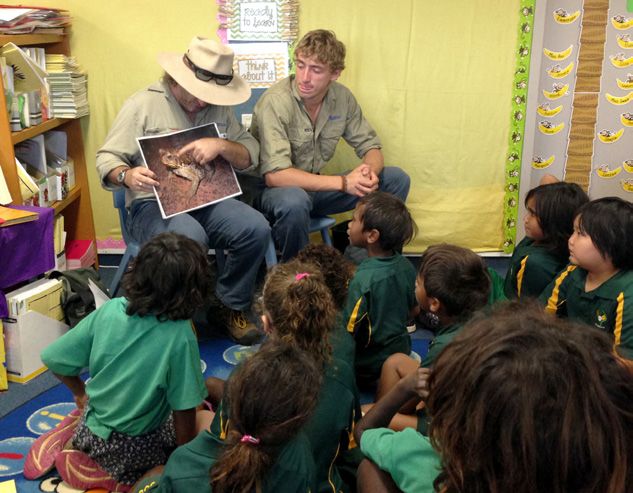
INTRODUCTION

    What are toads?
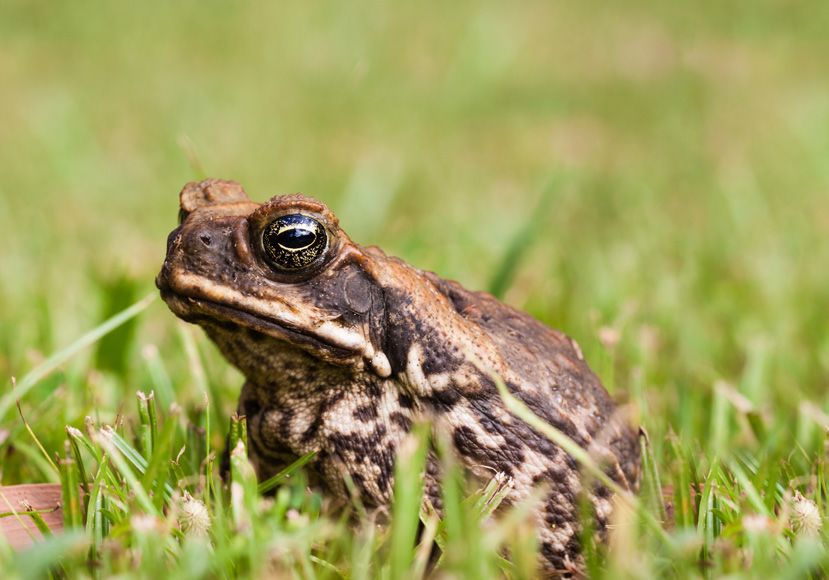
    Toads are a type of frog that are grouped together by key physical features. All frogs and
    toads are amphibians, meaning they start life as tadpoles who live in water and breathe
    with gills, then transform into adults who live on land and breathe with lungs. Australia has
    no native ‘true’ toads, but we do call some of our native frogs ‘toads’ or ‘toadlets’ which
    can be confusing.

    Key features of cane toads:
       •   dry, warty, leathery skin
       •   short legs
       •   M-shaped bony brow ridge
       •   poison glands on their shoulders
       •   crawl rather than hop
       •   lay eggs in long strings instead of in clumps like most native frogs.

                                   The big glands on the
                                   cane toad's shoulders                  Cane toads have a very
                                    release a poisonous                    distinctive bony 'M'-
                                      milky substance                     shaped ridge over their
                                    when the toad feels                     nose. These ridges
       Cane toad skin is dry            threatened.                         meet in the middle.
      and warty, rather than
      moist and slippery like
     the skin of many native
     frogs. It is usually a dull
        brownish colour.

                                                                                   The call of a
                                                                                   male toad is a
                                                                                   guttural trill.

      Adult cane toads
    are heavily built, and
      average between
    100mm and 150mm                             Cane toad feet don't
          in length.                            have suckers on the
                                                  end of the toes.

2                                  Ranger Handbook - Cane Toad Manual
Where did cane toads come from?
The cane toad (Rhinella marina) is the largest toad in the world, growing up to 23cm long.
The cane toad is native to South and Central America. Their natural range extends from
Texas, USA, in the north, to Brazil in the south.
The map below shows the native range of the cane toad in blue, and their present range in
red:

How did they get here?
In 1935, 102 cane toads were brought to Queensland to eat beetles that were destroying
sugar cane crops. This was a very popular solution at that time. The toads were allowed to
breed, and over the next few years more than 50,000 young toads were released across
Queensland and New South Wales. This turned out to be one of the biggest ecological
mistakes made in Australian history. Their population has been growing ever since.

                                 Ranger Handbook - Cane Toad Manual                          3
INTRODUCTION                       (Continued)

    Why are they a problem?
    In South and Central America, cane toads have many natural predators. These snakes,
    lizards, birds, fish and insects have evolved alongside toads and don’t get sick or die from
    eating them. Animals which would die from the toad’s poison have learnt to avoid toads
    and don’t try to eat them.
    As Australia has no toads of its own, Australian animals have not had time to adapt to the
    toad’s poison. This means Australian animals can get sick or even die from eating cane
    toads. Cane toads are poisonous as eggs, tadpoles, metamorphs (‘met-a-morf’ = baby
    toad) and adults. Any of our native animals that eat frogs, tadpoles or frog eggs will also
    try to eat toads. Some of our animals can survive or learn not to eat toads, but others
    will die. Cane toads are also good at adapting to new environments. They can travel long
    distances and can even survive in salty water for short periods.
    Key animals that are at risk from cane toads include:
      •   king brown snakes
      •   goannas
      •   blue tongue lizards
      •   quolls
      •   freshwater crocodiles.

    Scientists are working to find ways to help these animals. These can include teaching the
    animals that they will get sick if they eat toads and learning how to trap toad tadpoles
    using special chemicals (pheromones).

                Community groups can play an important role in education and
                       engagement activities to reduce toad impacts.
                See ‘Where can I find out more?’ (on page 19) to find out more.

4                                Ranger Handbook - Cane Toad Manual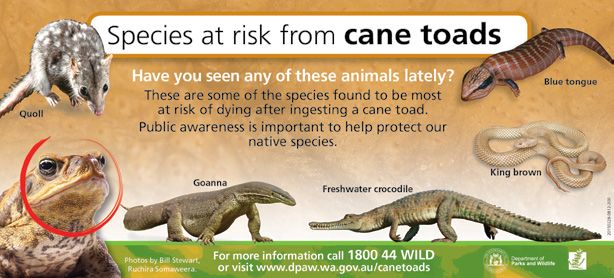
Where are they now?
Cane toads have now spread from Queensland and northern New South Wales right
across the top of Australia.

2009 Cane toads crossed the Northern Territory border into the Kimberley region of
     Western Australia
2010 Cane toads reached Kununurra.
2014 Cane toads reached Halls Creek.

How fast are they moving?
Toads are moving west at around 50km a year. They have been known to travel further,
especially when they get into river systems. How far they move depends on what kind of
wet season we have.

                                                                       'Reggie', Parks and
                                                                       Wildlife's cane toad
                                                                       detector dog, checks a
                                                                       pallet leaving Kununurra
                                                                       for the Mitchell Plateau

Toads may reach new places sooner if they travel on cars and trucks. We call these
‘hitchhiker’ toads. If a male and female toad hitchhike to a new location and find water
to breed in, they may start a ‘satellite population’ (new population of toads ahead of the
frontline). They can also ride on floating logs and branches to travel down rivers. This
'rafting' can help them move faster than expected, they sometimes even float across to
islands.'.

                                  Ranger Handbook - Cane Toad Manual                              5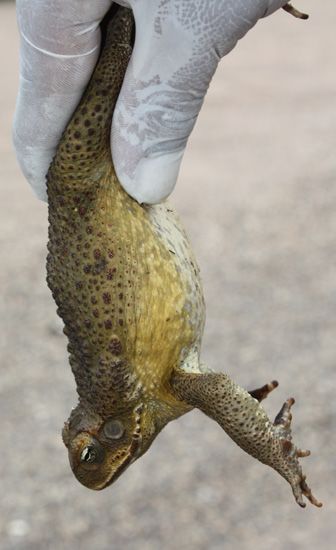
Safety

    Toad dangers
    The main danger with cane toads is the poison glands on the toads' shoulders. These
    glands release a poisonous milky substance when the toad feels in danger. Toads can also
    carry bacteria (germs) on their skin.

               Before any work takes place be sure to complete the Job Safety
                        Analysis which can be found on pages 28-29.

    How to pick up a toad
      • Always wear gloves or put a
        plastic bag over your hand. Put
        the gloves and bags in the bin
        when you have finished as they
        may have poison on them.
      • Pick up the toad by its legs. Point
        its head away from you and place
        in a plastic bag.
      • The toad may urinate (wee) on
        you when you pick it up.
      • Wear sunglasses or safety
        glasses if you have them. When
        scared, toads can squirt poison
        up to 2 metres (this is rare but it
        can happen).
      • Don’t touch your face or eyes
        after you have held a toad.
      • Wash your hands with
        disinfectant or soap when you
        are finished.
    Teach kids how to pick up toads safely.
    Makes sure they use a glove or a bag
    over their hand and wash their hands
    with soap afterwards. Watch out for
    little kids. Some kids will suck on the
    gloves they have used to pick up toads
    or will touch their face when they are
    still wearing gloves.

6                              Ranger Handbook - Cane Toad Manual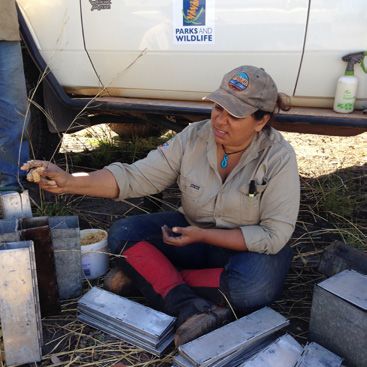
If your pet tries to eat a toad:
 • Wash out its mouth. Point the hose down and away from the body so poison is
   washed out
 • Wash your pet’s eyes
 • Call a vet. Your pet may be shaky, drooling, vomiting or have problems breathing and
   staying awake.

                    Poison hotline: 13 11 26
       If poison gets in your mouth or eyes
        wash out with water and go to the
           hospital or clinic immediately!
   Poison affects the heart, blood pressure and breathing. Toad poison can cause
                               heart attacks and death.
      If you think someone has swallowed toad poison take them to a doctor
      immediately and watch out for drooling, vomiting, twitching, breathing
                problems and paralysis. Poison in eyes may blind you.

                               Ranger Handbook - Cane Toad Manual                         7
Cane Toad Identification

    Is it a cane toad?
                                     When are they         Where do you see
    Cane toad life stage                                                                   What to look for:
                                       around?                 them?
    Eggs                            Humid weather          Still water, dams,     • Long clear strings (like spaghetti)
                                    during the wet         borrow pits, turkey      with small black dots in the
                                    season and             nest dams and            middle
                                    especially after       shallow water          • Found in still, shallow water
                                    heavy rain

                 © - David Nelson

    Tadpoles                        Humid weather          Still water, dams,     • Black body and tail, clear fins on
                                    during the wet         borrow pits, turkey      tail
                                    season and             nests and shallow      • Can’t see through their body
                                    especially after       water                    (opaque)
                                    heavy rain
                                                                                  • Swarms of black tadpoles
                                                                                  • Come to the surface to breathe

    Metamorphs (babies)             Wet season, active     Around the edge of     •   Tiny (1-2cm)
                                    during the day         water holes, ponds     •   At the water’s edge
                                                           and creeks
                                                                                  •   Jump around during the day
                                                                                  •   Little orange dots on their back

    Juveniles (kids/                All year, more         Day                    • 2-8cm
    teenagers)                      common in wet          - cool, dark hiding    • ‘M-shaped’ bony ridge over eyes
                                    season                 places (under rocks,
                                                                                  • Grey/green/brown pattern on
                                                           logs, plants)
                                                                                    their back
                                                           Night                  • May have orange spots
                                                           - open areas, near     • Grey/cream mottled belly (like
                                                           outdoor lights           camouflage pattern)

    Adults                          All year,              Day                    •   8-25cm
                                    more common in         - cool, dark hiding    •   ‘M-shaped’ bony ridge over eyes
                                    wet season and         places (under rocks,
                                                                                  •   Dry, warty skin,
                                    more active at night   logs, plants)
                                                                                  •   Poison glands on shoulders
                                                           Night                      (behind their round ears)
                                                           - open areas, near     •   Greeny brown colour
                                                           outdoor lights         •   Mottled or dirty cream belly
                                                                                  •   Males make a ‘brrr’ noise when
                                                                                      you pick them up (like an old
    Note that it can be really hard to tell the difference                            phone dial tone)
        between frog and toad eggs, tadpoles and                                  •   Can’t climb or jump really high
    metamorphs (babies). Before you euthanise (kill) any
    animals, check with Parks and Wildlife to make sure
             they are really toads (see page 9).

8                                          Ranger Handbook - Cane Toad Manual
CANE TOAD ID CHECKLIST
Date: ____________________________________________ Time: _______: _________ am/pm
Location: ________________________________________ GPS:________________________________________
Name: ___________________________________________ Ranger group: ______________________________
Phone: __________________________________________ Email: _______________________________________
It can be really hard to tell the difference between frog and toad eggs, tadpoles and
metamorphs (babies). Before you euthanise (kill) any animals, check with Parks and
Wildlife to make sure they really are toads. Tips for looking after toads and frogs while you
wait for a reply are on the next page.
Does Your Toad Have? Please Tick
‘M-shaped’ bony Y N
ridge between its
eyes
Dry, warty skin Y N
Poison glands on its
shoulders (behind Y N
its round ears)
If you ticked YES TO all 3 boxes, you may have found a toad.
How many toads are there? ___________ How big are they? __________cm (measure nose to ‘tail’)
Is this the first time you have seen toads here? Yes / No
Where is the nearest place to here that you usually see toads? _____________________________
How far away is that place from where you found this toad? _________________ km
If you find a toad somewhere that has not had toads before, text photos of the toad to
0400 693 807. Parks and Wildlife’s cane toad team will confirm it is a toad and help you decide
what to do next. This form and any extra photos can be emailed to canetoads@dpaw.wa.gov.au.
See tips for taking good toad photos on page 12.
Ranger Handbook - Cane Toad Manual 9What to do when you find a toad
1. Isolate the animal
• Use gloves to pick up the suspected toad.
• Put the toad in a bucket or container with air holes. Large, heavy duty bags can be
used, but you need to make sure the toad has enough air to breath without the toad
escaping.
• Cover the bottom of the bucket container with 0.5cm of water.
• Keep the bucket or container inside if you can. If not, keep it in the shade in a cool
place.
• Contact Parks and Wildlife ASAP if you have found a toad in a new place.
2. Report the animal and confirm it’s a toad
• See page 9 for instructions on identifying toads.
• If you think you have found a toad in a new place that hasn’t had toads before, text
your photos to Parks and Wildlife on 0400 693 807 (see page 12 for tips on taking
photos). If you can’t text, phone Parks and Wildlife on 08 9168 4200 and email your
photos to canetoads@dpaw.wa.gov.au.
• Keep your toad in the bucket in a cool place until Parks and Wildlife staff tell you to
release or euthanise (kill) it.
• If you are out bush and cannot contact Parks and Wildlife from your location or you
need to return to base, take the toad with you (in the bucket or container). Keep the
toad inside once you are at your base so it can’t escape.
• If Parks and Wildlife tell you that the animal you have found is not a toad they will
give you tips on how to release it. If Parks and Wildlife confirm that it is a toad, see
Step 3.
3. Euthanise the toad
Do not kill the toad until Parks and Wildlife tell you to do so. Toads must be euthanised
humanely. This means that the toad will not feel pain when it is killed. The easiest way to
euthanise a toad is by cooling and freezing.
• Put your toad in a plastic bag or small plastic container (e.g. ice cream container).
• Put the bag/container with the toad in the fridge for 4 hours. This puts the toad to
sleep.
• Move the bag/container with the toad into the freezer overnight. This will kill the
toad.
If you are unable to kill toads by cooling and freezing, please contact Parks and Wildlife’s
cane toad team on 08 9168 4200 for other options.
10 Ranger Handbook - Cane Toad ManualHOW TO EUTHANISE A TOAD
1. Put toad in a plastic container or
bag
2. Put toad in the fridge for 4 hours
3. After 4 hours, take toad out of
fridge and move to freezer
4. Leave toad in freezer overnight,
then throw it out with your rubbish
(you might want to leave it in the
freezer until bin day)
4. Dispose of the dead toad
• Toads are still poisonous after they are dead. To stop animals eating the dead toads,
toads should be buried and covered with at least 50cm of soil.
• If you can't dig a hole for them, you can put the dead toads in your bin on bin day.
• If you are disposing of toads at your tip, make sure they are covered over with soil as
soon as possible.
Before toads arrive, it’s important to conduct regular toad searches so we know how far
they have got to and how fast they are moving.
Ranger Handbook - Cane Toad Manual 11How to take good toad photos
Taking toad ID photos
• All photos need to be clear. Include one with the toad or tadpole next to a pen or coin to
show size.
• Text photos to 0400 693 807 or email them to canetoads@dpaw.wa.gov.au.
• Keep the suspected toad isolated in a bucket or container with air holes and a small
amount of water. Keep the bucket in the shade.
• Do not kill or release the animal until you have been told to do so by Parks and Wildlife.
What photos should I take?
Toads 4cm long or bigger (measure from nose to ‘tail’)
Top Front
Side Belly
Toads smaller than 4cm long
Top Belly
© - David Nelson
Tadpoles Eggs
Hold tadpole up to the light between fingers
12 Ranger Handbook - Cane Toad ManualManaging Cane Toads
What can we do now cane toads are here?
Once cane toads have arrived in your area or are expected to arrive in the next wet
season, the Parks and Wildlife cane toad team can work with you to choose the best
response. Actions they suggest may include:
Ongoing monitoring
Keep track of where the toads are, how many
there are, and how they are moving.
• Conduct a toad transect every month.
• Keep a record of all native animals you see when out
bush.
Toadbusting
Remove toads by hand. This works best in an
enclosed area such as a fenced park or a narrow
gorge. If done regularly, it can reduce the number
of toads in that area to give native animals a
better chance of survival.
• Toadbusting needs to be done at least once a
week during the wet season to be effective.
• Toadbusting works best if you have lots of
people to help.
• Toadbusting will not work over a large area.
Fencing important places
Fencing areas to keep toads out will only work
if you can regularly check the fence. The fence
needs to be high enough that toads can’t jump
over it.
• You will need to toadbust within your fenced
area to remove any toads that are already there.
• Fences will also stop native animals from moving
through the area, so make sure you are not
fencing off areas that they rely on for food, water
or shelter. Fencing is only suitable for smaller
areas, not for large blocks or out in the bush.
Ranger Handbook - Cane Toad Manual 13Managing cane toads (Continued)
Tadpole trapping
Scientists have learnt that toad tadpoles are attracted to a chemical (pheromone) found in
the poison of adult toads. Only toad tadpoles are attracted to this chemical, native frogs
are not interested in it.
To make a trap from an old 1.25L or 2L soft drink bottle:
1. Cut the top off the bottle
2. Using gloves, put a dead toad in
the bottom (toad should be humanely
euthanised, see pages 10-11)
3. Put top back on upside down seal
using waterproof glue or duct tape.
4. When the glue has dried, your trap is
finished.
14 Ranger Handbook - Cane Toad Manual• Leave the trap overnight somewhere where you suspect toad tadpoles are living
(shallow, slow-moving water eg a pond or pools at the edge of a creek). Tie your trap
to a tree with fishing line if you are placing in a creek.
Collect your trap the next morning and remove any toad tadpoles (using gloves). Contact
Parks and Wildlife on 08 9168 4200 or canetoads@dpaw.wa.gov.au for confirmation that
they are toad tadpoles and advice on euthanasia.
More information can be found here:
www.canetoadsinoz.com/cane_toad_tadpole_control.html
Don't follow the method for trapping described on this site. It involves squeezing a toad’s
glands to get poison out, this is dangerous!
Trapping toads
Toads are attracted to lights where they can find lots of insects to eat.
• Light traps will only catch toads, not kill them, and will only work if there are no
other lights nearby.
• Traps need to be checked every morning within two hours of sunrise.
An internet search for ‘cane toad trap design’ will give lots of ideas to plan your trap. One
such design is:
www.environment.nsw.gov.au/resources/pestsweeds/cane_toad_infosheet.pdf
Biodiversity surveys
Trap your native animals to learn
about them. Biodiversity surveys
are done before and after toads
arrive so we can compare any
changes.
• Biodiversity surveys need
to be approved by Parks
and Wildlife’s Animal Ethics
Committee. If you would like
to participate in a survey,
please contact Parks and
Wildlife on 08 9168 4200.'
• Animals are measured and
weighed and may have a
DNA sample taken. They are
then released.
Ranger Handbook - Cane Toad Manual 15Managing cane toads (Continued)
Taste aversion training
Scientists are trying to teach our animals not to eat toads. So far, they have tested this
with quolls and goannas.
• Animals are offered a baby toad or toad sausage that contains only a small amount
of poison.
• The animals get sick (but the amount of poison is small so the animals don't die).
• The animals learn not to eat toads because they will feel sick.
Learn more about taste aversion work the Balanggarra Rangers have been assisting with
at Oombulgurri:
www.nerpnorthern.edu.au/sites/default/files/managed/files/toad_goanna_booklet_for_web.pdf
Panoptes eating a toad © Kimberley Reptiles
How can we manage them in our backyard?
• Fence your backyard with chicken wire or shade cloth. Remember these
fences will also prevent movement by other native species like reptiles
who need to access water or food or shelter. Only fence small areas like
backyards in town, not bush blocks.
• Toadbust in your yard once a week.
• Empty out pools once a week.
• Turn off outside lights.
• Teach little kids to stay away from toads.
16 Ranger Handbook - Cane Toad ManualMonitoring cane toads
Before toads arrive, it’s important to conduct regular toad searches so we know how far
they have got to and how fast they are moving.
Monitoring
It is important to know when cane toads
arrive at a new location so we can do our
best job of protecting native animals. Once
cane toads are seen, keep track of where
the toads are, how many there are, and how
they are moving.
• Conduct a toad transect every month
(see page 18)
• Keep a record of all native animals
you see when out bush (especially key
species at risk, see page 4)
A complete cane toad monitoring form is
included on page 32. Before you start a
monitoring project, you need to:
1. Plan your search – ask where, when,
who and what method you will use.
(e.g. transects).
2. Prepare your equipment and make
sure you identify and minimise any
hazards. Use the job safety analysis
form on pages 28-29 to help.
3. Print off a search datasheet (pages 35-36), to keep a tally of cane toads and other
species you find on your search.
4. When you get back, you need to review and debrief . It’s important to store you data
safely and make sure all of your equipment is cleaned and ready for use next time.
See post trip checklist on page 37.
Using the Cane toad app
If you have an iPhone or iPad, there is a free app
to help you identify cane toads and native frogs.
Be sure to download to your device when in
mobile range and then you can use throughout
the Kimberley. (Note the internet links will only
work when you are within mobile range)
See page 24-26 for how to use the App
Ranger Handbook - Cane Toad Manual 17Monitoring cane toads (Continued)
Where should we be looking for toads?
Method What is it? When to do it?
This tells us where the toads have got to.
1. Start at the westernmost point where you last
found toads and drive west until you stop seeing
toads (e.g. 15km past your last toad sighting). Survey once a month
especially during the
2. Drive along a set road/track and record each wet season (September
Vehicle toad you see (and any other wildlife) on your to May).
search GPS.
Remember to switch your hazard lights on if you are Start at least 30
driving slowly, and wear high vis if you are getting out minutes after sunset.
of the vehicle. You need at least two people, one to
drive and one to spot toads and record them on the
GPS. Always tell someone where you are going and
check in when you get back.
This tells us where toads have got to, and how many
there are.
1. Drive to the westernmost point where you have
found toads. Survey twice a year in
2. On foot or in All Terrain Vehicles (ATV) or quad November and March.
bikes, follow any creek lines and check around
waterholes for signs of toads. Walk one way during
the day to check for
Foot 3. Record any toads you find (and other wildlife) on eggs, tadpoles and
search your GPS. metamorphs.
4. Listen out for calling toads. Record where you
hear them. Wait until its dark
before walking back to
Take a spotlight and wear sturdy closed shoes. If you check for adult toads.
are working along tracks, wear high vis. Always tell
someone where you are going and check in when you
get back. Complete a Job Safety Analysis if using ATV
or quad bikes (see page 28-29)
This is used once toads are already in your area.
It tells us how many toads there are (population
density).
1. Walk or drive a set route at the same time every Survey once a month,
month. especially during the
2. Record any toads (and other wildlife) you see in wet season (September
Toad your GPS. to May).
transect 3. We suggest you collect toads after recording, Start at least 30
assuming you are able to dispose of them minutes after sunset.
appropriately while in the field.
4. Graph your findings to view how numbers
change over time.
See the safety tips above for vehicle and foot
searches. Take at least two people.
18 Ranger Handbook - Cane Toad ManualWhere can I find out more?
Parks and Wildlife’s cane toad team
• Based in Kununurra but regularly travel across the Kimberley.
• Can assist with identifying toads.
• Can help plan monitoring and management strategies.
• Conduct biodiversity surveys across the Kimberley.
• Offer curriculum guides for the Kimberley and school visits for Kimberley teachers.
Phone: 08 9168 4200
Fax: 08 9168 2179
Email: canetoads@dpaw.wa.gov.au
Website: www.dpaw.wa.gov.au/canetoads
Brochures and posters: Can be downloaded from the website. Contact the office
for hardcopies.
The Parks and Wildlife education team can bring fun cane
toad activities to your school or community event
Ranger Handbook - Cane Toad Manual 19Where can I find out more? (Continued)
Kimberley Toad Busters
• Can work with your community or ranger group to organise and run toadbusts.
• Provide cane toad educational presentations and materials for your community or
school.
• Get involved with biodiversity monitoring of native wildlife through the “What’s in
your Backyard?” project on the University of Western Australia SPICE website.
Phone: 08 9168 7080
Email: kimberleytoadbusters@canetoads.com.au
BOOK: Kimberley Toad Busters, 10 Years of Community Effort Fighting an Alien
Invasion, J Groffen & S Porter (Eds), Kimberley Specialists, 2015
Website: www.canetoads.com.au
Facebook: www.facebook.com/KimberleyToadBusters
Western Australian Museum
• The experts on Western Australian frogs.
• Produce identification books and resources.
Book: Field Guide to Frogs of Western Australia, M J Tyler & P Doughty, Western
Australian Museum, 2009
Website: www.museum.wa.gov.au/explore/frogwatch/regions/kimberley
POSTER: Frogs of the Kimberley – contact Parks and Wildlife for copies
University of Sydney - Prof. Rick Shine
• Undertaking cane toad research.
Phone: 02 9351 3772
Fax: 02 9351 5609
Email: rick.shine@sydney.edu.au
Website: www.sydney.edu.au/science/biology/shine/
Other Websites
www.projectkimberley.org
www.canetoadsinoz.com
20 Ranger Handbook - Cane Toad ManualEducational resources: teaching kids about toads
• Parks and Wildlife have developed curriculum guides for Kimberley teachers
wanting to teach their students about toads. These guides contain background
information and lesson plans to use in the classroom, and list extra resources such as
video links, websites and books for younger readers. Parks and Wildlife’s education
team can come to your school and deliver incursions, conduct a toadbust, or meet
up with your students on a camp to run activities. Many of these activities are also
suitable for youth groups, clubs and school holiday programs.
Cane Toad Education: 08 9168 4200
Download teacher guides:
Kimberley Education Manuals: Cane Toads Years 1-3
www.dpaw.wa.gov.au/images/documents/plants-animals/animals/canetoads/
canetoad_education_manual_years_1-3.pdf
Kimberley Education Manuals: Cane Toads Years 4-6
www.dpaw.wa.gov.au/images/documents/plants-animals/animals/canetoads/
canetoad_educational_manual_4-6.pdf
• University of Sydney scientists working at Fogg Dam in the Northern Territory
created a book to teach local children about their work, including studies they have
done on how native animals are affected by cane toads:
www.sydney.edu.au/science/biology/shine/educational_resources/docs/fogg-dam-
interactive-book.pdf
Kimberley Toad Busters have resources for Year 7 teachers based on the 'What’s in
your backyard' program. Teacher's resources can be found on the website
(www.canetoads.com.au). Click on the links 'KTB Biodiversity identification cards in
a flip book' and 'Teachers Resource File Flip Book'.
• University of Western Australia:
www.spice.wa.edu.au/feeding-relationships
• Download Food web (for free) from the app store at:
www.itunes.apple.com/au/app/food-web/id565839214
Ranger Handbook - Cane Toad Manual 21References
Australian Government, Department of Sustainability, Environment, Water, Population and
Communities, 2010. Threat abatement plan for the biological effects, including lethal
toxic ingestion, caused by cane toads.
Groffen J & Porter S. (Eds.), 2015 Kimberley Toad Busters, 10 Years of Community Effort
Fighting an Alien Invasion, Kimberley Specialists.
Shine, R, ‘The Ecological Impact of Invasive Cane Toads (Bufo Marinus) in Australia’,
Quarterly Review of Biology. September 2010.
The Government of Western Australia, Department of Environment and Conservation,
2009. Draft Cane Toad Strategy for Western Australia.
The Government of Western Australia, Department of Parks and Wildlife, 2014, Cane toad
strategy for Western Australia 2014-2019.
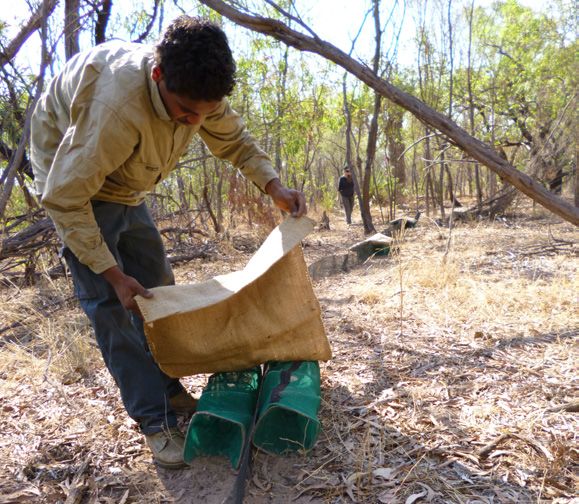
Miriuwung Gajerrong Ranger Keith Boombi set up a funnel trap line
22 Ranger Handbook - Cane Toad ManualFORMS, Checklists AND SHEETS
A copy of commonly used forms and sheets have been provided on
the following pages for you to photocopy and use as required.
Ranger Handbook - Cane Toad Manual 23CANE TOAD APP
Using the cane toad app
If you have an iPhone or iPad there is a free app to help you identify cane toads and native
frogs. Be sure to download to your device when in mobile range and then you can use
throughout the Kimberley. (Note the internet links will only work when you are within
mobile range).
www.itunes.apple.com/au/app/cane-toad/id642370264
Search for cane toad in the app store
'Is it a cane toad? (from the main menu)
24 Ranger Handbook - Cane Toad ManualFind frogs and toads
See toads as metamorphs (babies), juveniles and adults
Ranger Handbook - Cane Toad Manual 25CANE TOAD APP (Continued)
Find out about frogs, hear their calls Find colour, size, calls & ID info
Log frogs and toads that you find
26 Ranger Handbook - Cane Toad ManualRISK MATRIX
Use the matrix below to determine a risk rating for each hazard involved in the job
Consequence
Minor Moderate Major
Insignificant Extensive injuries; Catastrophic
First aid treatment Medical treatment
No treatment permanent disability
required; required; Loss of life;
required; or impairment;
>$10,000 to >$50,000 to >$1 million damage.
$250,000 toJob Safety Analysis
Ranger Group _________________________________________________________________________________________________
Job _________________________________________________________________________________________________
Job Description _________________________________________________________________________________________________
_________________________________________________________________________________________________
_________________________________________________________________________________________________
_________________________________________________________________________________________________
_________________________________________________________________________________________________
_________________________________________________________________________________________________
Date _____ / _____ / ________
Location of Job (please tick)
Field (please specify) _____________________________________________________________
Workshop
Office
Other (please specify) ____________________________________________________________
PPE Required (pelase tick):
Head Ear Safety Protective Hi-Vis Hand Foot
Protection Protection Glasses Clothing Clothing Protection Protection
Other PPE
Required
_________________________________________________________________________________________________
_________________________________________________________________________________________________
_________________________________________________________________________________________________
28 Ranger Handbook - Cane Toad ManualTraining
eg GPS skills, first aid…
Required
_________________________________________________________________________________________________
_________________________________________________________________________________________________
_________________________________________________________________________________________________
Relevant
Procedures or
_________________________________________________________________________________________________
Guidelines
(list any SOPs)
_________________________________________________________________________________________________
_________________________________________________________________________________________________
Job breakdown Potential hazards Initial risk rating Control measures Revised risk rating
Identify the hazard Assign each hazard a risk Try to eliminate the hazard, if that is not
List the main steps Reassess the risk now
associated with each rating using the matrix on possible use substitution, engineering,
involved in the job controls are in place.
step page 27 isolation and administrative controls
-Manual handling injuries Anything heavier than 20kg needs 2 people to
eg. load all equipment -Trips when carrying things High lift/carry. Pick up stuff off floor. Plan route Low
into vehicle before carrying. Bend knees and keep back
straight when lifting/carrying.
All team members need to write and sign their name below to confirm they have
read, understood and agree to the instructions outlined in this JSA!
Full Name Signature Date Manager / Ranger Coordinator / Ranger in Charge’s
approval:
Name: ___________________________________________________
Signature: _______________________________________________
Date: _______ / _______ / ____________
This JSA is valid for one year. This JSA needs to be
reviewed when the task changes, following a near-miss
or incident, or annually if the task has not changed.
Review Date: _______ / _______ / ____________
Ranger Handbook - Cane Toad Manual 29'POWER' VEHICLE CHECK
Use your vehicle’s manual to learn how to do these checks
Vehicle Details
Vehicle Type _______________________________________________________________________________
Date ______ / ______ / ____________
Completed By _______________________________________________________________________________
Odometer _______________________________________________________________________________
Registration _______________________________________________________________________________
Work Centre _______________________________________________________________________________
Next Service _______________________________________________________________________________
Vehicle Checks
Fuel - Petrol or Diesel Yes No
Check fuel is full (refuel if it’s not)
Identify fuel type (Is it diesel or petrol?)
Identify where fuel cap is located
Oil - Check levels are normal (tick ‘no’ if they’re not): Yes No
Engine oil
Clutch fluid
Brake fluid
Power steering fluid
Automatic transmission fluid
Water - Check levels are normal (tick ‘no’ if they’re not): Yes No
Radiator fluid level
Windscreen washer bottles (refill if empty)
30 Ranger Handbook - Cane Toad ManualElectricals - Check all are working (tick ‘no’ if they don’t work): Yes No
Battery is charged and working (Does the car start straight away?)
Check terminals (look for white corrosion)
Check water level in battery
Fuses (check you have spares)
Check lights (high and low beam headlights, spotlights and tail lights)
Indicators (front and back, left and right)
Reverse lights
Brake lights
Park lights
Horn
Rubber (Tyres) - Check all are normal (tick ‘no’ if they’re not): Yes No
Correctly identify tread wear
Identify tread patterns on all tyres the same
Check all tyres including spares
Check and inflate tyres to correct vehicle specification inflation
(including spares)
Check condition of windscreen wiper blades
Check condition of hoses and belts in engine bay
Check tension of belts
This vehicle is ready to use (all ‘yes’)
or
This vehicle needs further action before it can be used (if any are ‘no’)
Book the vehicle in with a mechanic if it’s not something you can fix yourself
Signed _________________________________________________________
Date ______ / ______ / ___________
Ranger Handbook - Cane Toad Manual 31Cane toad monitoring form
Monitoring toads on country
• Plan your search
• Prepare your equipment
• Conduct your search
• Review and debrief
A toad search of ______________________ by the ____________________________________ Rangers.
1. Plan your search
Leave a map of your search location with someone who you know will check you got back
safely
Start ________________________________________ GPS ________________________________________
Finish _______________________________________ GPS ________________________________________
Date ______ / ______ / _________ Start time _______:_______ pm Finish time _______:_______ pm
Ranger in charge ___________________________ Driver ______________________________________
Team members _____________________________________________________________________________
Hazard to people Control – A JSA should be created and signed by the whole team!
The driver’s job is just to drive. Do not use a spotlight, GPS or radio while driving. Do a
Vehicle accident POWER check before you go (see page 30-31). If you are working along tracks or roads,
wear high vis clothes. When you are driving slowly for a search, turn on hazard lights.
Always tell someone where you are going. Take a map and GPS with you. Mark your
journey on the GPS so you can follow it back if you need to. Bring a map and compass in
Getting lost/stuck
case your GPS goes flat. Bring radios and a sat phone and keep them with you if you are
on foot.
Hazard to the
Control
environment
Erosion, damage to Only drive on tracks. If there are no tracks, walk. Don’t drive down creek and river banks
vegetation (plants) if you don’t need to.
Take all rubbish with you including food scraps, cigarette butts and tea bags (bring a
Pollution
rubbish bag).
Clear all dead grass and plants within 4m of your fire. Make sure your fire is completely
Fire
out before you leave.
32 Ranger Handbook - Cane Toad ManualEQUIPMENT CHECKLIST
Check that all equipment is working and ready to use, and that you know how to use it!
Date Date
Clothing PPE
Checked Checked
Sturdy boots Head Torch
High vis vest/shirt
Safety glasses
(if working along roads)
Gloves
Date Date
General equipment
Checked Checked
Radios charged Drinking water
(with spare batteries) (at least 2L per person)
POWER check
Meals/snacks
completed for all vehicles
(cooking gear if needed)
(see page 26-27)
Vehicle recovery gear Hand sanitiser
First aid kit Rubbish bags
Checklist continued on page 34.
Ranger Handbook - Cane Toad Manual 33EQUIPMENT CHECKLIST (Continued)
Check that all equipment is working and ready to use, and that you know how to use it!
Date Date
Tools and materials for the job
Checked Checked
GPS charged (with spare
batteries). Start and Camera
finish points marked.
Survey plan complete Spotlight
Map with start and finish
Plastic bag or container
locations and access
with air holes for toads
routes marked
Clipboard and pens/ Datasheet printed and
pencils Section 1 filled in
Date Date
Safety
Checked Checked
Copy of trip plan and map
Sat phone charged,
given to a responsible
checked and ready (with
person who will check
spare batteries)
you get back safely
JSA signed by all team
members
(See page 24-25)
I confirm that all equipment has been checked and is ready to use,
Signed _____________________________________ Name ___________________________________________
34 Ranger Handbook - Cane Toad ManualSEARCH DATASHEET
Date ______ / ______ / ____________
Ranger in charge ____________________________ Ranger group _______________________________
Team members ___________________________________________________________________________________
_____________________________________________________________________________________________________
Type of search (please tick): Vehicle search Foot search Toad transect
Start time ________:________ pm Finish time ________:________ pm
Location
Start _________________________________________ GPS _________________________________________
Finish ________________________________________ GPS _________________________________________
Set your GPS to plot your route as you drive/walk. Drive at 20km per hour (switch on your
hazard lights). Mark a way point for each toad, species impacted (or other animal) you see.
Keep a tally (IIII) of toads you see every 2km driving or every 500m if you’re walking.
Location Number of Toads (IIII)
eg 0-2km
Ranger Handbook - Cane Toad Manual 35SEARCH DATASHEET (Continued)
Location Number of Toads (IIII)
eg 0-2km
List any other animals you see:
____________________________________________________________________________________________________
____________________________________________________________________________________________________
____________________________________________________________________________________________________
____________________________________________________________________________________________________
____________________________________________________________________________________________________
36 Ranger Handbook - Cane Toad ManualPOST TRIP CHECKLIST
• Save data and compare to previous searches
• Clean and maintain vehicles and equipment
• Debrief with your team
Task Date Signed
Upload your GPS data. If you can, print out a map
showing your route and where you found toads. Keep all
your maps in a file together.
Copy the results of your tally into an excel spreadsheet:
• For searches to find toads in new areas, you can save
each search on a new sheet within the same file.
• For a transect (searching the same route every month
once toads have arrived) you can record the number
of toads in each 2km sector against the date in one
table. You can then make a graph to see how the toad
population changes.
Tell Parks and Wildlife’s cane toad team what you have
found.
Email canetoads@dpaw.wa.gov.au with:
• For a search, send the location with GPS coordinates
of your westernmost toad after each search.
• For a transect, send your graph showing how your
toad population changes over the year through to
Parks and Wildlife every March.
Clean, refuel and check over vehicles. Fill in your
vehicle’s logbook (if you use one).
Clean and put away all equipment. Repair anything that
needs fixing
Recharge batteries (sat phone, radios, camera, GPS etc).
Replace materials used (garbage bags, gloves, first aid
supplies etc).
Ranger Handbook - Cane Toad Manual 37Ranger Handbook - Cane Toad Manual
CANE TOAD ID CHEAT SHEET

It can be really hard to tell the difference between frog and toad eggs, tadpoles and
metamorphs (babies). Before you euthanise (kill) any animals, check with Parks and
Wildlife to make sure they really are toads. Tips for looking after toads and frogs while you
wait for a reply are on page 10.

                            Does Your Toad Have?                                    Tick

 ‘M-shaped’ bony
 ridge between its                                                                  Y      N
 eyes

 Dry, warty skin
                                                                                    Y      N

 Poison glands on its
 shoulders (behind
                                                                                    Y      N
 its round ears)

      If you ticked YES TO all 3 boxes, you may have found a toad.

If you find a toad somewhere that has not had toads before, text photos of the toad
to 0400 693 807. Parks and Wildlife’s cane toad team will confirm it is a toad and
help you decide what to do next. This form and any extra photos can be emailed to
canetoads@dpaw.wa.gov.au . See tips for taking good toad photos on page 12.

                                  Ranger Handbook - Cane Toad Manual
Through education, awareness and engagement, Indigenous
Ranger groups are playing a key role in caring for their environment.
Collaboration is the key to any efforts aimed at reducing impacts of
cane toads on native species. Only through aligning Federal, State and
community efforts can we make an impact.You can also read


