Changing the Sentence - Overseeing Queensland's youth justice reforms - Queensland Family & Child ...
←
→
Page content transcription
If your browser does not render page correctly, please read the page content below
Changing
the Sentence
Overseeing Queensland’s youth justice reforms

                                                1
Copyright
Changing the sentence: Overseeing Queensland’s youth justice reforms.
Copyright © The State of Queensland (Queensland Family and Child Commission) 2021.

ISBN 978-0-6488903-4-8

Licence
This report is licensed by the State of Queensland (Queensland Family and Child Commission) under a
creative commons attribution (CC BY) 4.0 International licence. You are free to copy, communicate and
adapt this report, as long as you attribute the work to the State of Queensland (Queensland Family and
Child Commission). To view a copy of this licence visit https://creativecommons.org/licenses/by/4.0/.
Content from this report should be attributed as: The State of Queensland (Queensland Family and Child
Commission) Changing the sentence: Overseeing Queensland’s youth justice reforms.

March 2021

                                                                                                         When we have power over our destiny
                                                                                                         our children will flourish. They will walk
                                                                                                         in two worlds and their culture will be a
                                                                                                         gift to their country.

2                                                                                                                                                     1
Acknowledgement

    We acknowledge the Jagera and Turrbul peoples      As written in the Uluru statement from the Heart
    as the traditional custodians of the country on    ‘When we have power over our destiny our
    which we did most of this work and we pay our      children will flourish. They will walk in two worlds
    respects to Elders past, present and emerging.     and their culture will be a gift to their country’.

    Thank you to everyone we met with for your care,
    passion and compassion. In particular, we thank
    the young people and families who agreed to
    speak with us.

    2                                                                                                         3
Foreword                                                                                                              Foreword

    The Queensland Government’s Working together              To cover different demographics, we focused
    Changing the Story: Youth Justice Strategy                on Mt Isa, Townsville and North Brisbane. Over
    2019–23 has a strong focus on prevention, early           a period of seven months, we interviewed
    intervention and collaboration to tackle the              stakeholders from a wide range of organisations,
    underlying causes of youth crime.                         analysed data on young people in the system,
                                                              interviewed children and their families,
    In June 2019, the Director-General of the Department      commissioned a media analysis report, and
    of Youth Justice asked the Queensland Family and          studied three reform initiatives in depth.
    Child Commission (QFCC) to help monitor initiatives
    linked to recent youth justice reforms and to examine     We found that good work is occurring in the
    options for future investments.                           system, with state government agencies
                                                              collaborating to keep children out of court and
    This report is the outcome of that request. While         custody and placing more emphasis on working
    it was being prepared, three tragic incidents             with families than they have in the past.
    took place that significantly changed public
    discussion on the topics this report addresses. In        The three initiatives we examined are promising.
    June 2020, four Townsville teenagers died while           It is particularly heartening to note that 790 police
    riding in a stolen car driven by a 14-year-old. In        officers and police liaison officers nominated to                  currently provided too late in children’s lives,          prevention, early intervention and collaboration to
    January 2021, an allegedly stolen car driven by           participate in Operation Regenerate, and that                      or not at all in the case of those who live in            tackle the underlying causes of youth crime. This
    a 17-year-old struck and killed a Brisbane couple         there was a significant reduction in reoffending by                remote areas. There is also not enough focus on           is a sound approach, and the QFCC supports it. I
    and their unborn child. Eleven days later, a young        the young people who took part. The other two                      continuing the education of children who struggle         congratulate those who have been involved in the
    Townsville woman died after being hit by a car            initiatives are also delivering encouraging results.               to fit into a mainstream school or are returning          reforms and initiatives to date and encourage the
    allegedly following a stolen vehicle in what was                                                                             from disciplinary absences or youth justice               government to stay the course in order to achieve
    characterised as a ‘vigilante’ pursuit.                   These successes show that targeted interventions                   interventions. This is difficult, but critical. We know   the intent of the youth justice reforms.
                                                              in the lives of young people can work. This should                 disengagement from education can be an early
    These deaths were senseless, and rightly led to           encourage those responsible for areas where this                   indicator of a more general detachment from               We have more work to do.
    community demands for changes that would                  report has identified that more needs to be done.                  community, which in turn is one of the risk factors
    prevent a recurrence. For those changes to be                                                                                for criminal behaviour.
    lasting, as a community we must actively engage           Communication must improve — in the court
    with the potentially confronting concept that             system, between organisations and families and                     The services and support we provide should
    preventing youth crime also means addressing              between police and young people. Good news                         be more targeted and more focused on dealing
    its causes. Youth justice is much more than just          stories need to be heard. The bad news reported                    with trauma and specialist early intervention.            Cheryl Vardon
    court, bail, diversion, or detention. It involves         in the media generates fear and mistrust in the                    To help with this, Aboriginal and Torres Strait           Principal Commissioner
    health, education, non-government organisations,          community that does not help the system make                       Islander communities and families and community           Queensland Family and Child Commission
    community controlled organisations, victims of            the necessary shift away from a purely criminal                    controlled organisations should be directly               March 2021
    crime, the media, families, children and young            focus towards prevention, rights and well-being,                   involved in designing and prioritising programs.
    people, and society as a whole.                           which are proven to make a difference.                             More needs to be done with these communities in
                                                                                                                                 terms of collaboration and early intervention.
    Research shows the most effective way to improve          We consulted the Queensland Human Rights Act
    the youth justice system is to take a preventative and    2019, the Youth Justice Act 1992, and the United                   I urge decision makers to consider the future
    supportive approach. With that in mind, this report       Nations Convention on the Rights of the Child to                   opportunities listed in this paper. They are
    looks at initiatives related to keeping children out of   identify the rights of children and young people in                proposed to improve early support for families
    court and custody. We set out to determine whether        the youth justice system. Concerningly, we believe                 and reduce the over-representation of Aboriginal
    youth justice reforms are delivering a system that is     some of these rights are being neglected and, in                   children and Torres Strait Islander children in the
    reliable, trusted and built on shared commitments.        some cases, are at risk of being breached.                         statutory system.
    We also wanted to find out whether children’s rights,
    well-being and safety are being protected.                Specialist health and education services are                       The Youth Justice Strategy includes the use of

    4                                                                                                                                                                                                                                        5
Executive summary Executive summary
Introduction government and non-government agencies to ongoing improvement of services and safety of children can be made by police,
involved. greater benefits for families. educators and health providers. Examples of
In June 2019, the Director-General of the then 4. Behaviour change is hard, yet stakeholders delays in school enrolment and in receiving
Department of Youth Justice† (Youth Justice), While Youth Justice was responsible for understand and affirm the importance of medical treatment were provided to us and are
asked the Queensland Family and Child developing the strategy and related Youth Justice support for young children and their families as included in this report.
Commission (QFCC) to assist in ‘monitoring Strategy Action Plan 2019–21,4 many initiatives, a way to prevent initial or ongoing engagement 10. The system does not always provide the most
youth justice initiatives and examining options especially those relating to early intervention and of children in the youth justice system. vulnerable children and families with equitable
that will inform future youth justice systems prevention, are being led by other departments. 5. There are plenty of services for vulnerable access to specialist services and support,
and processes.’ The intent of this was to ‘ensure The action plan includes seven Queensland young people in Mount Isa, North Brisbane particularly in remote communities. Access to
that recent investment decisions of government Government departments as lead agencies. and Townsville; however, many services are these services is sometimes not available until
are implemented and continuously improved to activity-based. High risk or repeat offenders children arrive in the statutory youth justice
support the best outcomes for children, young We chose to draw heavily on the views of front need specialist help to address the offending system.
people and the community’.1 line service providers in Mount Isa, Townsville behaviour, including treatment of poor health, 11. Not enough health and education support
and Brisbane. We also included the voices of a trauma or family dynamics where that has is available for children below the age of 12.
This report addresses the Youth Justice request small number of children and family members. contributed to the behaviour. Recent funding to primary schools for extra
in the context of the QFCC’s Oversight Strategy By listening to these groups, we could gauge 6. Data on over-representation of Aboriginal and psychologists is welcome and should be part of
2020–22, from which we drew two key questions: the impact of reforms on the communities and Torres Strait Islander children in the youth an ongoing funding shift to focus on the earlier
individuals for whom they were intended. justice system: years of schooling.
• Are youth justice reforms ensuring there – continues to show there is an insufficient 12. There has been a focus on student
is a reliable, trusted system built on shared Findings on key questions response to the needs of Aboriginal and Torres engagement in education, but not enough
connections and commitment? Strait Islander children and their families consistency in ensuring continuity of education
• Are youth justice reforms ensuring children’s Are youth justice reforms ensuring – is not linked well enough to data on health, for children on disciplinary absences or for
rights, well-being and safety are being upheld there is a reliable, trusted system education and housing those who struggle to fit in a mainstream
and protected? built on shared connections and – is not detailed enough to use in local and school.
commitment? community-led responses. 13. The Queensland Children’s Court’s efforts to
The report considers activities and projects 7. There has been no improvement to the produce plain English versions of charges
related to pillars two and three of the Queensland 1. The percentage of children and young people statistics on over-representation. Despite this, and bail conditions for families and children is
Government Working together Changing the in contact with the formal (statutory) youth Aboriginal communities and families, Torres commendable, and this work needs to continue
Story: Youth Justice Strategy 2019–23 2 (the justice system is very small—representing 0.3 Strait Islander communities and families, and and expand to magistrates’ courts.
Youth Justice Strategy), which are: per cent of children aged 10 to 17. Forty-five per families in general, have limited opportunities
cent of children and young people never return to provide input into program design and Future opportunities
• Keep children out of court. to the statutory youth justice system after their prioritisation of funds for initiatives intended
• Keep children out of custody. court matter is finalised. for them. Closing the Gap action planning As part of its brief to examine options for future
2. There are good examples of state government provides an opportunity for government to youth justice systems and processes, the QFCC
The Australian Institute of Health and Welfare agencies working together, and the focus on include Indigenous communities and agencies has found:
defines a youth justice system as: keeping children out of court and custody in decision making about how to achieve the
may be further strengthened by Aboriginal or youth justice target in the new agreement. • The youth justice system would be more
the set of processes and practices for Torres Strait Islander community controlled 8. Legislative and policy changes, made in effective in improving the lives of vulnerable
managing children and young people who have organisations and non-government agencies response to particular incidents, may make it children and keeping the community safe if it
committed, or allegedly committed, an offence. having opportunities to increase their leadership harder for the system to achieve the intended viewed at-risk young people through a rights
In Australia, it deals primarily with young and participation in these collaborations. outcomes of the Youth Justice Strategy. and well-being, rather than just a criminal, lens.
people aged 10–17 at the time of the offence.3 3. There has been a strong move towards working • New programs and projects where the primary
with the families of children in the system, and Are youth justice reforms ensuring audience is Aboriginal children and families,
When we refer to the youth justice system in agencies are recognising the importance of children’s rights, well-being and safety and/or Torres Strait Islander children and
this document, we are talking about all the this. Lessons are emerging that will contribute are being upheld and protected? families, should be community-led.
• Governments (both state and federal) need to
†
In November 2020, the Department of Youth Justice was merged with the Department of Child Safety, Youth and Women to form the new Department of Children, Youth and Multicultural Affairs. 9. Improvements to the rights, well-being and make long-term, outcomes-based investments
6 7
Executive summary

                in prevention and early intervention in the         collaboration to tackle underlying causes of
                health of children and families, with regular       youth crime.
                review points. Investment should not be siloed
                by agency but shift to person-centred care.         This is a sound approach, and the QFCC supports
             • The Queensland Government should continue           it. While recent youth justice reforms may
                to strengthen the growing focus on prevention       contribute to reducing the numbers of some young
                and early intervention for young children (that     people in the youth justice system, they could be
                is, birth–five years of age) and their families     improved. Many initiatives focused on activities that
                through multi-agency co-operation and               did not include dedicated case management or
                partnerships.                                       specialised therapy and were not designed to cater
             • Data needs to be linked to Youth Justice from       for clients with very complex behaviours.
                other critical systems including Child Safety,
                Health, Education and the Queensland Police         While national data suggests a downward trend
                Service, and broken down to regional and local      of children placed on supervision orders or in
                levels, to help communities make decisions          detention, legislative change and new initiatives
                and prioritise services relevant to their region    by government over many years have failed to
                (this is also in the National Agreement on          improve the over-representation of Aboriginal and
                Closing the Gap5).                                  Torres Strait Islander children in the youth justice
             • While a long-term culture shift within the         system.7 Families must be included in all decisions
                Queensland Police Service towards crime             relating to their children, and the rights of children
                prevention and community policing remains           made central to funding decisions and to the work
                essential, there could also be regular training     of professionals, courts and family services.
                for police officers about working with children,
                Aboriginal peoples, and Torres Strait Islander      As required by the Australian Government’s
                peoples.                                            Closing the Gap and outlined in the Queensland
             • Youth Justice, the Queensland Police Service,      Government’s Changing tracks, an action plan
                legal services and courts could consider            for Aboriginal and Torres Strait Islander children
                collaborating on improving communication            and families,8 the Queensland Government
                with families and children involved in the          must increase the pace at which it is returning
                statutory youth justice system. This includes       decision-making affecting Aboriginal communities
                keeping families informed about the status or       and Torres Strait Islander communities to those
                progress of their child’s case, ensuring families   communities.
                have the means to attend court, and explaining
                things in ways that can be understood by the        If the long-term goal of reducing youth crime is
                client and family.                                  to be achieved, investment should focus firstly on
             • As identified in the Atkinson report,6 a           reduction of the factors that may contribute to a
                coordinated media strategy should be adopted        young person committing crime, and secondly, on
                to promote and support the policy position of       young people already in the formal system who
                the Youth Justice Strategy.                         are committing most of the youth crime.

         Chapter 5 provides more detail on future                   The QFCC urges government to stay the course             Every single program they’ve got him in now,
         opportunities.                                             and continue to provide long-term funding in             finishes once he goes to court. There’s no help
                                                                    accordance with the Youth Justice Strategy.
         Conclusion                                                 This will support the significant strides needed         after that. It just stops dead. So, there’s no
                                                                    towards reducing youth crime and realising the           continuity of care … there’s no follow on, there’s
         The Youth Justice Strategy includes the                    right of every Queensland child to be safe, with
         use of of prevention, early intervention and               opportunities to succeed.                                no follow up.

         8                                                                                                                                                                        9
Contents
    		        Acknowledgement                                                                           2

                                                                                                                 3.2     Is the youth justice system trusted?                                             54
    		        Foreword                                                                                  4                3.2.1    Influence of media                                                      57

    		        Executive summary                                                                         6        3.3     Is there evidence of shared connections and commitment?                          60
                                                                                                                         3.3.1    Collaboration between government agencies                               60
                                                                                                                         3.3.2 Collaboration with non-government organisations                            63
         1    Introduction                                                                             12                3.3.3 Collaboration with young people and families                               66

             1.1     Purpose                                                                           14        3.4	Findings—Are youth justice reforms ensuring there is a reliable,
                                                                                                                      trusted system built on shared connections and commitment?                          66

             1.2     Project methodology                                                               14
                                                                                                            4     Are children’s rights, well-being and safety being upheld and protected?                68

             1.3     Context, scope and limitations                                                    22
                                                                                                                 4.1     Are children’s and young people’s rights being upheld?                           70
                                                                                                                         4.1.1   Right to protection of families and children                             70
     2        The Queensland youth justice system                                                      24                4.1.2 Cultural rights                                                            70
                                                                                                                         4.1.3 Rights in criminal proceedings                                             71
                                                                                                                         4.1.4 Right to education                                                         74
             2.1     Overview                                                                          26                4.1.5 Right to health services                                                   81

             2.2     Numbers and characteristics of young people in the youth justice system           31        4.2     Are children and young people safe?                                              83
                     2.2.1 Children with complex behaviours                                            31                4.2.1 Stable accommodation                                                       83
                     2.2.2 Trajectory of younger children in the youth justice system                  33                4.2.2 Dealings with the police                                                   86

             2.3     Youth justice reform                                                              34        4.3     Findings—Are children’s rights, well-being and safety being upheld and protected? 86

             2.4     The views of young people and families in contact with the youth justice system   36   5.    Future opportunities                                                                    88

             2.5     Aboriginal and Torres Strait Islander young people and the youth justice system   37   6.    Next steps for the QFCC                                                                 92
                     2.5.1   Decision making                                                           37
                     2.5.2 Connection to community and culture                                         40   		    Appendix                                                                                96

                                                                                                            		    References                                                                             102
     3        Is the youth justice system reliable, trusted and built on
               shared connections and commitment?                                                      42

             3.1     Is the youth justice system reliable?                                             44
                     3.1.1    Consistency                                                              44
                     3.1.2    Complexity of the system                                                 50
                     3.1.3    Fulfilling its purpose—diversion and intervention                        51

    10                                                                                                                                                                                                     11
1. Introduction

                   On any given day in Queensland, approximately
                   1,643 young people aged 10–17 are on community
                   supervision and a further 252 are in custody.
                   This represents 0.4 of one per cent of the 512,416
                   people in Queensland aged 10–17.

     12                                                                 13
1. Introduction Introduction
1.1 Purpose of young offenders but only seven per cent of the to improve opportunities and well-being for Torres Strait Islander children in the youth justice
Queensland population.) vulnerable young people. system. We gathered examples of good practice
In June 2019, the then Director-General of the as well as evidence of where trust and reliability
Queensland Department of Youth Justice† (Youth 1.2 Project methodology Courts and custody are the points at which could be improved.
Justice) asked the Queensland Family and Child already vulnerable children become even
Commission (QFCC) to assist in monitoring Our discussion of the youth justice system more vulnerable. If governments want to make The project team conducted 83 meetings and
Queensland Government youth justice initiatives in this report is based on quantitative data wiser investment decisions for both social and interviews with 125 stakeholders from Mount
in the light of recent reforms and investments. and interviews with service providers. Our economic outcomes, the investment focus needs Isa, Townsville and Brisbane between November
He also asked us to examine options to inform observations are illustrated by quotes and stories to continue to be on diverting children away from 2019 and June 2020. Participants came from 43
future youth justice systems and processes. from community members, families, young people these points. organisations or regional offices drawn from:
and frontline service providers. • 13 government agencies
This report is in response to that request. Drawing from the Queensland Family and Child • 10 non-government agencies
It is not a review and includes no formal We conducted an environmental scan of youth Commission’s Oversight Strategy 2020–22,12 we • n ine Aboriginal and Torres Strait Islander
recommendations. Rather, it sets out findings justice policy in Australia and of major policies and sought answers to the following two questions: community controlled organisations.
and suggestions to guide future investment reforms in Queensland. •A
re youth justice reforms ensuring there
decisions and future directions within the youth is a reliable, trusted system built on shared
justice system. We identified three diverse locations in connections and commitment?
Queensland, choosing Mount Isa, Townsville and •A
re youth justice reforms ensuring children’s
The Family and Child Commission Act 2014 (the North Brisbane for their different remoteness rights, well-being and safety are being upheld
Act) requires the QFCC to promote and advocate classifications‡ and demographics. This allowed and protected?
for the safety and well-being of children and for more in-depth consideration of any variances
young people, particularly children in need of in common factors, such as front-line service One of the Oversight Strategy’s three impact
protection or in the youth justice system.9 provision, police arrest data, or media attention. areas is system reliability, from which the first
question was drawn. The strategy takes a rights-
The Act requires QFCC commissioners, in We sought advice from the central offices of based approach to considering how systems are
performing their functions, to: government departments involved in the system monitored. A priority is to deliver the best possible
a. engage with, and take account of, the views of about recent changes to policies and practices outcomes for Aboriginal and Torres Strait Islander
children, young people and their families; supporting youth justice reform. children and families and promote a responsive
b. ensure the interests of Aboriginal people and system enabling Aboriginal and Torres Strait
Torres Strait Islanders are adequately and To ensure consistency, we developed Islander people’s self-determination.
appropriately represented; conversation plans for a series of interviews with
c. respect and promote the role of Aboriginal government and non-government stakeholders. We sought evidence of:
and Torres Strait Islander service providers in These interviews focused on activities and • a ctive partnerships in the system
supporting Aboriginal and Torres Strait Islander projects relating to two pillars of the Working • r eliability of the system (whether it is
families and communities to protect and care together Changing the Story: Queensland Youth consistent, easy for end users to understand,
for their children and young people … 10 Justice Strategy (2019–2023) (the Youth Justice and fulfilling its remit to divert children away
Strategy), which are to: from the youth justice system)
Because of these functions, this report is • Keep children out of court. (pillar 2) • t rust in the system
particularly focused on the rights of children • Keep children out of custody. (pillar 3)11 • a ctive commitment to improving the lives of
and young people and their families in the young people and their families
youth justice system, and gives attention to the We chose these pillars because of the significant • t he upholding of children’s rights, as outlined
significant over-representation of Aboriginal and number of new government initiatives funded in the Queensland Human Rights Act 201913
Torres Strait Islander children in Queensland’s in 2019 that related to them and because of the and the United Nations Convention on the
youth justice system. (They make up 45 per cent QFCC’s interest in considering initiatives intended Rights of the Child.14
†
In November 2020, the Department of Youth Justice was merged with the Department of Child Safety, Youth and Women to form the new Department of Children, Youth and Multicultural Affairs
We sought views about the causes of the
‡ The Australian Bureau of Statistics classifies Mount Isa as remote, Townsville as outer regional, and North Brisbane as major city. over-representation of Aboriginal children and
14 15
Introduction                                                                                                             Introduction

                               Organisations that provided information.

 Organisation                  Region/s         Type             Organisation role                                    Organisation                Region/s     Type             Organisation role

 Aboriginal & Torres Strait    Brisbane         Community        Provides a range of health care services for the     Multicultural Australia     Brisbane     Non government   Multicultural Australia provides welcome and
 Islander Community Health                      controlled       Aboriginal and Torres Strait Islander communities.                                                             support to more than 5000 newly arrived
 Service (ATSICHS)                              organisation     It also delivers youth justice and family services                                                             Queenslanders every year, including refugees,
                                                                 for young people and families who have had                                                                     migrants, international students and people
                                                                 contact with the police, court or youth justice                                                                seeking asylum.
                                                                 system.

                                                                                                                      Murriwatch                  Brisbane     Community        Helps to divert from custody; makes cell visits.
 Aboriginal Torres Strait      Brisbane         Not for profit   ATSILS provides professional and culturally                                                   controlled
 Islander Legal Services       Mount Isa        (federally       competent legal services for Aboriginal and Torres                                            organisation
 (ATSILS)                      Townsville       funded)          Strait Islander people across Queensland.

                                                                                                                      Operation Regenerate—       Brisbane     State            A bail compliance program to help break the cycle
 Act for Kids                  Brisbane         Non government   Provides therapy and support services to children    Queensland Police Service   Townsville   government       of offending.
                                                                 and families who have experienced, or are at risk
                                                                 of child abuse and neglect
                                                                                                                      Forensic Child and Youth    Brisbane     State            A specialist service for consumers who are
                                                                                                                      Mental Health Services—                  government       currently involved in, or at risk of involvement in,
 Multi-agency                  Brisbane         State            An alternative schooling model for disengaged or     Queensland Health                                         the criminal justice system.
 re-engagement ASDAN                            government       at-risk young people.
 program (MARA)—
 Department of Education                                                                                              Queensland Program of       Brisbane     Non government   Provides flexible and culturally sensitive services
                                                                                                                      Assistance to Survivors                                   to promote the health and well-being of people
                                                                                                                      of Torture and Trauma                                     who have been tortured or who have suffered
 Kurbingui                     Brisbane         Community        Provides mentorship, including after-hours street    (QPASTT)                                                  refugee-related trauma prior to migrating to
                                                controlled       support and education for the Aboriginal and                                                                   Australia.
                                                organisation     Torres Strait Islander communities.

                                                                                                                      Specialist multi-agency     Brisbane     State            An initiative facilitated by Youth Justice to
 Life without Barriers (LWB)   Brisbane         Non government   Provides care and support services across            response teams (SMART)      Mount Isa    government       coordinate staff from government agencies to
                                                                 Australia in urban, rural and remote locations.                                  Townsville                    discuss specific cases of young offenders and
                                                                 Currently funded through a social bond to support                                                              make referrals for health and other supports, with
                                                                 young people in breaking the offending cycle and                                                               the aim of reducing offending and reoffending.
                                                                 become valued members of the community.

                       16                                                                                                                                                                                                              17
Introduction Introduction
Organisation Region/s Type Organisation role Organisation Region/s Type Organisation role
Youth Advocacy Centre Brisbane Non government Provides legal services, youth support and family Injilinji Youth Health Mount Isa Community Provides a life skills program to disengaged/
(YAC) support assistance and services to young people, Service—Aboriginal and controlled disadvantaged youth. Influences existing
particularly those who are involved in, or at risk of Torres Strait Islander organisation health services to accommodate the needs of
involvement in, the youth justice and/or the child Community Health the Mount Isa young people by facilitating a
protection systems; and/or are homeless or at risk greater understanding of their culture. Helps
of being homeless. with transitioning young people into their own
accommodation or a safe living place.
Youth and Family Support Brisbane State Youth and family support services for children
Services— Youth Justice government aged between 10 and 17 years who are at risk of Mount Isa Transitional Mount Isa Non government Connects at-risk youth with after-school activities
offending or reoffending. Hub—North-West and support services to help reduce youth crime
Queensland Indigenous rates.
Catholic Services
Kummara Association Ipswich Community Provides a range of support and education
controlled services for individuals and families.
organisation Mt Isa Family Support Mount Isa Non government Community-run centre with a mission ‘to enable
Service and Neighbourhood people within our community to connect with
Centre (MIFSSNC) each other, learn how to be physically and
Centacare North Mount Isa Non government A social services ministry of the Catholic Diocese mentally well, build self-reliance, and improve their
Queensland of Townsville aiming to promote the well- national supports of family, friends, workmates and
being and resilience of individuals, families and neighbours’.
communities.
Alcohol, Tobacco and Other Mount Isa State ATODS provides a range of services including
Community Connect Mount Isa State A project facilitated by the Queensland Police Drugs Service (ATODS)— government intake and assessment, outpatient (ambulatory)
government aimed at improving community safety and Queensland Health withdrawal, opiate substitution program,
reducing youth-associated crime in Mount Isa. Diversionary and Recovery Team (DART),
Government agencies meet to share information counselling and assessment for youth and
about at-risk youth. adults, health promotion, needle and syringe
program, and culturally appropriate support and
stakeholder engagement.
Gidgee Healing Mount Isa Community A health service for Aboriginal peoples and Torres
controlled Strait Islander peoples in Mount Isa, the Gulf and
organisation the north-west. Save the Children Mount Isa Non government Runs education and child protection programs
Townsville in urban, regional and remote locations across
Australia.
Headspace Mount Isa Federal Headspace centres act as a one-stop-shop for
Townsville government young people who need help with mental health,
physical health (including sexual health), alcohol
and other drugs or work and study support.
Headspace provides online and phone counselling
services and vocational services.
18 19Introduction Introduction
Organisation Region/s Type Organisation role Organisation Region/s Type Organisation role
Department of Seniors, Mount Isa State Provides whole-of-government leadership, Department of Children, Central State Assists children and families to be safe and to
Disability Services and government coordination and monitoring in policy, program Youth Justice and government thrive in culture and communities, free from abuse
Aboriginal and Torres Strait department and service delivery for Aboriginal and Torres Multicultural Affairs department and neglect. Also responsible for multicultural
Islander Partnerships Strait Islander Queenslanders and is responsible affairs, the redress scheme for Queensland
for seniors and disability services. survivors of institutional child sexual abuse, and
youth justice.
Young People Ahead (YPA) Mount Isa Community Provides support to young people experiencing
controlled homelessness or at risk of becoming homeless. Department of Central State Helps Queenslanders who need access to
organisation Also supports young people exiting from statutory Communities, Housing and government housing, improves social well-being of people and
care. Digital Economy department places, provides initiatives to make the most of
information and communication technology and
grow the arts sector.
Edmund Rice Flexi School Townsville Non government Provides young people with an opportunity to
engage in education in a flexible, supported
learning environment. The young people have Department of Education Central State Education services to ensure Queensland’s
typically experienced one or more significant government education systems are aligned to the state’s
and complex educational, social, developmental, department employment, skills and economic priorities. Also
psychological, health, legal or familial situations responsible for industrial relations and racing.
demanding unique responses.
Queensland Health Central State Provides leadership and direction for the
Tiddas Yarning Circle Townsville Community A community of women who meet to share ideas government health sector, and encourages innovation and
controlled and support each other. department improvement in the delivery of health services.
organisation
Department of Justice and Central State Responsible for administering justice in
Townsville Aboriginal and Townsville Community Provides culturally appropriate health care that Attorney-General government Queensland. Also responsible for women’s policy
Islander Health Service controlled encompasses physical, social, emotional, cultural, department and prevention of domestic and family violence.
(TAIHS) organisation spiritual and economic well-being.
Queensland Police Service Central State Responsible for community safety and crime
Townsville Stronger Townsville State Formed to help break the cycle of youth crime government prevention.
Communities Action Group government by dealing with underlying issues that lead some department
(TSCAG) young people to offend. The group of state
government representatives targets identified
repeat offenders and coordinates services for
at-risk youths and their families. Chaired by
Queensland Police Service.
20 21Introduction Introduction
Given Covid-19 intra-state travel restrictions, after-school activities and connects at-risk Out of scope the consistency of their stories, were factors we
most of our stakeholder interviews were young people with support and services to This report does not specifically consider the balanced against the small sample when we were
conducted via video or audio call. We were able assist them and to help drive down crime following matters: determining how to reflect their views in this
to make one introductory visit each to Mount rates • y outh detention centre operations. report.
Isa and Townsville before travel restrictions were – the Specialist Multi-Agency Response Queensland’s youth detention centre
introduced. Throughout the report we have Team (SMART), which is a partnership operations were the subject of an The QFCC will continue to seek out and hear the
included direct quotes from young people and between the Department of Youth Justice; independent review in 2016,15 and other voices of children and young people about their
from organisations on the front line of the youth Queensland Health; the Department of reviews of youth detention facilities were experiences in the youth justice system.
justice system. We also received second-hand Education; the Department of Child Safety, conducted in New South Wales, the Northern
reports and reviewed youth justice, police and Youth and Women; cultural representatives Territory, Victoria and Western Australia
education data that indicated children are not and other services as needed, to assist with between 2017 and 2019.16 The QFCC, with
getting the help they need in a timely way. coordinated care, decision making, and the Australian Children’s Commissioners
support of young people in the youth justice and Guardians, published a statement on
We logged all interview transcripts and coded system conditions and treatment in youth justice
them into themes relating to the two main detention in November 2017.17
questions listed earlier (relating to trust, reliability, Taken collectively, the material provides a rich • p rocesses and systems relating to young
collaboration and children’s rights). insight into Queensland’s youth justice system people on ‘dual orders’† with both Child
from multiple perspectives. Safety and Youth Justice. Due to its broad
As part of its analysis, the QFCC: scope this work considered recent reforms
1.3 Context, scope and limitations and the system, rather than particular groups
• captured the perspectives of young people of children.
through interviews with them and their Context
families This report was prepared during a period of Limitations
• invited front-line services and families to heightened community awareness about youth Hearing the views and perspectives of children
contribute to an illustration of the youth crime in Queensland, with regular reporting in the and young people is a critical aspect of the
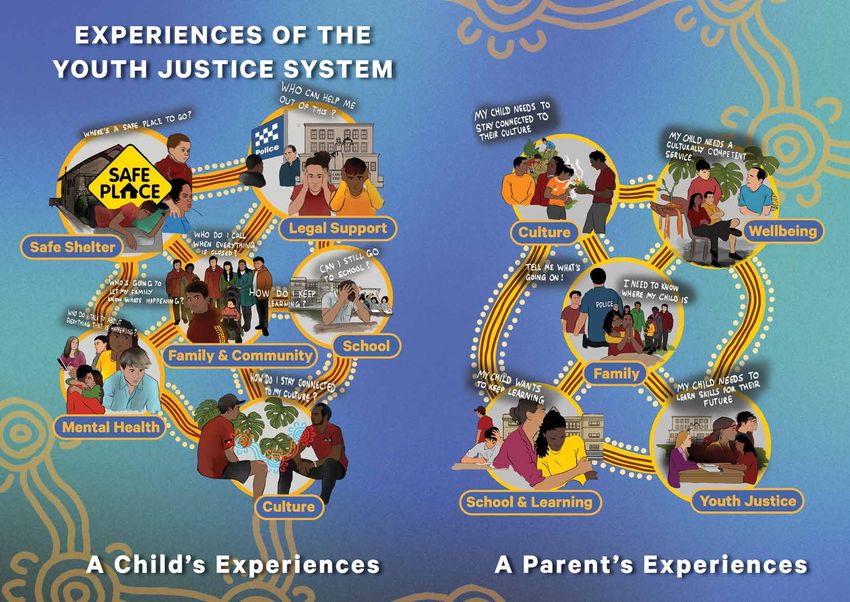
justice system from their perspective. (Visuals media and commentary by Queensland politicians. QFCC’s role. Early in the project, we contracted an
are sometimes easier than words.) In April 2019, there was an exposé on children in agency to engage with and speak to a group of
• commissioned a media analysis report to the Brisbane watch house. young people who had experiences in the youth
consider public perspectives on youth justice justice system. Unfortunately, this coincided with
reforms and young people in the system In May 2019, Youth Justice was separated from the introduction of Queensland’s most significant
• analysed data to provide a snapshot of young the Department of Child Safety, Youth and Women COVID-19 restrictions.
people involved with the youth justice system and made a stand-alone department. In November
• studied the following three reform initiatives 2020, following a state election, youth justice was The inability to travel, as well as changes to how
in greater depth: merged within the Department of Children, Youth some face-to-face services operated during this
– Operation Regenerate, which is a Queensland Justice and Multicultural Affairs. period, made it harder for QFCC staff to speak
Police Service initiative that helped 224 with community groups, clients of services and
young people to comply with their bail COVID-19 restrictions were in place from the end young people in general.
conditions of March, limiting our ability to conduct face-to-
– Mount Isa Transitional Hub, which provides face interviews. These restrictions meant only six young people
with experience of the youth justice system
were directly interviewed. While we accept this
“Refer young people to support services the first time they
small group does not speak for all children in the
youth justice system, the views of these young
go to court. Help children to go to school so they can learn
people are not often heard and this, along with
to read”. - Young person interview † A child who is concurrently on an order under the Child Protection Act 1999 and a youth justice order or program is on a ‘dual order’—available from Practice Resource; Youth Justice: an overview,
https://www.csyw.qld.gov.au/resources/childsafety/practice-manual/practice-resource-youth-justice.pdf, viewed 30 November 2020.
22 232. The Queensland
youth justice system
The Youth Justice Act has five objectives.
One of them is to recognise the
importance of families and communities
in the provision of services designed to
rehabilitate and reintegrate children who
commit offences.
24 252. The Queensland youth The Queensland youth justice system
justice system
2.1 Overview The United Nations Convention on the Rights of In addition, there are numerous community
the Child (the Convention)22 is also fundamental controlled organisations and non-government
The Youth Justice system in Queensland deals when considering how effectively a large system organisations that specialise in providing support
with children aged from 10 to 17 who have, or are supports children and young people. The for at-risk young people and their families. Under
alleged to have, committed a crime. The minimum Convention, signed and ratified by Australia a cross-agency approach, these agencies seek to
age of criminal responsibility in Queensland is 10, in 1990,23 proclaims not only a child’s right to address the complexities of offending behaviour
so children under that age who commit a crime appropriate health and education but also the in children and young people. These complexities
cannot be formally dealt with by the Queensland right to be involved in decisions affecting them are compounded by the fact that Queensland
Police Service or courts. and to have their opinions taken into account. is a vast state geographically, with considerable
This includes during judicial or administrative regional variation in demographics and service
The Youth Justice Act 199218 (the Act) is the basis proceedings (Article 12). availability and delivery.
for administering youth justice in Queensland,
including court proceedings. It recognises the Other organisations In 2018, Bob Atkinson (special advisor to the
importance of children’s families and communities, Minister for Child Safety, Youth and Women) was
particularly Aboriginal and Torres Strait Islander The Queensland youth justice system is broader asked to produce an independent report on youth
communities, in the provision of services designed than just Youth Justice itself, and is made up of justice.24 This identified four pillars:
to: many funded government and non-government 1. Intervene early
i. rehabilitate children who commit offences; and services designed to help children to stay out 2. Keep children out of court
ii. reintegrate children who commit offences into of court and out of custody. The aims of these 3. Keep children out of custody
the community.19 services include assisting children and young 4. Reduce offending.
people to have a safe place to live, engage in their
A Charter of Youth Justice Principles (the local community (including school) and address In response to this, Queensland released its first
Charter), appears at Schedule 1 of the Act and their health needs and behaviours. youth justice strategy in December 2018.
is intended to underpin its operation.20 The first A $320 million package of initiatives was
principle of the Charter is that the community In Queensland, the following government entities announced in April 2019 to support the strategy.
should be protected from offences. The remaining are strongly involved in the youth justice system, It was followed in July 2019 by a Youth Justice
20 principles elaborate on appropriate ways to having early contact with at-risk young people Strategy Action Plan 2019–21,25 identifying which
deal with children, including children with an and their families before they are known to Youth government agencies would take the lead on
Aboriginal or Torres Strait Islander background, as Justice: specific actions.
well as victims and parents. • the former Department of Child Safety, Youth
and Women (now the Department of Children, The following timeline outlines the sequence of
It is clear from the Act and the Charter that Youth Justice and Multicultural Affairs) events over the last two years.
administration of justice is only part of the • the Department of Education
expectations of the youth justice system and • Queensland Health (including hospital and
that child rights, diversion (from the youth justice health services)
system) and rehabilitation are also important • the Department of Justice and Attorney-
elements. General
• the Queensland Police Service.
Queensland’s Human Rights Act 2019, which came
into effect on 1 January 2020, is another important The departments of Communities, Housing
and relevant piece of legislation.21 It includes a and Digital Economy and Seniors, Disability
number of rights directly relevant to the broader Services and Aboriginal and Torres Strait Islander
youth justice system, in particular relating to Partnerships are also involved in leading or
families, culture, equal protection before the law, supporting projects in the youth justice system.
criminal proceedings, education and health. The The appendix to this document provides a
Human Rights Act applies to public entities and summary of the role of government agencies in
to non-government organisations and businesses the youth justice system.
performing a public function.
26 272018 2019 2020 2021
J anuary - March 2020, there were frequent media 26 January 2021, a stolen
reports about bail laws not working and about car driven by a 17-year-
Jan
Jan
30 April 2019, the investment of Operation Regenerate in Townsville old struck and killed a
$320 million was announced for Brisbane couple and their
expanding youth detention centres Operation Regenerate was modified in Townsville unborn child.
12 February 2018 onwards, and funding sector initiatives, with so that the work was now done by Police Liaison
young people aged 17 were a big focus on diversion and on Officers. 5 February 2021, a
Feb
Feb
Feb
included in the youth justice supporting children in meeting Townsville resident
system instead of the adult their bail conditions. Funding for 10 March 2020, the Queensland Premier, with pursuing a stolen car,
criminal justice system Specialised Multi-Agency Response the Minister for Police and Corrective Services lost control and killed a
Teams (SMART) panels, Operation and Minister for Child Safety, Youth and Women, motorcyclist. At time of
Mar
Regenerate and the Mount Isa announced a ‘hard line on youth crime’ that writing the resident had
Transitional Hub were included in included ‘tougher action on bail’, as part of a ‘five been charged with murder.
this tranche, to commence from point plan’.
July.27 9 February 2021, the
1 2 March 2020, the Queensland Government Queensland Government
May April
announced it would appeal court decisions around announced tougher
bail ‘where appropriate’. action on repeat youth
offenders, including
17 March 2020, the Queensland Government legislative changes, a
made a decision to amend the Youth Justice presumption against bail,
13 May 2019, Inside the watch Act 1992 ‘as it relates to youth bail’. assurances from parents
house went to air. This was an ABC and guardians prior to
Four Corners exposé of children 7 June 2020, four teenagers died when release on bail, electronic
held for lengthy periods in the a stolen car, driven by a 14 year-old, monitoring devices (GPS
June
8 June 2018, Brisbane watch house. crashed in Townsville. Trackers) for offenders
Jun
Atkinson Report aged 16 and 17; and
on Youth Justice 17 May 2019, a new stand-alone 17 June 2020, Parliament passed an announced a Youth Crime
was released. Department of Youth Justice was amendment to the Youth Justice Act Taskforce to implement
established.28 1992 to change ‘may’ to ‘must’ when the new measures.
refusing bail to young offenders at risk to
July
July
themselves or others.
25 July 2019, the Youth Justice
Strategy Action Plan 2019–21 was 1 July 2020, the successful tenders were
released. announced for three programs for young
repeat offenders to spend time ‘On
Aug
Country’†.
28 August 2019, the Queensland July 2020, an incident of child rape in
Parliament passed the Youth a remote community was made public,
Justice and Other Legislation highlighting the lack of specialist
Sept
Amendment Act 2019, clarifying services for victims and offenders
that concerns around a child’s in remote communities and the
accommodation cannot be consequential impact on families.
considered a reason to refuse bail.
30 July 2020, a new national Closing the
Oct
Gap agreement took effect.
5 December 2018 the Smith 17 December 2019, the Youth
report, Townsville’s voice: Justice Amendment Act (passed in September 2020, additional police sent
local Really26 community August) came into effect. to Townsville with a focus on recidivist
concern about youth crime in offenders.
Townsville.
31 October 2020, Palaszczuk government
1 1 December 2018, Working re-elected. † The program also includes intensive case
Together, Changing the work support for Aboriginal and Torres
Dec
Dec
Dec
Strait Islander young people who are
Story: Youth Justice Strategy December 2020, the Queensland repeat offenders or have high or complex
2019–23 was released. Government announced supervised needs. Information available at https://www.
youthjustice.qld.gov.au/aboriginal-torres-
community accommodation houses for strait-islander-young-people/country-
young people on bail would be closed. programs, viewed 18 February 2021.
28 29The Queensland youth justice system
2.2. Numbers and characteristics of In 2018-19 in the two Queensland youth detention
young people in the youth justice centres, Aboriginal and/or Torres Strait Islander
system young people accounted for 71 per cent of
detainees.37 At every escalation of statutory youth
On any given day in Queensland, justice intervention, the percentage of Aboriginal
approximately 1,64329 young people aged 10–17 children or Torres Strait Islander children involved
are on community supervision in the statutory† increases.
system and a further 252 are in custody30. This
represents 0.4 of one per cent of the 512,416 In Mount Isa, the proportion of Aboriginal children
people in Queensland aged 10–17. Of the and Torres Strait Islander children in the overall
young people who have had a finalised court population aged 10–17 is 26 per cent, while
appearance, 45 per cent have never returned in Townsville it is 12 per cent. However, of the
to the statutory youth justice system.31 children in contact with the police, 92 per cent
in Mount Isa and 58 per cent in Townsville are
In 2018–19, 4,716 individual young Aboriginal and/or Torres Strait Islander.
Queenslanders committed at least one proven
offence. Of these, 61 per cent were property Of children under Youth Justice supervision in
offences. Only seven per cent were violent Mount Isa between 2015 and 2019, an average of
offences.32 In 2019–20, 10 percent of young 93 per cent were Aboriginal and/or Torres Strait
offenders committed 48 per cent of proven Islander children, while the figure over the same
offences.33 period was 78 per cent in Townsville.
In 2019, 100 per cent of children in Mount Isa
In Queensland, Aboriginal and Torres Strait under the supervision of Youth Justice were
Islander children account for seven per cent of the Aboriginal and/or Torres Strait Islander, while the
total population of 10–17-year-olds, but in 2018–19, figure was 90 per cent in Townsville.38
they made up 45 per cent of young offenders.34
Aboriginal and Torres Strait Islander children aged 2.2.1. Children with complex behaviours
10–17 also made up 14 per cent of children in
contact with the police in 2018–19, compared to Within Queensland’s small group of young
three per cent for non-Indigenous children.35 offenders, there is an even smaller group of chronic,
repeat or serious offenders. These small cohorts
In 2019, there were 19,422 children who had need more intensive help beyond that provided by
formal‡ contact with and received a Queensland many diversion programs because of a combination
Police Service action. They accounted for about of factors that may include drug or alcohol
Tem qui conecti bearchi llautati dolore mil four per cent of children aged 10 to 17. This was dependency, school or employment problems, and/
molupit omnis destis et quat fugitatenist eiuntis ea the lowest number of children in contact with
police in the past five years (2015–2019). In 2019,
or an absence of appropriate care and support.
se adi rem. Ab int facium rempos sit aut estio offic children aged 10 to 14 represented 30 per cent Our analysis suggests that community fear
testibus a del imincti commolorio. Ut re ventur of this cohort. The percentage of children aged
10–14 formally in contact with police in 2019
of these groups may be amplified by media
attention. In order to make a difference to children
rereprestiam rest, ulparum qui ut que net qui vid accounted for 46 per cent of children in Mount and young people like these, the support provided
In Queensland,
quatint Aboriginal
expella borerec and Torres
aborum Strait
facil exeratur, Isa, 34 per cent in Townsville and 27 per cent in
North Brisbane.36
by the system needs to start earlier in their lives
(well before they enter the formal youth justice
Islander
unti children
con ratem account
quatem for seven
iditiatur adit, per cent of the
sinihil system) and continue for longer.
total population
lecepelescid of 10–17-year-olds,
modiciis in rem facesenbut in 2018–19,
ihillatium re
they
ex made up 45 per
es doluptatem cent of young offenders.
voluptas”
† That part of the youth justice system controlled by the Youth Justice Act 1992.
‡ ‘Formal contact’ refers to children who have received a QPS ‘action’, including but not limited to; a caution, a restorative justice conference, a notice to appear and an arrest.
30 31The Queensland youth justice system
Location Percentage of those Percentage aged Percentage under
aged 10–17 in this 10–17 in contact Youth Justice
location who identify with Queensland supervision in this
as Aboriginal and/or Police Service in this location who identify
Torres Strait Islander location who identify as Aboriginal and/or
as Aboriginal and/or Torres Strait Islander
Torres Strait Islander
Mount Isa 26 92 93
Townsville 12 58 78
Queensland 7 44 55
Figure 2: Average number of children under Youth Justice supervision between 2015 and 2019
from geographically remote locations were
six times more likely to be under youth justice
I think we deal with it [chronic offending] supervision as those from non-remote locations
better now than what we have. I think that and that children from the lowest socio-economic
there have been some big improvements, but areas were 10 times more likely to be under
I still don’t think that we’re really targeting the supervision.
kids that are chronic offenders.
GOVERNMENT STAFF MEMBER Eighty per cent of Queensland’s young offenders
have reported using at least one drug or volatile
substance (such as sniffing solvents, aerosols or
We were told by interviewees in Townsville that petrol) and 63 per cent have experienced or been
there are 10–20 youth crime leaders and another affected by domestic and family violence. Fifty-six
30–40 followers, and that this group may drive per cent have a mental health and/or behavioural
45–50 per cent of Townsville’s youth crime. disorder (diagnosed or suspected) and 53 per
Given this is a small number of young people cent are disengaged from education, training or
Tem qui conecti bearchi llautati dolore mil and families, there is an opportunity for them to employment. 40
molupit omnis destis et quat fugitatenist eiuntis ea receive specialised, intensive intervention and
support. Figure 3 shows the cascade of direct and indirect
se adi rem. Ab int facium rempos sit aut estio offic risk factors that may lead to an increased risk of
testibus a del imincti commolorio. Ut re ventur It is now well understood, both in Australia and
internationally, that youth offending is closely
involvement in the youth justice system.
Aboriginal and/or
rereprestiam Torres Strait
rest, ulparum qui utIslander
que netyoung
qui vid linked to disadvantage. Children who offend are 2.2.2. Trajectory of younger children in
people expella
quatint aged 10–14 are more
borerec likely
aborum to be
facil in contact
exeratur, more likely to have experienced child abuse and the youth justice system
neglect, disability, mental illness, drug and alcohol
withcon
unti the ratem
policequatem
than non-Indigenous children in
iditiatur adit, sinihil abuse, exposure to crime and violence, and Queensland Police Service data shows that
the same agemodiciis
lecepelescid group, with this
in rem even more
facesen likely re
ihillatium for homelessness. Aboriginal and/or Torres Strait Islander young
people aged 10–14 are more likely to be in contact
those
ex aged 10–11. voluptas”
es doluptatem Atkinson39 reports research finding that children with the police than non-Indigenous children in
32 33You can also read


