Chicks, Bunnies & Eggs Oh My! - Easter Activities for All Ages - Gee Whiz Education
←
→
Page content transcription
If your browser does not render page correctly, please read the page content below
Chicks, Bunnies & Eggs …
            Oh My!

                             Easter Activities for All Ages

© 2020 Gee Whiz Education, LLC             1                  www.geewhizeducation.com
Getting Started
Easter is fast approaching! This booklet of activities is designed to help you celebrate Easter with the
children. We are focusing on bunnies, eggs and chicks. Of course, if you prefer to add religious aspects of
this holiday into your program, you will see options for this in the activity plans. You can also simply focus
on eggs, chicks and bunnies without the Easter connection if you so choose. The activities in this booklet
address all ages from infants through school-age. Many of these are designed to be conducted outdoors
as well. Any materials printed in red may require a little more time to gather or prepare.
At Gee Whiz, we use a series of picture symbols to help you identify the developmental areas addressed
by each activity. Below you will find a chart that matches each picture to a developmental area. As you
review the experiences presented in this guide, you will quickly see that each experience addresses many
different developmental areas. For more information on these developmental areas, please check out our
User’s Guide https://geewhizeducation.com/gee-whiz-curriculum-users-guide/
Program Symbols for Developmental Areas
= Language Development = Social Studies Knowledge
= Literacy Knowledge = Social & Emotional Development
= Math Knowledge & = Music & Creative Arts
= Science Knowledge = Physical Development & Health
= Logic & Reasoning ☺ = Approaches to Learning
© 2020 Gee Whiz Education, LLC 2 www.geewhizeducation.com
Chicks, Bunnies & Eggs … Oh My!
Enjoy the following activities with your entire group!
Get Moving!
Exploring Together: Easter Bunny
(all ages, ☺ )
Materials:
Cotton balls, masking tape, plastic Easter eggs
• Easter falls on April 12th this year. This experience
encourages dramatic play as children pretend to be
Easter bunnies. If you prefer, you can easily adapt Questions to Spur Thinking
this activity to just focus on bunnies instead of the
• Where are you hopping, Easter Bunny?
Easter bunny.
• If you were the Easter bunny, where would you
• Use masking tape to attach a cotton ball to your hide the eggs?
backside and hop around the room. As children
become interested, give each of them a cotton ball
tail as well. Talk a little bit about the Easter bunny (or
just bunnies in general) as children hop around.
Then sing the following song and invite your little Get Moving!
Easter “bunnies” to participate in the movements. If
you prefer a song about bunnies in general, see p. 6.
Exploring Together: Easter Egg Roll
EASTER BUNNY (all ages, ☺ )
(tune: “Twinkle, Twinkle Little Star”)
Materials:
Easter Bunny, hopping ‘round. Plastic Easter eggs
Hopping, hopping, up and down. Spoons (assorted types)
Hiding eggs to find, it’s true
On the floor or in a shoe!
• The White House Easter Egg Roll has been a
Easter Bunny, hopping ‘round.
tradition for more than 100 years! This
Hopping, hopping, up and down.
experience invites children to have their own
Easter egg roll while experimenting and
• EXTENSION: Have children take turns being the practicing self-regulation at the same time. If
Easter Bunny hiding plastic eggs for others to find. you do not plan to celebrate Easter, just have
an egg roll instead.
• This is a great activity to do outdoors on a nice
day. Provide children with plastic Easter eggs
and assorted types of spoons. Have them help
you choose a starting and ending point for the
Questions to Spur Thinking Easter egg roll.
• What type of spoon did you choose to use?
• Then, have each child choose an egg and a
• How did your spoon work? Is there another type of spoon spoon. The object of the Easter egg roll is to
use the spoon to push the egg across the grass
you would like to try? Which one?
to the finish line. Before children begin,
• What other tool could you use to roll the egg? encourage the children to predict how the
spoons they chose will work. Then, have them
• What do you think would happen if eggs were square use their spoons to roll the eggs. Were their
instead of round? predictions correct?
• EXTENSION: Invite children to explore using
different sizes and types of spoons for the
Easter egg roll. Which work well? Which do
not? Why?
© 2020 Gee Whiz Education, LLC 3 www.geewhizeducation.com
Chicks, Bunnies & Eggs … Oh My!
Enjoy these activities with small groups of children.
Shiny and Beautiful Art
(Toddlers–4 years, ☺) Questions to Spur Thinking
• What do you notice that is different about this type of
Materials: paint?
White paper cut in the shape of an egg or cross
(your choice) • What colors of paint did you choose to use on your
Corn syrup paint - assorted color (see p. 8 for recipe) egg/cross?
Paintbrushes (thick & thin … for different children with
differing levels of fine motor development) • What other tools could you use as a paintbrush?
Vinyl tablecloth (if available) __________________________________________
• When corn syrup paint dries, it has a beautiful • Where should we go next, little chicks?
sheen! The children will also discover that this
type of paint has a different “feel” as well. Also, if • Why do you think real baby chicks follow their
possible, cover the table with a vinyl tablecloth to mamas?
make clean up easier. After all, this experience
just might get a little sticky!
• Provide each child with a white paper egg or Get Moving!
cross and access to the corn syrup paint. As
children decorate their eggs/crosses, engage
them in conversations about how this type of
paint is different for paint they may have used in (Toddlers–4 years, ☺ )
the past. This is especially important for ELL/DLL
children as well as Toddlers/Twos who are Materials:
building receptive language skills. None needed
• As children create, talk about the colors of paint • This activity group game challenges children to
they choose to use as well as the unique designs pretend as they follow directions.
they create.
• Play this game as you would, “Follow the
• Advanced Preschoolers: These children can use Leader.” But instead of simply being a “leader,”
smaller paintbrushes to add more intricate you are a mother hen and the children are your
designs to their eggs/crosses. baby chicks!
• To begin, invite children to pretend to be baby
chicks as they move freely around the room.
Then, introduce the game. Explain that you are
going to pretend to be the mother hen and they
should all follow you and imitate your movements.
• As you move around, describe your movements
to incorporate an element of language and
positional concepts. Such as, “OK...little
chicks...let’s all go around the table.” The children
can peep as they pretend to be chicks imitating
your motions.
• Advanced Preschoolers: These children can take
turns being the mother hen leading the baby
chicks as they do different motions.
© 2020 Gee Whiz Education, LLC 4 www.geewhizeducation.com
Chicks, Bunnies & Eggs … Oh My!
Enjoy these activities with small groups of children.
Questions to Spur Thinking
• Which cards belong together?
• In this group, what happens first? Next? Last? Sequence It!
• If you were a baby chick hatching from an egg, (Toddlers–4 years, ☺)
what would you do? Show me.
__________________________________________ Materials:
Sequencing Teaching Tool (p. 9) - To prepare,
• What do the eggs do when you put them in the print out copy of page and mount to heavyweight
water? Why don’t you think they sink? paper. Cut cards apart where indicated.
• What tool works best for “catching” the eggs? Why
do you think that is? • Using sequencing cards challenges children to
group by like characteristics and then sequence.
• What other tools could you use to catch eggs? Because you will probably have children at different
developmental levels, adapt and modify.
• Spread the cards for the Sequencing Teaching Tool
Water & Egg Fun on the table and invite more verbal children to
(Infants, ☺ ) describe what they see. This is the perfect time to
help children built both expressive and receptive
vocabulary skills. From this point, adapt and modify
Materials: as needed.
Water table or container (or containers) of water
Plastic Easter eggs • Toddlers/Twos/Young Threes: These children can
Kitchen strainers, slotted spoons, kitchen tongs, etc. work with you to sort the cards into groups. For
Plastic bowls instance, say something like, “Let’s find all the
bunnies and put them in a pile.” For this group, just
• Water play is not just fun for children, it helps them sorting the cards is fine. Talk about how the cards in
to build eye-hand coordination and fine motor each group are the “same” and how they are
control. While participating in water play, children “different.”
also need to practice following simple rules and
sharing materials. • Older Threes/Fours/Advanced Preschoolers: Have
these children work together to group the cards
• Set up the water table or a container (or containers) according to the event being sequenced. They will
of water. Include plastic Easter eggs, kitchen need to put all the cards for the flower growing in
strainers, slotted spoons, kitchen tongs, etc. one group, the bird hatching in the other group and
Include plastic bowls as well. Feel free to add other the baby bunny in the last group. Once sorted,
items you feel the children will enjoy using for this children can work together to sequence the cards in
experience. each group. Encourage them to use language to
describe their choices as they arrange the cards.
• As the children play, they can use the tools you
added to attempt to “catch” the Easter eggs in the
water. Some may choose to put the eggs they
“catch” in bowls or other containers. Others may
simply just enjoy catching the eggs (with tools or
their hands) and then putting them back in to catch
again. This is the type of experience where you can
observe, record anecdotal notes and ask lots of
open-ended questions. It would also be a very
appropriate time to talk about colors.
• Advanced Preschoolers: These children can be
challenged to describe which tools work best for
“catching” eggs. They can also be challenged to
count the number of eggs they “catch.”
© 2020 Gee Whiz Education, LLC 5 www.geewhizeducation.com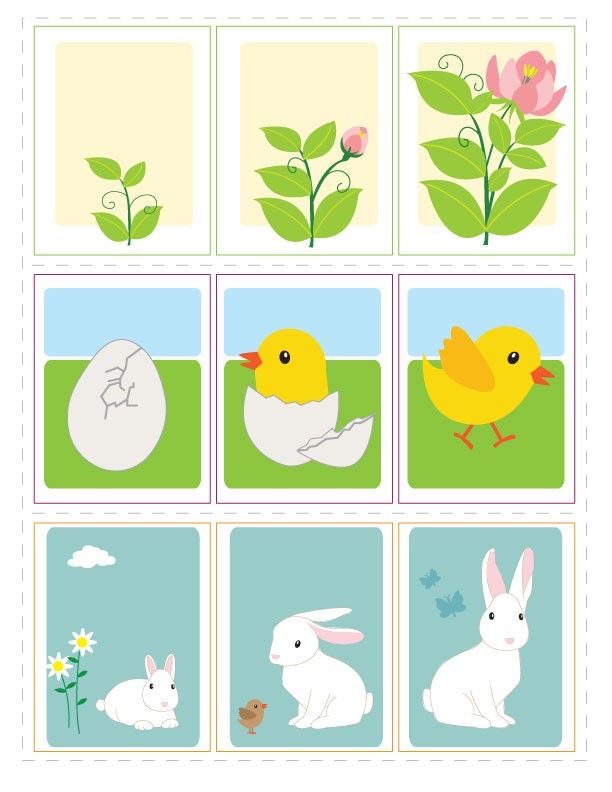
Chicks, Bunnies & Eggs … Oh My!
Enjoy these activities with your infants.
Sensory Egg Shakers
(Infants - )
Materials:
Sensory egg shakers - To make, fill plastic
eggs with assorted materials that make
different sounds. Suggested materials include
uncooked rice, uncooked beans, sand, small
pebbles, etc. Put the items inside the eggs,
close tightly and wrap the seam with plenty of
tape so that infant cannot open. Also, store out
of reach when not supervising closely.
Sanitized empty egg carton OR basket
• Infants use their senses to explore and learn
about their world. Sensory egg shakers are a
fun way for them to do this.
• Sit with the infant in your lap. Place the egg
carton or basket with the sensory egg shakers
on the floor in front of you. Invite the infant to
choose an egg.
• If the infant is older, he/she can shake the egg
to discover the sound. If not, you may need to
help the infant shake the egg. Use plenty of
language to talk about the sounds created by
My Little Bunny the eggs. As the infant explores all of the eggs,
(Infants, ) compare and contrast the sounds created.
Materials:
None needed
• A fingerplay is a fun way to build language skills
with infants.
• Hold the infant in your lap. Using your hand,
make it look like a bunny by holding up your
pointer and middle fingers up while using your
thumb to hold down the other two. Make the
finger “bunny” hop as you recite the rhyme.
LITTLE BUNNY
Little bunny, hopping ‘round.
Hopping up and hopping down.
Hopping down your arm and then
Hopping right back up again!
© 2020 Gee Whiz Education, LLC 6 www.geewhizeducation.com
Chicks, Bunnies & Eggs … Oh My!
Enjoy these activities with your school-age children
Questions to Spur Thinking
Colorful Resist Art • What happens when you draw with the white crayon on
(School-Age, ☺ ) the white paper?
Materials: • What do you think is going to happen when you paint
over your drawing? What actually happened? Were your
White paper cut in the shape of eggs or crosses predictions correct?
White crayons, watercolor paints, paintbrushes
• What colors of paint are you using on your creation?
• This activity is designed to help older children What happens when the colors bleed together?
explore the art technique of resist. It is also a fun ______________________________________________
way for them to explore cause and effect.
• How far do you think you are going to hop? How
• Provide children with white crayons and precut accurate was your prediction?
paper (egg or cross). Invite children to draw
designs on the white paper with white crayons. • What do you think you could do to hop farther?
What happens? Is this an easy or difficult task?
Why? Get Moving!
• Once children finish drawing, provide them with How Far Can You Hop?
watercolor paints, paintbrushes, cups of water and (Infants - )
folded paper towels. Children can then paint over
their eggs/crosses with watercolors. As they do Materials:
saw, encourage them to describe what happens. Tape measure or yardstick
Can they figure out why the paint does not stick to Large sheet of white paper and marker or pencil
the areas with crayon?
• This experience involves math (measurement),
• Allow paintings to dry completely and then tape to science (making & testing predictions), social/
windows, if possible, for a colorful display all can emotional skills (cooperation/taking turns) and
enjoy! physical development (gross motor). If the weather
is nice, you might want to take this experience
EXTEND FOR ANOTHER DAY: Children can cut outdoors.
paper into different shapes as they continue to
explore the art technique of resist. • Everyone knows the Easter bunny hops! This
experience invites the children to pretend to be the
Easter bunny while they hop...but with a twist. The
children will be challenged to predict how far they
can hop and then use a tape measure or yardstick
to identify the actual distance.
• Each child can take a turn by predicting the
distance (number of inches) they will be able to hop
forward from a standing position. Write down each
child’s prediction and then have him/her hop. The
other children can help you use a tape measure or
yardstick to identify the actual distance. You can
write this down beside the prediction. How close
was the child’s prediction to the actual results? Be
sure to invite the child to predict and hop multiple
times. Do their predictions become more accurate?
EXTEND FOR ANOTHER DAY: Repeat this activity
for at least one more day. Then use the data with the
children to create a graph.
© 2020 Gee Whiz Education, LLC 7 www.geewhizeducation.com
LITTLE BUNNY
          (tune: “Twinkle, Twinkle Little Star”)

         Little bunny, hopping ‘round.
         Hopping, hopping, up and down.
         Hopping through the sweet green grass
         Wiggle your tail as you hop past.
         Little bunny, hopping ‘round.
         Hopping, hopping, up and down.

                                                                  Corn Syrup Paint
                                                       To make, mix 4 tablespoons of corn
                                                       syrup with 1.5 teaspoons of liquid dish
                                                       soap. Mix in enough liquid tempera
                                                       paint or food coloring to tint. Repeat for
                                                       each color. Make several different
                                                       colors.

© 2020 Gee Whiz Education, LLC                     8                            www.geewhizeducation.com
© 2020 Gee Whiz Education, LLC 9 www.geewhizeducation.com
Gee Whiz is here to help family child
care providers during this emergency
Available online 24/7
The Gee Whiz Education Curriculum is designed
specifically for family child care providers
Easy-to-implement lesson plans (20 days per month + extras) include hands-on
experiences for all ages (infants through school-age)
Designed to be used in a home setting … not a center
Lots of outdoor experiences included
Nothing is shipped … no worries about shipping delays
Simply subscribe, log in and download … print what you need/want
Let Gee Whiz lend you a helping hand!
Special Offer for
Emergency Child Care Providers
Get your 1st month of Gee Whiz for just $8.95*
Use discount code EMCO2020
Go to www.geewhizeducation.com to subscribe!
*Offer valid for new, or returning, Gee Whiz customers only. Cannot be combined with any other discount or offer. Discount applies to first monthly only. After first month, customer will be
automatically charged at regular rate of $18.95/month. Customer may cancel at any time.
© 2020 Gee Whiz Education, LLC 10 www.geewhizeducation.comTech that benefits YOU and
puts high-quality activities at your fingertips
At Gee Whiz, we get it … we really do! Too many
times, technology that is supposed to make your life
easier actually makes it more complicated. This is NOT
the case with Gee Whiz. If you can click a button, you
can use the Gee Whiz curriculum. We even have a
helpful step-by-step guide with screenshots to help
you access and download everything you need in just
minutes.
To subscribe, go to www.geewhizeducation.com. Because we are an online
curriculum, subscribing and accessing the materials literally takes minutes!
www.geewhizeducation.com
© 2020 Gee Whiz Education, LLC 11 www.geewhizeducation.comYou can also read


