Chloe for COVID-19: Evolution of an Intelligent Conversational Agent to Address Infodemic Management Needs During the COVID-19 Pandemic - Journal ...
←
→
Page content transcription
If your browser does not render page correctly, please read the page content below
JOURNAL OF MEDICAL INTERNET RESEARCH                                                                                       Siedlikowski et al

     Viewpoint

     Chloe for COVID-19: Evolution of an Intelligent Conversational
     Agent to Address Infodemic Management Needs During the
     COVID-19 Pandemic

     Sophia Siedlikowski, BSc (Hons), MSci; Louis-Philippe Noël, BEng, MSci; Stephanie Anne Moynihan, BSc (Hons),
     MD; Marc Robin, BSc, MD
     Dialogue Health Technologies Inc, Montreal, QC, Canada

     Corresponding Author:
     Marc Robin, BSc, MD
     Dialogue Health Technologies Inc
     390 Rue Notre-Dame Ouest #200
     Montreal, QC, H2Y 1T9
     Canada
     Phone: 1 613 806 0671
     Email: marc.robin@dialogue.co

     Abstract
     There is an unprecedented demand for infodemic management due to rapidly evolving information about the novel COVID-19
     pandemic. This viewpoint paper details the evolution of a Canadian digital information tool, Chloe for COVID-19, based on
     incremental leveraging of artificial intelligence techniques. By providing an accessible summary of Chloe’s development, we
     show how proactive cooperation between health, technology, and corporate sectors can lead to a rapidly scalable, safe, and secure
     virtual chatbot to assist public health efforts in keeping Canadians informed. We then highlight Chloe’s strengths, the challenges
     we faced during the development process, and future directions for the role of chatbots in infodemic management. The information
     presented here may guide future collaborative efforts in health technology in order to enhance access to accurate and timely health
     information to the public.

     (J Med Internet Res 2021;23(9):e27283) doi: 10.2196/27283

     KEYWORDS
     chatbot; COVID-19; conversational agents; public health; artificial intelligence; infodemic; infodemiology; misinformation;
     digital health; virtual care

                                                                        In recent years, chatbots have emerged as a promising means
     Introduction                                                       to support public health efforts by easily increasing access to
     In the early stages of a global health crisis caused by a novel    accurate, tailored, and free information to millions of people at
     disease such as COVID-19, misinformation tends to propagate        once [4]. Leveraged with artificial intelligence (AI) tools,
     rapidly due to the absence of easily accessible and reliable       chatbots are intelligent conversational agents that result from
     information from authoritative sources [1]. According to the       the application of natural language processing techniques to
     World Health Organization, controlling the circulation of          analyze speech combined with an engine that is trained to
     information about a novel disease requires infodemic               provide human-like responses [5].
     management, defined as the application of “evidence-based          The recent surge in chatbot use across industries and business
     interventions that bring understandable, localized,                functions such as customer service, sales, marketing, and
     evidence-based information to citizens and drive positive          automation of internal processes stems from an evolution in the
     health-seeking behaviour” [2]. At the onset of the COVID-19        way humans communicate [6]. The current digital age, in which
     pandemic in Canada, however, public health hotlines were           most individuals have access to a mobile phone and are
     overwhelmed with calls, impeding the infodemic management          accustomed to holding multiple conversations at once through
     process. For example, on March 11, 2020, Quebec’s provincial       short online interactions, represents an ideal environment for
     health information 811 phone line received 16,840 calls            chatbot development [6]. Since the onset of the COVID-19
     compared to an average of 6000 calls managed on a typical day      pandemic, chatbots are increasingly being developed to
     [3].                                                               efficiently deliver evidence-based information about COVID-19
     https://www.jmir.org/2021/9/e27283                                                          J Med Internet Res 2021 | vol. 23 | iss. 9 | e27283 | p. 1
                                                                                                               (page number not for citation purposes)
XSL• FO
RenderX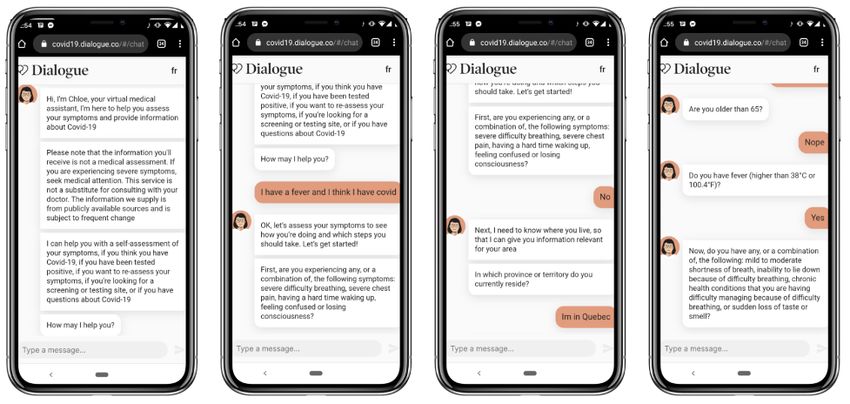
JOURNAL OF MEDICAL INTERNET RESEARCH                                                                                          Siedlikowski et al

     to the public [4]. Despite these advances, the possibility of         We wish to note that Chloe was designed and launched in an
     chatbots causing harm by communicating inaccurate information         emergency effort to support public health authorities in keeping
     to users warrants ongoing monitoring of chatbot quality and           Canadians informed during the first wave of the COVID-19
     safety [7].                                                           pandemic before any governmental information tools had been
                                                                           deployed. Following the rollout of official and local public
     The development of Dialogue Health Technologies Inc’s chatbot
                                                                           health online self-assessment tools providing features similar
     Chloe represents a successful Canadian cooperation among
                                                                           to ours, Chloe stopped being regularly updated.
     health, technology, and corporate sectors, in order to assist the
     public during the pandemic by addressing their questions and
     concerns about COVID-19 [8]. Founded in 2016, Dialogue is
                                                                           Chloe’s Development: From a Frequently
     a leading provider of virtual health care in Canada, offering its     Asked Questions Page to an Intelligent
     services exclusively to Canadian organizations through an online      Chatbot
     care platform using technologies developed in-house. This care
     platform consists of an interface in both desktop and mobile          Increased uncertainty surrounding the previously unknown virus
     application formats that connects members to a care team              and disease resulted in a deluge of questions not only for our
     consisting of health providers and coordinators. Our experience       own care team but also for the entire Canadian health care
     with chatbots in health care includes the design of various           system. In response to this surge, our Clinical Quality
     AI-enhanced bots used to collect and intuitively interpret patient    Committee led efforts to provide official answers to the most
     information in order to determine urgency, appropriateness for        frequently asked questions (FAQs) from members on our care
     virtual care, and the type of provider required. These chatbots       platform. This led to the release of the first version of our FAQ
     were built by combining medical knowledge with state-of the           section on our website on March 5, 2020.
     art algorithms and are continuously monitored, updated, and
     trained to enhance their effectiveness and efficiency, including      An FAQ section addresses predictable queries, but the constant
     bot-to-human handoff when required [9].                               flow of new information associated with the COVID-19
                                                                           pandemic required a dynamic tool. In response to this challenge,
     Chloe was initially conceived to integrate within the Dialogue        we designed a self-assessment flow based on official available
     care platform as a way to help manage questions about                 medical information surveyed by our care team. This allowed
     COVID-19 from our clients but was quickly converted into a            us to efficiently sort through and respond to the diverse concerns
     stand-alone digital application in order to be deployed as a free     our members and clients had about COVID-19. We then created
     tool for the general public. After Health Canada confirmed the        a smart virtual medical assistant that we named Chloe for
     first Canadian case of COVID-19 on January 27, 2020, our              COVID-19 that was released publicly for all Canadians on
     medical operations and customer success teams noted an                March 9, 2020. In accordance with Dialogue’s rigorous data
     increased flow of questions from members and organizations            security and privacy policies, every effort was made to ensure
     across the country about this novel disease, looking to us as a       that Canadians could use Chloe in an anonymous and secure
     health care company for guidance. The urgent need to slow the         fashion. To that effect, no information that could help identify
     spread of the virus and provide large-scale access to free            the user (including but not limited to IP addresses and
     information about COVID-19 from authoritative sources, as             approximate location) was collected by default.
     well as the desire to assist flooded provincial health information
     phone lines in answering common questions from Canadians,             Chloe would ask a user about their symptoms, location, travel
     prompted us to pursue an AI approach.                                 history, and recent contacts. This assessment resulted in a
                                                                           personalized recommendation including links to local resources
     We launched the chatbot Chloe, named after Dialogue’s first           such as the user’s provincial government’s COVID-19
     nurse, on March 9, 2020. Chloe was designed to provide free,          guidelines. Figure 1 presents one example of the start of the
     up-to-date information to all Canadians on COVID-19 from              assessment flow for a user in Quebec.
     trusted Canadian authorities, following federal, provincial, and
     territorial regulations based on each user’s location. To ensure      When provincial online self-assessment tools were later
     transparency of our technological approach, we rendered the           deployed, we integrated this information into Chloe. Our
     online service and content management system open-source.             self-assessment tool saw the highest traffic on March 15, 2020,
     Chloe was designed following best dialogue management                 with 5945 new users accessing the tool, coinciding with the
     principles [10] and built with Rasa, a state-of-the-art open-source   overflow of public health information phone lines. By April 18,
     framework [11].                                                       2020, it had been used 73,000 times, further indicating Chloe’s
                                                                           contribution to overall public health efforts in keeping Canadians
     This report first outlines the development of Chloe, an               informed.
     information and self-assessment tool to respond to a rapidly
     evolving health crisis. This was achieved by incrementally            In order to keep up with constantly evolving information
     leveraging AI tools in order to address the challenges associated     spanning multiple Canadian jurisdictions and to discriminate
     with the volume of demands and constantly changing                    between official information and disinformation, we designed
     information during the early phases of the COVID-19 pandemic.         and built a web scraper. This automated service was
     This paper then highlights Chloe’s strengths, the challenges we       programmed to extract the latest data from reliable sources
     faced, and future directions for chatbot development to support       identified by our medical team. During the peak of the first
     infodemic management.                                                 wave, it ran every hour. When the flow of new information later

     https://www.jmir.org/2021/9/e27283                                                             J Med Internet Res 2021 | vol. 23 | iss. 9 | e27283 | p. 2
                                                                                                                  (page number not for citation purposes)
XSL• FO
RenderX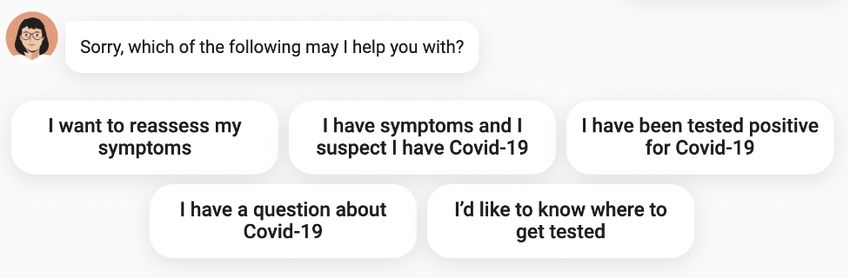
JOURNAL OF MEDICAL INTERNET RESEARCH                                                                                          Siedlikowski et al

     slowed, it was then activated every 4 hours to ensure Chloe as        scraper was used to refine the Q&A model, which was then
     well as our online FAQ still offered the most up-to-date              further optimized using machine learning techniques. Our team
     information to Canadians.                                             of applied researchers developed a machine learning model that
                                                                           would find the correct answer to a given question about
     In addition to the self-assessment tool and FAQ, we developed
                                                                           COVID-19 by feeding it approximately 4000 questions acquired
     a question and answer (Q&A) model within Chloe to further
                                                                           through crowdsourcing and several thousand more from data
     meet the information needs of Canadians regarding COVID-19.
                                                                           collection tools offered by Amazon Web Services [12].
     The up-to-date COVID-19 information identified by our web
     Figure 1. Example of self-assessment flow for a user in Quebec.

     Given the time-consuming nature of this process and the need          the word “surface” or “object” and a declension of the word
     to gain a better understanding of what questions were most            “time.” Next, we embedded the user’s question using the same
     commonly asked, we used clustering to divide the approximately        pretrained model, to have it in the same multidimensional space
     4000 questions into 40 groups of similar questions. Clustering        as the cluster averages. The distance between a user’s question
     is a form of unsupervised machine learning, which aims to             and the clusters could be computed mathematically. The closest
     segregate groups with similar traits and assign them into clusters.   cluster could then be identified and the question categorized.
     The clustering algorithm used word embeddings to represent
                                                                           For users’ questions that matched a related cluster, we could
     each of the questions in a multidimensional way. We were then
                                                                           then return the associated Q&A. For instance, the question “How
     able to accurately measure the similarity among the questions
                                                                           long does it take for coronavirus to vanish from doorknobs?”
     and split them into groups accordingly. For instance, all
                                                                           was matched to the cluster that dealt with the virus on surfaces.
     questions asking about how long the coronavirus could survive
                                                                           We could then return the associated question-answer pair that
     on surfaces, one of our most commonly asked questions, were
                                                                           would look like this:
     grouped into one cluster.
                                                                                 How long can coronavirus stay on surfaces? It has
     On April 28, 2020, we released our first interactive Q&A model,
                                                                                 been demonstrated that it can last for X hours on Y
     marking our transition from an FAQ system to a customized
                                                                                 surface.
     conversational experience. As a first iteration of a natural
     language Q&A model, we implemented a distance-computing,              If the distance between the user’s question and each of the
     similarity-matching algorithm. In this model, all clustered           cluster’s centers was too great, however, the question would
     questions were embedded in a multidimensional space. Figure           not be categorized, and an answer was not returned. In such
     2 represents this step of the process, in which each colored circle   cases, the user would be offered a link to our FAQ page, and
     is a question and its position is determined by the attributes        Chloe would ask the user if they had another question. Our
     computed by the algorithm. Averaging techniques were used             monitoring team also took note of these situations to further
     to obtain the center of each cluster. This identified the average     train Chloe to be able to answer an increasing number of user
     features of the questions within the same cluster.                    questions. This was achieved by having our team analyze these
                                                                           additional questions and add them to the set of questions used
     For example, it was determined that the average question              to retrain the clustering algorithm.
     regarding the coronavirus on surfaces holds a combination of

     https://www.jmir.org/2021/9/e27283                                                             J Med Internet Res 2021 | vol. 23 | iss. 9 | e27283 | p. 3
                                                                                                                  (page number not for citation purposes)
XSL• FO
RenderX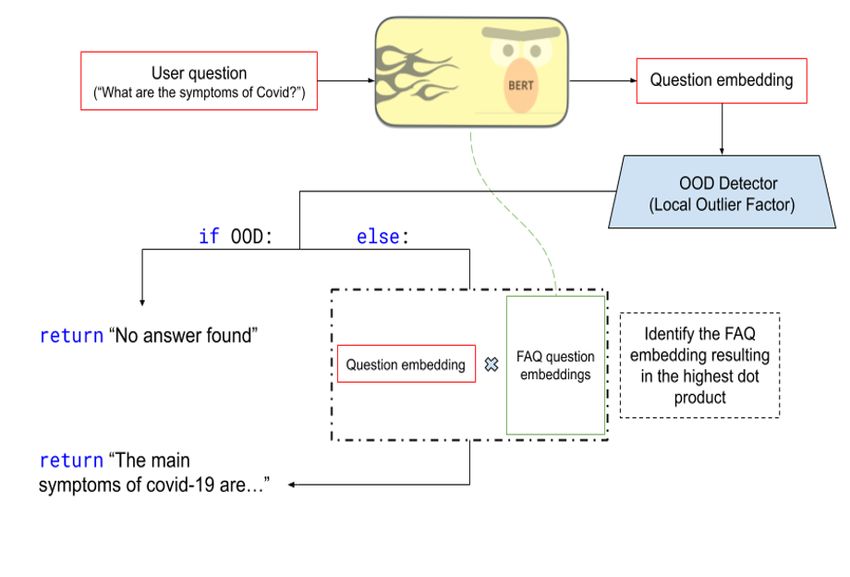
JOURNAL OF MEDICAL INTERNET RESEARCH                                                                                          Siedlikowski et al

     Figure 2. Representation of questions in a multidimensional space.

     Canada being a bilingual country, we also needed this model           FAQ questions from trusted sources according to their relevance
     to accurately return question-answer pairs to all Canadians in        with a user’s question and an out-of-distribution (OOD) detector
     both English and French. We therefore followed the                    using a Local Outlier Factor algorithm [14]. The purpose of this
     aforementioned process twice in order to cover questions in           OOD detector was to eliminate questions that could not be
     both languages.                                                       answered with the available information from the vetted sources
                                                                           the chatbot used. This improved the number of questions
     While developing the previously described similarity model,
                                                                           answered and the accuracy of the answers provided while
     we also worked on a more advanced model consisting of 2 main
                                                                           minimizing manual updating work from our care team. Figure
     components: a Bidirectional Encoder Representations from
                                                                           3 presents a general diagram of the model architecture.
     Transformers (BERT) model [13] that ranked all COVID-19
     Figure 3. Diagram of the final question & answer (Q&A) model architecture using the example of a question about the symptoms of COVID-19.
     BERT: Bidirectional Encoder Representations from Transformers; FAQ: frequently asked question; OOD: out-of-distribution.

     https://www.jmir.org/2021/9/e27283                                                             J Med Internet Res 2021 | vol. 23 | iss. 9 | e27283 | p. 4
                                                                                                                  (page number not for citation purposes)
XSL• FO
RenderX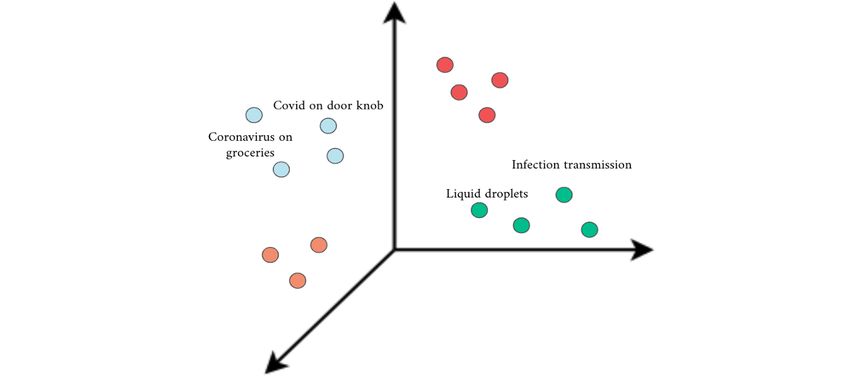
JOURNAL OF MEDICAL INTERNET RESEARCH                                                                                                Siedlikowski et al

     Table 1 describes the results obtained from this final Q&A                which explains the discrepancy between the English and French
     model’s accuracy. Overall accuracy represents the model’s                 results. Although higher metrics can be obtained from Q&A
     ability to give a correct answer to the user’s question, and OOD          models, we believe that these results are reasonable given time
     accuracy represents its ability to detect situations in which the         and data constraints. These results were also deemed acceptable
     question asked has no answer in our data sources. The BERT                because our Q&A model sought to provide answers to
     pretrained model we used has a better performance in English,             commonly asked questions and not directly inform patient care.

     Table 1. Overall and out-of-distribution (OOD) accuracies of the final question & answer (Q&A) model in English and in French.
      Language                                         Overall accuracy, %                             OOD accuracy, %
      English                                          81.83                                           90.48
      French                                           71.32                                           70.60

     We nevertheless addressed the error rates of our model to the             application programming interface into Chloe, any user whose
     best of our abilities by consistently displaying the question and         self-assessment resulted in a recommendation to get COVID-19
     answer as a pair when responding to the user. For example, if             testing would be prompted with the option to search for testing
     the user asked about coronavirus and pets and Chloe replied               sites. Once the user entered their desired location to get tested,
     with information about the coronavirus and surfaces, the user             they would receive a list of sites offering COVID-19 testing,
     would know that the model was responding about surfaces and               their opening hours, special instructions, as well as a link to
     not pets. This ensured the user would not be misled by false              obtain directions to the sites. Figure 4 presents an example of
     information. Lastly, the model was validated using a standard             local testing sites offered to a user in Quebec seeking navigation
     process [15]. The dataset was divided into training, validation,          assistance.
     and test sets, followed by an evaluation of how the test set (not
                                                                               To make the conversation feel as natural as possible for users,
     previously seen by the model) performed. Further details about
                                                                               we leveraged a machine-learning technology called natural
     the Q&A model are detailed in a poster presented at the
                                                                               language understanding (NLU), a subtopic of natural language
     Montreal AI Symposium 2020 [16].
                                                                               processing, which converts human-readable text inputs into
     Two other important features were implemented to increase                 machine language that can be processed to extract an
     Chloe’s ability to meet the evolving needs of Canadians: a daily          understanding. In our particular case, we extracted intents, which
     self-health assessment and COVID-19 testing navigation. The               represent the user’s query, and entities, which represent key
     self-health check feature was added to the assessment flow at             categorized values. For example, if a user said, “I want to find
     the end of May 2020. Users choosing to enroll in this feature             a test site close to Montreal,” NLU would help us map the user’s
     received a daily SMS message with a link to their self-health             intent to something like “find_test_site” and extract the entity
     check-in and had the choice to opt out at any time. Anyone                “Montreal,” which we know is a city. Test sites in Montreal
     using this self-health assessment service had their first name            could then easily be suggested to the user. The use of NLU
     and phone numbers securely stored on our data servers located             allowed for more open-ended questions akin to normal
     in Canada. Having regular contact with users helped tailor the            conversations and minimized clicking. As of June 29, 2020,
     assessment to the user’s particular situation and needs. When             Chloe could ask users: “How may I help you?” NLU
     starting the assessment flow, users’ previously reported                  components were associated with each possible question,
     symptoms and concerns helped the chatbot identify relevant                providing a natural conversational experience with an intelligent
     questions to be asked and offer appropriate recommendations.              chatbot. In terms of dialogue management strategies, we used
     For example, if the user reported a fever the day before, the             a combination of NLU and static flows defined by a
     chatbot might ask if it was still present and if it had gotten better     multidisciplinary team of medical experts, software and machine
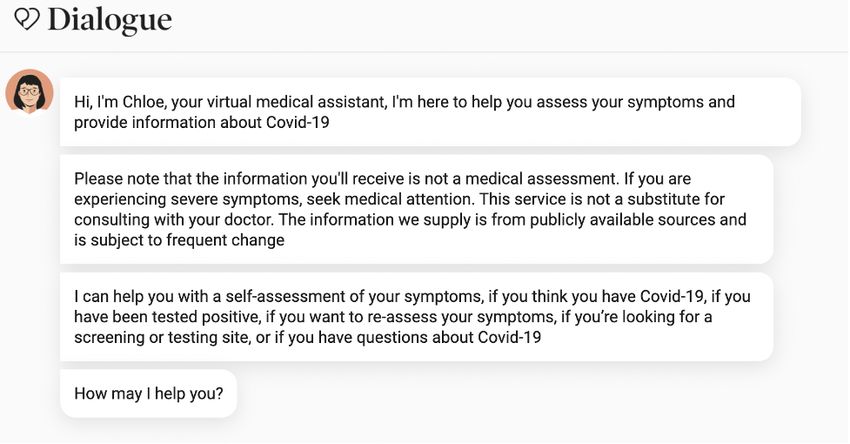
     or worse.                                                                 learning engineers, and conversational designers. Figure 5
                                                                               presents what the latest version of Chloe looks like to users
     The testing navigation feature was added on June 2, 2020 to the
                                                                               upon first connecting with the chatbot. In response to Chloe’s
     assessment flow to support public health officials and public
                                                                               initial “How may I help you?”, if a user’s response falls outside
     health information phone lines. This feature was built in
                                                                               the clusters of questions known to Chloe, the chatbot presents
     partnership with Clinia [17], a technology company enabling
                                                                               5 clear clickable options from which the user can choose. Figure
     health care resource navigation. By integrating Clinia’s
                                                                               6 shows Chloe’s main features as presented to users.

     https://www.jmir.org/2021/9/e27283                                                                   J Med Internet Res 2021 | vol. 23 | iss. 9 | e27283 | p. 5
                                                                                                                        (page number not for citation purposes)
XSL• FO
RenderX
JOURNAL OF MEDICAL INTERNET RESEARCH Siedlikowski et al
Figure 4. Example of test navigation results for a user in Quebec.
Figure 5. Chloe’s welcome message to users explaining their options.
https://www.jmir.org/2021/9/e27283 J Med Internet Res 2021 | vol. 23 | iss. 9 | e27283 | p. 6
(page number not for citation purposes)
XSL• FO
RenderXJOURNAL OF MEDICAL INTERNET RESEARCH Siedlikowski et al
Figure 6. Display of Chloe’s features available to users.
challenges, particularly in a pandemic context [7]. By
Strengths, Challenges, and Future reinforcing local provincial and territorial guidelines, we ensured
Directions that Chloe’s messaging to users aligned with the most up-to-date
public health information tailored to each user’s location and
To our knowledge, at the onset of the COVID-19 pandemic, health situation. We learned that having a multidisciplinary
there were no other accessible chatbots that provided free, local, team of technology, nursing, physician, customer success, and
up-to-date information on COVID-19 in both English and clinical quality experts, assisted by AI tools, was the best
French to the Canadian public. As of early March 2020, Chloe approach to quickly mobilize all necessary information and
for COVID-19 filled this important gap by supporting efforts make any required adjustments to Chloe as the pandemic
in keeping Canadians informed when public health hotlines situation evolved.
were most overwhelmed. Chloe underwent rigorous training by
a dedicated team of medical and technology experts who were Given that we developed Chloe as an informational tool in an
involved from inception to deployment. This team continually emergency effort to support overwhelmed public health hotlines,
monitored the chatbot using analytics data, making adjustments we lacked the time and resources needed to rigorously evaluate
and updates when needed. Informal user testing was conducted Chloe’s implementation and measure Chloe’s impact on users.
each time a major update was introduced. This involved In a noncrisis context, it would have been ideal to set and track
approximately 10 individuals recruited internally who tested specific implementation metrics other than general chatbot
out the different available flows and provided feedback. traffic to improve Chloe more systematically. In this instance,
we prioritized the need to act quickly in assisting public health
As the pandemic unfolded and more information emerged about efforts at the height of a health crisis. We also considered that
COVID-19, Chloe adapted to address evolving questions from implementation metrics are particularly important for chatbots
the public. In her most advanced version in June 2020, Chloe that directly inform patient care, such as those that refer users
uniquely integrated 5 features into 1 bilingual chatbot: a to consultations with health professionals. Those chatbots
self-assessment tool, resources for users who tested positive for require closer monitoring than chatbots such as Chloe, whose
COVID-19, answers to common questions about COVID-19, main goal was to reliably answer the public’s questions about
testing navigation, and a daily self-health check-in. COVID-19 and to redirect individuals to testing services and
Despite Chloe’s success in providing tailored information to local public health guidelines when needed.
the Canadian public early on in the pandemic, we encountered Moreover, we were unable to precisely measure Chloe’s
several challenges during Chloe’s development and after Chloe’s acceptability, but we acknowledge the importance of evaluating
launch, of which the most notable were keeping up with the this metric [18]. Current metrics used to determine the
increasingly vast and rapidly changing information available acceptability of AI chatbots in health care include
on COVID-19 as well as time and data constraints within an trustworthiness of the information provided as well as a user
emergency health crisis context. experience that is perceived as empathetic to the patient [19].
Rapidly changing information on COVID-19 (eg, how the Despite not formally evaluating Chloe’s acceptability, Chloe
disease presents in individuals, how the SARS-CoV-2 virus is was designed to be trustworthy, by offering up-to-date official
transmitted, and when individuals should get tested), information from public health sources, and empathetic, by
complicated by Canada’s multijurisdictional landscape with leveraging AI techniques to make the conversation feel as
guidelines changing from one region to another, required natural as possible with users. We also knew from prior
constant monitoring from our team to ensure accurate experience designing and implementing health technology tools
information was provided to users across the country. for the Dialogue platform, as well as extensive member
Furthermore, as mentioned earlier in this report, chatbots have feedback, that chatbots are an acceptable and easy-to-use tool
the potential to address the questions of millions of people at for collecting, assessing, and sharing health information. That
once [4], but the risk of amplifying misinformation and the lack being said, rigorous user testing combined with the systematic
of research on chatbot effectiveness present significant collection of user feedback, for instance through the integration
https://www.jmir.org/2021/9/e27283 J Med Internet Res 2021 | vol. 23 | iss. 9 | e27283 | p. 7
(page number not for citation purposes)
XSL• FO
RenderXJOURNAL OF MEDICAL INTERNET RESEARCH Siedlikowski et al
of a permanent feedback link in the user interface of a chatbot Moreover, in a recent Nature survey of infectious disease
as done by Herriman et al [4], may have allowed us to better researchers, virologists, and immunologists in 23 countries, the
understand user needs and make quicker improvements to majority of respondents predicted that the SARS-CoV-2 virus
Chloe’s features. will likely become endemic over time, with its future closely
depending on virus mutations and the type of immunity
In further building on Chloe’s development and envisioning the
individuals will acquire [24]. In anticipation of the upcoming
future of chatbots, we would also prioritize evaluating the impact
waves of uncertainty regarding this virus in the coming years,
of chatbots on how well individuals feel informed. In a scoping
we envision an ongoing and growing role for chatbots in
review of the technical metrics used to evaluate healthcare
supporting public health efforts in infodemic management in
chatbots, Abd-Alrazaq et al [20] found that most chatbots were
order to keep the public safe and informed.
assessed according to 27 different metrics, with global usability
and survey designs as the most commonly used metrics.
Although chatbots like Chloe are not “healthcare chatbots” in
Conclusion
that they do not deliver healthcare services, the evaluation of The devastating and widespread health consequences of the still
their usability and performance is warranted in order to improve ongoing COVID-19 pandemic and continued uncertainty
their ability to provide the right information to users at the right surrounding this novel disease are unprecedented challenges to
time. public health. Since the start of the pandemic, managing the
In summary, we believe Chloe’s development is useful in ensuing deluge of both information and misinformation about
illustrating the potential for rapid collaboration among health, COVID-19 has also required unparalleled efforts from health
technology, and corporate sectors to assist public health efforts authorities.
in keeping individuals informed at the height of a health crisis. In detailing the development of Chloe for COVID-19, we
Addressing the public’s need for accurate health information provide an encouraging example of collaboration leading to a
will remain important within the current pandemic context and rapidly scalable, safe, secure, and useful human-enhanced digital
during any future health crises. As COVID-19 vaccination tool to address the information needs of Canadians during this
campaigns continue to target the general public, intelligent pandemic. Continuing to leverage the potential of such chatbots
conversational agents have the potential to play a critical role to become trusted public health allies will support ongoing
in debunking misinformation surrounding vaccines and directing infodemic management strategies. As research on the safety
individuals to public health resources [21,22]. One study in the and acceptability of these tools advances, we anticipate a
preprint stage, which examined a chatbot designed to address growing role for chatbots, both standalone and integrated with
arguments against the COVID-19 vaccine, promisingly showed human-provided care, in the current pandemic, in particular
that individuals’ attitudes towards vaccination became more with vaccination rollout and ongoing efforts to combat
positive after receiving information from this chatbot [23]. misinformation.
Acknowledgments
The authors wish to acknowledge NuEcho and Clinia for their collaboration and their important contribution to Chloe’s development.
Financial support for this project was received from ScaleAI and Mitacs.
Conflicts of Interest
All four authors of this paper work at Dialogue Health Technologies Inc. but do not have any personal financial interests related
to the contents of this paper.
References
1. Vraga EK, Jacobsen KH. Strategies for Effective Health Communication during the Coronavirus Pandemic and Future
Emerging Infectious Disease Events. World Medical & Health Policy 2020 Jul 29;12(3):233-241. [doi: 10.1002/wmh3.359]
2. Infodemic Management. World Health Organization. 2021. URL: https://www.who.int/teams/risk-communication/
infodemic-management [accessed 2021-01-10]
3. Info-Santé 811 ne suffit pas à la demande. Radio Canada. 2020 Mar 12. URL: https://ici.radio-canada.ca/nouvelle/1662861/
811-engorge-ressources-mccann [accessed 2021-01-20]
4. Herriman M, Meer E, Rosin R, Lee V, Washington V, Volpp KG. Asked and answered: Building a chatbot to address
covid-19-related concerns. NEJM Catalyst Innovations in Care Delivery 2020:1 [FREE Full text] [doi: 10.1056/cat.20.0230]
5. Abdul-Kader SA, Woods JC. Survey on Chatbot Design Techniques in Speech Conversation Systems. International Journal
of Advanced Computer Science and Applications 2015;6(7):1. [doi: 10.14569/ijacsa.2015.060712]
6. Dale R. The return of the chatbots. Nat. Lang. Eng 2016 Sep 13;22(5):811-817. [doi: 10.1017/s1351324916000243]
7. Miner AS, Laranjo L, Kocaballi AB. Chatbots in the fight against the COVID-19 pandemic. NPJ Digit Med 2020;3:65
[FREE Full text] [doi: 10.1038/s41746-020-0280-0] [Medline: 32377576]
8. Chloe. Dialogue Health Technologies. URL: https://covid19.dialogue.co/#/ [accessed 2021-01-10]
https://www.jmir.org/2021/9/e27283 J Med Internet Res 2021 | vol. 23 | iss. 9 | e27283 | p. 8
(page number not for citation purposes)
XSL• FO
RenderXJOURNAL OF MEDICAL INTERNET RESEARCH Siedlikowski et al
9. Liu J, Gao Z, Kang Y, Jiang Z, He G, Sun C, et al. Time to Transfer: Predicting and Evaluating Machine-Human Chatting
Handoff. AAAI 2021:5841-5849 [FREE Full text]
10. Harms J, Kucherbaev P, Bozzon A, Houben G. Approaches for Dialog Management in Conversational Agents. IEEE
Internet Comput 2019 Mar;23(2):13-22. [doi: 10.1109/mic.2018.2881519]
11. Rasa. 2021. URL: https://rasa.com/ [accessed 2021-04-02]
12. Amazon Mechanical Turk. URL: https://www.mturk.com/ [accessed 2021-01-10]
13. Devlin J, Chang M, Lee K, Toutanova K. Bert: Pre-training of deep bidirectional transformers for language understanding.
Cornell University. 2019. URL: https://arxiv.org/abs/1810.04805 [accessed 2021-01-10]
14. Breunig M, Kriegel H, Ng R, Sander J. LOF. SIGMOD Rec 2000 Jun;29(2):93-104. [doi: 10.1145/335191.335388]
15. Brownlee J. What is the Difference Between Test and Validation Datasets? Machine Learning Mastery. 2020 Aug 14. URL:
https://machinelearningmastery.com/difference-test-validation-datasets/ [accessed 2021-06-25]
16. Bronzi M, Pinto J, Ghosn J, Subakan C, Sharma P, Lu X. Poster 58: A Question Answering System in Response to the
COVID-19 Crisis. 2020 Presented at: Montreal AI Symposium 2020; September 11, 2020; Montreal, Canada URL: https:/
/drive.google.com/file/d/1chJyp6mEhieL13EzbX_Xpf8m3MenDuDE/view?pli=1
17. Clinia. URL: https://clinia.com/en-ca [accessed 2021-01-10]
18. Tudor Car L, Dhinagaran DA, Kyaw BM, Kowatsch T, Joty S, Theng Y, et al. Conversational Agents in Health Care:
Scoping Review and Conceptual Analysis. J Med Internet Res 2020 Aug;22(8):e17158 [FREE Full text] [doi: 10.2196/17158]
[Medline: 32763886]
19. Nadarzynski T, Miles O, Cowie A, Ridge D. Acceptability of artificial intelligence (AI)-led chatbot services in healthcare:
A mixed-methods study. Digit Health 2019;5:2055207619871808 [FREE Full text] [doi: 10.1177/2055207619871808]
[Medline: 31467682]
20. Abd-Alrazaq AA, Rababeh A, Alajlani M, Bewick BM, Househ M. Effectiveness and Safety of Using Chatbots to Improve
Mental Health: Systematic Review and Meta-Analysis. J Med Internet Res 2020 Jul 13;22(7):e16021 [FREE Full text]
[doi: 10.2196/16021] [Medline: 32673216]
21. Vedhara K. Experts create ‘chatbot’ to address people’s concerns about Covid-19 vaccines. University of Nottingham.
2021 Apr 21. URL: https://www.nottingham.ac.uk/news/vaccine-hesitancy [accessed 2021-06-20]
22. Kinsella B. Nuance Launches COVID-19 Vaccine Bot and Vaccine Assistant. Voicebot.ai. 2020 Dec 28. URL: https:/
/voicebot.ai/2020/12/28/nuance-launches-covid-19-vaccine-bot-and-vaccine-assistant/ [accessed 2021-06-20]
23. Altay S, Hacquin A, Chevallier C, Mercier H. Information Delivered by a Chatbot Has a Positive Impact on COVID-19
Vaccines Attitudes and Intentions. PsyArXiv. 2021 Apr. URL: https://psyarxiv.com/eb2gt/ [accessed 2021-06-25]
24. Phillips N. The coronavirus is here to stay - here's what that means. Nature 2021 Feb;590(7846):382-384. [doi:
10.1038/d41586-021-00396-2] [Medline: 33594289]
Abbreviations
AI: artificial intelligence
BERT: Bidirectional Encoder Representations from Transformers
FAQ: frequently asked questions
NLU: natural language understanding
OOD: out-of-distribution
Q&A: question and answer
Edited by C Basch; submitted 20.01.21; peer-reviewed by A Kocaballi, H Belli; comments to author 17.03.21; revised version received
27.06.21; accepted 10.07.21; published 21.09.21
Please cite as:
Siedlikowski S, Noël LP, Moynihan SA, Robin M
Chloe for COVID-19: Evolution of an Intelligent Conversational Agent to Address Infodemic Management Needs During the COVID-19
Pandemic
J Med Internet Res 2021;23(9):e27283
URL: https://www.jmir.org/2021/9/e27283
doi: 10.2196/27283
PMID: 34375299
©Sophia Siedlikowski, Louis-Philippe Noël, Stephanie Anne Moynihan, Marc Robin. Originally published in the Journal of
Medical Internet Research (https://www.jmir.org), 21.09.2021. This is an open-access article distributed under the terms of the
Creative Commons Attribution License (https://creativecommons.org/licenses/by/4.0/), which permits unrestricted use, distribution,
https://www.jmir.org/2021/9/e27283 J Med Internet Res 2021 | vol. 23 | iss. 9 | e27283 | p. 9
(page number not for citation purposes)
XSL• FO
RenderXJOURNAL OF MEDICAL INTERNET RESEARCH Siedlikowski et al
and reproduction in any medium, provided the original work, first published in the Journal of Medical Internet Research, is
properly cited. The complete bibliographic information, a link to the original publication on https://www.jmir.org/, as well as
this copyright and license information must be included.
https://www.jmir.org/2021/9/e27283 J Med Internet Res 2021 | vol. 23 | iss. 9 | e27283 | p. 10
(page number not for citation purposes)
XSL• FO
RenderXYou can also read


