ÉCOLE O'KELLY SCHOOL RE-OPENING PLAN 2020 - Brandon ...
←
→
Page content transcription
If your browser does not render page correctly, please read the page content below
ÉCOLE O’KELLY SCHOOL
    RE-OPENING PLAN 2020

0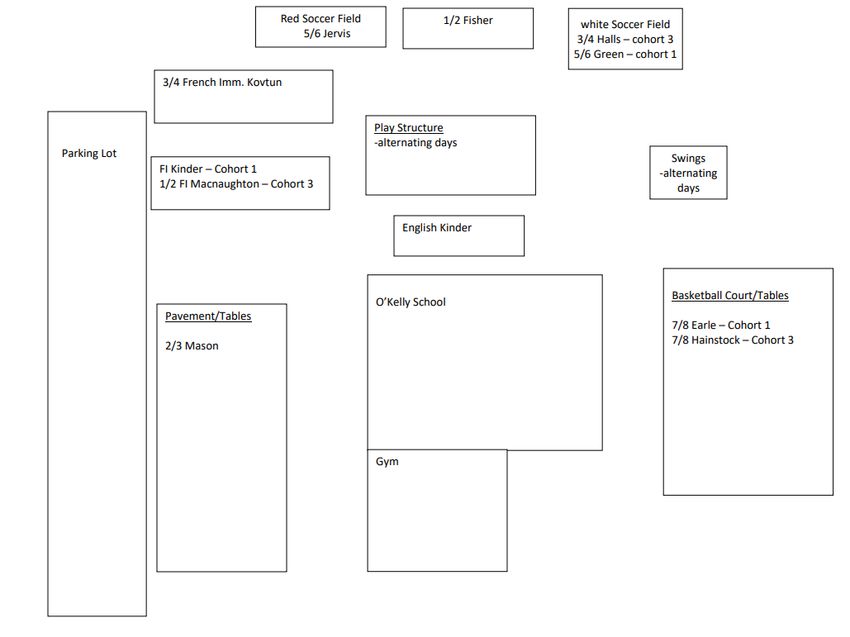
Re-Opening O’Kelly Plans 2020
 As a school, we will be taking direction from BSD, Manitoba Education and the Chief Medical Officer
                       daily; therefore, our plan is subject to change as advised.

                                         Health Orders
Before Coming into the School
   ➢ Individuals should self-isolate and not enter O’Kelly School if they:
                 o are experiencing symptoms suggestive of COVID-19
                 o have travelled outside Manitoba in the previous 14 days (outside of areas
                     excluded by public health orders, which currently exclude locations in
                     Western Canada, the territories, and Ontario west of Terrace Bay)
                 o are a close contact of a confirmed case of COVID-19
                 o are awaiting a COVID-19 test result (excluding persons tested as part of
                     voluntary asymptomatic surveillance for COVID-19, as they do not need
                     to isolate).

   ➢ An up-to-date list of symptoms can be found at:
     https://www.gov.mb.ca/covid19/about/index.html
Screening Protocols
   ➢ There will be screening protocols for all people entering O’Kelly School and limitations
      regarding visitors. Please call the office before coming into the school.

Screening
   ➢ Screening for symptoms is critical to identify any potential cases of COVID-19 as quickly
      as possible before exposure to others. If someone is unsure whether they or their child
      should be tested and self-isolate, they should be directed to the COVID-19 Screening
      Tool at https://sharedhealthmb.ca/covid19/screening-tool/.
   ➢ All screening that identifies suspected cases of COVID-19 should be referred to Health
      Links – Info Santé at 204-788-8200 or 1-888-315-9257.
   ➢ Symptom and exposure screening must occur at the start of each day.
   ➢ Staff must self-monitor daily for signs and symptoms of COVID-19. Staff who have any
      symptoms of COVID-19 must stay home, isolate, and be excluded from work. Schools
      must maintain records of staff absenteeism.
   ➢ Parents and caregivers need to monitor their child daily for symptoms and exposures
      before sending them to school. Parents and caregivers are responsible for ensuring their
      children are not displaying symptoms before sending them to school or on the bus.
      Schools can also support children with self-screening upon arrival at school if needed.
   ➢ Signage, with exclusion criteria, is posted at all entrances to O’Kelly.
   ➢ Anyone who meets any of the exclusion criteria will not be admitted to O’Kelly and will
      be advised to immediately isolate and consult Health Links – Info Santé or their health
      care provider. Those with symptoms should be tested. If the test is negative for COVID-
      19, they can return 24 hours after symptoms resolve. If individuals do not get tested,
      they should isolate for 14 days from symptom onset, and they may return if symptoms
      have resolved at that time.
➢ A chronic stable cough, sneeze, runny nose, or nasal congestion that is unchanged and
clearly linked to a known medical condition such as asthma or allergies is not an
absolute requirement for exclusion. As well, children who are crying can exhibit a runny
nose. Changing or worsening of chronic symptoms require isolation and contacting
Health Links – Info Santé. Staff will exercise judgment based on the symptoms but,
when in doubt, err on the side of caution by excluding the child and advising the
parent/caregiver to contact Health Links – Info Santé or their health care provider.
Routine screening or monitoring of temperatures with a thermometer or other device to assess for fever
is not recommended. Normal temperatures can be variable throughout the day and can be different
between individuals. It is recommended that parents and staff focus on monitoring for symptoms of
COVID-19, as outlined in the Screening Tool and poster at
https://sharedhealthmb.ca/covid19/screening-tool
Physical Distancing
➢ Physical distancing of two metres or six feet between all students should occur
whenever reasonably possible in a school setting. Where this is not possible, one-meter
separation between students will occur in cohorts.
➢ Visual cues/prompts will be used throughout the school to support students and manage
flow in common areas(markings on floor in hallways, two chairs at an activity,
pictures/posters, mats, numbers on floor, lines painted outside for designated play areas
and line up spots, etc).
➢ Physical barrier/plexiglass screen will be installed in main office.
➢ Risk Response Drills will be modified and reconsidered within the COVID-19
environment, as current procedures are not conducive to physical distancing.
Modifications of drills to achieve goals have been considered.
➢ Individual activity will be planned in all areas to minimize contact. Participating outdoors
when possible will also occur.
Cohorts/Groups
➢ It is recognized that strict physical distancing at all times (2 m), particularly with young
children, is not practical in the school setting. When physical distancing is not possible,
cohorts can be used to limit exposure and facilitate contact tracing if a case is identified.
➢ Staggered entrance into school will occur during the first week of school. This will allow
for students to become familiar with regulations and procedures in a safe manner.
➢ Here at O’Kelly, we will have 3 cohorts staggered for recess and lunch breaks and
students will stay in their classrooms/cohorts throughout the day between 8:40a.m. and
11:40a.m. and 12:40p.m. and 3:30p.m.
➢ We will have a separate bus cohort for our bus students.
➢ Please note that students in daycare programs and Parent Council Lunch Program will
not be part of our daily cohorts, as they are not part of our school programs.
➢ Maximum cohort size is to be no more than 75 students. Each cohort will be separated
to prevent contact with other groups. Each cohort must be able to arrive, depart, and
participate in school activities without co-mingling with members from other cohorts as
much as possible.
➢ Schedules and movement of cohorts will be staggered to avoid being in shared spaces
(e.g., foyers, hallways) at the same time.
➢ Teachers will move between classrooms instead of students whenever possible.➢ Daily records that include the names of students, staff, and volunteers of cohorts will be
kept.
Ventilation
➢ We are increasing air flow with fresh air/outdoor air (opening windows/vents/HVAC
systems) when possible and avoiding recirculating air (fan use). When this is not feasible
for the whole facility, we will consider this for higher risk areas (classrooms, busy areas,
etc.).
Hygiene Practices
➢ Students and staff will engage in frequent hand hygiene.
➢ Handwashing with soap and water for at least 20 seconds is the recommended hand
hygiene practice. Here at O’Kelly, we will be helping educate the students with training,
helpful hints and songs to ensure this is done correctly.
➢ Good hygiene practices and respiratory etiquette will be modelled, taught, and reinforced
regularly at O’Kelly. This includes coughing and sneezing into a tissue or sleeve, as well
as properly and promptly disposing of any used tissues and refrain from touching the
face.
Personal Protective Equipment (PPE)
➢ At O’Kelly, students (Grade 4 and up), staff, visitors and volunteers will be required to
wear non-medical masks in areas where physical distancing of two metres is not
possible.
➢ Students in Grade K-3 will also be highly recommended to wear non-medical masks.
➢ Masks will be provided to students and staff who need them. Inventory will be monitored
to ensure adequate supply.
How to Put a Mask on/Take it Off
➢ Our staff will train students on how to put on a mask and take off a mask.
https://www.youtube.com/watch?v=gvLA--hGU70#action=share
➢ When a non-medical mask is used, your hands should be cleaned before and after
putting it on and taking it off.
➢ Place the mask on your face carefully so it covers your mouth and nose, handling it with
the strings or elastic ear loops as much as possible, and mould the nose bridge to
ensure it does not move while it is on. Avoid touching the mask once you have put it on.
If the mask needs to be adjusted, hands should be cleaned before and after adjusting
the mask. Never pull the mask down below the nose, mouth, or chin. Never dangle the
mask from one ear or both ears.
➢ To remove the mask safely, remove it from behind using the strings or elastic ear loops.
Do not touch the front of the mask. Discard the mask immediately, ideally in a no-touch
receptacle. Perform hand hygiene by handwashing with soap and water or using
alcohol-based hand sanitizer.
➢ Visit https://www.gov.mb.ca/covid19/prepareandprevent/index.html for the latest
guidance on the use and care of masks.
Cleaning and Disinfecting
➢ O’Kelly will have an increased frequency of cleaning, disinfecting, and sanitizing on high-
touch surfaces (e.g., doorknobs, bathrooms, light switches, electronic devices including
photocopiers, printers, laptops, keyboards, mice monitors and touchscreens, chairs,desks, art supplies, toys, games, gym equipment, tools, and equipment) and in
common/shared areas. This is required at least twice daily or more often as needed.
➢ Cleaning products are available in each classroom and WHMIS training will be provided
and available to staff needing training on the safe use of products.
➢ Water fountains will be not used that are not touchless or cannot be cleaned between
users. It is recommended that students bring their own water bottles to school, if
possible.
Visitor Access
➢ Visitors and/or volunteers are permitted at O’Kelly School, but visits should be minimized
to the greatest extent possible. Online communication, video, and telephone should be
used to interact with families, where possible, rather than in person. Please call the
office before coming into the school.
➢ Visitors to O’Kelly and itinerant Divisional employees will have a staff member sign them
in at the office on the Visitor Sign in Register with the date, name, and entry time, and
the location(s) being accessed in the building. They will need to stop in at the office on
the way out and staff will sign-out their departure time on the Visitor Register.
Transportation
➢ Bus students that attend O’Kelly School will continue to receive school bus
transportation.
➢ All school bus passengers in Grade 4 and over, as well as the driver, are required to
wear a non-medical mask. These should be put on before getting on the bus and taken
off after exiting the bus, if removal is appropriate for the setting. Students in lower grades
are highly recommended to wear non-medical masks.
➢ Seating plans will be in place for each bus route and seats will be labeled. Students will
be seated in the same seats every day for regular bus routes.
➢ Students will be seated one per seat on the school bus. When possible students from
the same household will be assigned seats together.
➢ All buses will be loaded from back to front and unloaded from front to back when
possible.
➢ Enhanced cleaning and sanitizing of “high-touch” areas in buses after each route is
completed as directed by the provincial guidelines for restoring safe schools.
➢ All drivers will be provided with training and information for proper cleaning protocols.
Online WHMIS training will be provided by the Transportation Department in September
2020.
➢ The Transportation Department will communicate to parents/guardian and schools any
revisions to scheduling for bus routes related to bus drop off and pick up schedules.
Workplace Health and Safety
➢ The safety and health of students and staff is our number one priority as we develop the
plans for in class learning at O’Kelly. Manitoba Public Health advises the best defense
against the spread of COVID-19 is:
o self-screening
o frequent handwashing
o physical distancing
o wearing a mask when physical distancing is not possible
o staying home when sick.Personal Risk Factors
➢ Arrangements will be needed for students, teachers, administrators and school staff who
may be at higher risk of COVID-19 due to underlying health conditions or other risk
factors.
➢ Division-level remote learning will be in place for students who are medically advised not
to return to in class learning due to COVID-19 related risk factors. These situations
should be rare and limited to children with compromised immune systems or other
medical conditions that increase their risk. Parents and caregivers must consult with
physicians on the need for an accommodation.
School Staff Preparedness
➢ All staff and volunteers will have orientation on new public health protocols that must be
followed in the school, before resuming in-class learning.
➢ All staff will be given the online Manitoba Health COVID-19 Screening Tool.
➢ All staff will be given information on self-monitoring, managing a suspected case of
COVID-19, managing shared spaces, etc.
Staff/Student Screening and Self-Assessment
➢ Staff members/students must be in good health to attend work/school. Before leaving for
school all staff/students are to use the Manitoba Health COVID-19 Screening Tool, using
the following guidelines: (students with parent’s guidance)
o If a person in the household has been diagnosed with COVID-19, is in
close contact with anyone diagnosed with COVID-19, or if anyone in the
household has travelled outside Manitoba (outside of areas excluded by
public health orders, which currently exclude locations in Western
Canada, the territories, and Ontario west of Terrace Bay), they are
required to consult with Health Links and they may be required to self-
isolate prior to attending school.
o If a student shows any COVID-19 symptoms they should remain at home.
o NO COVID-19 related screening (including physical examination,
temperature taking, etc.) is to be conducted by employees of the School
Division on students, staff, or visitors entering a public-school facility.
o Staff may be required to assist a student with self-screening if the child
requests it or discloses that the parent/guardian was not able to conduct a
screening that day. Otherwise, staff are not to screen any students.
What Happens if a Staff Member/Student Exhibits Symptoms?
➢ If a staff member/student/volunteer in a school becomes symptomatic, they should
immediately isolate themselves from other staff and children, notify their supervisor, and
go home to isolate. They (or their parents) should then contact Health Links – Info Santé
(204-788-8200 or 1-888-315- 9257) or their health care provider for direction. Students
will be isolated 2 meters apart in the breakfast room (room 2)/front office area until
parents/guardians arrive to pick up their child. A medical mask will be provided to be
worn by the sick child.
➢ Additional environmental cleaning will occur. Focus will be on high-touch areas and
areas where the staff/student/volunteer spend time.
➢ Staff members who are away sick or who are self-isolating must follow the Division’s
human resources policy and collective agreement provisions.
➢ Medical notes are not required for staff who have COVID-19 or flu-related symptoms, or
for those who are caring for individuals in this situation.➢ A sick staff member/student can return to work/school once it has been determined that
it is safe to do so by their health care provider or public health.
➢ If that staff member/student has a positive test, further direction will be provided by
public health.
Outbreak Management, Reporting, and Contact Tracing
➢ In the event of the confirmation of a case of COVID-19 connected with a school, public
health will lead the response and ensure appropriate supports are in place to coordinate
the response.
➢ Contact tracing involves identifying the contacts of a positive case and contacting those
individuals who may have been exposed.
➢ Public health may:
o request records that identify cohorts/groups of students, staff, volunteers,
and visitors in the school for a specified timeframe
o contact students, staff, and families if they have been in close contact
with a confirmed/probable case, and confirm whether they need to self-
isolate or self-monitor and when they can return to school
o recommend testing following established guidelines to students, staff,
volunteers, and visitors who may have been exposed to a positive case
o assess the need for the school to be closed for a period of time.
➢ Schools will clean and disinfect areas where exposures took place; these areas will not
be used until they are determined to be safe.
➢ School closure would be a last resort and only upon evidence of transmission among
multiple cohorts.
➢ Upon request by public health officials, schools will provide contact information for staff
who would be considered “close contacts” of any individual who receives a positive test
result.
➢ Public health officials are responsible for communicating with "close contacts" and for
advising the wider school community. O’Kelly staff will not be sharing this information
without specific direction by superintendents and public health.
Training and Education
➢ Staff will use training videos/posters to reduce the spread of COVID-19.
➢ Training videos on how to effectively wash your hands available to both student, staff, &
public
o For children: https://www.canada.ca/en/public-
health/services/video/covid-19-hand-washingheroes-dv.html
o Others: https://www.canada.ca/en/public-health/services/video/covid-19-
hand-washing.html
➢ Signage will be posted regarding proper hand hygiene and cough/sneeze etiquette.
o For children:
https://www.gov.mb.ca/fs/childcare/resources/pubs/posters.pdf
o Others: https://sharedhealthmb.ca/files/precautions-to-follow-letter.pdf
➢ Video for kids on reducing the spread of COVID-19: Hygiene for kids.
o https://www.canada.ca/en/public-health/services/video/covid-19-kids-
hygiene.html
➢ Mental health and wellness
o Virtual Therapy https://manitoba.ca/covid19/bewell/virtualtherapy.htm
o https://sharedhealthmb.ca/covid19/providers/mental-health-resources/
o https://www.gov.mb.ca/health/mh/crisis.html
➢ COVID-19 awareness resources:o
https://www.canada.ca/en/public-health/services/diseases/2019-novel-
coronavirus-infection/awareness-resources.html
o https://www.gov.mb.ca/covid19/updates/resources.html
➢ Welcome Back to School - COVID-19 Return to School Animation
o https://www.youtube.com/watch?v=RGNi0mEmwpI
Mental Health and Well-Being of Students
➢ Some of our students will have experienced mental health challenges that will require
various interventions and supports. During the first weeks of school, our O’Kelly School
Team will connect with students and families in order to promote and support our
students’ health, well-being and well-becoming.
➢ We will continue to utilize social emotional learning curricula in different methods.
(instruction, presentations, videos)
➢ We will continue to utilize our Student Services team for consultation and refer out to
community supports when necessary.
➢ We will continue to utilize Social Emotional Programming and Behaviour Intervention
Plans, and this will be documented in Clevr.
➢ We have participated in transition meetings and planning and will continue to use these
processes to ease school re-entry that has been disrupted by the pandemic.
➢ We will communicate with parents about plans for safety and health measurements that
the school will be implementing so that they can talk with their children about what to
expect. Staff and parents will educate students about COVID, maintaining social
distancing, proper handwashing, etc.
➢ We will monitor every student to ensure they are feeling comfortable in school and check
for behaviours that are outside the normal baseline. Schools will provide mental health
and social emotional support to any student requiring assistance.
➢ We will continue to provide opportunities for early identification of learning needs and
academic support to ensure that children do not become overwhelmed.
➢ We will extend extra flexibility to students as they transition to new programs, schools,
specific educational programming, special programming, etc.
Mental Health and Well-Being of Staff
Create Support Networks As Per Kevin Cameron Workshop
➢ Establish “buddy” system support between staff as a means of providing ongoing
support. Two staff can absorb more anxiety than either one can alone. Encourage staff
to reference document: Psychologist First Aid: Providing Support to Each Other.
➢ Psychological First Aid for Educators and School Staff “Listen, Protect, Connect—Model
& Teach” (LPC-Model and Teach) was introduced as a stress reduction, crisis response
strategy
➢ Set aside time to connect with your “buddy” and for staff to naturally connect with their
emotional supports at school. (Staff meetings, etc)
➢ Resource Teacher, Counsellor, Social Worker, Principal will check in/look for signs on
staff who may not have made connections/relationships with others.
➢ Employee Assistance Program (EAP) support available to BSD employees.
Expectations for O’Kelly School
Staggered Entrance
➢ Students in grades 1-8 will start school this year using a staggered entrance model.➢ On September 8, our students with the last name starting with A-G will come to school
for their first day.
➢ On September 9, our students with the last name starting with H-M will come to school
for their first day.
➢ On September 10, our students with the last name starting with N-Z will come to school
for their first day.
➢ On September 11, all students will come to school.
Lockers
➢ Students will be assigned individual lockers this year.
➢ Students are to keep their own belongings in their lockers (jackets, backpack, etc) and
refrain from sharing or using other student’s lockers.
Schedules
➢ Cohort 1- 1/2F, 5/6G, K FI, 7/8E
➢ Cohort 2- 2/3T, 3/4FI, K, 5/6J
➢ Cohort 3- 3/4H, 1/2FI, 7/8H
Bells
➢ Please have the students arrive within 5 minutes of the bell times in the morning and at
lunch time.
➢ Students will line up outside in their classes at assigned places to enter the school at bell
times. Teachers will meet their students outside and lead them into their classroom.
o Front Door-1/2F and 2/3T
o East Door-5/6G, 3/4FI, 3/4H
o West Door-K FI, K, 1/2FI
o South Door-7/8E, 7/8E, 5/6J
Recess
➢ Students will have staggered recesses in the three different cohorts.
➢ Morning recess: Cohort 1 @ 10:00, Cohort 2 @ 10:07, Cohort 3 @ 10:20.
➢ Afternoon recess: Cohort 1@ 1:55, Cohort 2 @ 2:02, and Cohort 3 @ 2:15.
➢ All recesses will run for 15 minutes.
➢ Handwashing/ hand hygiene is performed before and after recessLunch
➢ Students will have staggered lunch in three different cohorts.
➢ Cohort 1&2 will have lunch at 11:40; Cohort 3 goes outside @ 11:40. Cohort 1 heads
outside @ 12:00. Cohort 3 inside for lunch @ 12:00. At 12:20 Cohort 2 goes outside.
Expectations for Regular & Special Needs Programming/Recovery
Learning/Learning Models
Blended Learning
➢ Students will be asked to stay home if they display any symptoms and as a result, we
are confident there will be higher student absenteeism. Therefore, the need for remote
learning remains for students who cannot attend in-class during these times.
➢ Staff are to design units and lessons to provide the rich learning experience for in-class
learning while designing activities for the critical outcomes in such a way that they can
be delivered either in-class or remotely.
➢ The application SEESAW has been introduced as a supported platform for student and
parent communication.
Special Needs Programming
➢ Special needs programming will be looked at on an individual basis as they have been in
the past with safety procedures as the priority.
➢ Priorities and accommodations will be made based on these individual student needs.
➢ Families will be contacted individually to set up times to meet prior to open house times.
Approach to recovery learning and transition planning
➢ Transition meetings between last year and this years’ teacher have occurred.➢ We have planned an Open House for our O’Kelly School Community to allow them to
tour the classroom briefly for Friday Sept 4, 1:00-1:45 for families with the last name
starting with A-G, 2:00-2:45 H-M families, 3:00-3:45 N-Z families.
➢ Routines and processes for families to drop children off have been established at their
designated door within five minutes of bell time.
➢ Communication and routines will be established by regularly contacting families through
telephone, emails, Seesaw or teleconference calls. Host tutorials for Seesaw if needed.
➢ We will do recovery learning through cohorts and student specific needs.
➢ We will target the “essential of the essentials” after we get routines established.
Numeracy and Literacy Intervention plan ready to go for mid Sept.
➢ We will identify new students and their needs.
Plan for other learning models
➢ Unless an underlying health condition prevents a student from being at school, regular
attendance is required.
➢ If remote learning is included as part of their learning plan, students will be expected to
participate.
➢ Students who are unable to return to school due to personal or family health risks factors
related to COVID-19 will be supported in remote learning.
➢ Ensure the understanding that students may not attend school when sick or displaying
symptoms of illness.
➢ Signal that in-class learning may be increased or suspended on short notice in response
to changing public health advice.
➢ Similarly, barring exceptional circumstances, students are expected to engage fully in
remote learning.
Classroom Set-Up/Equipment & Material Use
Classroom Configurations
➢ Unnecessary furniture removed to maximize open floor space.
➢ 7m x 7m open floor space provides 1m of personal space and 2m of physical distancing
space for 16 students.
➢ If a Level 2 response (Restricted, orange) is required, we would use additional
classrooms in our building (Rm 16, 20) and separate 1/2, 2/3, 3/4, into 1 more classroom
(Rm 16) and the two 5/6 classes into 3 rooms (Rm 20).
➢ Individual collection of materials/supplies will be used when possible and common
materials/supplies will be cleaned between uses.
➢ Entry and exits will be managed to avoid congestion. Classrooms will be assigned
different doors as well as they enter and exit the school. All four entrances will be used.
See schedule above.
➢ Where possible, teachers will move classrooms instead of students.
➢ Risk Response drills (ex. fire drills) will be practiced on an individual class basis to
reduce congestion.
Utilization of Staff
➢ EA’s will be assigned to specific cohorts based on the needs of the classrooms.
➢ HSL will work out of SLP office for space/social distancing.
➢ Additional staff for pause of IA/Home Ec-option courses added for 7/8 students, prep
coverage.Protocols for sharing equipment and materials
➢ Maintain separate containers of equipment for each class or cohort, and clean between
recess periods.
➢ Individual collection of materials/supplies will be used when possible and common
materials/supplies will be cleaned between uses.
➢ Laminate shared resources and clean between uses.
➢ Resources/materials that have been shared go into a bucket to get cleaned.
➢ Common spaces have posted cleaning protocols to follow for shared materials and
equipment.
➢ All equipment should be sanitized by staff between each new user. This includes
laptops, computer screens, keyboards, mice, printers, photocopiers, smart boards,
remotes.
➢ Use the same sanitizing solution that is applied to all other surfaces; however, it should
be sprayed on a soft cloth which is then used to wipe down the equipment. Sanitizing
solution should NEVER be sprayed directly on the surface of any equipment.
➢ Wash or sanitize hands before and after use of equipment (beginning and end of each
class).
Extra-Curricular & Off -Site Activities
➢ Each activity will be assessed individually ensuring they follow Manitoba’s Safe School’s
Guidelines.
➢ We will begin our school year with the essentials, in hopes to bring in field trips, extra
curricular activities, etc throughout the year.
Attendance/Absences
Expectations for attendance
➢ Unless an underlying health condition prevents a student from being at school, regular
attendance is required.
➢ Daily attendance will be recorded and follow up calls will be made to students who are
absent.
➢ Psychological First Aid will be provided for students and parents, if needed.
Back up plans in case of illness
➢ Please have alternate arrangements made ahead of time for your child to remain at
home. As well, if your child develops symptoms while at school, a parent/guardian will be
notified to come and pick up the child immediately.
➢ An up-to-date list of symptoms can be found at:
https://www.gov.mb.ca/covid19/about/index.htmlYou can also read


