Concert Programme Winter/Spring 2021 - bsolive.com
←
→
Page content transcription
If your browser does not render page correctly, please read the page content below
Concert Programme
Winter/Spring 2021

       bsolive.com
2 Recital Programme
Music from St Giles
St Giles House Mendelssohn Fauré
Wednesday 27 January Song Without Words 4’ Sicilienne 4’
Saint-Saëns Handel
Supported by The Swan 3’ Harp Concerto (1st mvt) 6’
John & Ruth Lang
Rachmaninov JS Bach
Vocalise 6’ Cello Suite No.1 20’
Kern
The Way You Look Tonight 3’
Donald Hoopingarner
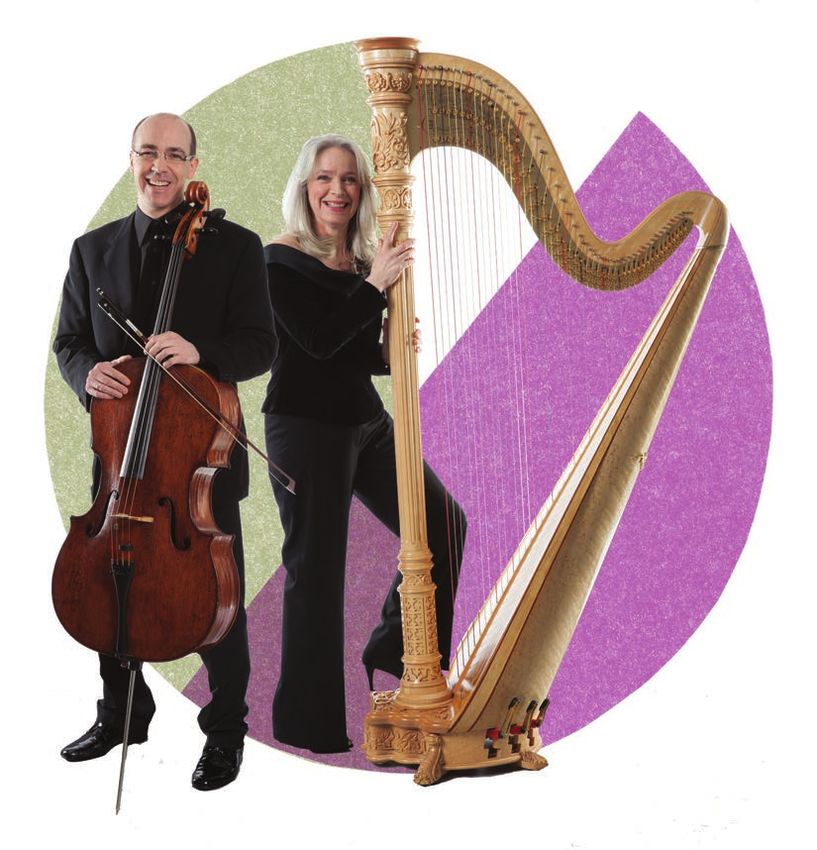
Romance 4’ Jesper Svedberg
Cello
Fauré Eluned Pierce
Après un rêve 4’ Harp
All information is correct at the
time of going to print. All timings
are guidelines only and may differ
slightly from actual lengths.Repertoire 3 Song without Words Felix Mendelssohn Born: 3 February 1809 Hamburg Died: 4 November 1847 Leipzig Mendelssohn’s ‘Songs without Words’ (Lieder ohne Worte) were primarily composed for solo piano and reflected the early Romantic sensibility to capture the essence of a mood, without the incumbrance of a text. As the composer explained to a friend, “What the music I love expresses to me, is not thought too indefinite to put into words, but on the contrary, too definite.” This work, his op. 109, is Mendelssohn’s sole example of a “song without words” for cello and piano; it was also his final work for that combination, written in 1845 for the cellist, Lisa Cristiani and not published until after his death. Andrew Burn
The Swan
Camille Saint-Saëns
Born: 9 October 1835 Paris
Died: 16 December 1921 Algiers

The Swan (‘Le cynge’) is the most famous
 movement from Saint-Saëns’ jeu d’esprit, his
‘Grand Zoological Fantasy’, The Carnival of
 the Animals, composed for the amusement
 of friends in 1886. Although performed
 privately on several occasions, the complete
 work remained unperformed in public, and
 also unpublished, during the composer’s
 lifetime, since he felt it was far too frivolous
 and might affect his reputation as a serious
 composer.

He relented though over the publication of
just The Swan which appeared in 1887. With
its rippling accompaniment and graceful
melody, Saint-Saëns perfectly captures an
image of serenity as the swan glides over
the water. The work’s popularity soared
when the great ballerina Anna Pavlova,
collaborated to create a dance version with
the choreographer Michel Fokine, inspired
by Tennyson’s poem, The Dying Swan. First
performed in 1905, Pavlova is reputed to
have danced the solo over 4000 times.

Andrew Burn
Repertoire 5

Vocalise
Sergei Rachmaninov
Born: 1 April 1873 Oneg, Novgorod District, Russia
Died: 28 March 1943 Beverley Hills, California

In 1915, for the last of his 14 Songs, op. 34,
Rachmaninov had an inspired and original
idea: why not compose, literally, a ‘song
without words’. Instead of singing a text,
he indicated that the singer should sing
the vocal line to just one vowel of their
choice. It was dedicated to the soprano
Antonia Nezhdanova who gave the premiere
with the composer in Moscow in January
1916. She had been rather bemused by
Rachmaninov’s idea, but he had reassured
her “What need is there for words, when you
will be able to convey everything better and
more expressively than anyone could with
words by your voice and interpretation.”

With its haunting melancholy, Vocalise,
rapidly caught audiences’ imagination, and
with no words was ripe to be arranged
for different instrumental combinations.
Rachmaninov’s cellist friend Anatoliy
Brandukov (the dedicatee of his Cello
Sonata) made the first for cello and piano,
although many others have followed
including those by Jascha Heifetz, Leonard
Rose and Mstislav Rostropvich.

Andrew Burn
The Way You Look Tonight
Jerome Kern
Born: 27 January 1885 New York
Died: 11 November 1945 New York

 Composer of dozens of musicals and one
 undisputed masterwork of American musical
 theatre, Showboat (1929), Jerome Kern’s
 outstandingly career spanned four decades.
 Among his 700 songs are hits which became
 standard numbers such as ‘Ol’ Man River’,
‘Smoke gets in your eyes’ and ‘The Last Time I
 saw Paris‘. Another huge success, ‘The Way
You Look Tonight’, with lyrics by Dorothy
 Fields, topped the charts in 1936 when sung
 by Fred Astaire to his co-star Ginger Rogers
 in the musical comedy film Swing Time.
 It went on to gain the Academy Award for
 the Best Original Film Song of 1936.

This arrangement was made by the
American harpist, John Escosa.

Andrew Burn
Repertoire 7

Romance
Donald Hoopingarner
Born: 3 February 1935 Detroit

There is a personal connection between
 Jesper Svedberg and the composer of this
 Romance for cello and harp, composed
 in 2017. When Jesper was in his teens he
 went on a year-long school exchange to
 the USA, where he lived in Michigan with
 Donald Hoopingarner and his very musical
 family. Alongside his composing (works for
 handbells, for instance, Alonsoa, were a
 speciality), Hoopingarner taught American
 History at the High School where Jesper
 recalls him as an inspirational teacher.
 Jesper is still in touch with the family and has
 an abiding memory of those times:
“I so remember him taking me to the local
 community orchestra, me in the cellos,
 Donald leading the basses – we were a great
 team.”

Andrew Burn
Après un rêve and Sicilienne
Gabriel Fauré
Born: 12 May 1845 Parmiers
Died: 4 November 1924 Paris

Aprés un rêve (‘After a dream’) was a            Fauré’s Sicilienne was originally composed
song, or ‘mélodie’, to use the French term,      in 1893, as part of incidental music for
composed early in Fauré’s career in 1877         a production of Molière’s Le Bourgeois
and published the following year as the          gentilhomme which never reached the
first of his Trois mélodies op.7. The words      stage. Five years later he made this version
of the song describe how a man dreams of         for cello and piano for the Dutch musician
escaping with his lover beyond the confines      Joseph Hollman, although he dedicated
of the earth, travelling towards a mystical      it to a leading English cellist of the time,
light; however, he wakes to reality and          W.H.Squire, who was principal cello of
disconsolately longs to return to the ecstatic   several London orchestras and an advocate
state the mysterious dream had given him.        of Saint-Saens’ cello concertos. Also in
It was the renowned cellist, Pablo Casals,       1898, Fauré included the Sicilienne in the
who realised that the somnolent beauty of        music he composed for the first English
the song’s melodic line perfectly suited the     production of Maurice Maeterlinck’s play
cello’s timbre; subsequently his arrangement,    Pelléas et Mélisande. In the drama, its gentle,
made in 1910, established this little gem’s      lilting rhythm captures a fleeting moment of
popularity with cellists and audiences alike     happiness for the doomed lovers.
the world over.
                                                 Andrew Burn
Repertoire 9 Concerto for Harp (first movement) George Frederick Handel Born: 23 February 1685 Halle Died: 14 April 1759 London Handel’s reputation as a virtuoso organist, famed across Europe, gave him what today would be described as a ‘super star’ status, and audiences flocked to his performances. Ever the canny entrepreneur, to help boost ticket sales, he would include organ concertos within his large scale works such as his choral odes and oratorios, and especially new ones. On 19 February 1736, for the premiere of his setting of an adaption of Dryden’s Ode, Alexander’s Feast or The Power of Music, he went even further by including three concertos - one for organ with strings, another for oboes and bassoons and strings, and finally, one for ‘harp, lute, lyrichord and other instruments’. (The lyrichord created a drone-like, hurdy- gurdy sound.) The Harp Concerto was composed for William Powell, ’harper’ to the Prince of Wales. Handel recast the concerto for organ when it was published in 1738 as the last of his Six Organ Concertos, op.4. Handel was no stranger to St Giles House. A friend of the Fourth Earl of Shaftesbury and his wife, he visited their home on several occasions and a portrait of the composer hangs there. Andrew Burn
Suite No.1 for solo cello
Johann Sebastian Bach
Born: 21 March 1685 Eisenach
Died: 28 July 1750 Leipzig

1. Prélude                                      In each of his cello suites Bach exploits a
2. Allemande                                    different aspect of the instrument’s nature in
3. Courante                                     the first movement, which is therefore cast
4. Sarabande                                    as a free fantasia, exploiting every possibility
5. Menuett I & II                               of development from the motifs which
6. Gigue                                        emerge out of the patterns of sound.

Bach’s instrumental works mainly date           The movements may be characterised as
from 1717-1723, when he was Kapellmeister       follows: The Allemande is a slow-moving
to Prince Leopold of Anhalt-Cöthen. His         dance, in which Bach’s arabesques produce
duties included the supervision of a small      a web of decorations. Based on a French
resident orchestra, which naturally led to      dance, the Courante tends to employ runs
him composing various solo and chamber          of quavers. The Sarabande uses chords
music items for his colleagues. It seems        as the pivots around which the melodies
likely, therefore, that the six cello suites    revolve. In this First Suite, Bach opted for a
were written for one or other of the Cöthen     pair of Menuetts; the form originated in a
cellists, Carl Abel and Christian Linike. The   triple-time court dance and was so called
First Suite, performed tonight, is in the key   because of its dainty steps (menu = small).
of G major.                                     The Gigue is a lively dance characterised
                                                by its wide intervals. Bach’s preference was
At Cöthen, the Baroque suite was an             for the recurring use of the open bottom
 instrumental genre that Bach particularly      string in order to make the effect of a rustic
 cultivated. By this time, its basis was        drone, while often concluding in a frenzy of
 established as a sequence of dance             semiquaver activity.
 movements: allemande, courante, sarabande
 and gigue, with the option of a preludial      Terry Barfoot
 opening and the insertion of another dance
– either bourrée, menuett or gavotte – as the
 penultimate number.
Repertoire 11 Title Music: Milo Mark-Anthony Turnage Born: 10 June 1960 Grays, Essex Holding an international reputation, Mark- Anthony Turnage is one of the leading composers of our time. On 7 November 2018, there was a palpable sense of excitement at the Lighthouse, Poole, when Kirill Karabits, soprano Natalya Romaniw, and the BSO, gave the world premiere of Turnage’s Testament, bold, powerful settings of Ukrainian poetry exploring themes of displacement and conflict, which the BSO jointly commissioned with Staatskapelle Weimar. In the pre-concert talk, Jesper Svedberg played Turnage’s short work for cello solo, Milo, which he had also performed a few months before at the Malmö Chamber Music Festival in Sweden. He and Turnage had met then, and whilst chatting they “realised that his son Milo and my son Hugo were exactly the same age. So, I can really hear and understand the strong love he feels for his son through this beautiful little piece.” Turnage composed Milo in 2009 for his son’s christening, when it was first performed by Guy Johnson, Milo’s Godfather. Andrew Burn
Jesper Svedberg
Cello

Swedish-born cellist Jesper       Jesper is a founding member
Svedberg began his cello          of the Kungsbacka Piano Trio.
studies aged eight and he         The trio took first prize in the
completed his Soloist Diploma     1999 Melbourne International
in 1998 at the Edsberg            Chamber Music Competition
Institute of Music in Stockholm   and was, in 2000, selected
under the tutelage of Frans       for the BBC Radio 3 New
Helmersson and Torlief            Generation Artists Scheme.
Thedeen.                          The trio has recorded for
                                  NAXOS with music including
He continued his cello studies    Schubert, Mozart, Haydn,
at the Guildhall School of        Fauré and Chopin. They
Music and Drama in London         are currently recording the
with Louise Hopkins. He           complete piano trio repertoire
graduated with a Masters          by Robert Schumann which will
Degree in Chamber Music           be released on the BIS label.
in 2001 and was appointed
Professor in Chamber Music at
the University of Gothenburg
where he remained for ten
years.

Jesper became Principal Cello
with the BSO in 2011. As a
soloist, Jesper has performed
with orchestras including
the BBC Scottish Symphony,
Swedish Radio Orchestra,
Copenhagen Philharmonic,
Dala Sinfonietta, Helsingborg
Symphony Orchestra and the
BSO.
Repertoire 13
Eluned Pierce
Harp
Principal harpist with the During her years living in
BSO since September Scotland she was the harpist
1995, Eluned performs as a with the BBC Scottish
chamber musician and solo Symphony, Royal Scottish
harpist within her post and National and Scottish Chamber
elsewhere. Often invited as orchestras.
guest principal with the British
orchestras she has performed She much enjoys coaching the
in the U.S. Japan, and most harp sections at National Youth
of the European countries Orchestra of Wales, National
with maestros such as Muti, Youth Orchestra of Great
Sanderling, Salonen, Maazel, Britain and National Children’s
Ashkenazy, Jarvi, Rattle, and Orchestra of Great Britain.
Karabits.
Eluned studied harp at the
She occasionally plays for Royal College of Music as
various television and radio a Foundation Scholar with
programmes and has been Marisa Robles.
involved on the soundtrack of
some of David Attenborough’s
series and a documentary
about Beyoncé.
It was a great honour on
Christmas Day 2014 to be
broadcast on Classic FM from
Buckingham Palace performing
some of Britten’s Ceremony
of Carols with the Choristers
of the Chapel Royal under the
baton of Huw Williams.14 Bournemouth Symphony Orchestra
A Cultural Beacon for the South
and South-West of England
One of the UK’s best-loved orchestras, A bold champion of talent the BSO boasts
Bournemouth Symphony Orchestra is a an enviable list of principal conductors,
professional ensemble known for igniting including Marin Alsop — the first female
change both on and off the stage. principal conductor of a major UK orchestra
With residencies in Bournemouth, Bristol, — Constantin Silvestri, Paavo Berglund and
Exeter, Poole and Portsmouth it is also the Andrew Litton. It has given memorable
largest cultural provider in the South West performances at Carnegie Hall, the
of England serving one of the biggest and Musikverein and Rudolfinum, and gives
most diverse regions. regular live broadcasts on BBC Radio 3 and
Classic FM.
Maintaining the highest artistic ideals
the BSO remains committed to new and Empowering lives through music remains
lesser-known repertoire whilst remaining at the core of all that the BSO does.
relevant to its broad audience’s tastes. Awarded the Royal Philharmonic Society’s
Under Chief Conductor Kirill Karabits the Impact Award in 2019, for its work in
Orchestra’s Voices from the East series of improving opportunities for disabled talent,
former Soviet music continues to receive the BSO continues to explore new territory
critical acclaim, and its recent recordings with BSO Resound — the world’s first
of Prokofiev and Walton are outstanding professional disabled-led ensemble at the
modern performances. The Orchestra is also core of a major orchestra. BSO Participate
loved for its performances of film and light works with all ages off the stage and is
music, and its discography charts a number internationally recognised as an act to
of landmark moments in 20th century music. follow: over 650 community workshops and
A commissioner of new music, the Orchestra events take place each year across the
will give premiere performances of works by Orchestra’s vast region, empowering
Azerbaijani composer Franghiz Ali-Zadeh, thousands of lives every year.
Shirley J. Thompson and Magnus Lindberg
in its 2020/21 season. In recent years it has Following the longest break in its 127-year
worked with Mark-Anthony Turnage, Sally history, the BSO was one of the first
Beamish and James MacMillan. ensembles in the UK to launch a series of full
symphonic performances in 2020.Bournemouth Symphony Orchestra 15
The Team
Board of Trustees Chief Executive Head of Finance & Operations
Dougie Scarfe Teresa Woolley
Chair
Terence O’Rourke MBE Executive Assistant Management Accountant
to Chief Executive Wendy Jones d
Deputy Chair Natalie Wright
Finance Officer
Annette D’Abreo Head of Human Resources Kim Ricketts
Jenny Wingfield d
Lorna Carver Head of Development
Adrian Dunford Head of Concerts Jackie Tanner
Andrew Flockhart & Programming
Heather Duncan Development Manager
Steve Edge
Faith Bayley
Lord Shaftesbury
Orchestra Manager
Mary O’Sullivan Development Manager
Liz Williams
Ashley Eldridge-Ford d
Vice Presidents Deputy Orchestra Manager
Nigel Beale Adam Glynn Development Manager
Brendan O’Brien Rebecca Kemp
Colin Patrick DL Concerts Manager
Alex Segrave d Development Officer
William Cainen
Concerts Administrator
Marion Aston Y Development Assistant
Jade Grassby
Orchestra Administration Officer
Emma Fisher Head of Marketing
Anthony Brown
Librarian
Alastair Simpson Senior Marketing Manager
Johanna Perkins d
Assistant Librarian
Carmen Ho Interim Marketing Manager
Katie Stitson
Senior Stage Manager
Scott Caines Senior Digital Marketing Officer
Emilie Barton
Stage Manager
Emily Trevett Publications Officer
Ivor Kemp Y
Head of BSO Participate
Lucy Warren Marketing Officer
Sophie Hart
BSO Participate
Programme Manager Digital Marketing Officer
Jess Craig d Alex Rimell
BSO Participate Digital Officer
Programme Manager Richard Berry
Ben Jennings Ticket Sales Assistant
Lisa Spencer
BSO Participate Coordinator
Y Long Service Award
Alison Sawyer d Communications Manager
d Diversity Champion
Claire Rawles
BSO Participate Coordinator
Catherine Hoolihan Communications Officer
Heidi O’Neill16 Support Us
Our Supporters
Principal Patrons Performance Champions Chair Sponsors
(annual gifts of £20,000 or more) (annual gifts of £1,000 or more) (annual gifts of £550 or more)
Steve Edge & Jane Fogg In memory of Sheila Barton Vivian & Audrey Axford
John & Ruth Lang Marie Betts – for David Robin & Sylvia Carter
Richard Lewis Mr & Mrs Bowden In memory of John C Crawford
Terence & Annette O’Rourke Janet Boyle - for Penny Tweed Pam & Liam Donnellan
David & Jill Peters Mrs Jennifer Coombs Jane Drabble OBE
Dave & Jan Pointer Carolyn Date MBE Margaret & David Eaton
The Stacey Family - in memory of Sandrey Alan & Valerie Frost
& one anonymous supporter Neil Davies & Marc Powis CEG
Charles & Pennie Denton Sue Gosling & Leo Jones
Symphonic Patrons Christine & Jim Dipple David Hayter
(annual gifts of £10,000 or more) In memory of Derek Dominey David & Ethna Jenkins
Heidi Bone & Jake Robbins Irene & Patrick Draper For Joanne
Michael & Judy Buckland In memory of Molly Duff Eddie & Barri Newcomb
Annette D’Abreo & Judy Emms & David Fisher In memory of Elizabeth Penketh
Edwin Bessant Jacqui & Steve Garrett Ian & Patricia Platt
Mike & Pam Jeffries Maureen Hasper George Prince
Edmund & Veronica Sandell John H John & Valerie Robinson
Sir Neville & Lady Simms JJ Romsey Concertgoers
Sue Thomas Peter Jackson & Douglas Scorey FCA
In memory of Ian Wilson Caroline Nicholson Robin & Hilary Scott
Robin & Elaine Johns James & Sylvia Sexton
Concert Patrons Dr Lesley Kay Dr Alastair & Mrs Sally Smith
(annual gifts of £5,000 or more) Penny Lightfoot In memory of Mrs M Smith
Simon Coombs & Alan & Marian Lusher Chris Spackman
in memory of Laura Coombs For Terence & Mary MacDonagh In memory of Cecily Tong
Sarah & Peter Eales Geoff & Hanneke Morgan In memory of John Trapnell
Gillian Emerson Susan Oakes & Mary Williams & David Morton
Dr John Eyers & Dr Monica Seeley & two anonymous supporters
Denis Fitzgibbon Martyn Partridge - for Jane
In memory of Barbara Myland Mr & Mrs Anthony Pitt-Rivers
The Salisbury Friends of the BSO David Pope & Josephine Davies
David & Josephine Westby Adrian Scott DL
& one anonymous supporter George & Veronique Seligman
Jack Stone
Performance Patrons Mr Christopher Tapper
(annual gifts of £2,500 or more) In memory of Mabs &
Den Racher
Nigel Beale & Anthony Lowrey In memory of Muriel Richards
Gillian Clarke Rev Dr John C Travell
Doug & Joan Cullen Canon John Turpin
Sally & Kelvyn Derrick Dr John & Rev. Heather Waldsax
David & Julie Edyvean Peter & Diane Yeman
Stephen Elder & & five anonymous supporters
Vanessa Claydon
Philip & Jane Green
Robin & Rosemary Haigh
Davina Hodson
Roger Keyworth
Chris & Clem Martin
WJNP & IJP
Rosemary Snoad
Dr J M G Walker
Tom & Kate Wickson
& two anonymous supporterBournemouth Symphony Orchestra would like to thank the following supporters
Principal Funder
Public Funders
Principal Media Partner Broadcast Partner
Principal Academic Partner Academic Partner Conservatoire Partner
Partners
Patrons
In-kind Partner
Trusts and Foundations We would also like to thank
The Pointer Family Trust Thriplow Charitable Trust our Patrons and Performance
Talbot Village Trust The Cressy Foundation Champions, those who have
The Valentine Charitable Trust The D’Oyly Carte Charitable Trust remembered the BSO in
The Flaghead Charitable Trust The Pitt-Rivers Charitable Trust their Will, and everyone who
The Michael & Ilse Katz Foundation Gess Charitable Trust supports us through donations,
Marchus Trust Homelands Charitable Trust membership or by volunteering
Bedhampton Charitable Trust their time.You can also read


