Conference programme - SpaceOps 2021
←
→
Page content transcription
If your browser does not render page correctly, please read the page content below

conference programme
S O U T H A F R I C A N N AT I O N A L S PA C E A G E N C Y

Celebrating a decade
of innovative space
products and services
for the good of
humanity
contents
Message from the SpaceOps 2021 Chairman						                              4

SpaceOps 2021 Organisations								 6

Sponsors											 8

Conference Overview									 9

Conference at a glance									11

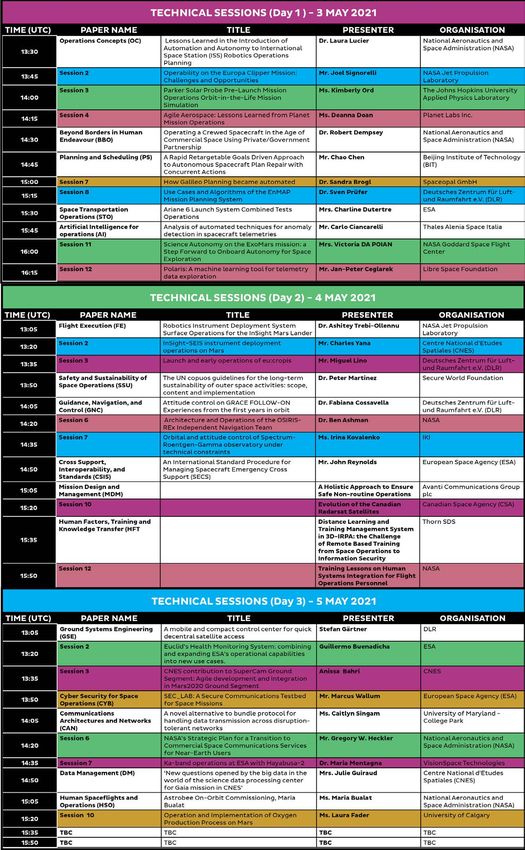
Technical Programme								                                                12

Student and Young Professionals Program (SYP)					                         17

Special Sessions

Plenary 1: Space Operations during COVID-19 pandemic				20

Plenary 2: Commercial Ground stations: New Space and Traditional Space     24

Plenary 3: Human Spaceflight Operations: Space Stations the Moon and MARS 28

Plenary 4: Space situational awareness: Protecting our assets in Space		   31

Closing Ceremony										36

Awards and Recognition									37

Paper Submissions										40
Message from the SpaceOps 2021 Chairman
Dear Friends and Colleagues,

Thank you for participating in the first ever Virtual Conference on Space Operations - SpaceOps
2021 - Virtual Edition. The South African National Space Agency is honored to have been
given this opportunity to bring the Space Operations community together in this momentous,
groundbreaking event.

With this being our first online Space Operations Conference, we trust and hope that at the end
of the Conference we would have delivered a successful and engaging Conference. SpaceOps
has held fifteen biennial conferences hosted by various countries around the world over the
years, and this time around the 16th biennial installment of the conference is being hosted for
the first time virtually.

Thank you to all our delegates, speakers, SpaceOps.org members, authors, sponsors, and
partner organisations, for making this conference possible.

It was our wish to meet you face-to-face, however, things dramatically changed across the
world. The SpaceOps 2021- Virtual Edition, has attracted many participants from across the
globe. We are encouraged that the “new normal” of hosting a Conference virtually has provided
more people an opportunity to participate and engage in the conference, as well as space
operations related conversations. Something we should all be proud of as an industry.

The programme for has been redesigned to suit a virtual format, allowing us to have more
meaningful conversations during plenary sessions on pertinent matters affecting most of
us in the industry, technical session where peers from the industry will be presenting well
researched papers. There will also be a session dedicated to the young professionals on the
6 May, I encourage our future space leaders to participate and to see some of our colleagues,
showcase their technical research.

The proceedings of SpaceOps2021, are filled with amazing content, interesting keynote
speakers, engaging plenary sessions.

We hope you enjoy the Conference.

Regards,

Tiaan Strydom
Tiaan Strydom

                                                                                                  4
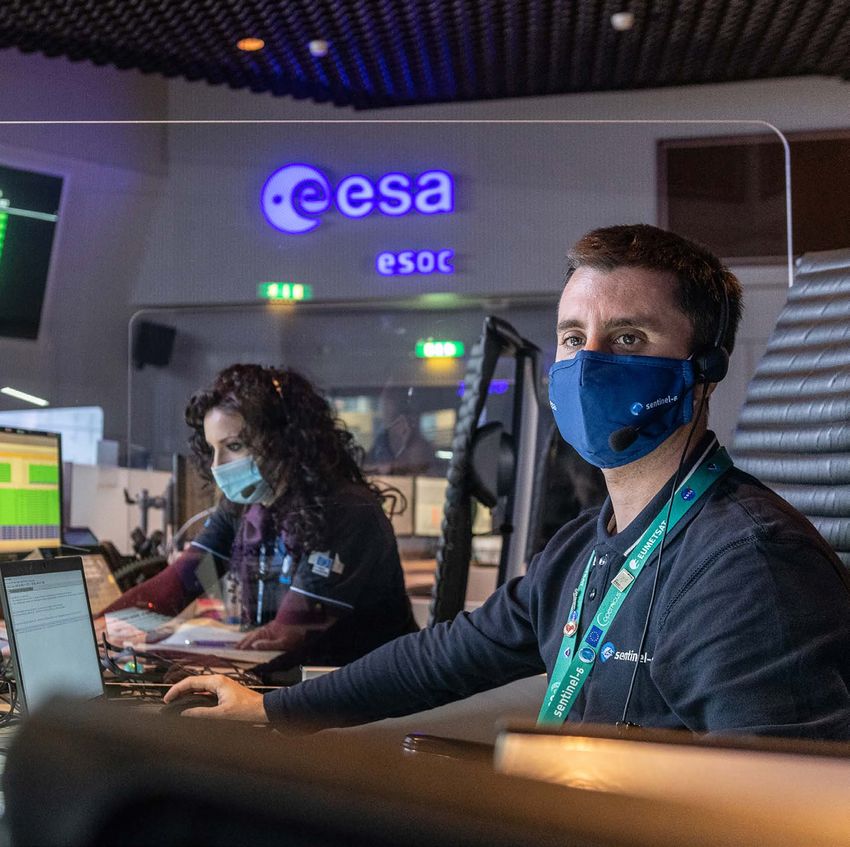
The European Space Operations Centre
Demanding customers, complex missions, global pandemic:
ESA mission control keeps them flying

SpaceOps 2021 Organisations

The South African National Space Agency (SANSA) came into being in December 2010, but South Africa’s
involvement with space research and activities started many decades earlier with helping early international
space efforts in the second half of the 20th century, and observing the Earth’s magnetic field at stations
around Southern Africa.

SANSA was created to promote the use of space and strengthen cooperation in space-related activities
while fostering research in space science, advancing scientific engineering through developing human
capital, and supporting industrial development in space technologies.

The research and work carried out at SANSA focuses on space science, engineering and technology that
can promote development, build human capital and provide important national services. Much of this work
involves monitoring the Earth and our surrounding environment, and using the collected data to ensure that
navigation, communication technology and weather forecasting services function as intended.

Founded in 1951, the International Astronautical Federation is the world’s leading space advocacy body
with 407 members in 71 countries, including all leading space agencies, companies, research institutions,
universities, societies, associations, institutes and museums worldwide.

Following its motto “Connecting all Space People” and its theme “A space-faring world cooperating for the
benefit of humanity”, the Federation advances knowledge about space, supporting the development and
application of space assets by promoting global cooperation.

                                                                                                               6
The International Committee on Technical Interchange for Space Mission Operations and Ground
Data Systems (also referred to as the SpaceOps Organization) was formed in the realization that
given the large number of people involved in space mission operations, an organized community
or technical forum is needed. Since mission operations have become an increasingly large
segment of space agency budgets, there is great interest in improving the capabilities and cost
efficiencies of mission operations. It was in the spirit of providing the broadest possible managerial
and technical interchange between space agencies, academia, and industry that SpaceOps was
established.

As the premier organization serving the space operations community, SpaceOps encompasses
the following areas:

•   Operations-enabling technology in ground and flight systems
•   Operations management
•   Mission planning
•   Mission management
•   Cross support and interoperability
•   Launch operations
•   Spaceflight operations

Since its inception in 1990, SpaceOps has held fifteen biennial Conferences hosted by various
countries around the world. This international forum discusses state-of-the-art operations
principles, methods, and tools and provide an opportunity to foster managerial and technical
interchange on all aspects of space mission operations, including such areas as robotics, human,
earth orbiting, and deep space aspects of space operations.

                                                                                                         7
Sponsors

Platinum Sponsors

gold Sponsors

silver Sponsors

other Sponsors

                             8
conference overview

Title: The 16th International Conference on Space Operations (SpaceOps2021)
Date: 3-5 May 2021
Official Language: English
Theme: Beyond Boundaries to Human Endevours
Website: www.spaceops2021.org

Hosted and organized by SANSA (South African National Space Agency), SpaceOps 2021 is an
international technical forum for the space operations community to discuss state-of-the-art
operations, principles, methods and tools.

This Conference is being hosted for the first time in history by an African space agency,
SpaceOps 2021 and it embraces the theme, “Beyond Boundaries to Human Endeavours”.

This iconic Conference in the Space Industry attracts technologists, scientists, managers, and
experts from various international space agencies, industries and academia. SpaceOps 2021
provides a platform to network, nurture existing relationships, build partnerships and discuss
new opportunities with key global industry leaders on all aspects of space mission operations,
including areas such as robotics, earth orbiting, deep space and human aspects of space
operations.

                                                                                                 9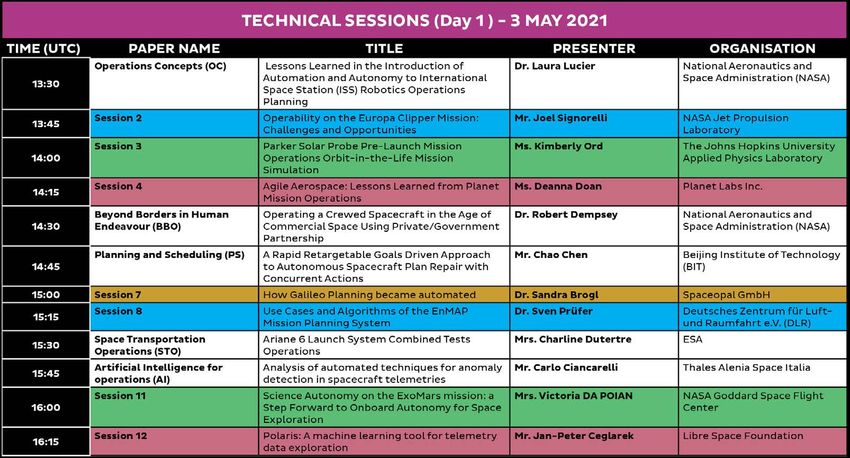
programme at a glance

                        11
Technical Program
The SpaceOps 2021- Virtual edition Technical Program Committee, comprises of experts from
major space organizations in the world, will offer a world-class program focusing on today’s
achievements in space operations and outlining trends in the operations of future missions.
The Conference program will bring together experienced and young professionals, as well as
students, from all over the world to discuss the status and future ideas of space operations.
The program will cover an impressive number of presentations in the following topics:
• Mission Design and Management (MDM)
• Operations Concepts (OC)
• Flight Execution (FE)
• Ground Systems Engineering (GSE)
• Data Management (DM)
• Planning and Scheduling (PS)
• Guidance, Navigation, and Control (GNC)
• Communications Architectures and Networks (CAN)
• Human Spaceflights and Operations (HSO)
• Cross Support, Interoperability, and Standards (CSIS)
• Human Factors, Training and Knowledge Transfer (HFT)
• Space Transportation Operations (STO)
• Artificial Intelligence for operations (AI)
• Cyber Security for Space Operations (CYB)
• Safety and Sustainability of Space Operations (SSU)
• Beyond Borders in Human Endeavour (BBO)
12TECHNICAL PROGRAM COMMITTEE
TPC chair – Eugene Avenant (SANSA)
Topics Topic Chair Topic Co-chair
Mission Design and Management (MDM) Young Lee (JPL/NASA) Alice Bowman (JHUAPL)
Operations Concept (OC) Dave Welch (LASP) Sabrina Eberle (DLR)
Flight Execution (FL) Mr Hubert Fraysse (CNES) Patel, Keyur C (NASA)
Ground Systems Engineering (GSE) Francois Jocteur-Monrozier (CNES) Hamid Salim (MYSA)
Data Management (DM) Zeina Mounzer (TPZ) Dodd, Suzanne R (NASA)
Planning and Scheduling (PS) Martin Wickler (DLR) Vladimir Nazarov (IKI)
Guidance, Navigation, and Control (GNC) Shinichi Nakamura (JAXA) Fabio D'Amico (ASI)
Communications Architectures and Networks (CAN) Brian Giovannoni (NASA JPL) Klaus-Juergen Schulz (ESA)
Human Spaceflights and Operations (HSO) Thomas Müller (DLR) Cesare Capararo (altecspace)
Cross Support, Interoperability, and Standards (CSIS) Gian-Paolo Calzolari (ESA) Christophe Belzile (CSA)
Human Factors, Training and Knowledge Transfer (HFT) Sean Burns (Eumetsat) Michael Schmidhuber (DLR)
Space Transportation System (STO) Julio Monreal (ESA) Craig Cruzen (NASA)
Saeed Hussain Al Mansoori
Artificial Intelligence for Space operations (AI) Gérard Galet (CNES)
(MBRSC)
Cyber Security for Space Operations (CYB) Thierry Levoir (CNES) Kevin Marston (Eumetsat)
Safety and Sustainability of Space Operations (SSU) Andrew Monham (Eumetsat) Alexi Glover (ESA)
Beyond Borders in Human Endeavour (BBO) Gladys Magagula (SANSA) Harry Shaw (NASA)
13technical programme
technical programme

                      15
16
Student and Young Professionals Program (SYP)
During the SpaceOps conference, which occurs every two years, the SpaceOps Organization, the hosting
agency - which in 2021 is the South African Space Agency (SANSA) - , and the Space Generation Advisory
Council (SGAC) execute the Students and Young Professionals (SYP) program. The activities of SYP are
always a big success at SpaceOps, and this year we record an exceptional number of participants, also
thanks to the conference being held virtually and for free. The received applications came from over 25
countries, with an increased participation of women. Like every year, three activities for SYP program are
organized: a Workshop, the Speed Mentoring and, in exchange of a technical tour, this year a Space Quiz has
been introduced in the program.

Harry Shaw
Staff Engineer at NASA Goddard Space Flight Center
                                   Harry Shaw is a Staff Engineer for the NASA Goddard Space Flight
                                   Center Space Network (SN) Project. The SN operates the fleet of
                                   geosynchronous Tracking and Data Relay Satellites (TDRS). He is also
                                   involved with development of CubeSats and CubeSat technologies
                                   compatible with the NASA Networks.

                                   Dr. Shaw has over 30 years of experience in technology development,
                                   computer networking, quantum communications, information theory,
                                   microelectronics and space communications, mission planning
                                   and proposal development. Harry Shaw has a Doctor of Science in
                                   Electrical Engineering from George Washington University.

Viqar Abbasi
 Simulation Engineer at Canadian Space Agency
                                    Viqar Abbasi has been with the Canadian Space Agency (CSA)
                                    since 2002, holding senior engineering responsibilities in support of
                                    International Space Station (ISS) robotics operations and training,
                                    space science and satellite operations, including missions such
                                    as the Near-Earth Object Surveillance Satellite (NEOSSat) and the
                                    RADARSAT Constellation Mission (RCM), and space situational
                                    awareness (SSA) activities such as CSA’s Conjunction Risk
                                    Assessment and Mitigation System (CRAMS).

                                    Prior to joining CSA, Viqar worked eight years in Canada’s aerospace
                                    industry.

Jessie Ndaba
Chief Executive Officer at Astrofica Technologies
                                   Jessie Ndaba was raised in Soweto, South Africa, my interests in joining
                                   the space sector started when I was in high school. I went on and
                                   graduated as an Electrical Engineer at the University of Witwatersrand.
                                   I have worked at CBI before taking up a position as a lecturer at Central
                                   Johannesburg College before joining the Space Internship Programme
                                   sponsored by the South African Department of Science and Technology
                                   and SunSpace. As a result of the internship programme, I earned a
                                   permanent position at SunSpace as a Satellite Design Engineer. I was
                                   also involved with the SunSpace outreach programme, in collaboration
                                   with DST/SAASTA whereby we worked with school kids from the lower
                                   level to varsity level. In particular, the outreach programme exposes the 17
students to space science and technology and informs them of the many benefits of humankind from
space.
In 2010, I was awarded a Young Space Leadership Award from the Space Generation Congress.
In 2011, I represented South Africa at the International Space University, where I got a chance to further
my studies in Space Engineering Systems. During this course I was introduced to Space Law, Space
Medicine and Space Management. In 2013, we, together with other young professionals in the industry
around the African continent formed the ALC-YF (African Space leadership Congress Youth Forum),
and I head the Space Engineering Working Group.
In 2013, I joined Space Commercial Services as an AIT Engineer/ Space Solutions Manager. I am the
member of the Space Generation Advisory Council (SGAC) and the African Space Leadership Youth
Forum.
In 2017, I co-founded Astrofica Technologies (PTY)LTD, with an aim to make change in Africa using
Space Science and Technology.
Francois Visser
Chief Engineer at Africa Space Innovation Centre (ASIC) - CPUT
Francois Visser is an RF and microwave engineer with more
than 20 years professional experience in the development of
radio communication products for microsatellites. He is the
Chief Engineer of the Africa Space Innovation Centre (ASIC) at
the Cape Peninsula University of Technology (CPUT). He heads
a team of engineers that develop and operate CubeSat satellites
for Maritime Domain Awareness.
He completed his MEng in Electronic Engineering in 1997 at
the University of Stellenbosch where he participated in the
development of SunSat, South Africa’s first satellite, launched in
1999. He continued working in South Africa’s satellite industry,
participating in the development of several satellites, including
South African satellites SumbandilaSat, Tshepisosat and
nSight-1.
dr. lourens visagie
Chief Engineer at Africa Space Innovation Centre (ASIC) - CPUT
Dr. Lourens Visagie is a lecturer in the Computer Systems and
Control Systems group at Stellenbosch University. He specialises
in satellite engineering, and has participated in numerous satellite
projects. Most notably was the Systems Engineering role he
played on the nSight-1 CubeSat, developed by SCS-Space and
launched in 2017.
Dr. Visagie leads a small team of post-graduate researchers,
focussing on space and satellite research. He also plays an active
consulting role in local space industry.
18WE CONNECT
SPACE AND EARTH
As the leading provider of Ground Network Services
and Earth Observation Services for many years,
we know what it takes to operate and deliver
fast and reliable services – every day.
We’re operating more than 200 antennas world-wide as in
integrated network currently handling 52 000 passes per month.
We will continue to explore new technologies that will
impact the future satellite operations for the benefit of the
global space community, from LEO to Lunar and beyond.
VISIT US AT
KSAT.NOSpecial Sessions
Plenary sessions
PLENARY 1
Space Operations during COVID-19 pandemic
Monday, 3 May 2021
Time: 12:30 -13:30 UTC
Topic outline:
The objective of this plenary session is to highlight and discuss the impact of the Covid-19
pandemic within the space operations and space industry. The plenary session will tackle
the questions such as:
• Initially reactive due to pandemic
• What pre-cautions were taken?
• What did the contingency plans look like?
• What changes were implemented (ie remote terminals etc.)
• Concerns about cybersecurity during remote work.
• Pro-active going forward: What changes will we retain?
• Specifically like to hear from the large operations centres i.e. GSOC/ESOC/GSFC etc
• How did we deal with human spaceflight and critical support?
• How did we manage maintenance actions?
Moderator: Yunus Bhayat,
Operations Manager (SANSA)
Jose Morales
Head of the Earth Observation Missions Division (ESA)
View profile
Mr Claude Audouy
Head of Applications and European Missions Operations Division (CNES)
View profile
Kevin Marston
Plenary speakers System Operations Manager (Eumetsat)
View profile
Sabrina Eberle
Project Manager (DLR)
View profile
Philip Baldwin
Operations Manager Space Communications and Navigation (SCaN) (NASA)
View profile
20Speaker 1 Jose Morales
(Head of the Earth Observation Missions Division - ESA)
Mr Morales has more than 20 years experience in the area of flight
operations, working for the European Space Agency (ESA/ESOC)
He is currently the Head of the Earth Observation Missions Division
within ESA’s Mission Operations Department, in Darmstadt
(Germany). He is responsible for flight operations implementation for
ESA and the EU Earth observation missions entrusted to the Agency.
Responsibilities include directing and executing flight operations in
all mission phases, in particular acting as Flight Operations Director
for pre-flight simulations, Launch & Early Orbit Phases (LEOP) and
for critical and commissioning phase operations.
Previously to this post, he was the Head of ESA’s Copernicus
Flight Operations Management Office also located in Darmstadt,
managing and coordinating all Copernicus Programme activities in
the area of Flight Operations entrusted to ESOC
Before that, he was the Deputy Spacecraft Operations Manager of
Rosetta.
Speaker 2 Mr Claude Audouy
Head of Applications and European Missions Operations
Division -CNES
Currently, Claude is the Head of Application and European Mission
Operations Division. This Division, as part of CNES Toulouse Centre’s
Operation Department, is in charge of the preparation of operations,
Launch and Early Orbit Phase, deployment and maintenance of
science, applications and European satellites. Throughout these
phases, the division runs and/or coordinates space segment
operations to guarantee the availability of the data collection for
these missions. The division is also responsible to conduct end-of-
life operations including technological experiments and platforms
decommissioning activities.
He directly manages or coordinates a multidisciplinary staff of c.a.
50 people) in charge of these operations and preparatory phases.
Seasoned engineer and manager involved in many programmes.
21Speaker 3 Kevin Marston
System Operations Manager- Eumetsat
Kevin Marston is the System Operations Manager at EUMETSAT.
His career spans more than 30 years of system and satellite
engineering and operations, supporting a wide variety of
satellite programmes and Organisations. As System Operations
Manager, Kevin is responsible for ensuring continuous 24/7
system operations across EUMETSAT’s programmes, as well
as transitioning new programmes into Operations. Kevin has
been heavily involved in EUMETSAT’s COVID coordination, in
terms of maintaining the operations support, with a balance of
on-site and (mainly) remote engineering support, and also for
the successful operations preparations and early operations of
Sentinel-6 despite the limitations posed by the pandemic.
Speaker 4 Sabrina Eberle,
Project Manager - DLR
Sabrina Eberle was born in Alexandria, VA, USA. She received
her masters degree in electrical engineering at the Technical
University of Munich, Germany.
In 2004 she joined DLR, the German Aerospace Center where
she worked at the German Space Operations Center (GSOC) in
Oberpfaffenhofen near Munich. She started as an Orbit Control
Subsystem Engineer for several LEO satellite missions, she was
then the Flight Director for several LEOPs and became the Project
Manager for an Earth Observation satellite mission. In 2015
she became the Project Manager for a German geostationary
satellite mission and today she leads the team “Geostationary
Satellite Missions”.
She is also a lecturer at the Carl-Cranz-Gesellschaft (CCG) for
“Satellite Communications” and contributes to the “Spacecraft
Operations Course” at GSOC. She has made several contributions
to the fields of satellite communications and mission operations
including many technical publications, books and her own book
titled “Satellite Communications”.
22Speaker 5 Phillip Baldwin
Operations Manager Space Communications and
Navigation (SCaN) - NASA
As Operations Manager for NASA Space Communications and
Navigation (SCaN) Program at NASA Headquarters, Philip Baldwin
strives to ensure that NASA’s science and exploration goals are
met through its two communications networks: the Deep Space
Network (DSN), which enables communication and data sharing
with distant spacecraft like Mars Curiosity and Voyager 2; the Near
Space Network (NSN), which shares voice and video with crews
aboard the International Space Station (ISS); and the downloading
and worldwide distribution of scientific data from Earth-observing
satellites.
At NASA Goddard, Philip served as a Mission Manager for the
Technology Enterprise and Mission Pathfinder Office (TEMPO) in
the Exploration & Space Communications Projects Division at NASA
Goddard. His worked focused on advancing new technologies with
to goal of rapid infusion into operations. His portfolio included
electronically steered antenna arrays, Delay Tolerant Networking
(DTN), and advanced navigation technologies. Previously, Mr. Baldwin
served as the Near Earth Network (NEN) (now apartChief Engineer,
leading technical and engineering teams in developing innovative
solutions for the NEN and ensuring engineering best practices are
followed as the independent technical authority for the NEN. Prior
to joining the NEN team, Mr. Baldwin worked in the Formation
Flying Testbed (FFTB), which developed mission concepts for multi-
spacecraft missions. This work contributed to the successful record
breaking Magnetospheric Multiscale (MMS) mission using GPS for
navigation and formation flying.
Mr. Baldwin earned a Bachelors degree in Electrical Engineering from
The University of Virginia. During this time working as a software
contributor to UC Berkley’s Center for Hybrid and Embedded Software
Systems (CHESS) were he co-created a wireless sensor package
that has been published in numerous journals and books and was
included as undergraduate coursework for studying wireless sensor
networks. This work was included in Mr. Baldwin’s undergraduate
thesis entitled “Modeling of Wireless Sensor networks in Ptolemy II”
23PLENARY 2
Commercial Ground stations: New Space and Traditional Space
Tuesday, May 2021
Time: 12:00 -13:00 UTC
Topic outline:
Traditionally Space Operations have been the domain of public entities using networks of
ground stations from a collective of space agencies and national facilities. The domain
of geostationary communication has been dealt with by the respective satellite owners.
The nature of satellite operations has changed however, and many public entities are con-
strained by decreasing budgets and changes in resources. Added to this we have a pro-
liferation of private space initiatives, the so called ‘newspace’. There are new mega con-
stellations being deployed for telecommunications and earth observation, private human
spaceflight and new countries entering the space operations domain. The challenges have
changed and there is a big move towards ‘outsourcing’ ground operations to commercial
entities with space operations becoming a ‘service’. This plenary will engage both public
and private space operators to highlight their changes in operating paradigm including the
challenges and opportunities in this sphere.
Moderator: Mr. Raoul Hodges,
Managing Director – Space Operations (SANSA)
Klaus-Juergen Schulz
Head of the Ground Station Engineering Division (ESA)
View profile
Jean-Marc Soula
Deputy Head of Telecom, Stations networks and Alert systems
(CNES)
View profile
Shayn Hawthorne
Space Technology Lead (Amazon web services)
Plenary speakers
View profile
Ian Jones
Founder and CEO (Goonhilly)
View profile
Arnulf Kjeldsen
Executive Vice President (KSAT)
View profile
24Speaker 1 Klaus-Juergen Schulz
Head of the Ground Station Engineering Division, European
Space Agency (ESA)
Dr. Klaus-Juergen Schulz is Head of the Ground Station Engineering
Division, European Space Agency (ESA) / European Space Operations
Center (ESOC) in Darmstadt, Germany.
Dr. Schulz is since 2009 the Head of the Ground Station Engineering
Division. The division is responsible for the engineering of the
multi-mission ground stations of the ESA Tracking Station Network
(ESTRACK) for space communication in near Earth and Deep Space
using radio frequency and optical techniques. Recent engineering
efforts were expanded into the domain of sensors for space object
tracking using Radar, passive and active optical means.
Dr. Schulz joined ESA in 1989 focussing on the engineering and
operating of space communication systems for precursor missions
of the International Space Station, and designing communication
solutions for the European ISS Columbus module. In 1999 he became
responsible for the operations and maintenance of the ESA Tracking
Stations (ESTRACK), and brought into operation the first two ESA deep
space stations. He was also the ESA representative to the Interagency
Operations Advisory Group (IOAG) and instrumental in the deployment
of the CCSDS Space Link Extension (SLE) cross support capability.
Dr. Schulz holds a Diploma degree in Physics from the University
of Karlsruhe, Germany, and a PhD in Computer Science from the
University of Zurich, Switzerland.NASA’s Jet Propulsion Laboratory
(JPL), California Institute of Technology.
Speaker 2 Jean-Marc Soula
Deputy Head of Telecom, Stations networks and Alert
systems - CNES
Jean-Marc Soula joined CNES in 1984, as an engineer in
Telecommuncations. Since then, he has been involved in all of the
developments of systems for the CNES Ground Station Network
and has participated, in several positions from Network engineer to
Management, to all of the over 200 satellite operations conducted
from the Toulouse Space Center.
Today, Deputy Head of Telecom, Stations networks and Alert systems
Department, he is in charge of the preparation of the future in the
Ground Segment domain. In the last two decades, he has been the
representative of CNES at the InterAgency Operations Advisory Group
(IOAG) and at the Consultative Committee For Space Data Systems
(CCSDS), and a member of the SpaceOps committees for more than
15 years.
25Speaker 3 Shayn Hawthorne,
Space Technology Lead- Amazon web services
Shayn Hawthorne works in the Amazon Web Service Aerospace
& Satellite Solutions Division as the Space Technology Leader. In
this role Shayn works with Commercial and Government space
customers around the world to develop innovative space system
architectures that help customers use AWS to transform space.
Shayn is focused on working across AWS to develop services
and features that disrupt how space exploration, satellite, and
launch operations are conducted and enabling space customers
to share, fuse and leverage space data to improve their missions
and products. Shayn is the founder of the AWS Ground Station
service. Prior to joining AWS Shayn worked at the MITRE
Corporation on Missile Defense and Space Operations and
served in the Air Force as an engineer and space operator for 10
years Active Duty and 13 years of Reserves.
Speaker 4 Ian Jones
Founder and CEO- Goonhilly
Ian Jones is the founder, CEO and significant shareholder of Goonhilly
Earth Station Ltd. He is a satellite communications engineer and
entrepreneur with over 30 years’ experience in the industry with a
background in digital satellite communications systems, RF design,
earth station development and operations.
He graduated from Leeds University in 1985 in Electrical and
Electronic Engineering. He developed new Digital Signal Processing
satellite modems at BT Research Labs and Communication
Systems Research Ltd (CSRL), leading the design of the Inmarsat
Aero communication system. When CSRL was acquired by Ferranti
International, Ian was promoted to Head of Satellite Engineering and
subsequently Head of Business Development within the Ferranti
Computer Systems Division.
In 1994 he co-founded Orbit Research Ltd where he was Managing
Director and 50% shareholder. Ian was responsible for a number of
innovations and new product designs for satellite communication
systems including remote control monitoring systems for satellite
earth stations. He led the development of a new business providing
mobile health care diagnostic services via satellite and he was also
responsible for a number of innovations in Education Outreach
which led to the creation of the Star Centre (Keighley) and the ESA
ESERO network.
26In 2008 he became aware of the impending closure of Goonhilly Earth Station and worked to create a
new business opportunity for the site. He founded Goonhilly Earth Station Ltd and built a successful,
profitable business leasing the antennas at Goonhilly from BT and bringing them back into service.
In January 2014, Ian led the team completing the successful acquisition of Goonhilly.
Ian’s vision for a sustainable, profitable and diverse business at Goonhilly is rapidly taking shape
with a growing client base covering all aspects of commercial satellite communications, space
communication, radio astronomy, big data and data centre services, training, outreach and business
co-location. His entrepreneur skills are in demand across Africa where he is involved in assisting
human capital development projects at other former telecommunication centres. Goonhilly has now
become an Enterprise Zone and the host of the Sat Apps Catapult South West Regional Centre of
Excellence, of which Ian is the Chair.
Speaker 5 Arnulf Kjeldsen,
Executive Vice President ,KSAT
Arnulf Kjeldsen is the Executive Vice President Strategy & Technology
of Kongsberg Satellite Services (KSAT). In this position Arnulf oversees
the business development and technology development at KSAT. KSAT
is a world-leading provider of ground station services for satellites
and maritime surveillance based on satellite data. With over 50 years
of experience, KSAT’s network today spans over 180 antennas at 20
ground station locations across the globe supporting space to ground
communication and satellite information services.
Arnulf began his career at Kongsberg Spacetec, a company within the
Kongsberg Defence and Aerospace division. During this period, Arnulf
coordinated the development work on ground station capture and
control systems as well as processing chains for remote sensing data.
At the Joint Research Centre (JRC) in northern Italy, Arnulf was leading
multiple projects within the Centre for Earth Observation, focusing on
development of systems and services enabling interoperability and
access to satellite data and derived products.
After returning from Italy Arnulf joined KSAT and became Chief
Operating Officer and the overall responsible for the KSAT Satellite
Operations business line. That involved all activities related to the
development, operations, and sales of ground stations services to a
wide range of satellite owners and operators.
Arnulf is an avid skier and enjoys travelling and meeting new people
in space industry. Arnulf lives in Tromsø, covering all aspects of
commercial satellite communications, space communication, radio
astronomy, big data and data centre services, training, outreach and
business co-location. His entrepreneur skills are in demand across
Africa where he is involved in assisting human capital development
projects at other former telecommunication centres. Goonhilly has
now become an Enterprise Zone and the host of the Sat Apps Catapult
South West Regional Centre of Excellence, of which Ian is the Chair.
27PLENARY 3
Human spaceflight operations: Space Stations the Moon and MARS
Tuesday, 4 May 2021
Time: 16:10 -17:00 UTC
Topic outline:
Humans last travelled to the moon in the 1970’s. There has however been a constant presence
of humans in low earth orbit with the Salyut, Spacelab, MIR, ISS and SienYhou orbiting capsules
and laboratories. The International Space Station has been the crowning achievement during
this period with 20 years of continuous occupation and the collaboration of many nations.
This orbiting laboratory has been allowing for research in a microgravity environment and
launchpad for many small satellites and hosting privately sponsored experiments. Now in the
next decade nations and even private entities has expressed their interest to return to the moon
and continue towards Mars. Some of these programs are already in advanced stages of planning
with early execution already happening. This plenary seeks to engage the human spaceflight
community, with specific focus on the operations requirements for these programs. We will un-
derstand the learning from the long operations of the ISS and the plans from those wanting to
return to the moon and go beyond. An important focus for this discussion will be international
cooperation and standards developed for these missions.(Artemisaccord)
Moderator: Mr. Eugene Avenant
Chief Engineer (SANSA)
Sami Asmar
General Secretary of the Consultative Committee, Space Data Systems
(CCSDS)
View profile
Courtenay McMillian
Flight Director (NASA)
View profile
Plenary speakers
Fiona Turett,
NASA HQ Artemis representative (NASA)
View profile
Petra Mittler
Senior ESA Operations Support Engineer & Business Development
Manager (DLR)
View profile
28Speaker 1 Sami Asmar
General Secretary of the Consultative Committee,
Space Data Systems (CCSDS)
Sami Asmar is the General Secretary of the Consultative
Committee for Space Data Systems (CCSDS), a multi-national
forum for the development of communications and data systems
standards for spaceflight.
He is also the Manager of Strategic Partnerships and Customer
Formulation in the Interplanetary Network Directorate at
NASA’s Jet Propulsion Laboratory (JPL), California Institute of
Technology.
Speaker 2 Courtenay McMillian
Flight Director - NASA
Ms. McMillan is the Manager for the International Space Station
Program’s Mission Integration and Operations Office, NASA. Ms.
McMillan has worked at Johnson Space Center since 1996, first
as a flight controller supporting the Shuttle/Mir and International
Space Station Programs, and subsequently in increasingly
responsible roles for human space flight operations. She was
selected as a Flight Director in 2007 and in that role led more
than 500 shifts of flight operations for the International Space
Station over twelve years. She led the teams that transitioned
ISS to a permanent crew of six people, conducted the first set
of contingency spacewalks for ISS, overhauled ISS emergency
response operations, and executed the Cygnus commercial
vehicle’s demonstration mission. Most recently she spent two
years managing FOD’s support to first the ISS Program and
subsequently the Commercial Crew Program.
29Speaker 3 Fiona Turett
NASA HQ Artemis representative, NASA
Fiona Turett began her NASA career in 2009 in Safety and Mission
Assurance, supporting propulsion system safety for the last nine
space shuttle missions. She later served as a program director
for Manna Project International in Managua, Nicaragua, for a year
before returning to NASA and becoming a flight controller and
instructor for the space station’s Motion Control System. Turett was
the Expedition 56 control system lead for both crew training and
real-time operations.
She then was the lead for operational integration of the Gateway
outpost that will orbit the Moon and the lunar Human Landing
System programs, and served as Flight Operations lead for
Gateway’s Power and Propulsion Element before becoming the
Flight Operations integration manager for Gateway. She originally
is from Rochester Hills, Michigan, and graduated with a bachelor’s
degree in mechanical engineering from Washington University in St.
Louis.
Speaker 4 Petra Mittler,
Senior ESA Operations Support Engineer & Business
Development Manager, DLR
In 1990, she joined DLR and worked in the Crew Operations
department, which she was responsible at the time for preparing the
German Spacelab mission D-2, a 10-day mission with 2 German and 5
U.S. American astronauts. Her task was to develop the schedule for
the experiment programme. The task was to coordinate a total of 90
experiments that were to be carried out within the 10 days of flight.
During the actual D-2 mission, she worked as a flight controller at
GSOC, the German Space Operations Centre, in Oberpfaffenhofen.
Later, she worked as the astronaut training coordinator for the
ESA mission EuroMir 95. On the German MIR 97 mission, I was
responsible for the German astronaut’s on-board computer to
support the crew.
Since 2000, she has been working as a DLR member for the ESA
Space Medicine Team, based at the European Astronaut Centre
(EAC) in Cologne. Here she was responsible for the on-board
implementation of medical care of ESA astronauts during their pre-,
in-, and post-flight phases of the mission.
More recently, in her role as a DLR Space Operations business
development team member she has taken over the project
coordination of the joint ESA/DLR project LUNA. LUNA is an
analogue facility that ESA and DLR plan to build together on the
DLR campus in Cologne.
30PLENARY 4
Space situational awareness: Protecting our assets in space
Wednesday, 5 May 2021
Time: 12:00 -13:00 UTC
Topic outline:
Space is a hostile environment. It is a resource that humans exploit for their needs in
telecommunication, position navigation timing, earth sciences, astronomy, and many others. As all
resources the environment need to be understood and managed to utilise to everyone’s benefit.
Space situational awareness is thus crucial for successful use of this resource. Two aspects are of
growing importance in this domain: Space Weather and Orbital management.
Space weather plays very important part in the design of space craft as spacecraft needs to be
protected against the harsh radiation environment. This plenary will look at the aspects required in
spacecraft design. With our global reliance on spacecraft, nations have setup dedicated units to
monitor the space environment for threats and the required actions related to different threat levels.
We will listen to how they approach this task and the level of coordination between both public
sector and private sector space.
Coordination is also vital in the management of separation of spacecraft in orbit and collision
avoidance. This issue is now crucial as there are now many more players in the space arena from
more nations and more sectors. We have the mega–constellations being deployed from commercial
entities with fas tturnaround and automated operations. What precautions are being taken for
collision avoidance and specifically for coordination between operating entities.
Moderator: Dr. Lee-Anne McKinnell,
Managing Director Space Science (SANSA)
Juha-Pekka Luntama
Head of Space Weather Office, Space Safety Programme (ESA)
View profile
Mr Laurent Francillout
Head of Space Safety Office (CNES)
View profile
Plenary speakers
Clive Charlton
Head of Solution Architecture - Sub-Saharan Africa, (Amazon Web services)
View profile
David B. Goldstein (Colonel., U.S. Air Force, Ret.)
Principal Guidance, Navigation and Control Engineer – Spacex
View profile
31Speaker 1 Juha-Pekka Luntama
Head of Space Weather Office,Space Safety Programme,
ESA
Juha-Pekka (“Jussi”) Luntama is the Head of the Space Weather Office in
ESA’s Space Safety Programme. He graduated from Helsinki University
of Technology in 1991 and continued working in the University as a
lecturer and leader of the small satellite technology research group until
1997, when he was awarded a EUMETSAT Research Fellow position in
the UK Meteorological Office. In 1998 Jussi Luntama was appointed
as the Mission Scientist for the GRAS radio occultation instrument
onboard the Metop meteorological satellite series in EUMETSAT HQ in
Germany. In 2005 he moved from EUMETSAT to Finnish Meteorological
Institute to lead the research on space weather impacts on GNSS
applications. Jussi Luntama joined ESA in 2009 when he was selected
as the manager of the Space Weather Segment in ESA’s new Space
Situational Awareness Programme, the predecessor of the Space
Safety Programme that is in progress now.
Space Weather Office is responsible for all space weather related
activities in ESA Directorate of Operations. The responsibilities of
Space Weather Office include definition, architecture design and
implementation of the ESA Space Weather System and delivery of the
corresponding services. Space Weather Office is also responsible for
development of software applications, ground systems, hosted payload
instruments and dedicated SmallSat and nanosatellite missions for
the ESA Space Weather System. The Space Weather Office is also
responsible for liaising with international entities and representing
ESA in international forums on space weather related topics.
Mr. Luntama is also the Mission Scientist and Mission Manager for
the Lagrange mission that is in preparation to provide unprecedented
space weather monitoring data for operational applications from the
5th Lagrangian point, L5.
Speaker 2 Mr Laurent Francillout
Head of Space Safety Office - CNES
Laurent Francillout is Head of CNES Space Safety Office for Orbital
Systems. He joined CNES in 1999 as interplanetary flight dynamics
specialist for Mars Sample Return project. Then he joined ESA ATV
program in the frame of ISS program where he held various position
as Flight Dynamics Team leader, Spacecraft Operation Manager and
Flight Director.
His mission is now to guarantee safety and sustainability of French
Orbital operations and balloon flights through regulation typically
French Space law certification and rulemaking. He is head of
French delegation in IADC (Inter Agency Space Debris Co-ordination
Committee) and chaired IADC in 2020.
He is delegate at COPUOS Scientific and technology subcommittee and
is involved in IAA Space Debris Working Group and IAF Space Traffic
Management group.
32Speaker 3 Clive Charlton
Head of Solution Architecture - Sub-Saharan Africa, Amazon
Web services
Clive Charlton leads a dynamic team of solutions architects, bringing
the latest in disruptive, cutting-edge cloud computing technologies
to bear on the difficult cost and agility problems facing public sector
customers and the surrounding ecosystem of ISVs, systems integrators
and resellers.
Clive’s team of solutions architects supports a sales and business
development team that covers public sector in sub-Saharan Africa. With
over two decades of experience, Clive is a hands-on leader who leads by
example with experience in building and managing high-performance
teams that help accelerate the growing AWS business. He leads and
mentors a team of highly talented solutions architects, helping them to
set and surpass their own goals and to develop their talents and careers.
Clive is a hands-on, detail-oriented, “roll-up-your-sleeves” leader with a
passion for innovation and an ability to deal with ambiguity as well as
an ability to scale and influence broadly.
As a head of solutions architecture for the AWS public sector in
Sub-Saharan Africa, he has the opportunity to shape and deliver on
a strategy to a new business unit to help customers succeed with
workloads on AWS. Clive’s responsibilities include supporting all public
sector teams via hiring, developing and managing a team of technical
SAs, to promote AWS as the best place to run these workloads, building
on his broad background and technical breadth and depth in security,
networking, operating systems and application architecture and a deep
understanding of how applications and services are best built and
operated on the AWS platform.
In addition to Clive’s responsibilities as a solutions architect manager,
he is an AI and machine learning specialist, acting as an expert advisor
to the Council for Artificial Intelligence Research (CAIR) in South Africa.
He is the technical lead for aerospace in the Middle East & Africa. Clive
is also an experienced presenter for Amazon at events in South Africa
and on a world stage.
33Speaker 4 David B. Goldstein (Colonel., U.S. Air Force, Ret.)
Principal Guidance, Navigation and Control Engineer -
Spacex
David Goldstein is a SpaceX Principal Guidance, Navigation and
Control (GNC) Engineer. In this role he’s an ambassador to government
agencies and satellite owner/operators on SpaceX satellite collision
avoidance and space safety, he leads SpaceX integration with the
Space Force’s 18th Space Control Squadron and NASA/CARA and he
develops, codes and fields satellite GNC algorithms.
Goldstein graduated from the United States Air Force Academy with
a bachelor’s of science in 1988. His career covers a wide variety of
Air Force technical leadership assignments including satellite science
and technology, research and development, test and evaluation,
payload integration, system engineering, acquisition, and launch
operations. After serving 27 years in the US Air Force, Goldstein retired
as a Colonel in January 2016. In his last assignment he was director
of the Air Force Research Laboratory, Space Vehicles Directorate and
Commander of the Phillips Research Site, at Kirtland Air Force Base.
Goldstein earned a PhD in Aerospace Engineering from the University
of Colorado at Boulder and three Master’s Degrees. . He has been
married for over 32 years and has three children.a bachelor’s degree in
mechanical engineering from Washington University in St. Louis.
34A new era is dawning at EUMETSAT.
Next-generation geostationary and low-Earth-orbiting satellite systems launched from 2023
will revolutionise weather forecasting and climate monitoring. New and better instruments will
provide insights into our planet faster and in higher quality than ever before.
At the same time, EUMETSAT is making its weather and climate data available to more people
more easily than ever before through cloud based access services coming on stream in 2021.
EUMETSAT’s satellite systems and data services support the European Commission’s Green Deal
in the digital age, empower European industry and enlighten and protect its citizens.
Meteosat Third Generation, carrying EUMETSAT Polar System – Second Generation,
the Sentinel-4 instrument carrying the Sentinel-5 instrument
The Sentinels are funded by the European Union’s Copernicus programme.
www.eumetsat.intCLOSING CEREMONY
Date: 5 May 2021
Time: 16:00 - 17:00 (UTC)
Opening of Closing Ceremony & Recap MC Alan Committie
Highlights of the Conference Eugene Avenant
Awards Ceremony Greg Marlow
Flag handover ceremony Dr. Val Munsami
Special Keynote address Guest Speaker
Vote of thanks and closing message Tiaan Strydom
Promote South Africa Video
36Awards and Recognition
The International SpaceOps Lifetime Achievement Medal (LAM), 2021
Mr. Phil Liebrecht is presented with the International
SpaceOps Lifetime Achievement Medal, 2021 , for
his over forty years’ dedication to and advocacy for
international cooperation in space operations, while
directly enabling the success of human exploration
and science missions through ensuring the transfer
of critical information across the Solar System and
interstellar space. He passionately and expertly
led the complex development and operation of the
NASA communications networks and demonstrated
exceptional diplomacy matching American and
Mr. Phil Liebrecht international interests in space around the globe.
The International SpaceOps Award for Outstanding
Achievement (AOA) 2021
In recognition of exceptional anomaly recovery and
saving a space mission, The NASA/JPL Dawn mission
conducted spectacularly successful explorations
of dwarf planet Ceres and the giant asteroid Vesta,
the two largest residents of the main asteroid belt
between Mars and Jupiter. The flight team brilliantly
overcame immense challenges, including critical
hardware failures on the spacecraft that should
have prevented the mission from achieving its most
important objectives.
Dawn Flight Team
37The International SpaceOps Award for Outstanding
Achievement (AOA) 2021
In recognition of development of a new paradigm
that has significant effect on the performance of a
space mission or to the space operations field, the
Mars Atmosphere and Volatile Evolution (MAVEN)
spacecraft successfully completed a transition into
a new orbit via a nearly two-month-long aerobraking
campaign, making the spacecraft available to provide
critical relay duties for the Mars 2020 rover and other
ground missions.
The MAVEN team took a spacecraft that had never
MAVEN Mission been designed for a prolonged aerobraking campaign
Operations Team and planned and executed a flawless transition while
still preserving the spacecraft’s science capabilities.
The International SpaceOps Exceptional Achievement
Medal (EAM), 2021
In recognition of development of a new paradigm
that has significant effect on the performance of a
space mission or to the space operations field, the
Mars Atmosphere and Volatile Evolution (MAVEN)
spacecraft successfully completed a transition into
a new orbit via a nearly two-month-long aerobraking
campaign, making the spacecraft available to provide
critical relay duties for the Mars 2020 rover and other
ground missions.
The MAVEN team took a spacecraft that had never
been designed for a prolonged aerobraking campaign
and planned and executed a flawless transition while
still preserving the spacecraft’s science capabilities.
Dr. Natan Eismont
38The International SpaceOps Distinguished Service Medal
(DSM), 2021
The 2021 International SpaceOps Distinguished
Service Medal goes to M. Pierre Lods in appreciation
for his involvement in the SpaceOps Organization for
more than 10 year, in particular for his leadership in
the organization of SpaceOps 2018 as Conference
Chairman. The SpaceOps 2018 conference, held in
Marseille, France, was an outstanding success with
a record number of participants.
M. Pierre Lods
39paper submissions
Paper ID Paper Title Speaker Name Speaker Company
Mission Design and Management (MDM)
1246 Evolution of the Canadian Radarsat Satellites Mr. Christophe Belzile Canadian Space Agency (CSA)
1404 Mission Design and the planning for the Dr. Alexey Grushevskii Keldysh Institute of Applied
international Venera-D Project Mathematics of RAS
1412 Gravity assist maneuvers as a tool for Mr. Vladislav Zubko Space Research Institute (IKI), Russian
broadening accessible landing areas on Venus Academy of Sciences (RAS)
surface
1419 EDRS-C – Challenging Way of Bringing the Dr. Gregor Rossmanith Deutsches Zentrum für Luft- und
Second Orbital Node into Space Raumfahrt e.V. (DLR)
1455 A holistic approach to ensure safe non-routine Mr. Lorenzo Arona Avanti Communications Group plc
operations
1514 Mission Design for Interplanetary Sample Mr. Paras Adlakha University of Petroleum and Energy
Return and study of Ganymede Studies
1532 Low thrust multi-injection approach for Mr. Vincenzo Maria Salvato Politecnico di Milano
constellation and multi-mission deployment
1587 Determination of possible landing areas on Mr. Andrey Belyaev Space Research Institute (IKI), Russian
Jupiter's moon Ganymede Academy of Sciences (RAS)
1655 Defining Mission for twin Exploration of Europa Ms. Aayushi Bohrey University of Petroleum and Energy
and auxiliary Enceladus Sample Return Studies
Paper ID Paper Title Speaker Name Speaker Company
Operations Concepts (OC)
1230 Automated Software for Crewed Spacecraft - Mr. Edward Van Cise National Aeronautics and Space
Bridging the Gap from Sci-Fi to Reality Administration (NASA)
1243 Automated anomaly response for Planet Mr. Pablo Bernal-Mencia Planet
constellations
1281 Lessons Learned in the Introduction of Dr. Laura Lucier National Aeronautics and Space
Automation and Autonomy to International Administration (NASA)
Space Station (ISS) Robotics Operations
Planning
1282 Meteosat Third Generation Ground Support for Ms. Claudia Tranquilli Eumetsat
Payload Calibration and Characterisation
1309 The Mars Terrain Simulator: an indoor analogue Mr. Maurizio Deffacis Altec S.p.A.
facility to validate and simulate ExoMars
Rover Operations and to support the ExoMars
Surface Mission
1319 Preparation, validation and operations Mrs. Ylenia Di crescenzio DLR-GfR
strategies for on-board software upgrade on
Galileo Constellation
1321 "My abstract has been submitted for 2020 Ms. Laura Seoane National Institute for Aerospace
under the paper id number 1056 and has been Technology (INTA)
updated" (Only 1 update: ExoMars 2020 to
ExoMars 2022) Operation Design Based on
short-term response for the RIS Instrument, on
board the Exomars 2022 RO
1323 Generation leap in subsea operations - Mrs. Carina Helle Berg NTNU Samfunnsforskning
learning from manned spaceflight
401324 Doing More With Less - Impact of GAIA Mission Mr. Javier Hernando European Space Agency (ESA/ESOC)
Ground Automation for ESA’s Astronomy Fleet
and Beyond
1333 Agile Aerospace: Lessons Learned From Planet Ms. Deanna Doan Planet Labs Inc.
Mission Operations
1349 Development and Validation of the Operations Ms. Rachel Dunwoody University College Dublin (UCD)
Procedures and Manual, for a 2U CubeSat,
EIRSAT-1, with Three Novel Payloads.
1357 Enabling the Next Era of Deep Space Robotic Mr. Jay Wyatt NASA Jet Propulsion Laboratory
Exploration: The General End-to-End Operations
Concept and Major Required Capabilities for
Autonomous Missions at the System Level
1400 Transition from partial to fully automated Mr. Andrea Bechi DLR-GfR
routine activities of a satellite constellation
1423 NAVCAST enables Precise Point Positioning Mr. Antonio Salonico Spaceopal GmbH
and Near Real Time Service Monitoring
1461 Implement Voice-user Interface in Mission Mr. Xiangcun Ji National Space Science Center (NSSC),
Control Center Chinese Academy of Sciences
1464 Modular operations, or how to reduce mission Dr. Abigail Ganopol Comision Nacional de Actividades
operations complexity and errors Espaciales (CONAE)
1467 DESCENT CubeSat Launch, Early Operation Ms. Vidushi Jain York University
and Obstacles
1475 Operation Coordination Platform for Scientific Dr. Meng Bai National Space Science Center (NSSC),
Space Science Mission Chinese Academy of Sciences
1501 OPS-SAT - The World's First Satellite Mr. David Evans ESA - European Space Agency
Accessible by the Public Over the Internet
1515 Parker Solar Probe Pre-Launch mission Ms. Kimberly Ord The Johns Hopkins University Applied
Operations Orbit-in-the-Life Mission Simulation Physics Laboratory
1527 Change Management and Verification of Dr. David Kortenkamp TRACLabs, Inc.
Electronic, Automated Procedures
1529 Fast and accurate re-planning tool under Mr. Jacopo Prinetto Politecnico di Milano
multidisciplinary constraints set
1543 Cost Effective Operations for Mission to the Mr. Gabriele Conti Space Applications Services N.V./S.A.
Moon
1553 A Novel concept for target of opportunity Dr. Gabriele De Canio European Space Agency (ESA)
Operations For Future Missions
1559 A Comparison of Satellite Measurement & Dr. Yanjie Song National University of Defense Technology
Control Scheduling Algorithms
1560 A Comprehensive Analysis of the Impact on Dr. Yanjie Song National University of Defense Technology
Satellite Mission Planning Benchmark
1570 Operability on the Europa Clipper Mission: Mr. Joel Signorelli NASA Jet Propulsion Laboratory
Challenges and Opportunities
1574 The evolution of the EDRS control center for Mr. Jan-Christoph Deutsches Zentrum für Luft- und Raumfahrt
automated operations of EDRS-C Scharringhausen e.V. (DLR)
1614 Concept For Operation of Kompsat Information Mrs. Yoon Jeong Jang Korea Aerospace Research Institute (KARI)
Service Open Api
1619 Soft Translatable Advanced Robot for In-Space Ms. Marissa Renteria Space Engineering Research Center,
Handling University of Southern California
1623 Towards automation of operations for Mr. Leon Steenkamp Cape Peninsula University of Technology
ZACube-2 - a South African maritime domain (CPUT)
awareness SmallSat mission
1626 Routine contact optimization in the frame of Mr. Andrea Di Carlo DLR-GfR
Galileo operations
1648 ESA Deep Space Tracking Network: Evolution Mr. Yves Doat European Space Agency (ESA)
and Cooperation
1656 Potentials of Atmospheric Mining: extraction, Mr. Pranjal Mhatre [unlisted]
storage and utilization of fusion fuels
41You can also read


