Conservation status of the New Zealand red katipo spider (Latrodectus katipo Powell, 1871)
←
→
Page content transcription
If your browser does not render page correctly, please read the page content below
Conservation status of the
New Zealand red katipo spider
(Latrodectus katipo Powell, 1871)
SCIENCE FOR CONSERVATION 194

Brian Patrick

Published by
Department of Conservation
P.O. Box 10-420
Wellington, New Zealand
Science for Conservation is a scientific monograph series presenting research funded by New Zealand
Department of Conservation (DOC). Manuscripts are internally and externally peer-reviewed; resulting
publications are considered part of the formal international scientific literature.
Titles are listed in the DOC Science Publishing catalogue on the departmental website http://
www.doc.govt.nz and printed copies can be purchased from science.publications@doc.govt.nz

© Copyright April 2002, New Zealand Department of Conservation

ISSN 1173–2946
ISBN 0–478–22240–8

This report was prepared for publication by DOC Science Publishing, Science & Research Unit; editing
by Michael Ashdown and layout by Ruth Munro. Publication was approved by the Manager, Science &
Research Unit, Science Technology and Information Services, Department of Conservation, Wellington.

All photographs are by the author. Email: brian.patrick@otagomuseum.govt.nz

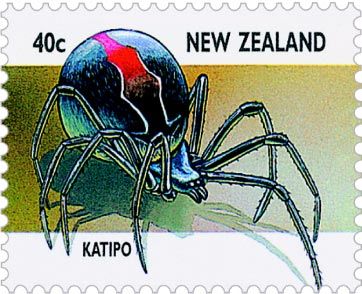
Frontispiece: Katipo spider stamp, reproduced by kind permission of New Zealand Post Limited from
their 1997 Creepy Crawlies stamp issue.
CONTENTS

Abstract                                                 5

1.    Introduction                                       6
      1.1    New Zealand’s endemic widow spider fauna    6
      1.2    Historical distribution                     8
      1.3    Previous studies                            8
      1.4    Study objectives                            9

2.    Survey method                                     10
      2.1    Sampling area and number of sites          10
      2.2    Survey method                              10

3.    Results                                           13
      3.1    Sites and distribution of the katipo       13
      3.2    Katipo habitat                             17

4.    Discussion                                        18
      4.1    Distribution and habitat of the katipo     18
      4.2    Threats to the katipo and its habitat      18
      4.3    Decline of other sand-dune biota           21
      4.4    Limitations of the present study           21
      4.5    Key sites for katipo                       22
      4.6    Why is the katipo important?               22
      4.7    Hope for the future                        23
      4.8    Conservation status of the katipo          24
      4.9    Conserving the katipo nationwide           25

5.    Acknowledgements                                  26

6.    References                                        26

Appendix 1
      Katipo spider survey results                      29
Conservation status of the
New Zealand red katipo
spider (Latrodectus katipo
Powell, 1871)
Brian Patrick
Otago Museum, Box 6202, Dunedin
ABSTRACT
The katipo (Latrodectus katipo Powell, 1871) is one of two endemic widow
spiders in New Zealand. It is a coastal sand-dune specialist and national
invertebrate icon that has suffered a dramatic decline in numbers, contraction
in geographical range and population fragmentation. This nationwide survey of
the katipo located 26 populations in 90 dune systems sampled of a total of 127
sites visited where it could potentially be found. Details of the 90 dune systems
are presented, including the number of adult female spiders found within a
standard search time, degree of naturalness of the dunes and location. A survey
of sites where katipo had been collected previously, based on specimens in
collections, showed that they were present at only 46% of these sites. On the
basis of this study, 19 key sites for katipo conservation are proposed.
The katipo is threatened with extinction for a myriad of reasons: the main
factors appear to be loss of habitat and declining quality of the remaining
habitat. The dramatic changes to its sand-dune habitat following European
settlement were due to stock grazing, disturbance and burning, and continue to
this day with commercial forestry, recreational use of dune systems and other
activities. The subsequent destabilisation of the dunes led to the introduction of
marram grass (Ammophila arenaria), which continues to displace native sand-
binding species. Marram grass can now become so dense that katipo web
construction may no longer be possible.
Based on this research, recommendations for the conservation of the katipo are
presented. Using the accepted New Zealand invertebrate classification criteria,
the katipo is assessed as a Category B threatened species, i.e. a second-priority
threatened species.
Keywords: black katipo, distribution, widow spiders, sand-dune
© April 2001, Department of Conservation. This paper may be cited as:
Patrick, B. 2002: Conservation status of the New Zealand red katipo spider (Latrodectus katipo
Powell, 1871). Science for Conservation 194. 33 p.
Science for Conservation 194 51. Introduction
1.1 NEW ZEALAND’S ENDEMIC WIDOW SPIDER
FAUNA
The katipo (Figs 1, 2) is a widow spider and was formally described as
Latrodectus katipo by Powell (1871), while Urquhart (1890) described the
black katipo, now considered a separate species (Latrodectus atritus), as a
variety of it. The black katipo is distinguished by the absence of the
characteristic red stripe of L. katipo and is found only in the northern third of
New Zealand.
Over the years, there has been debate on the taxonomy of the 32 species of
Latrodectus worldwide (Levi 1959; Forster & Forster 1999), and the recognition
of two distinct New Zealand species has been no exception (Parrott 1948).
Additionally, Urquhart (1887) had mistakenly named the much smaller male of
L. katipo (Fig. 2) as a separate species, Theridion melanozantha. The specific
separation of the two New Zealand katipo is now widely accepted pending
further examination using molecular techniques (Forster & Forster 1999).
For clarity, in this report I will also refer to the more widespread and familiar
red-striped L. katipo as red katipo and the wholly black L. atritus as
black katipo. I propose that red katipo and black katipo are suitable common
names for these two spiders.
In the earliest reference to the katipo, Dieffenbach (1843) listed it as a black
spider found on the seashore, noting that it was regarded as poisonous. Taylor
(1855), in a short list of New Zealand fauna, listed the katipo as the only
poisonous spider, describing it as ‘black with a red cross on its back’. He also
stated that the bite of the female causes immediate inflammation and much
pain. The much smaller male does not bite humans (Forster & Forster 1999).
According to Buller (1871), the Maori name katipo is derived from kakati, ‘to
sting’, and po, ‘the night’—the ‘night stinger’. Maori legend records many
deaths (Hornabrook 1981), with much of the earliest literature on the katipo
published in British and American journals, owing to interest in its potentially
fatal bite (Ralph 1857; Wright 1870; Anon. 1873; Meek 1877; Robson 1879; Rey
1887; Karsch 1888; Riley 1889; Pickard-Cambridge 1902). More recently,
Hornabrook (1951) lists early records of bites.
The genus Latrodectus belongs to the Theridiidae (cobweb spiders), a family of
spiders which is represented by a large number of species both in New Zealand
and worldwide. Spiders of this family are characterised by untidy webs
consisting of only a few sticky threads, and also by the usual presence of a row
of curved bristles on the tarsi of the hind pair of legs. This ‘comb’ has led them
to be called the comb-footed spiders, and is used to comb out silk from the
spinnerets to cast over prey (Forster & Forster 1999). Although most New
Zealand species inhabit forest or shrubland, some of these native species have
adapted well to gardens and buildings. Additionally, several species have been
accidentally introduced from Australia, Southern Africa and Europe, and have
thrived in various habitats here. These aliens include three species that
6 Patrick—Conservation status of the NZ red katipo spiderresemble katipo generally. Firstly, the slightly larger Australian redback
(L. hasselti) has become established since the 1970s and is spreading in mainly
dry inland areas of the South Island (Forster & Forster 1999). Secondly, two
species of Steatoda have become established, doubling the number of species
of this genus in New Zealand (Hann 1994). There has been no revision for New
Zealand, recent or otherwise, of this diverse family.
Figure 1. A female red
katipo (Latrodectus
katipo) from Karitane
Peninsula, Otago. The adult
is garden-pea size and is
capable of biting humans
and administering its
potentially deadly poison.
Figure 2. Male red katipo
(Latrodectus katipo) are
about 1/6 the size of the
female and resemble
juvenile katipo. They are
sometimes found at, or
close by female retreats.
Science for Conservation 194 71.2 HISTORICAL DISTRIBUTION
Although many authors noted that the katipo is confined to the coast, most
were unsure of its exact distribution nationwide. Forster & Forster (1999) state
that it is found along sandy beaches in both the North and South Islands as far
south as Karitane in the east of the South Island, and Greymouth in the west.
This stated southern limit of Karitane may be a mistake, or refer to its extant
rather than former distribution. Benham (1904) stated that it was not known as
far south as Dunedin. Forster (1967), however, illustrated a female from Doctors
Point, just north of Dunedin, where it may now be locally extinct. Peat &
Patrick (1995) also noted the Doctors Point population as the natural southern
limit of red katipo (L. katipo). McCutcheon (1976) briefly describes both red
katipo and black katipo (L. atritus) and describes their distributions
nationwide. He notes that the black katipo is found on both the east and west
coasts of the North Island, south to Cape Kidnappers and Wanganui,
respectively. He notes an overlap in distribution with that of red katipo north of
Wanganui to at least New Plymouth.
Sean Hann’s nationwide records of L. katipo (S. Hann, unpublished data) are
based on specimens in collections. These records, although obviously
opportunistic, suggest that L. katipo has (or had) a scattered distribution in
Northland and Auckland Conservancies. The species may now be extinct or
extremely rare in these two conservancies, since it has not been seen in either
of them recently, despite numerous surveys (Grace Hall, pers. comm.; James
Griffiths, pers. comm.). The present observed contraction in the range of
L. katipo is much more pronounced in the north of New Zealand than in the
south. In the South Island, L. katipo is still present in dunes north of Karitane,
relatively close to its historical southern limit at Doctors Point, Otago. In the
northern third of New Zealand, red katipo and black katipo can be sympatric
(McCutcheon 1976; Forster & Forster 1999).
Forster & Forster (1999) explained the northern distribution of black katipo
following experiments suggesting that black katipo spiderlings and eggs require
a temperature of at least 22°C or more for development, whereas those of red
katipo require only 17°C or more. This threshold temperature for development
helps explain the southern limit of L. katipo, but does not explain why it is so
rare in northern New Zealand.
1.3 PREVIOUS STUDIES
There have been several detailed studies concerning the life history of L. katipo,
threats to its existence and conservation issues. These include Smith (1971) at
South Brighton Beach in Canterbury, Hann (1990) at Motueka, Nelson, Ward
(1998) along the Manawatu-Wanganui coastline and Griffiths in both north and
mid-Canterbury (James Griffiths, pers. comm.).
Smith (1971), in a detailed study, found L. katipo abundant within a narrow
zone 10–30 m from the most seaward clumps of introduced marram grass
(Ammophila arenaria). Native pingao (Desmoschoenus spiralis) was still
common at the time of his study, along with marram, with introduced tree lupin
8 Patrick—Conservation status of the NZ red katipo spider(Lupinus arboreus) on the inner edge of the system. He found that L. katipo
preferred pingao and sparse to medium densities of marram, on sloping ground
facing north-west. He also examined 32 webs for prey items and listed the
contents, of which a native weevil species (Cecyropa sp.) was the most
common prey item found.
Hann’s (1990) study examined the possible displacement of L. katipo by the
theridiid spider Steatoda capensis, an introduced species from South Africa. He
studied the competitive interactions of the two species and concluded that
there was indeed evidence of displacement. He found that there was a high
degree of overlap in both food and space use, that S. capensis had a higher
reproductive output, and that it replaces L. katipo following population crashes
(natural or otherwise) of the latter. Interestingly, he found no evidence of direct
displacement due to competition. However, because S. capensis is also found
inland of the coastal habitat it shares with L. katipo, this greater population
reservoir, combined with its greater fecundity, generally allows it to recolonise
vacant habitat more rapidly than the katipo. Once S. capensis has become
established as the dominant species, it becomes difficult for the reproductively
inferior L. katipo to re-establish. Hann ultimately concluded that the disappear-
ance of L. katipo in the lower North Island (1975–90) was due to increased
human interference along the coastal area, perhaps leading to displacement of
the species.
Ward (1998) concluded that L. katipo had declined along the Wanganui/
Manawatu coastline, but was still present and breeding actively. Although
L. katipo was unclassified by DOC, she used DOC’s priority scoring system and
found that it was in Category A—‘Highest priority threatened species’. She set
up monitoring at five of the seven sites at which red katipo were found.
In addition to the above, there have been various other important studies on both
red katipo and black katipo (L. atritus). Court (1971), in an elegant paper based
on Northland and Auckland individuals, described the web structure of black
katipo and graphically showed the method of prey capture. McCutcheon (1976)
examined the distribution of the black katipo and found that, on the west coast of
the North Island, it extends south to Stony River dunes, south of New Plymouth,
Taranaki, and on the east coast to Waipatiki Beach, north of Napier, Hawke’s Bay.
Meanwhile, Forster & Kingsford (1983) studied the early development of
L. katipo and found that the smaller males mature after four moults and live from
just four to ten weeks. In contrast, they found that the females take six moults to
mature and live for up to two years. Forster & Forster (1999) describe the snare of
L. katipo in detail, pointing out that it is typical of the family worldwide.
1.4 STUDY OBJECTIVES
The aim of the present study was to assess the conservation status of L. katipo
according to criteria set by DOC (Molloy & Davis 1992; Tisdall et al. 1994) and
to make practical recommendations, based on these criteria, that DOC can
implement.
Science for Conservation 194 92. Survey method
2.1 SAMPLING AREA AND NUMBER OF SITES
Sand dunes were sampled nationwide within the known range of L. katipo, to
provide a regional context for understanding its current conservation status
(Fig. 3). Sites were chosen on the basis of historical presence of katipo (Hann,
unpubl. data), and also accessibility for sampling, follow-up of recent records,
sampling of likely dunes in Nelson, Marlborough, Canterbury, Otago, Waikato,
Hawkes Bay and Wellington conservancies where katipo have not been
previously recorded and the need to sample as many parts of each conservancy
as possible. In total, 127 sand dunes were visited and assessed. Some of these
dune systems, such as the north Kaipara Head dunes, Northland, are very
extensive and many sites were sampled along their length. Of these, 90 sites
which were within the previously recorded distribution of L. katipo were fully
sampled on at least one occasion and the resultant data listed (Appendix 1). The
remaining 37 sand dunes were either outside of the previously recorded
distribution and found to have no red katipo, or they had no katipo in any case
and were assessed to be in such a grossly modified state as to be incapable of
supporting them. A small number of dune systems were assessed by DOC
contractors, Robin Craw or Natasha Fijn (Appendix 1). Additionally, this survey
contributed to funding James Griffiths, a student at Lincoln University, who was
surveying L. katipo in the Canterbury region. His data from nine Canterbury
beaches are documented in Table 2.
2.2 SURVEY METHOD
The survey methodology was formulated following consultation with katipo
specialists and other spider researchers. It was designed for use by Otago Museum
personnel as well as other volunteers and students currently researching L. katipo.
It had to be a relatively simple method easily replicated by multiple users over a
large geographic area. Moreover, the method needed to be time-efficient and safe.
The survey method employed was as follows:
• First, apparently suitable sandy habitat (of at least 10 m distance between the
sea and inward extent) was examined to ascertain the presence or absence of
L. katipo or its relatives, in order that the survey target the appropriate sites
within the dune system. Apparently suitable habitat that had few, if any, katipo
was also measured as a comparison. Highly modified (with little or no vegeta-
tion and/or high human usage) sites were not normally measured after initial
examination. As the sites are reasonably fragile, it was important to ensure that
the site to be measured was free of other human disturbance while being meas-
ured as this could disturb the site sufficiently to alter the results. The observer
had to wear gloves for safety reasons.
Continue to next file: sfc194a.pdf
10 Patrick—Conservation status of the NZ red katipo spiderYou can also read


