Contemporary distribution records of the giant freshwater stingray Urogymnus polylepis in Borneo (Chondrichthyes: Dasyatidae) - Pfeil Verlag
←
→
Page content transcription
If your browser does not render page correctly, please read the page content below
337

Ichthyol. Explor. Freshwaters, Vol. 29, No. 4, pp. 337-342, 4 figs., 2 tabs., February 2020
© 2020 by Verlag Dr. Friedrich Pfeil, München, Germany – ISSN 0936-9902
LSID: http://zoobank.org/urn:lsid:zoobank.org:pub:DFACCD8F-33A9-414C-A2EC-A6DA8FDE6BEF
DOI: http://doi.org/10.23788/IEF-1089 Published 16 February 2019

                   Contemporary distribution records
         of the giant freshwater stingray Urogymnus polylepis
                               in Borneo
                     (Chondrichthyes: Dasyatidae)

                       Yuanita Windusari*, Muhammad Iqbal**, Laila Hanum*,
                                 Hilda Zulkifli* and Indra Yustian*

Stingrays (Dasyatidae) are found in marine (con-                     species entering, or occurring in freshwater. For
tinental, insular shelves and uppermost slopes,                      example, Fluvitrygon oxyrhynchus and F. signifer
one oceanic species), brackish and freshwater, and                   were only known from five or fewer major riverine
are distributed across tropical to warm temperate                    systems (Compagno, 2016a-b; Last et al., 2016a),
waters of the Atlantic, Indian and Pacific oceans                    though recent surveys yielded a single record of
(Nelson et al., 2016). Only a small proportion of                    F. oxyrhynchus and ten records of F. signifier in the
dasyatid rays occur in freshwater, and include                       Musi drainage, South Sumatra, indicating that
obligate freshwater species (those found only in                     both species are more widely distributed than
freshwater) and euryhaline species (those that                       previously expected (Iqbal et al., 2017, 2018).
move between freshwater and saltwater) (Last et                           Particularly, the dasyatid fauna of Borneo
al., 2016a). Recently, a total of 89 species of Dasy-                includes the giant freshwater stingray Urogymnus
atidae has been confirmed worldwide (Last et al.,                    polylepis. The occurrence of U. polylepis in Borneo
2016a), including 14 species which are known to                      has been reported from Sabah and Sarawak in
enter or live permanently in freshwater habitats of                  Malaysia and the Mahakam basin in Kaliman-
Southeast Asia [Brevitrygon imbricata, Fluvitrygon                   tan of Indonesia (Monkolprasit & Roberts, 1990;
kittipongi, F. oxyrhynchus, F. signifer, Hemitrygon                  Vidthayanon et al., 2016). While there are further
laosensis, Himantura uarnak, Makararaja chind-                       reports of the species being collected by locals
winensis, Megatrygon microps, Pateobatis bleekeri,                   in the Kapuas River at Pontianak, Kalimantan
Urogymnus granulatus, U. polylepis, Pastinachus                      (e. g. Vidthayanon et al., 2016), it has not been
ater, P. solocirostris, P. stellurostris] (Kottelat, 2013;           reported from other various regions of Borneo.
Last et al., 2016a).                                                 For example, fish surveys in Danau Sentarum
     Although the taxonomy of Dasyatidae has                         at Kapuas basin in West Kalimantan, as well
recently been revised (Last et al., 2016b), infor-                   as an extensive fish survey in the Rajang River
mation on the distribution of dasyatids is very                      in Sarawak did not record the species (Kottelat
limited for Southeast Asia, particularly for those                   & Widjanarti, 2005; Parenti & Lim, 2005). This

*  Department of Biology, Faculty of Science, Sriwijaya University, Jalan Raya Palembang-Prabumulih km 32,
   Indralaya, Sumatera Selatan 30662, Indonesia. E-mail: ywindusari@yahoo.com
** Conservation Biology Program, Faculty of Science, Sriwijaya University, Jalan Padang Selasa 524, Palembang,
   Sumatera Selatan 30129, Indonesia. E-mail: kpbsos26@yahoo.com (corresponding author)

Ichthyol. Explor. Freshwaters, Vol. 29, No. 4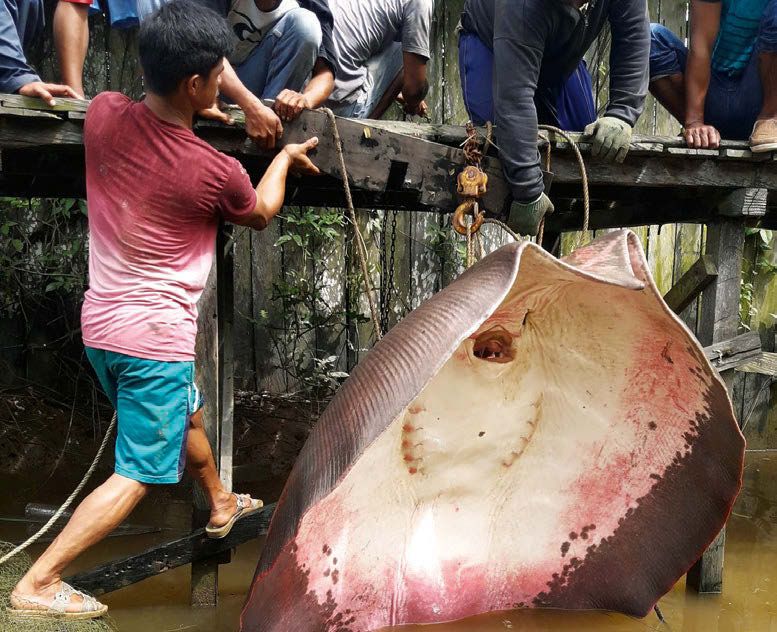
338

Fig. 1. Records of Urogymnus cf. polylepis in Borneo between 2011 and 2018. Numbers refer to all records of this
species, and correspond with numbers given in Table 1 (see table for detailed localities and remarks).

species is also absent from the checklist of fresh-          Urogymnus cf. polylepis was recorded at 29
water fishes of neighbouring Brunei Darussalam           localities in Borneo, covering all three countries
(Sulaiman et al., 2018). In the present paper, we        on the island: Malaysia, Brunei Darussalam, and
compile recent records of U. polylepis in Borneo in      Indonesia (Fig. 1). The identification of this species
an attempt to understand its contemporary occur-         was based on the combination of its large size,
rence. Records of U. polylepis in Borneo between         freshwater habitat and the following morphologi-
2011 and 2018 were compiled from the Internet            cal characters: snout very broad with enlarged
and local social media (mainly a few Facebook            narrow apical lobe; disc slightly longer than wide,
groups of local anglers in Borneo) which were            length about 1.1 times width; coloration of dorsal
supported with photographs or other evidence             surface of disc uniformly brownish or greyish
(e. g. location, habitat type, morphology, and de-       brown (Fig. 2), and ventral surface with a broad
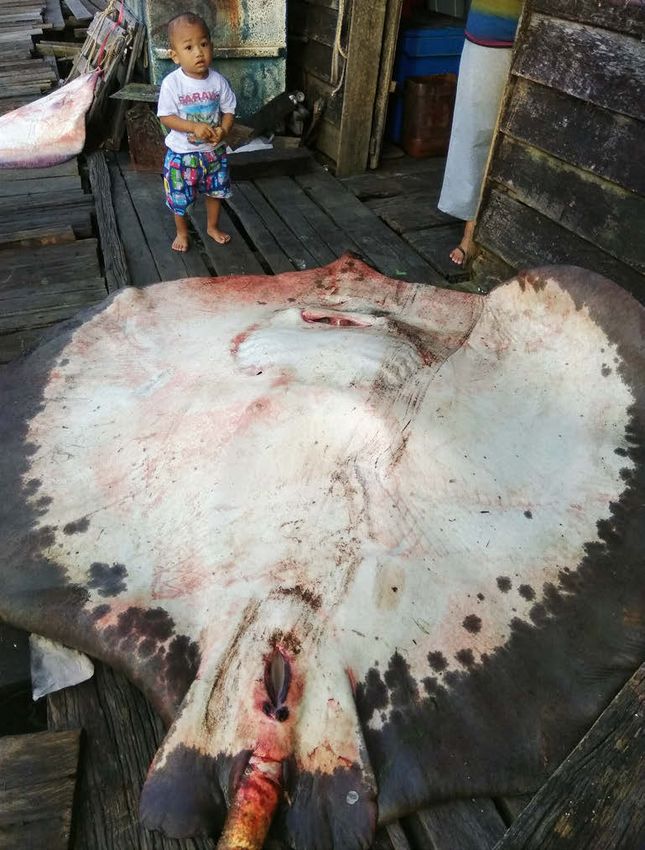
scription from fishermen). We screened all records       black marginal band around the disk (Figs. 3-4)
for authenticity and correct species identification,     (Monkolprasit & Roberts, 1990; Kottelat et al.,
and unconfirmed or ambiguous records were                1993; Vidthayanon et al., 2013; Iqbal & Yustian,
rejected. However, given that specimens were not         2016; Last et al., 2016a). Details of sites, coordi-
directly examined, and that Indonesia and Borneo         nates, dates and other remarks are provided in
are known for harbouring cryptic diversity in its        Figure 1 and Table 1.
biogeographically isolated valleys and basins,               Urogymnus cf. polylepis is known in Borneo
we chose to refer to the species as Urogymnus cf.        from Kampung Likas (Kota Kinabalu, Sabah, Ma-
polylepis.                                               laysia) in the north to Ujung Pandaran (Mentaya

                                                                      Windusari et al.: Urogymnus polylepis in Borneo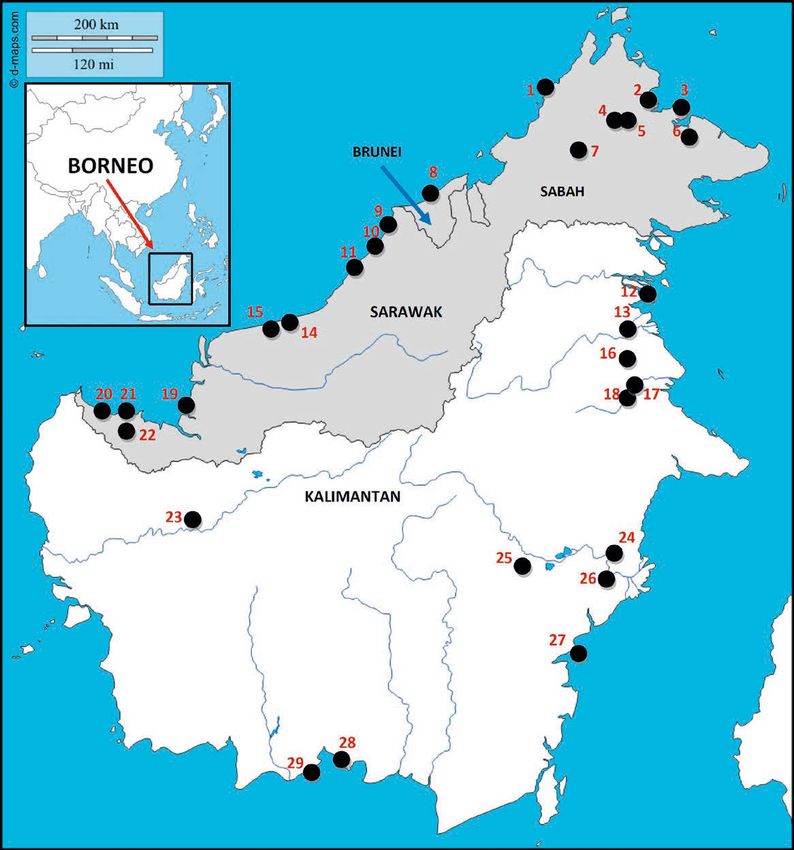
339
Fig. 2. Urogymnus cf. polylepis caught by local fishermen Fig. 3. Urogymnus cf. polylepis caught by local fishermen
on 25 August 2013 in Beluran, Sandakan,Sabah, Malay- on 7 January 2018 in Handil, Kutai Kartanegara, Kali-
sian Borneo (photograph by Razali Zalie). mantan Timur, Indonesia (photograph by Ahmad
Rustam).
Hilir Selatan, Kalimantan Tengah, Indonesia) in
the southern part of the island (Table 1). Records
of individual weights ranged from 82 to 400 kg.
Unfortunately, information on total length and
disc width are very limited, as in most instances
measurements were not taken by fishermen,
and fishermen frequently remove the tails of
these rays to avoid the caudal sting. Urogymnus
cf. polylepis reaches at least 2 m disc width and
5 m in total length, and can possibly grow larger
according to reports from the Mekong and Chao
Phraya Rivers of individuals weighing 500-600 kg
(Monkolprasit & Roberts, 1990; Last et al., 2016a).
Recent records of Urogymnus cf. polylepis be-
tween 2011 and 2018 in Borneo are a noteworthy
contribution, as they expand the known extent of
occurrence of this species to encompass all rivers
on the island. Although Urogymnus cf. polylepis
has been previously reported from Sabah and
Sarawak (Vidthayanon et al., 2016), the status of
the species in Borneo is largely unknown due to
insufficient data (Last et al., 2016a; Vidthayanon
et al., 2016). Recent data in Borneo between 2011
and 2018 show that there are several records of
Urogymnus cf. polylepis in Sabah, from at least
six different localities, and nine records from Fig. 4. Urogymnus cf. polylepis caught by local fishermen
on 12 April 2018 in Tarakan, Pulau Tarakan, Kaliman-
Sarawak, representing nine different localities
tan Utara, Indonesia (photograph by Rika Arif).
(Table 1).
A record of Urogymnus cf. polylepis from Da-
nau, Kampung Penapar, Telisai coastal village, Anecdotal records of Urogymnus cf. polylepis
Tutong district, on 20 September 2011 represents from the Kapuas River in West Kalimantan (Vidt
the country’s first confirmed record for Brunei hayanon et al., 2016) were not confirmed and
Darussalam. therefore not considered by Last et al. (2016a)
Ichthyol. Explor. Freshwaters, Vol. 29, No. 4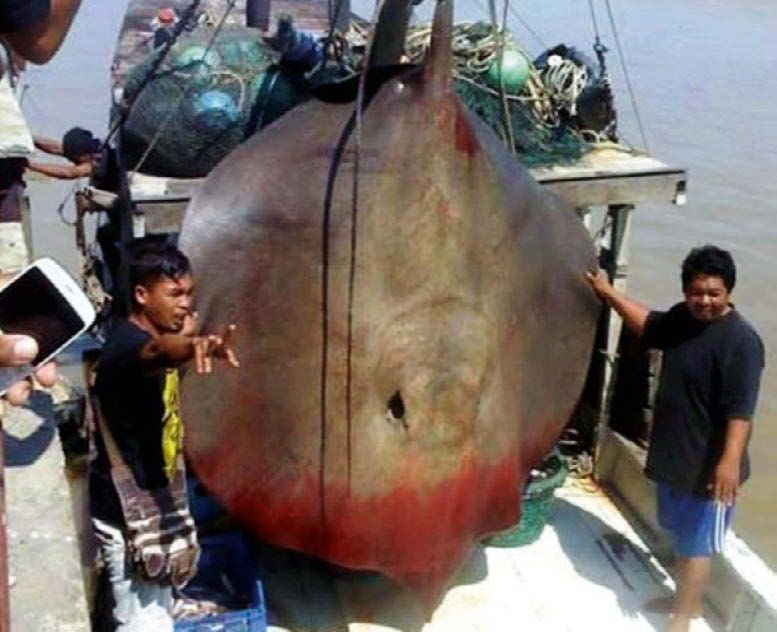
340

on their distribution map for this species. An in-      cf. polylepis from estuaries (between ca. 0-25 km)
land record of a stingray caught in 2016 at about       were reported in nearly every month except
200 km upstream in Seberang Kapuas (Sekadau,            February and May; records from tidal reaches
West Kalimantan) (Table 1) is the first confirmed       of rivers (between ca. 25-50 km) were reported
record of Urogymnus cf. polylepis from the Kapuas       only from February to November, with absence in
River and West Kalimantan waters. Urogymnus             April and September; and records from freshwater
cf. polylepis was recorded at various localities in     non-tidal reaches (between ca. 50-100 km) were
Kalimantan: a single record from West Kaliman-          reported from May to October, with absence in
tan; two from Central Kalimantan, three from            July and September. However, available data
North Kalimantan, and six from East Kalimantan          (Table 1), suggest that habitat use by Urogymnus
(Table 1).                                              cf. polylepis was not influenced by tidal factors.
    Records of Urogymnus cf. polylepis between          Within the ray groups, the ability to move loca-
2011 and 2018 in Borneo show the occurrence             tion or migrate varies greatly; egg-case laying
of this species from estuarine waters to about          rays, the skates, need to move to find suitable
200 km inland (Table 1). To consider information        localized feeding or spawning habitat, whereas
on the habitat use of Urogymnus cf. polylepis, the      large live-bearing species carry their embryonic
distributional records were classified using the        young and can disperse more freely (Last et al.,
criteria of habitat and the months when individu-       2016a). The extensive lowlands of Borneo contain
als were caught (Table 2). Records of Urogymnus         a large number of estuaries such as the Kapuas

Table 1. Records of Urogymnus cf. polylepis between 2011 and 2018 in Bornean waters. Records are listed form
north to south. Numbers refer to localities in Figure 1.

No. Site                                                 Country              Coordinates                 Date

1     Kampung Likas (Kota Kinabalu, Sabah)               Malaysia       06°00'01" N 116°06'27" E       6 Oct 2013
2     Kampung Kolapis (Sandakan, Sabah)                  Malaysia       05°54'42" N 117°37'30" E      13 Aug 2015
3     Sandakan (Sandakan, Sabah)                         Malaysia       05°50'21" N 118°08'43" E       25 Jul 2011
4     Beluran (Sandakan, Sabah)                          Malaysia       05°54'06" N 117°33'17" E       10 Jul 2012
5     Beluran (Sandakan, Sabah)                          Malaysia       05°54'06" N 117°33'17" E      25 Aug 2013
6     Orico estate (Kinabatangan, Sabah)                 Malaysia       05°27'20" N 118°10'07" E       2 Aug 2014
7     Sungai Milian (Labau, Sabah)                       Malaysia       05°08'11" N 116°35'39" E      21 Aug 2016
8     Danau (Kampong Penapar, Telisai)               Brunei Darusalam   04°45'15" N 114°35'06" E      20 Sep 2011
9     Pujut (Kuala Baram, Sarawak)                       Malaysia       04°25'46" N 114°01'29" E        4 Jul 2013
10    Tanjung Bungai (Bekenu, Sarawak)                   Malaysia       04°02'59" N 113°49'01" E       8 Dec 2016
11    Kuala Nyalau (Bintulu, Sarawak)                    Malaysia       03°36'48" N   113°24'54" E   19 Apr 2016
12    Tarakan, (Tarakan island, North Kalimantan)       Indonesia       03°17'59" N   117°34'27" E   12 Apr 2018
13    Salimbatu (Nunukan, North Kalimantan)             Indonesia       02°57'08" N   117°21'14" E   19 Nov 2017
14    Kampung Litong (Mukah, Sarawak)                    Malaysia       02°54'39" N   112°05'42" E   26 Nov 2012
15    Mukah fish market (Mukah, Sarawak)                 Malaysia       02°54'35" N   112°05'43" E   10 Mar 2017
16    Tanjung Selor (Bulungan, North Kalimantan)        Indonesia       02°50'28" N   117°34'44" E    6 Jan 2018
17    Tanjung Redep (Berau, East Kalimantan)            Indonesia       02°09'51" N   117°29'42" E   12 May 2014
18    Tanjung Redep (Berau, East Kalimantan)            Indonesia       02°09'51" N   117°29'42" E   30 Jun 2017
19    Kabong (Saratok, Sarawak)                          Malaysia       01°47'17" N   111°06'20" E   23 Aug 2016
20    Kampung Semunin (Lundu, Sarawak)                   Malaysia       01°40'11" N   109°51'17" E   21 Jun 2016
21    Kucing (Kuching, Sarawak)                          Malaysia       01°35'58" N 110°22'26" E       8 Sep 2017
22    Batu Kawa (Kuching, Sarawak)                       Malaysia       01°32'47" N 110°17'50" E      24 Feb 2013
23    Seberang Kapuas (Sekadau, West Kalimantan)        Indonesia       00°01'43" N 110°53'28" E      19 Mar 2016
24    Tanah Merah (Samarinda, East Kalimantan)          Indonesia       00°30'18"S 117°08'24" E       19 Oct 2017
25    Mahakam river (Kutai Barat, East Kalimantan)      Indonesia       00°19'25"S 116°03'47" E        6 Mar 2015
26    Handil (Kutai Kartanegara, East Kalimantan)       Indonesia       00°44'41"S 117°17'14" E        7 Jan 2018
27    Muara Talake (Paser, East Kalimantan)             Indonesia       01°37'11"S 116°32'54" E       14 Nov 2017
28    Pagatan (Katingan, Central Kalimantan)            Indonesia       03°16'23"S 113°20'09" E       23 Oct 2017
29    Ujung Pandaran                                    Indonesia       03°10'10"S 113°01'45" E       14 Dec 2017
      (Mentaya Hilir Selatan, Central Kalimantan)

                                                                    Windusari et al.: Urogymnus polylepis in Borneo
341
and Mahakam in Kalimantan and the Lupar in Vidthayanon et al. (2016) reported that based on
Sarawak. They are characterized by high flood catch data and tagging work, the species does
volumes, rapid tidal currents, high tidal ranges occur in both brackish and freshwater, but it is
and extreme turbidities (Blaber, 1997). unlikely that the species needs to move between
Urogymnus cf. polylepis has previously been brackish and freshwater to complete its life cycle.
considered as either an obligate freshwater spe- However, large numbers of pregnant females are
cies or presumed to be a freshwater species found seen in brackish waters, so estuaries could be a
in large rivers with muddy or sandy bottom pupping ground, at least for some populations
(Monkolprasit & Roberts, 1990; Martin 2005), (Vidthayanon et al., 2016). Recent data on Uro-
despite records from coastal marine and brackish gymnus cf. polylepis in Borneo between 2011 and
habitats in parts of Indonesia (Last et al., 2016a). 2018 suggest that records from estuarine waters
Table 2. Records of Urogymnus cf. polylepis between 2011 and 2018 in Borneo, based on the distance from the
sea and months reported.
Approximate distance from the sea Months
Jan Feb Mar Apr May Jun Jul Aug Sep Oct Nov Dec
1 0-25 km (estuarine) + + + + + + + + + +
2 25-50 km (tidal riverine) + + + + + + + +
3 50-100 km (freshwater riverine) + + + +
Approximate Remarks Source
distance from sea
0 km 100 kg Dede Kocung, his Facebook account
15 km 500 kg Sabah Viral, Facebook page
0 km 206 kg Sandakan Magic, Facebook page; youtube.com
20 km Salmiah Badar, her Facebook account
20 km 300 kg Razali Zalie, posting to Sandakankini public group
50 km 2 ind Kassim Sam, his Facebook account
70 km Otong Ramli, his Facebook account
1 km 200 kg Shahna Danish, his Facebook account
3 km 82 kg Jang Rabing Mittz, his Facebook account
1 km 350 kg Sarawak Aritok, Facebook page
4 km 2 ind (145 kg and 160 kg) Kapok 2016
0 km 200 kg Rika Arif, her Facebook account
30 km Lencauyat Yat, his Facebook account
0 km 200 kg Tinta Media Facebook page; Deli Sahari, his Facebook account
1 km 150 kg Sarawak Aritok Facebook page
10 km Zahida Qalbi Nahdhifa Difa, her Facebook account
50 km Ari mbombo, posting to Mancing Kulonprogo Facebook group
50 km Effendi Tanjung, his Facebook account
0 km 400 kg Youtube.com
7 km 250-300 kg Sarawak Edition, Facebook page
15 km Nora Sikin, her Facebook account
20 km 150-200 kg Ana Nesing Onak Dayung B’singai, her Facebook account
200 km Gian Saputra, posting to Facebook group of Ikan air tawar Indonesia
50 km Puma Trk, his Facebook account
200 km 100-200 kg Yudha Ricki Rifaidi, his Facebook account
15 km Ahmad Rustam, his Facebook account
0 km Ahmad Amran, his Facebook account
0 km 300 kg Anonymous 2017a
0 km 100 kg Anonymous 2017b
Ichthyol. Explor. Freshwaters, Vol. 29, No. 4342
or nearby predominated compared to inland Iqbal, M., D. Setiawan & Ajiman. 2018. New data on
records (Tables 1-2); and that large individu- the distribution of the endangered white-edge
als are reported from both estuaries and inland freshwater whipray Fluvitrygon signifer (Chondrich-
thyes: Dasyatidae). Ichthyological Exploration of
freshwater habitats. Information on whether
Freshwaters, 28: 171-176.
these individuals are pregnant females or not is Kapok, A. 2016. [2 of 305 kg giant stingrays struck on by
unavailable, stressing the need for more data in Bintulu fishermen, finally landed]. [in Malaysian].
Borneo (Vidthayanon et al., 2016). As suggested by https://sarawakvoice.com/2016/04/19/2-ekor-pa-
Vidthayanon et al. (2016), habitat use by Urogym- ri-gergasi-305-kg-serang-nelayan-bintulu-akhirnya-
nus cf. polylepis within and between river systems berjaya-ditumpas/(accessed 10 April 2018).
(including estuarine waters) is largely unknown Kottelat, M. 2013. The fishes of inland waters of South-
and requires further research. east Asia: a catalogue and core bibliography of the
fishes known to occur in freshwaters, mangroves
and estuaries. Raffles Bulletin of Zoology, Supple-
ment, 27: 1-663.
Acknowledgements Kottelat, M., A. J. Whitten, S. N. Kartikasari & S.
Wirjoatmodjo. 1993. Freshwater fishes of western
We thank our friends in various Facebook groups who Indonesia and Sulawesi. Periplus Editions, Hong
shared information on Urogymnus cf. polylepis in Borneo. Kong, 293 pp., 84 pls.
We are very grateful to Razali Zalie, Ahmad Rustam Kottelat, M. & E. Widjanarti. 2005. The fishes of Danau
and Rika Arif for sharing and allowing us to use their Sentarum National Park and the Kapuas Lakes
photos. We thank Tan Heok Hui for providing us ad- area, Kalimantan Barat, Indonesia. Raffles Bulletin
ditional references. We are very grateful to Stephen of Zoology, Supplement 13: 139-173.
Debus for his advise to improve this manuscript. We Last, P. R., G. J. P. Naylor & B. M. Manjaji-Matsumoto.
thank Peter Kyne and one anonymous reviewer who 2016a. A revised classification of the family Dasy-
provided suggestions for this paper. atidae (Chondrichthyes: Myliobatiformes) based
on new morphological and molecular insights.
Zootaxa, 4139: 345–368.
Literature cited Last, P. R., W. T. White. & P. M. Kyne. 2016b. Urogymnus
acanthobothrium sp. nov., a new euryhaline whipray
Anonymous. 2017a. [Caught by fishing net, big size (Myliobatiformes: Dasyatidae) from Australia and
stingray sold to sampit]. [in Indonesian]. http:// Papua New Guinea. Zootaxa, 4147: 162-176.
sampit.prokal.co/read/news/12964-tersangkut-ja- Last, P. R., T. W. William, M. R. de Carvalho, B. Séret, M.
ring-nelayan-pari-ukuran-monster-dijual-ke-sam- F. W. Stehmann & G. J. P. Naylor. 2016c. Rays of the
pit.html (accessed 12 April 2018). world. Cornell University Press, Ithaca, viii + 790 pp.
— 2017b. [Wow !! Sei Ijum village fishermen caught Martin, R. A. 2005. Conservation of freshwater and
giant stingrays]. [in Indonesian]. https://kalten- euryhaline elasmobranchs: a review. Journal of
gekspres.com/2017/12/14/wow-nelayan-desa-sei- the Marine Biological Association of the United
ijum-raya-tangkap-ikan-pari-raksasa/ (accessed 10 Kingdom, 85: 1049-1073.
April 2018). Monkolprasit, S. & T. R. Roberts. 1990. Himantura chao-
Blaber, S. J. M. 1997. Fish and fisheries of tropical phraya, a new giant freshwater stingray from Thai-
estuaries. Chapman & Hall, London, xiv + 367 pp. land. Japanese Journal of Ichthyology, 37: 203-208.
Compagno, L. J. V. 2016a. Fluvitrygon oxyrhyncha. Nelson, J. S., T. C. Grande & M. V. H. Wilson. 2016. Fishes
The IUCN red list of threatened species 2016: of the World. Fifth Edition. John Wiley, Hoboken,
e.T44185A104180982. (accessed 16 April 2018). xli + 707 pp.
— 2016b. Fluvitrygon signifer. The IUCN red list of Parenti, L. R. & K. K. P. Lim. 2005. Fishes of the Rajang
threatened species 2016: e.T39411A104182090. (ac- Basin, Sarawak, Malaysia. The Raffles Bulletin of
cessed 16 April 2018). Zoology, Supplement 13: 175-208.
Iqbal, M. & I. Yustian. 2016. Occurrence of the giant Sulaiman, Z., H. H. Tan & K. P. Lim. 2018. Annotated
freshwater stingray Urogymnus polylepis in Sumatra, checklist of freshwater fishes from Brunei Darus-
Indonesia (Chondrichthyes: Dasyatidae). Ichthyo- salam, Borneo. Zootaxa, 4379: 24-46.
logical Exploration of Freshwaters, 27: 333-336. Vidthayanon, C., I. Baird & Z. Hogan. 2016. Urogym-
Iqbal, M., D. Setiawan & Ajiman. 2017. Presence of nus polylepis. The IUCN Red List of Threatened
Fluvitrygon oxyrhynchus in Sumatra, Indonesia Species 2016: e.T195320A104292419. (accessed 16
(Chondrichthyes: Dasyatidae). Ichthyological Ex- April 2018).
ploration of Freshwaters, 28: 83-85.
Received 17 April 2018
Revised 16 May 2018
Accepted 21 January 2019
Windusari et al.: Urogymnus polylepis in BorneoYou can also read


