Copper Coast SA Retail Market Profile - Copper Coast Council
←
→
Page content transcription
If your browser does not render page correctly, please read the page content below
Copper Coast SA
Retail Market Profile

Prepared for Copper Coast Council
April 2018
Deep End Services                                                                       Assumptions and data sources
Deep End Services is an economic research and property
consulting firm based in Melbourne. It provides a range of                              All spending data includes GST and is expressed in future dollars.
services to local and international retailers, property owners
                                                                                        Sources include:
and developers including due diligence and market scoping
studies, store benchmarking and network planning, site                                  Australian Bureau of Statistics
analysis and sales forecasting, market assessments for a
variety of land uses, and highest and best use studies.                                 •   2016 Census

Contact
                                                                                        •   Dwelling approvals, 2011/12-2016/17
Deep End Services Pty Ltd                                                               •   Estimated resident population, 2001-2016
Suite 304
9-11 Claremont Street                                                                   Copper Coast Council
South Yarra VIC 3141
                                                                                        •   Kadina Town Centre redevelopment concept plan
T +61 3 8825 5888
F +61 3 9826 5331                                                                       Deloitte Access Economics
deependservices.com.au                                                                  •   Spend per capita estimates and forecasts by category, 2012-2026
Enquiries about this report should be directed to:
                                                                                        Market Data Systems
Chris Abery
Director                                                                                •   MarketInfo retail spending propensity by category, 2012
Chris.abery@deependservices.com.au
                                                                                        South Australia Government
John Deane
Senior Associate
                                                                                        •   Department of Planning, Transport and Infrastructure, Population
john.deane@deependservices.com.au                                                           projections for SA2s, 2011-31, Aug 2016 release
Document Name                                                                           •   Department of Education & Childhood Development, school
Copper Coast Market Profile - 18 April 2018                                                 enrolment data

Disclaimer                                                                              South Australia Tourism Commission
This report has been prepared by Deep End Services Pty Ltd solely for use by
the party to whom it is addressed. Accordingly, any changes to this report will         •   Tourism data by Local Government Area
only be notified to that party. Deep End Services Pty Ltd, its employees and
agents accept no responsibility or liability for any loss or damage which may arise
from the use or reliance on this report or any information contained therein by any
other party and gives no guarantees or warranties as to the accuracy or
completeness of the information contained in this report.

This report contains forecasts of future events that are based on numerous
sources of information as referenced in the text and supporting material. It is not
always possible to verify that this information is accurate or complete. It should be
noted that information inputs and the factors influencing the findings in this report
may change hence Deep End Services Pty Ltd cannot accept responsibility for
reliance upon such findings beyond six months from the date of this report.
Beyond that date, a review of the findings contained in this report may be
necessary. This report should be read in its entirety, as reference to part only
may be misleading.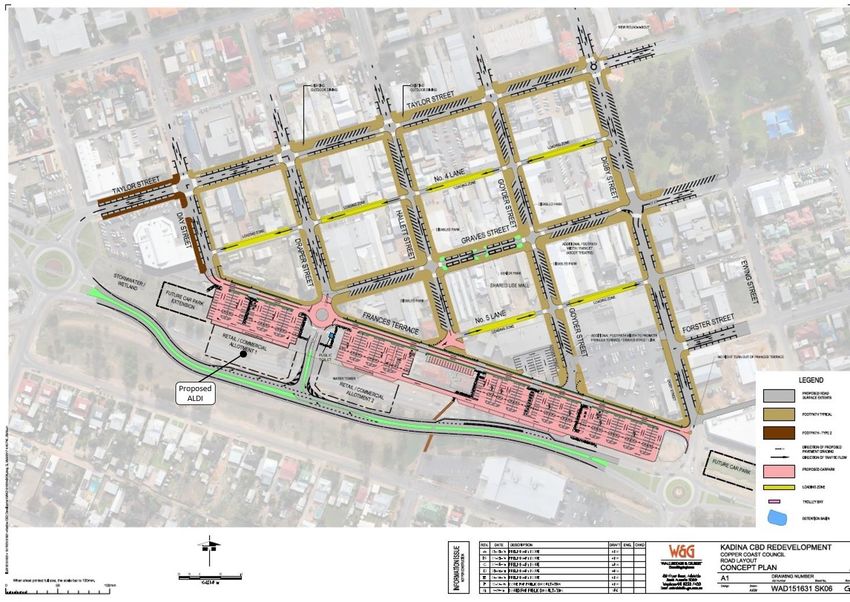
Contents   1      Regional context                    2
           1.1    Location                             3
           1.2    Yorke Peninsula population           3
           1.3    Township growth                      4
           1.4    Regional comparison                  4
           1.5    Regional economic base               6
           1.6    Workforce                            6
           1.7    Unemployment                         6
           1.8    Workforce catchments                 8
           1.9    Tourism                              9
           1.10   Town Centre floorspace               9
           2      Catchment area                      10
           2.1    Kadina catchment                    11
           2.2    Population                          12
           2.3    Population characteristics          15
           2.4    Retail spending                     17
           2.5    Escape spending                     17
           3      Township profiles                   18
           3.1    Kadina                              19
           3.2    Moonta – Moonta Bay – Port Hughes   24
           3.3    Wallaroo                            27
           4      Opportunities                       30
           4.1    Kadina                              31
           4.2    Moonta                              32
           4.3    Wallaroo                            33

                                                           Deep End Services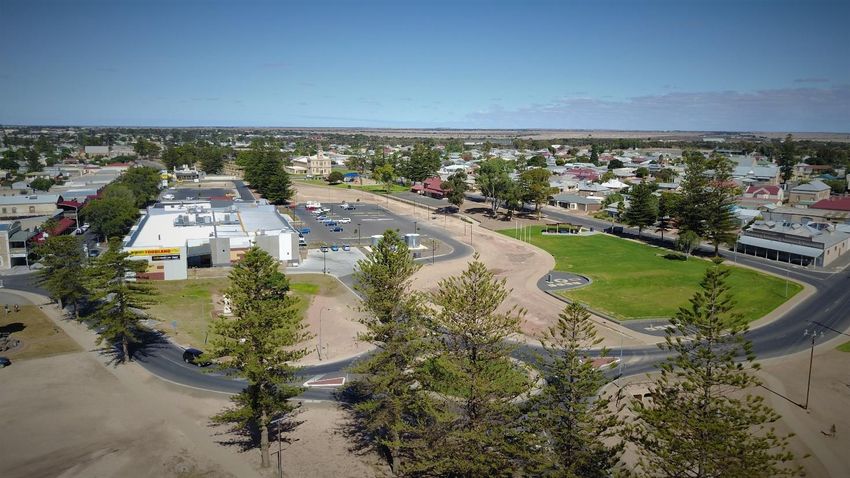
2

1
Regional context

                   Deep End Services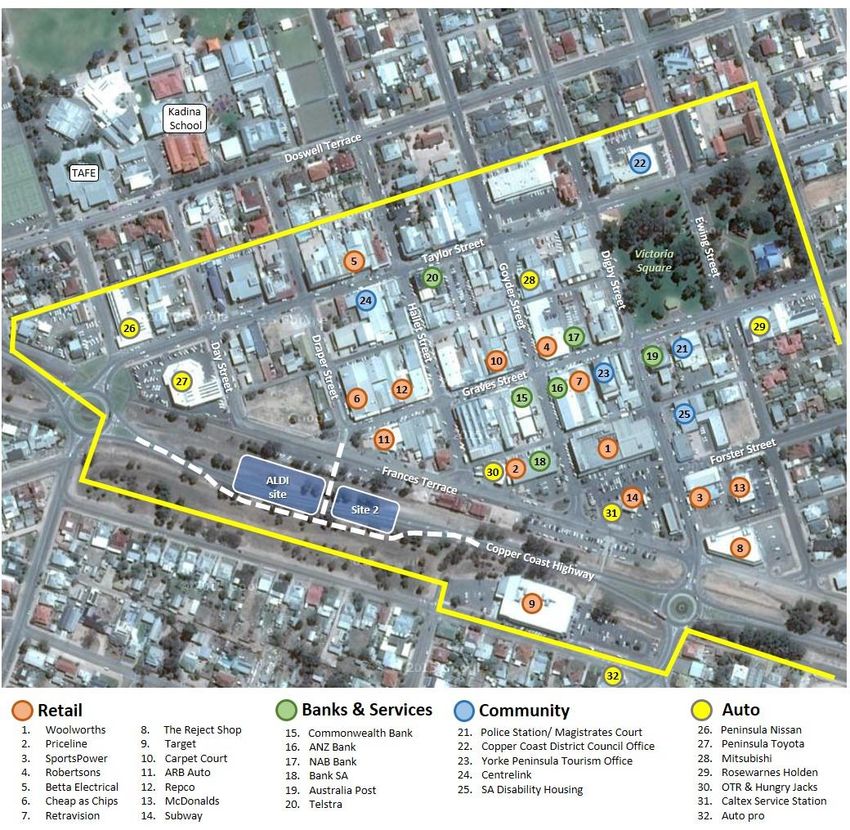
3

1.1 Location                                              to the area’s temperate climate, heritage attractions,   Figure 2—Copper Coast townships

                                                          water activities and good local services.
South Australia’s Yorke Peninsula is a vast region of
broadacre farming and coastal and rural townships.        Figure 1—Regional location
The local government areas of Copper Coast, Barunga
West and Yorke Peninsula span the 250 km length of
the Peninsula, with a population of 28,400 people.
Almost half the population live in the closely-situated
Copper Coast towns of Kadina, Wallaroo and Moonta.
Kadina (pop. 4,700) lies 8 km inland of Wallaroo (pop.
4,000) on the Spencer Gulf and 15 km north of Moonta
and the adjoining coastal villages of Moonta Bay and
Port Hughes (pop. 4,700).
Beyond the main townships are the smaller villages of
Port Broughton (pop. 1,050) and Bute (pop. 250) to the
north and Maitland (pop. 1,050), Port Victoria (pop.
280) and Ardrossan (pop. 1,200) within 40-minutes’
drive to the south.                                                                                                1.2 Yorke Peninsula population
Kadina is the principal commercial and administrative                                                              State Government forecasts released before the 2016
centre for the Yorke Peninsula, hosting a range of                                                                 Census indicate the Yorke Peninsula will grow to
local, state and federal government agencies and                                                                   almost 30,000 people by 2026 – an increase of 1,600
service providers, a vibrant town centre with national                                                             people (Figure 3). The Copper Coast townships will
retailers and franchises, major banks, professional                                                                accommodate all the region’s projected growth with
services, car dealerships and service industries.                                                                  stable population levels across the balance of the
The sea port at Wallaroo has bulk grain handling and                                                               Peninsula.
commodity facilities and the Peninsula’s major health                                                              The forecast for Copper Coast of 1.1% average annual
service. The coastal towns of Wallaroo and Moonta                                                                  growth for the next 10 years (or +161 people per
attract large seasonal populations and retirees drawn                                                              annum) appears conservative based on the last 10
                                                                                                                   years averaging +278 people per annum.

                                                                                                                                                            Deep End Services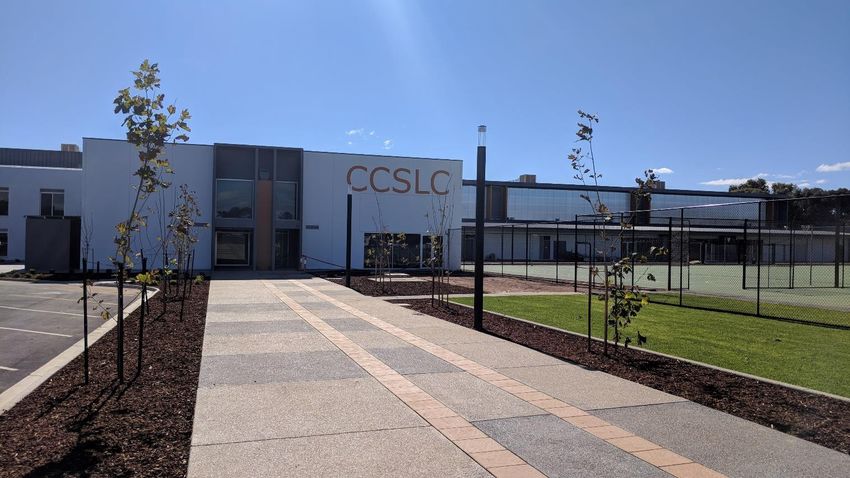
4

Copper Coast’s share of the Peninsula’s population will                resort apartments and retail and restaurant areas.            Figure 5—Population levels - 2016

rise from 51% in 2016 to over 55% in 2031.                             Private works valued at $7m have been contracted to
                                                                                                                                                   26,665
                                                                       Council for completion by August 2018.                                               24,530
                                                                                                                                                                      22,424
Figure 3—Yorke Peninsula region population
                                                                                                                                                                                17,336
                                                                       Figure 4—Copper Coast township growth                                                                             14,913    14,093     13,434
                                                                                                                                        13,433
       York e Peninsula (DC)   Barunga West (DC)   Copper Coast (DC)
 35,000                                                                                       20 01   20 06       20 11   20 16
                                                                       5,000
 30,000
 25,000                                                                4,000
 20,000                                                                                                                                 Copper     Gawler    Fleurieu Whyalla   Murray   Riverland Port Pirie  Port
                                                                                                                                         Coast              Peninsula           Bridge    towns               Augusta
                                                                       3,000
 15,000                                                                                                                                 towns                 towns

 10,000                                                                2,000
  5,000                                                                                                                              In terms of population growth, the Copper Coast towns
                                                                       1,000
      0                                                                                                                              had the highest growth rate of all regional areas of
           2006      2011      2014    2016    2021     2026    2031
                                                                           0                                                         South Australia between 2011 and 2016 (Figure 6).
Source: DPTI (August 2016)                                                           Kadina            Wallaroo            M oonta

                                                                       Source: ABS                                                   Figure 6—Population growth 2011-16 (% per annum)
1.3 Township growth
                                                                       1.4 Regional comparison                                            1.8%
                                                                                                                                                    1.7%
There has been strong and steady growth in the
                                                                                                                                                             1.3%
Copper Coast townships in the last 15 years (Figure 4).                As a single market, the three towns had a 2016                                                           1.2%

Between 2001 and 2016, Kadina grew by 690 people,                      Census population of 13,433 - comparable to the
                                                                                                                                                                                         0.6%
Wallaroo by 1,020 and Moonta-Port Hughes by 1,320                      Riverland towns, Port Pirie and Port Augusta (Figure
people.                                                                5).                                                                                            0.0%                        0.1%      -0.2%

                                                                                                                                         Copper    Gawler    Fleurieu Whyalla Murray Riverland Port Pirie Port
At Port Hughes, new owner-occupier and holiday                                                                                            Coast             Peninsula         Bridge  towns              Augusta
homes are being built in the Patrick’s Cove and The                                                                                      towns                towns

Dunes golf course estates.                                                                                                           Source: ABS

Wallaroo has become a popular destination for retirees
and ‘sea changers’ with new apartments and housing
in the canal estates of Copper Cove Marina. The $220
million Wallaroo Shores development is under
construction on 18.5 hectares of foreshore land. The
project will include 650 dwellings, a hotel complex.

                                                                                                                                                                                                         Deep End Services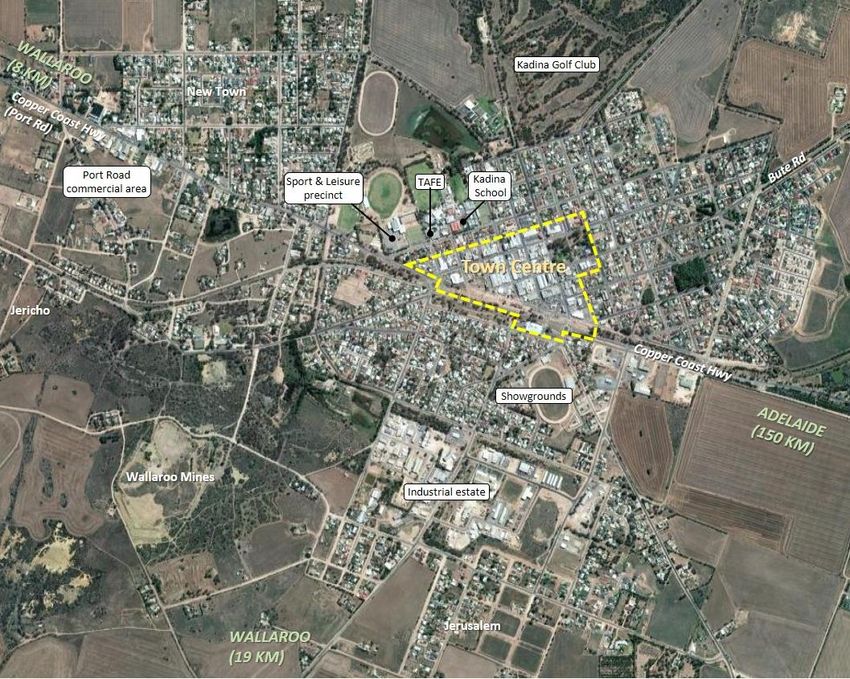
5

Figure 7—Comparative regions

                               Deep End Services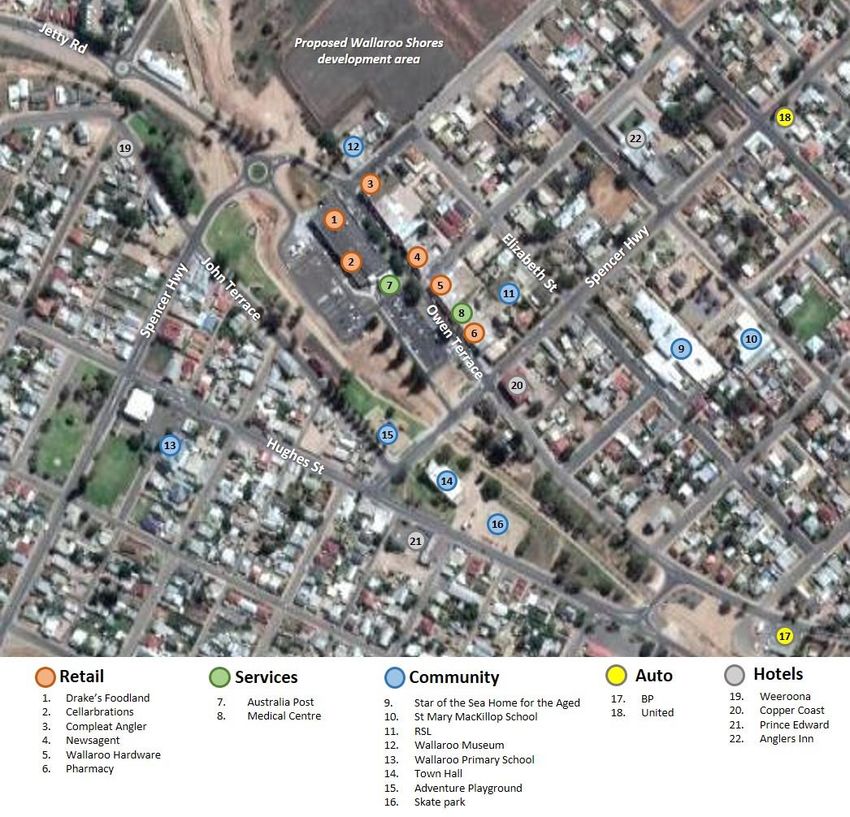
6

1.5 Regional economic base                                The employment mix of each township reflects the           28% of all jobs in Wallaroo - more than double the
                                                          varying commercial and service role that each              proportion of other towns.
Kadina and Moonta were founded on rich copper
                                                          performs within the region (Figure 9).
deposits mined by Cornish migrants from the mid-                                                                     Like Moonta, Accommodation & Food and Retailing
1850’s. Today, the region’s economy is based on           Kadina                                                     are the next largest sectors.
arable farming (barley, wheat, legumes, canola, chick     Retail trade is the largest sector in Kadina, providing    Figure 9—Township workforce by industry - 2016
peas and field peas), an associated engineering and       18% of all jobs. The town’s regional retail role is           30%
services sector, commercial fishing, tourism and          underlined by floorspace surveys which show Kadina                         Kadina   M oonta   Wallaroo
                                                                                                                        25%
government services.                                      has 60% of all retail floorspace in the three townships.
                                                                                                                        20%
The largest industries of employment in the townships     Other significant sectors in Kadina are Public
                                                                                                                        15%
are Health care & social assistance (17%) and             Administration & Safety - reflecting the local council
Retailing (15%) while across the broader catchment of     and state agency offices - Finance & insurance and
                                                                                                                        10%

20,000 people it is Agriculture and fishing (18%).        Education & training.                                          5%

                                                                                                                         0%
1.6 Workforce                                             Pre-schools, a primary school, two secondary schools
                                                          and a TAFE generate 12% of all jobs in Kadina.
Although Kadina has a similar population to Moonta, its
                                                          Moonta
role as the main centre for the Yorke Peninsula is
underlined by the size of its daily workforce. At the     Construction is the largest employment sector in
2016 Census, there were 2,421 jobs in Kadina (or 55%      Moonta with 16% of all jobs – well above Wallaroo
of all jobs in three towns) compared to approximately     (8%) and Kadina (4%). The strong home building
                                                                                                                     1.7 Unemployment
1,000 each in Moonta and Wallaroo.                        market and coastal lifestyle has attracted builders,       The average unemployment rate across Kadina,
                                                          trades and other contractors to the town. The 80-          Wallaroo and Moonta was 8.8% at December 2017 –
Figure 8—Township employment - 2016
                                                          hectare Dunes Estate around the championship golf          slightly above the state level (6.2%). Rates had fallen
       2,421
                                                          course will ultimately comprise 227 residential lots.      from a peak of 12% in 2015/16 but lifted in late 2017
                                                          Employment in Commercial accommodation and                 against a slightly improving state-wide trend.
                      1,018            954
                                                          retailing is also significant in Moonta.

       Kadina         Moonta         Wallaroo
                                                          Wallaroo
                                                          The Wallaroo Hospital and Health Services dominates
                                                          employment in Wallaroo, contributing most of the jobs
                                                          in the Health & Social Assistance sector that makes up

                                                                                                                                                                   Deep End Services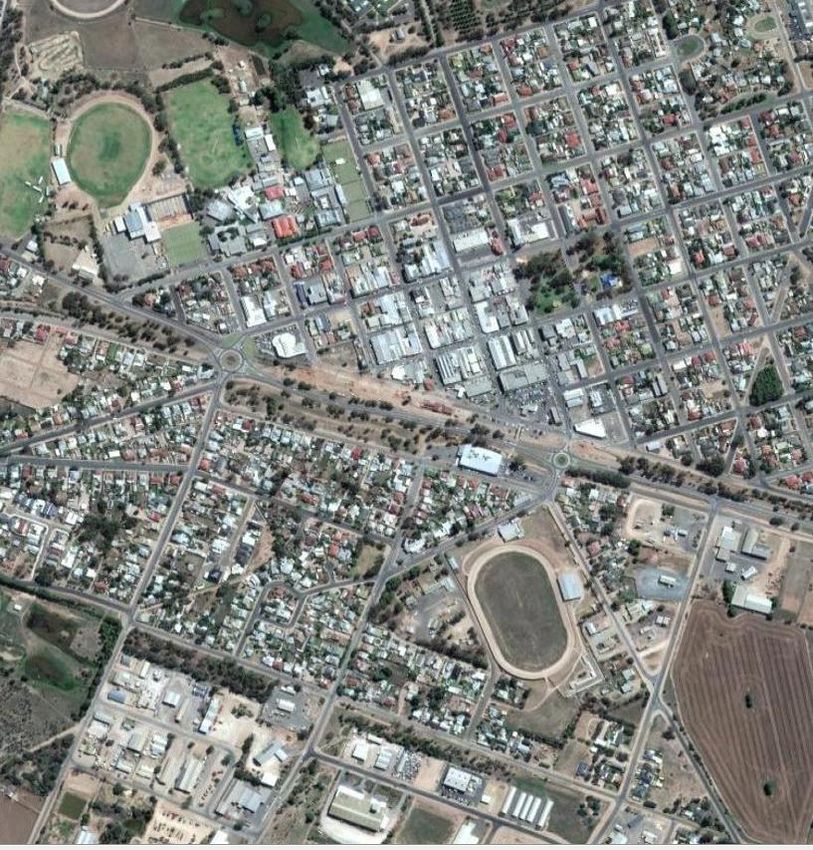
10%
                             12%
                             14%

                              0%
                              2%
                              4%
                              6%
                              8%
                    Dec-10
                    Apr-11
                    Aug-11
                    Dec-11
                    Apr-12
                    Aug-12
                    Dec-12
                    Apr-13
                    Aug-13
                    Dec-13
                                                        Figure 10—Unemployment

                    Apr-14
                                   Copper Coast towns

                    Aug-14
                    Dec-14
                    Apr-15
                    Aug-15
                    Dec-15
                    Apr-16
                    Aug-16
                                   SA

                    Dec-16
                    Apr-17
                    Aug-17
                    Dec-17
                                                                                 7

Deep End Services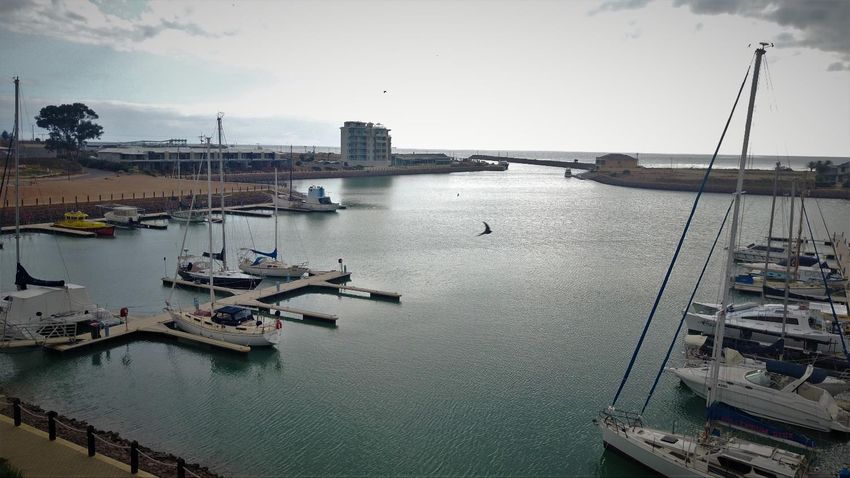
8

1.8 Workforce catchments                                 Wallaroo (Figure 12) also has a relatively high 47% of     Moonta (Figure 13) has a more self-contained trade-
                                                         its workforce commuting from outside the township,         based workforce with only 33% of jobs filled by people
The place-of-residence of each township’s workforce is
                                                         possibly due to the more specialised positions at the      living outside the town.
thematically mapped showing the size and spatial
                                                         hospital and the close proximity of a large workforce at
pattern of labour drawn to each centre.                                                                             The workforce catchments show high levels of
                                                         Kadina.
                                                                                                                    economic interaction and co-dependency between the
Kadina (Figure 11) has a larger workforce than the
                                                         Figure 12—Wallaroo workforce by place of residence         three townships. Kadina however is clearly the primary
other towns and draws more deeply and widely, with
                                                                                                                    centre for employment with its workforce sourced from
54% of its workforce living outside Kadina township.
                                                                                                                    a broader 50km radius.
Figure 11—Kadina workforce by place of residence
                                                                                                                    Figure 13—Moonta workforce by place of residence

                                                         Source: Census 2016; Deep End Services

Source: Census 2016; Deep End Services
                                                                                                                    Source: Census 2016; Deep End Services

                                                                                                                                                               Deep End Services
9
1.9 Tourism Source: South Australia Tourism Commission
1.10 Town Centre floorspace
Commercial accommodation is concentrated at
South Australians dominate the Yorke Peninsula visitor The town centres are defined by the presence of
Wallaroo and Moonta – both known for their safe
market, making up 89% of the 485,000 annual visits supermarkets, supporting shops and services for
beaches, protected moorings and boat ramps giving
and staying 1.7 million visitor nights per year1. The residents and cafes, restaurants and amenities for the
access to rich fishing areas.
region also receives 535,000 day-trips per year. visitor market.
Wallaroo has a mix of accommodation from motels and
About 95% of all visits and visitor nights are classified Kadina has approximately 41,000 sqm of retail
guest houses, hotels, serviced apartments and caravan
as ‘Leisure’ – either for holidays or visiting friends or floorspace and about 15,000 sqm in other non-retail
parks. At Moonta, it is mainly holiday units and
relatives. Two thirds of all visitors stay in residential and commercial uses.
caravan parks.
accommodation (friend, rented or own dwellings) with
Moonta (13,600 sqm) has about one-third the retail
25% either camping or in caravan parks. Figure 15—Short-term accommodation floorspace of Kadina, while Wallaroo (6,900 sqm) is
Visitors are attracted to the Peninsula’s family friendly about half the size of Moonta.
reputation and broad range of leisure activities.
Kadina has a large Woolworths supermarket while
In 2013/14, tourism contributed an estimated $236 Kadina and Wallaroo have either new or refurbished
million to the Yorke Peninsula’s economy. It employed Drakes’ Foodland stores.
900 people directly in the tourism industry and indirectly
Figure 16—Town centre floorspace comparison
supported another 1,500 jobs.
Figure 14—Yorke Peninsula annual visitors – 2014-2016
Kadina Town Centre
& Port Road commercial
50,000 5,000
Moonta Town Centre
Retail
Wallaroo Town Centre Non-ret ail
Vacant
0 10,000 20,000 30,000 40,000 50,000 60,000
Floorspace (sqm)
Source: Deep End Services February 2016 survey
429,000
Source: Deep End Services
Int rast ate Int erst at e Int ernational
1
Yorke Peninsula Regional Profile 2014-16. South Australia Tourism Commission.
Deep End Services10
2
Catchment area
Deep End Services11
2.1 Kadina catchment Figure 17—Catchment area
Kadina’s catchment area reflects its role as the
major centre for food, comparison goods and
personal, financial and government services for
the central and northern areas of the Yorke
Peninsula.
The primary catchment is defined on the Copper
Coast council boundary and is split into four
sectors:
• Kadina
• Moonta
• Wallaroo
• Rural balance
The Secondary north sector covers the Barunga
West council area and its main townships - Port
Broughton and Bute – which are directly linked
by road to Kadina. Port Broughton is 50 km
north of Kadina, beyond which Port Pirie would
be the dominant centre. The eastern boundary
is defined by the Hummock Range.
The Secondary south sector extends 70 km
south covering the central Peninsula town of
Maitland, Ardrossan on Gulf St Vincent and Port
Victoria on Spencer Gulf.
Kadina also draws on lower areas of the Yorke
Peninsula through regional sporting fixtures and
the supply of agricultural equipment and
services.
Source: Deep End Services
Deep End Services12
2.2 Population Figure 18—Dwelling approval trends
Kadina’s primary catchment had a population of Table 1—Catchment area population
200
14,451 people at the 2016 Census. Between 2011- Actual Projected
180
Residential building approvals
160
2016 it grew by 1,300 people or 259 people per annum Catchment area sector 2006 2011 2016 2018 2021 2026
140
– a slightly lower rate than the previous 5 years (296 Population
120
Kadina primary 4,172 4,530 4,695 4,765 4,870 5,045
per annum). M oonta primary 3,562 4,076 4,690 4,950 5,340 6,090 100
Wallaroo primary 3,317 3,666 4,048 4,228 4,568 5,568 80
While the southern coastal areas of the Fleurieu
Rural primary 623 882 1,018 1,068 1,143 1,268 60
Peninsula had the highest absolute increase in Total Primary 11,674 13,154 14,451 15,011 15,921 17,971
40
population in regional SA (+3,138 between 2011- Secondary north 2,597 2,522 2,644 2,704 2,743 2,803
20
Secondary south 3,705 3,734 3,766 3,786 3,801 3,826
2016), the 5-year increase on the Copper Coast Total 17,976 19,410 20,861 21,501 22,465 24,600 0
(+1,300) was similar to the larger cities of Murray 2011/ 12 2012/ 13 2013/ 14 2014/ 15 2015/ 16 2016/ 17
Pop. growth (No. p.a.)
Kadina primary Moonta primary Wallaroo primary
Primary - 296 259 280 303 410
Bridge (+1,329) and Mt Gambier (+1,171). In the 5- Rural primary Secondary north Secondary south
Secondary north - -15 24 30 13 12
year period, Copper Coast recorded the largest Secondary south - 6 6 10 5 5
Source: ABS
percentage growth rate of any Council area in regional Total - 287 290 320 321 427
Pop. growth (% p.a.)
SA.
Primary - 2.4% 1.9% 1.9% 2.0% 2.5%
Secondary north - -0.6% 0.9% 1.1% 0.5% 0.4%
The two secondary catchments had 6,410 people
bringing Kadina’s catchment to 20,861 in 2016. The
Secondary south - 0.2% 0.2% 0.3% 0.1% 0.1%
Total - 1.5% 1.5% 1.5% 1.5% 1.8%
secondary areas had small positive rates of growth.
Kadina and Moonta had almost identical township
population levels of approximately 4,700 people each
while Wallaroo was about 15% smaller at 4,048.
About 42% of growth in the catchment has been at
Moonta, with 26% at Wallaroo and 14% at Kadina.
Small townships and rural areas contributed 20%.
The distribution of dwelling approvals across the
catchment from 2012 to 2017 (Figure 18) shows the
solid contribution of Moonta and Wallaroo. The spatial
pattern of residential dwelling approvals is shown in
Figure 19 for the last available year (2017).
Deep End Services13
Figure 19—Dwelling approvals by small statistical area Copper Coast’s actual population at the 2016 Census • New housing estates and aged living options
- 2017
(14,451) was higher than estimated by DPTI in their drawing new residents to the Copper Coast over
last forecasts (14,116). DPTI’s projections appear alternative areas. Housing estates at Port Hughes
highly conservative as their future annual growth rates have catered to a need in the area while the
to 2021 and 2026 average just 160 new residents per construction of Wallaroo Shores will provide other
annum compared to actual growth rates in the last 10 forms of medium density housing well-suited to
years of 278 new residents per annum. small families and retirees.
• Service and amenity improvements throughout the
Population growth on the Copper Coast in the next 10
townships including new businesses (ALDI),
years will be driven by a range of demographic forces
recreation facilities and CBD improvement
and demand and supply-induced factors including:
schemes.
• Low levels of natural population increase (i.e. births
minus deaths) On these observations there is every likelihood that
Copper Coast will exceed its historic 10-year average
• High levels on in-migration which will continue to
growth rate of 278 new residents per annum, moving
offset any outward migration of young residents to
Adelaide for work or education and older people for to 300 people per annum to 2026 and 400 per annum
by 2031, as projects such as Wallaroo Shores are
health and aged care. The largest growth factor
developed drawing in new residents and the peak of
will be soon-to-be-retired or retired people moving
permanently into dwellings owned but previously the baby boomer retirement years is reached in
Adelaide.
used on an occasional basis and others selling
elsewhere and buying into the coastal areas. A In addition to the resident population, the spending
survey2 in 2012 of non-resident rate payers of the market available to retailers and other businesses is
Copper Coast found that one-third of absentee boosted through the course of the year by non-resident
owners intend to move to the Copper Coast on a ratepayers who occupy their coastal home on
Source: Deep End Services; ABS permanent basis. weekends or during holiday periods. Based on
Local government area population forecasts are • The influx of older people is likely to increase as frequency-of-use data collected by the University of
prepared and published by the State Government Adelaide’s population of baby-boomers ages and Adelaide, the effect of this absentee owner group is an
(DPTI) however the last available series (2015) pre- moves into retirement. Adelaide’s inner and additional 7% increase in the resident population of the
dates the 2016 Census. northern suburbs have been a rich source of new Copper Coast over the course of a year.
residents for the Copper Coast.
2
Survey of non-resident and resident ratepayers of the District Council of the Copper Coast
(January 2012), Professor Graeme Hugo & Professor Kevin Harris.
Deep End Services14
Population levels are also boosted by the similar
occupation of rented homes and holiday units,
commercial accommodation and caravan parks.
Deep End Services15
2.3 Population characteristics Age retirees travelling in other parts of Australia during
winter months. The vacancy level at Kadina was just
Demographic and housing data for the catchment area 35% of Moonta’s population is 65 years or over,
11%.
is shown in Table 2 while specific characteristics are followed by Wallaroo (31%) and Kadina (23%). The
presented below with thematic maps. SA average is just 18% highlighting the strong Figure 22—Average Household income
attraction of the coastal area for retirees.
Households
The Copper Coast townships are distinguished by Figure 21—Age > 65 years
older, retired populations at Moonta and Wallaroo
which show up in various Census variables.
Families with children make up 35% of households in
Kadina but just 26-28% in Wallaroo and Moonta.
Couples without children are much higher in the
coastal towns while single-person households (32%)
are similar across all three towns, as older single
people potentially move to Kadina with better services.
Figure 20—Couples with children (% all households)
Figure 23—Unoccupied dwellings
Household income
Average household income levels are lower where
there is a higher proportion of retirees and others on
support payments. Household incomes are 28%
below the SA average in Moonta and Wallaroo and -
20% below in Kadina.
Unoccupied dwellings
On Census night, 35% of dwellings at Moonta and
Source: Deep End Services; ABS 31% at Wallaroo were vacant, revealing the large
weekend and holiday home market and possibly
Deep End Services16
Other characteristics Table 2—Trade area demographics
Index.
Kadina M oonta Wallaroo Rural Secondary Secondary Total
Compared to the South Australian averages the Demographic characteristic
primary primary primary primary north south catchment
SA Catchment
to SA.
catchment area shows other characteristics: Persons and dwellings
Usual resident population 4,585 4,573 3,988 994 2,582 3,687 20,409 1,676,653 -
• Workforce participation rates are about 20% below Total private dwellings 2,156 3,272 2,775 454 1,876 2,490 13,023 765,669 -
- % unoccupied 11% 37% 33% 19% 38% 36% 31% 12% 2.60
the SA average, a level consistent with other rural Average household size (5)(7)
2.30 2.12 2.10 2.66 2.14 2.16 2.19 2.42 0.90
and regional areas. Economic indicators
(2)
Workforce Participation rate 51% 41% 41% 61% 45% 49% 46% 58% 0.79
• Low tertiary education levels and a low proportion Unemployment rate (2) 9.1% 7.5% 10.1% 6.9% 5.5% 5.7% 7.7% 7.5% 1.03
(2)
White collar workers 34% 36% 36% 46% 51% 53% 41% 47% 0.88
of white collar workers Bachelor degree or higher (2)(3)
7% 7% 6% 8% 7% 7% 7% 19% 0.37
• A high proportion of Australian-born residents. Age group
0-9 11% 9% 10% 13% 9% 11% 10% 12% 0.86
• High levels of home ownership – again typical of 10-19 13% 9% 8% 14% 8% 10% 10% 12% 0.88
20-34 16% 11% 12% 15% 10% 11% 13% 19% 0.65
an area with retirees and rural areas. 35-49 18% 13% 14% 22% 15% 14% 15% 19% 0.78
• Detached dwellings are the dominant housing from 50-64 19% 24% 25% 22% 25% 25% 23% 20% 1.20
65+ 23% 34% 31% 13% 32% 28% 29% 18% 1.56
with town houses and semi-detached dwellings Average age 42.4 49.0 48.1 38.6 49.1 46.5 46.4 40.4 1.15
Annual household income (1)(3)(5)
making up just 5% of all homes in the three
$182,400 2% 2% 3% 6% 4% 4% 3% 7% 0.40
Total 100% 100% 100% 100% 100% 100% 100% 100%
peaking at 40% in Moonta and 37% at Wallaroo. Average household income $64,408 $57,728 $58,916 $79,127 $63,334 $65,482 $62,364 $80,521 0.77
Country of birth (1)
• Lone person households make up almost one in
Australia 94% 88% 91% 96% 93% 94% 92% 76% 1.21
three households in the three large townships. England 3% 8% 4% 4% 5% 4% 5% 6% 0.79
New Zealand 1% 1% 1% 0% 0% 0% 1% 1% 0.65
Other 2% 4% 4% 0% 2% 2% 3% 17% 0.16
(1)(4)(5)(6)
Occupied private dwelling tenure
Fully owned 40% 46% 42% 47% 59% 55% 47% 34% 1.41
Being purchased 33% 28% 24% 35% 21% 23% 27% 37% 0.72
Rented 27% 26% 35% 18% 20% 21% 26% 30% 0.88
Dwelling type (1)(4)(7)
Separate house 94% 90% 92% 100% 95% 98% 94% 78% 1.20
Townhouse/ semi-detached 6% 4% 6% 0% 3% 1% 4% 15% 0.28
Apartment 0% 5% 2% 0% 1% 1% 2% 7% 0.29
Household composition (4)(5)
Couples with children 23% 18% 18% 36% 20% 21% 21% 29% 0.71
Couples without children 32% 40% 37% 34% 38% 36% 36% 28% 1.31
One parent family 12% 8% 10% 10% 7% 8% 9% 11% 0.82
Lone person 31% 32% 32% 19% 33% 33% 32% 28% 1.11
Group 2% 2% 3% 2% 2% 2% 2% 4% 0.59
Source: Deep End Services; ABS
Deep End Services17
Figure 24—Retail spend per capita, 2018
2.4 Retail spending and larger centre of Kadina. The new Drakes
$ 6,000
Cop per Co ast catch ment
supermarket at Wallaroo in 2015 is likely to have
Retail spending levels at the small area level are captured a higher share of local food spending.
$ 5,000 SA avge
modelled from ABS Household Expenditure Survey
$ 4,000
results and local area income and other characteristics. Survey data on the more discretionary clothing,
$ 3,000
household goods and other non-food products showed
Average annual spending per capita by Copper Coast $ 2,000
that 33% of Copper Coast residents shop in the
area residents in seven major categories is shown in $ 1,000 Adelaide CBD on a monthly basis and 50% in other
Figure 24. $0 Adelaide centres on a similar frequency.
Foo d & Take- Home Dini ng Clo thi ng & Lei sure & Hou sehol d
Annual spending on Food & Groceries is modelled at Gr oceri es Liq uo r A ccessor ies Gene ral & Ser vices
Modelling the behavioural responses to all centres and
$5,864 per capita or about 2.9% above the SA Source: Deep End Services; ABS; DPTI, MDS; Deloitte Access Economics
applying differential spending levels by frequency of
average. Packaged liquor is about 2% below average. visit, indicates that Copper Coast residents direct about
Table 3—Catchment area spending, 2018
The discretionary spending categories of dining out & 39% (or $28.4 million in 2018) of their available $72.4m
Category Primary Secondary Total
restaurants, clothing & accessories, leisure & general ($m) ($m) ($m) of non-food spending to centres in Adelaide.
(comprising recreational goods, books & stationery) Food & Groceries 88.0 38.1 126.1
Take-Home Liquor 9.1 4.1 13.3 This is a significant level which could be captured by a
and cosmetics and household goods and services are Dining 23.5 10.5 34.0 wider and better range of retailers in the three main
all slightly below the SA average – reflecting the older Clothing & Accessories 13.4 5.9 19.3
centres of the Copper Coast.
and lower income profile of the catchment. Leisure & General 16.1 7.7 23.8
Household Goods 42.9 19.7 62.6
Figure 25—Distribution of Copper Coast residents’
The average annual per capita spending level of Services 7.4 3.2 10.6
Total 200.4 89.3 289.8
spending on clothing, leisure & household goods
$13,477 for catchment area residents is about 3.5%
Source: Deep End Services; ABS, MDS; Deloitte Access Economics Other
below the SA average. centres, 2%
Population estimates combined with per capita 2.5 Escape spending
Adelaide
spending levels generate the retail spending market for SCs, 26%
A 2012 survey and report of Copper Coast ratepayers Kadina, 40%
each major product group (Table 3).
by the University of Adelaide gathered data on where
The overall spending market in 2018 is estimated at residents shop for food and groceries and non-food,
$289.8 million. More than two-thirds is generated by household goods and clothing. Adelaide
the Primary catchment. Food & Groceries is the CBD, 13%
Kadina and Moonta residents are strongly aligned to
largest category at $126 million or 43% of all spending. Other Yorke
their own supermarkets with little cross-shopping to Peninsula, Moonta, Wallaroo,
other centres. At the time, Wallaroo residents divided 0.5% 12% 5%
Source: Deep End Services; University of Adelaide (2012)
their food spending between Wallaroo and the close
Deep End Services18
3
Township profiles
Deep End Services19
3.1 Kadina Wakefield to Kadina. An aerodrome 5 km west of These reflect Kadina’s commercial and service sector
Kadina accommodates emergency services aircraft, with major retailers such as Woolworths, Target,
Overview
ultralights, microlights, paragliders and helicopters. Reject Shop, Cheap as Chips and McDonald’s,
Kadina is the Yorke Peninsula’s principal retail and government agencies such as Regional Disability
The Kernewek Lowender Copper Coast Festival is a
service centre and the main inland stop for visitors to Support Services and Centrelink and educational
biennial cultural event celebrating the region’s Cornish
the coastal townships. facilities from early learning to TAFE.
heritage. It is held jointly in Kadina, Moonta and
It has a rich history from its Cornish mining origins and Wallaroo and attracts up to 50,000 people. Major Projects
a broad based commercial area with a range of well-
Other attractions at Kadina are the Farm Shed Kadina CBD Redevelopment
preserved hotels and heritage-listed commercial and
Museum and tourist centre, annual show and field
public buildings. Copper Coast Council will complete a major
days.
redevelopment of its CBD infrastructure, roads,
Kadina is strongly tied to the fortunes of the rural sector
Education footpaths, public areas and landscaping in July 2018
on the central and north Yorke Peninsula. The fertile
(refer page 19). The works will upgrade ageing
soil, temperate climate and reliable rainfall patterns In 2013, the Kadina Primary School and Kadina
infrastructure, improve disability access and pedestrian
support a productive rural sector which underpins Memorial High School merged forming the Kadina
movement and safety, provide shade and other
Kadina’s economic base and its supporting industries. Memorial School. The R-12 school serving Kadina,
amenity improvements, upgrade and level pavement
Wallaroo and the rural district has grown steadily to
The town has government agencies and service surfaces and improve traffic flow within and through
more than 1,200 students.
providers and regional level leisure and education the area.
facilities. National retailers and franchises, major Harvest Christian College is Kadina’s second R-12
Development sites & new retailers
banks, professional services, car dealerships and school, with around 300 students.
service industries are the base of a vibrant town As part of the CBD Redevelopment, a 250-metre
TAFE SA’s Kadina campus is the only tertiary
centre. section of the Copper Coast Highway has been
education facility on the Copper Coast offering Award
realigned to the south, creating two development sites
Kadina’s industrial area has a range of transport and and Short courses.
and a new CBD access road to Draper Street via a
logistics, rural supplies and engineering services Employment new roundabout on Frances Terrace.
supporting the town and regional farming sector.
Industry sectors employing over 200 people in Kadina ALDI has purchased the western site of 6,100 sqm and
Kadina is well-connected to Adelaide. The Princes in 2016 were: will develop a 1,770 sqm store. Construction is
Highway (Port Wakefield Highway) is a divided 4-lane
• Retail Trade (427) expected to start in May 2018 with an opening before
carriageway from Adelaide’s northern suburbs to Port
• Health & Social Assistance (284) Christmas 2018. The second commercial site opposite
Wakefield (75km) with the bitumen-sealed Copper
• Education & Training (276) ALDI presents an opportunity for other new retailers or
Coast Highway extending the last 50 km from Port
commercial tenants.
Deep End Services20
Sport & leisure centre Figure 26—Kadina township
Just east of the Kadina CBD, the Copper Coast Sport
and Leisure Centre has undergone a $10.5 million
redevelopment. The works include:
• three new multipurpose undercover courts;
• renovation of the show court with permanent
seating;
• relocation of the gym;
• child and vacation-care facilities;
• resurfacing the tennis and netball courts and
installation of new light towers
The leisure centre is an important community asset
drawing people from across the Yorke Peninsula. It
can now host major regional and State-level
competitions that will increase visitation levels to
Kadina.
Other projects
• $3m redevelopment of the former BP site on
Frances Terrace with an OTR fuel station and
Hungry Jack’s restaurant;
• Rezoning of the land at the Showgrounds to
facilitate the relocation of automotive uses;
• Potential refurbishment of Woolworths;
• Future redevelopment of the former (cleared) Mobil
site; and
• Development opportunities at the east end of the
CBD.
Deep End Services21
Kadina CBD Figure 27—Kadina CBD
The Kadina CBD covers a large triangular-
shaped area extending 3-4 blocks north of
Copper Coast Highway. It straddles two main
east-west streets (Taylor St & Graves St) which
are bisected by six north-south running streets.
The centre has approximately 140 retail,
commercial and service businesses.
Graves St is the central axis where small shops.
services and banks have historically established,
extending into adjoining blocks.
Major retailers have developed on larger
peripheral sites. Woolworths (3,200 sqm) has a
key position at the southern entry while a small
Target store is on Railway Terrace, south of the
Highway. Other large retailers include Cheap as
Chips (1,300 sqm), The Reject Shop (600 sqm),
Betta Electrical (550 sqm) and Priceline.
McDonalds and Subway have stores with
Hungry Jacks under construction.
Kadina has a good range of banks (4) and
community and government services, mainly at
the east end. Small furniture, electrical, auto
and homewares retailers are on Taylor Street
and the west end of Graves St.
Kadina CBD has 4 car dealerships which
underline its regional service role.
Source: Deep End Services; Nearmap
Deep End Services22
Kadina CBD redevelopment Figure 28—Kadina Town Centre redevelopment concept plan
The Redevelopment Project will transform the
image and amenity of Kadina, creating a safer,
more pleasant shopping area and better
environment for businesses. The major works
are:
• New stormwater drainage, underground
power and re-levelling of street sections with
new road surfaces and kerbing, street
lighting and wider pedestrian paths.
• New off-street car park areas off Frances
Terrace, easily accessible for Copper Coast
traffic.
• New single-direction traffic flows on selected
streets.
• Copper Coast Highway realignment to
improve traffic flow and facilitate the
expanded parking areas and create a new
CBD entry road to Draper Street with two
retail / commercial development sites.
The works are expected to be fully complete by
July 2018.
The general upgrading of the centre and
development of ALDI will generate interest from
other retailers looking to establish in the growing
catchment. Source: Copper Coast Council
Deep End Services23
Figure 29—Kadina CBD redevelopment images
Deep End Services24
3.2 Moonta – Moonta Bay – Port Hughes and Port Hughes enabling the subdivision of large • Health & Social Assistance (130)
residential lots previously serviced by septic tanks.
Moonta, Moonta Bay and Port Hughes is the fastest
• At Port Hughes, new permanent and holiday
growing area on the Copper Coast – increasing by
homes in the Patrick’s Cove estate.
over 600 people between 2011 and 2016 to 4,700 at
• New homes in the 227-lot Dunes estate situated
the last Census.
around the Copperclub Golf Course.
The resort area is popular for its safe beaches, good • New or expanding lifestyle villages for the over
boating facilities and village centre with hotels, cafes 50’s.
and restaurants in well-preserved historic buildings. • Conversion of former holiday homes to permanent
Retirees are settling in the area as it offers a range of residences.
housing options and the sought-after coastal lifestyle,
The tourist market is well catered for with popular
recreation facilities and retail services.
caravan parks at Port Hughes and Moonta Bay which
The attractions of the area’s Cornish mining heritage have a steady occupancy with travelling retirees
include the National Trust Museum, Moonta Mines throughout the year. Elsewhere, there is a good range
National Heritage Area, Moonta School of Mines and of motel, serviced apartment and B&B
Tourist Railway. accommodation.
Other popular family attractions are the Moonta Bay Local schooling is provided with the Moonta Area
Jetty, the Council-developed Splash Town Water Park School (1-12) which had 500 enrolments in 2016. A
at Moonta Bay and the Statewide Cinema in the $4 million upgrade is being planned as part of the
Moonta Town Hall. Council’s redevelopment of the Building Better Schools Program.
Port Hughes boat ramp has improved its capacity and
A small public hospital closed in Moonta in 2013 with
safety.
an aged care service continuing to operate in the
The Greg Norman-designed Copperclub Golf Course facility with on-site medical staff.
at Port Hughes is rated one of the best layouts in
Employment
South Australia.
Industry sectors employing more than 100 people in
Population growth has been driven by several factors:
Moonta and Port Hughes at the 2016 Census were:
• The Community Wastewater Management
• Construction (155)
Scheme has fully sewered Moonta, Moonta Bay
• Retail Trade (149)
• Accommodation & Food (140)
Deep End Services25
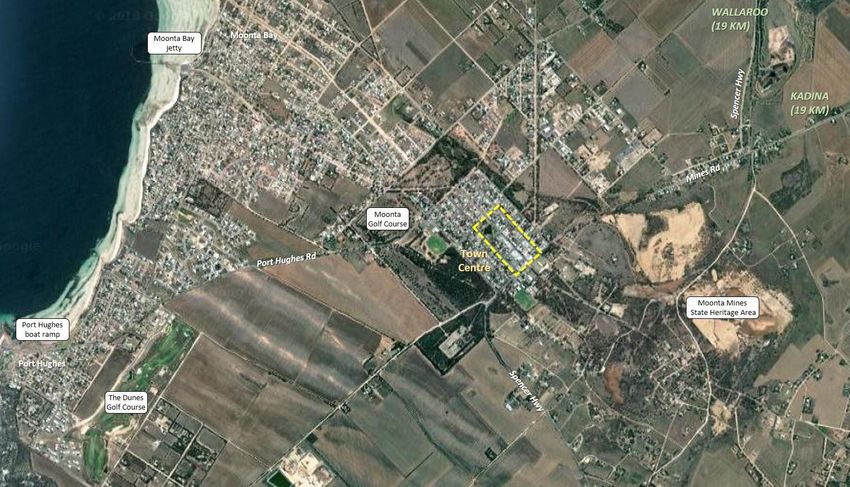
Figure 30—Moonta Bay – Moonta – Port Hughes
Source: Deep End Services; Nearmap
Deep End Services26
Moonta Town Centre Figure 31—Moonta Town Centre
The Moonta Town Centre is situated in the old
township grid, close to the mines but 2km from
Spencer Gulf. The coastal residential areas
developed away from the Town Centre after the
mine closed in 1923.
Moonta has about 70 retail and commercial
businesses and a low vacancy rate reflecting the
compact nature of the centre, the township’s
recent growth and a visible tourist market drawn
to its heritage elements and attractive
streetscape.
The compact centre is based on a 2-block length
of George Street with other buildings along Ellen
and Ryan Streets.
The focus is a recently upgraded Drakes
Foodland of approximately 1,400 sqm with off-
street parking. A pharmacy, newsagent, cafes
and other services are grouped near Drakes at
the southern end of George Street.
The centre has notable sandstone heritage
buildings including the Town Hall at the north
end (opposite Queen Square Gardens) which is
home to a Cinema. There are 3 hotels, a school
and community facilities close by.
Council is preparing a Town Centre Master Plan
which has progressed through the first stage of
community consultation.
Source: Deep End Services; Nearmap
Deep End Services27
3.3 Wallaroo and holiday homes. New homes are being gradually • Retail Trade (149)
built in the area on elevated blocks with coastal views. • Accommodation & Food (140)
Wallaroo is a popular coastal town and major grain
port on the Spencer Gulf, a short 8km drive west of A second area of new housing is Investigator Heights, Future developments
Kadina. The 2016 population of just over 4,000 people a subdivision of about 120 lots on the eastern entry to
Wallaroo Shores is a $220 million master-planned
has grown steadily over the last 15 years. Wallaroo, from Kadina.
development of the former Incitec Pivot site. The 18.5
The town was founded in the 1850’s on cereal Wallaroo has two schools - Wallaroo Primary (132 ha of foreshore land has sweeping views over Spencer
cropping and a copper smelter processing ore from students) and St Mary MacKillop (R-7) with 135 Gulf and will link the Town Centre and Copper Cove
Kadina - both shipped out via the Wallaroo port. The enrolments. Marina with residential, tourist and commercial uses.
local economy is now based on tourism, a large retired The town’s largest employer is the Wallaroo Hospital Initial planning approvals include 100 2-storey
population base, a regional hospital and the deep-sea and Health Services. As the only hospital for the townhouses with four-star resort facilities and a
port which hosts a bulk grain storage and export facility Copper Coast, it is a 28-bed facility with general and function centre to be managed by Mantra Group.
operated by Viterra. Wheat and barley are the main palliative care, allied health services and 24-hour Other elements of the Master Plan include a residential
commodities shipped from Wallaroo. emergency. subdivision, lifestyle village for over 50’s and a
During warmer months a fleet of prawn trawlers and commercial precinct close to the Town Centre.
For visitors, Wallaroo has a range of caravan, camping
crab boats operate from the Wallaroo Marina. These and accommodation options. The main outdoor Council is contracted to develop $7m of private works
and other leisure boats support a small boat servicing attractions are Wallaroo Beach with its new protected which are scheduled for completion in August 2018.
industry. swimming enclosure, the jetty used by recreational
Other potential developments at Wallaroo are:
The Copper Cove Marina with its protective rock walls anglers and divers and boating.
• Potential king fish farming in pens off Wallaroo and
was built in the 1990’s. It has pens for leisure and Other local facilities include the Wallaroo Heritage and
changes to existing fishing zones to allow farming
commercial fishing boats, a public boat ramp and a Nautical Museum, the irrigated 18-hole Wallaroo Golf
of finfish and other marine species.
large residential canal estate with private berths Club and the adjoining Community Sports Club which
• Undeveloped land holdings at Copper Cove
affording a safe passage to Spencer Gulf. Today, the has an outdoor bowling rink and a unique indoor
Marina for residential and apartment buildings.
marina lots are about 60% developed. bowling facility that hosts state-wide events.
• Extended residential subdivisions at North Beach
A hotel and 7-level serviced apartment building on the Employment on zoned and serviced land.
marina provides premium accommodation for the
town. Other sites on the marina have similar The largest industries of employment in Wallaroo at
development potential. the 2016 Census reflect the regional service role of the
hospital and the importance of tourism.
A small coastal subdivision known as North Beach lies
• Health & Social Assistance (263 jobs)
just north of Wallaroo with a large retiree population
Deep End Services28
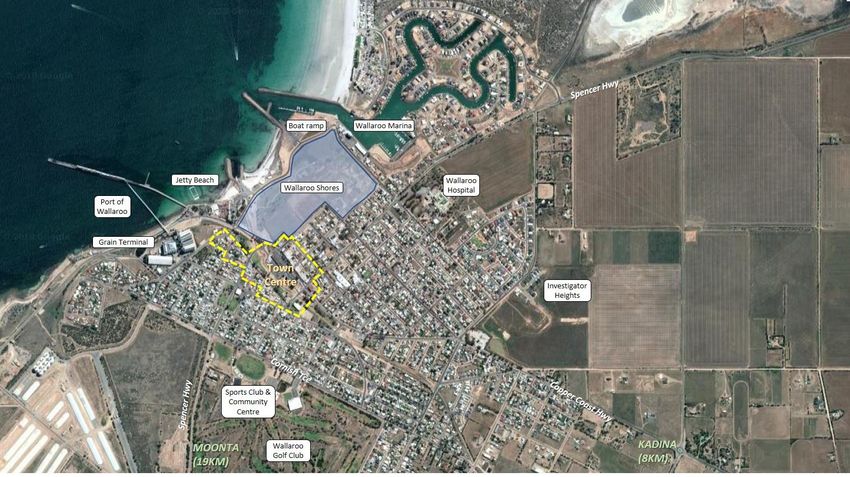
Figure 32—Wallaroo
Source: Deep End Services; Nearmap
Deep End Services29
Wallaroo Town Centre Figure 33—Wallaroo Town Centre
The Wallaroo Town Centre was originally established
around the rail head with shops on John Terrace and
Owen Terrace, close to the port and former copper
smelter.
Retailing is now centred on Owen Terrace with other
establishments, hotels and public buildings spread
around the former rail reservation which Council has
developed as an attractive central parkland.
The centre has about 25 retail and service businesses
and about 7,000 sqm of retail space. Owen Terrace
has a tree-lined streetscape with old commercial
buildings and awnings where a pharmacy, newsagent,
cafes, restaurants and services are situated in the two
blocks north of Spencer Highway.
In 2015, Wallaroo Central opened on the south side of
Owen Terrace. It houses a Drakes supermarket
(2,500sqm) - which relocated from an old centre on
Hughes Street - and 9 shops including a liquor store,
café, restaurant, sports store and Australia Post.
Wallaroo is a compact and attractive centre with
heritage buildings and modern retail outlets. The
business mix provides a basic range of weekly
services to residents with food and beverage outlets
catering to the visitor market. Owen Terrace and
Wallaroo Central have leasing opportunities suited to a
range of small retailers.
Source: Deep End Services; Nearmap
Deep End Services30
4
Opportunities
Deep End Services31
4.1 Kadina • New development sites created by the CBD works Specialty food & liquor
and enhanced prospects for other underutilised
The Kadina Town Centre presents a strong opportunity • Organic baker
land holdings. • Natural foods
for the establishment of new independent retail
• A redeveloped leisure centre bringing more sporting
businesses and the extension of existing national or • Independent wine store
participants and visitors to Kadina.
franchised store networks from Adelaide or other
• Good road connections and a short travel time from
regional areas of South Australia. Hospitality
Adelaide enabling cost efficient supply chains.
Kadina has the advantages of: • A large, available workforce. • Bar / boutique brewery
• Thai restaurant
• A stable economic base. Agriculture and primary
production, tourism, retailing and government
Franchised food
services have lower volatility than other cities
dependent on mining, industry and resources. • Dominos
• Existing retail, business and government services • KFC
which operate on a regional catchment across the • Red Rooster / Oporto
central and northern areas of the Yorke Peninsula • Pizza Hut
– an area of over 20,000 people. • Sushi
• A local or primary catchment of 14,000 people
across Kadina, Moonta and Wallaroo. Specialty shops
• Population growth across the three towns at higher • Mid-range fashion (Katies, Millers, Suzanne Grae,
In view of Kadina’s characteristics and a review of other
rates than other regional areas. Noni B)
regional cities and major retailers and franchises, the
• Large seasonal population increases and travelling • Youth fashion
following list of potential retailers / categories would be
visitors throughout the year. • Footwear
potentially suited to Kadina now or in the future.
• A supportive Council investing heavily in renewing • Gifts / small homewares
the CBD with upgraded infrastructure and works to Some retailers will duplicate existing businesses • Mobile phones / telecoms.
enhance access, parking and pedestrian comfort however a growing regional market requires • Electronics / games
and safety. These works are equally beneficial to competition and choice within its retail and business
businesses. sector. Retail / personal services
• An ALDI supermarket opening in 2018 bringing Mini-majors • Massage
price and range competition and drawing new or
• Best & Less • Day spa
more frequent shoppers to Kadina.
• Nail salon
• Audiology
Deep End Services32
• Flight centre and visitor market. The 80 retail and business For the most part, Moonta Town Centre has not grown
premises provide a good range of services covering beyond the original limits of the commercial centre laid
Large format most of the essential needs for a population of 4,700 out in the mid-1800’s. It has maintained a pedestrian
people. scale and intimacy with the main retailers serving
• Camping / outdoor supplies
weekly needs grouped around Drakes at the southern
• Radio rentals Survey data shows residents have strong loyalty to the
end of George Street with cafes and services
• Beaumont tiles existing supermarket, largely due to the town’s distance
extending north along George and Ellen Streets.
• Discount city carpets from Kadina (compared to Wallaroo) and a strong
• Dreamland operator in Drakes. Retaining high levels of grocery The centre has a low vacancy rate but opportunities
• Godfreys / Leading appliances spending is beneficial to the centre and supports other are present for new businesses in existing buildings or
• Petstock retailers who can leverage the customer traffic. by redevelopment of properties within the Town
• Solomon’s flooring Centre zone. Major discretionary goods such as
• Toyworld furniture, electrical and large homewares should be
encouraged to locate at Kadina which leaves Moonta
Banks / financial services to service its resident and visitor market with food and
• Westpac, groceries, limited non-food items, retail and personal
• Bendigo Bank services and cafes and restaurants.
• People’s Choice Credit Union
Non- retail
• Fitness centre / Pilates
Fuel
• Coles Express While the township population is similar to Kadina,
Moonta has a more constrained catchment and has
developed as a boutique village centre without the
4.2 Moonta higher-level services. This lesser role and its historic Moonta has grown at a faster rate than Wallaroo and
Moonta is a compact and vibrant village centre with location in-land, away from the sprawling coastal areas Kadina, although growth is in the older age groups
attractive streetscapes, historic buildings and has seen it develop about one-third of the retail and which have different needs. Moonta has 34% of its
businesses drawing on the area’s rich Cornish heritage commercial floorspace of Kadina. population aged over 65 (South Australia 18%) and a
high proportion in the 50-65 years cohort.
Deep End Services33
It also has the highest proportion of unoccupied • New or expanded retail and personal services
dwellings (37%) which underlines the high seasonality including medical practitioners and health therapists
of the population. This is positive for the town but (in shops or boutique offices), optometry and
presents challenges for retailers through both peak audiology, skin care, hairdressers and beauticians.
and non-peak periods. • Other services and products for the middle and
older age groups such as financial and estate
Cafes and restaurants are not over-represented in the
planning, accountants, travel agency, home
Town Centre although some recent additions are
maintenance, personal and home security, aged
evident. This could be due to its location away from
care services, mobility aids, hobbies & crafts and
the beach side areas and camping grounds and the
computer repairs & support.
local traffic function of George Street. The Town
• Pilates and fitness. The population has a similar aged profile to Moonta
Centre also has a unique setting, positioned in the
• Age-relevant fashion and accessories and outdoor / and high proportion of absentee ratepayers.
original township with a close population of 500 people
leisure clothing. The new Wallaroo Central complex, built in 2015,
which is surrounded by large areas of community land
• Services to the new home-building / renovation relocated and extended an existing Drakes
and the historic mining reserves. This results in only a
market including home improvement products and supermarket to Owen Terrace with 9 new shops. The
small population within a walkable distance of the
homewares. development has consolidated Wallaroo’s retail
Town Centre and most of the coastal population
• For permanent residents and the day trip / and activity to the historic and compact precinct close to
dependant on car access.
visitor market, a broader range of cafes and the foreshore and adjacent to the Wallaroo Shores
The age profile, visitor market and continued growth of restaurants with outdoor / footpath dining, arts & development site.
the township would see the following potential retail crafts, unique homewares, day spa & beauty.
and business opportunities in the Moonta Town
Centre:
• An expanded or relocated supermarket. The 4.3 Wallaroo
existing Drakes Foodland is about 1,400 sqm and
has recently upgraded indicating its continued Wallaroo is the smallest of the three Copper Coast
townships with 4,000 people. Its close and direct (8km)
operation from the current site for some time. The
store however is small relative to the recent new road link to Kadina and the effect of the larger inland
Drakes at Wallaroo (2,500 sqm) which services a centre on Wallaroo’s catchment has historically limited
Wallaroo to a smaller provision of shops and services.
smaller market and may look to expand in the
future. New off-street parking and Council’s landscaping of
the former rail land with other road works has created
Deep End Services34
an attractive town centre and environment for new • The growing visitor and day trip market.
businesses. The open area is framed by old public • The staged development of Wallaroo Shores which
buildings, hotels and commercial buildings on John will bring new permanent residents, quality
Terrace. accommodation for travellers and convention
facilities for the business market and employment
opportunities. New retail and commercial premises
will also be part of the development.
• The large specialist employment base and visitors
to Wallaroo Hospital.
• The potential to draw residents from Kadina to the
foreshore and town centre amenities.
Having regard to the above and the existing business
mix, the opportunities for new retailers / businesses at
Wallaroo are somewhat similar to Moonta and include:
The new retail floorspace is still being absorbed by the
• Cafes and unique casual dining.
market with leasing opportunities in Wallaroo Central
• Take away food (differentiated).
and in the historic 3-block section of Owen Terrace.
• Specialty food retailers to complement the
The current small retail and business mix in the centre supermarket (bakery, butcher, natural foods)
could be characterised as serving some daily and • Arts & crafts.
weekly needs with a newsagent, pharmacy, Australia • Antiques, gifts and small homewares.
Post, liquor store, hardware store, a range of retail and • Discount variety store.
personal services, health professionals and several • Heath professionals including optometrist,
cafes and restaurants. audiologist, physiotherapy, podiatrist.
The catalysts for new business and retail growth at • Bank / credit union.
Wallaroo are: • Aged care services.
• The completed Town Centre and other foreshore
projects by Council which encourages residents
and visitors to the beachside areas to park and
explore the Town Centre.
• Wallaroo’s ongoing population growth.
Deep End ServicesYou can also read


