Coronavirus: Enforcing restrictions - By Jennifer Brown 27 July 2021 - UK Parliament
←
→
Page content transcription
If your browser does not render page correctly, please read the page content below
By Jennifer Brown

27 July 2021
                    Coronavirus: Enforcing
                    restrictions

                    Summary
                    1  Who enforces coronavirus restrictions?
                    2 Fixed Penalty Notices
                    3 Police powers
                    4 Statistics
                    5 Commentary

                    commonslibrary.parliament.uk
Number 9024 Coronavirus: Enforcing restrictions
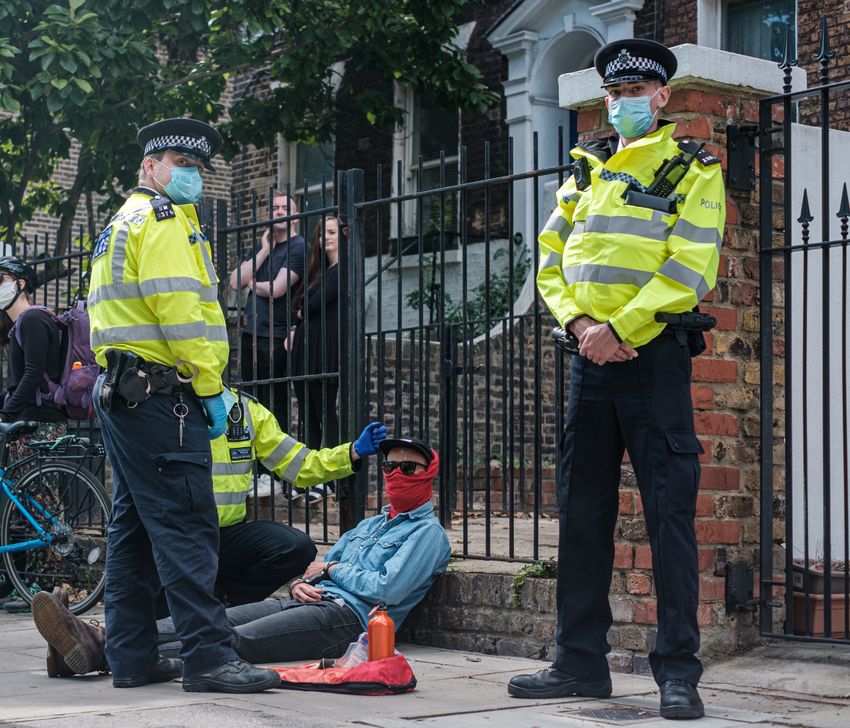
Image Credits
Ehimetalor Akhere Unuabona on Unsplash
Disclaimer
The Commons Library does not intend the information in our research
publications and briefings to address the specific circumstances of any
particular individual. We have published it to support the work of MPs. You
should not rely upon it as legal or professional advice, or as a substitute for
it. We do not accept any liability whatsoever for any errors, omissions or
misstatements contained herein. You should consult a suitably qualified
professional if you require specific advice or information. Read our briefing
‘Legal help: where to go and how to pay’ for further information about
sources of legal advice and help. This information is provided subject to the
conditions of the Open Parliament Licence.
Feedback
Every effort is made to ensure that the information contained in these publicly
available briefings is correct at the time of publication. Readers should be
aware however that briefings are not necessarily updated to reflect
subsequent changes.
If you have any comments on our briefings please email
papers@parliament.uk. Please note that authors are not always able to
engage in discussions with members of the public who express opinions
about the content of our research, although we will carefully consider and
correct any factual errors.
You can read our feedback and complaints policy and our editorial policy at
commonslibrary.parliament.uk. If you have general questions about the work
of the House of Commons email hcenquiries@parliament.uk.
2 Commons Library Research Briefing, 27 July 2021Coronavirus: Enforcing restrictions Contents Summary 4 1 Who enforces coronavirus restrictions? 7 2 Fixed Penalty Notices 15 3 Police powers 20 4 Statistics 23 5 Commentary 27 3 Commons Library Research Briefing, 27 July 2021
Coronavirus: Enforcing restrictions

                     Summary

                     Various restrictions and requirements have been placed on individuals and
                     businesses to help slow the spread of coronavirus in England and Wales:

                     •     Lockdown restrictions: Rules have been imposed which require people
                           to “stay home”, “stay local” or “stay in the UK”. Rules have prevented
                           different types of gatherings. Some businesses have been required to
                           close or operate under restrictions. Some lockdown restrictions still
                           apply in Wales, but all lockdown restrictions were removed in England on
                           19 July 2021.
                     •     Face covering requirements: Most people in Wales are required to wear
                           a face covering on public transport, in shops and businesses and in other
                           public spaces. The requirement was removed in England on 19 July 2021.
                     •     International quarantine requirements: England and Wales operate a
                           “traffic light system” for quarantine restrictions. People entering England
                           must adhere to different rules depending on whether they have come
                           from a ‘green’, ‘amber’ or ‘red’ list country.
                     •     Self-isolation requirements: People who have tested positive for
                           coronavirus (or come into close contact with someone who has) are
                           required to self-isolate.

                     Responsibility for enforcing coronavirus restrictions is shared between several
                     public agencies. Some private businesses also have responsibilities.

Organisations and individuals responsible for enforcing coronavirus
restrictions
              Lockdown
                                                                       Police
                                                                  Local authorities

           Face coverings                                       Transport operators
                                                                  Business owners
                                                                       Police
                                                           Commercial transport operators
       International quarantine
                                                              Civil Aviation Authority

                     4                                            Commons Library Research Briefing, 27 July 2021
Coronavirus: Enforcing restrictions
Border Force
Public Health England’s Isolation Assurance Service
NHS Test and Trace
Police
Self-isolation NHS Test and Trace
Police
Employers
Police approach to coronavirus restrictions
The police have adopted a “four-phase approach” to policing coronavirus
restrictions in which enforcement is “the last resort”:’
• Engage: officers speak to people and try to establish their “awareness
and understanding of the situation”.
• Explain: officers “try to education people” about the coronavirus risks.
• Encourage: officers encourage people to “act reasonably”.
• Enforce: officers may “as a last resort, remove a person to the place
where they live, using reasonable force only if it is a necessary and
proportionate means of ensuring compliance”.
Police powers
The police (and others if designated) have a range of new powers they can
use to enforce coronavirus restriction regulations:
• They can issue directions requiring people they suspect have broken the
rules to disperse.
• They can issue Fixed Penalty Notices (FPNs) to those they suspect are
breaking or have broken coronavirus rules. Those issued with an FPN
under coronavirus regulations can pay a fine to avoid criminal
proceedings.
• They can also use “reasonable force if necessary” to enforce the
regulations.
• They can make an arrest (if necessary) and formally charge suspects
with an offence.
• Police in Wales can enter people’s homes without permission to enforce
coronavirus restrictions in certain circumstances.
5 Commons Library Research Briefing, 27 July 2021Coronavirus: Enforcing restrictions
Enforcement statistics
117,213 FPNs were issued in England and Wales under lockdown regulations
between 27 March 2020 and the 20 June 2021.
Periods of national lockdown have seen a marked increase in the number of
FPNs issued by police. The police issued more fines in the third national
lockdown than the first and second. During the first national lockdown the
police issued an average of 1,552 FPNs per week. During the third national
lockdown they issued an average of 4,491.
The number of FPNs issued for other coronavirus restrictions/requirements
has been small:
• 3,765 FPNs have been issued under face coverings regulations between 15
June 2020 and 20 June 2021.
• 737 FPNs were issued by police forces to those failing to follow
international travel regulations up to 20 June 2021.
• 187 FPNs were issued under self-isolation regulations up until 16 May
2021.
6 Commons Library Research Briefing, 27 July 2021Coronavirus: Enforcing restrictions
1 Who enforces coronavirus restrictions?
Several public agencies share responsibility for enforcing coronavirus
restrictions. Private individuals also have responsibilities connected to
enforcement of some rules.
1.1 Lockdown restrictions
Police and local authorities share responsibility for enforcing lockdown
The Library’s restrictions. In Wales, where some lockdown restrictions remain in place, this
briefing enforcement regime remains in place. There are no longer any lockdown
coronavirus: restrictions in force in England.
lockdown laws
• Police officers and police and community support officers (PCSOs) had
provides more formal powers to enforce lockdown restrictions. 1
information on the • Designated local authority employees had formal powers to enforce
lockdown lockdown business restrictions. 2
restrictions imposed • Environmental Health Officers and Trading Standards Officers had
in the UK. powers to enforce business restrictions. 3
• Local authority coronavirus marshals were unlikely to have formal
powers to enforce lockdown restrictions but did play a role “encouraging
compliance”. 4
Police
Early in the pandemic the police played an integral role enforcing movement
and gatherings restrictions. During the first national lockdown (Spring 2020)
the police reported fallen crime rates and redeployed their personnel to
1
Part 3, The Health Protection (Coronavirus, Restrictions) (All Tiers) (England) Regulations 2020; Part
5, The Health Protection (Coronavirus Restrictions) (No. 3) (Wales) Regulations 2020
2
Ibid
3
College of Policing, The Health Protection (Coronavirus, Restrictions) (All Tiers) (England) Regulations
2020, December 2020, p3
4
Ministry of Housing, Communities & Local Government, Guidance to support local authority
compliance and enforcement activity, including COVID-19 secure marshals or equivalents, 8 October
2020
7 Commons Library Research Briefing, 27 July 2021Coronavirus: Enforcing restrictions
lockdown enforcement. 5 Local authorities played a greater role encouraging
compliance with these restrictions from summer 2020 onwards.
Lockdown restriction enforcement was an operational matter for the police.
This means police leaders (not national or local politicians) decided whether
and how to deploy their officers to lockdown enforcement. The National Police
Chief’s Council said chief officers assessed…
…the threats and risks in their local areas, alongside the national
and local Covid-19 restrictions in place, and… [resource] their
patrols and responses accordingly. 6
Local authorities
Local authorities (in the form of Environmental Health and Trading Standards
Officers) always led the enforcement of business restrictions. The police were
only involved in this enforcement “as a last resort and to support partner
agencies as required”. 7
Local authorities in England did have coronavirus enforcement powers which
mirrored their health and safety enforcement powers. These powers allowed
them to issue improvement notices (and ultimately prosecute) businesses
which fail to comply with their obligations under various pieces of coronavirus
related legislation. 8 These powers were revoked on 19 July 2021.
Coronavirus marshals
Coronavirus marshals were local authority employees (or volunteers). They
had no formal enforcement powers, but they did play a role “encouraging
compliance” with lockdown restrictions.
Coronavirus marshals: 9
• “promoted social distancing” and “encouraged public compliance” with
coronavirus restrictions.
• “educated and explained” coronavirus guidance to the public and
businesses,
5
NPCC, Update: Covid-19 FPN data, and chiefs urge public to keep reporting crime, 15 April 2020
6
NPCC, Crime is close to pre-lockdown levels, and fines given to the public rise as new regulations
introduced, 30 September 2020
7
Ibid, p20
8
The Health Protection (Coronavirus, Restrictions) (Local Authority Enforcement Powers and
Amendment) (England) Regulations 2020
9
Ministry of Housing, Communities & Local Government, Guidance to support local authority
compliance and enforcement activity, including COVID-19 secure marshals or equivalents, 8 October
2020
8 Commons Library Research Briefing, 27 July 2021Coronavirus: Enforcing restrictions
• “identified and supported” businesses and premises not following
guidelines.
The UK Government provided English local authorities with £30 million to
support lockdown compliance and enforcement activities. 10 The Government
asked local authorities to “consider using this funding for the deployment of
COVID-19 secure marshals, or their equivalents”. 11 The Government issued
guidance to support local authority compliance and enforcement activity,
including COVID-19 secure marshals or equivalents which provided more
information on coronavirus marshals. This guidance was withdrawn on 19 July
2021.
1.2 Face coverings
Police, transport operators and business owners shared responsibility for
enforcing the requirement to wear face coverings. In Wales, where the face
covering requirement is still in force, this enforcement regime remains in
place. There is no longer a legal requirement to wear a face covering in
England.
• Police officers and PCSOs had formal powers to enforce the requirement
to wear a face covering. 12
• Transport workers could deny travel to those not complying with the
requirement to wear a face covering. Transport for London
enforcement officers also had powers to issues Fixed Penalty Notices to
those they suspect are failing to comply. 13
• Business owners had to display signs reminding people of their
obligation to wear a face covering. 14 They also have general obligations
under health & safety legislation, liability law and the law on negligence
to take steps to ensure their business is “covid secure”. The UK
10
Ministry of Housing, Communities & Local Government, Guidance to support local authority
compliance and enforcement activity, including COVID-19 secure marshals or equivalents, 8 October
2020
11
Ibid
12
r5, The Health Protection (Coronavirus, Wearing of Face Coverings in a Relevant Place) (England)
Regulations 2020; r5, The Health Protection (Coronavirus, Wearing of Face Coverings on Public
Transport) (England) Regulations 2020; The Health Protection (Coronavirus Restrictions) (No. 3)
(Wales) Regulations 2020
13
The Health Protection (Coronavirus Restrictions) (No. 3) (Wales) Regulations 2020
14
Health Protection (Coronavirus, Restrictions) (Obligations of Undertakings) (England) Regulations
2020
9 Commons Library Research Briefing, 27 July 2021Coronavirus: Enforcing restrictions
Government has published guidance on working safely during
coronavirus which provides detailed information for business owners.
Police
Police guidance said their attendance to enforce the requirement to wear a
face covering should have been a “last resort”. The police welcomed the
support of business owners “engaging with the public in the first instance,
explaining the new requirements and encouraging compliance, to keep us all
safe”. 15
Businesses
Business owners and employees normally had the right to refuse entry to
customers not wearing a face covering. 16 However, businesses must not
discriminate against those with protected characteristics. 17
1.3 International travel quarantine
Airlines and channel shuttle services, the Civil Aviation Authority, Border
The Library’s Force, Public Health England’s Isolation Assurance Service (IAS), NHS Test
briefing and Trace and the police share responsibility for enforcing international
Coronavirus: travel quarantine requirements.
international travel
• Commercial transport services have obligations to ensure their
FAQs for England passengers have filled in a passenger locator form and have a negative
explains the Covid-19 test taken no more than 72 hours before departure. 18
international travel Additionally, transport operators have obligations to provide public
quarantine rules. health information relating to international quarantine requirements to
passengers during booking, at check-in and during the journey.
15
College of Policing, Policing brief in response to the Health Protection (Coronavirus, Wearing of Face
Coverings in a Relevant Place) (England) Regulations 2020, September 2020, p2
16
Ibid
17
Equality and Human Rights Commission, Retailers’ legal responsibility to disabled customers, 4
September 2020
18
Part 4, The Health Protection (Coronavirus, International Travel and Operator Liability) (England)
Regulations 2021; Part 3, The Health Protection (Coronavirus, International Travel, Pre-Departure
Testing and Operator Liability) (Wales) (Amendment) Regulations 2021
10 Commons Library Research Briefing, 27 July 2021Coronavirus: Enforcing restrictions
• The Civil Aviation Authority has powers to issue Fixed Penalty Notices to
commercial transport services who do not meet their coronavirus
obligations. 19
• Border Force officials check the passenger locator forms and test
results collected by airlines and channel shuttle services. They have
powers to issue Fixed Penalty Notices to individuals who fail to provide
accurate passenger locator form. 20
• Public Health England’s Isolation Assurance Service (IAS) checks people
are quarantining and alerts the police to potential breaches. 21
• NHS Test and Trace staff visits people who are required to quarantine to
check they are complying. 22
• Police officers and PCSOs have formal powers to enforce the
requirement to quarantine. 23
Border Force
Border Force officials carry out “biosecurity checks” on every person arriving
in the UK. Border Force officials also check every passenger locator form.
Border Force officials should ensure that all passengers have complied with
their arrival requirements. 24
IAS
Staff in the IAS contact a random sample of those required to quarantine.
They check they are complying with their quarantine and provide advice on
coronavirus symptoms. 25 The Government says the IAS makes 3,000 calls a
day, successfully contacting 1,500 people. 26
19
r20, The Health Protection (Coronavirus, International Travel and Operator Liability) (England)
Regulations 2021
20
r20(9)(a)(ii), The Health Protection (Coronavirus, International Travel and Operator Liability)
(England) Regulations 2021
21
PQ100895, British Nationals Abroad: Coronavirus, answered 13 October 2020
22
Home Office, New government service launched to support quarantine compliance, 12 April 2021
23
R11 The Health Protection (Coronavirus, International Travel and Operator Liability) (England)
Regulations 2021
24
Home Office, Border Force health measures factsheet, 11 June 2021; Home Office, Mandatory COVID-
19 testing introduced to bolster border measures, 16 January 2020; HC Deb, UK Border: Covid
Protections, 26 January 2020,
25
Home Office, Letter to the Home Affairs Select Committee, 2 September 2020
26
HC Deb, Covid Security at UK Borders, 1 February 2020, c757
11 Commons Library Research Briefing, 27 July 2021Coronavirus: Enforcing restrictions
IAS contact a “triage centre” when they have concerns that a person is not
quarantining. The “triage centre” reviews this information and refers the case
to NHS Test and Trace or the police if necessary. 27
NHS Test and Trace
Staff working for NHS Test and Trace carry out up to 1,000 visits a day to
people who are required to quarantine. They provide information about what
to do if you experience coronavirus symptoms and give information about the
testing requirements. NHS Test and Trace staff have no enforcement powers
but can refer a case to the police if they have concerns about a person’s
compliance. 28
Police
Police officers have been deployed to airports and ports to support the
enforcement of international travel quarantine requirements. Officers at ports
check the reasons for passengers’ journeys and help ensure passengers
arriving from “red list countries” comply with the requirement to quarantine
in designated hotels. 29
Once a potential breach of quarantine rules is a referred to the police they
decide how best to respond. The police should visit the person quarantining
and conduct a follow-up visit if they do not receive an answer. If there is still
no answer, the police should report their visits to the Border Force. 30 On the
27 January 2021, the Home Secretary said the police had “stepped up checks
and are carrying out more physical checks at addresses to ensure that people
are complying with the rules” 31
27
College of Policing, Policing brief in response to Health Protection Regulations (International Travel)-
updated, July 2020
28
Home Office, New government service launched to support quarantine compliance, 12 April 2021
29
Home Office, Police to receive £60 million to support COVID-19 response, 12 February 2020
30
NPCC, Update on crime trends and penalty notices issued under Covid Regulations, 28 January 2020
31
HC Deb, Health Measures at UK Borders, 27 January 2021, c401
12 Commons Library Research Briefing, 27 July 2021Coronavirus: Enforcing restrictions
1.4 Self-isolation
Police, NHS Test and Trace and employers share responsibility for ensuring
The Library briefing those who are required to self-isolate:
Coronavirus: Self-
isolation and Test & • Police officers and PCSOs have formal powers to enforce self-isolation
Trace Support requirements. 32
Payments explains • NHS Test and Trace has powers to notify people that they are required
to self-isolate. 33 It has obligations to share certain information with the
the self-isolation
police when requested. 34
rules.
• Employers have responsibilities to ensure their staff do not break self-
isolation to work. 35
NHS Test and Trace
NHS Test and Trace organises and delivers coronavirus tests. The service also
traces the close contacts of people who test positive for coronavirus. 36 The
Library’s briefing paper Coronavirus: testing for Covid-19 explains more about
the coronavirus testing system.
People are legally required to self-isolate when NHS Test and Trace informs
them that they, or someone they have been in close contact with, has tested
positive for coronavirus.
Police
Unlike for international travel quarantining, there is no “triaging service”
which alerts the police to potential breaches of the requirement. However,
the public may report potential breaches directly to the police. 37
32
r10, The Health Protection (Coronavirus, Restrictions) (Self-Isolation) (England) Regulations 2020
33
Department of Health and Social Care, NHS Test and Trace: how it works, 8 October 2020
34
r14, The Health Protection (Coronavirus, Restrictions) (Self-Isolation) (England) Regulations 2020
35
r7, The Health Protection (Coronavirus, Restrictions) (Self-Isolation) (England) Regulations 2020
36
Department of Health and Social Care, NHS Test and Trace: how it works, 8 October 2020
37
College of Policing, COVID-19 –Policing brief in response to Health Protection Regulations (Self-
Isolation) updated, December 2020, p3
13 Commons Library Research Briefing, 27 July 2021Coronavirus: Enforcing restrictions
The police should contact NHS Test and Trace when they receive report of a
suspected self-isolation rule break. 38 NHS Test and Trace will then share the
following information with the police: 39
• first and last name of individual
• home address and telephone number
• period of self-isolation
• date notification to self-isolate was received
• details of how the individual was notified by Test and Trace, including
address, telephone number and email address where relevant
• date of birth
• whether the individual is a positive case or a close contact
• a copy of the notification issued by Test and Trace, where possible
• whether the individual is taking part in coronavirus related research (and
is therefore exempt from the legal duty to self-isolate)
The police will “risk assess the report and, if appropriate…visit the address
provided by the individual as the place where they are self-isolating to
determine compliance”. 40
Employers
Employers are required to not knowingly allow their workers to break their
self-isolation. Employers who fail to meet this requirement commit and
offence. 41
38
College of Policing, COVID-19 –Policing brief in response to Health Protection Regulations (Self-
Isolation) updated, December 2020, p3
39
HCWS746, COVID-19 update on house party fines and domestic enforcement measures, 28 January
2021
40
College of Policing, COVID-19 –Policing brief in response to Health Protection Regulations (Self-
Isolation) updated, December 2020, p3
41
r7, The Health Protection (Coronavirus, Restrictions) (Self-Isolation) (England) Regulations 2020
14 Commons Library Research Briefing, 27 July 2021Coronavirus: Enforcing restrictions
2 Fixed Penalty Notices
Fixed Penalty Notices (FPNs) are a form of out of court criminal justice
outcome being used to dispose of cases involving coronavirus restrictions
offences.
FPNs offer those accused of breaching coronavirus restrictions the chance to
avoid criminal proceedings by paying a fine. Those issued with FPNs under the
regulations have 28 days to pay their fine otherwise court proceedings may
follow. 42
Paying the fine associated with an FPN is not an admission of guilt and FPNs
do not typically appear on an individual’s criminal record. 43
FPNs (and the related Penalty Notice for Disorder) have been used as a
criminal justice outcome since the early 2000s. They are designed as an
efficient means of address some low-level offending whilst still providing a
deterrent to potential offenders. The Library’s briefing police powers: an
introduction contains more information about pre-existing FPNs and PNDs.
2.1 Who can issue a coronavirus FPN?
Police officers and Police Community Support Officers (PCSOs) can issue
FPNs for most coronavirus restrictions offences. Other people have powers to
issue FPNs for specific coronavirus offences:
• Border Force officers can issue FPNs to those who fail to fill out a
“passenger locator form” as required. 44
• The Civil Aviation Authority can issue FPNs to commercial travel services
that do not meet their coronavirus obligations.
42
See for example: r11(4), The Health Protection (Coronavirus, Restrictions) (All Tiers) (England)
Regulations 2020
43
See: House of Commons Library, Introduction to police powers, 24 April 2020
44
r7, The Health Protection (Coronavirus, International Travel) (England) Regulations 2020
15 Commons Library Research Briefing, 27 July 2021Coronavirus: Enforcing restrictions
• People designated by the Secretary of State or a local authority may
have powers to issue an FPN for specific coronavirus offences. 45
2.2 FPN fine values
Coronavirus FPN fine values (England)
International quarantine
£10,000 (for fourth
Failure to quarantine at self- Doubles with each
£1,000 and subsequent
designated place as required subsequent offence
offences)
£10,000 (for third
Failure to quarantine in a hotel as
£5,000 £8,000 and subsequent
required
offences)
Failure to provide a “passenger
Doubles with each £4,000 (for forth and
locator form”/ coronavirus test result £500
subsequent offence subsequent offences)
on arrival
Failure to possess a coronavirus
£1,000 £1,000 £1,000
testing package on arrival
Subsequent
First offence Maximum
offences
Failure to obtain a coronavirus testing
£2,000 £2,000 £2,000
package
Failure to take coronavirus tests in £2,000 (for second
£1,000 £2,000
accordance with the testing package test)
Obstructing the enforcement of
international quarantine £1,000 £1,000 £1,000
requirements
Providing false or misleading
information about ones travel through
£10,000 £10,000 £10,000
“red list“ countries/ entering the
country via an undesignated port.
Self-isolation
45
See for example: r20(9)(a)(iii), The Health Protection (Coronavirus, International Travel and Operator
Liability) (England) Regulations 2021
16 Commons Library Research Briefing, 27 July 2021Coronavirus: Enforcing restrictions
£10,000 (for the fourth
Doubles at the second
Failure to self-isolate £1,000 and subsequent
and third offence
offences)
Failure to self-isolate and come into close
contact with someone/ were likely meet £10,000 for second
£4,000 £10,000
someone/ was negligent to the possibility offence
of meeting someone.
Failure of worker to notify employer of
£50 £50 £50
need to self-isolate
2.3 £10,000 FPNs
Various coronavirus offences can incur an FPN to the value of £10,000. This is
an unusually high value for an FPN fine. The Government says it acts as a
“deterrent on the (coronavirus restriction) breaches that put the public most
at risk.” 46
There has been some evidence that those who challenge a £10,000 FPN have
been issued a lower fine on conviction. This has raised questions about the
fairness and workability of the fines. 47
Police chiefs suspended the issuing of the £10,000 fine for five days in mid-
November 2020. The NPCC explained:
Advice was given to forces on 13 November, requesting that notices
issued for large gatherings of over thirty people (resulting in a
£10,000 FPN) should be dealt with by Summons instead of through
the issuance of an FPN. This advice was revoked on 17 November as a
resolution was quickly found relating to a discrepancy in the
information provided to offenders. Forces should now be issuing
these notices again in the normal way, wherever appropriate. 48
The police say they have issued 366 FPNs between 27 March 2020 and 20 June
2021 for large gatherings incurring a £10,000 FPN. They say these “include but
are not limited to unlicensed music events, protests and private parties”. 49
46
Home Office, Tougher fines ahead of Bank Holiday to crack down on illegal gatherings, 23 August
2020
47
The Guardian, Police can resume issuing instant £10,000 Covid fines, 17 November 2020; Big Brother
Watch, Covid police fines misued warn Big Brother Watch and Liberty, November 2020
48
NPCC, More Fixed Penalty Notices issued since national Coronavirus restrictions were reintroduced,
with crime 9 per cent lower than last year, 30 November 2020
49
NPCC, Update on Coronavirus FPNs issued by police – June 2021, 28 June 2021
17 Commons Library Research Briefing, 27 July 2021Coronavirus: Enforcing restrictions
2.4 Contesting an FPN
Those issued with an FPN can choose to not pay the associated fine and
thereby contest it. Those who do not pay may face criminal proceedings
related to their alleged offence. Police forces review FPNs that have not been
paid and pass cases to Her Majesty’s Courts and Tribunal Service where
appropriate. 50 Those convicted of a coronavirus offence at court are punished
by a fine set by the Magistrate hearing their case. 51 ACRO (the criminal
records office for England and Wales) has provided further information about
contesting a coronavirus FPN on its website.
According to early police data almost as many people had not paid their FPN
as had. As at 22 September, 9,428 FPNs had been paid and 9,413 have not
been paid. 52 On 28 June 2021 the NPCC said it was
…unable to provide individual force totals or payment proportions
for Regulations which still have payment periods outstanding. We
have committed to publishing this at a later date. 53
The Joint Committee on Human Rights has called the current process for
challenging an FPN “not clear, consistent or transparent”. It has called on the
Government to “introduce a means of challenging FPNs by way of
administrative review or appeal”. 54
2.5 Prison sentences
Those who provide false or misleading information to avoid hotel quarantine
can be investigated for fraud. 55 Those found guilty of the relevant fraud
offence can be imprisoned for up to ten years if convicted at a Crown Court.
The sentence is a maximum of 12 months if convicted by a Magistrate. 56
50
Ibid
51
r10(2), The Health Protection (Coronavirus, Restrictions) (All Tiers) (England) Regulations 2020
52
NPCC, Crime is close to pre-lockdown levels, and fines given to the public rise as new regulations
introduced, 30 September 2020
53
NPCC, Update on Coronavirus FPNs issued by police – June 2021, 28 June 2021
54
JCHR, Joint Committee on Human Rights: Every Fixed Penalty Notice issued under coronavirus
Regulations must be reviewed, 27 April 2021
55
r10(3)(c), The Health Protection (Coronavirus, International Travel) (England) Regulations 2020
56
s1, Fraud Act 2006
18 Commons Library Research Briefing, 27 July 2021Coronavirus: Enforcing restrictions
The former Health Secretary Matt Hancock said he made “no apologies” for
the strength of this measure. 57 Some, including the Shadow Attorney General,
have accused the Government of “spin” regarding the potential sanction.
They say judges are unlikely to issue the maximum penalty in these fraud
cases. 58
57
HC Deb, Covid-19 Update, 9 February 2021, c157
58
The Guardian, Ten-year sentences for Covid rule-breaking 'utterly ridiculous', 10 February 2021
19 Commons Library Research Briefing, 27 July 2021Coronavirus: Enforcing restrictions
3 Police powers
The police have a range of powers they can use to enforce coronavirus
restriction regulations. They can only use these powers in response to a public
health need. 59 They cannot use their coronavirus powers to support their
everyday policing.
Directions and prohibition notices
Police can issue directions to individuals they suspect are breaching
gatherings restrictions requiring they disperse their illegal gathering and
return home. 60
Use of force
Police officers can use “reasonable force if necessary” to enforce coronavirus
restrictions. 61 The Library’s paper police powers: an introduction contains
information about the police power to use force.
Arrest
Police officers in England and Wales have an expanded power of arrest which
allows them to arrest those they suspect of lockdown offences for public order
reasons. 62
Normally officers in England and Wales can only arrest without a warrant
those they suspect have committed an offence when it is necessary to:
59
s45C, Public Health (Control of Disease) Act 1984
60
r11(1), The Health Protection (Coronavirus, International Travel and Operator Liability) (England)
Regulations 2021; r24, The Health Protection (Coronavirus Restrictions) (No. 3) (Wales) Regulations
2020. Note: References in this section for English powers are only given to The Health Protection
(Coronavirus, International Travel and Operator Liability) (England) Regulations 2021 only but English
police officers have equivalent powers in relation to other coronavirus offences. The English powers
discussed in this section are relevant to all coronavirus restriction enforcement unless stated
otherwise.
61
r11(7), The Health Protection (Coronavirus, International Travel and Operator Liability) (England)
Regulations 2021
62
r19(17), The Health Protection (Coronavirus, International Travel and Operator Liability) (England)
Regulations 2021, r29(6), The Health Protection (Coronavirus Restrictions) (No. 3) (Wales)
Regulations 2020
20 Commons Library Research Briefing, 27 July 2021Coronavirus: Enforcing restrictions
ascertain their name and address; protect vulnerable people; prevent injury
or damage to property; or to support the prompt investigation or prosecution
of an offence. 63
It is not clear whether an arrest for public order reasons under the regulations
would be unlawful. Under the regulations’ parent legislation, all enforcement
of the coronavirus restrictions regulations must be for public health reasons
only. 64
Entry
English police can enter a property to enforce the hotel quarantine
requirement. Police officers can enter and search properties when they have
“reasonable grounds” to suspect they will find someone who should be
quarantining in a designated hotel. 65
Welsh officers have a power of entry they can use to enforce lockdown
restrictions. Welsh officers can enter someone’s home without permission
when they have “reasonable grounds” to suspect someone is breaking a
lockdown law and consider it necessary. 66 Officers can use reasonable force
to enter property in these circumstances. 67
Lack of stop and account powers
The police sometimes conduct a ‘stop and account’ where they stop a
member of the public and ask them what they are doing. There is no police
power to conduct a stop and account and coronavirus restrictions regulations
do not (and never have) provided for one. 68
Members of the public are under no obligation to answer an officer’s
questions during a stop and account. They can remain silent if they do not
wish to cooperate.
Police approach
The police and others are focusing on encouraging compliance with
coronavirus restrictions before enforcement action is taken against those
suspected of breaking the rules.
The police have adopted a “four-phase approach” to policing all coronavirus
restrictions. This approached is based on ‘four Es:’ 69
• Engage: officers first speak to people and try to establish their
“awareness and understanding of the situation”.
21 Commons Library Research Briefing, 27 July 2021Coronavirus: Enforcing restrictions
• Explain: officers “try to education people” about the coronavirus risks.
• Encourage: officers encourage people to “act reasonably”.
• Enforce: officers may “as a last resort, remove a person to the place
where they live, using reasonable force only if it is a necessary and
proportionate means of ensuring compliance”.
63
s24(5), Police and Criminal Evidence Act 1984; see also: House of Commons Library, Police powers: an
introduction, June 2020, section 2.1
64
s45C, Public Health (Control of Disease) Act 1984
65
r12, The Health Protection (Coronavirus, International Travel and Operator Liability) (England)
Regulations 2021
66
r27, The Health Protection (Coronavirus Restrictions) (No. 3) (Wales) Regulations 2020
67
r27, The Health Protection (Coronavirus Restrictions) (No. 3) (Wales) Regulations 2020
68
College of Policing, Stop and Search APP, last accessed 3 April 2020, subsection: stop and account
69
College of Policing, Engage, Explain, Encourage, Enforce: applying the four ‘E’s, undated
22 Commons Library Research Briefing, 27 July 2021Coronavirus: Enforcing restrictions
4 Statistics
4.1 Lockdown
105,329 Fixed Penalty Notices were issued in England under lockdown
Data is only regulations between 27 March 2020 and 20 June 2021. 70 Periods of national
available for FPNs lockdown have seen a marked increase in the number of FPNs issued by
and charges. There police.
is no published data Weekly count of FPNs issued in England
on other types of 8,000
enforcement (e.g. 7,000
use of force, 6,000 Shaded areas
directions). show national
5,000
lockdowns
4,000
3,000
2,000
1,000
0
May 20
Jun 20
Sep 20
May 21
Jun 21
Nov 20
Dec 20
Aug 20
Oct 20
Jan 21
Feb 21
Mar 20
Apr 20
Jul 20
Mar 21
Apr 21
During the first national lockdown (weeks 1-9 of lockdown restrictions, before
the “stay at home” order was lifted) an average of 1,691 FPNs were issued per
week. The number of FPNs issued peaked in week three of the lockdown (at
2,989). This week was inclusive of the Easter Bank Holiday weekend.
On 13 May 2020 (in the middle of the 7th full week of lockdown), the rules
changed so that people could meet one person outdoors. Following this rule
change the number of FPNs fell by 75%. The law was further relaxed on 4 July
so that lockdown laws only regulated large gatherings. During the summer of
70
Note: Unless stated otherwise all FPN statistics in this section are sourced from NPCC, Update on
Coronavirus FPNs issued by police – June 2021, 28 June 2021
23 Commons Library Research Briefing, 27 July 2021Coronavirus: Enforcing restrictions
2020 the number of FPNs issued per week was small whilst few lockdown
restrictions were in force.
In the autumn of 2020, enforcement activity increased as lockdown
restrictions were tightened. A second national lockdown was imposed in
England on 5 November, during which an average of 1,743 FPNs were issued
per week. This was a slightly higher weekly average than during the first
lockdown.
The police issued more FPNs during the third national lockdown than the first
and second. The number of FPNs issued weekly peaked in week four of
lockdown three (at 7,584) and averaged 4,491 per week. This reflects a
change to the policing approach during the third lockdown (discussed in
section 5.2 of this paper).
FPNs issued during national lockdowns
Number of FPNs per
Start End Total FPNs
weeks week
Lockdown one 27 Mar 2020 1 Jun 2020 10 15,532 1,553
Lockdown two 5 Nov 2020 2 Dec 2020 4 6,969 1,742
Lockdown three 6 Jan 2021 17 Mar 2021 13 58,386 4,491
Source: NPCC, Update on Coronavirus FPNs issued by police – June 2021, 28 June 2021
Note: the rules were different during each lockdown. The Library has described how lockdown rules have changed in the briefing
coronavirus: a history of lockdown laws.
Wales
11,884 FPNs were Weekly count of FPNs issued in Wales
issued in Wales under 900
national coronavirus 800
700
restrictions 600
regulations between 500
27 March 2020 and 20 400
June 2021. 300
200
100
Ethnicity 0
May 20
Jun 20
Sep 20
May 21
Jun 21
Nov 20
Dec 20
Aug 20
Oct 20
Jan 21
Feb 21
Mar 20
Apr 20
Jul 20
Mar 21
Apr 21
The National Police
Chiefs Council
conducted an analysis of the FPNs issued between 27 March and 25 May 2020
in England and Wales. The analysis showed that Black, Asian and Minority
24 Commons Library Research Briefing, 27 July 2021Coronavirus: Enforcing restrictions
Ethnic people were 1.6 times more likely to be issued an FPN than White
people. 71 The disparity was larger for Black and Asian people, both groups
were 1.8 times more likely to be issued an FPN than White people. 72
The analysis showed that young men, across all ethnic groups, were
“significantly over-represented” amongst those issued an FPN. Young men
aged between 18 and 24 accounted for 57% of those issued FPNs despite
making up only 14% of the resident population. Young Black Asian and
Minority Ethnic men (aged between 18 and 34) were twice as likely to be
issued an FPN than their White peers. 73
4.2 Other coronavirus offences
Face coverings
3,765 FPNs have been issued to those in breach of face covering regulations in
England between 15 June 2020 and 20 June 2021 (635 of which were for failure
to wear a face covering on public transport).
International travel regulations
Police have issued 737 FPNs under international travel regulations up to 20
June 2021. Most were for failure to self-isolate after entering England or
Wales from a country on the quarantine list.
Self-isolation
187 FPNs were issued under self-isolation regulations up to 16 May 2021.
4.3 Charges
1,631 people in England and Wales were charged with a coronavirus
regulation offence between 1 May 2020 and 30 June 2021. 319 of these cases
were incorrectly charged (an error rate of 21%). 74
71
NPCC, Analysis of Coronavirus fines published, 27 July 2020
72
Ibid
73
Ibid
74
CPS, April’s coronavirus review findings, 1 June 2021 [contains links to previous data]
25 Commons Library Research Briefing, 27 July 2021Coronavirus: Enforcing restrictions
Charges made under coronavirus regulations offences in England and Wales
Total Incorrectly charged Error rate
May 2020 84 8 10%
June 2020 105 6 6%
July 2020 162 19 12%
August 2020 112 16 14%
September 2020 122 15 12%
October 2020 91 10 11%
November 2020 95 28 29%
December 2020 62 11 18%
January 2021 154 39 25%
February 2021 171 47 27%
March 2021 205 68 33%
April 2021 163 46 28%
June 2021 105 6 6%
Total 1,631 319 21%
Source: CPS, April’s coronavirus review findings, 1 June 2021 [contains links to previous data]
26 Commons Library Research Briefing, 27 July 2021Coronavirus: Enforcing restrictions
5 Commentary
5.1 Policing the first lockdown
Former Supreme Court Justice Lord Sumption was critical of early police
enforcement of the regulations for being “excessive”. He said that “most
police forces have behaved in a thoroughly sensible and moderate fashion”
but criticised the use of drones to monitor the Peak District National Park. 75
Chair of the NPCC Martin Hewitt, writing in The Times on 4 April 2020,
accepted that there were:
…some well-publicised instances, as we were adjusting to the new
regulations, where some of the actions and information shared by
forces were felt to be overzealous.
I believe that the majority of the public will recognise that these
examples were no more than well-meant attempts to encourage
responsible behaviour as we were all trying to adjust. 76
The Home Affairs Select Committee published a report on the police response
to coronavirus on 17 April 2020. They concluded that the early response from
the police was overall proportionate and effective but called on regular
monitoring of enforcement where there is “significant divergence” between
forces on the use of enforcement measures. 77
Her Majesty’s Inspectorate of Constabulary and Fire & Rescue Services
(HMICFRS) published an early assessment of the police response to
coronavirus as part of its annual report on the state of policing in July 2020.
The Inspectorate noted that “enforcement was at times firm” (particularly
over the Easter weekend) but praised the police service for its “sensitive,
careful approach” to the lockdown. 78
75
BBC News, Coronavirus: Lord Sumption brands Derbyshire Police 'disgraceful', 30 March 2020
76
The Times, Police need your help in the fight against coronavirus, 4 April 2020
77
Home Affairs Select Committee, Home Office preparedness for COVID-19 (Coronavirus): Policing, First
Report of Session 2019–21 (HC 232), 17 April, para 23
78
HMICFRS, State of Policing The Annual Assessment of Policing in England and Wales 2019, July 2020,
p18
27 Commons Library Research Briefing, 27 July 2021Coronavirus: Enforcing restrictions
In April 2021 HMICFRS published a full inspection report Policing in the
pandemic which provides a detailed discussion of the police response
between March and November 2020. The inspection concluded that
“although there were some inconsistencies, in general police forces took
immediate and decisive action to respond to the extreme circumstances of
the pandemic.” 79
5.2 Policing the third lockdown
At the start of the third national lockdown some police leaders said policing
of the rules would be stricter. Dame Cressida Dick (Commissioner of the
Metropolitan Police Service- MPS) said rule breakers are “increasingly likely to
be fined”. 80 Martin Hewitt has said that:
everyone should now understand the rules in their area. We all know
for example that large gatherings should not be happening. Forces
will continue to bear down on that very small minority who flagrantly
and selfishly breach the regulations. 81
Police guidance on the third English lockdown rules included new advice to
enforce “without repeated attempts to encourage people to comply with the
law” when people “do not respond appropriately”. 82
Government spokespeople were in favour of stronger enforcement. Home
Secretary Priti Patel said there was a “need for strong enforcement”. 83
Policing Minister Kit Malthouse supported the MPS decision to issue fines more
readily. 84
5.3 Confusion
The Prime Minister has acknowledged “over time, the (coronavirus) rules have
become quite complicated and confusing”. 85 There have been concerns that
79
HMICFRS, Police generally responded well to exceptional circumstances of pandemic, 20 April 2021
80
BBC News, Covid-19: Rule-breakers 'increasingly likely' to be fined - Cressida Dick, 12 January 2021
81
NPCC, Martin Hewitt takes stock of policing during the pandemic, 7 January 2021
82
College of Policing, Tier 4 National lockdown: The Health Protection (Coronavirus, Restrictions) (All
Tiers) (England) Regulations 2020, 6 January 2021, p4
83
The Guardian, Priti Patel defends police crackdown on Covid lockdown rule-breakers, 9 January 2021
84
BBC News, Covid-19: Rule-breakers 'increasingly likely' to be fined - Cressida Dick, 12 January 2021
85
Prime Minister's Office, 10 Downing Street, Prime Minister's statement on coronavirus (COVID-19), 9
September 2020
28 Commons Library Research Briefing, 27 July 2021Coronavirus: Enforcing restrictions
confusion surrounding the laws has impacted the police’s ability to enforce
them.
Chair of the Police Federation (the staff association for rank and file officers)
John Apter has criticised the “mixed messages” given by the Government on
the rules. He said that it was “putting extreme pressure on [those] on the
frontline trying to enforce legislation in these most challenging of times.” 86
Differences between Government information and legal restrictions caused
early confusion about how the lockdown should be enforced. Media reports
suggested that officers have sometimes enforced guidance rather than the
law. 87 In its Policing in the pandemic inspection HMICFRS noted that poor
communication about the introduction of new rules and guidance “inevitably
led to some errors or inconsistencies in [the police’s] approach” but said the
police did “very well to operate coherently and to maintain public support
and consent”. 88
86
Police Federation, PFEW position on lockdown guidance, 10 May 2020
87
BBC News, Coronavirus: Lord Sumption brands Derbyshire Police 'disgraceful', 30 March 2020
88
HMICFRS, Policing in the pandemic – The police response to the coronavirus pandemic during 2020,
April 2021, headline findings
29 Commons Library Research Briefing, 27 July 2021The House of Commons Library is a research and
information service based in the UK Parliament.
Our impartial analysis, statistical research and
resources help MPs and their staff scrutinise
legislation, develop policy, and support constituents.
Our published material is available to everyone
on commonslibrary.parliament.uk.
Get our latest research delivered straight to your inbox.
Subscribe at commonslibrary.parliament.uk/subscribe
or scan the code below:
commonslibrary.parliament.uk
@commonslibraryYou can also read


