Country Policy and Information Note Iran: Fear of punishment for crimes committed in other countries ('Double Jeopardy' or re-prosecution) ...
←
→
Page content transcription
If your browser does not render page correctly, please read the page content below
Country Policy and Information Note
Iran: Fear of punishment for crimes
committed in other countries (‘Double
Jeopardy’ or re-prosecution)

Version 1.0
January 2018
Preface
This note provides country of origin information (COI) and policy guidance to Home
Office decision makers on handling particular types of protection and human rights
claims. This includes whether claims are likely to justify the granting of asylum,
humanitarian protection or discretionary leave and whether – in the event of a claim
being refused – it is likely to be certifiable as ‘clearly unfounded’ under s94 of the
Nationality, Immigration and Asylum Act 2002.
Decision makers must consider claims on an individual basis, taking into account the
case specific facts and all relevant evidence, including: the policy guidance
contained with this note; the available COI; any applicable caselaw; and the Home
Office casework guidance in relation to relevant policies.
Country information
COI in this note has been researched in accordance with principles set out in the
Common EU [European Union] Guidelines for Processing Country of Origin
Information (COI) and the European Asylum Support Office’s research guidelines,
Country of Origin Information report methodology, namely taking into account its
relevance, reliability, accuracy, objectivity, currency, transparency and traceability.
All information is carefully selected from generally reliable, publicly accessible
sources or is information that can be made publicly available. Full publication details
of supporting documentation are provided in footnotes. Multiple sourcing is normally
used to ensure that the information is accurate, balanced and corroborated, and that
a comprehensive and up-to-date picture at the time of publication is provided.
Information is compared and contrasted, whenever possible, to provide a range of
views and opinions. The inclusion of a source is not an endorsement of it or any
views expressed.
Feedback
Our goal is to continuously improve our material. Therefore, if you would like to
comment on this note, please email the Country Policy and Information Team.
Independent Advisory Group on Country Information
The Independent Advisory Group on Country Information (IAGCI) was set up in
March 2009 by the Independent Chief Inspector of Borders and Immigration to make
recommendations to him about the content of the Home Office’s COI material. The
IAGCI welcomes feedback on the Home Office’s COI material. It is not the function
of the IAGCI to endorse any Home Office material, procedures or policy. IAGCI may
be contacted at:
Independent Chief Inspector of Borders and Immigration,
5th Floor, Globe House, 89 Eccleston Square, London, SW1V 1PN.
Email: chiefinspector@icinspector.gsi.gov.uk
Information about the IAGCI’s work and a list of the COI documents which have
been reviewed by the IAGCI can be found on the Independent Chief Inspector’s
website at https://www.gov.uk/government/organisations/independent-chief-
inspector-of-borders-and-immigration/about/research#the-independent-advisory-
group-on-country-information

                                        Page 2 of 23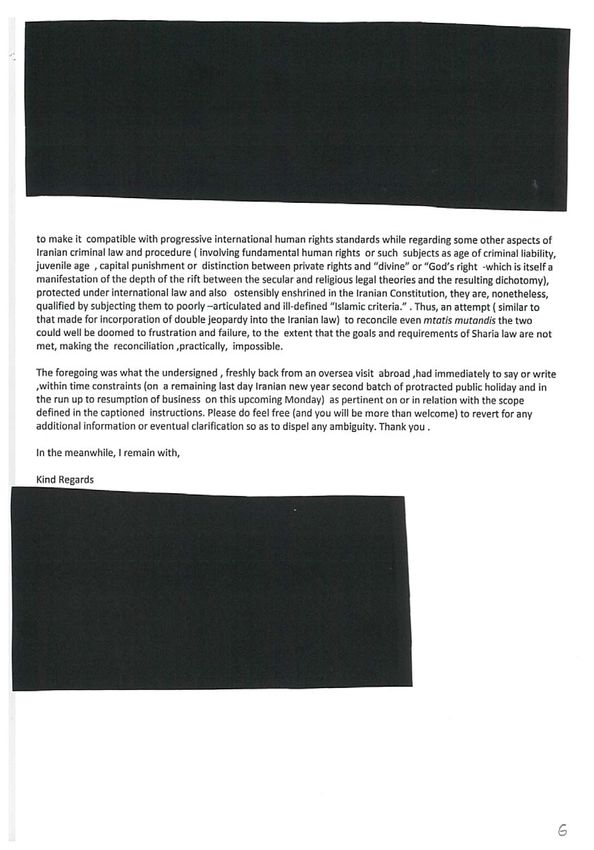
Contents
Policy guidance ........................................................................................................ 4
   1.    Introduction ...................................................................................................... 4
         1.1 Basis of claim ........................................................................................... 4
         1.2 Points to note ........................................................................................... 4
   2.    Consideration of issues ................................................................................... 4
         2.1 Credibility.................................................................................................. 4
         2.2 Exclusion .................................................................................................. 4
         2.3 Particular social group .............................................................................. 4
         2.4 Assessment of risk ................................................................................... 5
         2.5 Protection ................................................................................................. 6
         2.6 Internal relocation ..................................................................................... 6
         2.7 Certification .............................................................................................. 6
Country information ................................................................................................. 7
   3.    Article 7 of the Penal Code (‘double jeopardy’) ................................................ 7
   4.    Punishments prescribed under Sharia Law ..................................................... 8
         4.1 Overview .................................................................................................. 8
         4.2 Hadd/Hudud/ Hodoud ............................................................................... 8
         4.3 Qisas/ Qesas ............................................................................................ 9
         4.4 Diya .......................................................................................................... 9
         4.5 Ta’zir ........................................................................................................ 9
   5.    Application of Article 7 in practice .................................................................. 11
   6.    Cases involving Article 7 ................................................................................ 15
Annex A: Letter from legal expert ......................................................................... 16
Version control ....................................................................................................... 23

                                                        Page 3 of 23
Policy guidance
Updated: 31 January 2018
1. Introduction
1.1 Basis of claim
1.1.1 Fear of punishment on return to Iran for crimes the person has committed
and been punished for in another country (‘double jeopardy’ or re-
prosecution).
1.2 Points to note
1.2.1 The term double jeopardy is used to refer to a circumstance where a person
is charged in Iran for an offence which was committed and punished in
another country. The UK no longer uses the term ‘double jeopardy’ but it is
commonly referred to in articles regarding Iran. Where the term is used in
this CPIN it refers to cases of this sort.
Back to Contents
2. Consideration of issues
2.1 Credibility
2.1.1 For information on assessing credibility, see the Asylum Instruction on
Assessing Credibility and Refugee Status.
2.1.2 Decision makers must also check if there has been a previous application for
a UK visa or another form of leave. Asylum applications matched to visas
should be investigated prior to the asylum interview (see the Asylum
Instruction on Visa Matches, Asylum Claims from UK Visa Applicants).
2.1.3 Decision makers should also consider the need to conduct language
analysis testing (see the Asylum Instruction on Language Analysis).
Back to Contents
2.2 Exclusion
2.2.1 Where there are serious reasons for considering that a person has
committed a criminal offence, decision makers must consider whether any of
the exclusion clauses – in particular Article 1F(b) – apply.
2.2.2 If the person is excluded from the Refugee Convention, they will also be
excluded from a grant of humanitarian protection.
2.2.3 For further guidance on the exclusion clauses and restricted leave, see the
Asylum Instructions on Exclusion under Articles 1F and 33(2) of the Refugee
Convention, Humanitarian Protection and Restricted Leave.
Back to Contents
2.3 Particular social group
2.3.1 Persons facing (or potentially facing) ‘double jeopardy’ are not considered to
form a particular social group (PSG) within the meaning of the 1951 UN
Refugee Convention. This is because they do not possess an immutable (or
innate) characteristic that cannot be changed.
Page 4 of 232.3.2 In the absence of a link to one of the five Convention reasons necessary for
the grant of asylum, the question to be addressed in each case will be
whether the particular person will face a real risk of serious harm sufficient to
qualify for Humanitarian Protection (HP).
2.3.3 For further guidance on particular social groups, see the Asylum Instruction
on Assessing Credibility and Refugee Status.
Back to Contents
2.4 Assessment of risk
2.4.1 Double jeopardy (or re-prosecution) is covered by Article 7 of the Iranian
penal code. It states that any Iranian national who commits a crime outside
Iran and is found in, or extradited to, Iran shall be prosecuted and punished
in accordance with the laws of the Islamic Republic of Iran. Article 7(b) states
that crimes punishable by ta’zir (crimes for which punishments are not fixed
and instead are left to the discretion of the Shari’a judge) are specifically
excluded from re-prosecution provided the accused person is not tried and
acquitted in the place of the commission of the crime, or in the case of
conviction the punishment is not, wholly or partly, carried out against him
(see Article 7 of the Penal Code (‘double jeopardy’)).
2.4.2 Almost all ta’zir crimes are dealt with in the Penal Code and the judge may
apply the punishments prescribed in the Code. Crimes punishable by ta’zir
include bribery, money laundering and those covered by Iran’s Anti-
Narcotics Law (see Punishments prescribed under Sharia Law).
2.4.3 Crimes involving drug trafficking will generally fall under the anti-narcotics
law and will not be subject to re-prosecution unless they involve attacks on
Iranian national interests (i.e. breaking into diplomatic and consular
premises, physical aggression and/or assault on Iranian diplomatic and
consular officers) or involve activity which is deemed to be openly hostile to
the Iranian regime, i.e. through public speeches, demonstrations, rallies etc.
(see Application of Article 7 in practice).
2.4.4 Hudad (or Hadd/ Hodoud) crimes are those with fixed and severe
punishments for which the grounds for, type, amount and conditions of
execution are specified in holy Shari’a. Qisas (or Qesas) is the main
punishment for intentional bodily crimes against life, limbs, and abilities.
Crimes punishable by Hudad, which include illicit sex and sodomy, or
punishable by Qisas, for example murder, may be liable to re-prosecution in
Iran when a private party who sustained damages resulting from a crime
committed by an Iranian abroad, or a victim of the crime, makes a complaint
to the Public Prosecutor Office and the Penal Court (see Punishments
prescribed under Sharia Law and Application of Article 7 in practice).
2.4.5 The evidence does not suggest that even when a crime falls within the scope
of Article 7 that a prosecution on the same charge has ever been successful
(see examples on pages 3 and 4 of Annex A).
2.4.6 Given the limited scope of offences to which double jeopardy may apply, the
specific exclusion of those punishable by ta’zir, that it is unclear whether a
prosecution on the same charge of crimes punishable by Hudad or Qisas
can be initiated by the authorities; and the lack of evidence of prosecutions
Page 5 of 23taking place in practice, the evidence does not suggest there is, in general, a
real risk of double jeopardy in Iran.
2.4.7 Where a person can demonstrate that their circumstances are such that the
Iranian authorities are likely to be aware of their activity or a victim of the
crime or others who have sustained damages are likely to make a complaint
to the Public Prosecutor Office, then they may be at a greater risk of
prosecution again for the same offence. However, decision makers must
note that the Home Office does not disclose criminal convictions to the
Iranian authorities and in the majority of cases there is no evidence to
suggest that re-prosecution would occur.
2.4.8 Each case must however be considered on its facts with the onus on the
person to demonstrate that they would be at real risk from the state
authorities on return.
2.4.9 Where a person can demonstrate a real risk of re-prosecution they may
qualify for a grant of Humanitarian Protection, or if excluded, Discretionary
Leave or Restricted Leave. Decision makers should also refer to the country
policy and information note on Iran: prison conditions where they believe
someone is at risk of re-prosecution.
2.4.10 For further guidance on assessing risk, see the Asylum Instruction on
Assessing Credibility and Refugee Status.
Back to Contents
2.5 Protection
2.5.1 As the person’s fear is of persecution and/or serious harm by the state, they
will not be able to avail themselves of the protection of the authorities.
2.5.2 For further guidance on assessing the availability of state protection, see the
Asylum Instruction on Assessing Credibility and Refugee Status.
Back to Contents
2.6 Internal relocation
2.6.1 As the person’s fear is of persecution and/or serious harm by the state, they
will not be able to relocate to escape that risk.
2.6.2 For further guidance on internal relocation and the factors to be considered,
see the Asylum Instruction on Assessing Credibility and Refugee Status.
Back to Contents
2.7 Certification
2.7.1 Where a claim is refused, it is unlikely to be certifiable as ‘clearly unfounded’
under section 94 of the Nationality, Immigration and Asylum Act 2002.
2.7.2 For further guidance on certification, see Certification of Protection and
Human Rights claims under section 94 of the Nationality, Immigration and
Asylum Act 2002 (clearly unfounded claims).
Back to Contents
Page 6 of 23Country information
Updated: 29 January 2018
3. Article 7 of the Penal Code (‘double jeopardy’)
3.1.1 The Iran Human Rights Documentation Centre (IHRDC) noted in an article
titled ‘English Translation of Books I & II of the New Islamic Penal Code’
dated 8 April 2014;
‘Article 7- In addition to the cases mentioned in the articles above, any
Iranian national who commits a crime outside Iran and is found in, or
extradited to, Iran shall be prosecuted and punished in accordance with the
laws of the Islamic Republic of Iran, provided that:
a. The committed conduct is deemed an offense under the law of the
Islamic Republic of Iran.
b. If the committed crime is punishable by ta’zir, the accused person is not
tried and acquitted in the place of the commission of the crime, or in the
case of conviction the punishment is not, wholly or partly, carried out
against him.
c. According to Iranian laws there is no basis for removal or discontinuation
of prosecution or discontinuation or cancellation of execution of the
punishment.’ 1
3.1.2 The Austrian Centre for Country of Origin and Asylum Research and
Documentation (ACCORD), noted in a document titled ‘Iran: Political
Opposition Groups, Security Forces, Selected Human Rights Issues, Rule of
Law: COI Compilation’ dated July 2015 that:
‘As regards the issue of “double jeopardy”, Tellenbach [Silvia Tellenbach, a
specialist on Iranian criminal law at the Max Planck Institute for Comparative
Public Law and International Law in Heidelberg (Germany), noted in a 2014
commentary on the new Islamic Penal Code (IPC) of 2013] states that in
some cases, criminal judgments passed in other countries may become
effective in Iran. This effect had been provided for in the 1926 Penal Code
(amended as of 1973) but was abandoned during amendment processes
after the Islamic Revolution. The IPC of 2013 has reinstated detailed
provisions with regard to counting sentences served abroad and the
prohibition of double jeopardy. These provisions, however, only apply to
ta’zir crimes. With the exception of crimes committed abroad by Iranian or
foreign civil servants in connection with their professional activity, ta’zir
crimes will not be punished for a second time if the perpetrator has been
1
Iran Human Rights Documentation Centre. ‘English Translation of the Islamic Republic of Iran's
Criminal Code of Procedure for Public and Revolutionary Courts, Approved on September 19, 1999
with amendments’ http://www.iranhrdc.org/english/human-rights-documents/iranian-
codes/1000000026-english-translation-of-the-islamic-republic-of-irans-criminal-code-of-procedure-for-
public-and-revolutionary-courts.html. Accessed: 18 September 2017.
Page 7 of 23acquitted or has entirely or partially served his/her sentence in the country
where the crime had occurred (Article 7). 2
Back to Contents
4. Punishments prescribed under Sharia Law
4.1 Overview
4.1.1 The IHRDC website’s English Translation of Books I & II of the New Islamic
Penal Code published on 8 April 2014 stated that:
‘Article 14- Punishments provided in this law are divided into four categories:
(a) Hadd
(b) Qisas
(c) Diya
(d) Ta’zir
‘Note- If causality between a legal person’s conduct and a loss is
established, diya and damages can be claimed. Imposing ta’zir punishments
against legal persons shall be in accordance with article 20.’ 3
Back to Contents
4.2 Hadd/Hudud/ Hodoud
4.2.1 The IHRDC website’s 2014 English Translation of Books I & II of the New
Islamic Penal Code stated that ‘Article 15- Hadd is a punishment for which
the grounds for, type, amount and conditions of execution are specified in
holy Shari’a.’ 4
4.2.2 In a different article, dated March 2012, the IHRDC explained ‘Crimes
punishable by hadd (pl. hudud) are those with fixed and severe punishments
in Islamic sources. These include crimes such as illicit sex, sodomy,
homosexual behaviour between women, consumption of intoxicants,
muharebeh, etc. and are punishable by the death penalty, stoning to death,
amputation of the right hand and left foot, flogging, etc.’ 5
Back to Contents
2
Austrian Centre for Country of Origin and Asylum Research and Documentation (ACCORD), Iran: Political
Opposition Groups, Security Forces, Selected Human Rights Issues, Rule of Law: COI Compilation, July
2015, http://www.refworld.org/docid/559baae44.html. Accessed: 18 September 2017.
3
Iran Human Rights Documentation Centre, ‘English Translation of Books I & II of the New Islamic
Penal Code’, 8 April 2014 http://www.iranhrdc.org/english/human-rights-documents/iranian-
codes/1000000455-english-translation-of-books-1-and-2-of-the-new-islamic-penal-code.html.
Accessed: 18 September 2017.
4
Iran Human Rights Documentation Centre, ‘English Translation of Books I & II of the New Islamic
Penal Code’, 8 April 2014 http://www.iranhrdc.org/english/human-rights-documents/iranian-
codes/1000000455-english-translation-of-books-1-and-2-of-the-new-islamic-penal-code.html.
Accessed: 18 September 2017.
5
Iran Human Rights Documentation Centre, ‘All you need to know: a quick breakdown of findings
from Dr. Ahmed Shaheed’s UN report’, 7 March 2012 http://www.iranhrdc.org/english/human-rights-
documents/united-nations-reports/un-reports/1000000065-all-you-need-to-know-a-quick-breakdown-
of-findings-from-dr-ahmed-shaheeds-un-report.html. Accessed: 18 November 2017.
Page 8 of 234.3 Qisas/ Qesas
4.3.1 The IHRDC website’s 2014 English Translation of Books I & II of the New
Islamic Penal Code stated that ‘Article 16- Qisas is the main punishment for
intentional bodily crimes against life, limbs, and abilities which shall be
applied in accordance with Book One of this law.’ 6
4.3.2 In a different article, dated March 2012, the IHRDC explained ‘Crimes
punishable by Qisas (retribution) are a category of crimes under Islamic
criminal law which is best illustrated in the old maxim “An eye for an eye, a
tooth for a tooth, and a life for a life”.’ 7
Back to Contents
4.4 Diya
4.4.1 The IHRDC website’s 2014 English Translation of Books I & II of the New
Islamic Penal Code stated that ‘Article 17- Diya, whether fixed or unfixed, is
monetary amount under holy Shari’a which is determined by law and shall be
paid for unintentional bodily crimes against life, limbs and abilities or for
intentional crimes when for whatever reason qisas is not applicable.’ 8
Back to Contents
4.5 Ta’zir
4.5.1 The IHRDC website’s 2014 English Translation of Books I & II of the New
Islamic Penal Code stated that
‘Article 18- Ta’zir is a punishment which does not fall under the categories
of hadd, qisas, or diya and is determined by law for commission of prohibited
acts under Shari’a or violation of state rules. The type, amount, conditions of
execution as well as mitigation, suspension, cancellation and other relevant
rules of ta’zir crimes shall be determined by law. In making decisions in ta’zir
crimes, while complying with legal rules, the court shall consider the
following issues:
a. The offender’s motivation and his/her mental and psychological
conditions when committed the crime
b. Method of committing the crime, extent of a breach of duty and its
harmful consequences
c. Conduct of the offender after committing the crime
6
Iran Human Rights Documentation Centre, ‘English Translation of Books I & II of the New Islamic
Penal Code’, 8 April 2014 http://www.iranhrdc.org/english/human-rights-documents/iranian-
codes/1000000455-english-translation-of-books-1-and-2-of-the-new-islamic-penal-code.html.
Accessed: 18 September 2017.
7
Iran Human Rights Documentation Centre, ‘All you need to know: a quick breakdown of findings
from Dr. Ahmed Shaheed’s UN report’, 7 March 2012 http://www.iranhrdc.org/english/human-rights-
documents/united-nations-reports/un-reports/1000000065-all-you-need-to-know-a-quick-breakdown-
of-findings-from-dr-ahmed-shaheeds-un-report.html. Accessed: 18 November 2017.
8
Iran Human Rights Documentation Centre, ‘English Translation of Books I & II of the New Islamic
Penal Code’, 8 April 2014 http://www.iranhrdc.org/english/human-rights-documents/iranian-
codes/1000000455-english-translation-of-books-1-and-2-of-the-new-islamic-penal-code.html.
Accessed: 18 September 2017.
Page 9 of 23d. The offender’s personal, family, and social background and the effect of
the ta’zir punishment on him/her.’ 9
4.5.2 In a different article, dated March 2012, the IHRDC explained ‘Ta’zir: crimes
punishable by ta’zir are those for which punishments are not fixed and
instead are left to the discretion of the Shari’a judge. However, almost all
ta’zir crimes are dealt with in the Penal Code and the judge may apply the
punishments prescribed in the Code. They include the rest of the crimes
other than hudud and qisas.’ 10
4.5.3 Amnesty International’s report ‘Growing up on death row- the death penalty
and juvenile offenders in Iran’ published in January 2016 stated that:
‘The 2013 Islamic Penal Code defines ta’zir as offences not covered by
hodud, qesas and diyah. The rules governing their definition, scope and
punishment are prescribed by law (Article 18). Examples of ta’zir crimes
include the financial offences of corruption, bribery and money laundering as
well as national security-related offences such as “working with hostile
governments” and “gathering and colluding against national security”. These
crimes are typically punishable with imprisonment but they may attract the
death penalty if they are judged to amount to “corruption on earth” (efsad-e
fel-arz) due to their scale, severity and organized nature.’
‘Other ta’zir crimes that attract the death penalty include those covered in
Iran’s Anti-Narcotics Law. This law, which was introduced in January 1989
and amended in 1997 and 2011, prescribes a mandatory death sentence for
trafficking more than 5kg of narcotics acquired from opium and specified
synthetic, non-medical psychotropic substances (Article 4.4); and trafficking
or possessing more than 30g of heroin, morphine, cocaine or their
derivatives as well as specified synthetic, non-medical psychotropic drugs
(Article 8.6).’ 11
4.5.4 Book five of the Islamic penal code deals with ta’zir crimes and deterrent
punishments, crimes against national security, crimes against property and
crimes against people. The English translation of Book Five can be found on
the Iran Human Rights and Documentation Centre webpage. 12
4.5.5 For more information on punishments prescribed in Sharia law, see the
report produced by Penal Reform International titled ‘Sharia law and the
9
Iran Human Rights Documentation Centre, ‘English Translation of Books I & II of the New Islamic
Penal Code’, 8 April 2014 http://www.iranhrdc.org/english/human-rights-documents/iranian-
codes/1000000455-english-translation-of-books-1-and-2-of-the-new-islamic-penal-code.html.
Accessed: 18 September 2017.
10
Iran Human Rights Documentation Centre, ‘All you need to know: a quick breakdown of findings
from Dr. Ahmed Shaheed’s UN report’, 7 March 2012 http://www.iranhrdc.org/english/human-rights-
documents/united-nations-reports/un-reports/1000000065-all-you-need-to-know-a-quick-breakdown-
of-findings-from-dr-ahmed-shaheeds-un-report.html. Accessed: 18 November 2017.
11
Amnesty International, ‘Growing up on death row- the death penalty and juvenile offenders in Iran’,
January 2016 https://www.amnesty.org.uk/sites/default/files/growing_up_on_death_row.pdf.
Accessed: 18 September 2017.
12
Iran Human Rights and Documentation Centre, ‘Islamic Penal Code of the Islamic Republic of Iran
– Book Five’, 18 July 2013, http://www.iranhrdc.org/english/human-rights-documents/iranian-
codes/1000000351-islamic-penal-code-of-the-islamic-republic-of-iran-book-five.html. Accessed: 18
September 2017.
Page 10 of 23death penalty Would abolition of the death penalty be unfaithful to the
message of Islam?’ published in July 2015. 13
Back to Contents
5. Application of Article 7 in practice
5.1.1 In a September 2013 compilation of Country of Origin Information for Iran,
ACCORD provided information in relation to the application of Article 7 of the
Islamic Penal Code taken from a 2004 Journal of Financial Crime article by
Mansour Rahmdel, ‘Attorney at Law in Tehran’. In his article, Rahmdel made
reference to Article 7, having noted:
‘This Article has caused some problems for people who have committed
offences abroad and have been punished. When they come back to Iran,
especially when there is a private complainant, the court prosecutes the
accused. Most problems arise from the difference between the kinds of
punishment in Iranian law and those in other penal systems, especially of
non-Islamic countries, because in Islamic countries many similar acts are
criminalised, but some of these acts committed in non-Islamic countries
either are not criminalised or have shorter sentences.
‘The post-revolutionary legislator in Iran does not accept not only the ne bis
in idem rule [double jeopardy] but also the reduction of punishment rule,
because it considers foreign judgments to have no validity and says ‘every
Iranian national who commits an offence abroad will be punished according
to Iranian penal laws upon return’, whether he has been punished or not and
whether he returns to Iran voluntarily or not, and in some cases the accused
can be punished twice.
‘The ambiguity of Article 7 of the Iranian penal code has led judges to make
differing interpretations. Some judges believe that whether the accused has
been convicted abroad or not, he could still be prosecuted and punished in
Iran.’ 14
5.1.2 The September 2013 ACCORD compilation also outlined information
provided in October 2008 by the Swedish embassy in Tehran on the subject
of double jeopardy in Iran. The information provided indicated that, for a
‘double proceeding’ to occur in relation to a crime that had been committed
by an Iranian national abroad, it would require a complaint to be made by a
private party in Iran who had been adversely impacted by the crime in
question. The crime also had to be a qesas or hadd crime. The relevant
information read:
‘1- According to the Iranian Penal Procedure Act, the double proceeding
has not been recognized.
13
Penal reform international, Sharia law and the death penalty ‘Would abolition of the death penalty
be unfaithful to the message of Islam?’ July 2015 https://www.penalreform.org/wp-
content/uploads/2015/07/Sharia-law-and-the-death-penalty.pdf. Accessed: 18 September 2017.
14
Austrian Centre for Country of Origin and Asylum Research and Documentation (ACCORD) 2013,
Iran: COI Compilation, September, UNHCR Refworld, p.153
http://www.refworld.org/docid/522ec5aa4.html. Accessed: 18 September 2017.
Page 11 of 23Notwithstanding to the above, in practice, the Iranian Prosecution Office
and the criminal courts accept to examine the complain of a private party
for further examination of the case in order to apply the Iranian Law when
the punishment is Qesas and Hodoud punishment. This issue of double
proceeding is currently practiced by the Iranian Legal system and reflected
in the newspapers and I have not noted any law for out ruling the above.
2- The risk of being exposed to double proceeding, occurs when a private
party who sustained damages resulting from a crime committed by an
Iranian in abroad, or a victim of the crime, complains to the Public
Prosecutor Office and the Penal Court and request examination of the
case according to Islamic Penal Code in order to rule the punishment of
the Qesas and Hodoud, in which case, all the criteria for proving the case,
such as hearing the witnesses and confession, etc. and other Islamic
evidences would be required by the court.
3- There is no difference between the crimes. All crimes which are
considered under the Qesas and Hodoud, will be examined and the
punishment will be ruled by the court subject to the requirement for proving
the case according to the Iranian Legal System.
4- There is no higher or lower risk for any particular groups or individuals
with regard to double proceeding.
5- For initiating the double proceeding, there must be a private complaint
and the crime must be Hodoud or Qesas.’ 15
5.1.3 The Electronic journal of Islamic and Middle Eastern Law published a
‘Comparative Critique of Regulating the Personal and the Passive
Personality Principles in the Iranian Penal System’ in 2015, which read:
‘Article 7(b) posits that “[i]f the committed crime is punishable by ta’zir, the
accused person is not tried and acquitted in the place of the commission of
the crime, or in the case of conviction the punishment is not, wholly or partly,
carried out against him”. As a result, if an Iranian national commits a crime
outside Iran, and is subjected to trial and punishment there, he cannot be
tried and punished in Iran again. However, if he has not served punishment
either in part or in total, it is possible to bring him before an Iranian court on
another occasion. Obviously, in a scenario where the sentence of a convict
is only partly carried out, it will not be the Iranian judiciary’s responsibility to
carry out the unexecuted part of the sentence. Rather, in these cases, the
Iranian judiciary must establish a new trial for the accused to be tried in
accordance with Iranian criminal laws. This is because, save for some
exceptional cases such as the international agreements on the transfer of
persons sentenced to terms of imprisonment in foreign countries, states do
not execute the sentences of those convicted in foreign jurisdictions.
However, an Iranian judge can reduce the punishment of those who have
served part of their sentence abroad by invoking the diminutive factors of
punishment articulated in Article 22 of the Islamic Penal Code of 2013.’
15
Austrian Centre for Country of Origin and Asylum Research and Documentation (ACCORD) 2013,
Iran: COI Compilation, September, UNHCR Refworld, pp.153-154
http://www.refworld.org/docid/522ec5aa4.html. Accessed: 18 September 2017.
Page 12 of 23‘However, the principle of double jeopardy in the Iranian courts is respected
only insofar as its application relates to ta’zirat, whose specific cases and
punishments are not prescribed in sharia law. Hence, when at issue are
offences of the kind susceptible to such types of punishments as hodood,
qisas and diyat, and ta’zirat prescribed by sharia law, Article 7(2) cannot
generally be applied. This means, for example, if an Iranian national accused
of murder is tried and punished in England, he can be subjected to another
trial and punishment in Iran for the same crime upon his return to Iran, since
his crime is punishable by qisas.’ 16
5.1.4 A legal expert identified and contacted on behalf of the Home Office by the
FCO in Iran, stated in a report dated March 2017 that:
‘While according to the provisions of the aforesaid Art.7 of the Islamic Penal
Code, Iranian courts will not have the jurisdiction to re-try a matter which had
occurred outside Iran, there are however, notable exceptions as respect for
this principle are subject to limitations. Indeed the principle of double
jeopardy is on the proviso that and only insofar as its application relates to
ta’zir at (plural of ta’zir, Cf. supra; lawyers note), whose specific cases and
punishments are not prescribed in sharia law. Hence, when at issue are
offences of the kind susceptible to such types of punishment as hodood
(crimes which have been specifically dealt with by the Koran and for
punishment of which the judge has no room for manoeuvre such as first
degree murder, adultery, sodomy, taking alcohol, defamation; lawyers note),
qisas (lex talionis: law of retaliation) and diyat (blood money or bloodwite as
formerly known in Scotland;) Article 7(b) cannot generally be applied. This
means, for example, if an Iranian national accused of murder is tried and
punished outside Iran, he can be subjected, both in theory and in practice as
we shall see later on to another trial and punishment in Iran for the same
crime upon his return to Iran, since crime is punishable by qisas.
‘Furthermore, it is noteworthy that crimes or offence against Iranian security
are explicitly ruled out and excluded from this rule of “ne bis in idem”. This is
of prime and vital importance as some asylum seekers and applicants for
refugee status have been actually involved in attacks on Iranian interests
(breaking into diplomatic and consular premises entailing destruction of
property or even physical aggression and assault on Iranian diplomatic and
consular officers) or openly hostile publicized activity [ such as through
public speeches, interviews, rallies, demonstrations, mock executions, sit-
ins.. in a bid to arouse public awareness and to win sympathy for their
cause) against the Iranian state and its dignitaries or, at least, are blamed in
Iran for such counts of charges (penalized under the Islamic penal code). In
this connection, please note that such offenses go explicitly beyond the
purview of Art. 7(b). Therefore, in more concrete terms and for the sake of
clarity by way of exemplification, while a person having been say, convicted
outside Iran of drug trafficking […] and served a prison sentence outside Iran
16
Electronic journal of Islamic and Middle Eastern Law, University of Zurich, A Comparative Critique
of Regulating the Personal and the Passive Personality Principles in the Iranian Penal System by
Hassan Poorbafrani and Masoud Zamani, Vol. 3 (2015) pp. 117-133
https://papers.ssrn.com/sol3/Delivery.cfm/SSRN_ID2713296_code1476382.pdf?abstractid=2713296&
mirid=1. Accessed: 18 September 2017.
Page 13 of 23for it, is not liable to be tried or punished in Iran, however, if such a crime
involved an Iranian interest , then “double jeopardy” would not apply, and
that person may be tried for the same offense in Iran regardless and
irrespective of whether he or she already stood trial in the host country.
‘Thus, in practice too, no cases of double jeopardy have been reported in
recent times for ta’zirat cases’…
‘Indeed, apart from offenses dealing with state internal and external security
of the state (for which odds, logic and common sense would be against an
eventual voluntary return of the perpetrators back home) and as far as the
undersigned can personally recollect […] none of the cases opened before
Iranian courts at the initiative of next of kin of the victims in Iran after the
murderers were deported to Iran at the expiry of their jail terms got anywhere
and, while in almost all those cases first degree murder […] could not be
disputed, Iranian judges (still at a time when “double jeopardy” as such was
not clearly enshrined in the Iranian law) dismissed, one way or the other i.e.
by a combination of both legal and technical or logistical issues raised such
as questioning “reliability” of confessions made (obviously free from any
duress or coercion, let alone torture) by the perpetrators before a “non-
Muslim judge” or arguing that the “indispensable” reconstituting of the crime
scene in the presence of a “Muslim clerical/canonical judge” was impossible
because of “lack of cooperation on the part of Japanese authorities”) coupled
with discrete behind-the-scene pressure on the heirs and assigns of the
victims to acquiesce and consent to collection of diyya (or blood money) so
much so that this concurrence of carrot and stick culminated in the dismissal
of cases opened by the next of kin before the Iranian judiciary….
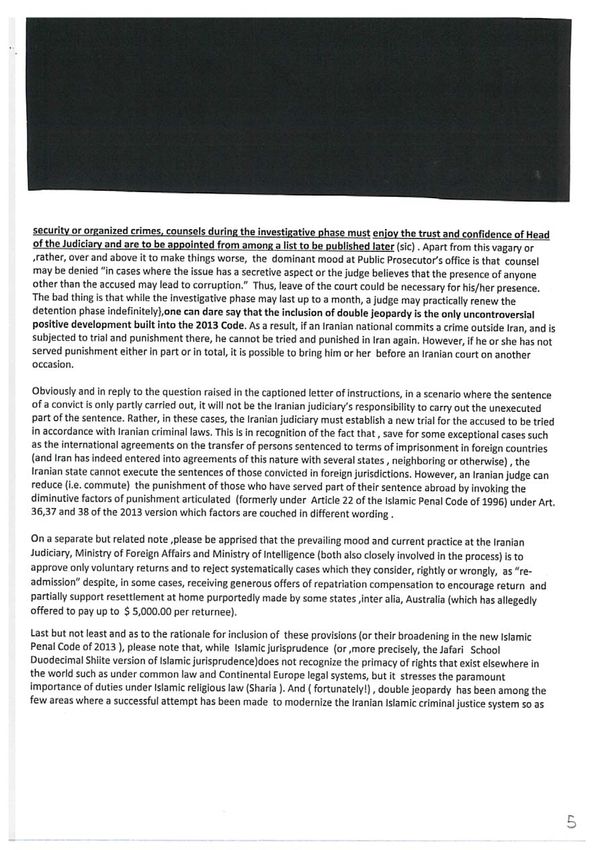
‘As a result, if an Iranian national commits a crime outside Iran, and is
subject to trial and punishment there, he cannot be tried and punished in Iran
again. However, if he or she has not served punishment either in part or in
total, it is possible to bring him or her before an Iranian court on another
occasion’
‘[…] in a scenario where the sentence of a convict is only partly carried out, it
will not be the Iranian judiciary’s responsibility to carry out the unexecuted
part of the sentence. Rather, in these cases, the Iranian judiciary must
establish a new trial for the accused to be tried in accordance with Iranian
criminal laws. This is in recognition of the fact that, save for some
exceptional cases such as the international agreements on the transfer of
persons sentenced to terms of imprisonment in foreign countries (and Iran
has indeed entered into agreements of this nature with several states,
neighbouring or otherwise), the Iranian state cannot execute the sentences
of those convicted in foreign jurisdictions. However, an Iranian judge can
reduce (i.e. commute) the punishment of those who have served part of their
sentence abroad by invoking the diminutive factors of punishments
articulated (formerly under Article 22 of the Islamic Penal Code of 1996)
under Art. 36, 37 and 38 of the 2013 version which factors couched in
different wording.’ 17
17
Legal Expert report, 31 March 2007, available at Annex A.
Page 14 of 235.1.5 ACCORD noted in a document titled ‘Iran: Political Opposition Groups,
Security Forces, Selected Human Rights Issues, Rule of Law: COI
Compilation’ dated July 2015 that:
‘As regards the issue of “double jeopardy”, Tellenbach [Silvia Tellenbach, a
specialist on Iranian criminal law at the Max Planck Institute for Comparative
Public Law and International Law in Heidelberg (Germany), noted in a 2014
commentary on the new Islamic Penal Code (IPC) of 2013] states…
‘In practice, no cases of double jeopardy have been reported in recent times.
But since Iranian law previously did not prohibit double jeopardy and the
judicature did not arrive at a clear position on this matter, there was always a
degree of uncertainty with regard to this issue. This matter has now been
clarified in the IPC of 2013’ [see Article 7 of the Penal Code (‘double
jeopardy’) for the updated Penal code]’. 18
Back to Contents
6. Cases involving Article 7
6.1.1 Kurdistan 24 reported in December 2015 that:
‘Hamid Sameie, an Iranian-American was executed in Iran for a crime […] he
allegedly committed a crime in Los Angeles in 2008. An Iranian court
convicted Sameie of murdering another Iranian-American citizen in California
in 2008. The state-run Iranian newspapers reported the execution but
provided few details. A Norway-based Iran Human Rights organization
revealed on Tuesday that Iranian authorities carried out the death sentence
for Hamid Samiee at Karaj's Rajai Shahr Prison last month.’ 19
6.1.2 The Guardian reported in the same month, however, that ‘it was not
immediately clear if Sameie [sic] was charged for the murder in the US – or
even sought by police.’ It was also reported that ‘details of the crime remain
hazy’ and that the Los Angeles Police Department had stated that ‘case files
appeared to show no record of a criminal investigation into the death of a
person named Janmohammadi.’ 20
6.1.3 The Australian Immigration Department in a document on common claims
from Iran and published in September 2017 noted that ‘There have been no
recent reports of this provision having been applied in practice.’ 21
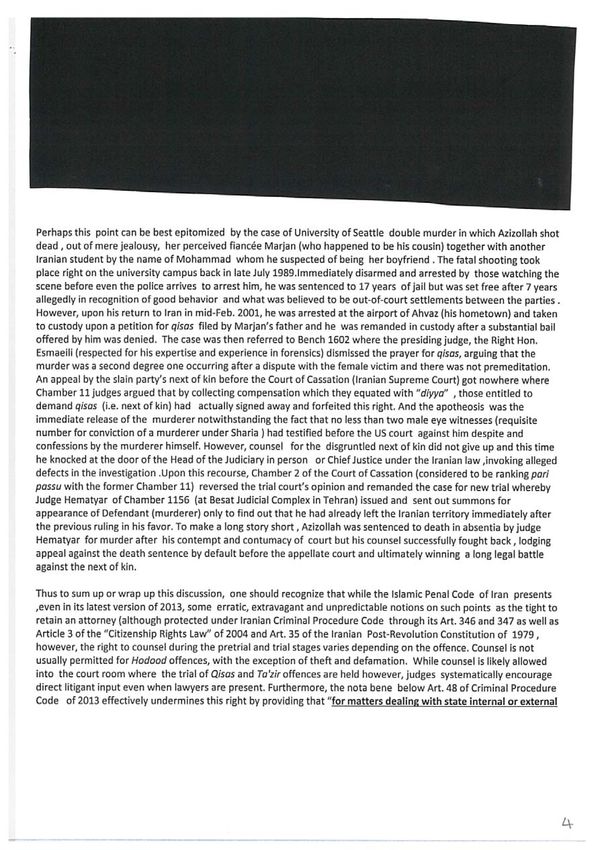
6.1.4 There are older examples of cases where murders have been committed
and re-prosecution proceedings were initiated but failed to result in a
18
Austrian Centre for Country of Origin and Asylum Research and Documentation (ACCORD), Iran:
Political Opposition Groups, Security Forces, Selected Human Rights Issues, Rule of Law: COI
Compilation, July 2015, http://www.refworld.org/docid/559baae44.html. Accessed: 18 September 2017.
19
Kurdistan 24, ‘Iran hanged an Iranian-American for a crime committed in California’, 3 December
2015 http://www.kurdistan24.net/en/news/65063dfb-50a8-4aaa-9ddf-8f54199fbf8b/iran-hanged-an-
iranian-american-for-a-crime-committed-in-california. Accessed: 18 September 2017.
20
The Guardian, ‘Iranian-American man hanged in Iran for alleged crime in California’, 3 December
2015, http://www.theguardian.com/world/2015/dec/02/iranian-american-man-hanged-iran-alleged-
california-usa Accessed: 30 August 2016
21
Australian Government, Department of Immigration and Border Protection, ‘Common claims- Iran’ 5
September 2017, available on request. Accessed: 18 September 2017.
Page 15 of 23conviction mentioned in the report by the legal expert approached by the
Home Office and which can be viewed at Annex A (pages 3 and 4).
Back to Contents
Annex A: Letter from legal expert
The legal expert was asked to write a report on the provisions of ‘double jeopardy’ in
Iran i.e. the current legal position regarding double jeopardy- specifically what crimes
it refers to the application of this in practise- establishing if in fact people who return
to Iran and re-prosecuted for crimes committed outside the country and empirical
evidence to support/counter this.
Page 16 of 23Page 17 of 23
Page 18 of 23
Page 19 of 23
Page 20 of 23
Page 21 of 23
Page 22 of 23
Version control
Clearance
Below is information on when this note was cleared:
x version 1.0
x valid from 31 January 2018

Changes from last version of this note
First version in CPIN format.
                                                      Back to Contents

                                     Page 23 of 23
You can also read


